air condition GMC SAVANA 1998 User Guide
[x] Cancel search | Manufacturer: GMC, Model Year: 1998, Model line: SAVANA, Model: GMC SAVANA 1998Pages: 388, PDF Size: 20.04 MB
Page 141 of 388
Rear Air Conditioning and Rear Heater
If your vehicle has a rear air conditioning and rear heater
system combination, controls are provided
to regulate the
temperature, location and speed
of the airflow.
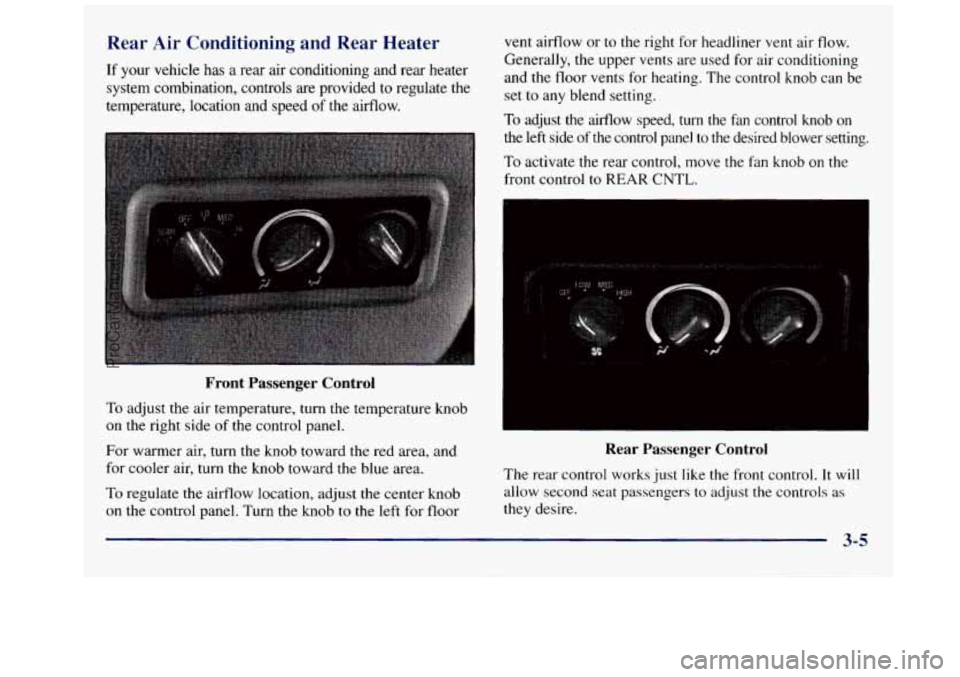
Front Passenger Control
To adjust the air temperature, turn the temperature knob
on the right side
of the control panel.
For warmer air, turn the knob toward the red area, and
for cooler air, turn the knob toward the blue area.
To regulate the airflow location, adjust the center knob
on the control panel. Turn the knob to the left for floor vent airflow
or to
the right for headliner vent air flow.
Generally, the upper vents are used
for air conditioning
and the floor vents for heating. The control knob can be
set to any blend setting.
To adjust the airflow speed, turn the fan control knob on
the left side of the control panel to the desired blower setting.
To activate the rear control, move the fan knob on the
front control
to REAR CNTL.
Rear Passenger Control
The rear control works just like the front control. It will
allow second seat passengers to adjust the controls as
they desire.
3-5
ProCarManuals.com
Page 142 of 388
Air Conditioning Heating
Before using your vehicle’s air conditioning, open the
windows to clear the vehicle
of hot air. This reduces the
time it takes for your vehicle to cool down. Then keep
your windows closed for the air conditioner to work at
its best.
You can use MAX
AIC with the temperature knob in the
blue area when it’s really hot outside and you need to
cool
the inside air quickly. MAX A/C lets in only a little
air from the outside.
If you first
use MAX A/C, you can then use A/C with
the temperature knob in the blue area, as soon as the
vehicle has cooled down,
so outside air will be going
through your vehicle.
If your vehicle has rear air conditioning, setting it on
LO
may enhance front A/C performance by allowing
trapped refrigerant in rear lines to circulate.
When the air conditioning,
DEFROST or BLEND is on,
you may notice a slight increase
or decrease in engine
speed, due to compressor operation. This
is normal
because the system
is designed to cycle the compressor
on and off to keep the desired temperature.
On cold days, use HEATER with the temperature knob
in the red area. Outside air will be brought in through
the floor outlets. The heater works best if you keep your
windows closed while using it.
If you use the optional engine coolant heater before
starting your engine, your heating system will produce
warmer air faster
to heat the passenger compartment in
cold weather. See “Engine Coolant Heater” in the Index.
Ventilation Tips
0
0
0
Keep the hood and front air inlet free of ice, snow, or
any other obstruction (such
as leaves). The heater
and defroster will work
far better, reducing the
chance of fogging
the inside of your windows.
When you
enter a vehicle in cold weather, turn the
blower fan to
HI for a few moments before driving
off. This helps clear the intake ducts of snow and
moisture, and reduces the chance
of fogging the
inside
of your windows.
Keep the air path under the front seats clear of objects.
This helps air
to circulate throughout your vehicle.
Your vehicle has air vents in
the center and on the sides
of your instrument panel.
3-6
ProCarManuals.com
Page 215 of 388
If No Steam Is Coming From Your Engine
If you get the overheat warning but see or hear no
steam, the problem may not be too serious. Sometimes
the engine can get a little too hot when
you:
0 Climb a long hill on a hot day.
0 Stop after high-speed driving.
0 Idle for long periods in traffic.
0 Tow a trailer. See “Driving on Grades” in the Index.
If
you get the overheat warning with no sign of steam,
try this for a minute or
so:
1. If you have an air conditioner, turn it off.
2. Turn on your heater to full hot at the highest fan
speed and open the window as necessary. If
you no longer
have the overheat warning, you can
drive. Just
to be safe, drive slower for about 10 minutes.
If the warning doesn’t come back on,
you can
drive normally.
If the warning continues, pull over, stop, and park your
vehicle right away.
If there’s still no sign
of steam, push the accelerator until
the engine speed
is about twice as fast as normal idle
speed. Bring the engine speed back to normal idle speed
after two
or three minutes. Now see if the warning stops.
But then, if
you still have the warning, turn ofSthe
engine
and get everyone out of the vehicle until it
cools down.
You may decide not to lift the hood but to get service
help right away.
3. If you’re in a traffic jam, shift to NEUTRAL (N);
otherwise, shift to the highest gear while
driving
-- DRIVE (D).
5-13
ProCarManuals.com
Page 223 of 388
Engine Fan Noise If a Tire Goes Flat
Your vehicle has a clutched engine cooling fan. When the
clutch is engaged,
the fan spins faster to provide more air
to cool the engine. In most everyday driving conditions,
the fan is spinning slower and
the clutch is not fully
engaged. This improves
fuel economy and reduces fan
noise. Under heavy vehicle loading, trailer towing andor
high outside temperatures,
the fan speed increases as the
clutch more fully engages.
So you may hear an increase in
fan noise. This is normal and should not
be mistaken as
the transmission slipping or making extra shifts. It is
merely the cooling system functioning properly. The fan
will slow down when additional cooling
is not required
and the clutch partially disengages.
You may also hear this fan noise when you start
the engine. It will go away as
the fan clutch
partially disengages. It’s unusual
for a tire to “blow out” while you’re driving,
especially if you maintain your tires properly. If air goes
out of a tire, it’s much more likely to leak out slowly.
But
if you should ever have a “blowout,” here are a few
tips about what
to expect and what to do:
If a front tire fails, the flat tire will create a drag that
pulls the vehicle toward that side. Take your foot off the
accelerator pedal and grip the steering wheel firmly.
Steer to maintain lane position, and then gently brake
to
a stop well out of the traffic lane.
A rear blowout, particularly on a curve, acts much like a
skid and may require the same correction you’d use in a
skid. In any rear blowout, remove your foot from the
accelerator pedal. Get the vehicle under control by
steering the way
you want the vehicle to go. It may be
very bumpy and noisy, but you can still steer. Gently
brake
to a stop -- well off the road if possible.
If a tire goes flat, the next part shows how to use your
jacking equipment to change a flat tire safely.
5-21
ProCarManuals.com
Page 244 of 388
If your vehicle is certified to meet California Emission
Standards (indicated on the underhood emission control
label), it is designed to operate on fuels that meet
California specifications. If such fuels are not available
in states adopting California emissions standards, your
vehicle will operate satisfactorily on fuels meeting
federal specifications, but emission control system
performance may be affected. The malfunction indicator
lamp on your instrument panel may turn on and/or your
vehicle may fail a smog-check test. If this occurs, return
to your authorized
GM dealer for diagnosis to determine
the cause of failure. In the event it is determined that
the
cause of the condition is the type of fuels used, repairs
may not be covered by your warranty.
Some gasolines that are not reformulated for
low
emissions contain an octane-enhancing additive called
methylcyclopentadienyl manganese tricarbonyl (MMT);
ask your service station operator whether or not his fuel
contains MMT. General Motors does not recommend the
use of such gasolines. If fuels containing MMT are used,
spark plug life may be reduced and your emission
control system performance may be affected. The
malfunction indicator lamp on your instrument panel
may turn on. If this occurs, return to your authorized
GM dealer for service.
To provide cleaner air, all gasolines in the United States
are now required to contain additives that will help
prevent deposits from forming
in your engine and fuel
system, allowing your emission control system to
function properly. Therefore,
you should not have to add
anything to the fuel. In addition, gasolines containing
oxygenates, such as ethers and ethanol, and
reformulated gasolines may be available in your area to
help clean the air. General Motors recommends that you
use these gasolines
if they comply with the
specifications described earlier.
NOTICE:
Your vehicle was not designed for fuel that
contains methanol. Don’t use it. It can corrode
metal parts in your fuel system and also damage
plastic and rubber parts. That damage wouldn’t
be covered under your warranty.
6-4
ProCarManuals.com
Page 248 of 388
Checking Things Under the Hood
A CAUTION:
If your vehicle has air conditioning, the auxiliary
engine fan under the hood can start up and
injure you even when the engine is not running.
Keep hands, clothing and tools
away from any
underhood electric fan.
A CAUTION:
Things that burn can get on hot engine parts
and start
a fire. These include liquids like
gasoline
or diesel fuel, oil, coolant, brake fluid,
windshield washer and other fluids, and plastic
or rubber. You or others could be burned. Be
careful not to drop or spill things that will burn
onto a hot engine.
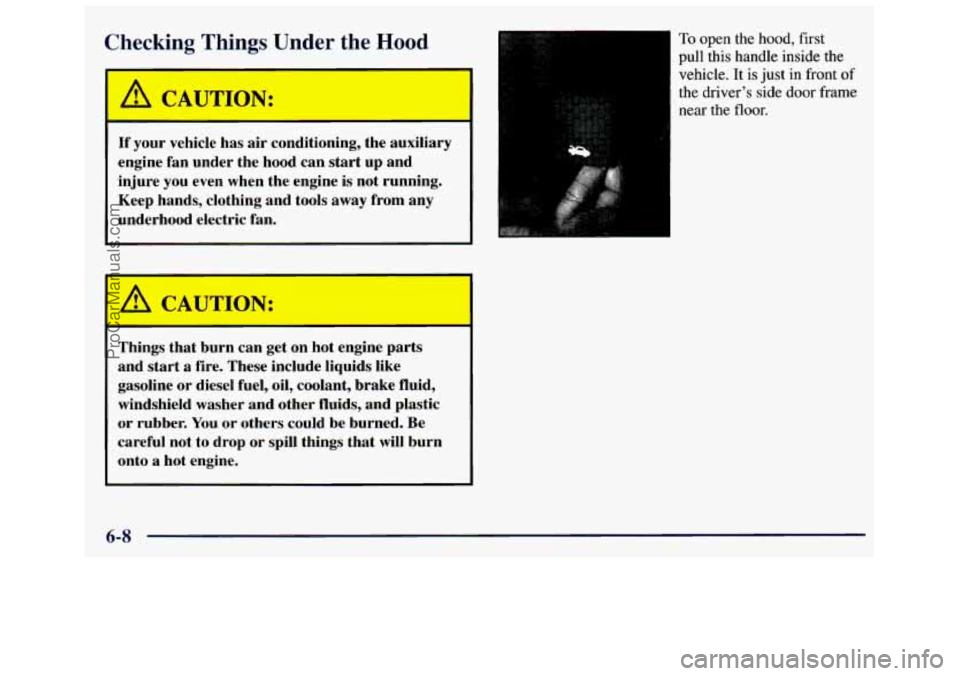
To open the hood, first
pull this handle inside the
vehicle. It is
just in front of
the driver’s side door frame
near the floor.
I
6-8
ProCarManuals.com
Page 251 of 388
If your vehicle has a 7.4 liter engine and air
conditioning, your vehicle will have a auxiliary
engine fan in addition to the belt driven fan.
Before closing the hood, be sure all the filler caps
are
on properly.
Then lift the hood
to relieve pressure on the hood prop.
Remove
the hood prop from the slot in the hood and
return the prop
to its retainer. Then just let the hood
down and close it firmly.
Noise Control System
The following information relates to compliance with
Federal noise emission standards for vehicles with a
Gross Vehicle Weight Rating (GVWR) of more than
10,000 lbs. (4 536 kg). The Maintenance Schedule
provides information on maintaining the noise control
system
to minimize degradation of the noise emission
control system during the life of your vehicle. The
noise control system warranty
is given in your
Warranty booklet.
These standards apply only to vehicles sold in
the
United States.
Tampering With Noise Control
System Prohibited
Federal law prohibits the following acts or the causing
thereof:
1. The removal or rendering inoperative by any person,
other than for purposes of maintenance, repair or
replacement,
of any device or element of design
incorporated into any new vehicle for the purpose
of noise control, prior to its sale or delivery to the
ultimate purchaser or while
it is in use; or
2. The use of the vehicle after such device or element
of design has been removed or rendered inoperative
by any person.
Among those acts presumed to constitute tampering are
the
acts listed below.
Insulation:
0 Removal of the noise shields or underhood insulation.
Engine:
0 Removal or rendering engine speed governor (if
equipped) inoperative
so as to allow engine speed to
exceed manufacturer specifications.
6-11
ProCarManuals.com
Page 256 of 388
If none of them is true, use the long triphighway
maintenance schedule. Change the oil and filter every
7,500 miles (12 500 km) or 12 months -- whichever
occurs first. Driving
a vehicle with a fully warmed
engine under highway conditions causes engine oil
to break down slower.
What to Do with Used Oil
Did you know that used engine oil contains certain
elements that may be unhealthy for your skin and could
even cause cancer? Don't let used oil stay
on your skin
for very long. Clean your slun and nails with soap and
water, or
a good hand cleaner. Wash or properly throw
away clothing
or rags containing used engine oil. (See
the manufacturer's warnings about the use and disposal
of oil products.)
Used
oil can be a real threat to the environment. If you
change your own oil, be sure to drain all free-flowing
oil from the filter before disposal. Don't ever dispose
of
oil by putting it in the trash, pouring it on the ground,
into sewers, or into streams or bodies of water. Instead,
recycle
it by taking it to a place that collects used oil. If
you have a problem properly disposing of your used oil,
ask your dealer, a service station or a local recycling
center for help.
Air Cleaner (Gasoline Engines)
A
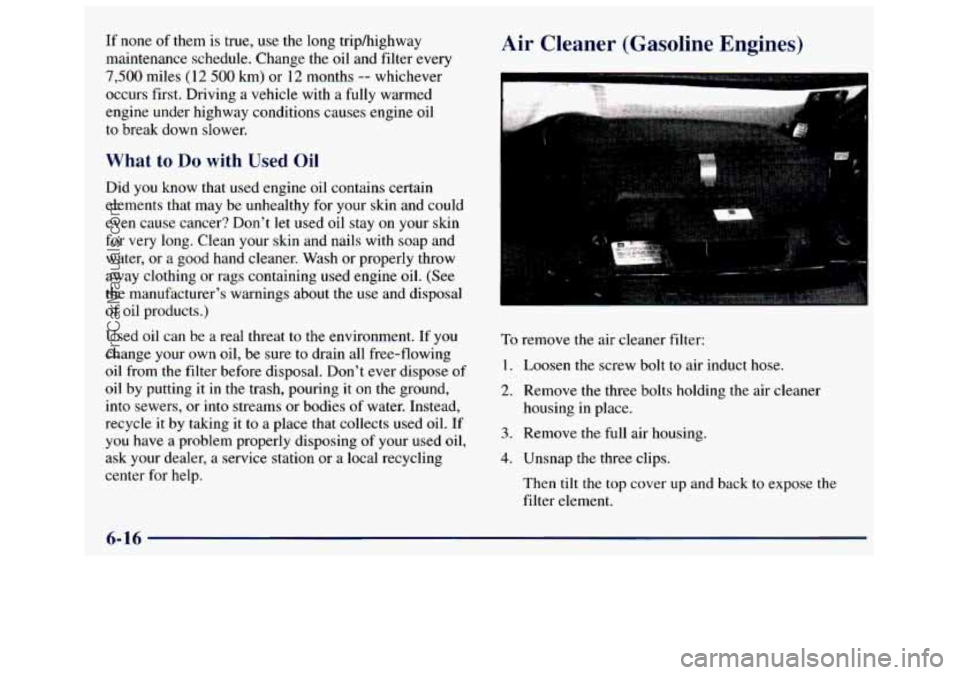
To remove the air cleaner filter:
1. Loosen the screw bolt to air induct hose.
2. Remove the three bolts holding the air cleaner
housing in place.
3. Remove the full air housing.
4. Unsnap the three clips.
Then
tilt the top cover up and back to expose the
filter element.
6- 16
ProCarManuals.com
Page 257 of 388
5. Install a new filter element with the folds in the
down position.
Reverse Steps
1 through 4 to replace the air cleaner.
See “Normal Replacement Parts” for the proper filter
to use.
Refer to the Maintenance Schedule
to determine when to
replace the air filter and crankcase ventilation filter.
See “Scheduled Maintenance Services” in the Index.
I
Operating the engine with the air cleaner off can
cause you or others to be burned. The air cleaner
not only cleans the air,
it stops flame if the engine
backfires.
If it isn’t there, and the engine
backfires, you could be burned. Don’t drive with
it
off, and be careful working on the engine with
the air cleaner
off.
NOTICE:
If the air cleaner is off, a backfire can cause a
damaging engine fire. And, dirt can easily get
into your engine, which will damage
it. Always
have the air cleaner in place when you’re driving.
Automatic Transmission Fluid
If your vehicle has a diesel engine, see “Automatic
Transmission Fluid” in the Diesel Supplement.
When to Check and Change
A good time to check your automatic transmission fluid
level
is when the engine oil is changed.
Change both the fluid and filter every
50,000 miles
(83 000 km) if the vehicle’s GVWR is over 8,600 or
if the vehicle is mainly driven under one or more of
these conditions:
0 In heavy city traffic where the outside temperature
regularly reaches
90°F (32°C) or higher.
0 In hilly or mountainous terrain.
0 When doing frequent trailer towing.
6-17
ProCarManuals.com
Page 270 of 388
Brake Wear
Your vehicle has front disc brakes and rear drum brakes.
Disc brake pads have built-in wear indicators
that
make a high-pitched warning sound when the brake
pads are worn and new pads are needed. The sound
may come and go or be heard all the time your vehicle
is moving (except when you are pushing on the brake
pedal firmly).
The brake wear warning sound means that soon
your brakes won’t work well. That could lead to
an accident. When you hear the brake wear
warning sound, have your vehicle serviced.
I NOTICE:
Continuing to drive with worn-out brake pads
could result in costly brake repair.
Some driving conditions or climates may cause a
brake squeal when the brakes are first applied or
lightly applied. This does not mean something is
wrong with your brakes.
Properly torqued wheel nuts
are necessary to help
prevent brake pulsation. When tires are rotated, inspect
brake pads for wear and evenly torque wheel nuts in
the proper sequence
to GM specifications.
Your rear drum brakes don’t have wear indicators, but
if you ever hear a rear brake rubbing noise, have the
rear brake linings inspected immediately.
Also, the rear
brake drums should be removed and inspected each time
the tires are removed for rotation or changing. When
you have the front brake pads replaced, have the rear
brakes inspected, too.
Brake linings should always
be replaced as complete
axle sets.
See “Brake System Inspection” in Section
7 of this
manual under Part
C “Periodic Maintenance Inspections.”
Brake Pedal Travel
See your dealer if the brake pedal does not return to
normal height, or if there
is a rapid increase in pedal
travel. This could be a sign of brake trouble.
6-30
ProCarManuals.com