engine GMC SAVANA 1998 User Guide
[x] Cancel search | Manufacturer: GMC, Model Year: 1998, Model line: SAVANA, Model: GMC SAVANA 1998Pages: 388, PDF Size: 20.04 MB
Page 94 of 388
It is dangerous to get out of your vehicle if the
shift lever is not fully in PARK
(P) with the
parking brake firmly set. Your vehicle can roll.
Don’t leave your vehicle when the engine is
running unless you have to.
If you have left the
engine running, the vehicle can move suddenly.
You or others could be injured. To be sure your
vehicle won’t move, even when you’re on fairly
level ground, always set your parking brake and
move the shift lever to PARK
(P).
See “Shifting Into PARK (P)” in the Index. If
you’re pulling a trailer, see “Towing a Trailer” in
the Index.
Ensure the shift lever is fully in PARK (P) before
starting the engine. Your vehicle has
a
brake-transmission shift interlock. With the ignition in
the RUN position, you must fully apply your regular
brakes before you can shift from PARK
(P).
If you cannot shift out of PARK (P), ease pressure on
the shift lever and push the shift lever all the way into
PARK (P) as you continue pressing the brake pedal.
Then move the shift lever into
the gear you want. See
“Shifting Out
of PARK (P)” later in this section.
REVERSE (R): Use this gear to back up.
NOTICE:
Shifting into REVERSE (R) while your vehicle is
moving forward could damage your
transmission. Shift to REVERSE
(R) only after
your vehicle is stopped.
To rock your vehicle back and forth to get out of snow,
ice or sand without damaging your transmission, see
“Stuck: In Sand, Mud, Ice or Snow” in the Index.
NEUTRAL
(N): In this position, your engine doesn’t
connect with the wheels.
To restart when you’re already
moving, use
NEUTRAL (N) only. Also, use
NEUTRAL (N) when your vehicle is being towed.
2-22
ProCarManuals.com
Page 95 of 388
r
I I - CAUTION:
Shifting out of PARK (P) or NEUTRAL (N) while
your engine is “racing” (running at high speed) is
1 dangerous. Unless your foot is firmly on the
brake pedal, your vehicle could move very rapidly.
You could lose control and hit people or
objects. Don’t shift
out of PARK (P) or
NEUTRAL (N) while your engine
is racing.
NOTICE:
Damage to your transmission caused by shifting
out
of PARK (P) or NEUTRAL (N) with the
engine racing isn’t covered by your warranty.
DRIVE
(D): This position is for normal driving. If you
need more power for passing, and you’re:
0 Going less than about 35 mph (55 km/h), push your
accelerator pedal about halfway down.
Going about 35 mph (55 km/h) or more, push the
accelerator all the way down.
You’ll shift down
to the next gear and have more power.
You should use DRIVE (D) (or, as
you need to, a lower
gear) when towing a trailer
to minimize heat build-up
and extend the life
of your transmission.
THIRD (3): This position is also used for normal
driving, however, it offers more power and lower fuel
economy than DRIVE (D). You should use THIRD
(3)
when carrying a heavy load or driving on steep hills.
SECOND (2): This position gives you more power but
lower fuel economy. You can use
SECOND (2) on hills.
It can help control your speed as you go down steep
mountain roads, but then you would also want
to use
your brakes off and on. If you manually select
SECOND
(2), the transmission will drive in
SECOND
(2). You may use this feature for reducing
torque
to the rear wheels when you are trying to start
your vehicle from a stop on slippery road surfaces.
FIRST (1): This position gives you even more power
(but lower fuel economy) than
SECOND (2). You can
use it on very steep hills, or
in deep snow or mud. If
the selector lever is put in FIRST(
l), the transmission
won’t shift into first gear until the vehicle is going
slowly enough.
ProCarManuals.com
Page 97 of 388
NOTICE:
Driving with the parking brake on can cause your
rear brakes to overheat. You may have to replace
them, and you could also damage other parts of
your vehicle. Always check to
be sure your parking
brake
is fully released before you drive.
If you are towing a trailer and are parking on any hill,
see “Towing a Trailer” in the Index. That section shows
what to do first to keep the trailer from moving.
Shifting Into PARK (P)
It can be dangerous to get out of your vehicle if
the shift lever is not fully in PARK
(P) with the
parking brake firmly set. Your vehicle can roll.
If
you have left the engine running, the vehicle can
move suddenly. You or others could be injured.
To be sure your vehicle won’t move, even when
you’re on fairly level ground, use the steps that
follow.
If you’re pulling a trailer, see “Towing a
Trailer” in the Index.
1. Hold the brake pedal down with your right foot and
set the parking brake.
2-25
ProCarManuals.com
Page 99 of 388
Leaving Your Vehicle With the
Engine Running
A CAUTION:
It can be dangerous to leave your vehicle with the
engine running. Your vehicle could move
suddenly if the shift lever is not fully in
PARK (P)
with the parking brake firmly set. And, if you
leave the vehicle with the engine running, it could
overheat and even catch fire. You
or others could
be injured. Don’t leave your vehicle with the
engine running unless you have to.
Torque Lock
If you are parking on a hill and you don’t shift your
transmission into
PARK (P) properly, the weight of the
vehicle may put too much force on the parking pawl in
the transmission. You may find it difficult to pull the
shift lever out of PARK (P). This
is called “torque lock.”
To prevent torque lock, set the parking brake and then
shift into PARK
(P) properly before you leave the
driver’s seat.
To find out how, see “Shifting Into
PARK (P)” in the Index.
When you are ready
to drive, move the shift Tever out of
PARK (P)
before you release the parking brake.
If torque lock does occur, you may need to have another
vehicle push yours a little uphill to take some
of the
pressure from the parking pawl in the transmission,
so
you can pull the shift lever out of PARK (P).
ProCarManuals.com
Page 101 of 388
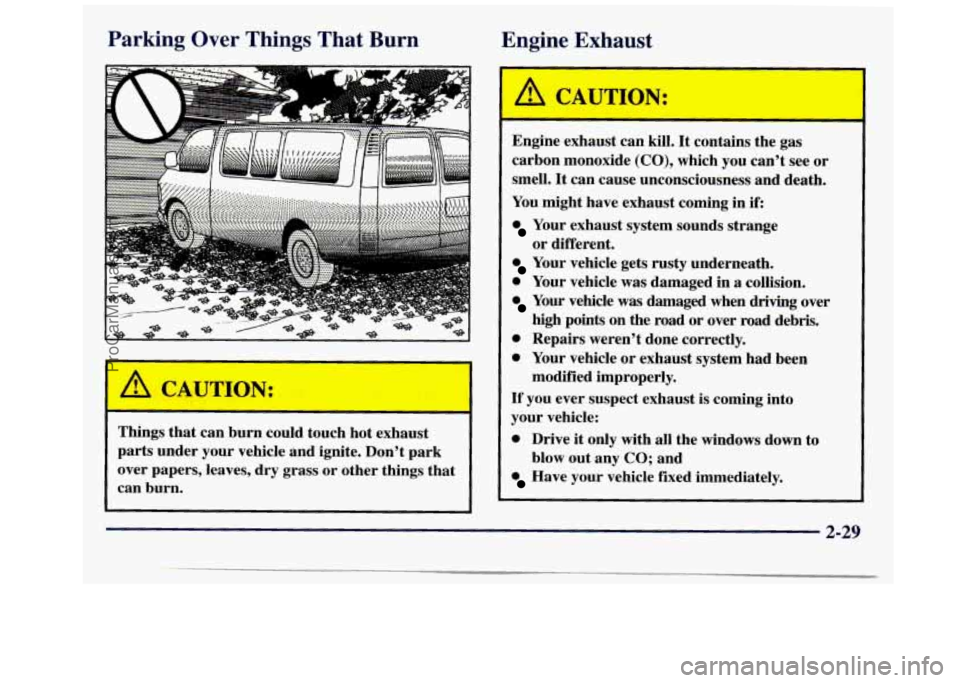
Parking Over Things That Burn
Engine Exhaust
Engine exhaust can kill. It contains the gas
carbon monoxide (CO), which you can’t see or
smell.
It can cause unconsciousness and death.
You might have exhaust coming in if:
Your exhaust system sounds strange
Your vehicle gets rusty underneath.
0 Your vehicle was damaged in a collision.
Your vehicle was damaged when driving over
high points on the road or over road debris.
0 Repairs weren’t done correctly.
0 Your vehicle or exhaust system had been
If you ever suspect exhaust is coming into
your vehicle:
0 Drive it only with all the windows down to
Have your vehicle fixed immediately. or
different.
modified improperly.
blow out any
CO; and
2-29
ProCarManuals.com
Page 102 of 388
Running Your Engine While
You’re Parked
It’s better not to park with the engine running. But if
ever you have to, here are some things to know.
t-
Idling the engine with the air system control off
could allow dangerous exhaust into your vehicle
(see the earlier Caution under “Engine Exhaust”).
I Also, idling in a closed-in place can let deadly
carbon monoxide
(CO) into your vehicle even
if the fan switch is
at the highest setting. One
place this can happen
is a garage. Exhaust -- with
CO -- can come in easily. NEVER park in a
garage with the engine running.
Another closed-in place can be
a blizzard.
(See “Blizzard” in the Index.) It can
be dangerous to get out of
yvur vehicle if
the shift lever is not fully in PARK
(P) with the
parking brake firmly set. Your vehicle can roll.
Don’t leave your vehicle when the engine is
running unless you have to. If you’ve left the
engine running, the vehicle can move suddenly.
You
or others could be injured. To be sure your
vehicle won’t move, even when you’re
on fairly
level ground, always set your parking brake and
move the shift lever to PARK (P).
Follow the proper steps to be sure your vehicle won’t
move. See “Shifting Into
PARK (P)” in the Index.
If you’re pulling a trailer, see “Towing
a Trailer” in
the Index.
Locking Rear Axle (If Equipped)
If you have this feature, your locking rear axle can give
you additional traction on snow, mud, ice, sand or
gravel. It works like a standard axle most of the time,
but when
one of the rear wheels has no traction and the
other does, this feature will allow
the wheel with
traction to move the vehicle.
2-30
ProCarManuals.com
Page 105 of 388
A CAUTION:
It can be dan
swing-out windows or rear door(s) open because
carbon monoxide (CO) gas can come into your
vehicle. You can’t see or smell
CO. It can cause
unconsciousness and even death.
If you must drive with the rear swing-out
windows or rear door(s) open or
if electrical
wiring or other cable connections must pass
through the seal between the body and the rear
swing-out windows or rear door(s):
0 Make sure all windows are shut.
CAUTION: (Continued)
’ CAUTION: (Continued: -
0 Thrn the fan on your heating or cooling
system to its highest speed with the setting
on VENT, HEAT, BLEND or DEF.
Additionally, on vehicles with heatingair
conditioning systems,
NORM A/C or
BI-LEVEL A/C can be used. That will
force outside
air into your vehicle. See
“Comfort Controls” in the Index.
0 If you have air outlets on or under the
instrument panel, open them all the
way.
See “Engine Exhaust” in the Index.
Horn
Press the horn symbol in the middle of the steering
wheel to sound the horn.
2-33
ProCarManuals.com
Page 114 of 388
The DRL system will make your headlamps come on at
a reduced brightness when:
The ignition is on,
The headlamp switch is off, and
The parking brake is released.
When the DRL are
on, only your headlamps will be on.
The taillamps, sidemarker and other lamps won’t be on.
Your instrument panel won’t be lit up either.
When it begins
to get dark, your DRL indicator light is
a reminder
to turn your headlamp switch on. The other
lamps that come
on with your headlamps will also
come
on.
When you turn off the headlamp switch, the regular
lamps will go off, and your headlamps will change to
the reduced brightness of
DRL.
To idle your vehicle with the engine on and the DRL off,
set the parking brake. The DRL will stay off until you
release the parking brake.
As with any vehicle, you should turn on the regular
headlamp system when you need it.
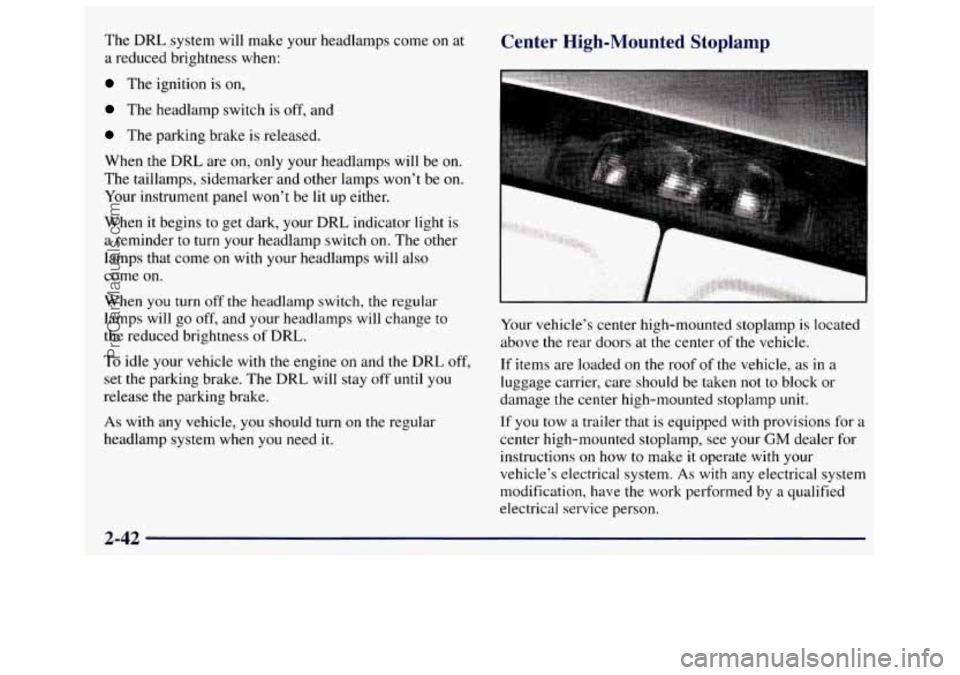
Center High-Mounted Stoplamp
Your vehicle’s center high-mounted stoplamp is located
above the rear doors at the center of the vehicle.
If items are loaded on the roof of the vehicle, as in a
luggage carrier, care should be taken
not to block or
damage the center high-mounted stoplamp unit.
If you tow a trailer that is equipped with provisions for a
center high-mounted stoplamp, see your
GM dealer for
instructions
on how to make it operate with your
vehicle’s electrical system.
As with any electrical system
modification, have the work performed by a qualified
electrical service person.
2-42
ProCarManuals.com
Page 116 of 388
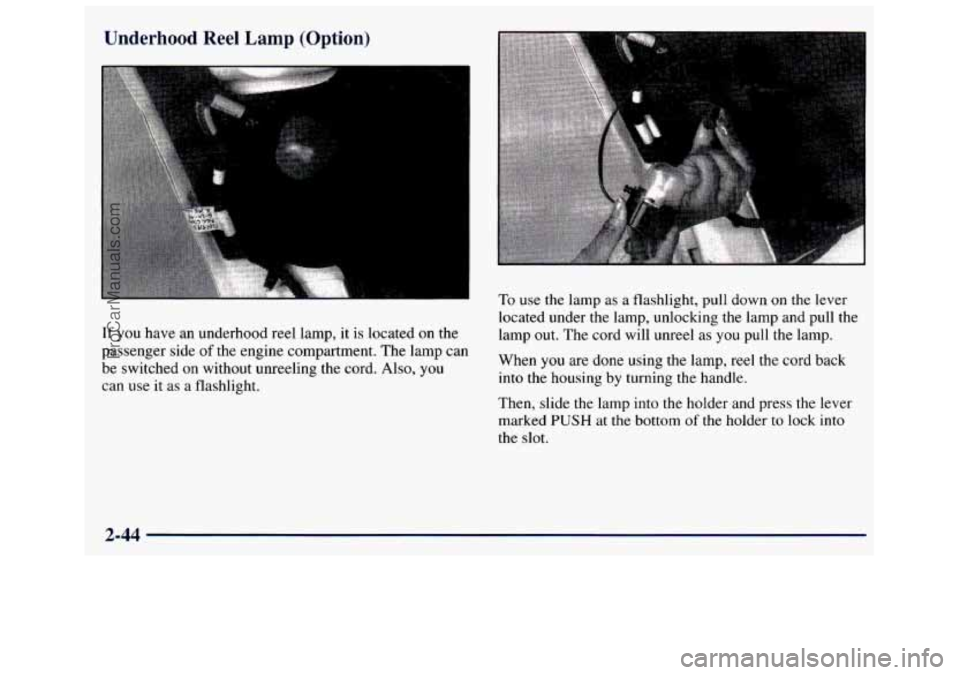
Underhood Reel Lamp (Option)
If you have an underhood reel lamp, it is located on the
passenger side
of the engine compartment. The lamp can
be switched
on without unreeling the cord. Also, you
can use
it as a flashlight.
To use the lamp as a flashlight, pull down on the lever
located under the lamp, unlocking the lamp and pull the
lamp out. The cord will unreel as you
pull the lamp.
When
you are done using the lamp, reel the cord back
into the housing by turning the handle.
Then, slide the lamp into the holder and press the
lever
marked PUSH at the bottom of the holder to lock into
the slot.
2-44
ProCarManuals.com
Page 125 of 388
Electronic Road-Speed Governor
(Gasoline Engines) (Option)
This optional system automatically controls vehicle top
speed. The system controller receives
a signal from the
vehicle speed sensor and reduces power when the
vehicle speed reaches the maximum
65 mph (105 kdh)
governed speed.
Warning Lights, Gages
and Indicators
This part describes the warning lights and gages that
may be on your vehicle. The pictures will help you
locate them.
Warning lights and gages can signal that something is
wrong before it becomes serious enough to cause an
expensive repair or replacement. Paying attention to
your warning lights and gages could also save you or
others from injury.
Warning lights come on when there may be or is a
problem with one of your vehicle’s functions. As you
will see in the details
on the next few pages, some
warning lights come
on briefly when you start the
engine just to let you know they’re working.
If you are
familiar
with this section, you should not be alarmed
when this happens. Gages
can indicate when there may be or is
a problem
with one of your vehicle’s functions. Often gages and
warning lights work together to let you know when
there’s
a problem with your vehicle.
When one of the warning lights comes on and
stays on
when you are driving, or when one of the gages shows
there may be a problem, check the section that tells you
what to do about it. Please follow this manual’s advice.
Waiting to do repairs can be costly
-- and even
dangerous.
So please get to know your warning lights
and gages. They’re
a big help.
Safety Belt Reminder Light
When the key is turned to RUN or START, a tone will
come on for about eight seconds to remind people to
fasten their safety belts, unless the driver’s safety belt is
already buckled.
The safety belt light will
also come on and stay on
for about
20 seconds, then it
will flash for about
5 5 seconds.
If the driver’s belt is already buckled, neither the tone
nor the light will come on.
2-53
ProCarManuals.com