engine GMC SAVANA 1998 Workshop Manual
[x] Cancel search | Manufacturer: GMC, Model Year: 1998, Model line: SAVANA, Model: GMC SAVANA 1998Pages: 388, PDF Size: 20.04 MB
Page 210 of 388
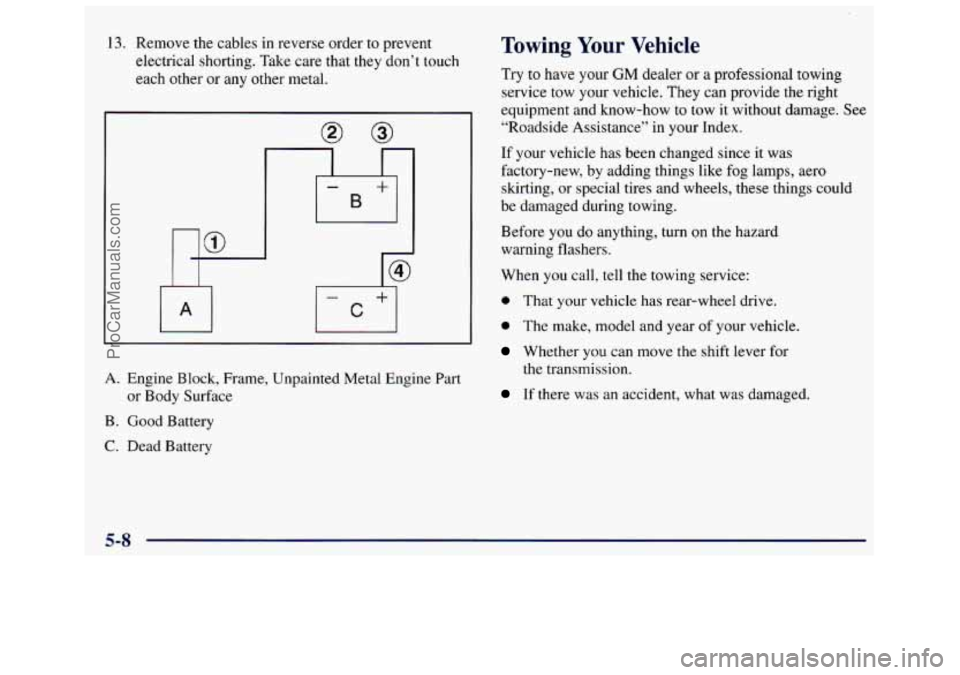
13. Remove the cables in reverse order to prevent
electrical shorting. Take care that they don’t touch
each other or any other metal.
A. Engine Block, Frame, Unpainted Metal Engine Part
or Body Surface
Towing Your Vehicle
Try to have your GM dealer or a professional towing
service tow your vehicle. They can provide the right
equipment and know-how to
tow it without damage. See
“Roadside Assistance” in your Index.
If your vehicle has been changed since it was
factory-new,
by adding things like fog lamps, aero
skirting, or special tires and wheels, these things could
be damaged during towing.
Before you do anything, turn
on the hazard
warning flashers.
When
you call, tell the towing service:
0 That your vehicle has rear-wheel drive.
0 The make, model and year of your vehicle.
Whether you can move the shift lever for
the transmission.
If there was an accident, what was damaged.
B. Good Battery
C. Dead Battery
5-8
ProCarManuals.com
Page 213 of 388
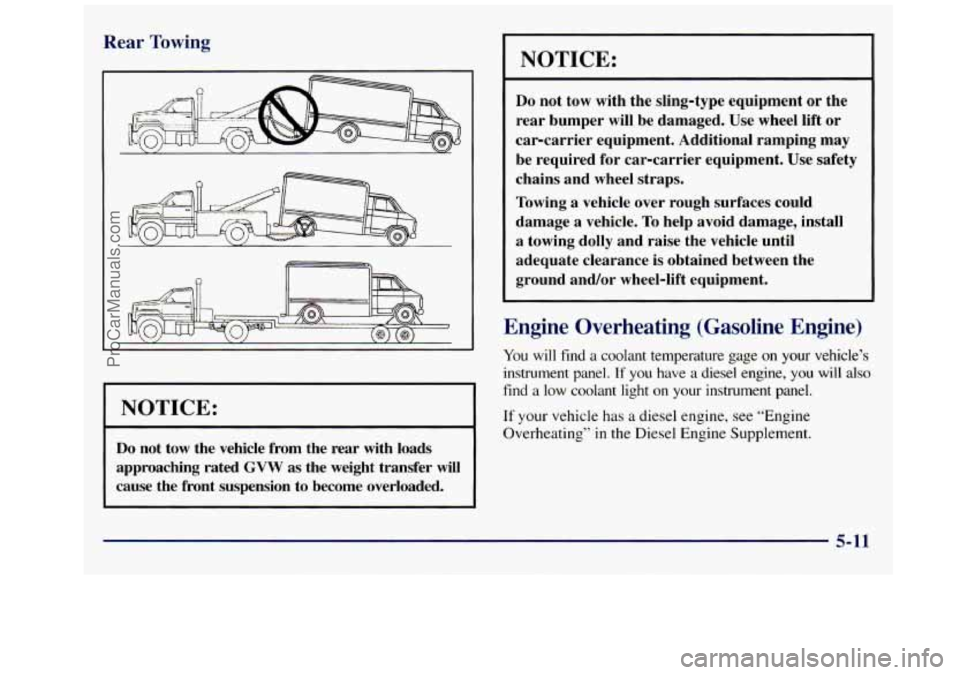
Rear Towir -
I NOTICE:
Do not tow the vehicle from the rear with loads
approaching rated
GVW as the weight transfer will
cause the front suspension to become overloaded.
NOTICE:
Do not tow with the sling-type equipment or the
rear bumper will be damaged. Use wheel lift
or
car-carrier equipment. Additional ramping may
be required for car-carrier equipment. Use safety
chains and wheel straps.
Towing a vehicle over rough surfaces could
damage a vehicle. To help avoid damage, install
a towing dolly and raise the vehicle until
adequate clearance is obtained between the
ground and/or wheel-lift equipment.
Engine Overheating (Gasoline Engine)
You will find a coolant temperature gage on your vehicle’s
instrument panel.
If you have a diesel engine, you will also
find a low coolant light on your instrument panel.
If your vehicle has a diesel engine, see “Engine
Overheating”
in the Diesel Engine Supplement.
5-11
ProCarManuals.com
Page 214 of 388
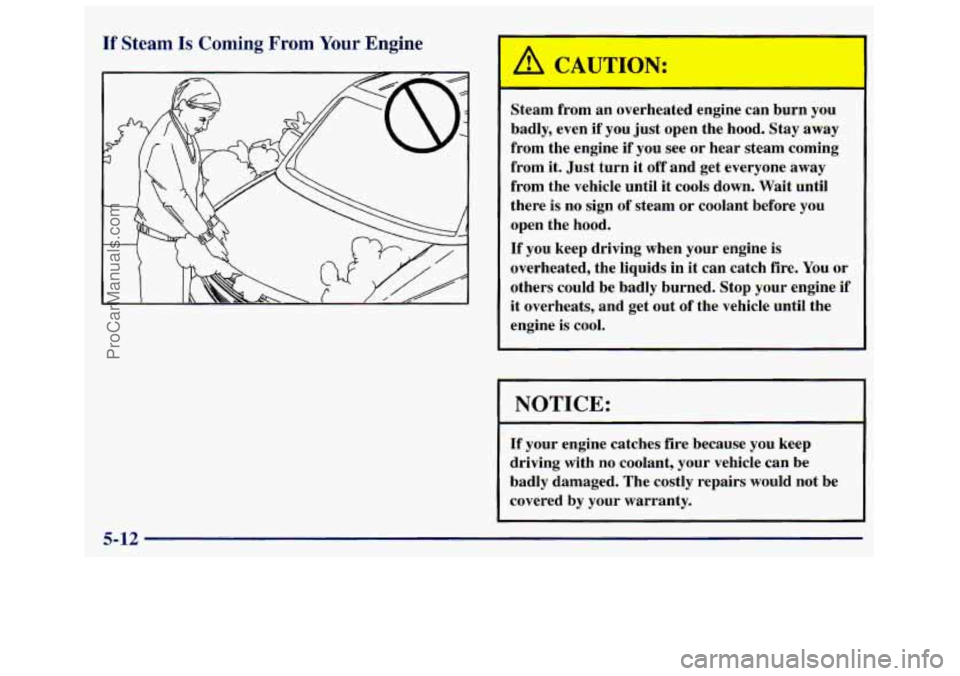
If Steam Is Coming From Your Engine
' Steam from an overheated engine can burn you
badly, even if you just open the hood. Stay away
from the engine if you see or hear steam coming
from
it. Just turn it off and get everyone away
from the vehicle until it cools down. Wait until
there is no sign of steam or coolant before you
open the hood.
If you keep driving when your engine is
overheated, the liquids in
it can catch fire. You or
others could
be badly burned. Stop your engine if
it overheats, and get out of the vehicle until the
engine is cool.
NOTICE:
If your engine catches fire because you keep
driving with no coolant, your vehicle can be
badly damaged. The costly repairs would not be
covered
by your warranty.
5-12
ProCarManuals.com
Page 215 of 388
If No Steam Is Coming From Your Engine
If you get the overheat warning but see or hear no
steam, the problem may not be too serious. Sometimes
the engine can get a little too hot when
you:
0 Climb a long hill on a hot day.
0 Stop after high-speed driving.
0 Idle for long periods in traffic.
0 Tow a trailer. See “Driving on Grades” in the Index.
If
you get the overheat warning with no sign of steam,
try this for a minute or
so:
1. If you have an air conditioner, turn it off.
2. Turn on your heater to full hot at the highest fan
speed and open the window as necessary. If
you no longer
have the overheat warning, you can
drive. Just
to be safe, drive slower for about 10 minutes.
If the warning doesn’t come back on,
you can
drive normally.
If the warning continues, pull over, stop, and park your
vehicle right away.
If there’s still no sign
of steam, push the accelerator until
the engine speed
is about twice as fast as normal idle
speed. Bring the engine speed back to normal idle speed
after two
or three minutes. Now see if the warning stops.
But then, if
you still have the warning, turn ofSthe
engine
and get everyone out of the vehicle until it
cools down.
You may decide not to lift the hood but to get service
help right away.
3. If you’re in a traffic jam, shift to NEUTRAL (N);
otherwise, shift to the highest gear while
driving
-- DRIVE (D).
5-13
ProCarManuals.com
Page 216 of 388
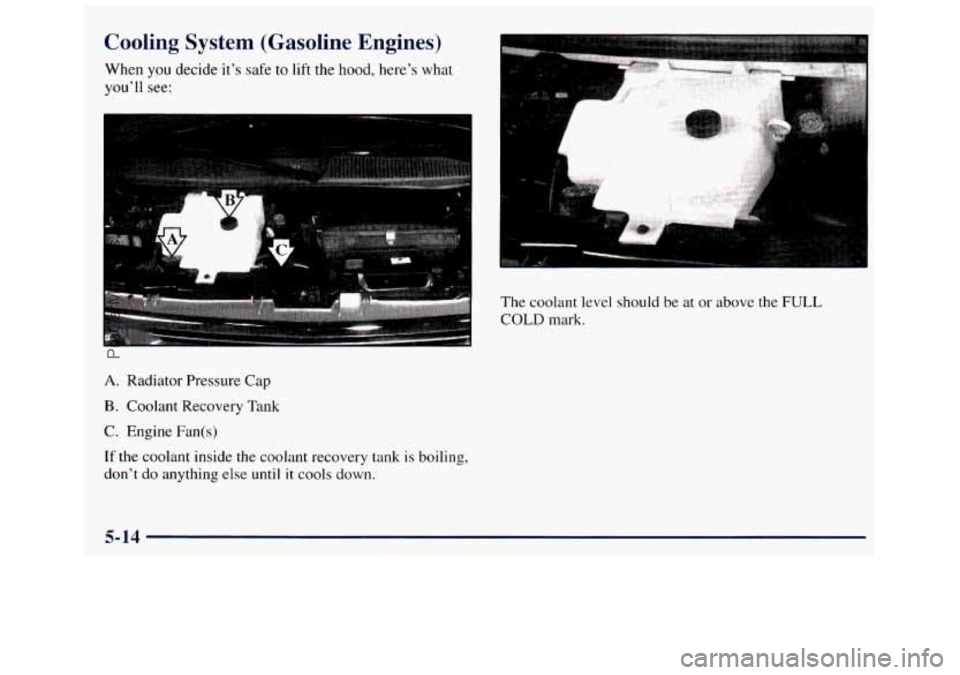
Cooling System (Gasoline Engines)
When you decide it’s safe to lift the hood, here’s what
you’ll see:
.. .
A. Radiator Pressure Cap
B. Coolant Recovery Tank
C. Engine Fan(s)
If the coolant inside the coolant recovery tank is boiling,
don’t do anything else
until it cools down.
e;- ..
The coolant level should be at or above the FULL
COLD mark.
5-14
ProCarManuals.com
Page 217 of 388
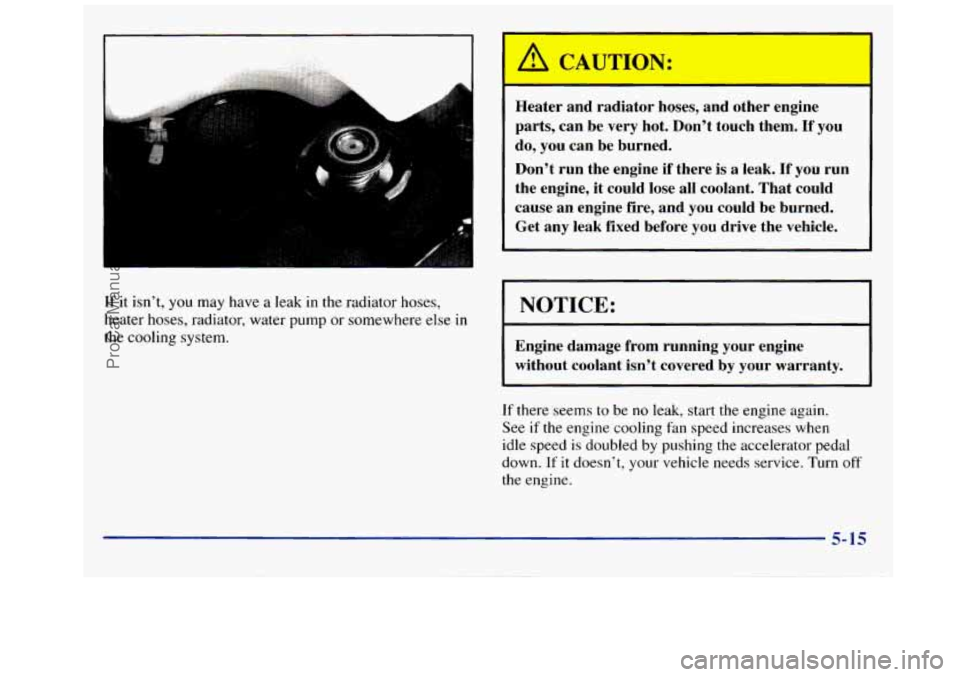
If it isn’t, you may have a leak in the radiator hoses,
heater hoses, radiator, water pump or somewhere else
in
the cooling system.
Heater and radiator hoses, and other engine
parts, can be very hot. Don’t touch them.
If you
do, you can be burned.
Don’t run the engine if there is
a leak. If you run
the engine, it could lose all coolant. That could
cause an engine fire, and you could be burned.
Get any leak fixed before
you drive the vehicle.
I NOTICE:
Engine damage from running your engine
without coolant isn’t covered by your warranty.
If there seems to be no leak, start the engine again.
See
if the engine cooling fan speed increases when
idle speed
is doubled by pushing the accelerator pedal
down.
If it doesn’t, your vehicle needs service. Turn off
the engine.
5-15
ProCarManuals.com
Page 218 of 388
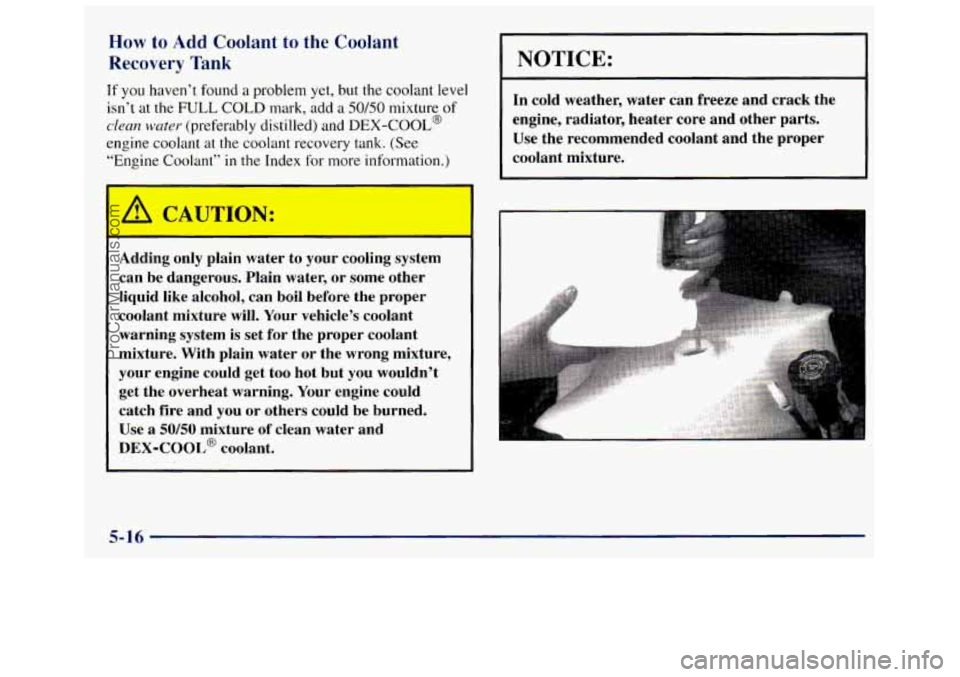
How to Add Coolant to the Coolant
Recovery
Tank
If you haven’t found a problem yet, but the coolant level
isn’t
at the FULL COLD mark, add a 50/50 mixture of
clean water (preferably distilled) and DEX-COOL@
engine coolant at the coolant recovery tank. (See
“Engine Coolant“
in the Index for more information.)
A C”UT1 )N:
Adding only plain water to your cooling system
can be dangerous. Plain water, or some other
liquid like alcohol, can boil before the proper
coolant mixture will. Your vehicle’s coolant
warning system is set for the proper coolant
mixture. With plain water or the wrong mixture,
your engine could get too hot but you wouldn’t
get the overheat warning. Your engine could
catch fire and you or others could be burned.
Use a
50/50 mixture of clean water and
DEX-COOL@ coolant.
I NOTICE:
In cold weather, water can freeze and crack the
engine, radiator, heater core and other parts.
Use the recommended coolant and the proper
coolant mixture.
5-16
ProCarManuals.com
Page 219 of 388
A CAUTION:
You can be burned if you spill coolant on hot
engine parts. Coolant contains ethylene glycol
and
it will burn if the engine parts are hot
enough. Don’t spill coolant on a hot engine.
When the coolant in the coolant recovery tank is at the
FULL COLD mark, start your vehicle.
If the overheat warning continues, there’s one more
thing you can try.
You can add the proper coolant
mixture directly to the radiator, but be sure the cooling
system is cool before you
do it.
-
A CAUTION:
Steam and scalding liquids from a hot cooling
system can blow out and burn you badly. They
are under pressure, and if you turn the radiator
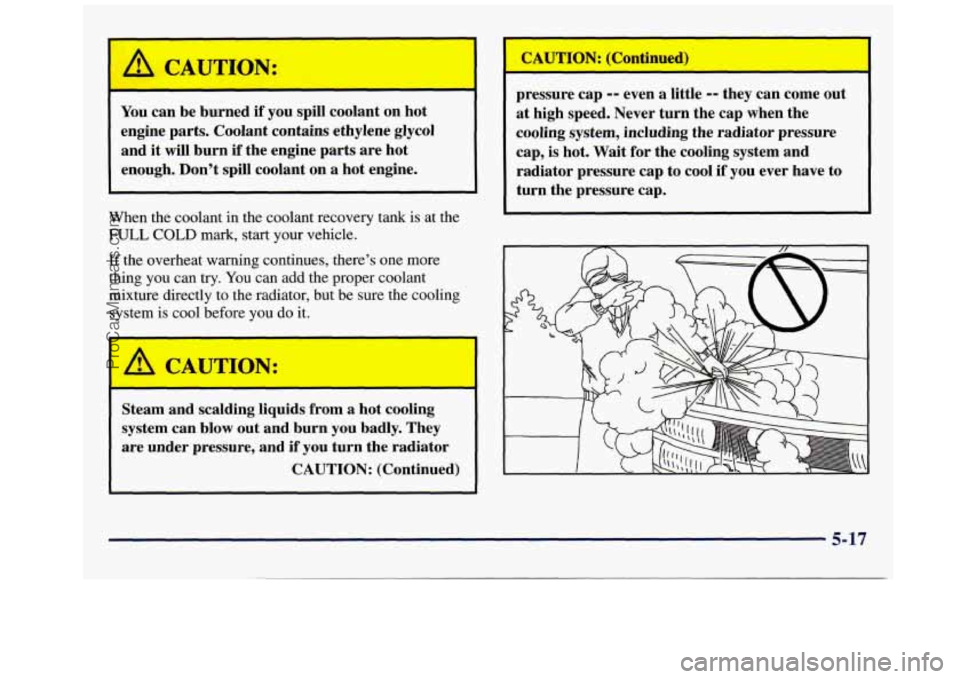
CAUTION: (Continued) CAUTION: (Continued)
pressure cap
-- even a little -- they can come out
at high speed. Never turn the cap when the
cooling system, including the radiator pressure
cap, is hot. Wait for the cooling system and
radiator pressure cap to cool
if you ever have to
turn the pressure cap.
5-17
ProCarManuals.com
Page 221 of 388
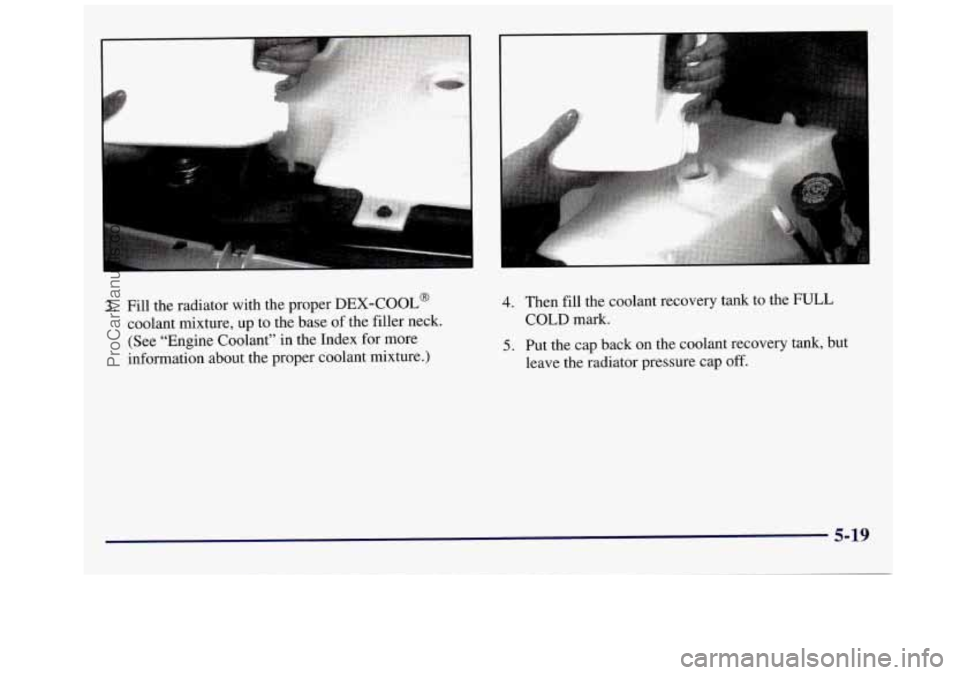
3. Fill the radiator with the proper DEX-COOL@
coolant mixture, up to the base of the filler neck.
(See “Engine Coolant’’ in the Index for more
information about the proper coolant mixture.)
4. Then fill the coolant recovery tank to the
COLD mark.
5. Put the cap back on the coolant recovery tank, but
leave the radiator pressure cap off.
5-19
ProCarManuals.com
Page 222 of 388
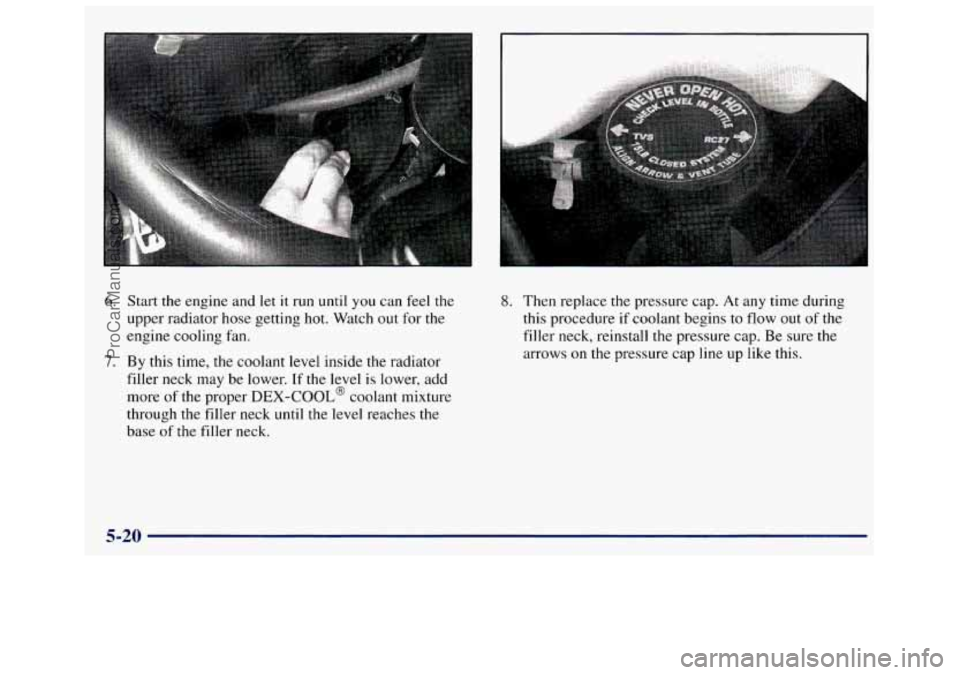
6.
7.
Start the engine and let it run until you can feel the
upper radiator hose getting
hot. Watch out for the
engine cooling fan.
By this time, the coolant level inside the radiator
filler neck may be lower. If the level
is lower, add
more
of the proper DEX-COOL@ coolant mixture
through the filler neck until the
level reaches the
base
of the filler neck.
8. Then replace the pressure cap. At any time during
this procedure
if coolant begins to flow out of the
filler neck, reinstall
the pressure cap. Be sure the
arrows on the pressure cap line up like this.
5-20
ProCarManuals.com