weight GMC SAVANA 1998 User Guide
[x] Cancel search | Manufacturer: GMC, Model Year: 1998, Model line: SAVANA, Model: GMC SAVANA 1998Pages: 388, PDF Size: 20.04 MB
Page 196 of 388
Total Weight on Your Vehicle’s Tires
Be sure your vehicle’s tires are inflated to the upper
limit for cold tires. You’ll find these numbers on the
Certification label at the rear edge of the driver’s door or
see “Tire Loading” in
the Index. Then be sure you don’t
go over the
GVW limit for your vehicle, including the
weight of the trailer tongue.
Hitches
It’s important to have the correct hitch equipment.
Crosswinds, large trucks going by and rough roads are
a
few reasons why you’ll need the right hitch. Here are
some rules to follow:
The bumpers on your vehicle are not intended for
hitches.
Do not attach rental hitches or other
bumper-type hitches to them. Use only
a
frame-mounted hitch that does not attach to the
bumper. Do not use a ball hitch, because it could pull
the bumper loose.
If you’ll be pulling a trailer that, when loaded, will
weigh more than
4,000 lbs. (1 800 kg), be sure to use
a properly mounted, weight-distributing hitch and
sway control
of the proper size. This equipment is
very important for proper vehicle loading and good
handling when you’re driving.
Will you have to make any holes in the body of your
vehicle when you install a trailer hitch?
If you’re using the wiring provided by the
factory-installed hitch, you should not need to make
any holes in the body
of your vehicle. However, if
you have an aftermarket hitch installed, you may
need to make holes in
the body.
If you do, then be sure to seal the holes later when
you remove the hitch. If you don’t seal them, deadly
carbon monoxide
(CO) from your exhaust can get
into your vehicle (see “Carbon Monoxide”
in the
Index). Dirt and water can, too.
4-32
ProCarManuals.com
Page 198 of 388
Towing a trailer requires a certain amount of experience.
Before setting out for the open road, you’ll want to get
to know your rig. Acquaint yourself with the feel of
handling and braking with the added weight
of the
trailer. And always keep in mind that the vehicle
you are
driving is now a good deal longer and
not nearly as
responsive as your vehicle is by itself.
Before you start, check the trailer hitch and platform
(and attachments), safety chains, electrical connector,
lamps, tires and mirror adjustment.
If the trailer has
electric brakes, start your vehicle and trailer moving and
then apply the trailer brake controller by hand
to be sure
the brakes are working. This lets you check your
electrical connection at the same time.
During your trip, check occasionally to be sure that the
load is secure, and that the lamps and any trailer brakes
are still working.
Following Distance
Stay at least twice as far behind the vehicle ahead as you
would when driving your vehicle without a trailer. This
can help you avoid situations that require heavy braking
and sudden turns.
Passing
You’ll need more passing distance up ahead when
you’re towing a trailer. And, because you’re a good deal
longer, you’ll need to go much farther beyond the
passed vehicle before
you can return to your lane.
Backing Up
Hold the bottom of the steering wheel with one hand.
Then,
to move the trailer to the left, just move that hand
to the left.
To move the trailer to the right, move your
hand
to the right. Always back up slowly and, if
possible, have someone guide you.
4-34
ProCarManuals.com
Page 213 of 388
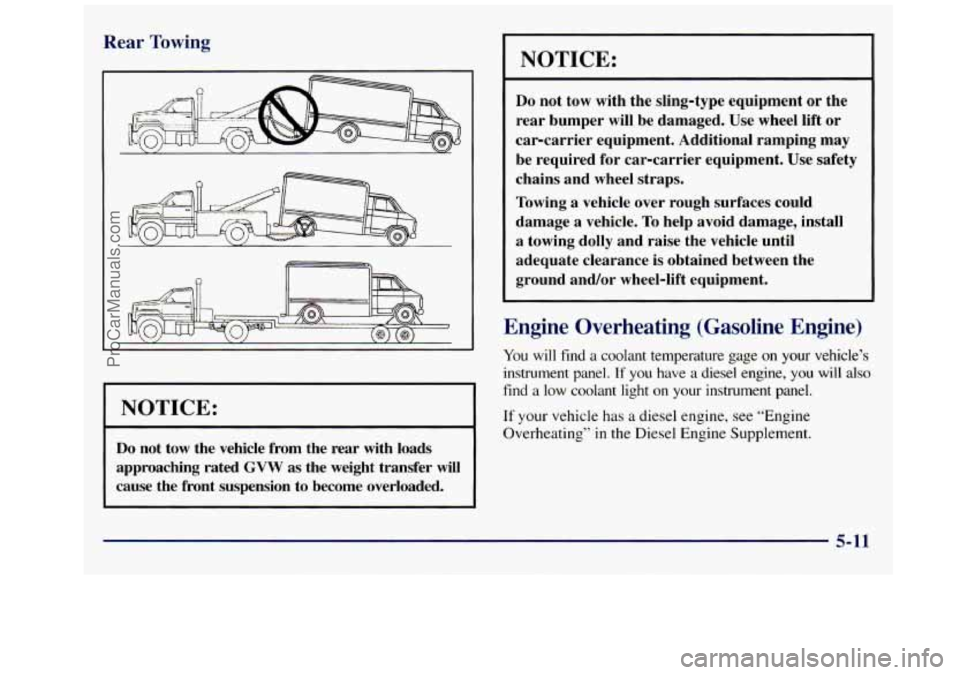
Rear Towir -
I NOTICE:
Do not tow the vehicle from the rear with loads
approaching rated
GVW as the weight transfer will
cause the front suspension to become overloaded.
NOTICE:
Do not tow with the sling-type equipment or the
rear bumper will be damaged. Use wheel lift
or
car-carrier equipment. Additional ramping may
be required for car-carrier equipment. Use safety
chains and wheel straps.
Towing a vehicle over rough surfaces could
damage a vehicle. To help avoid damage, install
a towing dolly and raise the vehicle until
adequate clearance is obtained between the
ground and/or wheel-lift equipment.
Engine Overheating (Gasoline Engine)
You will find a coolant temperature gage on your vehicle’s
instrument panel.
If you have a diesel engine, you will also
find a low coolant light on your instrument panel.
If your vehicle has a diesel engine, see “Engine
Overheating”
in the Diesel Engine Supplement.
5-11
ProCarManuals.com
Page 251 of 388
If your vehicle has a 7.4 liter engine and air
conditioning, your vehicle will have a auxiliary
engine fan in addition to the belt driven fan.
Before closing the hood, be sure all the filler caps
are
on properly.
Then lift the hood
to relieve pressure on the hood prop.
Remove
the hood prop from the slot in the hood and
return the prop
to its retainer. Then just let the hood
down and close it firmly.
Noise Control System
The following information relates to compliance with
Federal noise emission standards for vehicles with a
Gross Vehicle Weight Rating (GVWR) of more than
10,000 lbs. (4 536 kg). The Maintenance Schedule
provides information on maintaining the noise control
system
to minimize degradation of the noise emission
control system during the life of your vehicle. The
noise control system warranty
is given in your
Warranty booklet.
These standards apply only to vehicles sold in
the
United States.
Tampering With Noise Control
System Prohibited
Federal law prohibits the following acts or the causing
thereof:
1. The removal or rendering inoperative by any person,
other than for purposes of maintenance, repair or
replacement,
of any device or element of design
incorporated into any new vehicle for the purpose
of noise control, prior to its sale or delivery to the
ultimate purchaser or while
it is in use; or
2. The use of the vehicle after such device or element
of design has been removed or rendered inoperative
by any person.
Among those acts presumed to constitute tampering are
the
acts listed below.
Insulation:
0 Removal of the noise shields or underhood insulation.
Engine:
0 Removal or rendering engine speed governor (if
equipped) inoperative
so as to allow engine speed to
exceed manufacturer specifications.
6-11
ProCarManuals.com
Page 378 of 388
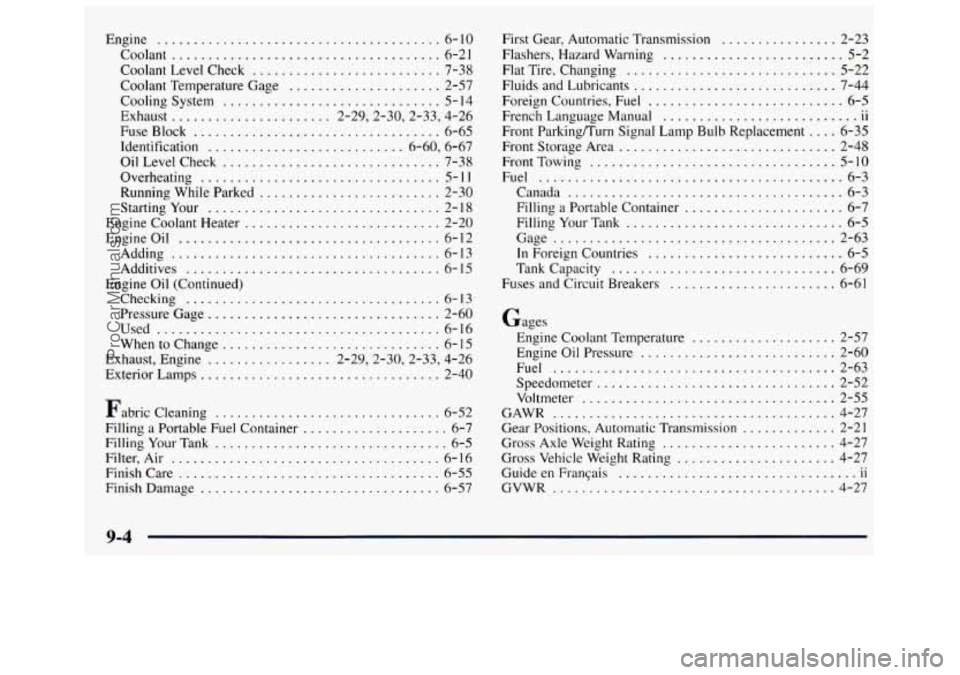
Engine ....................................... 6-10
Coolant ..................................... 6-21
Coolant Level Check
.......................... 7-38
Cooling System
.............................. 5-14
Exhaust
...................... 2.29.2.30.2.33. 4.26
FuseBlock
.................................. 6-65
Identification
........................... 6.60. 6.67
OilLevelCheck
.............................. 7-38
Overheating
................................. 5-11
Running While Parked
......................... 2-30
Starting Your
................................ 2- 18
Engine Coolant Heater ........................... 2-20
Engineoil
.................................... 6-12
Adding
..................................... 6-13
Additives
................................... 6-15
Checking
................................... 6-13
Pressure Gage ................................ 2-60
Used ....................................... 6-16
Whentochange
.............................. 6-15
Exhaust, Engine
................. 2-29,2-30.2-33, 4-26
Exterior Lamps
................................. 2-40
Coolant Temperature
Gage
..................... 2-57
Engine Oil (Continued)
Fabric Cleaning
............................... 6-52
Filling
a Portable Fuel Container .................... 6-7
Filling Your Tank
................................ 6-5
Filter. Air ..................................... 6-16
Finish Care
.................................... 6-55
Finish Damage
................................. 6-57 First Gear. Automatic Transmission
................ 2-23
Flashers. Hazard Warning
......................... 5-2
Flat Tire. Changing
............................. 5-22
Fluids and Lubricants
............................ 7-44
Foreign Countries. Fuel
........................... 6-5
French Language Manual 11
Front Parkingmurn Signal Lamp Bulb Replacement .... 6-35
Front Storage Area
.............................. 2-48
FrontTowing
.................................. 5-10
Fuel
.......................................... 6-3
Canada
...................................... 6-3
Filling
a Portable Container ...................... 6-7
Gage
....................................... 2-63
In Foreign Countries ........................... 6-5
Tank Capacity
............................... 6-69
Fuses and Circuit Breakers
....................... 6-61
.. ...........................
Filling Your Tank .............................. 6-5
Gages Engine Coolant Temperature
.................... 2-57
Engine Oil Pressure
........................... 2-60
Fuel
....................................... 2-63
Speedometer
................................. 2-52
Voltmeter
................................... 2-55
Gear Positions. Automatic Transmission
............. 2-21
Gross Axle Weight Rating
........................ 4-27
Gross Vehicle Weight Rating
...................... 4-27
Guide en Franpis
11
GAWR ....................................... 4-27
.. .................................
GVWR ....................................... 4-27
9-4
ProCarManuals.com
Page 384 of 388
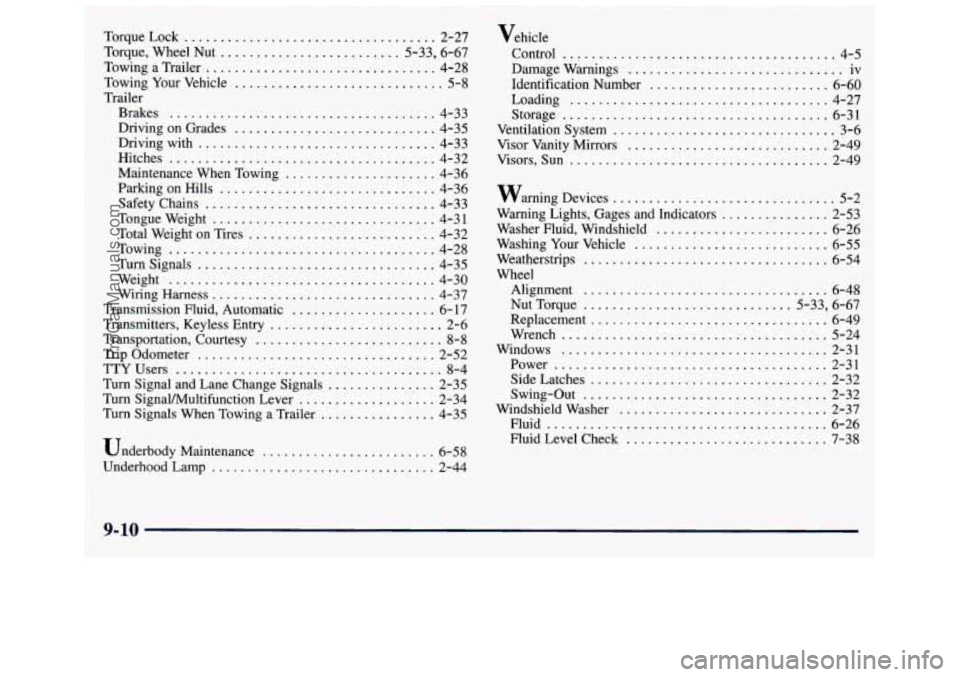
TorqueLock ................................... 2-27
rorque. Wheel Nut ......................... 5.33. 6.67
Towing a Trailer ................................ 4-28
Towing Your Vehicle ............................. 5-8
Driving on Grades ............................ 4-35
Driving with ................................. 4-33
Parking on Hills .............................. 4-36
Safety Chains ................................ 4-33
Tongue Weight ............................... 4-3 1
Total Weight on Tires .......................... 4-32
Towing ..................................... 4-28
Turn Signals ................................. 4-35
Weight ..................................... 4-30
Wiring Harness ............................... 4-37
Transmission Fluid, Automatic .................... 6- 17
rransmitters, Keyless Entry ........................ 2-6
Transportation, Courtesy .......................... 8-8
Trip Odometer ................................. 2-52
Turn SignaVMultifunction Lever ................... 2-34
Trailer
Brakes
...................................... 4-33
Hitches ..................................... 4-32
Maintenance When Towing ..................... 4-36
TTYUsers ..................................... 8-4
Turn Signal and Lane Change Signals ............... 2-35
Turn Signals When Towing a Trailer ................ 4-35
Underbody Maintenance .............. ,. ......... 6-58
Underhood Lamp ............................... 2-44
Vehicle
Control
...................................... 4-5
Damagewarnings .............................. iv
Identification Number
......................... 6-60
Loading .................................... 4-27
Storage ..................................... 6-31
Ventilation System ............................... 3-6
Visor Vanity Mirrors ............................ 2-49
Visors. Sun .................................... 2-49
warning Devices ............................... 5-2
Warning Lights. Gages and Indicators ............... 2-53
Washer Fluid. Windshield ........................ 6-26
Washing Your Vehicle ........................... 6-55
Weatherstrips .................................. 6-54
Wheel
Alignment
.................................. 6-48
Nut Torque ............................. 5-33. 6-67
Replacement ................................. 6-49
Wrench ..................................... 5-24
Windows ..................................... 2-31
Power ...................................... 2-31
SideLatches ................................. 2-32
Swing-Out .................................. 2-32
Windshield Washer ............................. 2-37
Fluid ....................................... 6-26
Fluid Level Check ............................ 7-38
9-10
ProCarManuals.com