coolant GMC SAVANA 1998 Owner's Manual
[x] Cancel search | Manufacturer: GMC, Model Year: 1998, Model line: SAVANA, Model: GMC SAVANA 1998Pages: 388, PDF Size: 20.04 MB
Page 253 of 388
Checking Engine Oil
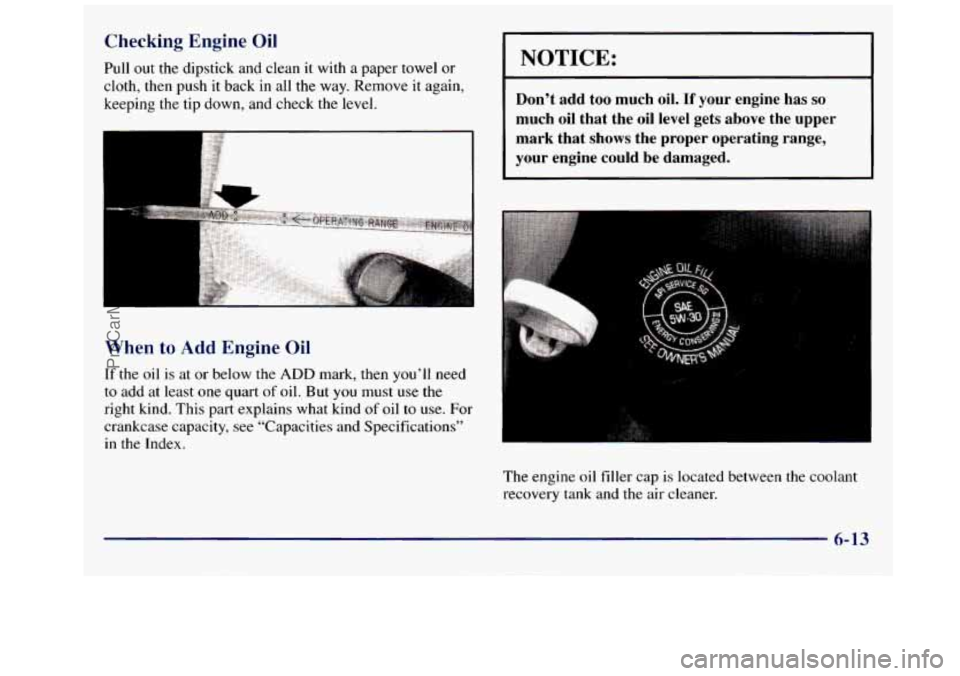
Pull out the dipstick and clean it with a paper towel or
cloth, then push
it back in all the way. Remove it again,
keeping the tip down, and check the level.
When to Add Engine Oil
If the oil is at or below the ADD mark, then you’ll need
to add at least one quart of oil. But you must use the
right kind. This part explains what kind of oil to use. For
crankcase capacity, see “Capacities and Specifications”
in the Index.
I NOTICE:
Don’t add too much oil. If your engine has so
much oil that the oil level gets above the upper
mark that shows the proper operating range, your engine could be damaged.
The engine oil filler cap is located between the coolant
recovery tank and the air cleaner.
6-13
ProCarManuals.com
Page 261 of 388
Rear Axle What to Use
When to Check and Change Lubricant
Refer to the Maintenance Schedule to determine how
often to check the lubricant and when to change it. See
“Scheduled Maintenance Services” in the Index.
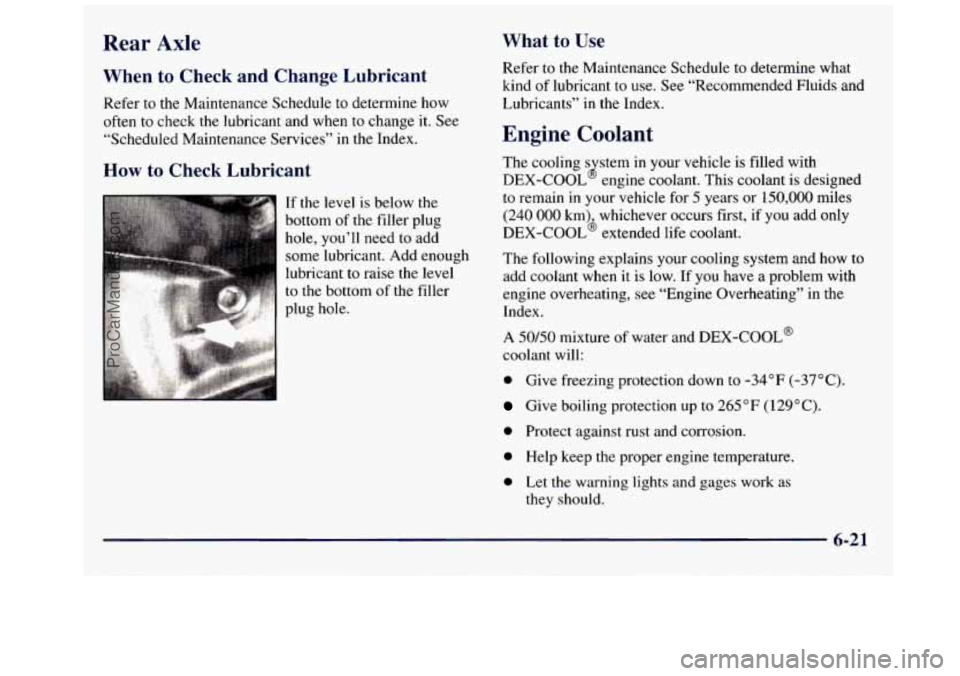
How to Check Lu’_ -~I
If the level is below the
bottom of the filler plug
hole, you’ll need
to add
some lubricant. Add enough
lubricant to raise the level
to the bottom of the filler
plug hole. Refer
to the Maintenance Schedule to determine what
kind of lubricant to use. See “Recommended Fluids and
Lubricants”
in the Index.
Engine Coolant
The cooling s stem in your vehicle is filled with
DEX-COOL engine coolant. This coolant is designea
to remain
in your vehicle for 5 years or 150,000 miles
(240 000 km) whichever occurs first, if you add only
DEX-COOL6 extended life coolant.
The following explains your cooling system and how to
add coolant when it is low. If you have
a problem with
engine overheating, see “Engine Overheating” in the
Index.
A 50/50 mixture of water and DEX-COOL@
coolant will:
2
0 Give freezing protection down to -34°F (-37°C).
Give boiling protection up to 265 “F (129” C).
0 Protect against rust and corrosion.
0 Help keep the proper engine temperature.
0 Let the warning lights and gages work as
they should.
6-21
ProCarManuals.com
Page 262 of 388
NOTICE:
When adding coolant, it is important that you
use only
DEX-COOL@ (silicate-free) coolant.
If coolant other than DEX-COOL is added to
the system, premature engine, heater core or
radiator corrosion may result. In addition, the
engine coolant will require change sooner
-- at
30,000 miles (50 000 km) or 24 months,
whichever occurs
first. Damage caused by the
use of coolant other than DEX-COOL@ is not
covered by your new vehicle warranty.
What to Use
Use a mixture of one-half clean water (preferably
distilled) and one-half
DEX-COOL@ coolant which
won’t damage aluminum parts. If you
use this mixture,
you don’t need
to add anything else.
I
A CAC LILA:
Adding only plain water to your cooling system
can be dangerous. Plain water, or some other
liquid like alcohol, can boil before the proper
coolant mixture will. Your vehicle’s coolant
warning system
is set for the proper coolant
mixture. With plain water or the wrong mixture,
your engine could get too hot but you wouldn’t
get the overheat warning. Your engine could
catch fire and you or others could be burned.
Use
a 50/50 mixture of clean water and
DEX-COOL@ coolant.
6-22
ProCarManuals.com
Page 263 of 388
NOTICE:
If you use an improper coolant mixture, your
engine could overheat and be badly damaged.
The repair cost wouldn’t be covered by your
warranty.
Too much water in the mixture can
freeze and crack the engine, radiator, heater core
and other parts.
If you have to add coolant more than four times a year,
have your dealer check your cooling system.
NOTICE:
If you use the proper coolant, you don’t have to
add extra inhibitors or additives which claim to
improve the system. These can be harmful.
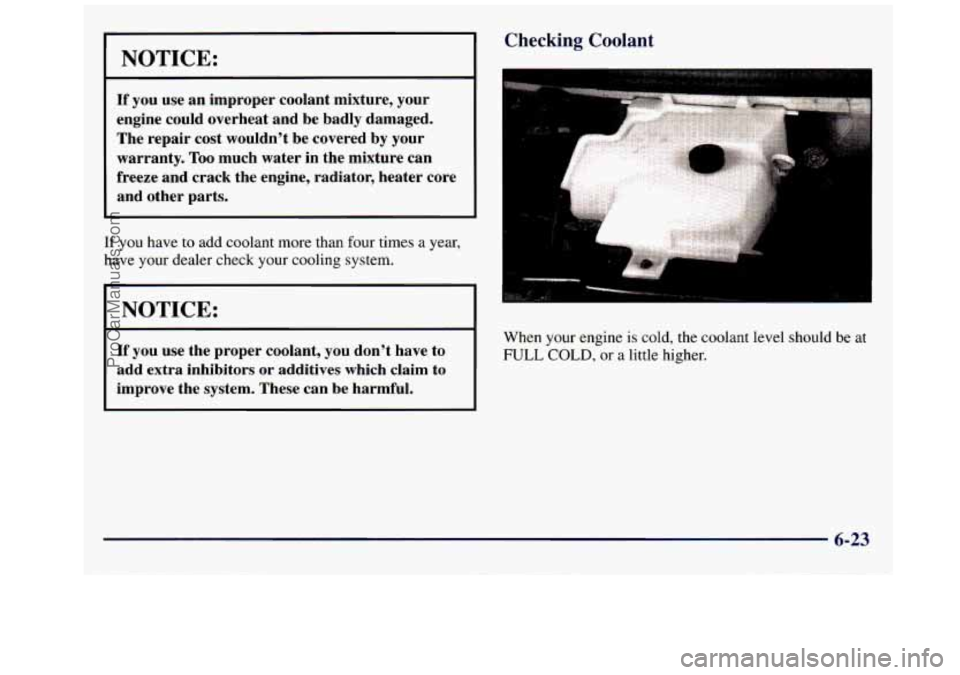
Checking Coolant
When your engine is cold, the coolant level should be at
FULL COLD, or a little higher.
6-23
ProCarManuals.com
Page 264 of 388
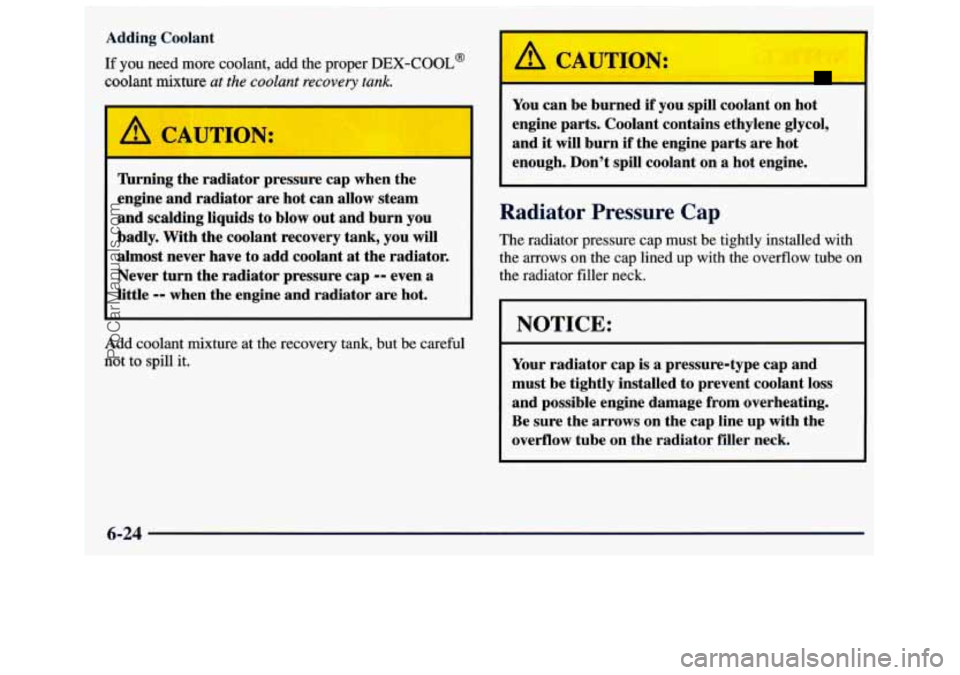
Adding Coolant
If you need more coolant, add the proper DEX-COOL@
coolant mixture at the coolant recovery tank. 1
lbrning me radiator pressure cap when the
engine and radiator are hot can allow steam
and scalding liquids to blow out and burn you
badly. With the coolant recovery tank, you will
almost never have to add coolant at the radiator.
Never turn the radiator pressure cap
-- even a
little
-- when the engine and radiator are hot.
I
e I.
Add coolant mixture at the recovery tank, but be careful
not to spill it.
You can be burned if you spill coolant on hot
engine parts. Coolant contains ethylene glycol,
and
it will burn if the engine parts are hot
enough. Don’t spill coolant on
a hot engine.
Radiator Pressure Cap
The radiator pressure cap must be tightly installed with
the arrows on the cap lined up with the ovefflow tube on
the radiator filler neck.
NOTICE:
Your radiator cap is a pressure-type cap and
must be tightly installed to prevent coolant loss
and possible engine damage from overheating.
Be sure the arrows on the cap line up with the
overflow tube on the radiator filler neck.
6-24
ProCarManuals.com
Page 265 of 388
Thermostat
Engine coolant temperature is controlled by a thermostat
in the engine cooling system. The thermostat stops the
flow
of coolant through the radiator until the coolant
reaches
a preset temperature.
When
you replace your thermostat, an AC@ thermostat
is recommended.
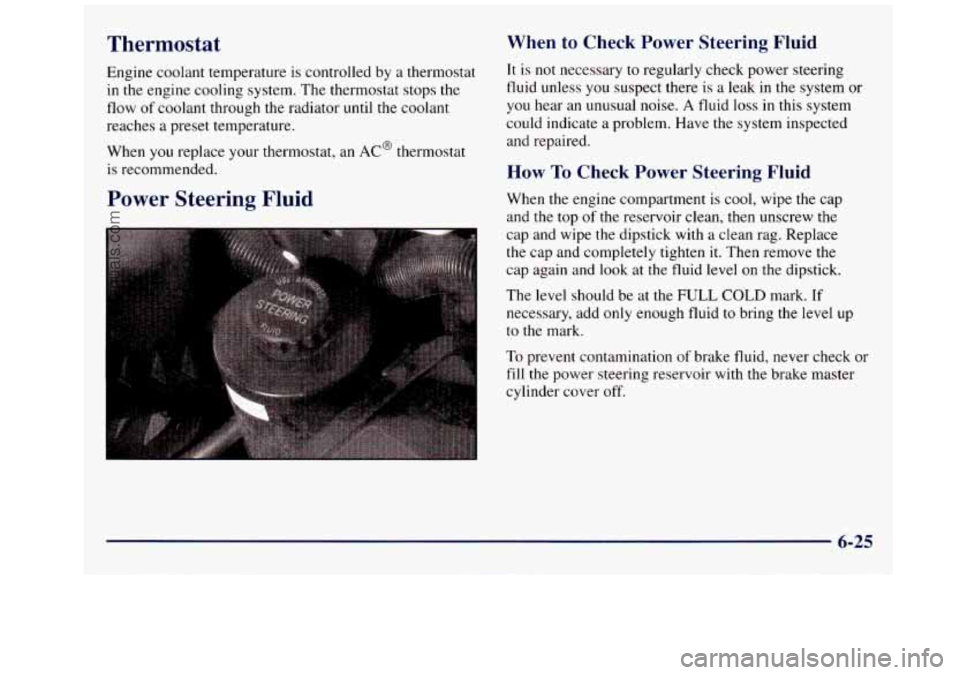
Power Steering Fluid
When to Check Power Steering Fluid
It is not necessary to regularly check power steering
fluid unless you suspect there
is a leak in the system or
you hear an unusual noise. A fluid loss in this system
could indicate
a problem. Have the system inspected
and repaired.
How To Check Power Steering Fluid
When the engine compartment is cool, wipe the cap
and the top
of the reservoir clean, then unscrew the
cap and wipe the dipstick with a clean rag. Replace
the cap and completely tighten it. Then remove the
cap again and look at the fluid level on the dipstick.
The level should be at the
FULL COLD mark. If
necessary, add only enough fluid to bring the level up
to the mark.
To prevent contamination of brake fluid, never check or
fill the power steering reservoir with the brake master
cylinder cover
off.
6-25
ProCarManuals.com
Page 267 of 388
NOTICE:
0
0
0
0
When using concentrated washer fluid,
follow the manufacturer’s instructions for
adding water.
Don’t
mix water with ready-to-use washer
fluid. Water can cause the solution to freeze
and damage your washer fluid tank and
other parts of the washer system. Also,
water doesn’t clean as well
as washer fluid.
Fill your washer fluid tank only
three-quarters full when it’s very cold.
This allows for expansion if freezing occurs,
which could damage the tank
if it is
completely full.
Don’t use engine coolant (antifreeze) in
your windshield washer.
It can damage
your washer system and paint.
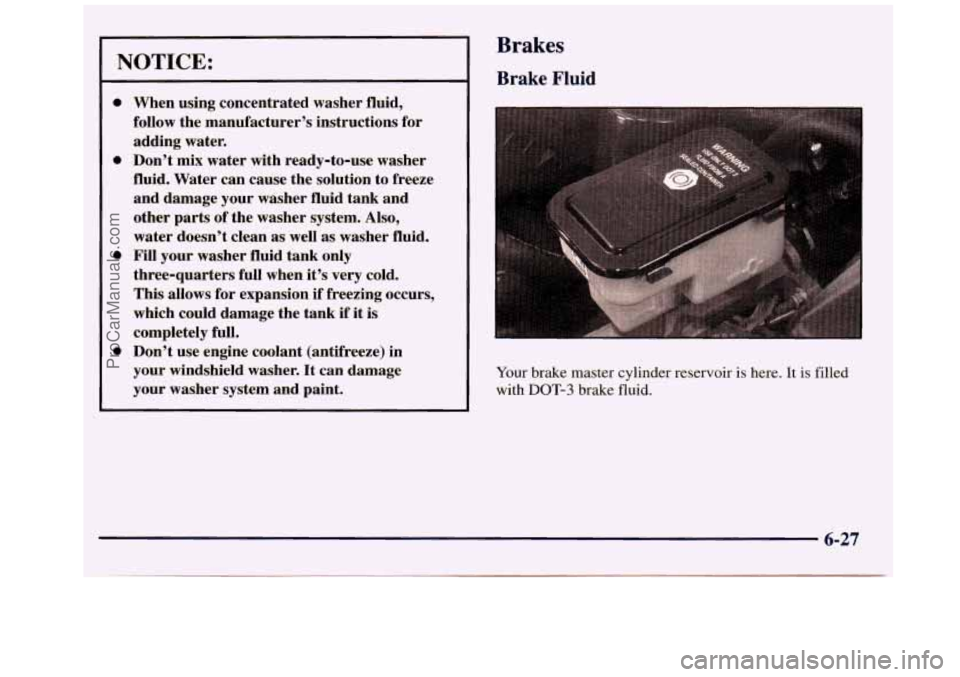
Brakes
Brake Fluid
Your brake master cylinder reservoir is here. It is filled
with DOT-3 brake fluid.
6-27
ProCarManuals.com
Page 303 of 388
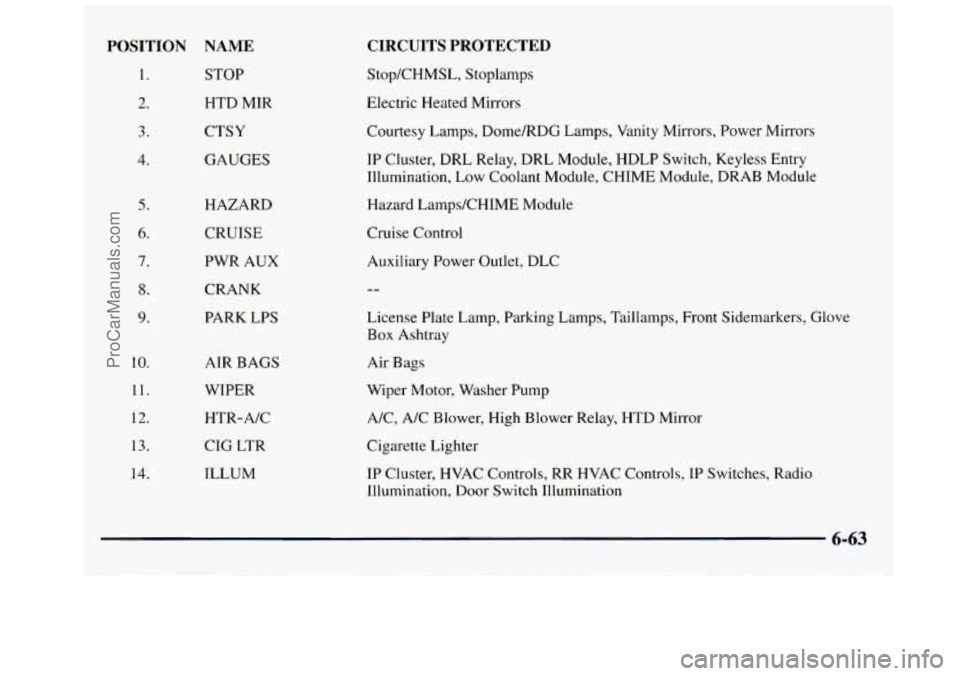
POSITION NAME
1. STOP
2. HTD MIR
3. CTSY
4. GAUGES
5.
6.
7.
8.
9.
10.
11.
12.
13.
14.
HAZARD
CRUISE
PWR AUX
CRANK
PARK LPS
AIR BAGS
WIPER
HTR-A/C
CIG LTR
ILLUM
CIRCUITS PROTECTED
StopKHMSL, Stoplamps
Electric Heated Mirrors
Courtesy Lamps, Dome/RDG Lamps, Vanity Mirrors, Power Mirrors
IP Cluster, DRL Relay, DRL Module, HDLP Switch, Keyless Entry
Illumination, Low Coolant Module, CHIME Module, DRAB Module
Hazard LampdCHIME Module
Cruise Control
Auxiliary Power Outlet, DLC
License Plate Lamp, Parking Lamps, Taillamps, Front Sidemarkers, Glove
Box Ashtray
Air Bags
Wiper Motor, Washer Pump
A/C, A/C Blower, High Blower Relay, HTD Mirror
Cigarette Lighter
IP Cluster, HVAC Controls, RR HVAC Controls, IP Switches, Radio
Illumination, Door Switch Illumination
6-63
ProCarManuals.com
Page 338 of 388
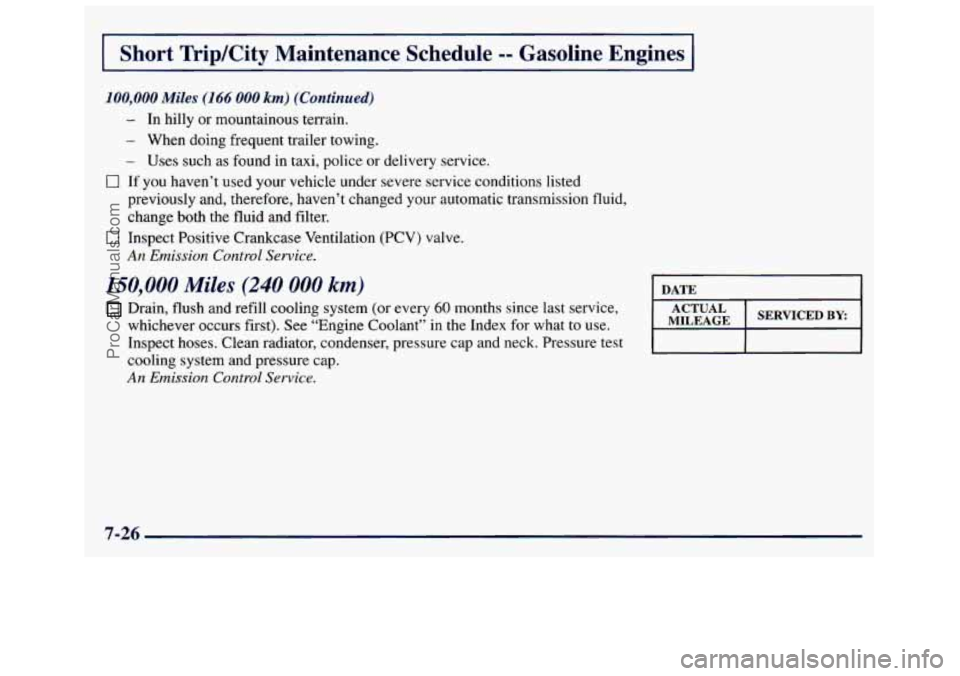
Short TripKity Maintenance Schedule -= Gasoline Engines
100,000 Miles (1 66 000 km) (Continued)
- In hilly or mountainous terrain.
- When doing frequent trailer towing.
- Uses such as found in taxi, police or delivery service.
0 If you haven’t used your vehicle under severe service conditions listed
previously and, therefore, haven’t changed your automatic transmission fluid,
change both the fluid and filter.
An Emission Control Service.
0 Inspect Positive Crankcase Ventilation (PCV) valve.
150,000 Miles (240 000 km)
Drain, flush and refill cooling system (or every 60 months since last service,
Inspect hoses. Clean radiator, condenser, pressure cap and neck. Pressure test
cooling system and pressure cap.
whichever
occurs first). See “Engine Coolant” in the Index for what to use.
MILEAGE
An Emission Control Service.
7-26
ProCarManuals.com
Page 349 of 388
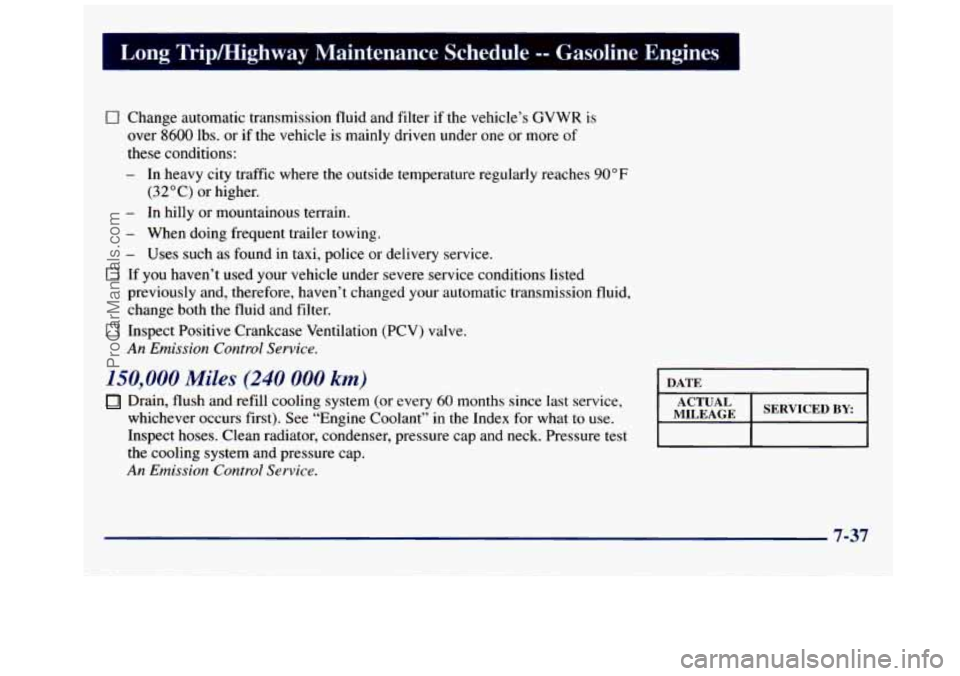
Long TripMighway Maintenance Schedule -I Gasoline Engines I
0 Change automatic transmission fluid and filter if the vehicle’s GVWR is
over
8600 lbs. or if the vehicle is mainly driven under one or more of
these conditions:
- In heavy city traffic where the outside temperature regularly reaches 90°F
- In hilly or mountainous terrain.
- When doing frequent trailer towing.
(32°C) or
higher.
- Uses such as found in taxi, police or delivery service.
previously and, therefore, haven’t changed your automatic transmission fluid,
change both
the fluid and filter.
An Emission Control Service.
0 If you haven’t used your vehicle under severe service conditions listed
0 Inspect Positive Crankcase Ventilation (PCV) valve.
150,000 Miles (240 000 km)
Drain, flush and refill cooling system (or every 60 months since last service,
whichever occurs first). See “Engine Coolant”
in the Index for what to use.
Inspect hoses. Clean radiator, condenser, pressure cap and neck. Pressure test
the cooling system and pressure cap.
An Emission Control Service.
DATE I
7-37
ProCarManuals.com