fuel GMC SAVANA 1998 Owner's Manual
[x] Cancel search | Manufacturer: GMC, Model Year: 1998, Model line: SAVANA, Model: GMC SAVANA 1998Pages: 388, PDF Size: 20.04 MB
Page 247 of 388
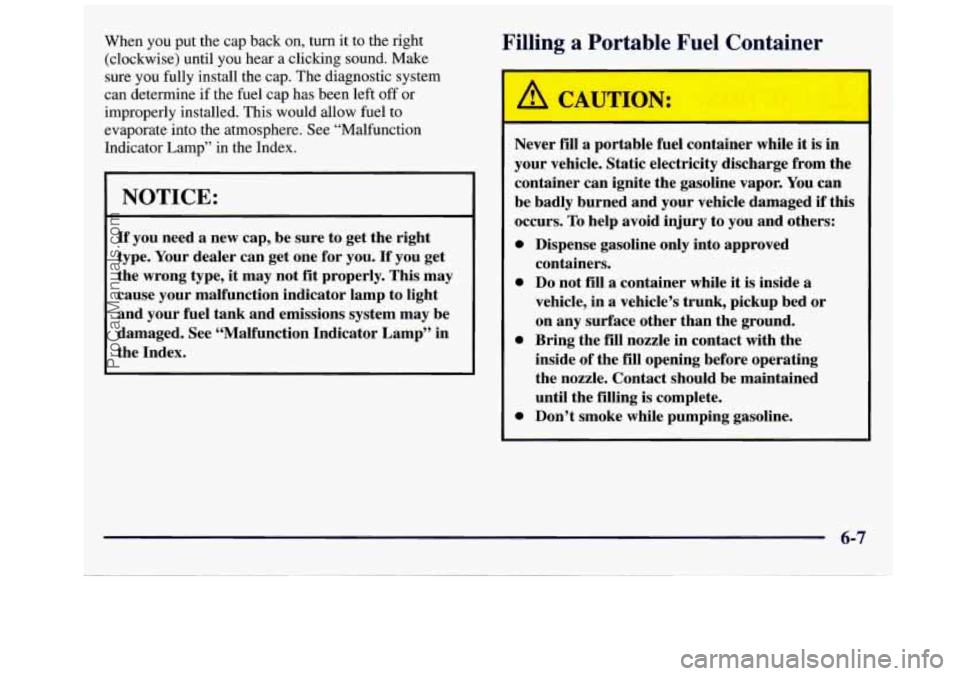
When you put the cap back on, turn it to the right
(clockwise) until you hear a clicking sound. Make
sure you fully install the cap. The diagnostic system
can determine
if the fuel cap has been left off or
improperly installed. This would allow fuel to
evaporate into the atmosphere. See “Malfunction
Indicator Lamp” in the Index.
NOTICE:
If you need a new cap, be sure to get the right
type. Your dealer can get one for you.
If you get
the wrong type, it may not
fit properly. This may
cause your malfunction indicator lamp to light
and your fuel tank and emissions system may be
damaged. See “Malfunction Indicator Lamp” in
the Index.
Filling a Portable Fuel Container
I
Never fill a portable fuel container while it is in
your vehicle. Static electricity discharge from the
container can ignite the gasoline vapor. You can
be badly burned and your vehicle damaged
if this
occurs.
To help avoid injury to you and others:
0 Dispense gasoline only into approved
containers.
0 Do not fill a container while it is inside a
vehicle, in a vehicle’s trunk, pickup bed or
on any surface other than the ground.
inside of the fill opening before operating
the nozzle. Contact should be maintained
until the filling
is complete.
0 Bring the fill nozzle in contact with the
0 Don’t smoke while pumping gasoline.
6-7
ProCarManuals.com
Page 248 of 388
Checking Things Under the Hood
A CAUTION:
If your vehicle has air conditioning, the auxiliary
engine fan under the hood can start up and
injure you even when the engine is not running.
Keep hands, clothing and tools
away from any
underhood electric fan.
A CAUTION:
Things that burn can get on hot engine parts
and start
a fire. These include liquids like
gasoline
or diesel fuel, oil, coolant, brake fluid,
windshield washer and other fluids, and plastic
or rubber. You or others could be burned. Be
careful not to drop or spill things that will burn
onto a hot engine.
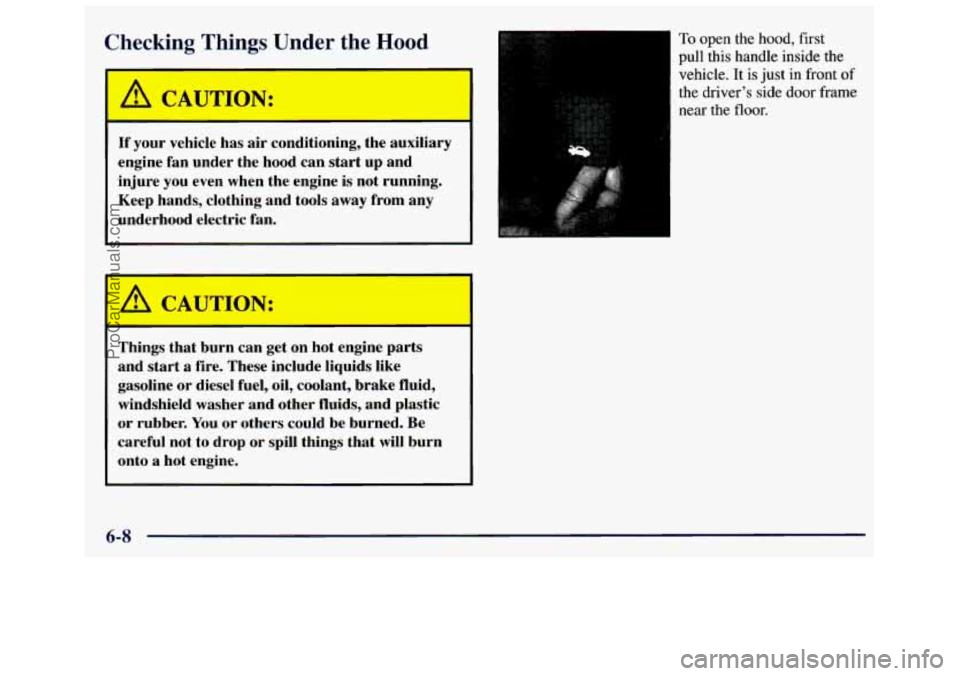
To open the hood, first
pull this handle inside the
vehicle. It is
just in front of
the driver’s side door frame
near the floor.
I
6-8
ProCarManuals.com
Page 252 of 388
Fan and Drive:
Removal of fan clutch (if equipped) or rendering
Removal of the fan shroud (if equipped).
Air Intake:
clutch inoperative.
0 Removal of the air cleaner silencer.
Reversing the air cleaner cover.
Exhaust:
Removal of the muffler and/or resonator.
Removal of the exhaust pipes and exhaust
pipe clamps.
Engine Oil (Gasoline Engine)
If your vehicle has a diesel engine, see “Engine Oil
(Diesel Engine)” in the Diesel Engine Supplement.
It’s a good idea to check your engine oil every time you
get
fuel. In order to get an accurate reading, the oil must
be warm and the vehicle must be on level ground.
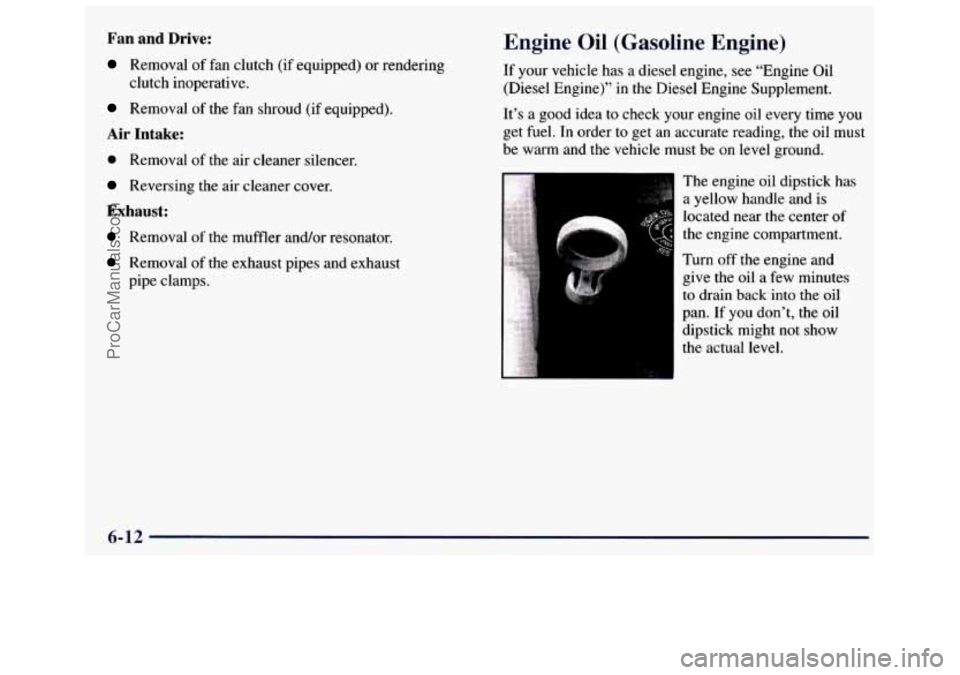
The engine oil dipstick has
a yellow handle and is
located near the center
of
the engine compartment.
Turn
off the engine and
give the oil
a few minutes
to drain back into
the oil
pan. If you don’t, the oil
dipstick might not show
the actual level.
6-12
ProCarManuals.com
Page 254 of 388
Be sure to fill it enough to put the level somewhere in
the proper operating range. Push the dipstick all the way
back
in when you’re through.
What Kind of Engine Oil to Use
Oils recommended for your vehicle can be identified
by looking for the “Starburst” symbol. This symbol
indicates that the oil has been certified by the American
Petroleum Institute (API).
Do not use any oil which
does not carry this Starburst symbol.
If you change your own
oil, be sure
you use oil that
has the Starburst symbol
on the front of the oil
container. If
you have your
oil changed for
you, be sure
the oil put
into your engine
is American Petroleum
Institute certified for
gasoline engines.
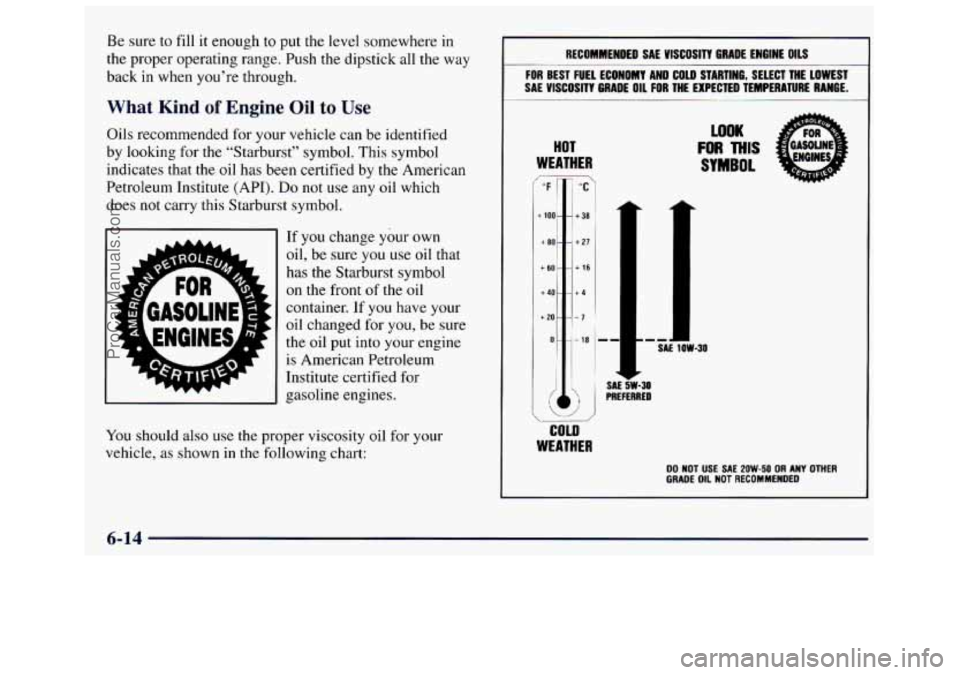
You should also use the proper viscosity oil for your
vehicle, as shown
in the following chart:
RECOMMENDED SAE VISCOSITY GRADE ENGINE OILS
FOR BEST FUEL ECONOMY AND COLD STARTING, SELECT THE LOWEST
SAE VISCOSITY GRADE
011 FOR THE EXPECTED TEMPERATURE RANGE.
HOT
WEATHER
COLD
WEATHER
LOOK
FOR THIS
SYMBOL
00 NOT USE SAE 2OW-50 OR ANY OTHER GRADE OIL NOT RECOMMENDED
6-14
.
ProCarManuals.com
Page 282 of 388
Inflation -- Tire Pressure
The Certificationflire label, which is on the rear edge of
the driver’s door, shows the correct inflation pressures
for your tires when they’re cold.
“Cold” means your
vehicle has been sitting for at least three hours or driven
no more than
1 mile (1.6 km).
NOTICE:
Don’t let anyone tell you that underinflation or
overinflation is all right. It’s not. If your tires
don’t
hav.2 enough air (underinflation), you can
get the following:
Too much flexing
Too much heat
Tire overloading
0 Bad wear
Bad handling
Bad fuel economy.
NOTICE: (Continued)
NOTICE: (Continued)
If your tires have too much air (overinflation),
you can get the following:
Unusual wear
Bad handling
Rough ride
Needless damage from road hazards.
Check your tires once
a month or more. Also, check the
tire pressure
of the spare tire.
6-42
ProCarManuals.com
Page 298 of 388
Underbody Maintenance
Chemicals used for ice and snow removal and dust
control can collect
on the underbody. If these are not
removed, accelerated corrosion (rust) can occur on
the underbody parts such as fuel lines, frame, floor
pan and exhaust system even though they have
corrosion protection.
At least every spring, flush these materials from
the
underbody with plain water. Clean any areas where mud
and other debris can collect. Dirt packed in closed areas
of the frame should be loosened before being flushed.
Your dealer or an underbody car washing system can
do
this for you.
Chemical Paint Spotting
Some weather and atmospheric conditions can create
a chemical fallout. Airborne pollutants can fall upon
and attack painted surfaces on your vehicle. This
damage can take two forms: blotchy, ringlet-shaped
discolorations, and small irregular dark spots etched
into the paint surface.
Although no defect in the paint job causes this,
GM
will repair, at no charge to the owner, the surfaces of
new vehicles damaged by this fallout condition within
12 months or 12,000 miles (20 000 km) of purchase,
whichever occurs first.
This applies only
to materials manufactured and sold by
General Motors. Bodies, body conversions or equipment
not made or sold by General Motors
are not covered.
6-58
ProCarManuals.com
Page 305 of 388
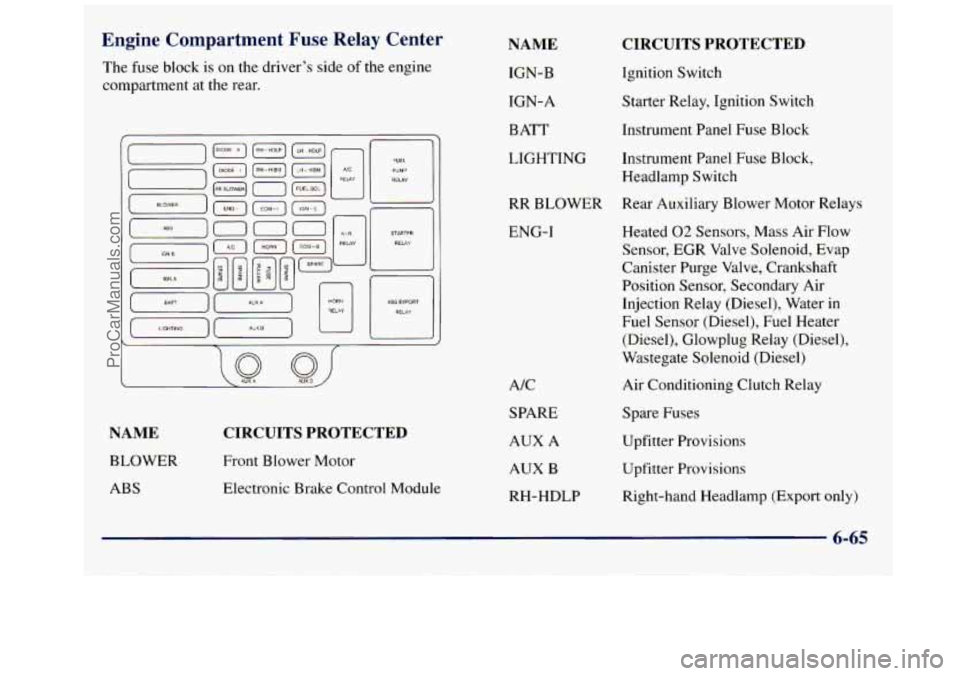
Engine Compartment Fuse Relay Center
The fuse block is on the driver’s side of the engine
compartment at the rear.
NAME
BLOWER
ABS
CIRCUITS PROTECTED
Front Blower Motor
Electronic Brake Control Module
NAME
IGN-B
IGN-A
BATT
LIGHTING
CIRCUITS PROTECTED
Ignition Switch
Starter Relay, Ignition Switch
Instrument Panel Fuse Block
Instrument Panel Fuse Block,
Headlamp Switch
RR BLOWER Rear Auxiliary Blower Motor Relays
ENG-I
AIC
SPARE
AUX A
AUX B
RH-HDLP
Heated 02 Sensors, Mass Air Flow
Sensor, EGR Valve Solenoid, Evap
Canister Purge Valve, Crankshaft
Position Sensor, Secondary Air
Injection Relay (Diesel), Water in
Fuel Sensor (Diesel), Fuel Heater
(Diesel), Glowplug Relay (Diesel),
Wastegate Solenoid (Diesel)
Air Conditioning Clutch Relay
Spare Fuses
Upfitter Provisions
Upfitter Provisions Right-hand Headlamp (Export only)
6-65
ProCarManuals.com
Page 306 of 388
NAME
RH-HIBM
ECM-I
HORN
LH-HDLP
LH-HIBM
FUEL SOL
IGN-E
ECM-B
CIRCUITS PROTECTED
Right-hand High-beam Headlamp
(Export only)
Ignition Coil, Camshaft Position
Sensor,
VCM, Fuel Injectors, Coil
Driver
Horn Relay, Underhood Lamp( s)
Left-hand Headlamp (Export
only)
Left-hand High-beam Headlamp
(Export only)
PCM,
Fuel Solenoid Driver, Engine
Shutoff Solenoid
Air Conditioning Clutch Relay
Fuel Pump Relay, VCM, PCM, Fuel
Pump and Engine Oil Pressure
Switch
Replacement Bulbs
LAMP OR BULB
Sealed Beam Headlamps
Composite Low-Beam
Headlamps
Composite High-Beam
Headlamps
Front Sidemarker Lamp
Front Parking and Turn Lamp
Rear Parking Lamp
Rear Stop and Turn Lamp
Back- up Lamp
Back-up Lamp
Rear Parking, Stop, and
Turn Lamp
CHMSL
License Plate Lamp
Underhood Lamp
Reel Lamp
Reading Lamps
Sunshade Vanity Mirror
QTY NUMBER
2 H6054
2 6052
2
2
4
2
1
1
1
6
4
9005
194
2357NA
3057
3057
3156
1156 1157
92
1
194
232
232
211-2
74
6-66
ProCarManuals.com
Page 307 of 388
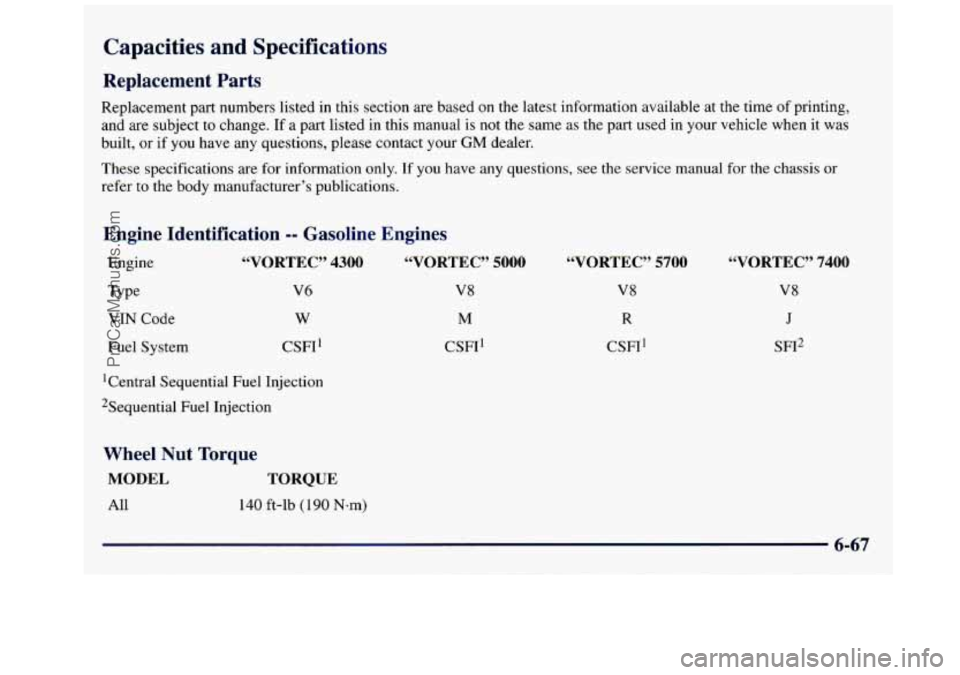
Capacities and Specifications
Replacement Parts
Replacement part numbers listed in this section are based on the latest information available at the time of printing,
and are subject to change. If a part listed in this manual
is not the same as the part used in your vehicle when it was
built, or if you have any questions, please contact your
GM dealer.
These specifications are for information only.
If you have any questions, see the service manual for the chassis or
refer to the body manufacturer’s publications.
Engine Identification -- Gasoline Engines
Engine “VORTEC” 4300 “VORTEC” 5000
Type V6 V8
VIN Code w M
Fuel System CSFI~ CSFI~
*Central Sequential Fuel Injection
2Sequential
Fuel Injection
“VORTEC” 5700
V8
R
CSFI~
“VORTEC” 7400
V8
J
SFI~
Wheel Nut Torque
MODEL TORQUE
All 140 ft-lb (190 N-m)
ProCarManuals.com
Page 309 of 388
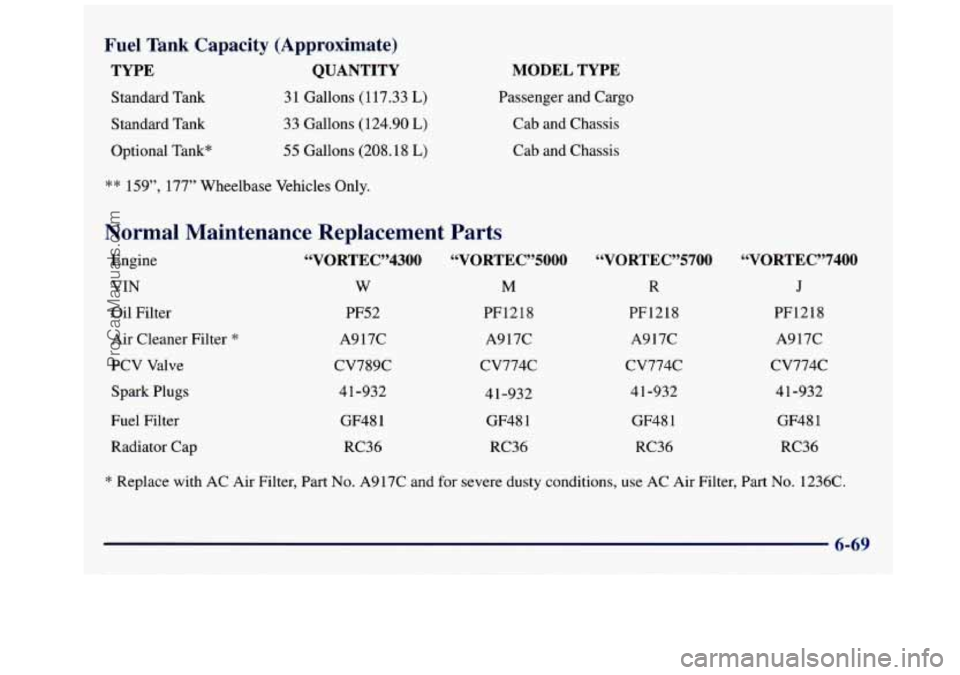
Fuel Tank Capacity (Approximate)
TYPE QUANTITY
Standard Tank 3 1 Gallons (117.33 L)
Standard Tank 33 Gallons (124.90 L)
Optional Tank* 55 Gallons (208.18 L)
** 159”, 177” Wheelbase Vehicles Only.
MODEL TYPE
Passenger and Cargo
Cab and Chassis
Cab and Chassis
Normal Maintenance Replacement Parts
Engine “VORTEC”4300 “VORTEC”5000
VIN W M
Oil Filter PF52 PF1218
Air Cleaner Filter
* A917C A917C
PCV Valve CV789C cv774c
Spark Plugs 41-932 4 1-932
Fuel Filter GF48 1 GF48 1
Radiator Cap
RC36 RC36
“VORTEC”5700
R
PF1218
A917C
cv774c 4 1-932
GF48 1
RC36
“VORTEC”7400
J
PF1218 A917C
cv774c 4 1-932
GF48
1
RC36
* Replace with AC Air Filter, Part No. A917C and for severe dusty conditions, use AC Air Filter, Part No. 1236C.
6-69
ProCarManuals.com