key GMC SAVANA 1998 Owner's Manual
[x] Cancel search | Manufacturer: GMC, Model Year: 1998, Model line: SAVANA, Model: GMC SAVANA 1998Pages: 388, PDF Size: 20.04 MB
Page 125 of 388
Electronic Road-Speed Governor
(Gasoline Engines) (Option)
This optional system automatically controls vehicle top
speed. The system controller receives
a signal from the
vehicle speed sensor and reduces power when the
vehicle speed reaches the maximum
65 mph (105 kdh)
governed speed.
Warning Lights, Gages
and Indicators
This part describes the warning lights and gages that
may be on your vehicle. The pictures will help you
locate them.
Warning lights and gages can signal that something is
wrong before it becomes serious enough to cause an
expensive repair or replacement. Paying attention to
your warning lights and gages could also save you or
others from injury.
Warning lights come on when there may be or is a
problem with one of your vehicle’s functions. As you
will see in the details
on the next few pages, some
warning lights come
on briefly when you start the
engine just to let you know they’re working.
If you are
familiar
with this section, you should not be alarmed
when this happens. Gages
can indicate when there may be or is
a problem
with one of your vehicle’s functions. Often gages and
warning lights work together to let you know when
there’s
a problem with your vehicle.
When one of the warning lights comes on and
stays on
when you are driving, or when one of the gages shows
there may be a problem, check the section that tells you
what to do about it. Please follow this manual’s advice.
Waiting to do repairs can be costly
-- and even
dangerous.
So please get to know your warning lights
and gages. They’re
a big help.
Safety Belt Reminder Light
When the key is turned to RUN or START, a tone will
come on for about eight seconds to remind people to
fasten their safety belts, unless the driver’s safety belt is
already buckled.
The safety belt light will
also come on and stay on
for about
20 seconds, then it
will flash for about
5 5 seconds.
If the driver’s belt is already buckled, neither the tone
nor the light will come on.
2-53
ProCarManuals.com
Page 126 of 388
Air Bag Readiness Light
There is an air bag readiness light on the instrument
panel, which shows AIR
BAG. The system checks the
air bag’s electrical system for malfunctions. The light
tells you if there
is an electrical problem. The system
check includes the air bag sensor, the air bag modules,
the wiring and the crash sensing and diagnostic module.
For more information
on the air bag system, see “Air
Bag” in the Index.
AIR
This light will come on
when you start your engine,
and it will flash for a few
seconds. Then the light should go
out. This means
the system
is ready.
If the air bag readiness light stays on after you start the
engine or comes on when you are driving, your air bag
system may not work properly. Have your vehicle
serviced right away. The
air bag readiness light should flash for a few
seconds when
you turn the ignition key to RUN. If the
light doesn’t come
on then, have it fixed so it will be
ready
to warn you if there is a problem.
Charging System Light
(CJ
This light should come on
briefly when you turn on the
ignition, before starting the
engine, as a check to show
you it is working.
After the engine starts, the light should
go out. If it stays
on or comes on while you are driving, you may have a
problem with your charging system. It could indicate a
problem with the alternator drive belt, or some other
charging system problem. Have
it checked right away.
Driving while this light is on could drain your battery.
If you must drive a short distance with this light
on, it
helps
to turn off all your accessories, such as the radio
and air conditioner.
2-54
ProCarManuals.com
Page 128 of 388
Brake System Warning Light
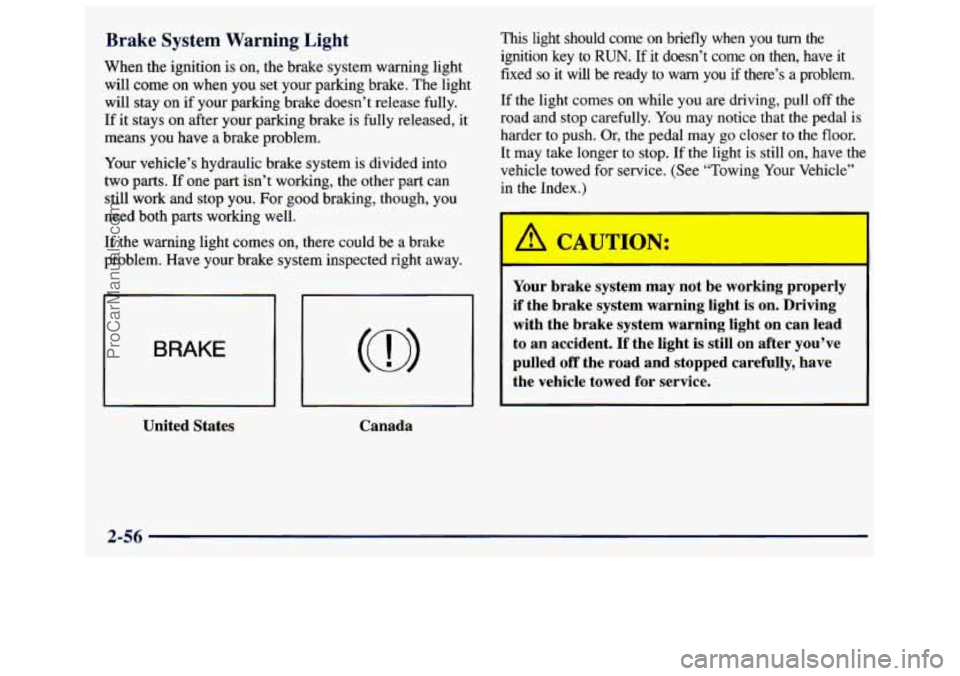
When the ignition is on, the brake system warning light
will
come on when you set your parking brake. The light
will stay on if your parking brake doesn’t release fully.
If it stays on after your parking brake is fully released, it
means you have a brake problem.
Your vehicle’s hydraulic brake system
is divided into
two
parts. If one part isn’t working, the other part can
still work and stop you. For good braking, though,
you
need both parts working well.
If the warning light comes on, there could be
a brake
problem. Have your brake system inspected right away.
BRAKE
United States
Canada
This light should come on briefly when you turn the
ignition key to RUN. If it doesn’t come on then, have it
fixed
so it will be ready to warn you if there’s a problem.
If the light comes on while you are driving, pull off the
road and stop carefully.
You may notice that the pedal is
harder to push. Or, the pedal may
go closer to the floor.
It may take longer to stop. If the light is still on, have the
vehicle towed for service. (See “Towing Your Vehicle’’
in the Index.)
A CAUTION:
Your brake system may not be working properly
if the brake system warning light is on. Driving
with the brake system warning light on can lead
to an accident.
If the light is still on after you’ve
pulled
off the road and stopped carefully, have
the vehicle towed for service.
2-56
ProCarManuals.com
Page 129 of 388
Anti-Lock Brake System Warning Light
ANTI -
LOCK
United States Canada
With
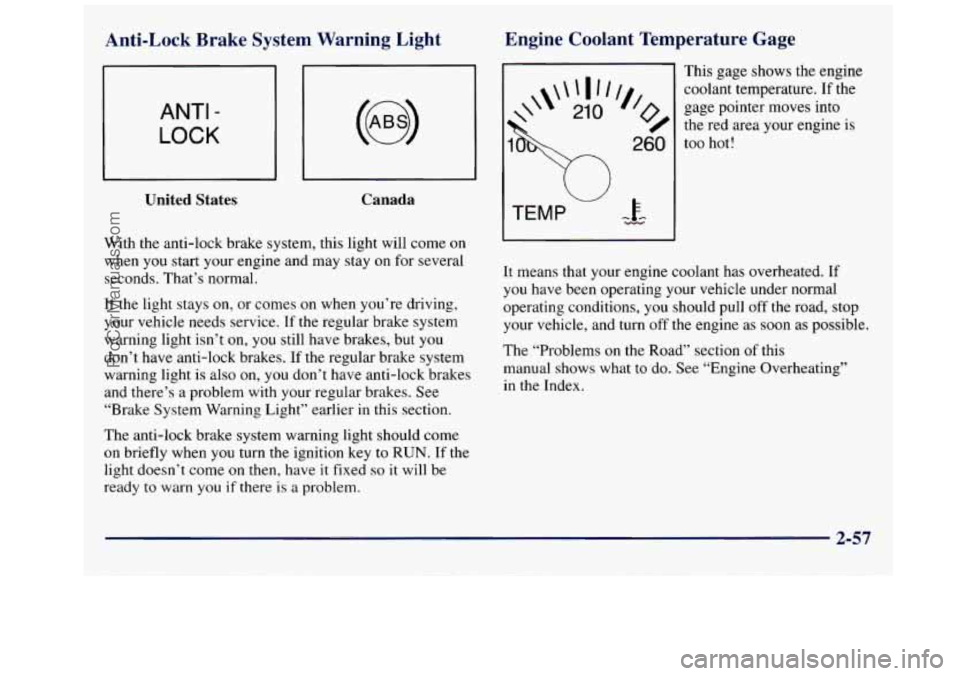
the anti-lock brake system, this light will come on
when you start your engine and may stay on for several
seconds. That’s normal.
If the light stays on, or comes
on when you’re driving,
your vehicle needs service. If the regular brake system
warning light isn’t
on, you still have brakes, but you
don’t have anti-lock brakes. If the regular brake system
warning light is also
on, you don’t have anti-lock brakes
and there’s a problem with your regular brakes. See
“Brake System Warning Light” earlier in this section.
The anti-lock brake system warning light should come
on briefly when
you turn the ignition key to RUN. If the
light doesn’t come on then, have it fixed
so it will be
ready
to warn you if there is a problem.
Engine Coolant Temperature Gage
This gage shows the engine
gage pointer moves into
the red area your engine is
coolant temperature.
If the
260 too
hot!
It means that your engine coolant has overheated.
If
you have been operating your vehicle under normal
operating conditions,
you should pull off the road, stop
your vehicle, and turn off the engine as soon as possible.
The “Problems on the Road’’ section of this
manual shows what
to do. See “Engine Overheating”
in the Index.
2-57
ProCarManuals.com
Page 131 of 388
If the Light Is Flashing If the Light Is On Steady
The following may prevent more serious damage to
your vehicle:
Reducing vehicle speed.
Avoiding hard accelerations.
Avoiding steep uphill grades.
If you are towing a trailer, reduce the amount of
cargo being hauled as soon as it is possible.
If the light stops flashing and remains on steady, see “If
the Light Is On Steady” following.
If the light continues
to flash, when it is safe to do so,
stop the vehicle. Find a safe place to park your vehicle.
Turn the key
off, wait at least 10 seconds and restart the
engine. If
the light remains on steady, see “If the Light
Is On Steady” following. If the light is still flashing,
follow the previous steps, and drive the vehicle to your
dealer or qualified service center for service. You
may be able to correct the emission system
malfunction by considering the following:
Did you recently put fuel into your vehicle?
If
so, reinstall the fuel cap, making sure to fully install
the cap. The diagnostic system can determine if
the fuel
cap has been left off or improperly installed.
A loose or
missing fuel cap will allow fuel to evaporate into the
atmosphere.
A few driving trips with the cap properly
installed should turn the light off.
Did you just drive through a deep puddle of water?
If
so, your electrical system may be wet. The condition
will usually be corrected when the electrical system
dries
out. A few driving trips should turn the light off.
Are you low
on fuel?
As your engine starts to run out of fuel, your engine may
not run as efficiently as designed since small amounts
of
air are sucked into the fuel line causing a misfire. The
system can detect this. Adding fuel should correct
this
condition. Make sure to install the fuel cap properly. It
will take a few driving trips
to turn the light off.
2-59
ProCarManuals.com
Page 133 of 388
-
UTION:
-
Don’t keep driving if the oil pressure is low. If
you do, your engine can become so hot that it
catches fire. You
or others could be burned.
Check your oil
as soon as possible and have your
vehicle serviced.
[ NOTICE:
I I
Damage to your engine from neglected oil
problems can be costly and is not covered by
your warranty.
Security Light
SECURITY
This light will come on
briefly when you turn the ignition key
to START.
The light will stay
on until the engine starts. If the light
flashes, the Passlock@System has entered a tamper
mode. If the vehicle fails to start,
see “Passlock” in
the Index.
If the light comes on continuously while driving and
stays
on, there may be a problem with the Passlock
System. Your vehicle will
not be protected by Passlock,
and
you should see your GM dealer.
2-61
ProCarManuals.com
Page 167 of 388
Drunken Driving
Death and injury associated with drinking and driving is
a national tragedy. It’s the number
one contributor to
the highway death toll, claiming thousands of victims
every year.
Alcohol affects four things that anyone needs
to drive
a vehicle:
0 Judgment
0 Muscular Coordination
0 Vision
0 Attentiveness.
Police records show that almost half
of all motor
vehicle-related deaths involve alcohol. In most cases,
these deaths are the result of someone who was drinking
and driving. In recent years, over
17,000 annual motor
vehicle-related deaths have
been associated with the use
of alcohol, with more than
300,000 people injured.
Many adults
-- by some estimates, nearly half the adult
population
-- choose never to drink alcohol, so they
never drive after drinking. For persons under
2 1, it’s
against the law in every
U.S. state to drink alcohol.
There are good medical, psychological and
developmental reasons for these laws. The
obvious way to solve this highway safety problem
is for people never
to drink alcohol and then drive. But
what if people do? How much is
“too much” if the
driver plans to drive? It’s a lot less than many might
think. Although it depends on each person and situation,
here
is some general information on the problem.
The Blood Alcohol Concentration (BAC) of someone
who is drinking depends upon four things:
The amount of alcohol consumed
0 The drinker’s body weight
0 The amount of food that is consumed before and
during drinking
consume the alcohol.
The length of time it has taken the drinker to
According to the American Medical Association, a
180-lb. (82 kg) person who drinks three
‘i 2-ounce
(355 ml) bottles
of beer in an hour will end up with a
BAC of about 0.06 percent. The person would reach the
same BAC by drinking three 4-ounce (120 ml) glasses
of wine or three mixed drinks if each had
1 - 1/2 ounces
(45 ml) of a liquor like whiskey, gin
or vodka.
4-3
ProCarManuals.com
Page 204 of 388
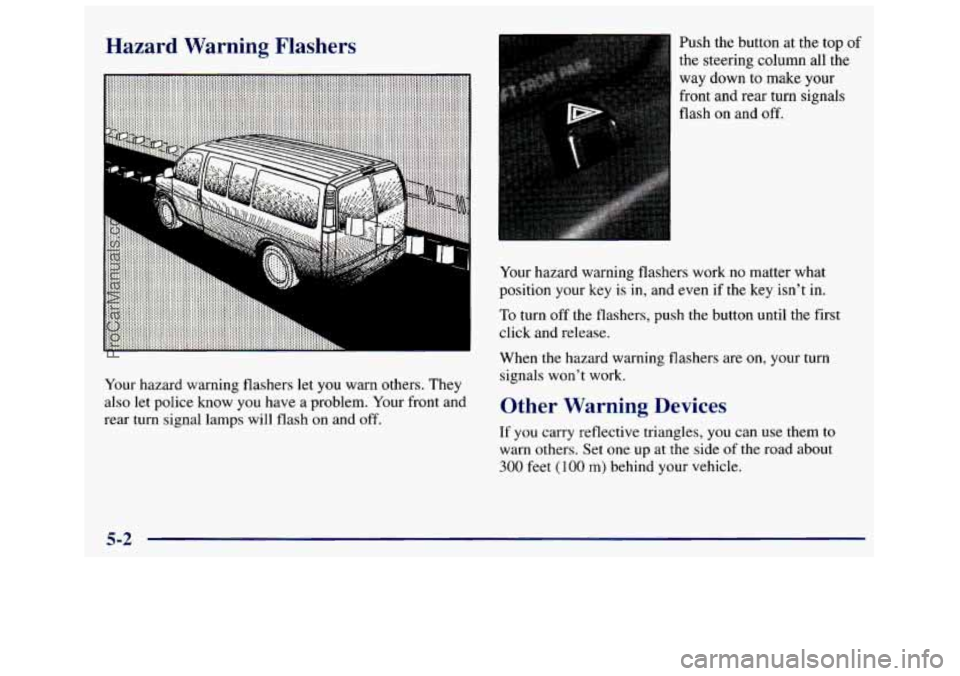
Hazard Warning Flashers
Your hazard warning flashers let you warn others. They
also let police know you have
a problem. Your front and
rear turn signal lamps will flash on and
off.
Push the button at the top of
the steering column all the
way down to
make your
front and rear turn signals
flash on and off.
Your hazard warning flashers work
no matter what
position your key
is in, and even if the key isn’t in.
To turn off the flashers, push the button until the first
click and release.
When the hazard warning flashers are on, your turn
signals won’t work.
Other Warning Devices
If you carry reflective triangles, you can use them to
warn others. Set one up at the side of the road about
300 feet (100 m) behind your vehicle.
5-2
ProCarManuals.com
Page 211 of 388
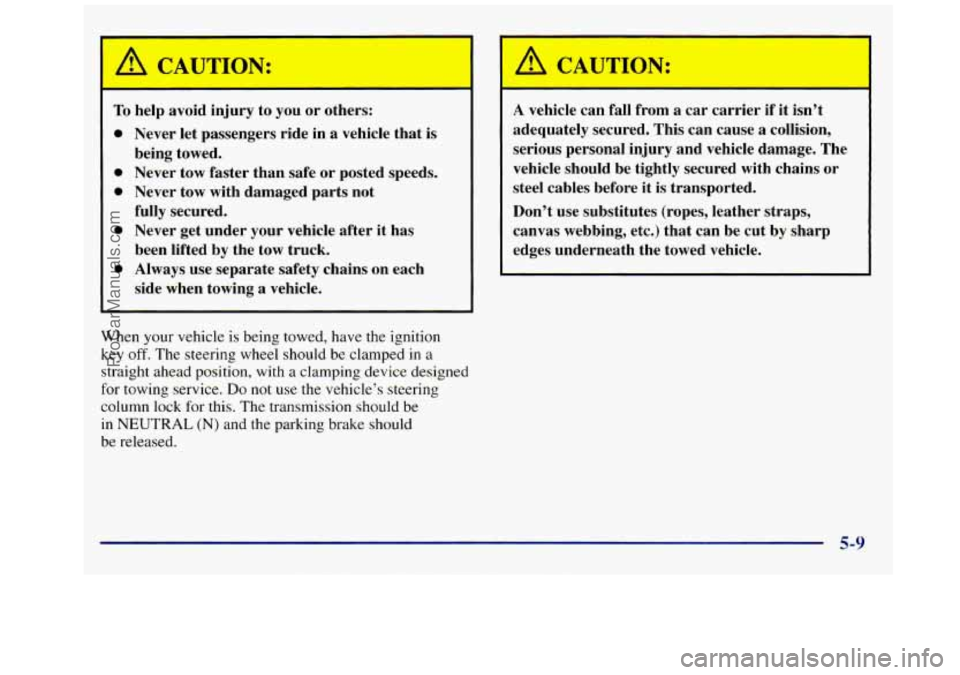
A I
I /! CAUTION:
To
0
0
0
0 0
help avoid injury
to you or others:
Never let passengers ride in a vehicle that is
being towed.
Never tow faster than safe or posted speeds.
Never tow with damaged parts not
fully secured. Never get under your vehicle after it has
been lifted by the tow truck.
Always use separate safety chains on each
side when towing a vehicle.
When your vehicle is being towed, have the ignition
key off. The steering wheel should be clamped in a
straight ahead position, with a clamping device designed
for towing service.
Do not use the vehicle’s steering
column lock for this. The transmission should be
in NEUTRAL (N) and the parking brake should
be released.
A CAUTION:
A vehicle can fall from a car carrier if it isn’t
adequately secured. This can cause a collision,
serious personal injury and vehicle damage. The
vehicle should be tightly secured with chains or
steel cables before it is transported.
Don’t use substitutes (ropes, leather straps,
canvas webbing, etc.) that can be cut by sharp
edges underneath the towed vehicle.
5-9
ProCarManuals.com
Page 303 of 388
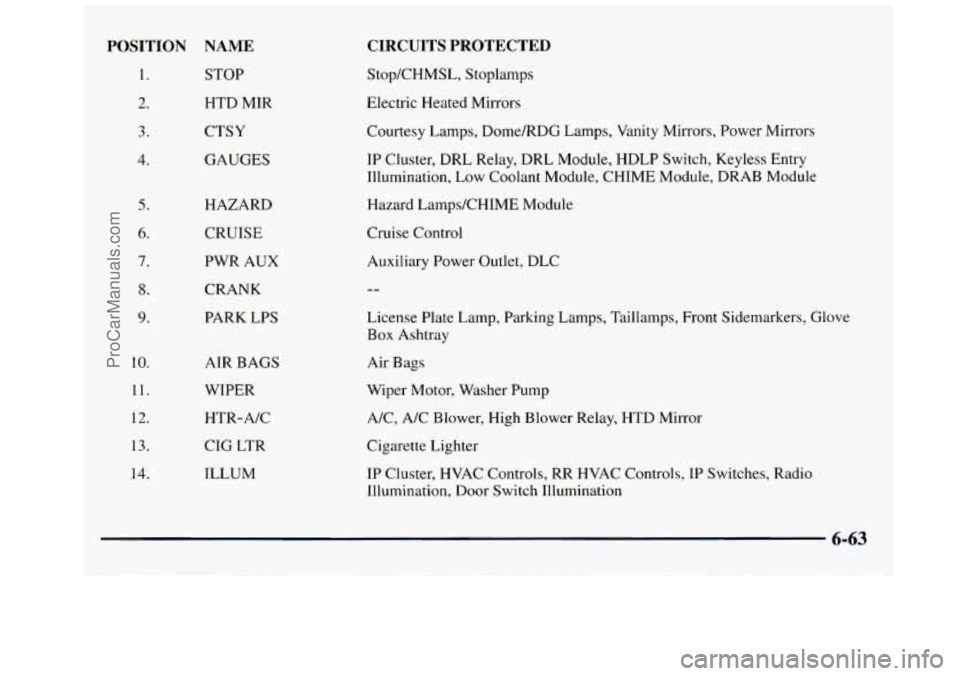
POSITION NAME
1. STOP
2. HTD MIR
3. CTSY
4. GAUGES
5.
6.
7.
8.
9.
10.
11.
12.
13.
14.
HAZARD
CRUISE
PWR AUX
CRANK
PARK LPS
AIR BAGS
WIPER
HTR-A/C
CIG LTR
ILLUM
CIRCUITS PROTECTED
StopKHMSL, Stoplamps
Electric Heated Mirrors
Courtesy Lamps, Dome/RDG Lamps, Vanity Mirrors, Power Mirrors
IP Cluster, DRL Relay, DRL Module, HDLP Switch, Keyless Entry
Illumination, Low Coolant Module, CHIME Module, DRAB Module
Hazard LampdCHIME Module
Cruise Control
Auxiliary Power Outlet, DLC
License Plate Lamp, Parking Lamps, Taillamps, Front Sidemarkers, Glove
Box Ashtray
Air Bags
Wiper Motor, Washer Pump
A/C, A/C Blower, High Blower Relay, HTD Mirror
Cigarette Lighter
IP Cluster, HVAC Controls, RR HVAC Controls, IP Switches, Radio
Illumination, Door Switch Illumination
6-63
ProCarManuals.com