fuse GMC SAVANA 1998 Owners Manual
[x] Cancel search | Manufacturer: GMC, Model Year: 1998, Model line: SAVANA, Model: GMC SAVANA 1998Pages: 388, PDF Size: 20.04 MB
Page 7 of 388
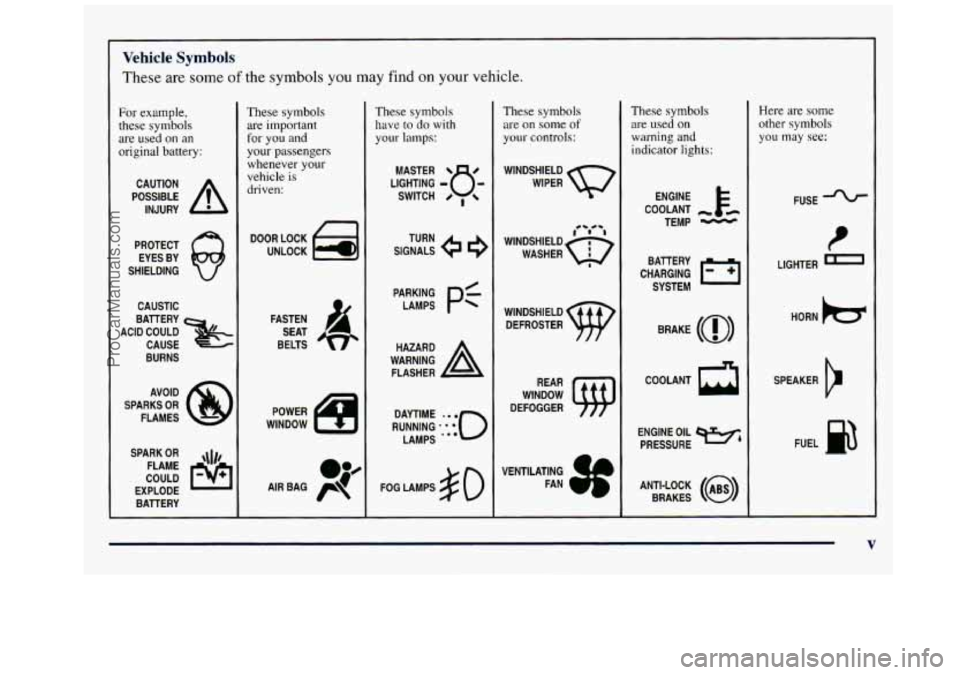
Vehicle Symbols
These are some of the symbols you may find on your vehicle.
For example,
these symbols
are used on
an
original battery:
POSSIBLE A
CAUTION
INJURY
PROTECT EYES BY
SHIELDING
CAUSTIC
BAlTERY
CAUSE
BURNS
ACID COULD
&
AVOID
SPARKS
OR
FLAMES
SPARK
OR ,\I/,
COULD FLAME
EXPLODE BATTERY
These symbols are important
for you and
your passengers whenever your
vehicle is
driven:
DOOR LOCK
UNLOCK
FASTEN SEAT
BELTS
These symbols have
to do with
your lamps:
SIGNALS e e
TURN
FOG LAMPS
$0
These symbols
are on some
of
your controls:
WINDSHIELD
WIPER
WINDSHIELD DEFROSTER
WINDOW
DEFOGGER
VENTILATING FAN
These symbols are used
on
warning and
indicator
lights:
COOLANT -
TEMP -
CHARGING l=l
BATTERY
SYSTEM
BRAKE
(0)
COOLANT a
ENGINE OIL e,
PRESSURE
ANTI-LOCK
(@)
BRAKES
Here are some
other symbols
you may
see:
FUSE -%-
P
LIGHTER m
HORN )cr
SPEAKER
b
FUEL p3
V
ProCarManuals.com
Page 10 of 388
Seats and Seat Controls
This part tells you about the seats -- now to adjust them,
take them out and put them back
in. It also tells you
about reclining front seatbacks.
Manual Front Seats
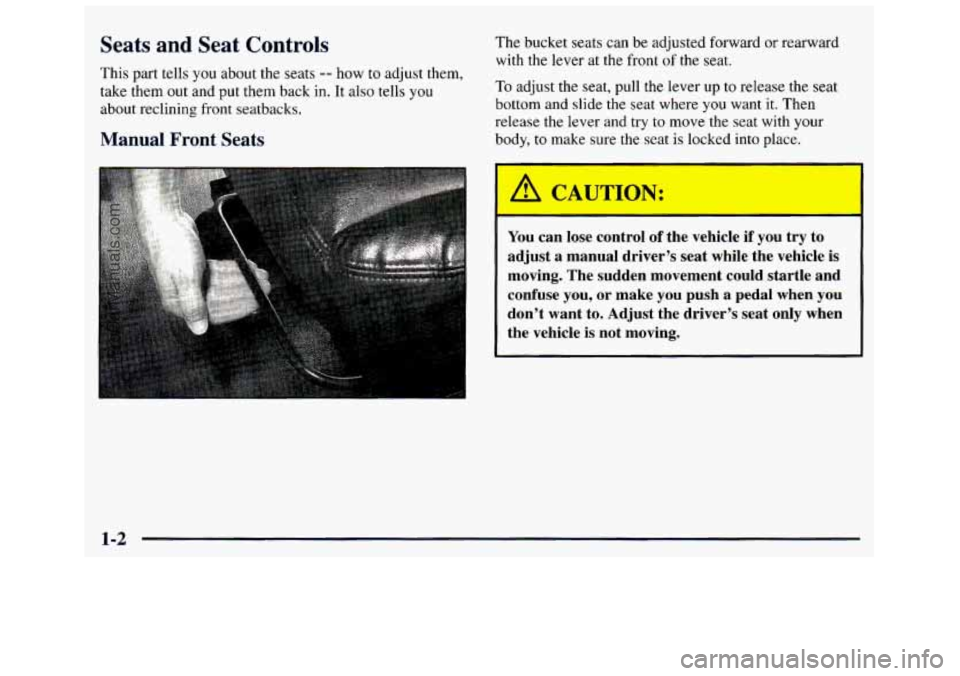
The bucket seats can be adjusted forward or rearward
with the lever at
the front of the seat.
To adjust the seat, pull the lever up to release the seat
bottom and slide the seat where you want
it. Then
release the lever and try to move the seat with your
body,
to make sure the seat is locked into place.
I-- -
[ON:
You can lose control of the vehicle if you try to
adjust a manual driver’s seat while the vehicle is
moving. The sudden movement could startle and confuse you, or make
you push a pedal when you
don’t want to. Adjust the driver’s seat only when
the vehicle
is not moving.
1-2
ProCarManuals.com
Page 88 of 388
Parking Lots
If you park in a lot where someone will be watching
your vehicle, it’s best to lock it up and take your keys.
But what if
you have to leave your ignition key? What if
you have to leave something valuable in your vehicle?
Put your valuables in a storage area, like your front
storage compartment.
Lock all the doors excePt the driver’s.
Passlock’
Your vehicle is equipped with the Passlock
theft-deterrent system.
Passlock is a passive theft-deterrent system. The system
is armed once the key is removed from the ignition.
Passlock enables fuel if the ignition lock cylinder is
turned with a valid key.
If a correct key is not used,
fuel is disabled. During
normal operation, the SECURITY light will go
off after the engine is started.
If the engine stalls and the SECURITY light flashes,
wait until the light stops flashing before trying to restart
the engine. Remember to release the key from the
START position as soon
as the engine starts.
If you are driving and the SECURITY light comes on, you
will be able
to restart the engine if you turn the engine off.
However, your Passlock system is not working properly
and must
be serviced by your dealer. Your vehicle is not
protected by Passlock at
this time. You may also want to
check the
fuse (see “Fuses and Circuit Breakers” in the
Index). See your dealer for service.
If the SECURITY light comes on while
the engine is
running, a problem has been detected and the system
may need service. See your dealer for service.
In an emergency, call the
GM Roadside Assistance
Center. See “Roadside Assistance” in the Index.
2-16
ProCarManuals.com
Page 107 of 388
Turn Signal and Lane Change Signals
The turn signal has two upward (for right) and two
downward (for left) positions. These positions allow
you to signal a turn or a lane change.
To signal a turn, move the lever all the way up
or down. When the turn is finished, the lever
will return automatically.
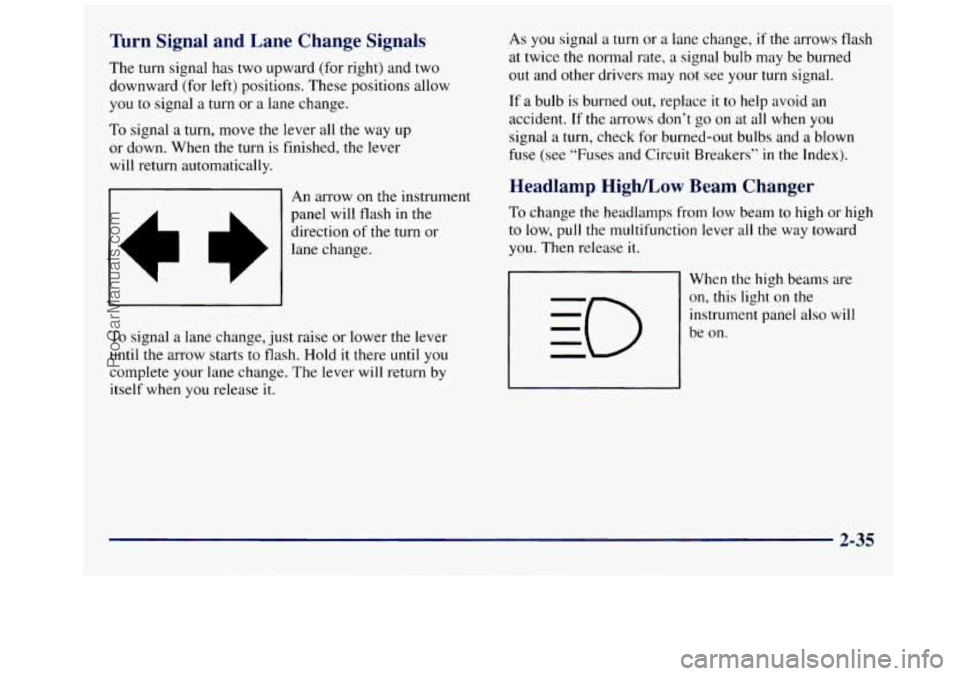
&I An arrow on the instrument
II
panel will flash in the
direction
of the turn or
lane change.
I I
To signal a lane change, just raise or lower the lever
until the arrow starts to flash. Hold it there
until you
complete your lane change. The lever will return by
itself when you release it. As you signal
a turn or a
lane change, if the arrows flash
at twice the normal rate, a signal bulb may be burned
out and other drivers may not see your turn signal.
If a bulb is burned out, replace
it to help avoid an
accident. If the arrows don’t
go on at all when you
signal a turn, check for burned-out bulbs and a blown
fuse (see “Fuses and Circuit Breakers”
in the Index).
Headlamp High/Low Beam Changer
To change the headlamps from low beam to high or high
to low, pull the multifunction lever all the way toward
you. Then release it.
When the high beams are
on, this light on the
instrument panel also will
be
on.
2-35
ProCarManuals.com
Page 108 of 388
Windshield Wipers
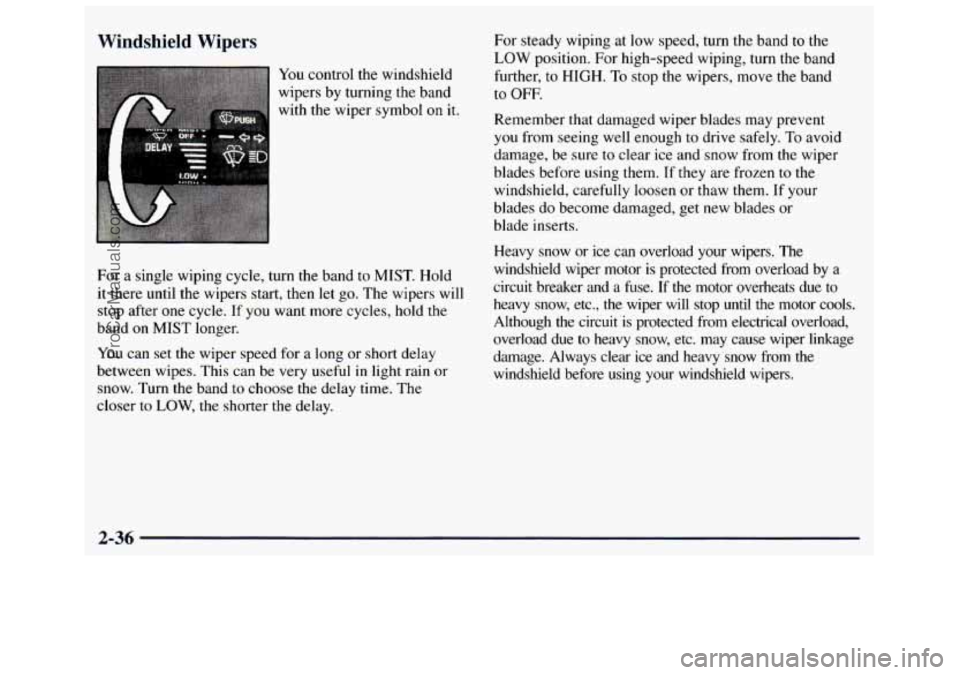
You control the windshield
wipers by turning the band
with the wiper symbol on it.
For a single wiping cycle, turn the band
to MIST. Hold
it there until the wipers start, then let
go. The w-ipers will
stop after one cycle. If you want more cycles, hold the
band
on MIST longer.
You can
set the wiper speed for a long or short delay
between wipes. This can be very useful
in light rain or
snow. Turn the band
to choose the delay time. The
closer to
LOW, the shorter the delay. For steady wiping at low speed, turn the band
to the
LOW position.
For high-speed wiping, turn the band
further, to HIGH.
To stop the wipers, move the band
to OFF.
Remember that damaged wiper blades may prevent
you from seeing well enough to drive safely. To avoid
damage, be sure to clear ice and snow from the wiper
blades before using them. If they are frozen to
the
windshield, carefully loosen or thaw them. If your
blades do become damaged, get new blades or
blade inserts.
Heavy snow or ice
can overload your wipers. The
windshield wiper motor
is protected from overload by a
circuit breaker and a fuse. If
the motor overheats due to
heavy snow, etc., the wiper will stop until the motor cools.
Although the circuit is protected from electrical overload,
overload due
to heavy snow, etc. may cause wiper linkage
damage. Always clear ice and heavy snow from the
windshield before using your windshield wipers.
2-36
ProCarManuals.com
Page 243 of 388
You can be injured and your vehicle could be
damaged
if you try to do service work on a
vehicle without knowing enough about it.
Be sure you have sufficient knowledge,
experience, the proper replacement parts
and tools before you attempt any vehicle
maintenance task.
Be sure to use the proper nuts, bolts and
other fasteners. “English” and “metric”
fasteners can be easily confused.
If you use
the wrong fasteners, parts can later break
or fall off. You could be hurt.
Adding Equipment to the Outside of
Your Vehicle
Things you might add to the outside of your vehicle can
affect the airflow around
it. This may cause wind noise
and affect windshield washer performance. Check with
your dealer before adding equipment to the outside of
your vehicle.
Fuel (Gasoline Engine)
If your vehicle has a diesel engine, see “Diesel Fuel
Requirements and
Fuel System” in the Diesel Engine
Supplement. For vehicles with gasoline engines,
please read this.
Use regular unleaded gasoline rated at 87 octane or
higher. At a minimum, it should meet specifications
ASTM D4814 in the United States and CGSB
3.5-M93
in Canada. Improved gasoline specifications have
been developed by the American Automobile
Manufacturers Association (AAMA) for better
vehicle performance and engine protection. Gasolines
meeting the AAMA specification could provide
improved driveability and emission control system
protection compared
to other gasolines.
Be sure the posted octane
is at least 87. If the octane is
less than 87, you may get a heavy knocking noise when
you drive.
If it’s bad enough, it can damage your engine.
If you’re using fuel rated at 87 octane or higher and you
hear heavy knocking, your engine needs service. But
don’t worry if you hear a little pinging noise when
you’re accelerating or driving up a hill. That’s normal,
and
you don’t have to buy a higher octane fuel to get rid
of pinging. It’s the heavy, constant knock that means
you have
a problem.
6-3
ProCarManuals.com
Page 301 of 388
Electrical System
Add-on Electrical Equipment
I NOTICE:
~
Don’t add anything electrical to your vehicle
unless you check with your dealer first. Some
electrical equipment can damage your vehicle
and the damage wouldn’t be covered by your
warranty. Some add-on electrical equipment
can keep other components from working as
they should.
Your vehicle has an air bag system. Before attempting to
add anything electrical
to your vehicle, see “Servicing
Your Air Bag-Equipped Vehicle” in the Index.
Headlamp Wiring
The headlamp wiring is protected by a circuit breaker in
the lamp switch. An electrical overload will cause the
lamps to flicker
on and off, or in some cases to remain
off. If this happens, have your headlamp wiring checked
right away.
Windshield Wiper Fuses
The windshield wiper motor is protected by a circuit
breaker and a fuse. If
the motor overheats due to heavy
snow, etc., the wiper will stop until the motor cools.
Although the circuit is protected from electrical
overload, overload due to heavy snow, etc., may cause
wiper linkage damage. Always clear ice and heavy snow
from the the windshield before using the windshield
wipers. If the overload is caused
by some electrical
problem and not
snow, etc., be sure to get it fixed.
6-61
ProCarManuals.com
Page 302 of 388
Instrument Panel Fuse Block
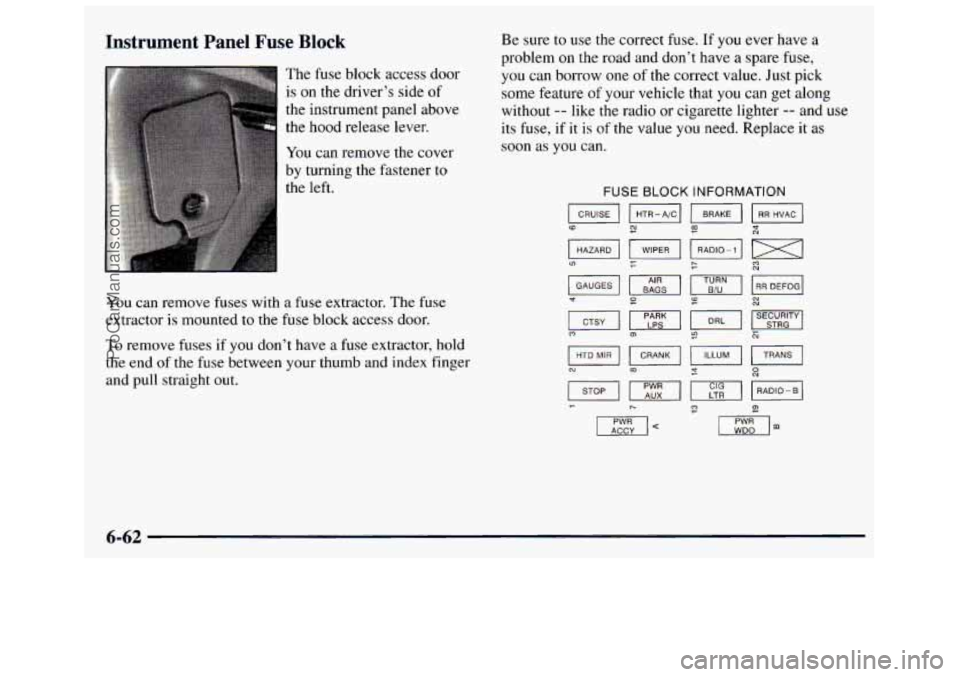
The fuse block access door
is
on the driver's side of
the instrument panel above
the hood release lever.
You can remove the cover
by turning the fastener to
the left.
You can remove fuses with
a fuse extractor. The fuse
extractor is mounted
to the fuse block access door.
To remove fuses if you don't have a fuse extractor, hold
the end
of the fuse between your thumb and index finger
and pull straight out. Be
sure
to use the correct fuse. If you ever have a
problem
on the road and don't have a spare fuse,
you can borrow
one of the correct value. Just pick
some feature
of your vehicle that you can get along
without
-- like the radio or cigarette lighter -- and use
its fuse, if
it is of the value you need. Replace it as
soon as
you can.
FUSE BLOCK INFORMATION
6-62
ProCarManuals.com
Page 304 of 388
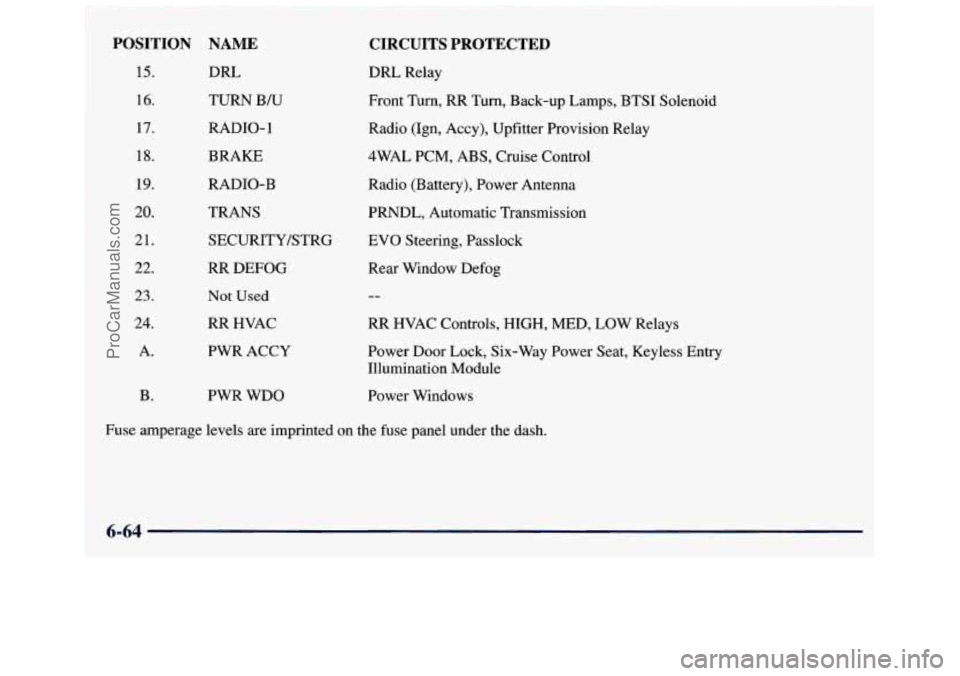
POSITION
15.
16.
17.
18.
19.
20.
21.
22.
23.
24.
A. B.
NAME
DRL TURN
B/U
RADIO- 1
BRAKE
RADIO-B
TRANS SECURITY/STRG
RR DEFOG
Not Used
RR HVAC
PWR ACCY
CIRCUITS PROTECTED
DRL Relay
Front Turn,
RR Turn, Back-up Lamps, BTSI Solenoid
Radio (Ign, Accy), Upfitter Provision Relay
4WAL PCM, ABS, Cruise Control
Radio (Battery), Power Antenna
PRNDL, Automatic Transmission
EVO Steering, Passlock
Rear Window Defog
--
RR HVAC Controls, HIGH, MED, LOW Relays
Power Door Lock, Six-Way Power Seat, Keyless Entry
Illumination Module
PWR WDO Power Windows
~ Fuse amperage levels are imprinted on the fuse panel under the dash.
' 6-64
ProCarManuals.com
Page 305 of 388
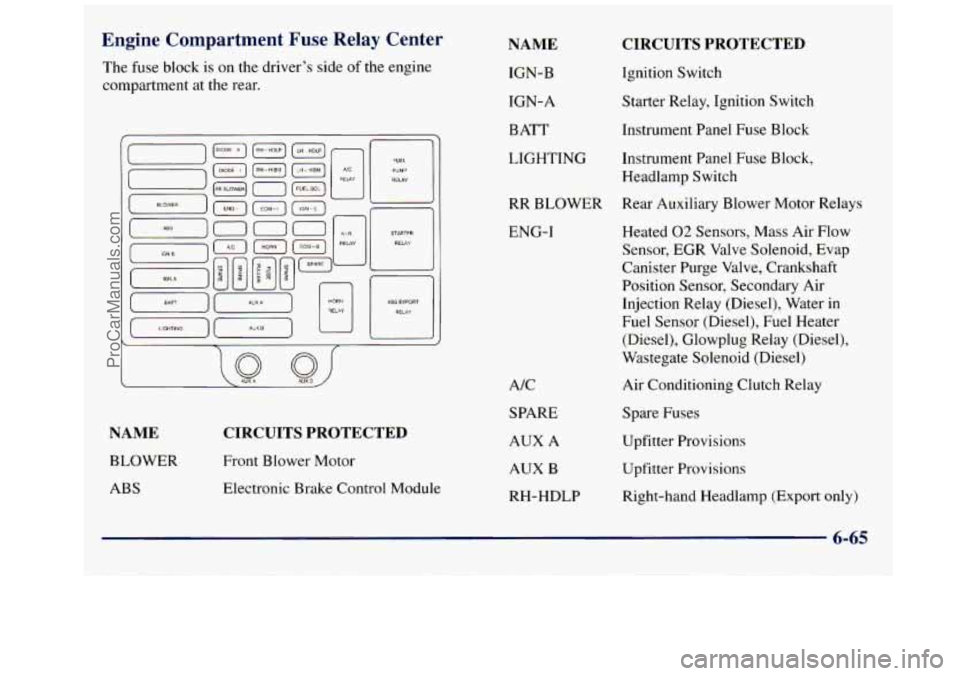
Engine Compartment Fuse Relay Center
The fuse block is on the driver’s side of the engine
compartment at the rear.
NAME
BLOWER
ABS
CIRCUITS PROTECTED
Front Blower Motor
Electronic Brake Control Module
NAME
IGN-B
IGN-A
BATT
LIGHTING
CIRCUITS PROTECTED
Ignition Switch
Starter Relay, Ignition Switch
Instrument Panel Fuse Block
Instrument Panel Fuse Block,
Headlamp Switch
RR BLOWER Rear Auxiliary Blower Motor Relays
ENG-I
AIC
SPARE
AUX A
AUX B
RH-HDLP
Heated 02 Sensors, Mass Air Flow
Sensor, EGR Valve Solenoid, Evap
Canister Purge Valve, Crankshaft
Position Sensor, Secondary Air
Injection Relay (Diesel), Water in
Fuel Sensor (Diesel), Fuel Heater
(Diesel), Glowplug Relay (Diesel),
Wastegate Solenoid (Diesel)
Air Conditioning Clutch Relay
Spare Fuses
Upfitter Provisions
Upfitter Provisions Right-hand Headlamp (Export only)
6-65
ProCarManuals.com