ABS GMC SAVANA 1998 Owners Manual
[x] Cancel search | Manufacturer: GMC, Model Year: 1998, Model line: SAVANA, Model: GMC SAVANA 1998Pages: 388, PDF Size: 20.04 MB
Page 171 of 388
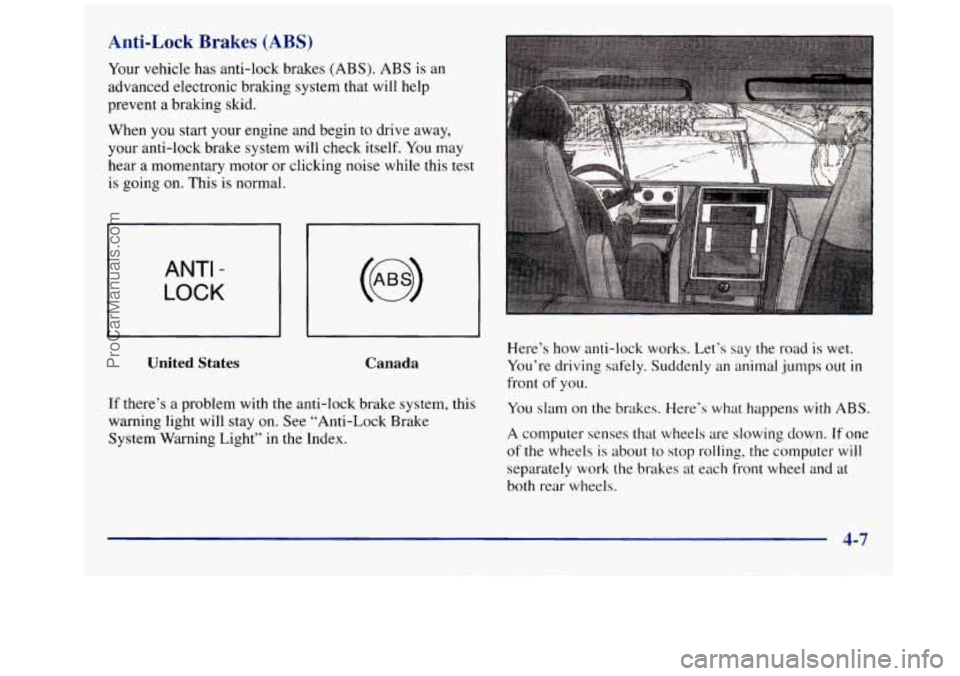
Anti-Lock Brakes (ABS)
Your vehicle has anti-lock brakes (ABS). ABS is an
advanced electronic braking system that will help
prevent a braking skid.
When you start your engine and begin to drive away,
your anti-lock brake system will check itself.
You may
hear a momentary motor or clicking noise while this test
is going
on. This is normal.
ANTI -
LOCK
United States
Canada
If there’s a problem with the anti-lock brake system, this
warning light will stay
on. See “Anti-Lock Brake
System Warning Light” in the Index. Here’s how anti-lock works. Let’s say the road
is wet.
You’re driving
safely. Suddenly an animal jumps out in
front of you.
You slam
on the brakes. Here’s what happens with ABS.
A computer senses that wheels are slowing down. If one
of the wheels is about to stop rolling, the computer will
separately work the brakes at each front wheel and at
both rear wheels.
4-7
ProCarManuals.com
Page 177 of 388
In a skid, a driver can lose control of the vehicle.
Defensive drivers avoid most skids by taking reasonable
care suited to existing conditions, and by not
“overdriving” those conditions. But skids
are
always possible.
The three types of skids correspond to your vehicle’s
three control systems. In the braking skid, your wheels aren’t rolling. In the steering
or cornering skid, too
much speed or steering in a curve causes tires
to slip and
lose cornering force. And in the acceleration skid, too
much throttle causes the driving wheels
to spin.
A cornering skid and an acceleration skid
are best
handled by easing your foot off the accelerator pedal.
If your vehicle starts to slide,
ease your foot off the
accelerator pedal and quickly steer the way you want the
vehicle to go. If you start steering quickly enough, your
vehicle may straighten out. Always be ready for a
second skid if it occurs. Of
course, traction is reauced when water, snow, ice,
gravel or other material is on the road. For safety, you’ll
want to slow down and adjust your driving to these
conditions.
It is important to slow down on slippery
surfaces because stopping distance will be longer and
vehicle control more limited.
While driving
on a surface with reduced traction, try
your best to avoid sudden steering, acceleration or
braking (including engine braking by shifting to a lower
gear). Any sudden changes could cause the tires to
slide. You may not realize the surface is slippery until
your vehicle is skidding. Learn to recognize warning
clues
-- such as enough water, ice or packed snow on
the road to make a “mirrored surface”
-- and slow
down when you have any doubt.
Remember: Any anti-lock brake system (ABS) helps
avoid only the braking skid.
4-13
ProCarManuals.com
Page 200 of 388
Parking on Hills
You really should not park your vehicle, with a trailer
attached, on a hill. If something goes wrong, your rig
could start to move. People can be injured, and both
your vehicle and the trailer can be damaged.
But if you ever have to park your rig on a hill, here’s
how to do it:
1. Apply your regular brakes, but don’t shift into
PARK
(P) yet. Then turn your wheels into the curb if
facing downhill or into traffic if facing uphill.
2. Have someone place chocks under the trailer wheels.
3. When the wheel chocks are in place, release the
regular brakes until the chocks absorb the load.
4. Reapply the regular brakes. Then apply your parking
brake and then shift to
PARK (P).
5. Release the regular brakes.
When You Are Ready to Leave After
Parking
on a Hill
1. Apply your regular brakes and hold the pedal down
while you:
Start your engine;
Shift into a gear; and
Release the parking brake.
2. Let up on the brake pedal.
3. Drive slowly until the trailer is clear of the chocks.
4. Stop and have someone pick up and store the chocks.
Maintenance When Trailer Towing
Your vehicle will need service more often when you’re
pulling a trailer. See the Maintenance Schedule for more
on this. Things that are especially important in trailer
operation are automatic transmission fluid (don’t
overfill), engine oil, axle lubricant, belt, cooling system
and brake adjustment. Each of these
is covered in this
manual, and the Index will help you find them quickly.
If you’re trailering, it’s a good idea to review these
sections before you start your trip.
Check periodically to see that all hitch nuts and bolts
are tight.
4-36
ProCarManuals.com
Page 299 of 388
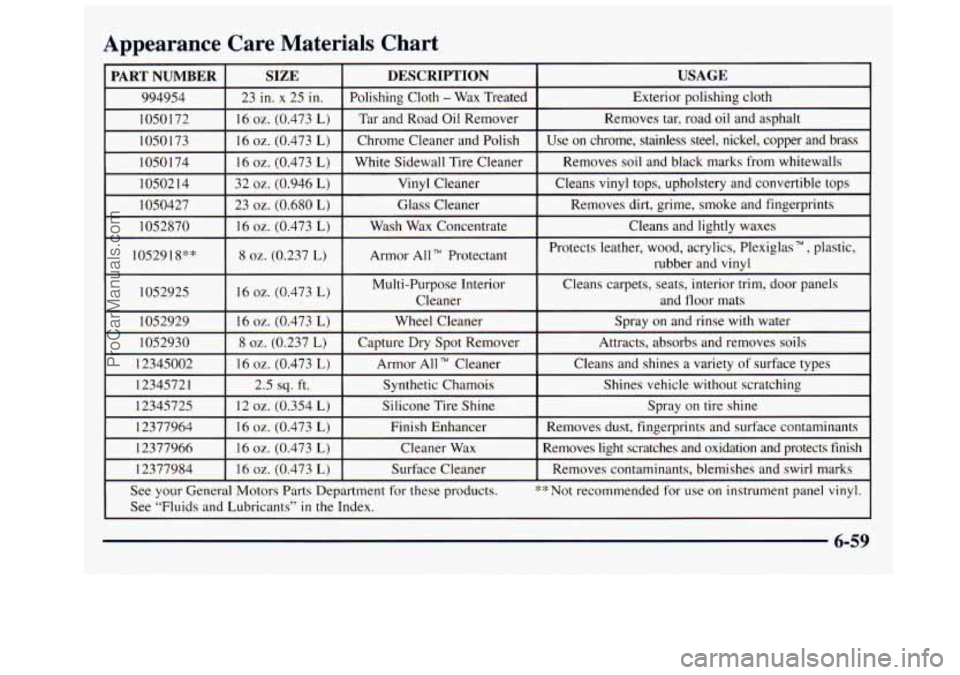
Appearance Care Materials Chart
PART NUMBER SIZE DESCRIPTION USAGE
994954 23 in. x 25 in. Polishing Cloth - Wax
Treated
Exterior polishing cloth
1050172 16
oz. (0.473 L) Tar and Road Oil Remover Removes tar, road oil and asphalt
1050 173 16
oz. (0.473 L) Chrome Cleaner and Polish
Use on chrome, stainless steel, nickel, copper and brass
1050174 16 oz. (0.473 L) White
Sidewall Tire Cleaner Removes soil and black marks from whitewalls
10502 I4 32
oz. (0.946 L) Vinyl Cleaner Cleans vinyl tops, upholstery and
convertible tops
I050427
23 oz. (0.680 L) Glass Cleaner Removes
dirt, grime, smoke and fingerprints
1052870 16
oz. (0.473 L) Wash Wax
Concentrate Cleans
and lightly waxes
I 10529 18”“ I 8 oz. (0.237 L) I Armor All Protectant Protects leather, wood,
acrylics, Plexiglas l‘, plastic,
rubber and vinyl
I 1052925 1 16 oz. (0.473 L) I I
Multi-Purpose Interior Cleans
carpets, seats, interior trim, door panels
Cleaner and floor mats
1052929
16 oz. (0.473 L) Wheel Cleaner
Spray on and rinse with water
1052930
8 oz. (0.237 L) Capture Dry Spot Remover Attracts, absorbs and removes
soils
12345002 16
oz. (0.473 L) Armor All TM Cleaner Cleans
and shines a variety of surface types
1234572
1 2.5 sq. ft. Synthetic Chamois Shines
vehicle without scratching
12345725 12
oz. (0.354 L) Silicone Tire Shine Spray on tire shine
12377964
16 02. (0.473 L) Finish Enhancer Removes dust, fingerprints and surface contaminants
I 12377966 I 16 oz. (0.473 L) I Cleaner Wax I Removes light scratches and oxidation and protects finish
I 12377984 I 16 oz. (0.473 L) I Surface Cleaner I Removes contaminants, blemishes and swirl marks
See your General Motors
Parts Department for these products. **Not recommended for use on instrument panel vinyl.
See “Fluids and Lubricants’’ in the Index.
6-59
ProCarManuals.com
Page 304 of 388
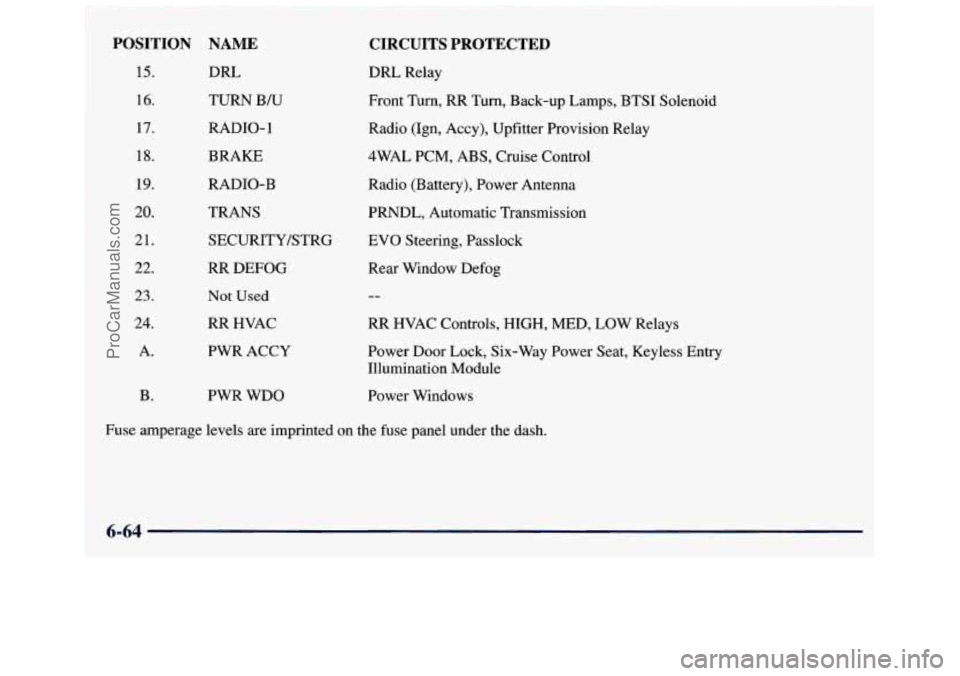
POSITION
15.
16.
17.
18.
19.
20.
21.
22.
23.
24.
A. B.
NAME
DRL TURN
B/U
RADIO- 1
BRAKE
RADIO-B
TRANS SECURITY/STRG
RR DEFOG
Not Used
RR HVAC
PWR ACCY
CIRCUITS PROTECTED
DRL Relay
Front Turn,
RR Turn, Back-up Lamps, BTSI Solenoid
Radio (Ign, Accy), Upfitter Provision Relay
4WAL PCM, ABS, Cruise Control
Radio (Battery), Power Antenna
PRNDL, Automatic Transmission
EVO Steering, Passlock
Rear Window Defog
--
RR HVAC Controls, HIGH, MED, LOW Relays
Power Door Lock, Six-Way Power Seat, Keyless Entry
Illumination Module
PWR WDO Power Windows
~ Fuse amperage levels are imprinted on the fuse panel under the dash.
' 6-64
ProCarManuals.com
Page 305 of 388
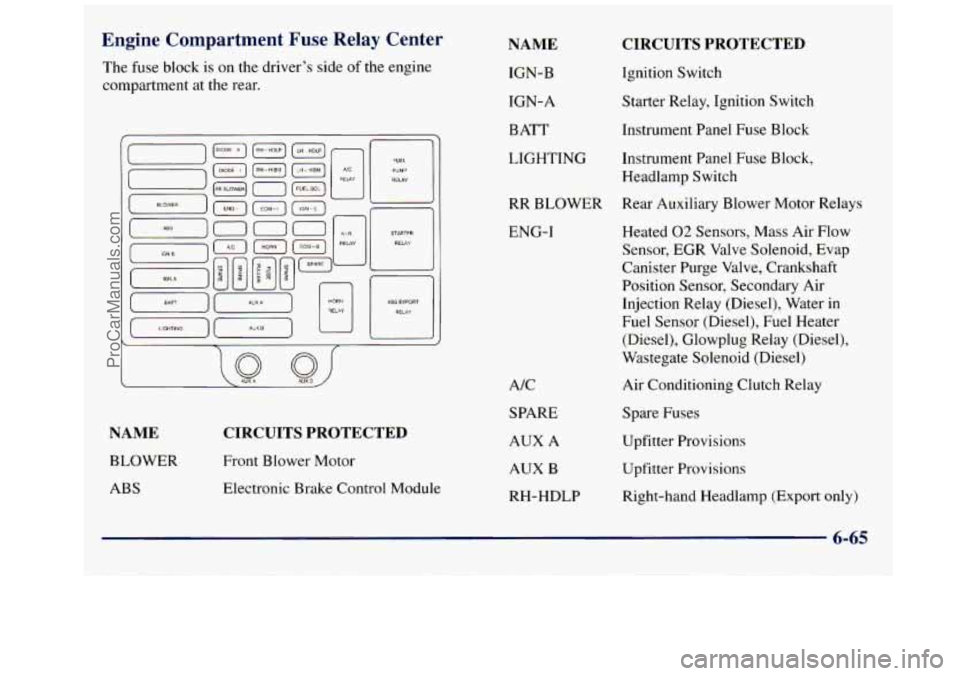
Engine Compartment Fuse Relay Center
The fuse block is on the driver’s side of the engine
compartment at the rear.
NAME
BLOWER
ABS
CIRCUITS PROTECTED
Front Blower Motor
Electronic Brake Control Module
NAME
IGN-B
IGN-A
BATT
LIGHTING
CIRCUITS PROTECTED
Ignition Switch
Starter Relay, Ignition Switch
Instrument Panel Fuse Block
Instrument Panel Fuse Block,
Headlamp Switch
RR BLOWER Rear Auxiliary Blower Motor Relays
ENG-I
AIC
SPARE
AUX A
AUX B
RH-HDLP
Heated 02 Sensors, Mass Air Flow
Sensor, EGR Valve Solenoid, Evap
Canister Purge Valve, Crankshaft
Position Sensor, Secondary Air
Injection Relay (Diesel), Water in
Fuel Sensor (Diesel), Fuel Heater
(Diesel), Glowplug Relay (Diesel),
Wastegate Solenoid (Diesel)
Air Conditioning Clutch Relay
Spare Fuses
Upfitter Provisions
Upfitter Provisions Right-hand Headlamp (Export only)
6-65
ProCarManuals.com