heating GMC SAVANA 1998 Owners Manual
[x] Cancel search | Manufacturer: GMC, Model Year: 1998, Model line: SAVANA, Model: GMC SAVANA 1998Pages: 388, PDF Size: 20.04 MB
Page 87 of 388
It can be dangerous to drive with the rear doors
open because carbon monoxide
(CO) gas can
come into your vehicle. You can’t see or smell
CO. It can cause unconsciousness and even death.
If you must drive with the rear doors open or if
electrical wiring or other cable connections must
pass through the seal between the body and the rear doors:
Make sure all windows are shut.
0 Turn the fan on your heating or cooling
system to its highest speed with the setting on VENT, HEAT,
BLEND or DEF.
Additionally, on vehicles with heatindair
conditioning systems,
NORM A/C or
BI-LEVEL
A/C can be used. That will
force outside air into your vehicle. See
“Comfort Controls’’ in the Index.
If you have air outlets on or under the
instrument panel, open them all the way.
See “Engine Exhaust” in the Index.
Theft
Vehicle theft is big business, especially in some cities.
Although your vehicle has a number of theft-deterrent
features, we know that nothing we put on it can
make it
impossible to steal. However, there are ways
you can help.
Key in the Ignition
If you leave your vehicle with the keys inside, it’s an
easy target for joy riders or professional thieves
-- so
don’t do it.
When you park your vehicle and open the driver’s door,
you’ll hear a tone reminding
you to remove your key from
the ignition and take it with you. Always do this. Your steering wheel will be locked, and
so will your ignition
and transmission. And remember to lock the doors.
Parking at Night
Park in a lighted spot, close all windows and lock your
vehicle. Remember to keep your valuables
out of sight.
Put them in a storage area, or take them with you.
2-15
ProCarManuals.com
Page 105 of 388
A CAUTION:
It can be dan
swing-out windows or rear door(s) open because
carbon monoxide (CO) gas can come into your
vehicle. You can’t see or smell
CO. It can cause
unconsciousness and even death.
If you must drive with the rear swing-out
windows or rear door(s) open or
if electrical
wiring or other cable connections must pass
through the seal between the body and the rear
swing-out windows or rear door(s):
0 Make sure all windows are shut.
CAUTION: (Continued)
’ CAUTION: (Continued: -
0 Thrn the fan on your heating or cooling
system to its highest speed with the setting
on VENT, HEAT, BLEND or DEF.
Additionally, on vehicles with heatingair
conditioning systems,
NORM A/C or
BI-LEVEL A/C can be used. That will
force outside
air into your vehicle. See
“Comfort Controls” in the Index.
0 If you have air outlets on or under the
instrument panel, open them all the
way.
See “Engine Exhaust” in the Index.
Horn
Press the horn symbol in the middle of the steering
wheel to sound the horn.
2-33
ProCarManuals.com
Page 121 of 388
I NOTICE:
Holding a cigarette lighter in with your hand
while it is heating can make it overload,
damaging the lighter and the heating element.
Just push the lighter all the way in and let go. When it’s done, it will pop back by itself.
To remove the front ashtray, pull up on the tab with a
key or screw driver inserted in the tab, and lift the
ashtray out.
Sun Visors
To block out glare, you can swing down the visors. You
can also swing them from side to side. Your visors have
elastic straps you
can use to hold items such as maps.
Visor Vanity Mirror (Option)
Some visors have mirrors built in, with or without
lamps. Just lift the mirror cover on each visor to turn the
lamps on, if you have them.
Lighted mirrors
also have an intensity switch to make
the mirror lamps brighter or dimmer. Just slide the
switch to the top for brighter light and to the bottom for
dimmer light.
2-49
ProCarManuals.com
Page 129 of 388
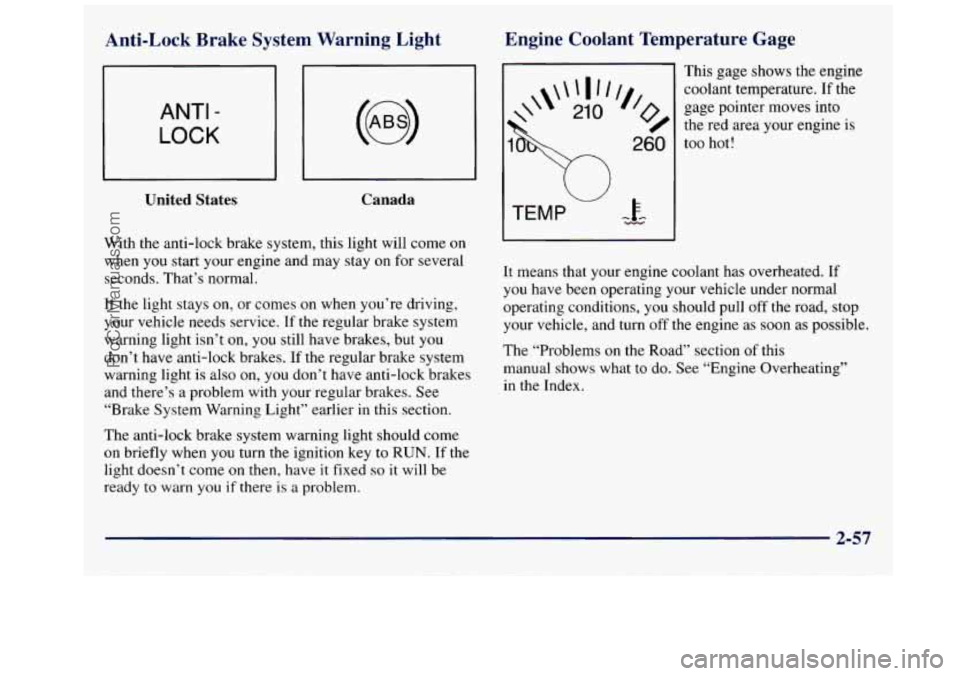
Anti-Lock Brake System Warning Light
ANTI -
LOCK
United States Canada
With
the anti-lock brake system, this light will come on
when you start your engine and may stay on for several
seconds. That’s normal.
If the light stays on, or comes
on when you’re driving,
your vehicle needs service. If the regular brake system
warning light isn’t
on, you still have brakes, but you
don’t have anti-lock brakes. If the regular brake system
warning light is also
on, you don’t have anti-lock brakes
and there’s a problem with your regular brakes. See
“Brake System Warning Light” earlier in this section.
The anti-lock brake system warning light should come
on briefly when
you turn the ignition key to RUN. If the
light doesn’t come on then, have it fixed
so it will be
ready
to warn you if there is a problem.
Engine Coolant Temperature Gage
This gage shows the engine
gage pointer moves into
the red area your engine is
coolant temperature.
If the
260 too
hot!
It means that your engine coolant has overheated.
If
you have been operating your vehicle under normal
operating conditions,
you should pull off the road, stop
your vehicle, and turn off the engine as soon as possible.
The “Problems on the Road’’ section of this
manual shows what
to do. See “Engine Overheating”
in the Index.
2-57
ProCarManuals.com
Page 137 of 388
Sectici 3 Comfort Controls and Audio Systems
In this section, you’ll find out how to operate the comfort control and audio systems offered with your vehicle. Be
sure to read about the particular systems supplied with your vehicle.
3-2 3-2
3-3
3-4 3-5
3-6
3-6
3
-6
3-7
3-7
3-7
3 -7
Comfort Controls
Heater Controls
Heater/Air Conditioning Controls
Rear Heater (Without Air Conditioning)
Rear Air Conditioning and Rear Heater
Air Conditioning
Heating
Ventilation Tips
Audio Systems
Setting the Clock for Systems without
Automatic Tone Control
Setting the Clock for Systems with
Automatic Tone Control
AM-FM Stereo 3-9
3-11
3- 16
3-20
3-2 1
3-23 3-24
3 -25
3-26
3-26 3-27 AM-FM
Stereo with Cassette Tape Player
(If Equipped)
AM-FM Stereo with Cassette Tape and
Automatic Tone Control (If Equipped)
AM-FM Stereo with Compact Disc Player
and Automatic Tone Control (If Equipped)
Remote Compact Disc Player (If Equipped)
Theft-Deterrent Feature (If Equipped)
Understanding Radio Reception
Tips About Your Audio System
Care of Your Cassette Tape Player
Care
of Your Compact Discs
Care
of Your Compact Disc Player
Power Antenna Mast Care
3-1
ProCarManuals.com
Page 138 of 388
Comfort Controls Fan Knob
This section tells you how to make your air system
work for you. Your comfort control system uses
ozone-friendly
R- 134a refrigerant.
With these systems, you can control the heating, cooling and ventilation
in your van. Your vehicle also
has a flow-through ventilation system described later
in this section.
Heater Controls
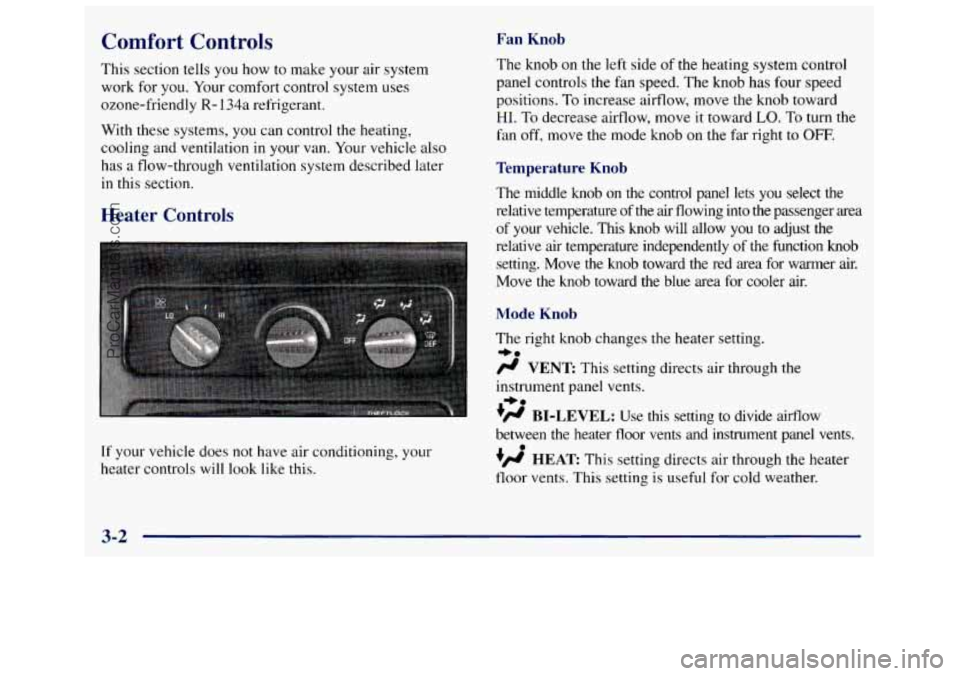
If your vehicle does not have air conditioning, your
heater controls will look like
this.
The knob on the left side of the heating system control
panel controls the fan speed. The knob has four speed
positions.
To increase airflow, move the knob toward
HI. To decrease airflow, move it toward LO. To turn the
fan off, move the mode knob on the far right
to OFF.
Temperature Knob
The middle knob on the control panel lets you select the
relative temperature of the air flowing into
the passenger area
of your vehicle. This knob will allow
you to adjust the
relative air temperature independently
of the function knob
setting. Move the knob toward the red area for warmer air.
Move the knob toward the blue area for cooler air.
Mode Knob
The right knob changes the heater setting.
/.I VENT This setting directs air through the
instrument panel vents.
+H BI-LEVEL: Use this setting to divide airflow
between the heater floor vents and instrument panel vents.
+fl HEAT This setting directs air through the heater
floor vents. This setting is useful for cold weather.
=+a
+e
0
3-2
ProCarManuals.com
Page 139 of 388
w.
?# HEAT/DEFROST Use this setting to divide
airflow between the heater floor vents and windshield.
DEFROST This setting directs air through the
windshield defroster vents. This setting is useful when
you have fog or ice on the windshield.
Heater/Air Conditioning Controls
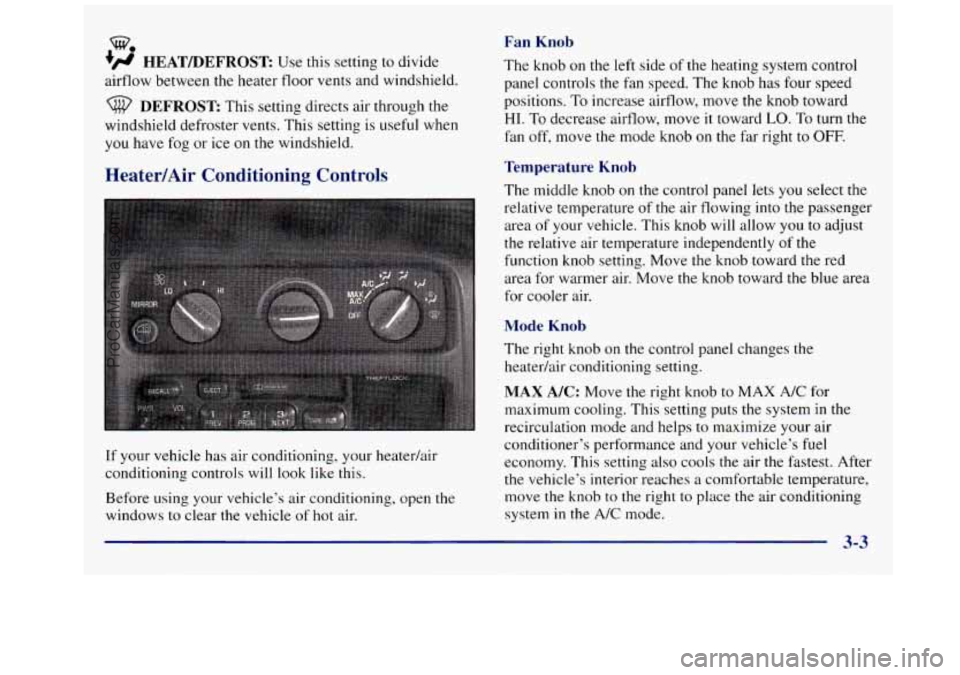
If your vehicle has air conditioning, your heatedair
conditioning controls will look like this.
Before using your vehicle’s air conditioning, open
the
windows to clear the vehicle of hot air.
Fan Knob
The knob on the left side of the heating system control
panel controls the fan speed. The knob has four speed
positions. To increase airflow, move the knob toward
HI. To decrease airflow, move it toward LO. To turn the
fan off, move the mode knob on
the far right to OFF.
Temperature Knob
The middle knob on the control panel lets you select the
relative temperature
of the air flowing into the passenger
area of your vehicle. This knob will allow
you to adjust
the relative air temperature independently of the
function knob setting. Move the knob toward the red
area for warmer air. Move the
knob toward the blue area
for cooler air.
Mode Knob
The right knob on the control panel changes the
heatedair conditioning setting.
MAX A/C: Move the right knob to MAX A/C for
maximum cooling. This setting puts the system in the
recirculation mode and helps to maximize your air
conditioner’s performance and your vehicle’s
fuel
economy. This setting also cools the air the fastest. After
the vehicle’s interior reaches a comfortable temperature,
move the knob to the right to place the air conditioning
system in the
A/C mode.
ProCarManuals.com
Page 141 of 388
Rear Air Conditioning and Rear Heater
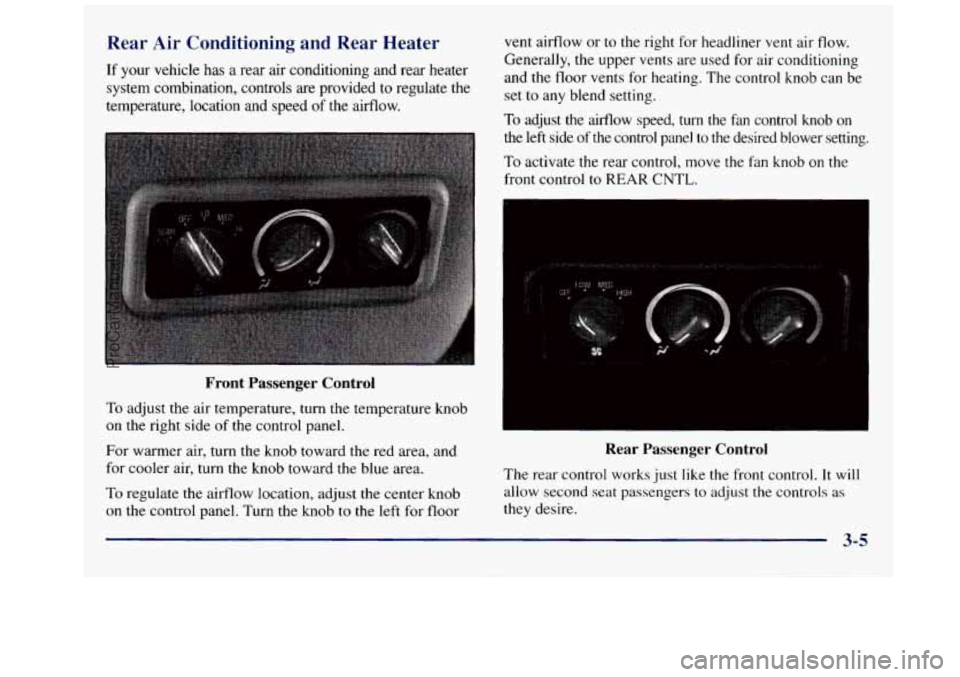
If your vehicle has a rear air conditioning and rear heater
system combination, controls are provided
to regulate the
temperature, location and speed
of the airflow.
Front Passenger Control
To adjust the air temperature, turn the temperature knob
on the right side
of the control panel.
For warmer air, turn the knob toward the red area, and
for cooler air, turn the knob toward the blue area.
To regulate the airflow location, adjust the center knob
on the control panel. Turn the knob to the left for floor vent airflow
or to
the right for headliner vent air flow.
Generally, the upper vents are used
for air conditioning
and the floor vents for heating. The control knob can be
set to any blend setting.
To adjust the airflow speed, turn the fan control knob on
the left side of the control panel to the desired blower setting.
To activate the rear control, move the fan knob on the
front control
to REAR CNTL.
Rear Passenger Control
The rear control works just like the front control. It will
allow second seat passengers to adjust the controls as
they desire.
3-5
ProCarManuals.com
Page 142 of 388
Air Conditioning Heating
Before using your vehicle’s air conditioning, open the
windows to clear the vehicle
of hot air. This reduces the
time it takes for your vehicle to cool down. Then keep
your windows closed for the air conditioner to work at
its best.
You can use MAX
AIC with the temperature knob in the
blue area when it’s really hot outside and you need to
cool
the inside air quickly. MAX A/C lets in only a little
air from the outside.
If you first
use MAX A/C, you can then use A/C with
the temperature knob in the blue area, as soon as the
vehicle has cooled down,
so outside air will be going
through your vehicle.
If your vehicle has rear air conditioning, setting it on
LO
may enhance front A/C performance by allowing
trapped refrigerant in rear lines to circulate.
When the air conditioning,
DEFROST or BLEND is on,
you may notice a slight increase
or decrease in engine
speed, due to compressor operation. This
is normal
because the system
is designed to cycle the compressor
on and off to keep the desired temperature.
On cold days, use HEATER with the temperature knob
in the red area. Outside air will be brought in through
the floor outlets. The heater works best if you keep your
windows closed while using it.
If you use the optional engine coolant heater before
starting your engine, your heating system will produce
warmer air faster
to heat the passenger compartment in
cold weather. See “Engine Coolant Heater” in the Index.
Ventilation Tips
0
0
0
Keep the hood and front air inlet free of ice, snow, or
any other obstruction (such
as leaves). The heater
and defroster will work
far better, reducing the
chance of fogging
the inside of your windows.
When you
enter a vehicle in cold weather, turn the
blower fan to
HI for a few moments before driving
off. This helps clear the intake ducts of snow and
moisture, and reduces the chance
of fogging the
inside
of your windows.
Keep the air path under the front seats clear of objects.
This helps air
to circulate throughout your vehicle.
Your vehicle has air vents in
the center and on the sides
of your instrument panel.
3-6
ProCarManuals.com
Page 197 of 388
Safety Chains Driving with a Trailer
You should always attach chains between your vehicle
and your trailer. Cross the safety chains under the tongue
of the trailer
so that the tongue will not drop to the road
if it becomes separated from the hitch. Instructions
about safety chains may be provided by the hitch
manufacturer or by the trailer manufacturer. Follow the
manufacturer’s recommendation for attaching safety
chains and do not attach them to the bumper. Always
leave just enough slack
so you can turn with your rig.
And, never allow safety chains to drag
on the ground.
Trailer Brakes
If your trailer weighs more than 1,000 lbs. (450 kg)
loaded, then it needs its own brakes
-- and they must be
adequate. Be sure to read and follow the instructions for
the trailer brakes
so you’ll be able to install, adjust and
maintain them properly.
If you have a rear-most window open and you
pull
a trailer with your vehicle, carbon monoxide
(CO) could come into your vehicle. You can’t see
or smell
CO. It can cause unconsciousness or
death. (See “Engine Exhaust” in the Index.)
To
maximize your safety when towing a trailer:
0
0
0
Have your exhaust system inspected for
leaks, and make necessary repairs before
starting on your trip.
Keep the rear-most windows closed.
If exhaust does come into your vehicle
through a window in the rear or another
opening, drive
with your front, main
heating or cooling system on and with the
fan on any speed. This will bring fresh,
outside
air into your vehicle. Do not use
MAX A/C because it only recirculates the
air inside your vehicle. (See “Comfort
Controls’’ in the Index.)
4-33
ProCarManuals.com