maintenance GMC SAVANA 1998 Owners Manual
[x] Cancel search | Manufacturer: GMC, Model Year: 1998, Model line: SAVANA, Model: GMC SAVANA 1998Pages: 388, PDF Size: 20.04 MB
Page 3 of 388
The 1998 GMC Savana Owner’s Manual
1-1
2- 1
3-1
4-1
5-1
6-1
7- 1
8- 1
9-1
Seats and Restraint Systems
This section tells you how to use your seats and safety belts properly. It also explains the air bag system.
Features and Controls
This section explains how to start and operate your vehicle.
Comfort Controls and Audio Systems
This section tells you how to adjust the ventilation and comfort controls and how to operate your audio system.
Your Driving and the Road
Here you’ll find helpful information and tips about the road and how to drive under different conditions.
Problems on the Road
This section tells what to do if you have a problem while driving, such as a flat tire or overheated engine, etc.
Service and Appearance Care
Here the manual tells you how to keep your vehicle running properly and looking good.
Maintenance Schedule
This section tells you when to perform vehicle maintenance and what fluids and lubricants to use.
Customer Assistance Information
This section tells you how to contact GMC for assistance and how to get service and owner publications.
It
also gives you information on “Reporting Safety Defects” on page 8- 10.
Index
Here’s an alphabetical listing of almost every subject in this manual. You can use it to quickly find
something
you want to read.
i
ProCarManuals.com
Page 40 of 388
Let only qualified technicians work on your air bag
system. Improper service can mean that your air
bag system won’t work properly. See
your dealer
for service.
NOTICE:
If you damage the covering for the driver’s or the
right front passenger’s air bag, the bag may not
work properly.
You may have to replace the air
bag module
in the steering wheel or both the air
bag module and the instrument panel for the
right front passenger’s air bag.
Do not open or
break the
air bag coverings.
If your vehicle ever gets into a lot of water -- such as
water up
to the carpeting or higher -- or if water enters
your vehicle and
soaks the carpet, the air bag controller
can be soaked and ruined. If this ever happens, and then
you start your vehicle, the damage could make the air
bags inflate, even if there’s no crash.
You would have to
replace
the air bags as well as the sensors and related
parts.
If your vehicle is ever in a flood, or if it’s exposed
to water that soaks the carpet, you can avoid needless
repair costs by turning
off the vehicle immediately. Don’t
let anyone start the vehicle,
even to tow it, unless
the battery cables are first disconnected.
Servicing Your Air Bag-Equipped Vehicle
Air bags affect how your vehicle should be serviced.
There are parts
of the air bag system in several places
around your vehicle.
You don’t want the system to
inflate while someone
is working on your vehicle. Your
dealer and the
GM Service Manual have information
about servicing your vehicle and the air bag system.
To
purchase a service manual, see “Service and Owner
Publications” in the Index.
For up to 10 minutes after the ignition key is
turned off and the battery is disconnected, an air
bag can still inflate during improper service.
You
can be injured if you are close to an air bag when
it inflates. Avoid wires wrapped with yellow tape
or yellow connectors. They are probably part of
the air bag system. Be sure to follow proper
service procedures, and make sure the person
performing work for you is qualified to
do so.
The air bag system does not need regular maintenance.
1-32
ProCarManuals.com
Page 69 of 388
I
Never do this. Here a child is sitting in a seat that has a
lap-shoulder belt, but the shoulder part is behind
the child.
If the child wears the belt in this way, in
a crash the child might slide under the belt. The
belt’s force would then be applied right on the
child’s abdomen. That could cause serious or
fatal injuries.
Wherever the child sits, the lap portion of the belt
should be worn low and snug on the hips, just touching
the child’s thighs. This applies belt force to the child’s
pelvic bones in a crash.
Safety Belt Extender
If the vehicle’s safety belt will fasten around you, you
should use it. But
if
a safety belt isn’t long enough to fasten, your
dealer will order you an extender. It’s free. When you go
in to order it, take the heaviest coat you
will wear, so the
extender will be long enough for you. The extender will
be just for you, and just
for the seat in your vehicle that
you choose. Don’t let someone else use it, and use it
only for
the seat it is made to fit. To wear it, just attach it
to the regular safety belt.
Checking Your Restraint Systems
Now and then, make sure the safety belt reminder light
and all your belts, buckles, latch plates, retractors and
anchorages are working properly. Look for any other
loose or damaged safety belt system parts.
If you see
anything that might keep a safety belt system from
doing its job, have it repaired.
Torn or frayed safety belts may not protect you in a
crash. They can rip apart under impact forces.
If a belt is
torn or frayed, get a new one right away.
Also look for any opened or broken air bag covers, and
have them repaired or replaced. (The air bag system
does not need regular maintenance.)
1-61
ProCarManuals.com
Page 200 of 388
Parking on Hills
You really should not park your vehicle, with a trailer
attached, on a hill. If something goes wrong, your rig
could start to move. People can be injured, and both
your vehicle and the trailer can be damaged.
But if you ever have to park your rig on a hill, here’s
how to do it:
1. Apply your regular brakes, but don’t shift into
PARK
(P) yet. Then turn your wheels into the curb if
facing downhill or into traffic if facing uphill.
2. Have someone place chocks under the trailer wheels.
3. When the wheel chocks are in place, release the
regular brakes until the chocks absorb the load.
4. Reapply the regular brakes. Then apply your parking
brake and then shift to
PARK (P).
5. Release the regular brakes.
When You Are Ready to Leave After
Parking
on a Hill
1. Apply your regular brakes and hold the pedal down
while you:
Start your engine;
Shift into a gear; and
Release the parking brake.
2. Let up on the brake pedal.
3. Drive slowly until the trailer is clear of the chocks.
4. Stop and have someone pick up and store the chocks.
Maintenance When Trailer Towing
Your vehicle will need service more often when you’re
pulling a trailer. See the Maintenance Schedule for more
on this. Things that are especially important in trailer
operation are automatic transmission fluid (don’t
overfill), engine oil, axle lubricant, belt, cooling system
and brake adjustment. Each of these
is covered in this
manual, and the Index will help you find them quickly.
If you’re trailering, it’s a good idea to review these
sections before you start your trip.
Check periodically to see that all hitch nuts and bolts
are tight.
4-36
ProCarManuals.com
Page 241 of 388
Section 6 Service and Appearance Care
Here you will find information about the care of your vehicle. This section begins with service and fuel information,
and then it shows how to check important fluid and lubricant levels. There is also technical information about your
6-2
6-3
6-5
6-5
6-7
6-8
6- 11
6- 12
6- 16
6-
17
6-2 1
6-2 1
6-24
6-25
6-25
6-26
6-27
6-3
1
vehicle, and a part devoted to its appearance care.
Service
Fuel (Gasoline Engine)
Fuels in Foreign Countries (Gasoline Engines)
Filling Your Tank (Gasoline Engine)
Filling a Portable Fuel Container
Checking Things Under the Hood
Noise Control System Engine Oil (Gasoline Engine)
Air Cleaner (Gasoline Engines)
Automatic Transmission Fluid
Rear Axle
Engine Coolant
Radiator Pressure Cap
Thermostat
Power Steering Fluid
Windshield Washer Fluid
Brakes
Battery
6-32
6-32
6-40
6-4
1
6-5 1
6-5 1
6-55
6-56
6-57
6-57
6-57
6-59
6-60
6-6
1
6-66
6-67
6-69 Bulb
Replacement
Halogen Bulbs
Windshield Wiper Blade Replacement
Tires Appearance Care
Cleaning the Inside
of Your Vehicle
Cleaning the Outside of Your Vehicle
Cleaning Aluminum Wheels (If Equipped)
Cleaning Tires
Sheet Metal Damage
Finish Damage
Appearance Care Materials Chart
Vehicle Identification Number (VJN)
Electrical System
Replacement Bulbs
Capacities and Specifications
Normal Maintenance Replacement Parts
6-1
ProCarManuals.com
Page 242 of 388
Service
Your dealer knows your vehicle best and wants you to
be happy with it. We hope you’ll go to your dealer for
all your service needs. You’ll get genuine GM parts and
GM-trained and supported service people.
We hope you’ll want to keep your GM vehicle all GM.
Genuine GM parts have one of these marks:
Genuine
Doing Your Own Service Work
If you want to do some of your own service work, you’ll
want
to use the proper GM Service Manual. It tells you
much more about how to service your vehicle than this
manual can.
To order the proper service manual, see
“Service and Owner Publications” in the Index.
Your vehicle may have an air bag system. If it does,
see “Servicing Your Air Bag-Equipped Vehicle’’ in the
Index before attempting to do your own service work.
You should keep
a record with all parts receipts and list
the mileage and the date of any service work you
perform. See “Maintenance Record” in the Index.
6-2
ProCarManuals.com
Page 243 of 388
You can be injured and your vehicle could be
damaged
if you try to do service work on a
vehicle without knowing enough about it.
Be sure you have sufficient knowledge,
experience, the proper replacement parts
and tools before you attempt any vehicle
maintenance task.
Be sure to use the proper nuts, bolts and
other fasteners. “English” and “metric”
fasteners can be easily confused.
If you use
the wrong fasteners, parts can later break
or fall off. You could be hurt.
Adding Equipment to the Outside of
Your Vehicle
Things you might add to the outside of your vehicle can
affect the airflow around
it. This may cause wind noise
and affect windshield washer performance. Check with
your dealer before adding equipment to the outside of
your vehicle.
Fuel (Gasoline Engine)
If your vehicle has a diesel engine, see “Diesel Fuel
Requirements and
Fuel System” in the Diesel Engine
Supplement. For vehicles with gasoline engines,
please read this.
Use regular unleaded gasoline rated at 87 octane or
higher. At a minimum, it should meet specifications
ASTM D4814 in the United States and CGSB
3.5-M93
in Canada. Improved gasoline specifications have
been developed by the American Automobile
Manufacturers Association (AAMA) for better
vehicle performance and engine protection. Gasolines
meeting the AAMA specification could provide
improved driveability and emission control system
protection compared
to other gasolines.
Be sure the posted octane
is at least 87. If the octane is
less than 87, you may get a heavy knocking noise when
you drive.
If it’s bad enough, it can damage your engine.
If you’re using fuel rated at 87 octane or higher and you
hear heavy knocking, your engine needs service. But
don’t worry if you hear a little pinging noise when
you’re accelerating or driving up a hill. That’s normal,
and
you don’t have to buy a higher octane fuel to get rid
of pinging. It’s the heavy, constant knock that means
you have
a problem.
6-3
ProCarManuals.com
Page 251 of 388
If your vehicle has a 7.4 liter engine and air
conditioning, your vehicle will have a auxiliary
engine fan in addition to the belt driven fan.
Before closing the hood, be sure all the filler caps
are
on properly.
Then lift the hood
to relieve pressure on the hood prop.
Remove
the hood prop from the slot in the hood and
return the prop
to its retainer. Then just let the hood
down and close it firmly.
Noise Control System
The following information relates to compliance with
Federal noise emission standards for vehicles with a
Gross Vehicle Weight Rating (GVWR) of more than
10,000 lbs. (4 536 kg). The Maintenance Schedule
provides information on maintaining the noise control
system
to minimize degradation of the noise emission
control system during the life of your vehicle. The
noise control system warranty
is given in your
Warranty booklet.
These standards apply only to vehicles sold in
the
United States.
Tampering With Noise Control
System Prohibited
Federal law prohibits the following acts or the causing
thereof:
1. The removal or rendering inoperative by any person,
other than for purposes of maintenance, repair or
replacement,
of any device or element of design
incorporated into any new vehicle for the purpose
of noise control, prior to its sale or delivery to the
ultimate purchaser or while
it is in use; or
2. The use of the vehicle after such device or element
of design has been removed or rendered inoperative
by any person.
Among those acts presumed to constitute tampering are
the
acts listed below.
Insulation:
0 Removal of the noise shields or underhood insulation.
Engine:
0 Removal or rendering engine speed governor (if
equipped) inoperative
so as to allow engine speed to
exceed manufacturer specifications.
6-11
ProCarManuals.com
Page 255 of 388
As shown in the chart, SAE 5W-30 is best for your
vehicle. However, you can use
SAE 1OW-30 if it’s going
to be 0” F (- 18°C) or above. These numbers on an oil
container show its viscosity, or thickness. Do
not use
other viscosity oils, such
as SAE 20W-50.
1 NOTICE:
Use only engine oil with the American Petroleum
Institute Certified For Gasoline Engines
“Starburst” symbol. Failure to use the
recommended oil can result in engine damage
not covered by your warranty.
GM Goodwrench@ oil meets all the requirements for
your vehicle.
If you are in an area where
the temperature falls
below
-20°F (-29”C), consider using either an
SAE 5W-30 synthetic oil or an SAE OW-30 oil. Both
will provide easier cold starting and better protection
for your engine at extremely low temperatures.
Engine Oil Additives
Don’t add anything to your oil. Your dealer is ready to
advise if
you think something should be added.
When to Change Engine Oil
If any one of these is true for you, use the short tripkity
maintenance schedule:
0
0
0
0
0
Most trips are less than 5 to 10 miles (8 to 16 km).
This is particularly important when outside
temperatures are below freezing.
Most trips include extensive idling (such as frequent
driving in stop-and-go traffic).
Most trips are through dusty areas.
You frequently tow a trailer or use a carrier on top of
your vehicle.
The vehicle
is used for delivery service, police, taxi
or other commercial application.
Driving under these conditions causes engine oil to
break down sooner. If any one of these is true for your
vehicle, then you need to change your oil and filter
every
3,000 miles (5 000 km) or 3 months -- whichever
occurs first.
6-15
ProCarManuals.com
Page 256 of 388
If none of them is true, use the long triphighway
maintenance schedule. Change the oil and filter every
7,500 miles (12 500 km) or 12 months -- whichever
occurs first. Driving
a vehicle with a fully warmed
engine under highway conditions causes engine oil
to break down slower.
What to Do with Used Oil
Did you know that used engine oil contains certain
elements that may be unhealthy for your skin and could
even cause cancer? Don't let used oil stay
on your skin
for very long. Clean your slun and nails with soap and
water, or
a good hand cleaner. Wash or properly throw
away clothing
or rags containing used engine oil. (See
the manufacturer's warnings about the use and disposal
of oil products.)
Used
oil can be a real threat to the environment. If you
change your own oil, be sure to drain all free-flowing
oil from the filter before disposal. Don't ever dispose
of
oil by putting it in the trash, pouring it on the ground,
into sewers, or into streams or bodies of water. Instead,
recycle
it by taking it to a place that collects used oil. If
you have a problem properly disposing of your used oil,
ask your dealer, a service station or a local recycling
center for help.
Air Cleaner (Gasoline Engines)
A
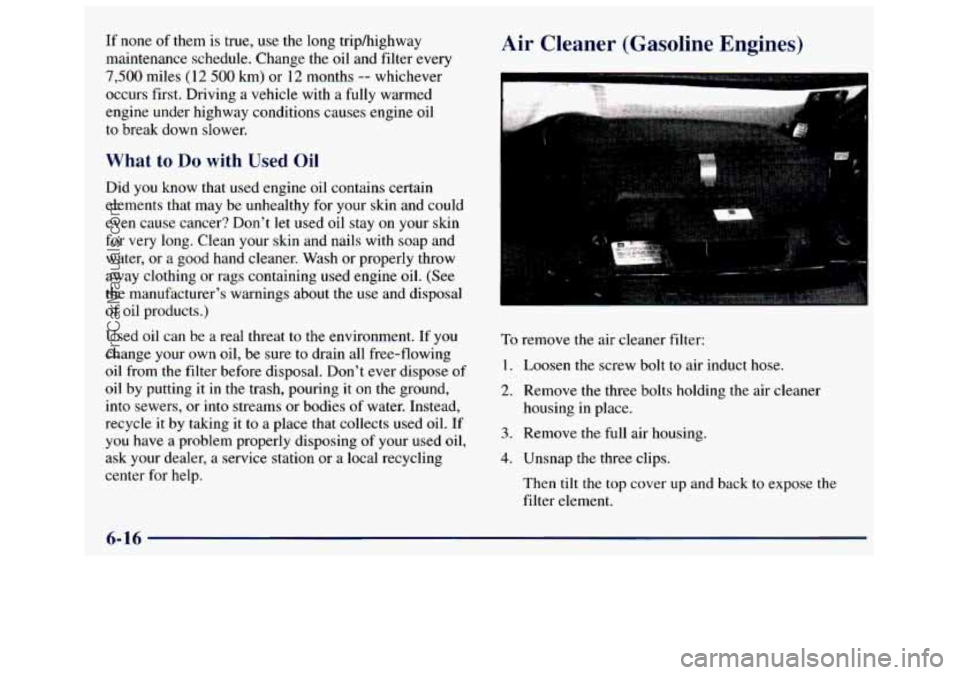
To remove the air cleaner filter:
1. Loosen the screw bolt to air induct hose.
2. Remove the three bolts holding the air cleaner
housing in place.
3. Remove the full air housing.
4. Unsnap the three clips.
Then
tilt the top cover up and back to expose the
filter element.
6- 16
ProCarManuals.com