towing GMC SAVANA 2003 Owner's Guide
[x] Cancel search | Manufacturer: GMC, Model Year: 2003, Model line: SAVANA, Model: GMC SAVANA 2003Pages: 392, PDF Size: 2.34 MB
Page 259 of 392

Automatic Transmission Fluid
When to Check and Change
A good time to check your automatic transmissionfluid
level is when the engine oil is changed.
Change both thefluid andfilter every 50,000 miles
(83,000 km) if the vehicle’s GVWR is over 8,600 or if
the vehicle is mainly driven under one or more of these
conditions:
•In heavy city traffic where the outside temperature
regularly reaches 90°F (32°C) or higher.
•In hilly or mountainous terrain.
•When doing frequent trailer towing.
•Uses such as found in taxi, police or delivery
service.
If your vehicle’s GVWR is not over 8,600 and you do
not use your vehicle under any of these conditions,
change thefluid andfilter every 100,000 miles
(166 000 km).
SeePart A: Scheduled Maintenance Services on
page 6-4.
How to Check
Because this operation can be a little difficult, you may
choose to have this done at the dealership service
department.
If you do it yourself, be sure to follow all the instructions
here, or you could get a false reading on the dipstick.
Notice:Too much or too littlefluid can damage
your transmission. Too much can mean that some
of thefluid could come out and fall on hot engine
part or exhaust system parts, starting afire.
Too littlefluid could cause the transmission to
overheat. Be sure to get an accurate reading if you
check your transmissionfluid.
Wait at least 30 minutes before checking the
transmissionfluid level if you have been driving:
•When outside temperatures are above 90°F (32°C).
•At high speed for quite a while.
•In heavy traffic–especially in hot weather.
•While pulling a trailer.
5-19
2003 - Savana OM
Page 267 of 392

Notice:If your engine catchesfire because you keep
driving with no coolant, your vehicle can be badly
damaged. The costly repairs would not be covered by
your warranty. See“Overheated Engine Protection
Operating Mode”in the Index for information on
driving to a safe place in an emergency.
If No Steam Is Coming From Your
Engine
If you get an engine overheat warning but see or
hear no steam, the problem may not be too serious.
Sometimes the engine can get a little too hot when you:
•Climb a long hill on a hot day.
•Stop after high-speed driving.
•Idle for long periods in traffic.
•Tow a trailer. See“Driving on Grades”inTowing a
Trailer on page 4-31.If you get the overheat warning with no sign of steam,
try this for a minute or so:
1. In heavy traffic, let the engine idle in NEUTRAL(N)
while stopped. If it is safe to do so, pull off the road,
shift to PARK (P) or NEUTRAL(N) and let the
engine idle.
2. Turn on your heater to full hot at the highest fan
speed and open the window as necessary.
If you no longer have the overheat warning, you can
drive. Just to be safe, drive slower for about 10 minutes.
If the warning doesn’t come back on, you can drive
normally.
If the warning continues, and you have not stopped,
pull over, stop, and park your vehicle right away.
If there’s still no sign of steam, push down the
accelerator until the engine speed is about twice as fast
as normal idle speed for at least three minutes while
you’re parked. If you still have the warning,turn off the
engine and get everyone out of the vehicleuntil it
cools down.
You may decide not to lift the hood but to get service
help right away.
5-27
2003 - Savana OM
Page 274 of 392
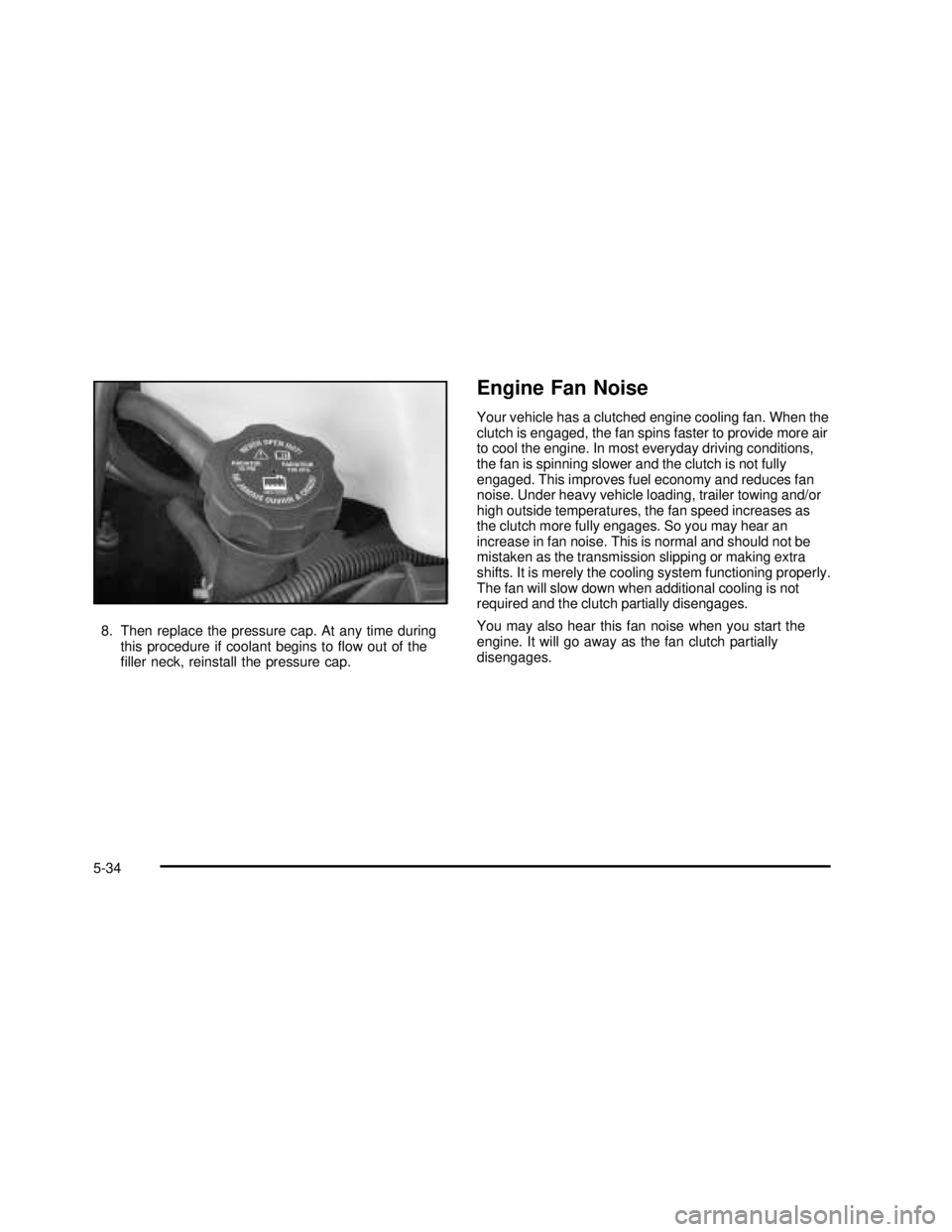
8. Then replace the pressure cap. At any time during
this procedure if coolant begins toflow out of the
filler neck, reinstall the pressure cap.
Engine Fan Noise
Your vehicle has a clutched engine cooling fan. When the
clutch is engaged, the fan spins faster to provide more air
to cool the engine. In most everyday driving conditions,
the fan is spinning slower and the clutch is not fully
engaged. This improves fuel economy and reduces fan
noise. Under heavy vehicle loading, trailer towing and/or
high outside temperatures, the fan speed increases as
the clutch more fully engages. So you may hear an
increase in fan noise. This is normal and should not be
mistaken as the transmission slipping or making extra
shifts. It is merely the cooling system functioning properly.
The fan will slow down when additional cooling is not
required and the clutch partially disengages.
You may also hear this fan noise when you start the
engine. It will go away as the fan clutch partially
disengages.
5-34
2003 - Savana OM
Page 348 of 392

45,000 Miles (75 000 km)
❑Inspect engine air cleanerfilter change indicator.
If necessary, replace thefilter. If vehicle is driven in
dusty/dirty conditions, inspectfilter change indicator at
every engine oil change. SeeEngine Air Cleaner/Filter
on page 5-17for more information.An Emission
Control Service. (See footnote†.)
❑Check rear/front axlefluid level and addfluid as
needed. Check constant velocity joints and axle seals
for leaking.
❑Vehicles With GVWR Above 10,000 lbs. Only: Inspect
shields for damage or looseness. Adjust or replace as
required.This is a Noise Emission Control Service.
Applicable only to vehicles sold in the United States.
❑Rotate tires. SeeTire Inspection and Rotation on
page 5-58for proper rotation pattern and additional
information.(See footnote +.)
50,000 Miles (83 000 km)
❑Change automatic transmissionfluid andfilter if the
vehicle’s GVWR is over 8,600 lbs or if the vehicle is
mainly driven under one or more of these conditions:
In heavy city traffic where the outside
temperature regularly reaches 90°F (32°C)
or higher.
In hilly or mountainous terrain.
When doing frequent trailer towing.
Uses such as found in taxi, police or delivery
service.
If you do not use your vehicle under any of these
conditions, change the fluid and filter at 100,000 miles
(166 000 km).
52,500 Miles (87 500 km)
❑Check rear/front axle uid level and add uid as
needed. Check constant velocity joints and axle seals
for leaking.
❑Rotate tires. SeeTire Inspection and Rotation on
page 5-58for proper rotation pattern and additional
information.(See footnote +.)
6-8
2003 - Savana OM
Page 351 of 392

100,000 Miles (166 000 km)
❑Inspect spark plug wires.An Emission Control
Service.
❑Replace spark plugs.An Emission Control Service.
❑Change automatic transmissionuid andlter if the
vehicle’s GVWR is over 8600 lbs or if the vehicle is
mainly driven under one or more of these conditions:
In heavy city traffic where the outside
temperature regularly reaches 90°F (32°C)
or higher.
In hilly or mountainous terrain.
When doing frequent trailer towing.
Uses such as found in taxi, police or delivery
service.
❑If you haven’t used your vehicle under severe service
conditions listed previously and, therefore, haven’t
changed your automatic transmissionuid, change
both theuid andlter.
❑Inspect Positive Crankcase Ventilation (PCV) valve.
An Emission Control Service.
150,000 Miles (240 000 km)
❑Drain,ush and rell cooling system (or every
60 months since last service, whichever occursrst).
SeeEngine Coolant on page 5-22for what to use.
Inspect hoses. Clean radiator, condenser, pressure
cap and neck. Pressure test the cooling system
and pressure cap.An Emission Control Service.
❑Inspect engine accessory drive belt.An Emission
Control Service.
6-11
2003 - Savana OM
Page 368 of 392

Roadside Assistance Program
GMC’s Roadside Assistance Provides stranded owners
with over-the-phone roadside repairs, location of the
nearest GMC dealer or the following special services:
Flat Tire Change:Installation of spare tire will be
covered at no charge (customer is responsible for repair
or replacement of tire).
Fuel Delivery:Delivery of enough fuel for the customer
to get to the nearest service station (up to $5.00)
will be covered.
Jump Start:No-start situations which require a battery
jump start will be covered at no charge.
Lock Out:Replacement keys or locksmith service will be
covered at no charge if you are unable to gain entry
into your vehicle. Delivery of the replacement key will be
covered within 10 miles (16 km).
Emergency Towing Service:Towing to the nearest GMC
dealer for warranty related disablements will be covered.
Trip Routing:Custom-made, computerized highlighted
maps using the most direct or scenic route are provided
free of charge. Maps include points of interest and a
list of GMC dealers along the route. Also included is
a list of hotels along the route that are discounted
through affiliation with“Quest International.”Trip Routing
is available through Roadside Assistance by calling
1-800-GMC-8782 (462-8782). Please be prepared to
provide your Vehicle Identication Number (VIN).
Allowve working days for fulllment.Trip Interruption Assistance:GMC will reimburse any
reasonable trip interruption expenses (up to $500.00)
when directly associated with warranty disablement.
Trip interruption service covers expenses such as meals
and overnight lodging if vehicle disablement occurs at
least 150 miles (240 km) from your home or rental
property. You will be required to obtain prior approval
from GMC Roadside Assistance and pay for expenses
at the time of disablement. Original receipts should
be submitted to GMC Roadside Assistance for
reimbursement. A service representative will provide
assistance when you call.
The Roadside Assistance services listed are available to
retail lease customers operating 2003 GMC light duty
trucks for a period of 3 years/36,000 miles (60,000 km).
All services must be pre-arranged by GMC Roadside
Assistance.
Over-the-phone assistance, such as providing the name
of the closest dealer or minor technical advice, etc.,
is available to all owner/operators of GMC trucks,
regardless of vehicle or mileage.
Just dial GMC Roadside Assistance at 1-800-GMC-8782
(1-800-462-8782, Roadside Assistance prompt) to
reach a qualied representative who can assist you.
Text telephone (TTY) users, call 1-888-889-2438.
7-6
2003 - Savana OM
Page 383 of 392

Light (cont.)
Malfunction Indicator....................................3-33
Safety Belt Reminder...................................3-26
Security.....................................................3-38
Tow/Haul Mode ...........................................3-39
Loading Your Vehicle.......................................4-29
Locking Rear Axle............................................ 4-9
Lockout Protection..........................................2-11
Locks
Cargo Door Relocking.................................... 2-9
Door ........................................................... 2-8
Leaving Your Vehicle....................................2-11
Lockout Protection.......................................2-11
Power Door .................................................. 2-9
Rear Door Security Locks.............................2-10
Loss of Control...............................................4-13
Low Coolant Warning Light..............................3-33
M
Maintenance, Normal Replacement Parts..........5-100
Maintenance Schedule
At Each Fuel Fill.........................................6-12
At Least Once a Month................................6-12
At Least Once a Year..................................6-13
At Least Twice a Year..................................6-13Maintenance Schedule (cont.)
At the First 100, 1,000 and 6,000 Miles
(160, 1 600 and 10 000km).......................6-12
Brake System Inspection..............................6-17
Engine Cooling System Inspection.................6-16
Exhaust System Inspection...........................6-16
Fuel System Inspection................................6-16
How This Section is Organized....................... 6-3
Introduction.................................................. 6-2
Maintenance Requirements............................. 6-2
Part A - Scheduled Maintenance Services......... 6-4
Part B - Owner Checks and Services.............6-12
Part C - Periodic Maintenance Inspections......6-16
PartD-Recommended Fluids and
Lubricants...............................................6-18
PartE-Maintenance Record........................6-20
Rear Axle Service........................................6-17
Scheduled Maintenance................................. 6-5
Steering and Suspension Inspection...............6-16
Throttle System Inspection............................6-17
Transfer Case and Front Axle
(All-Wheel Drive) Inspection.......................6-17
Using Your................................................... 6-4
Your Vehicle and the Environment................... 6-2
Maintenance When Trailer Towing.....................4-45
Making Turns.................................................4-43
Malfunction Indicator Light................................3-33
9
2003 - Savana OM
Page 386 of 392

Radios (cont.)
Radio with CD............................................3-45
Radio with Six-Disc CD................................3-60
Rear Seat Audio..........................................3-71
Setting the Time for Radios with Radio
Data Systems (RDS)................................3-41
Setting the Time for Radios without Radio
Data Systems (RDS)................................3-41
Theft-Deterrent............................................3-73
Understanding Reception..............................3-74
RDS Messages......................................3-54, 3-65
Reading Lamps..............................................3-15
Rear Air Conditioning and Heating System.........3-19
Rear Axle......................................................5-47
Locking........................................................ 4-9
Service......................................................6-17
Rear Door Security Locks................................2-10
Rear Doors....................................................2-15
Rear Heating System......................................3-18
Rear Safety Belt Comfort Guides......................1-29
Rear Seat Audio (RSA)....................................3-71
Rear Seat Operation......................................... 1-5
Rear Seat Outside Passenger Positions.............1-26
Rear Seat Passengers, Safety Belts..................1-26
Rear Seat Radio Controls................................3-72
Rear Window Defogger....................................3-22
Rearview Mirrors.............................................2-32Reclining Seatbacks.......................................... 1-3
Recreational Vehicle Towing.............................4-29
Remote Keyless Entry System............................ 2-4
Remote Keyless Entry System, Operation............ 2-5
Removing the Flat Tire and Installing the
Spare Tire..................................................5-73
Removing the Rear Seat................................... 1-5
Removing the Spare Tire and Tools...................5-67
Removing the Wheel Covers............................5-73
Replacement Bulbs.........................................5-54
Replacing Brake System Parts..........................5-40
Replacing Restraint System Parts
After a Crash..............................................1-76
Replacing the Rear Seats.................................. 1-7
Reporting Safety Defects
Canadian Government..................................7-10
General Motors...........................................7-10
United States Government.............................. 7-9
Restraint System Check...................................6-13
Checking Your Restraint Systems...................1-75
Replacing Restraint System Parts
After a Crash..........................................1-76
Restraint Systems
Checking....................................................1-75
Replacing Parts...........................................1-76
Resynchronization............................................. 2-6
Retained Accessory Power (RAP)......................2-21
12
2003 - Savana OM
Page 389 of 392

To Use the Engine Coolant Heater....................2-23
Top of the Instrument Panel.............................5-84
Top Strap......................................................1-49
Top Strap Anchor Location...............................1-50
Torque Lock...................................................2-29
Total Weight on Your Vehicle’s Tires..................4-40
Tow/Haul Mode ...............................................4-33
Tow/Haul Mode Light.......................................3-39
Towing
Recreational Vehicle.....................................4-29
Towing a Trailer..........................................4-31
Your Vehicle...............................................4-29
Trailer Brakes.................................................4-42
Trailer Wiring Harness.....................................4-46
Transfer Case................................................5-46
Transmission
Fluid, Automatic...........................................5-19
Transmission Operation, Automatic....................2-24
Transmission, Transaxle, Transfer Case Unit
Repair Manual............................................7-10
Transportation Options...................................... 7-8
Trip Odometer................................................3-26
Turn and Lane Change Signals.......................... 3-6
Turn Signal/Multifunction Lever........................... 3-6
Turn Signals When Towing a Trailer..................4-44U
Underbody Flushing Service.............................6-15
Understanding Radio Reception........................3-74
Uniform Tire Quality Grading............................5-62
United States................................................... 7-4
Using Cleaner on Fabric..................................5-83
Using RDS............................................3-52, 3-63
Using Song List Mode.....................................3-69
V
Vehicle
Control........................................................ 4-6
Damage Warnings........................................... iv
Loading......................................................4-29
Symbols......................................................... iv
Vehicle Identification
Number (VIN).............................................5-90
Service Parts Identification Label...................5-91
Vehicle Storage..............................................5-40
Vinyl.............................................................5-84
Visor Vanity Mirror..........................................2-19
Visors...........................................................2-19
Voltmeter Gage..............................................3-30
15
2003 - Savana OM