warning GMC SAVANA 2003 Owner's Guide
[x] Cancel search | Manufacturer: GMC, Model Year: 2003, Model line: SAVANA, Model: GMC SAVANA 2003Pages: 392, PDF Size: 2.34 MB
Page 262 of 392

How to Add Fluid
Refer to the Maintenance Schedule to determine
what kind of transmissionfluid to use. SeePart D:
Recommended Fluids and Lubricants on page 6-18.
Using a funnel, addfluid down the transmission dipstick
tube only after checking the transmissionfluid while it
is hot. (A cold check is used only as a reference.)
If thefluid level is low, add only enough of the proper
fluid to bring the level up to the HOT area for a hot
check. It doesn’t take muchfluid, generally less than
one pint (0.5 L).Don’t overfill.
Notice:We recommend you use onlyfluid labeled
DEXRON
®-III, becausefluid with that label is
made especially for your automatic transmission.
Damage caused byfluid other than DEXRON
®-III
is not covered by your new vehicle warranty.
•After addingfluid, recheck thefluid level as
described under″How to Check.″
•When the correctfluid level is obtained, push the
dipstick back in all the way; thenflip the handle
down to lock the dipstick in place.
Engine Coolant
The cooling system in your vehicle isfilled with
DEX-COOL®engine coolant. This coolant is designed
to remain in your vehicle for 5 years or 150,000 miles
(240 000 km), whichever occursfirst, if you add
only DEX-COOL
®extended life coolant.
The following explains your cooling system and how to
add coolant when it is low. If you have a problem
with engine overheating, seeEngine Overheating on
page 5-26.
A 50/50 mixture of clean, drinkable water and
DEX-COOL
®coolant will:
•Give freezing protection down to−34°F(−37°C).
•Give boiling protection up to 265°F (129°C).
•Protect against rust and corrosion.
•Help keep the proper engine temperature.
•Let the warning lights and gages work as they
should.
5-22
2003 - Savana OM
Page 263 of 392
Notice:When adding coolant, it is important that
you use only DEX-COOL®(silicate-free) coolant.
If coolant other than DEX-COOL®is added to the
system, premature engine, heater core or radiator
corrosion may result. In addition, the engine coolant
will require change sooner -- at 30,000 miles
(50,000 km) or 24 months, whichever occursfirst.
Damage caused by the use of coolant other than
DEX-COOL
®is not covered by your new vehicle
warranty.
What to Use
Use a mixture of one-halfclean, drinkable waterand
one-half DEX-COOL®coolant which won’t damage
aluminum parts. If you use this coolant mixture,
you don’t need to add anything else.
{CAUTION:
Adding only plain water to your cooling
system can be dangerous. Plain water, or
some other liquid such as alcohol, can boil
before the proper coolant mixture will.
CAUTION: (Continued)
CAUTION: (Continued)
You vehicle’s coolant warning system is set for
the proper coolant mixture. With plain water or
the wrong mixture, your engine could get too
hot but you wouldn’t get the overheat warning.
Your engine could catchfire and you or others
could be burned. Use a 50/50 mixture of clean,
drinkable water and the proper coolant.
Notice:If you use an improper coolant mixture,
your engine could overheat and be badly damaged.
The repair cost wouldn’t be covered by your
warranty. Too much water in the mixture can freeze
and crack the engine, radiator, heater core and
other parts.
If you have to add coolant more than four times a year,
have your dealer check your cooling system.
Notice:If you use the proper coolant, you don’t
have to add extra inhibitors or additives which claim
to improve the system. These can be harmful.
5-23
2003 - Savana OM
Page 267 of 392

Notice:If your engine catchesfire because you keep
driving with no coolant, your vehicle can be badly
damaged. The costly repairs would not be covered by
your warranty. See“Overheated Engine Protection
Operating Mode”in the Index for information on
driving to a safe place in an emergency.
If No Steam Is Coming From Your
Engine
If you get an engine overheat warning but see or
hear no steam, the problem may not be too serious.
Sometimes the engine can get a little too hot when you:
•Climb a long hill on a hot day.
•Stop after high-speed driving.
•Idle for long periods in traffic.
•Tow a trailer. See“Driving on Grades”inTowing a
Trailer on page 4-31.If you get the overheat warning with no sign of steam,
try this for a minute or so:
1. In heavy traffic, let the engine idle in NEUTRAL(N)
while stopped. If it is safe to do so, pull off the road,
shift to PARK (P) or NEUTRAL(N) and let the
engine idle.
2. Turn on your heater to full hot at the highest fan
speed and open the window as necessary.
If you no longer have the overheat warning, you can
drive. Just to be safe, drive slower for about 10 minutes.
If the warning doesn’t come back on, you can drive
normally.
If the warning continues, and you have not stopped,
pull over, stop, and park your vehicle right away.
If there’s still no sign of steam, push down the
accelerator until the engine speed is about twice as fast
as normal idle speed for at least three minutes while
you’re parked. If you still have the warning,turn off the
engine and get everyone out of the vehicleuntil it
cools down.
You may decide not to lift the hood but to get service
help right away.
5-27
2003 - Savana OM
Page 269 of 392

If there seems to be no leak, start the engine again.
See if the engine cooling fan speed increases when idle
speed is doubled by pushing the accelerator pedal
down. If it doesn’t, your vehicle needs service. Turn off
the engine.
Notice:Engine damage from running your engine
without coolant isn’t covered by your warranty.
See“Overheated Engine Protection Operating
Mode”in the Index for information on driving to
a safe place in an emergency.
Notice:When adding coolant, it is important that
you use only DEX-COOL
®(silicate-free) coolant.
If coolant other than DEX-COOL®is added to the
system, premature engine, heater core or radiator
corrosion may result. In addition, the engine coolant
will require change sooner—at 30,000 miles
(50 000 km) or 24 months, whichever occursfirst.
Damage caused by the use of coolant other than
DEX-COOL
®is not covered by your new vehicle
warranty.
If there seems to be no leak, start the engine again.
See if the engine cooling fan speed increases when
idle speed is doubled by pushing the accelerator
pedal down. If it doesn’t, your vehicle needs service.
Turn off the engine.
How to Add Coolant to the Coolant
Recovery Tank
If you haven’t found a problem yet, but the coolant level
isn’t at the COLD FILL mark, add a 50/50 mixture of
clean, drinkable waterand DEX-COOL
®engine coolant
at the coolant recovery tank. SeeEngine Coolant on
page 5-22for more information.
{CAUTION:
Adding only plain water to your cooling
system can be dangerous. Plain water, or
some other liquid such as alcohol, can boil
before the proper coolant mixture will. Your
vehicle’s coolant warning system is set for the
proper coolant mixture. With plain water or the
wrong mixture, your engine could get too hot
but you wouldn’t get the overheat warning.
Your engine could catchfire and you or others
could be burned. Use a 50/50 mixture of clean,
drinkable water and DEX-COOL
®coolant.
Notice:In cold weather, water can freeze and crack
the engine, radiator, heater core and other parts.
Use the recommended coolant and the proper
coolant mixture.
5-29
2003 - Savana OM
Page 270 of 392
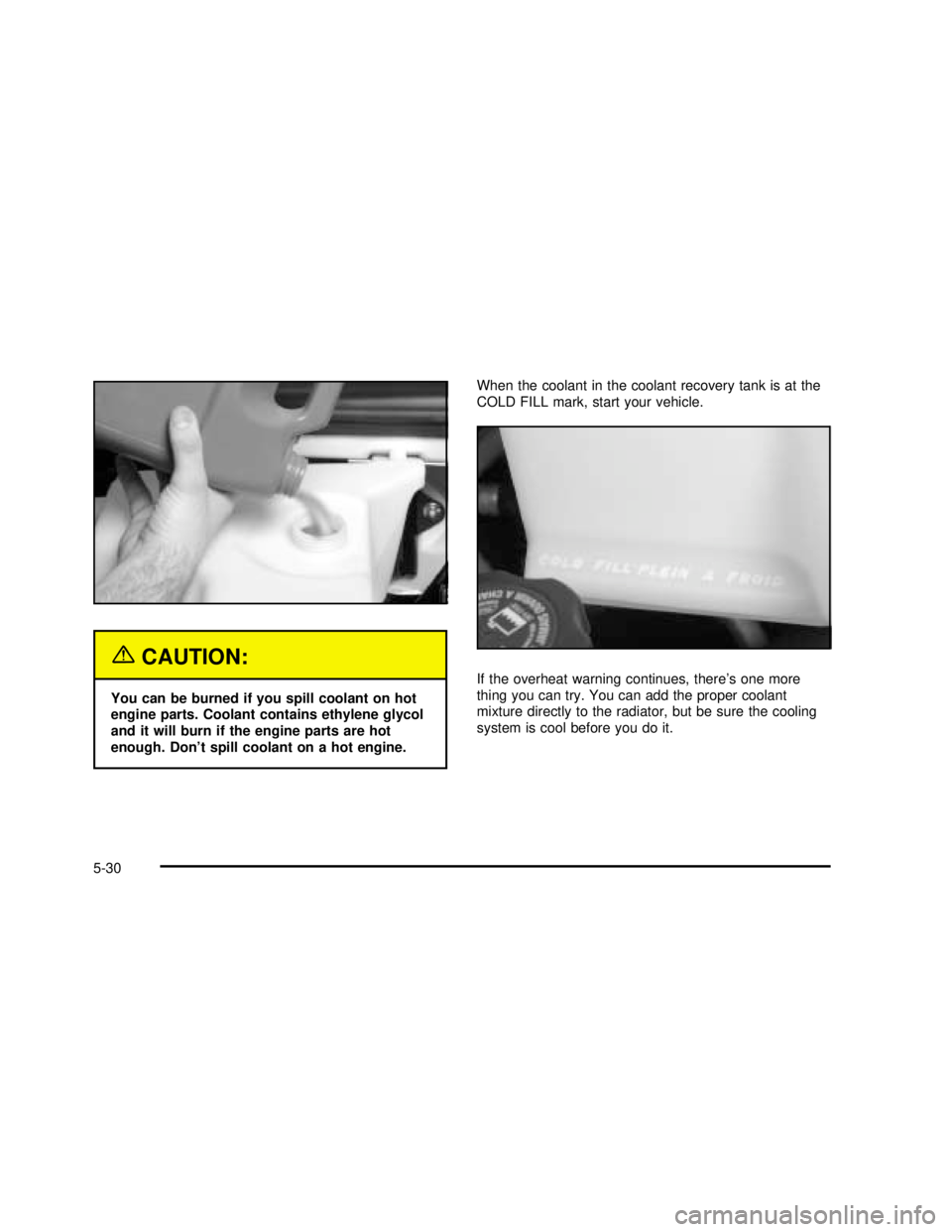
{CAUTION:
You can be burned if you spill coolant on hot
engine parts. Coolant contains ethylene glycol
and it will burn if the engine parts are hot
enough. Don’t spill coolant on a hot engine.When the coolant in the coolant recovery tank is at the
COLD FILL mark, start your vehicle.
If the overheat warning continues, there’s one more
thing you can try. You can add the proper coolant
mixture directly to the radiator, but be sure the cooling
system is cool before you do it.
5-30
2003 - Savana OM
Page 279 of 392

Brake Wear
Your vehicle has four-wheel disc brakes.
Disc brake pads have built-in wear indicators that make
a high-pitched warning sound when the brake pads
are worn and new pads are needed. The sound
may come and go or be heard all the time your vehicle
is moving (except when you are pushing on the
brake pedalfirmly).
{CAUTION:
The brake wear warning sound means that soon
your brakes won’t work well. That could lead to
an accident. When you hear the brake wear
warning sound, have your vehicle serviced.
Notice:Continuing to drive with worn-out brake
pads could result in costly brake repair.Some driving conditions or climates may cause a brake
squeal when the brakes arefirst applied or lightly
applied. This does not mean something is wrong with
your brakes.
Properly torqued wheel nuts are necessary to help
prevent brake pulsation. When tires are rotated, inspect
brake pads for wear and evenly tighten wheel nuts in
the proper sequence to GM torque specifications.
Brake linings should always be replaced as complete
axle sets.
SeeBrake System Inspection on page 6-17.Brake Pedal Travel
See your dealer if the brake pedal does not return to
normal height, or if there is a rapid increase in
pedal travel. This could be a sign of brake trouble.
Brake Adjustment
Every time you make a brake stop, your disc brakes
adjust for wear.
5-39
2003 - Savana OM
Page 280 of 392
Replacing Brake System Parts
The braking system on a vehicle is complex. Its many
parts have to be of top quality and work well together if
the vehicle is to have really good braking. Your vehicle
was designed and tested with top-quality GM brake parts.
When you replace parts of your braking system—for
example, when your brake linings wear down and you
need new ones put in—be sure you get new approved
GM replacement parts. If you don’t, your brakes may no
longer work properly. For example, if someone puts in
brake linings that are wrong for your vehicle, the balance
between your front and rear brakes can change—for the
worse. The braking performance you’ve come to expect
can change in many other ways if someone puts in the
wrong replacement brake parts.
Battery
Your new vehicle comes with a maintenance free
ACDelco®battery. When it’s time for a new battery, get
one that has the replacement number shown on the
original battery’s label. We recommend an ACDelco
®
battery. SeeEngine Compartment Overview on
page 5-12for battery location.Warning:Battery posts, terminals and related
accessories contain lead and lead compounds,
chemicals known to the State of California to cause
cancer and reproductive harm. Wash hands after
handling.
Vehicle Storage
If you’re not going to drive your vehicle for 25 days
or more, remove the black, negative (−) cable from
the battery. This will help keep your battery from
running down.
{CAUTION:
Batteries have acid that can burn you and gas
that can explode. You can be badly hurt if you
aren’t careful. See“Jump Starting”next for
tips on working around a battery without
getting hurt.
Contact your dealer to learn how to prepare your
vehicle for longer storage periods.
Also, for your audio system, seeTheft-Deterrent
Feature (Non-RDS Radios) on page 3-73or
Theft-Deterrent Feature (RDS Radios) on page 3-73.
5-40
2003 - Savana OM
Page 302 of 392

Uniform Tire Quality Grading
Quality grades can be found where applicable on the
tire sidewall between tread shoulder and maximum
section width. For example:
Treadwear 200 Traction AA Temperature A
The following information relates to the system
developed by the United States National Highway
Traffic Safety Administration, which grades tires by
treadwear, traction and temperature performance.
(This applies only to vehicles sold in the United States.)
The grades are molded on the sidewalls of most
passenger car tires. The Uniform Tire Quality Grading
system does not apply to deep tread, winter-type
snow tires, space-saver or temporary use spare tires,
tires with nominal rim diameters of 10 to 12 inches
(25 to 30 cm), or to some limited-production tires.
While the tires available on General Motors passenger
cars and light trucks may vary with respect to these
grades, they must also conform to federal safety
requirements and additional General Motors Tire
Performance Criteria (TPC) standards.
Treadwear
The treadwear grade is a comparative rating based on
the wear rate of the tire when tested under controlled
conditions on a specified government test course.
For example, a tire graded 150 would wear one and
a half (1.5) times as well on the government course as
a tire graded 100. The relative performance of tires
depends upon the actual conditions of their use,
however, and may depart significantly from the norm
due to variations in driving habits, service practices and
differences in road characteristics and climate.
Traction–AA, A, B, C
The traction grades, from highest to lowest, are AA, A,
B, and C. Those grades represent the tire’s ability
to stop on wet pavement as measured under controlled
conditions on specified government test surfaces of
asphalt and concrete. A tire marked C may have poor
traction performance. Warning: The traction grade
assigned to this tire is based on straight-ahead braking
traction tests, and does not include acceleration,
cornering, hydroplaning, or peak traction characteristics.
5-62
2003 - Savana OM
Page 303 of 392

Temperature–A, B, C
The temperature grades are A (the highest), B, and C,
representing the tire’s resistance to the generation
of heat and its ability to dissipate heat when tested
under controlled conditions on a specified indoor
laboratory test wheel. Sustained high temperature
can cause the material of the tire to degenerate and
reduce tire life, and excessive temperature can lead to
sudden tire failure. The grade C corresponds to a
level of performance which all passenger car tires must
meet under the Federal Motor Vehicle Safety Standard
No. 109. Grades B and A represent higher levels of
performance on the laboratory test wheel than the
minimum required by law.
Warning: The temperature grade for this tire is
established for a tire that is properly inflated and not
overloaded. Excessive speed, underinflation, or
excessive loading, either separately or in combination,
can cause heat buildup and possible tire failure.
Wheel Alignment and Tire Balance
The wheels on your vehicle were aligned and balanced
carefully at the factory to give you the longest tire life
and best overall performance.
Scheduled wheel alignment and wheel balancing are
not needed. However, if you notice unusual tire wear or
your vehicle pulling one way or the other, the alignment
may need to be reset. If you notice your vehicle
vibrating when driving on a smooth road, your wheels
may need to be rebalanced.
Wheel Replacement
Replace any wheel that is bent, cracked, or badly
rusted or corroded. If wheel nuts keep coming loose,
the wheel, wheel bolts and wheel nuts should be
replaced. If the wheel leaks air, replace it (except some
aluminum wheels, which can sometimes be repaired).
See your dealer if any of these conditions exist.
Your dealer will know the kind of wheel you need.
5-63
2003 - Savana OM
Page 306 of 392

Changing a Flat Tire
If a tire goesflat, avoid further tire and wheel damage
by driving slowly to a level place. Turn on your
hazard warningflashers.
{CAUTION:
Changing a tire can cause an injury. The
vehicle can slip off the jack and roll over you
or other people. You and they could be badly
injured. Find a level place to change your tire.
To help prevent the vehicle from moving:
1. Set the parking brakefirmly.
2. Put the shift lever in PARK (P).
3. Turn off the engine.
To be even more certain the vehicle won’t
move, you can put blocks at the front and
rear of the tire farthest away from the one
being changed. That would be the tire on
the other side of the vehicle, at the
opposite end.The following steps will tell you how to use the jack and
change a tire.
5-66
2003 - Savana OM