check engine GMC SAVANA 2003 Owner's Guide
[x] Cancel search | Manufacturer: GMC, Model Year: 2003, Model line: SAVANA, Model: GMC SAVANA 2003Pages: 392, PDF Size: 2.34 MB
Page 262 of 392

How to Add Fluid
Refer to the Maintenance Schedule to determine
what kind of transmissionfluid to use. SeePart D:
Recommended Fluids and Lubricants on page 6-18.
Using a funnel, addfluid down the transmission dipstick
tube only after checking the transmissionfluid while it
is hot. (A cold check is used only as a reference.)
If thefluid level is low, add only enough of the proper
fluid to bring the level up to the HOT area for a hot
check. It doesn’t take muchfluid, generally less than
one pint (0.5 L).Don’t overfill.
Notice:We recommend you use onlyfluid labeled
DEXRON
®-III, becausefluid with that label is
made especially for your automatic transmission.
Damage caused byfluid other than DEXRON
®-III
is not covered by your new vehicle warranty.
•After addingfluid, recheck thefluid level as
described under″How to Check.″
•When the correctfluid level is obtained, push the
dipstick back in all the way; thenflip the handle
down to lock the dipstick in place.
Engine Coolant
The cooling system in your vehicle isfilled with
DEX-COOL®engine coolant. This coolant is designed
to remain in your vehicle for 5 years or 150,000 miles
(240 000 km), whichever occursfirst, if you add
only DEX-COOL
®extended life coolant.
The following explains your cooling system and how to
add coolant when it is low. If you have a problem
with engine overheating, seeEngine Overheating on
page 5-26.
A 50/50 mixture of clean, drinkable water and
DEX-COOL
®coolant will:
•Give freezing protection down to−34°F(−37°C).
•Give boiling protection up to 265°F (129°C).
•Protect against rust and corrosion.
•Help keep the proper engine temperature.
•Let the warning lights and gages work as they
should.
5-22
2003 - Savana OM
Page 263 of 392
Notice:When adding coolant, it is important that
you use only DEX-COOL®(silicate-free) coolant.
If coolant other than DEX-COOL®is added to the
system, premature engine, heater core or radiator
corrosion may result. In addition, the engine coolant
will require change sooner -- at 30,000 miles
(50,000 km) or 24 months, whichever occursfirst.
Damage caused by the use of coolant other than
DEX-COOL
®is not covered by your new vehicle
warranty.
What to Use
Use a mixture of one-halfclean, drinkable waterand
one-half DEX-COOL®coolant which won’t damage
aluminum parts. If you use this coolant mixture,
you don’t need to add anything else.
{CAUTION:
Adding only plain water to your cooling
system can be dangerous. Plain water, or
some other liquid such as alcohol, can boil
before the proper coolant mixture will.
CAUTION: (Continued)
CAUTION: (Continued)
You vehicle’s coolant warning system is set for
the proper coolant mixture. With plain water or
the wrong mixture, your engine could get too
hot but you wouldn’t get the overheat warning.
Your engine could catchfire and you or others
could be burned. Use a 50/50 mixture of clean,
drinkable water and the proper coolant.
Notice:If you use an improper coolant mixture,
your engine could overheat and be badly damaged.
The repair cost wouldn’t be covered by your
warranty. Too much water in the mixture can freeze
and crack the engine, radiator, heater core and
other parts.
If you have to add coolant more than four times a year,
have your dealer check your cooling system.
Notice:If you use the proper coolant, you don’t
have to add extra inhibitors or additives which claim
to improve the system. These can be harmful.
5-23
2003 - Savana OM
Page 264 of 392
Checking Coolant
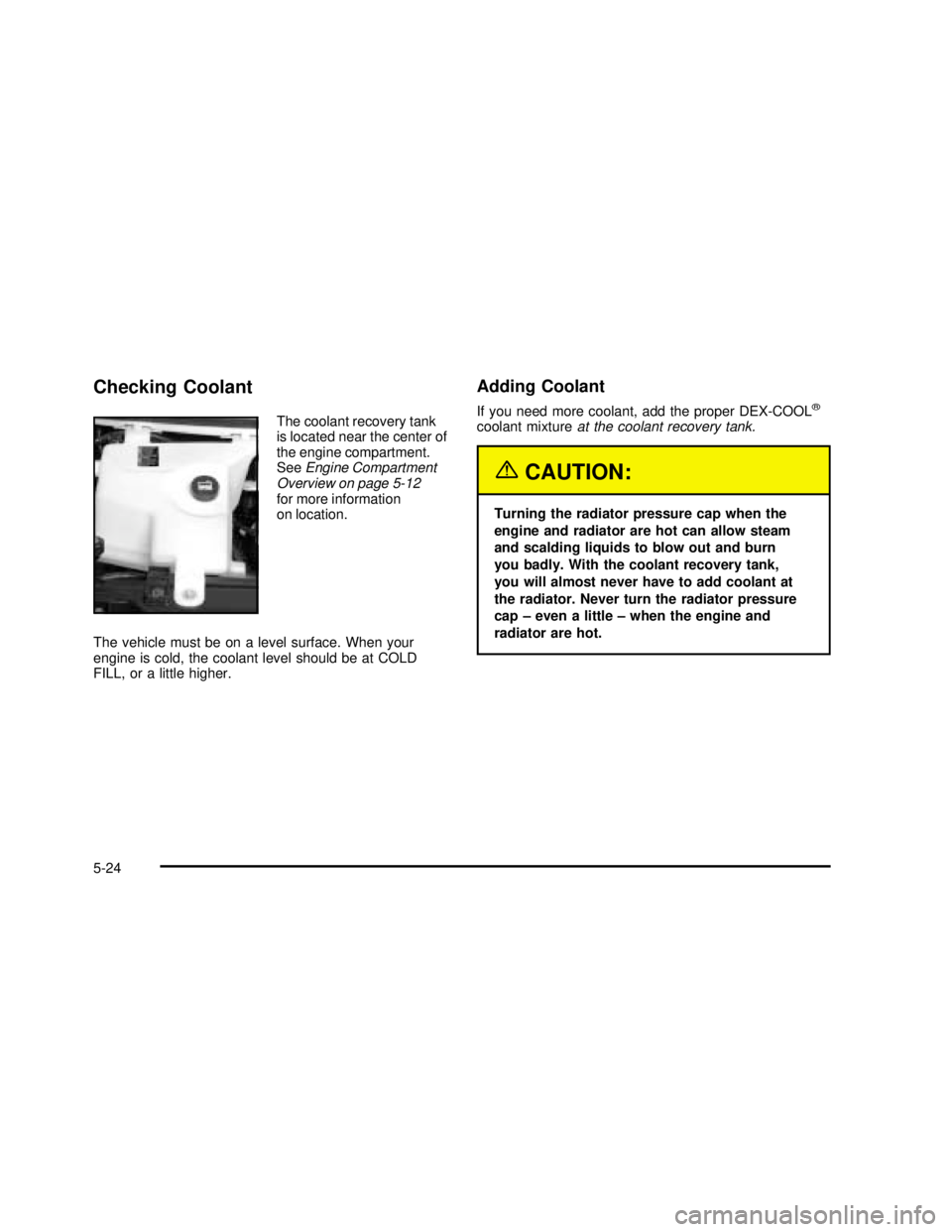
The coolant recovery tank
is located near the center of
the engine compartment.
SeeEngine Compartment
Overview on page 5-12
for more information
on location.
The vehicle must be on a level surface. When your
engine is cold, the coolant level should be at COLD
FILL, or a little higher.
Adding Coolant
If you need more coolant, add the proper DEX-COOL®
coolant mixtureat the coolant recovery tank.
{CAUTION:
Turning the radiator pressure cap when the
engine and radiator are hot can allow steam
and scalding liquids to blow out and burn
you badly. With the coolant recovery tank,
you will almost never have to add coolant at
the radiator. Never turn the radiator pressure
cap–even a little–when the engine and
radiator are hot.
5-24
2003 - Savana OM
Page 265 of 392
Add coolant mixture at the recovery tank, but be careful
not to spill it.
{CAUTION:
You can be burned if you spill coolant on hot
engine parts. Coolant contains ethylene glycol,
and it will burn if the engine parts are hot
enough. Don’t spill coolant on a hot engine.
Occasionally check the coolant level in the radiator.
For information on how to add coolant to the radiator,
seeCooling System on page 5-28.
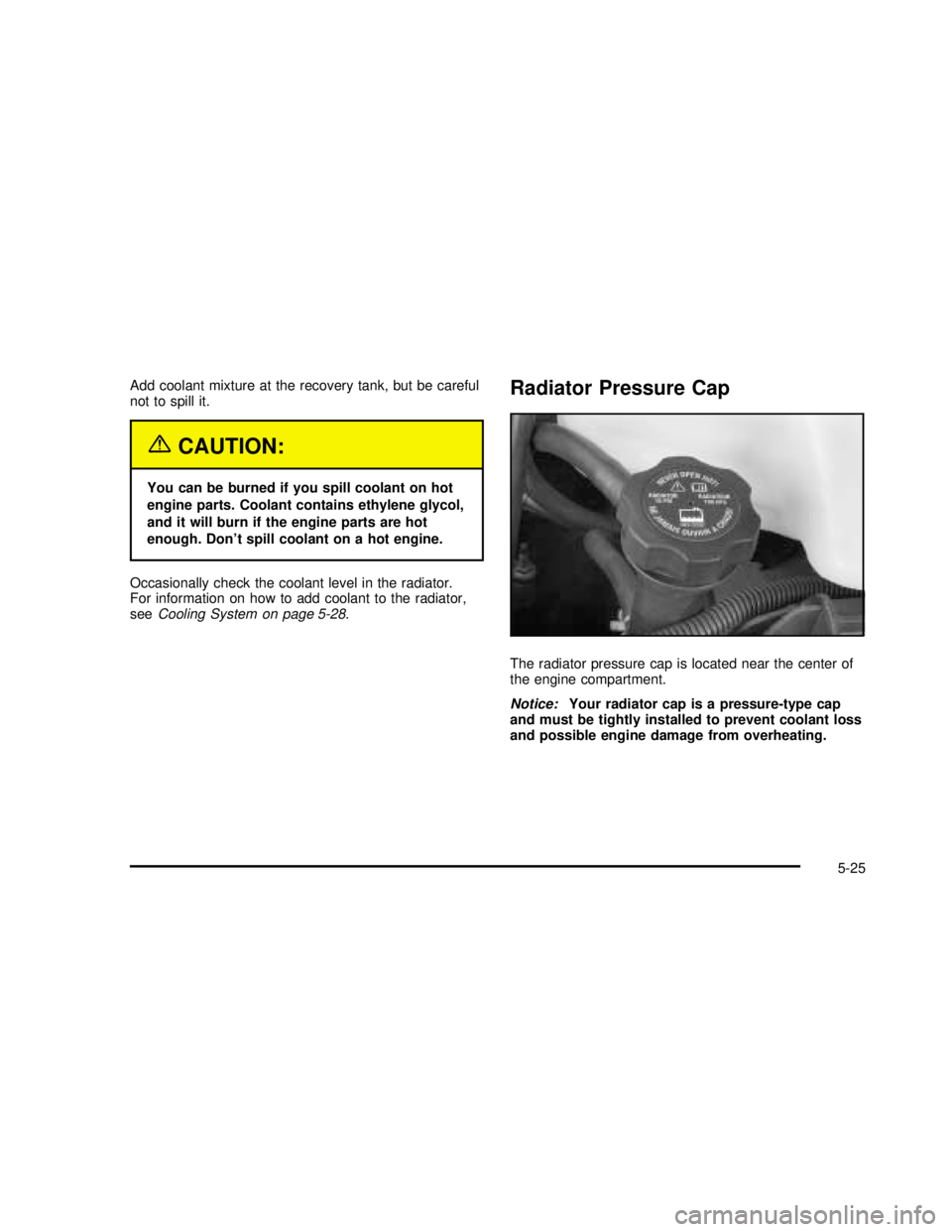
Radiator Pressure Cap
The radiator pressure cap is located near the center of
the engine compartment.
Notice:Your radiator cap is a pressure-type cap
and must be tightly installed to prevent coolant loss
and possible engine damage from overheating.
5-25
2003 - Savana OM
Page 275 of 392
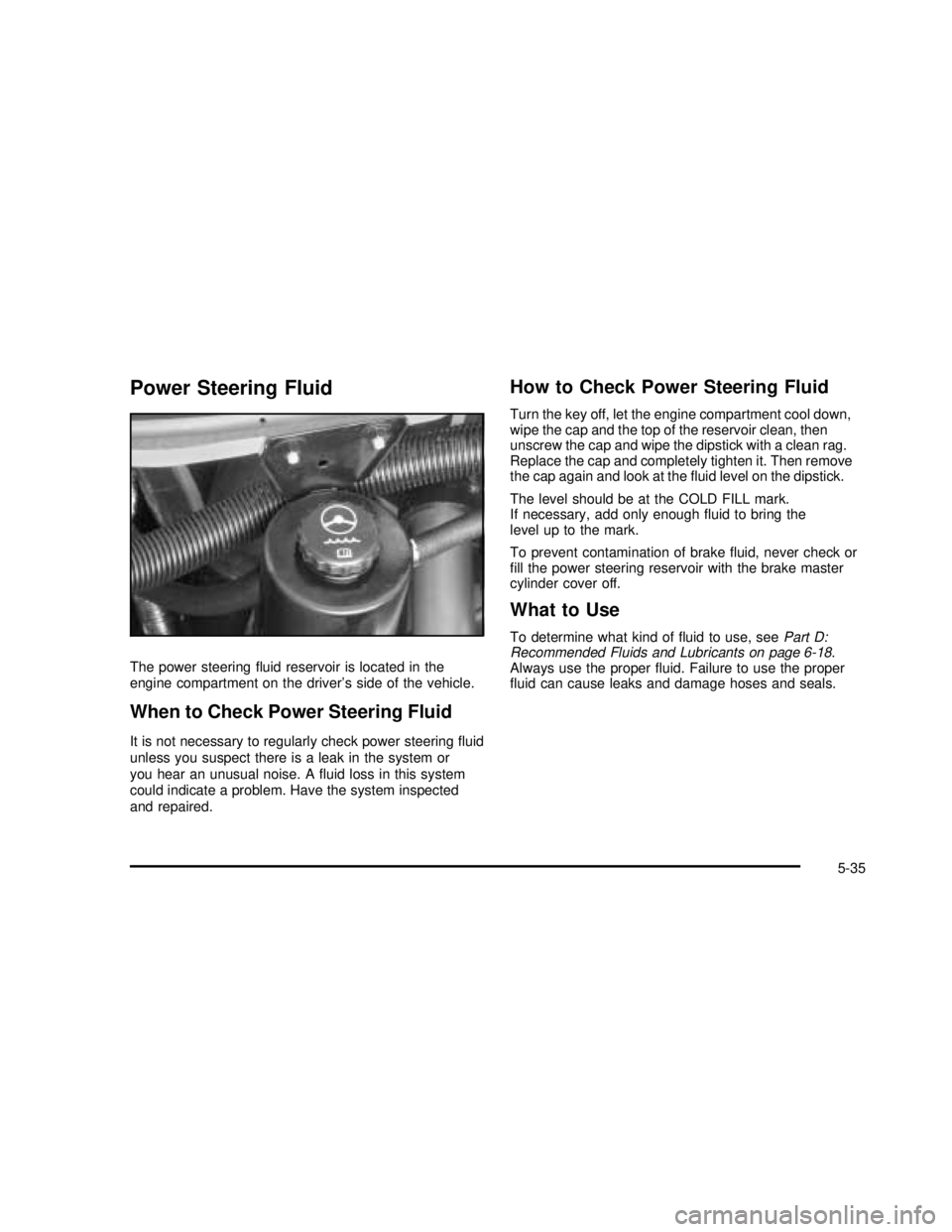
Power Steering Fluid
The power steeringfluid reservoir is located in the
engine compartment on the driver’s side of the vehicle.
When to Check Power Steering Fluid
It is not necessary to regularly check power steeringfluid
unless you suspect there is a leak in the system or
you hear an unusual noise. Afluid loss in this system
could indicate a problem. Have the system inspected
and repaired.
How to Check Power Steering Fluid
Turn the key off, let the engine compartment cool down,
wipe the cap and the top of the reservoir clean, then
unscrew the cap and wipe the dipstick with a clean rag.
Replace the cap and completely tighten it. Then remove
the cap again and look at thefluid level on the dipstick.
The level should be at the COLD FILL mark.
If necessary, add only enoughfluid to bring the
level up to the mark.
To prevent contamination of brakefluid, never check or
fill the power steering reservoir with the brake master
cylinder cover off.
What to Use
To determine what kind offluid to use, seePart D:
Recommended Fluids and Lubricants on page 6-18.
Always use the properfluid. Failure to use the proper
fluid can cause leaks and damage hoses and seals.
5-35
2003 - Savana OM
Page 277 of 392
Brakes
Brake Fluid
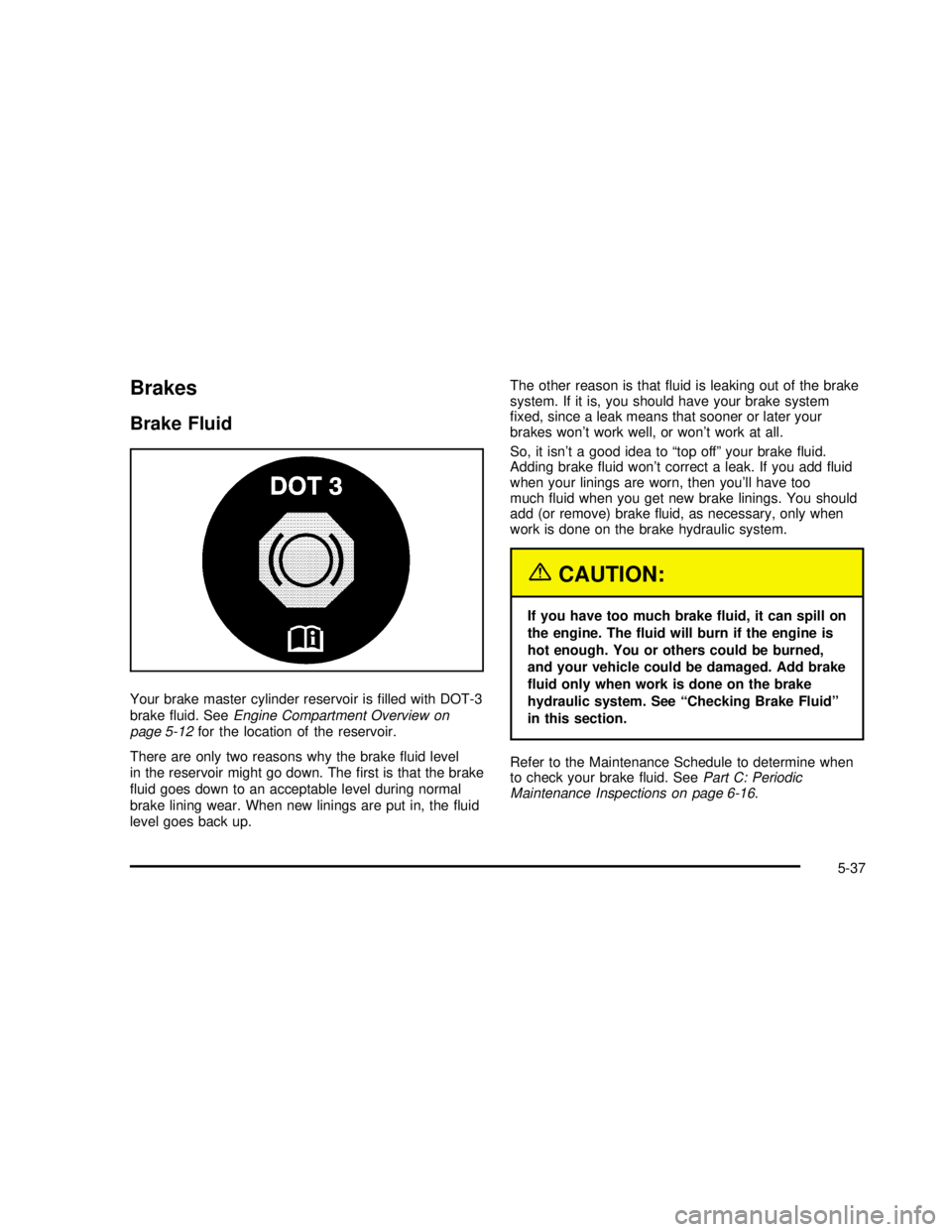
Your brake master cylinder reservoir isfilled with DOT-3
brakefluid. SeeEngine Compartment Overview on
page 5-12for the location of the reservoir.
There are only two reasons why the brakefluid level
in the reservoir might go down. Thefirst is that the brake
fluid goes down to an acceptable level during normal
brake lining wear. When new linings are put in, thefluid
level goes back up.The other reason is thatfluid is leaking out of the brake
system. If it is, you should have your brake system
fixed, since a leak means that sooner or later your
brakes won’t work well, or won’t work at all.
So, it isn’t a good idea to“top off”your brakefluid.
Adding brakefluid won’t correct a leak. If you addfluid
when your linings are worn, then you’ll have too
muchfluid when you get new brake linings. You should
add (or remove) brakefluid, as necessary, only when
work is done on the brake hydraulic system.
{CAUTION:
If you have too much brakefluid, it can spill on
the engine. Thefluid will burn if the engine is
hot enough. You or others could be burned,
and your vehicle could be damaged. Add brake
fluid only when work is done on the brake
hydraulic system. See“Checking Brake Fluid”
in this section.
Refer to the Maintenance Schedule to determine when
to check your brakefluid. SeePart C: Periodic
Maintenance Inspections on page 6-16.
5-37
2003 - Savana OM
Page 278 of 392
Checking Brake Fluid
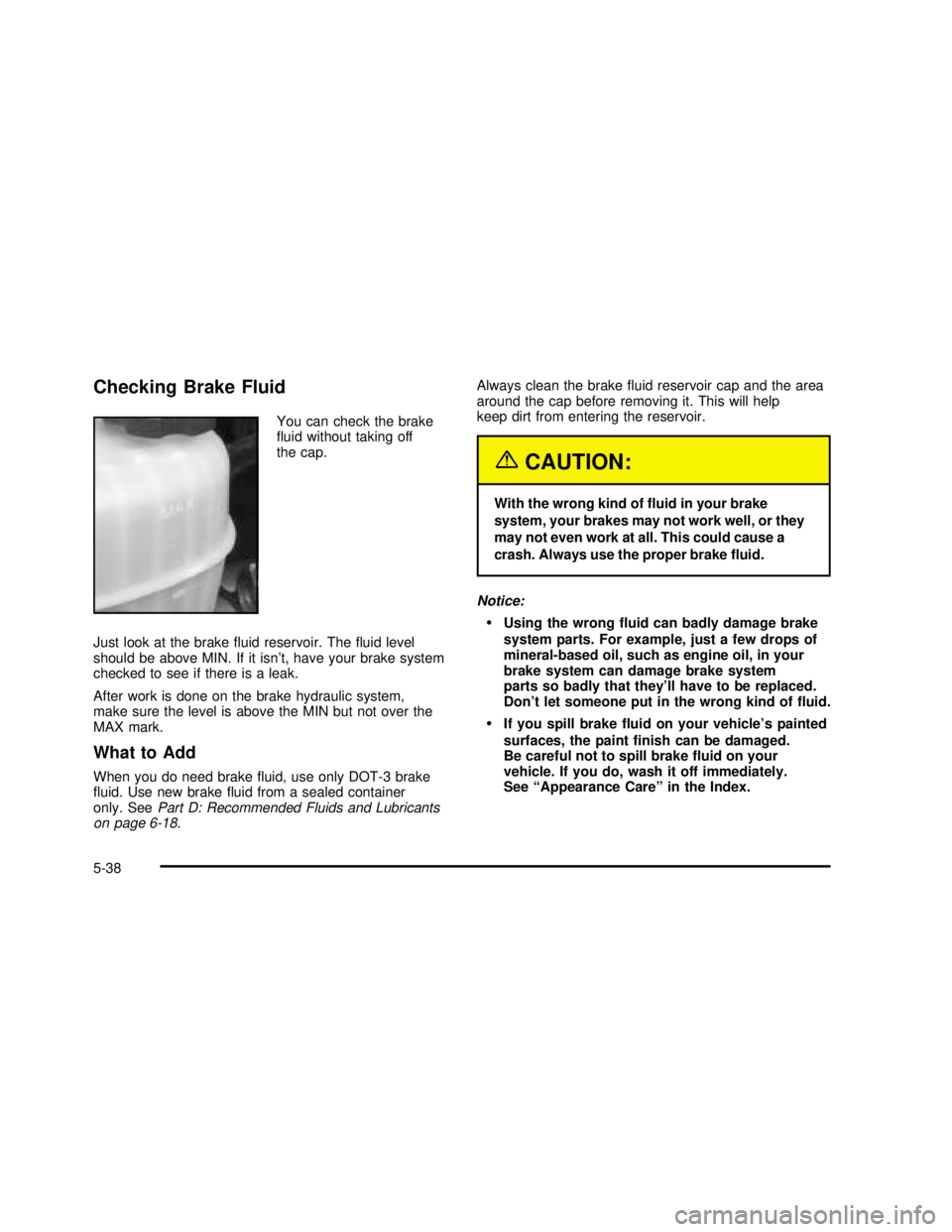
You can check the brake
fluid without taking off
the cap.
Just look at the brakefluid reservoir. Thefluid level
should be above MIN. If it isn’t, have your brake system
checked to see if there is a leak.
After work is done on the brake hydraulic system,
make sure the level is above the MIN but not over the
MAX mark.
What to Add
When you do need brakefluid, use only DOT-3 brake
fluid. Use new brakefluid from a sealed container
only. SeePart D: Recommended Fluids and Lubricants
on page 6-18.Always clean the brakefluid reservoir cap and the area
around the cap before removing it. This will help
keep dirt from entering the reservoir.
{CAUTION:
With the wrong kind offluid in your brake
system, your brakes may not work well, or they
may not even work at all. This could cause a
crash. Always use the proper brakefluid.
Notice:
•Using the wrongfluid can badly damage brake
system parts. For example, just a few drops of
mineral-based oil, such as engine oil, in your
brake system can damage brake system
parts so badly that they’ll have to be replaced.
Don’t let someone put in the wrong kind offluid.
•If you spill brakefluid on your vehicle’s painted
surfaces, the paintfinish can be damaged.
Be careful not to spill brakefluid on your
vehicle. If you do, wash it off immediately.
See“Appearance Care”in the Index.
5-38
2003 - Savana OM
Page 283 of 392
{CAUTION:
Fans or other moving engine parts can injure
you badly. Keep your hands away from moving
parts once the engine is running.
5. Check that the jumper cables don’t have loose or
missing insulation. If they do, you could get a
shock. The vehicles could be damaged, too.
Before you connect the cables, here are some
basic things you should know. Positive (+) will go to
positive (+) or to a remote positive (+) terminal if
the vehicle has one. Negative (−) will go to a heavy,
unpainted metal engine part or to a remote
negative (−) terminal if the vehicle has one.
Don’t connect positive (+) to negative (−) or you will
get a short that would damage the battery and
maybe other parts, too. And don’t connect
the negative (−) cable to the negative (−) terminal
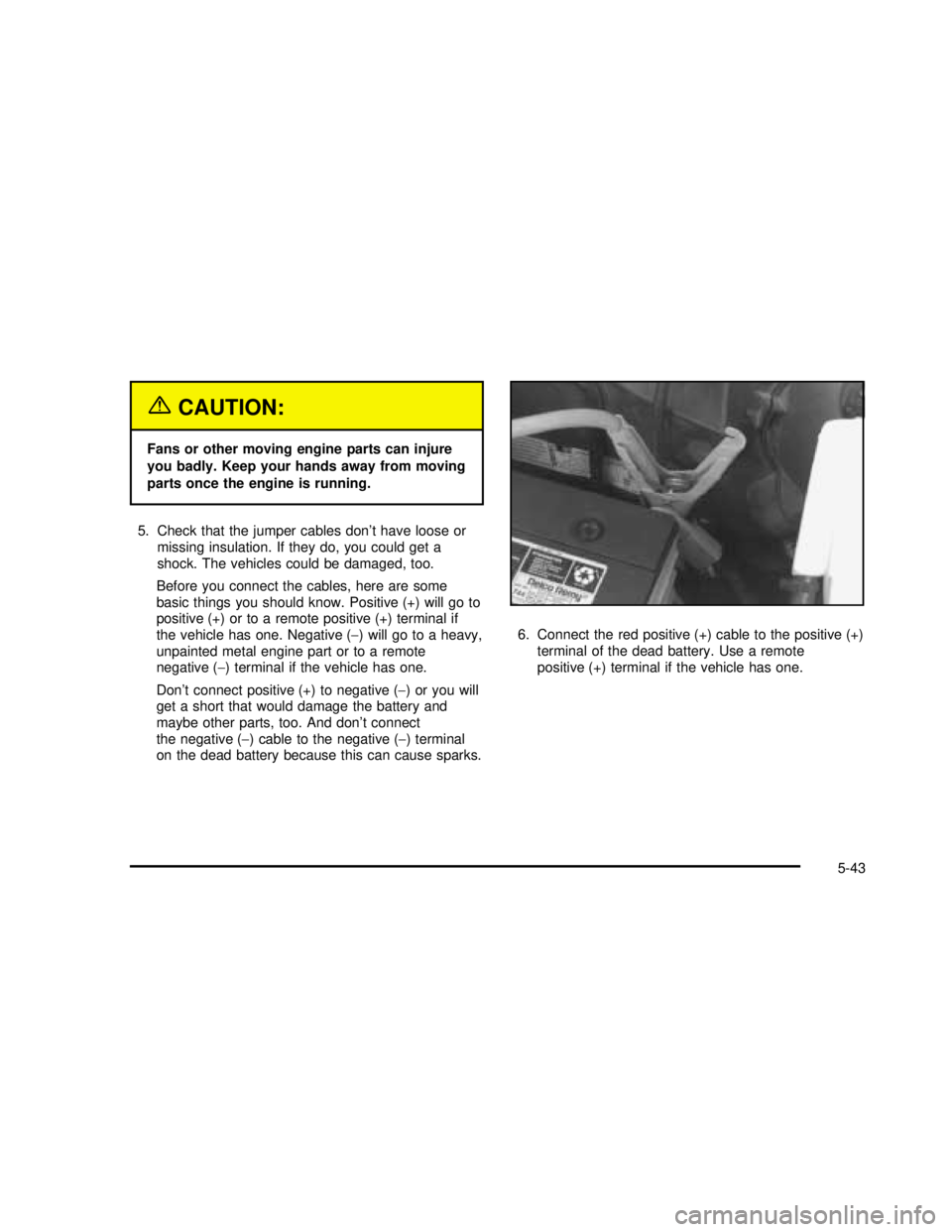
on the dead battery because this can cause sparks.6. Connect the red positive (+) cable to the positive (+)
terminal of the dead battery. Use a remote
positive (+) terminal if the vehicle has one.
5-43
2003 - Savana OM
Page 338 of 392

Capacities
ApplicationCapacities
QTY Without
Rear HeaterQTY With
Rear Heater
Cooling System
After refill, the level must be rechecked. See“Cooling System”in the Index.
VORTEC™4300 V6 11.0 quarts (10.4 L) 14.0 quarts (13.2 L)
VORTEC™4800 V8 13.4 quarts (12.7 L) 16.4 quarts (15.5 L)
VORTEC™5300 V8 13.4 quarts (12.7 L) 16.4 quarts (15.5 L)
VORTEC™6000 V8 14.8 quarts (14.0 L) 17.8 quarts (17.0 L)
ApplicationCapacities
English Metric
Engine Oil With Filter
After refill, the level must be rechecked. Add enough engine oil so that thefluid is within the proper operating
range. SeeEngine Oil on page 5-13
VORTEC™4300 V6 (Vin W) 4.5 quarts 4.3 L
VORTEC™4800 V8 ( Vin V) 6.0 quarts 5.7 L
VORTEC™5300 V8 (Vin T) 6.0 quarts 5.7 L
VORTEC™6000 V8 (Vin U) 6.0 quarts 5.7 L
5-98
2003 - Savana OM
Page 341 of 392

Maintenance Schedule......................................6-2
Introduction...................................................6-2
Your Vehicle and the Environment....................6-2
Maintenance Requirements..............................6-2
How This Section is Organized.........................6-3
Part A: Scheduled Maintenance Services...........6-4
Using Your Maintenance Schedule....................6-4
Scheduled Maintenance...................................6-5
Part B: Owner Checks and Services................6-12
At the First 100, 1,000 and 6,000 Miles
(160, 1 600 and 10 000km)........................6-12
At Each Fuel Fill..........................................6-12
At Least Once a Month.................................6-12
At Least Twice a Year...................................6-13At Least Once a Year...................................6-13
Part C: Periodic Maintenance Inspections.........6-16
Steering and Suspension Inspection................6-16
Exhaust System Inspection............................6-16
Fuel System Inspection..................................6-16
Engine Cooling System Inspection...................6-16
Throttle System Inspection.............................6-17
Rear Axle Service.........................................6-17
Transfer Case and Front Axle
(All-Wheel Drive) Inspection........................6-17
Brake System Inspection................................6-17
Part D: Recommended Fluids
and Lubricants..........................................6-18
Part E: Maintenance Record...........................6-20
Section 6 Maintenance Schedule
6-1
2003 - Savana OM