tow GMC SAVANA 2003 Workshop Manual
[x] Cancel search | Manufacturer: GMC, Model Year: 2003, Model line: SAVANA, Model: GMC SAVANA 2003Pages: 392, PDF Size: 2.34 MB
Page 261 of 392
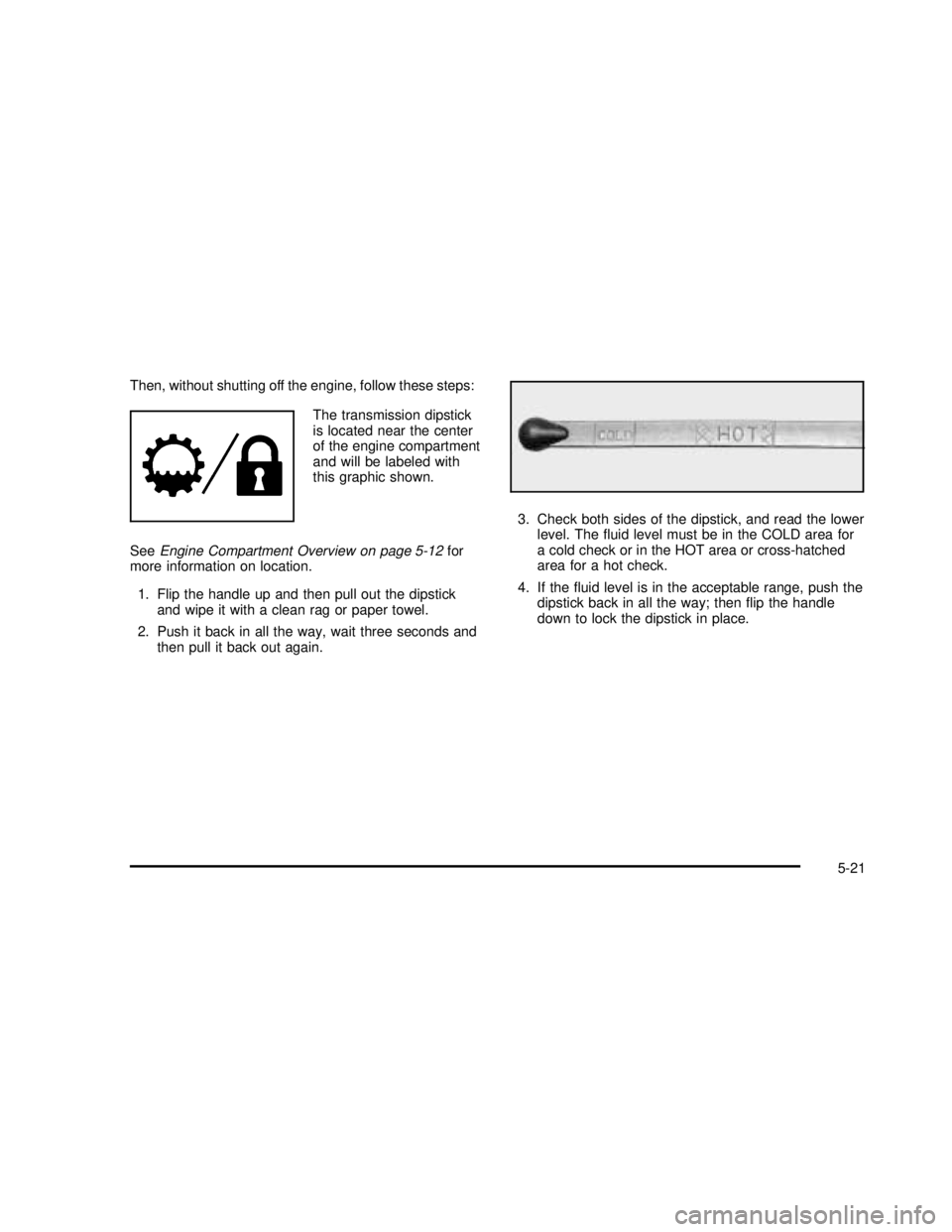
Then, without shutting off the engine, follow these steps:
The transmission dipstick
is located near the center
of the engine compartment
and will be labeled with
this graphic shown.
SeeEngine Compartment Overview on page 5-12for
more information on location.
1. Flip the handle up and then pull out the dipstick
and wipe it with a clean rag or paper towel.
2. Push it back in all the way, wait three seconds and
then pull it back out again.3. Check both sides of the dipstick, and read the lower
level. Thefluid level must be in the COLD area for
a cold check or in the HOT area or cross-hatched
area for a hot check.
4. If thefluid level is in the acceptable range, push the
dipstick back in all the way; thenflip the handle
down to lock the dipstick in place.
5-21
2003 - Savana OM
Page 267 of 392

Notice:If your engine catchesfire because you keep
driving with no coolant, your vehicle can be badly
damaged. The costly repairs would not be covered by
your warranty. See“Overheated Engine Protection
Operating Mode”in the Index for information on
driving to a safe place in an emergency.
If No Steam Is Coming From Your
Engine
If you get an engine overheat warning but see or
hear no steam, the problem may not be too serious.
Sometimes the engine can get a little too hot when you:
•Climb a long hill on a hot day.
•Stop after high-speed driving.
•Idle for long periods in traffic.
•Tow a trailer. See“Driving on Grades”inTowing a
Trailer on page 4-31.If you get the overheat warning with no sign of steam,
try this for a minute or so:
1. In heavy traffic, let the engine idle in NEUTRAL(N)
while stopped. If it is safe to do so, pull off the road,
shift to PARK (P) or NEUTRAL(N) and let the
engine idle.
2. Turn on your heater to full hot at the highest fan
speed and open the window as necessary.
If you no longer have the overheat warning, you can
drive. Just to be safe, drive slower for about 10 minutes.
If the warning doesn’t come back on, you can drive
normally.
If the warning continues, and you have not stopped,
pull over, stop, and park your vehicle right away.
If there’s still no sign of steam, push down the
accelerator until the engine speed is about twice as fast
as normal idle speed for at least three minutes while
you’re parked. If you still have the warning,turn off the
engine and get everyone out of the vehicleuntil it
cools down.
You may decide not to lift the hood but to get service
help right away.
5-27
2003 - Savana OM
Page 274 of 392
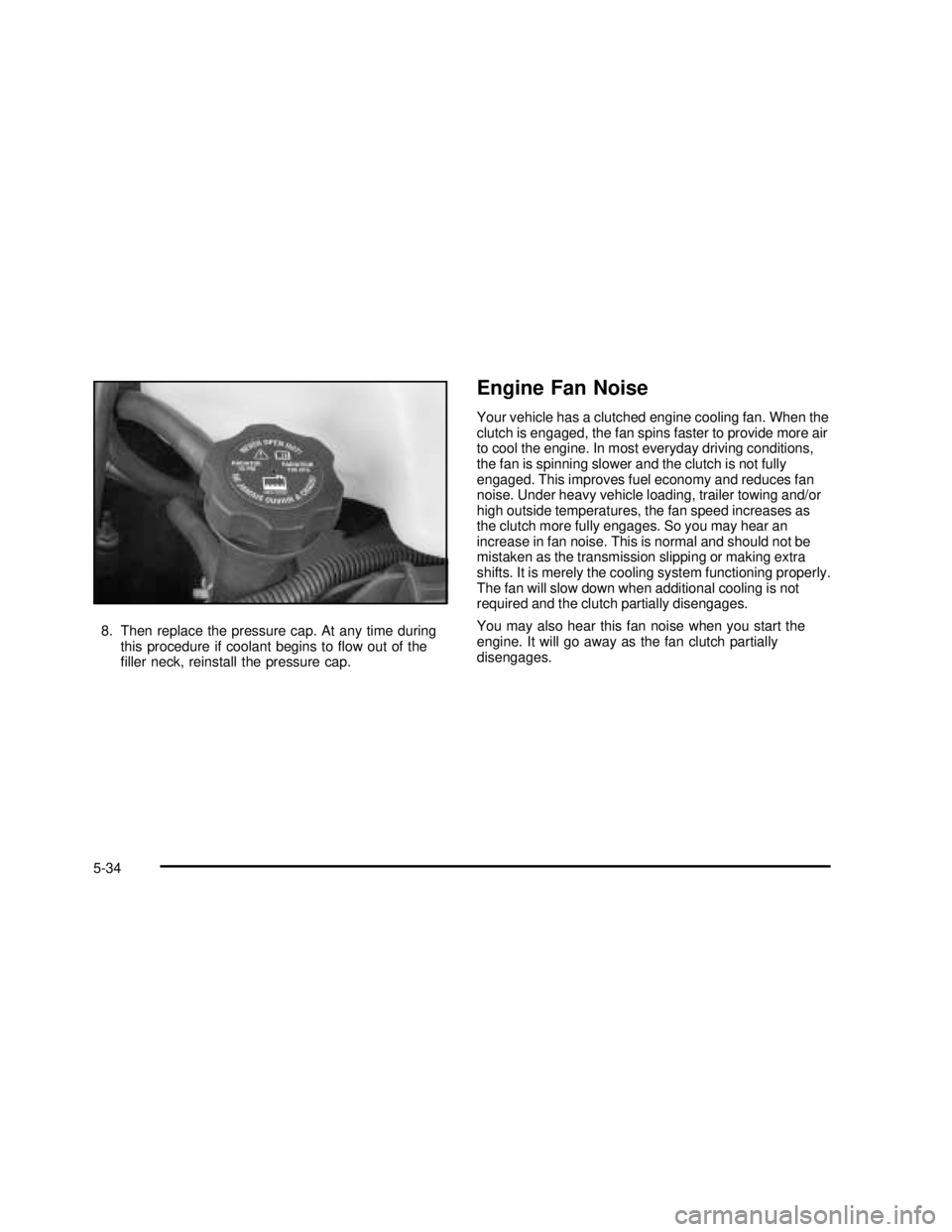
8. Then replace the pressure cap. At any time during
this procedure if coolant begins toflow out of the
filler neck, reinstall the pressure cap.
Engine Fan Noise
Your vehicle has a clutched engine cooling fan. When the
clutch is engaged, the fan spins faster to provide more air
to cool the engine. In most everyday driving conditions,
the fan is spinning slower and the clutch is not fully
engaged. This improves fuel economy and reduces fan
noise. Under heavy vehicle loading, trailer towing and/or
high outside temperatures, the fan speed increases as
the clutch more fully engages. So you may hear an
increase in fan noise. This is normal and should not be
mistaken as the transmission slipping or making extra
shifts. It is merely the cooling system functioning properly.
The fan will slow down when additional cooling is not
required and the clutch partially disengages.
You may also hear this fan noise when you start the
engine. It will go away as the fan clutch partially
disengages.
5-34
2003 - Savana OM
Page 300 of 392

After the tires have been rotated, adjust the front
and rear inflation pressures as shown on the
Certification/Tire label. Make certain that all wheel nuts
are properly tightened. See“Wheel Nut Torque”
underCapacities and Specifications on page 5-97.
{CAUTION:
Rust or dirt on a wheel, or on the parts to
which it is fastened, can make wheel nuts
become loose after a time. The wheel could
come off and cause an accident. When you
change a wheel, remove any rust or dirt from
places where the wheel attaches to the vehicle.
In an emergency, you can use a cloth or a
paper towel to do this; but be sure to use a
scraper or wire brush later, if you need to, to
get all the rust or dirt off. See“Changing a Flat
Tire”in the Index.
When It Is Time for New Tires
One way to tell when it’s
time for new tires is to
check the treadwear
indicators, which will
appear when your tires
have only 1/16 inch
(1.6 mm) or less of tread
remaining. Some
commercial truck tires
may not have treadwear
indicators.
You need a new tire if any of the following statements
are true:
•You can see the indicators at three or more places
around the tire.
•You can see cord or fabric showing through the
tire’s rubber.
•The tread or sidewall is cracked, cut or snagged
deep enough to show cord or fabric.
•The tire has a bump, bulge or split.
•The tire has a puncture, cut or other damage that
can’t be repaired well because of the size or
location of the damage.
5-60
2003 - Savana OM
Page 305 of 392

Tire Chains
Notice:Use tire chains only where legal and only
when you must. Use chains that are the proper size
for your tires. Install them on the tires of the rear
axle. Tighten them as tightly as possible with
the ends securely fastened. Drive slowly and follow
the chain manufacturer’s instructions. If you can
hear the chains contacting your vehicle, stop
and retighten them. If the contact continues, slow
down until it stops. Driving too fast or spinning the
wheels with chains on will damage your vehicle.
If a Tire Goes Flat
It’s unusual for a tire to“blowout”while you’re driving,
especially if you maintain your tires properly. If air goes
out of a tire, it’s much more likely to leak out slowly.
But if you should ever have a“blowout”, here are a few
tips about what to expect and what to do:
If a front tire fails, theflat tire will create a drag that
pulls the vehicle toward that side. Take your foot off the
accelerator pedal and grip the steering wheelfirmly.
Steer to maintain lane position, and then gently brake to
a stop well out of the traffic lane.
A rear blowout, particularly on a curve, acts much like a
skid and may require the same correction you’d use
in a skid. In any rear blowout, remove your foot from the
accelerator pedal. Get the vehicle under control by
steering the way you want the vehicle to go. It may be
very bumpy and noisy, but you can still steer. Gently
brake to a stop—well off the road if possible.
If a tire goesflat, the next part shows how to use your
jacking equipment to change aflat tire safely.
5-65
2003 - Savana OM
Page 309 of 392
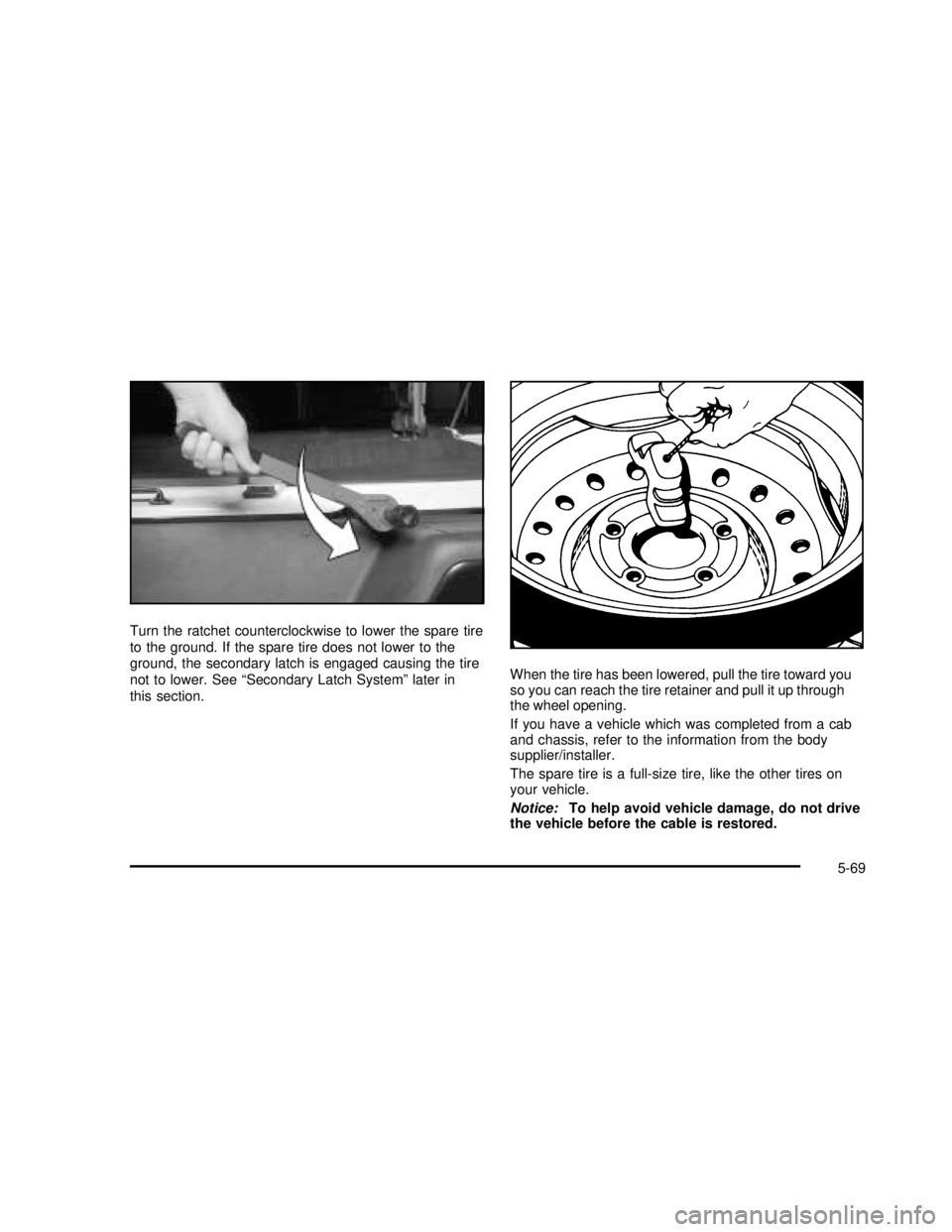
Turn the ratchet counterclockwise to lower the spare tire
to the ground. If the spare tire does not lower to the
ground, the secondary latch is engaged causing the tire
not to lower. See“Secondary Latch System”later in
this section.When the tire has been lowered, pull the tire toward you
so you can reach the tire retainer and pull it up through
the wheel opening.
If you have a vehicle which was completed from a cab
and chassis, refer to the information from the body
supplier/installer.
The spare tire is a full-size tire, like the other tires on
your vehicle.
Notice:To help avoid vehicle damage, do not drive
the vehicle before the cable is restored.
5-69
2003 - Savana OM
Page 310 of 392

Secondary Latch System
Your vehicle has an underbody mounted tire hoist
assembly equipped with a secondary latch system. It’s
designed to stop the spare tire from suddenly falling
off your vehicle if the cable holding the spare tire
is damaged. For the secondary latch to work, the tire
must be stowed with the valve stem pointing down.
See“Storing the Spare Tire and Tools”later in
this section for instructions on storing the spare tire
correctly.
{CAUTION:
Before beginning this procedure read all the
instructions. Failure to read and follow the
instructions could damage the hoist assembly
and you and others could get hurt. Read and
follow the instructions listed below.To release the spare tire from the secondary latch,
do the following:
{CAUTION:
Someone standing too close during the
procedure could be injured by the jack. If the
spare tire does not slide off the jack
completely, make sure no one is behind you or
on either side of you as you pull the jack out
from the spare.
5-70
2003 - Savana OM
Page 317 of 392
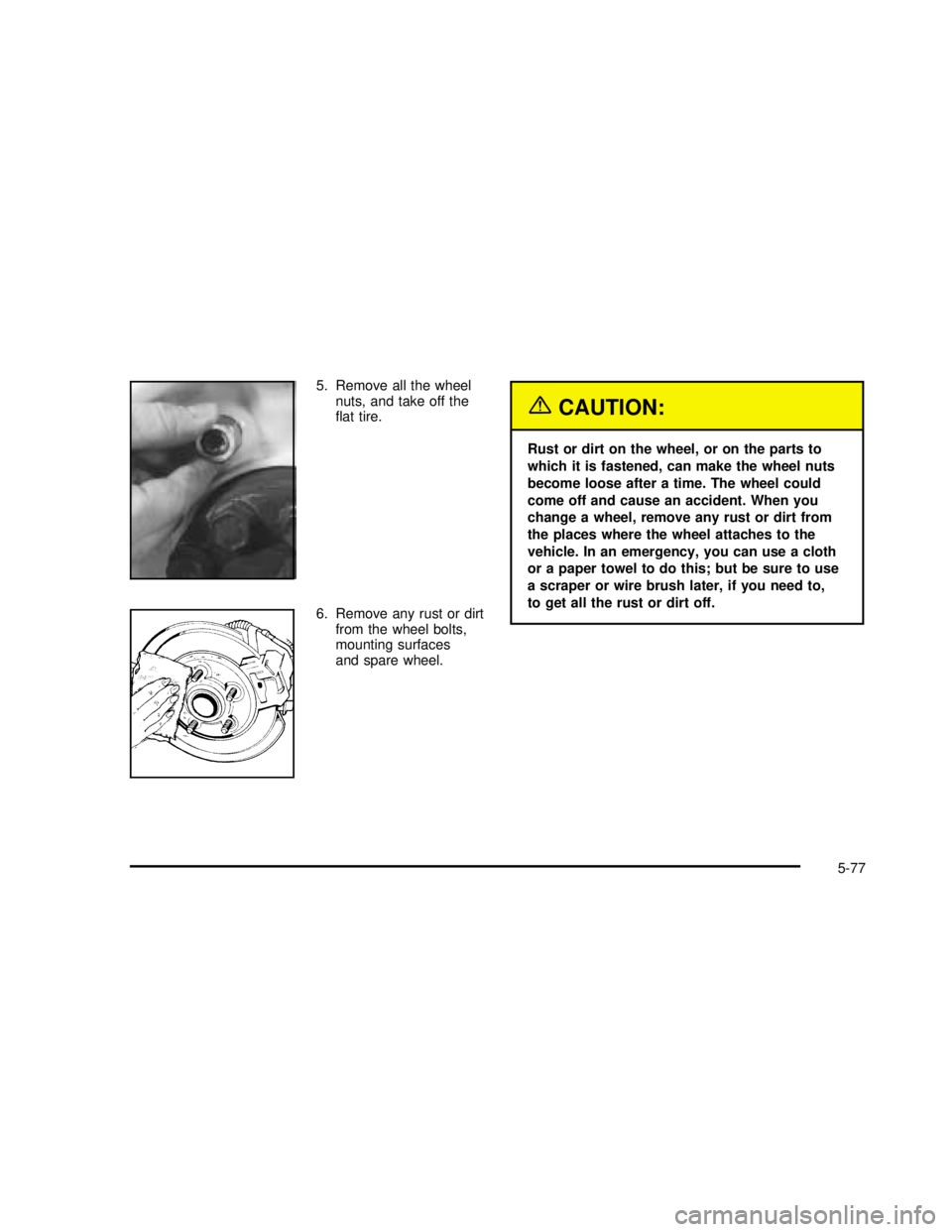
5. Remove all the wheel
nuts, and take off the
flat tire.
6. Remove any rust or dirt
from the wheel bolts,
mounting surfaces
and spare wheel.
{CAUTION:
Rust or dirt on the wheel, or on the parts to
which it is fastened, can make the wheel nuts
become loose after a time. The wheel could
come off and cause an accident. When you
change a wheel, remove any rust or dirt from
the places where the wheel attaches to the
vehicle. In an emergency, you can use a cloth
or a paper towel to do this; but be sure to use
a scraper or wire brush later, if you need to,
to get all the rust or dirt off.
5-77
2003 - Savana OM
Page 318 of 392
{CAUTION:
Never use oil or grease on studs or nuts. If you
do, the nuts might come loose. Your wheel
could fall off, causing a serious accident.
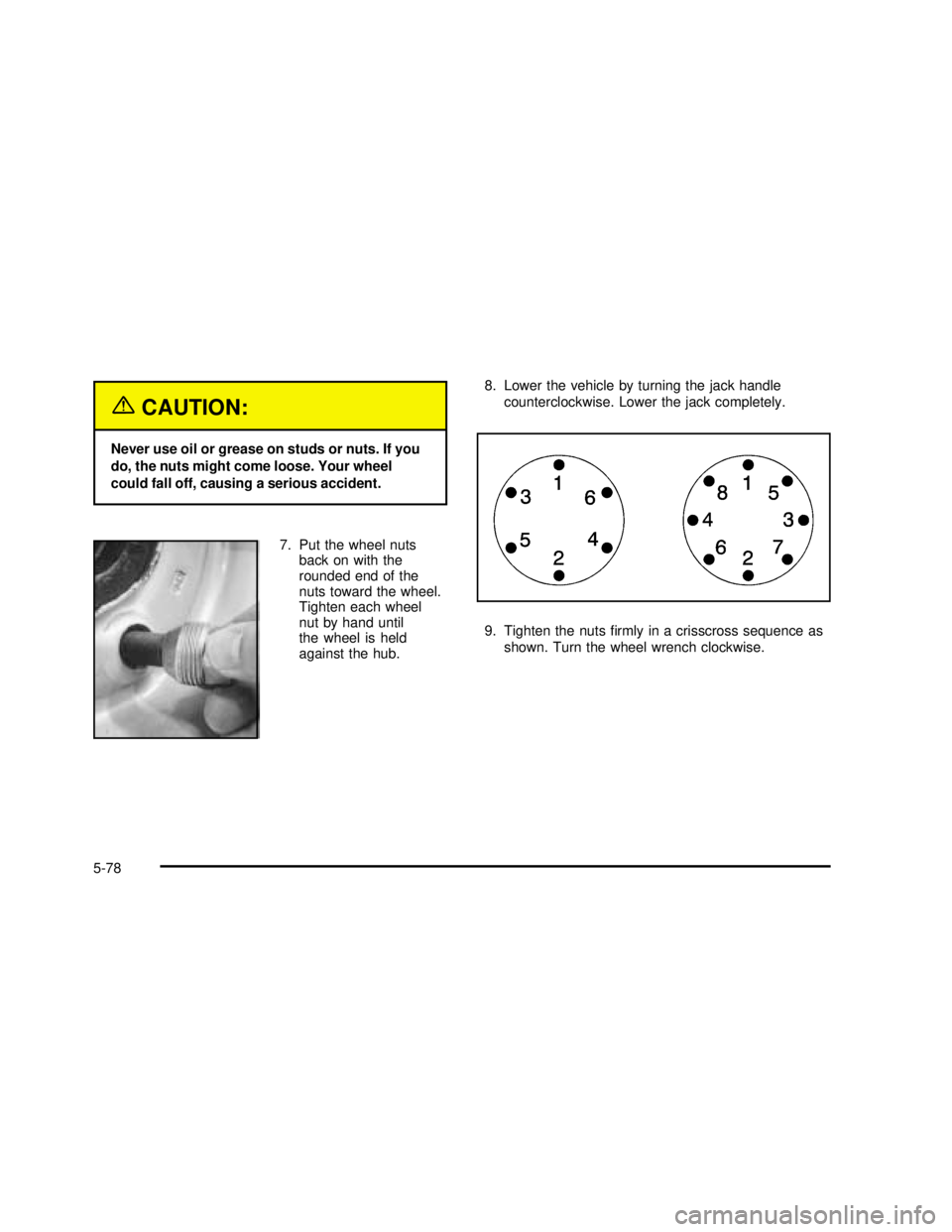
7. Put the wheel nuts
back on with the
rounded end of the
nuts toward the wheel.
Tighten each wheel
nut by hand until
the wheel is held
against the hub.8. Lower the vehicle by turning the jack handle
counterclockwise. Lower the jack completely.
9. Tighten the nutsfirmly in a crisscross sequence as
shown. Turn the wheel wrench clockwise.
5-78
2003 - Savana OM
Page 321 of 392
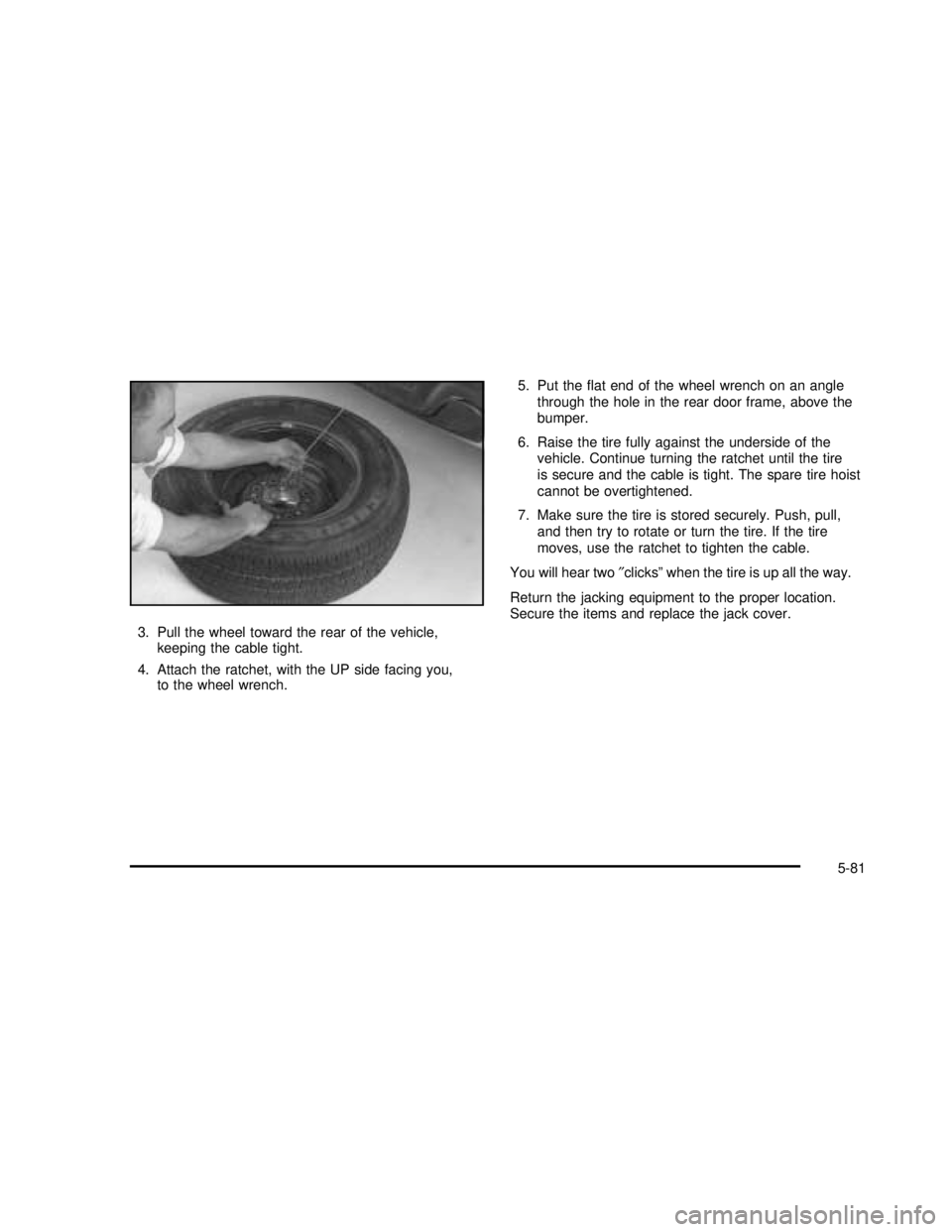
3. Pull the wheel toward the rear of the vehicle,
keeping the cable tight.
4. Attach the ratchet, with the UP side facing you,
to the wheel wrench.5. Put theflat end of the wheel wrench on an angle
through the hole in the rear door frame, above the
bumper.
6. Raise the tire fully against the underside of the
vehicle. Continue turning the ratchet until the tire
is secure and the cable is tight. The spare tire hoist
cannot be overtightened.
7. Make sure the tire is stored securely. Push, pull,
and then try to rotate or turn the tire. If the tire
moves, use the ratchet to tighten the cable.
You will hear two″clicks”when the tire is up all the way.
Return the jacking equipment to the proper location.
Secure the items and replace the jack cover.
5-81
2003 - Savana OM