brake light GMC SAVANA 2004 User Guide
[x] Cancel search | Manufacturer: GMC, Model Year: 2004, Model line: SAVANA, Model: GMC SAVANA 2004Pages: 398, PDF Size: 4.4 MB
Page 215 of 398
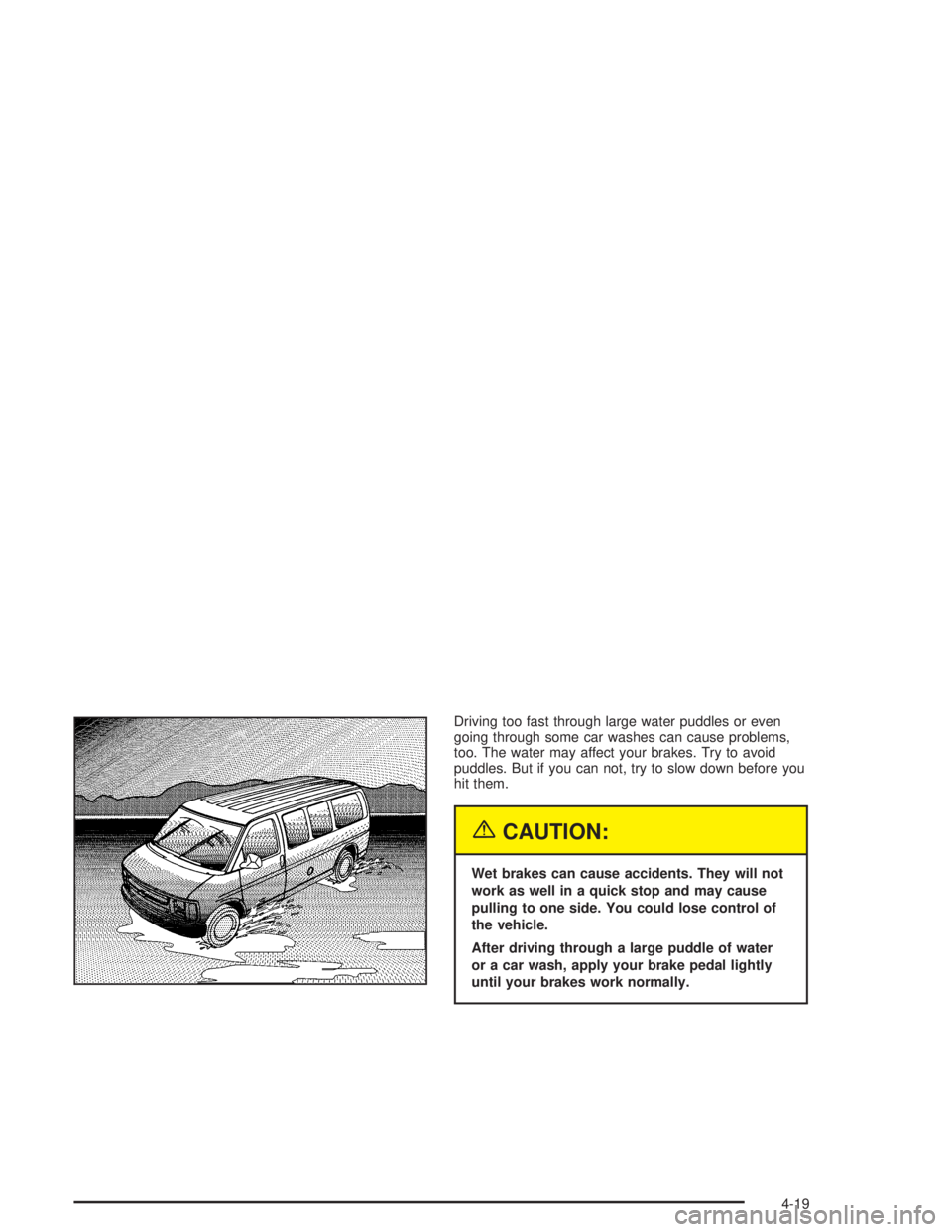
Driving too fast through large water puddles or even
going through some car washes can cause problems,
too. The water may affect your brakes. Try to avoid
puddles. But if you can not, try to slow down before you
hit them.
{CAUTION:
Wet brakes can cause accidents. They will not
work as well in a quick stop and may cause
pulling to one side. You could lose control of
the vehicle.
After driving through a large puddle of water
or a car wash, apply your brake pedal lightly
until your brakes work normally.
4-19
Page 246 of 398
Maintenance When Trailer Towing
Your vehicle will need service more often when you’re
pulling a trailer. See the Maintenance Schedule for more
on this. Things that are especially important in trailer
operation are automatic transmission uid (don’t overll),
engine oil, axle lubricant, belt, cooling system and
brake system. Each of these is covered in this manual,
and the Index will help you nd them quickly. If
you’re trailering, it’s a good idea to review these sections
before you start your trip.
Check periodically to see that all hitch nuts and bolts
are tight.
Trailer Wiring Harness
The optional heavy-duty trailer wiring package includes
a seven-wire harness assembly at the rear of the
vehicle and a four-wire harness assembly under the left
hand side of the instrument panel. The seven-wire
harness assembly is taped together and located in a
frame pocket at the driver side rear left corner of
the frame. The seven-wire harness includes a 30-amp
feed wire. Both harnesses come without connectors and
should be wired by a qualied electrical technician.
The technician can use the following color code chart
when connecting the wiring harness to your trailer
and trailer brake controller.Seven-Wire Harness
Light Green: Back-up lamps
Brown: Parking lamps
Yellow: Left stoplamp and turn signal
Dark Green: Right stoplamp and turn signal
Dark Blue: Use for electric trailer brakes
Orange: Trailer accessory
White (heavy gage): Ground wire
Four-Wire Harness (Trailer Brake Controller)
Black: Ground
Red/White Stripe: Fused Battery
Dark Blue: Trailer Brake Feed
Light Blue: Fused Stop/CHMSL
4-50
Page 286 of 398
Brake Wear
Your vehicle has four-wheel disc brakes.
Disc brake pads have built-in wear indicators that make
a high-pitched warning sound when the brake pads
are worn and new pads are needed. The sound
may come and go or be heard all the time your vehicle
is moving (except when you are pushing on the
brake pedal rmly).
{CAUTION:
The brake wear warning sound means that
soon your brakes will not work well. That
could lead to an accident. When you hear the
brake wear warning sound, have your vehicle
serviced.
Notice:Continuing to drive with worn-out brake
pads could result in costly brake repair.Some driving conditions or climates may cause a brake
squeal when the brakes are rst applied or lightly
applied. This does not mean something is wrong with
your brakes.
Properly torqued wheel nuts are necessary to help
prevent brake pulsation. When tires are rotated, inspect
brake pads for wear and evenly tighten wheel nuts in
the proper sequence to GM torque specications.
Brake linings should always be replaced as complete
axle sets.
Brake Pedal Travel
See your dealer if the brake pedal does not return to
normal height, or if there is a rapid increase in
pedal travel. This could be a sign of brake trouble.
Brake Adjustment
Every time you make a brake stop, your disc brakes
adjust for wear.
5-40
Page 288 of 398
Jump Starting
If your battery has run down, you may want to use
another vehicle and some jumper cables to start your
vehicle. Be sure to follow the steps below to do it safely.
{CAUTION:
Batteries can hurt you. They can be dangerous
because:
They contain acid that can burn you.
They contain gas that can explode or
ignite.
They contain enough electricity to
burn you.
If you do not follow these steps exactly, some
or all of these things can hurt you.
Notice:Ignoring these steps could result in costly
damage to your vehicle that would not be covered
by your warranty.
Trying to start your vehicle by pushing or pulling it
will not work, and it could damage your vehicle.
1. Check the other vehicle. It must have a 12-volt
battery with a negative ground system.Notice:If the other vehicle’s system is not a 12-volt
system with a negative ground, both vehicles can
be damaged. Only use vehicles with 12-volt systems
with negative grounds to jump start your vehicle.
2. Get the vehicles close enough so the jumper cables
can reach, but be sure the vehicles aren’t touching
each other. If they are, it could cause a ground
connection you don’t want. You wouldn’t be able to
start your vehicle, and the bad grounding could
damage the electrical systems.
To avoid the possibility of the vehicles rolling, set
the parking brake rmly on both vehicles involved in
the jump start procedure. Put an automatic
transmission in PARK (P) or a manual transmission
in NEUTRAL before setting the parking brake.
Notice:If you leave your radio or other accessories
on during the jump starting procedure, they could
be damaged. The repairs would not be covered
by your warranty. Always turn off your radio and
other accessories when jump starting your vehicle.
3. Turn off the ignition on both vehicles. Unplug
unnecessary accessories plugged into the cigarette
lighter or in the accessory power outlet. Turn off
the radio and all lamps that aren’t needed. This will
avoid sparks and help save both batteries. And it
could save your radio!
5-42
Page 308 of 398
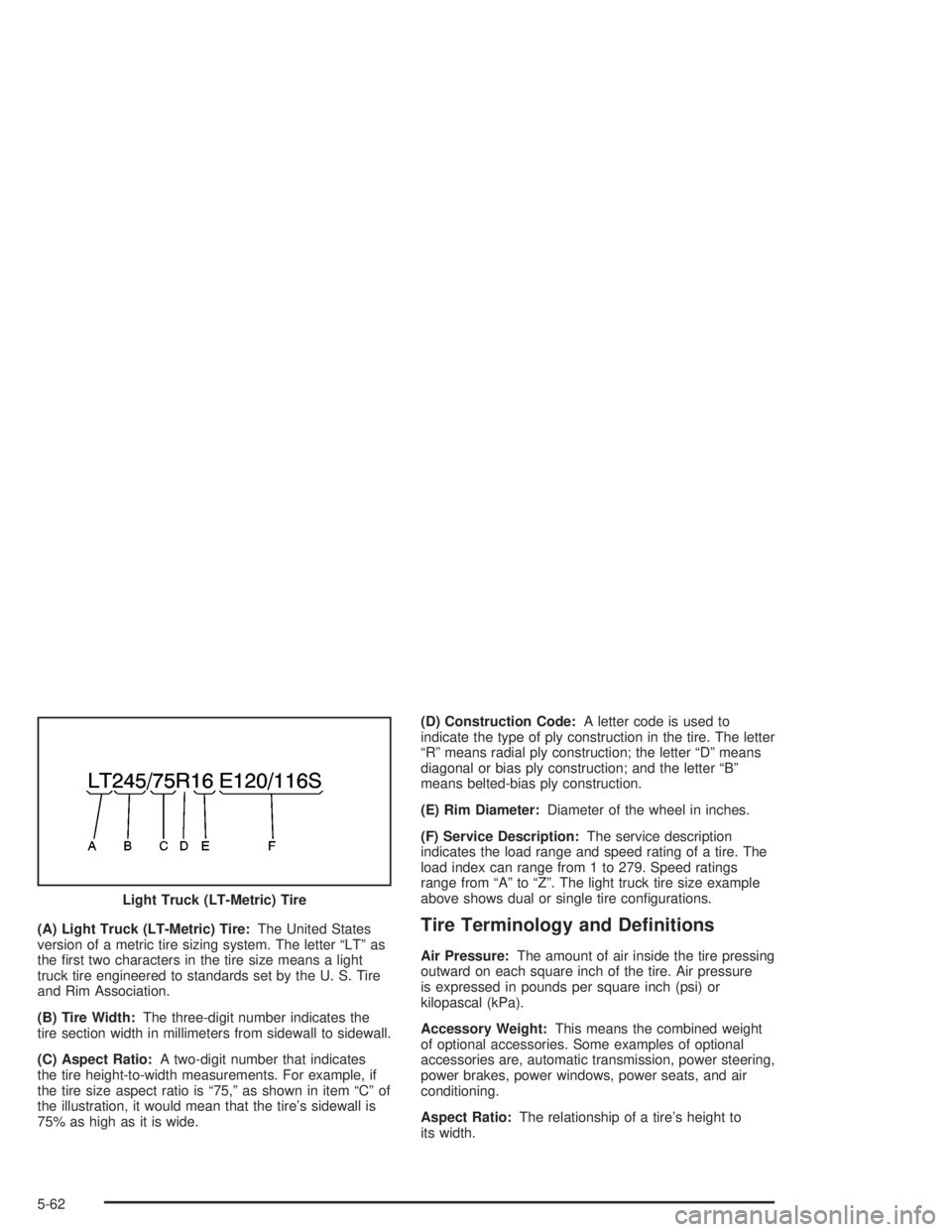
(A) Light Truck (LT-Metric) Tire:The United States
version of a metric tire sizing system. The letter “LT” as
the rst two characters in the tire size means a light
truck tire engineered to standards set by the U. S. Tire
and Rim Association.
(B) Tire Width:The three-digit number indicates the
tire section width in millimeters from sidewall to sidewall.
(C) Aspect Ratio:A two-digit number that indicates
the tire height-to-width measurements. For example, if
the tire size aspect ratio is “75,” as shown in item “C” of
the illustration, it would mean that the tire’s sidewall is
75% as high as it is wide.(D) Construction Code:A letter code is used to
indicate the type of ply construction in the tire. The letter
“R” means radial ply construction; the letter “D” means
diagonal or bias ply construction; and the letter “B”
means belted-bias ply construction.
(E) Rim Diameter:Diameter of the wheel in inches.
(F) Service Description:The service description
indicates the load range and speed rating of a tire. The
load index can range from 1 to 279. Speed ratings
range from “A” to “Z”. The light truck tire size example
above shows dual or single tire congurations.Tire Terminology and Denitions
Air Pressure:The amount of air inside the tire pressing
outward on each square inch of the tire. Air pressure
is expressed in pounds per square inch (psi) or
kilopascal (kPa).
Accessory Weight:This means the combined weight
of optional accessories. Some examples of optional
accessories are, automatic transmission, power steering,
power brakes, power windows, power seats, and air
conditioning.
Aspect Ratio:The relationship of a tire’s height to
its width. Light Truck (LT-Metric) Tire
5-62
Page 350 of 398

Fuse Usage
4 Right Rear Turn Lamp
5 Backup Lamps Trailer Wiring
6 Ignition 0
7 Stop Lamp
8 Right Rear Defogger/Heated Mirror
9 Right Daytime Running Lamp/Turn Signal
10 Left Daytime Running Lamp/Turn Signal
11 Truck Body Control Module 4
12 Fuel Pump
13 Trailer
14 Flasher
15 Horn
16 Truck Body Control Module 3
17 Trailer Stop/Turn Signal
18 Truck Body Control Module 2
19 Truck Body Control Module
20 Remote Function Actuator
21 Engine 2Fuse Usage
22 Ignition E
23 Engine 1
24 Truck Body Control Module Ignition 1
25 Spare
26 RPA/Inside Rearview Mirror
27 Crankcase
28 Brake Transmission Shift Interlock System
29 Auxiliary Power Outlets
30 Cigarette Lighter
31 Instrument Panel Cluster
32 Air Conditioning
33 Spare
34 Vent
35 Spare
36 Vehicle Back Up
37 Supplemental Inatable Restraint System
38 Powertrain Control Module Ignition 1
39 Oxygen Sensor B
5-104
Page 362 of 398
(e)Make sure the safety belt reminder light and all your
belts, buckles, latch plates, retractors and anchorages
are working properly. Look for any other loose or
damaged safety belt system parts. If you see anything
that might keep a safety belt system from doing its
job, have it repaired. Have any torn or frayed safety belts
replaced. Also look for any opened or broken air bag
coverings, and have them repaired or replaced. (The air
bag system does not need regular maintenance.)
(f)Lubricate all key lock cylinders, hood hinges, hood
prop rod pivot, hood latch assembly, secondary
latch, pivots, spring anchor, release pawl, rear
compartment hinges, latches, locks, fuel door hinge and
any moving seat hardware. More frequent lubrication
may be required when exposed to a corrosive
environment. Applying silicone grease on weatherstrips
with a clean cloth will make them last longer, seal
better and not stick or squeak.
(g)Vehicles with GVWR above 10,000 lbs. only: Inspect
shields for damage or looseness. Adjust or replace
as required. This is a Noise Emission Control Service.
Applicable only to vehicles sold in the United States.
(h)Change automatic transmission uid and lter if the
vehicle is mainly driven under one or more of these
conditions:
In heavy city traffic where the outside temperature
regularly reaches 90°F (32°C) or higher.
In hilly or mountainous terrain.When doing frequent trailer towing.
Uses such as found in taxi, police or delivery
service.
(i)Drain, ush and rell cooling system. See Engine
Coolant on page 5-19for what to use. Inspect hoses.
Clean radiator, condenser, pressure cap and ller neck.
Pressure test the cooling system and pressure cap.
(j)A uid loss in any vehicle system could indicate a
problem. Have the system inspected and repaired and
the uid level checked. Add uid if needed.
(k)Clean and repack the front wheel bearings (or at
each brake relining, whichever occurs rst).
(l)Inspect system. Check all fuel and vapor lines and
hoses for proper hook-up, routing and condition. Check
that the purge valve works properly (if equipped).
Replace as needed.
(m)Check system for interference or binding and for
damaged or missing parts. Replace parts as needed.
Replace any components that have high effort or
excessive wear. Do not lubricate accelerator or cruise
control cables.
6-8
Page 385 of 398
A
Accessory Power Outlets.................................3-18
Adding Equipment to Your
Air Bag-Equipped Vehicle.............................1-79
Adding Washer Fluid.......................................5-37
Additional Program Information........................... 7-9
Additives, Fuel................................................. 5-6
Add-On Electrical Equipment...........................5-101
Add-On Equipment..........................................4-37
Adjusting the Speakers
(Balance/Fade)....................3-45, 3-47, 3-52, 3-63
Air Bag
Off Light.....................................................3-29
Readiness Light..........................................3-28
Air Bag System..............................................1-67
Adding Equipment to Your
Air Bag-Equipped Vehicle..........................1-79
Air Bag Off Switch.......................................1-75
How Does an Air Bag Restrain?....................1-73
Servicing Your Air Bag-Equipped Vehicle.........1-78
What Makes an Air Bag Inate?....................1-73
What Will You See After an
Air Bag Inates?......................................1-74
When Should an Air Bag Inate?...................1-71
Where Are the Air Bags?..............................1-70
Air Bag Systems.............................................1-73
Air Cleaner/Filter, Engine.................................5-18
Airbag Sensing and Diagnostic Module (SDM)......... 7-9All Overseas Locations...................................... 7-4
All-Wheel Drive...............................................5-47
All-Wheel Drive (AWD) System.........................2-26
AM ...............................................................3-72
AM-FM Radio.................................................3-43
Antenna, Fixed Mast.......................................3-74
Anti-lock Brake System..................................... 4-7
Anti-Lock Brake, System Warning Light..............3-33
Appearance Care............................................5-92
Care of Safety Belts....................................5-95
Chemical Paint Spotting...............................5-98
Cleaning the Inside of Your Vehicle................5-92
Cleaning the Outside of Your Vehicle..............5-95
Finish Damage............................................5-98
Sheet Metal Damage...................................5-97
Underbody Maintenance...............................5-98
Vehicle Care/Appearance Materials................5-99
Weatherstrips..............................................5-95
Ashtrays........................................................3-18
Audio System(s).............................................3-42
AM-FM Radio.............................................3-43
Care of Your Cassette Tape Player................3-72
Care of Your CD Player...............................3-74
Care of Your CDs........................................3-74
Chime Level Adjustment...............................3-74
Fixed Mast Antenna.....................................3-74
Radio with Cassette and CD.........................3-50
Radio with CD............................................3-46
Radio with Six-Disc CD................................3-61
1
Page 386 of 398
Audio System(s) (cont.)
Setting the Time for Radios with
Radio Data Systems (RDS).......................3-43
Setting the Time for Radios without
Radio Data Systems (RDS).......................3-43
Theft-Deterrent Feature................................3-72
Understanding Radio Reception.....................3-72
Automatic Transmission
Fluid..........................................................5-19
Operation...................................................2-24
B
Backing Up....................................................4-48
Battery..........................................................5-41
Battery Replacement......................................... 2-6
Battery Run-Down Protection............................3-17
Before Leaving on a Long Trip.........................4-23
Brake
Parking......................................................2-26
System Warning Light..................................3-32
Brake Adjustment............................................5-40
Brake Fluid....................................................5-38
Brake Pedal Travel.........................................5-40
Brake Wear...................................................5-40
Brakes..........................................................5-38
Braking........................................................... 4-6
Braking in Emergencies..................................... 4-9Break-In, New Vehicle.....................................2-20
Bulb Replacement...........................................5-51
Front Turn Signal, Sidemarker and
Parking Lamps.........................................5-53
Halogen Bulbs............................................5-51
Headlamps.................................................5-51
Replacement Bulbs......................................5-55
Taillamps....................................................5-53
Buying New Tires...........................................5-70
C
California Fuel.................................................. 5-5
Canada........................................................... 7-4
Canadian Owners................................................ ii
Canadian Roadside Assistance........................... 7-7
Capacities and Specications..........................5-106
Carbon Monoxide...........................4-26, 4-37, 2-30
Care of
Safety Belts................................................5-95
Your Cassette Tape Player............................3-72
Your CD Player...........................................3-74
Your CDs ...................................................3-74
Cargo Door Relocking....................................... 2-9
Cargo Vans and Cab and Chassis Models
with an Air Bag Off Switch............................1-48
Cargo Vans and Cab and Chassis Models
without an Air Bag Off Switch........................1-47
2
Page 387 of 398
Cargo Vans with a Passenger Air Bag and
an Air Bag Off Switch, Passenger Vans
and Cab and Chassis Models.......................1-36
Cargo Vans with a Passenger Air Bag and
without an Air Bag Off Switch........................1-39
Cassette Tape Messages.................................3-58
CD Adapter Kits.............................................3-58
CD Messages................................3-50, 3-60, 3-71
Center High Mounted
Stoplamp (CHMSL)......................................5-55
Center High-Mounted Stoplamp.........................3-16
Center Passenger Position, Safety Belts.......1-24, 1-25
Chains, Tires..................................................5-73
Charging System Light....................................3-30
Check
Engine Light...............................................3-35
Gages Warning Light...................................3-41
Check Engine Light.........................................3-35
Checking Brake Fluid......................................5-39
Checking Coolant............................................5-23
Checking Engine Oil........................................5-13
Checking Things Under the Hood....................... 5-9
Checking Your Restraint Systems......................1-79
Chemical Paint Spotting...................................5-98
Child Restraints
Child Restraint Systems...............................1-42
Infants and Young Children...........................1-36
Lower Anchorages and Top Tethers for
Children (LATCH System)..........................1-52Child Restraints (cont.)
Older Children.............................................1-32
Securing a Child Restraint Designed for
the LATCH System...................................1-54
Securing a Child Restraint in a
Center Seat Position.........................1-59, 1-60
Securing a Child Restraint in a
Rear Outside Seat Position........................1-57
Securing a Child Restraint in the
Right Front Seat Position..........................1-62
Top Strap...................................................1-49
Top Strap Anchor Location............................1-50
Where to Put the Restraint...........................1-45
Chime Level Adjustment..................................3-74
Cigarette Lighter.............................................3-18
Cleaning
Inside of Your Vehicle..................................5-92
Outside of Your Vehicle................................5-95
Underbody Maintenance...............................5-98
Weatherstrips..............................................5-95
Cleaning Aluminum Wheels..............................5-97
Cleaning Exterior Lamps/Lenses.......................5-96
Cleaning Fabric/Carpet....................................5-92
Cleaning Glass Surfaces..................................5-94
Cleaning Interior Plastic Components.................5-94
Cleaning Leather............................................5-94
Cleaning the Top of the Instrument Panel...........5-94
Cleaning the Windshield and Wiper Blades.........5-97
Cleaning Tires................................................5-97
Cleaning Vinyl................................................5-97
3