towing GMC SAVANA 2007 Owner's Guide
[x] Cancel search | Manufacturer: GMC, Model Year: 2007, Model line: SAVANA, Model: GMC SAVANA 2007Pages: 452, PDF Size: 2.68 MB
Page 279 of 452
During your trip, check occasionally to be sure
that the load is secure, and that the lamps and any
trailer brakes are still working.
Following Distance
Stay at least twice as far behind the vehicle ahead
as you would when driving your vehicle without
a trailer. This can help you avoid situations
that require heavy braking and sudden turns.
Passing
You’ll need more passing distance up ahead when
you’re towing a trailer. And, because you’re a
good deal longer, you’ll need to go much farther
beyond the passed vehicle before you can
return to your lane.
Backing Up
Hold the bottom of the steering wheel with
one hand. Then, to move the trailer to the left, just
move that hand to the left. To move the trailer
to the right, move your hand to the right. Always
back up slowly and, if possible, have someone
guide you.
Making Turns
Notice:Making very sharp turns while
trailering could cause the trailer to come in
contact with the vehicle. Your vehicle could be
damaged. Avoid making very sharp turns
while trailering.
When you’re turning with a trailer, make wider
turns than normal. Do this so your trailer
won’t strike soft shoulders, curbs, road signs,
trees or other objects. Avoid jerky or sudden
maneuvers. Signal well in advance.
279
Page 280 of 452
Turn Signals When Towing a Trailer
When you tow a trailer, your vehicle has to have
extra wiring and a heavy-duty turn signal
flasher (included in the optional trailering package).
The arrows on your instrument panel will flash
whenever you signal a turn or lane change.
Properly hooked up, the trailer lamps will also flash,
telling other drivers you’re about to turn, change
lanes or stop.
When towing a trailer, the arrows on your
instrument panel will flash for turns even if the bulbs
on the trailer are burned out. Thus, you may think
drivers behind you are seeing your signal when
they are not. It’s important to check occasionally to
be sure the trailer bulbs are still working.
Driving On Grades
Reduce speed and shift to a lower gearbefore
you start down a long or steep downgrade. If you
don’t shift down, you might have to use your
brakes so much that they would get hot and no
longer work well.
You can tow in DRIVE (D). You may want to shift
the transmission to THIRD (3) or a lower gear
under heavy loads and/or hilly conditions.
When towing at high altitude on steep uphill grades,
consider the following: Engine coolant will boil at a
lower temperature than at normal altitudes. If you
turn your engine off immediately after towing at high
altitude on steep uphill grades, your vehicle may
show signs similar to engine overheating. To avoid
this, let the engine run while parked (preferably on
level ground) with the automatic transmission in
PARK (P) for a few minutes before turning the
engine off. If you do get the overheat warning, see
Engine Overheating on page 309.
280
Page 282 of 452
Maintenance When Trailer Towing
Your vehicle will need service more often when
you’re pulling a trailer. See the Maintenance
Schedule for more on this. Things that are
especially important in trailer operation are
automatic transmission fluid (don’t overfill), engine
oil, axle lubricant, belt, cooling system and brake
system. Each of these is covered in this manual,
and the Index will help you find them quickly.
If you’re trailering, it’s a good idea to review these
sections before you start your trip.
Check periodically to see that all hitch nuts and
bolts are tight.
Trailer Wiring Harness
The optional heavy-duty trailer wiring package
includes a seven-wire harness assembly at
the rear of the vehicle and a four-wire
harness assembly under the left hand side
of the instrument panel. The seven-wire
harness assembly is taped together and
located in a frame pocket at the driver side
rear left corner of the frame.The seven-wire harness includes a 30-amp feed
wire. Both harnesses come without connectors and
should be wired by a qualified electrical technician.
The technician can use the following color code
chart when connecting the wiring harness to
your trailer and trailer brake controller.
Seven-Wire Harness
•Light Green: Back-up lamps
•Brown: Parking lamps
•Yellow: Left stoplamp and turn signal
•Dark Green: Right stoplamp and turn signal
•Dark Blue: Use for electric trailer brakes
•Red/Black Stripe: Trailer accessory
•White (heavy gage): Ground wire
Four-Wire Harness (Trailer Brake Controller)
•Black: Ground
•Red/White Stripe: Fused Battery
•Dark Blue: Trailer Brake Feed
•Light Blue: Fused Stoplamp/CHMSL
282
Page 310 of 452
If Steam Is Coming From Your Engine
{CAUTION:
Steam from an overheated engine can
burn you badly, even if you just open the
hood. Stay away from the engine if you
see or hear steam coming from it. Just
turn it off and get everyone away from the
vehicle until it cools down. Wait until
there is no sign of steam or coolant
before you open the hood.
If you keep driving when your engine is
overheated, the liquids in it can catch re.
You or others could be badly burned.
Stop your engine if it overheats, and get
out of the vehicle until the engine is cool.
Notice:If your engine catches re because
you keep driving with no coolant, your vehicle
can be badly damaged. The costly repairs
would not be covered by your warranty.
If No Steam Is Coming From
Your Engine
If you get an engine overheat warning but see or
hear no steam, the problem may not be too
serious. Sometimes the engine can get a little too
hot when you:
•Climb a long hill on a hot day.
•Stop after high-speed driving.
•Idle for long periods in traffic.
•Tow a trailer. See “Driving on Grades” under
Towing a Trailer on page 266.
If you get the overheat warning with no sign of
steam, try this for a minute or so:
1. In heavy traffic, let the engine idle in
NEUTRAL (N) while stopped. If it is safe to do
so, pull off the road, shift to PARK (P) or
NEUTRAL (N) and let the engine idle.
2. Turn on your heater to full hot at the highest
fan speed and open the windows as
necessary.
310
Page 317 of 452
Engine Fan Noise
Your vehicle has a clutched engine cooling fan.
When the clutch is engaged, the fan spins faster to
provide more air to cool the engine. In most
everyday driving conditions, the fan is spinning
slower and the clutch is not fully engaged.
This improves fuel economy and reduces fan
noise. Under heavy vehicle loading, trailer towing,
and/or high outside temperatures, the fan speed
increases as the clutch more fully engages, so you
may hear an increase in fan noise. This is
normal and should not be mistaken as the
transmission slipping or making extra shifts. It is
merely the cooling system functioning properly.
The fan will slow down when additional cooling is
not required and the clutch partially disengages.
You may also hear this fan noise when you
start the engine. It will go away as the fan clutch
partially disengages.
Power Steering Fluid
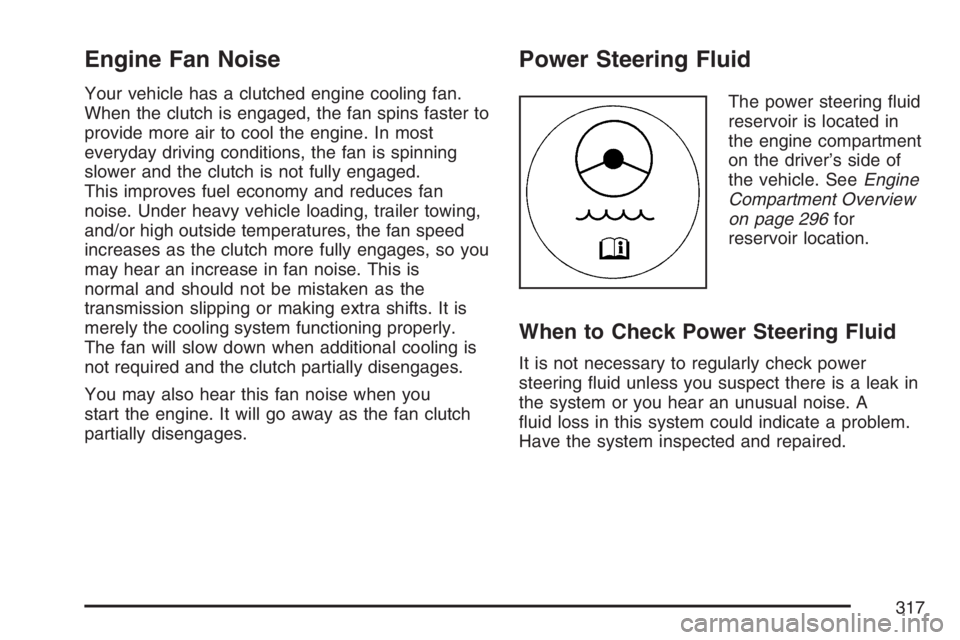
The power steering fluid
reservoir is located in
the engine compartment
on the driver’s side of
the vehicle. SeeEngine
Compartment Overview
on page 296for
reservoir location.
When to Check Power Steering Fluid
It is not necessary to regularly check power
steering fluid unless you suspect there is a leak in
the system or you hear an unusual noise. A
fluid loss in this system could indicate a problem.
Have the system inspected and repaired.
317
Page 405 of 452
(h)Change automatic transmission uid and lter
if the vehicle is mainly driven under one or
more of these conditions:
-In heavy city traffic where the outside
temperature regularly reaches 90°F (32°C) or
higher.
-In hilly or mountainous terrain.
-When doing frequent trailer towing.
-Uses such as found in taxi, police, or delivery
service.
(i)Drain, ush, and rell cooling system. This
service can be complex; you should have
your dealer perform this service. See Engine
Coolant on page 306 for what to use. Inspect
hoses. Clean radiator, condenser, pressure cap,
and ller neck. Pressure test the cooling
system and pressure cap.
(j)A uid loss in any vehicle system could indicate
a problem. Have the system inspected and
repaired and the uid level checked. Add uid if
needed.
(k)Inspect system. Check all fuel and vapor lines
and hoses for proper hook-up, routing, and
condition. Check that the purge valve works
properly, if equipped. Replace as needed.(l)If you drive regularly under dusty conditions,
inspect the lter at each engine oil change.
(m)Check system for interference or binding and
for damaged or missing parts. Replace parts
as needed. Replace any components that have
high effort or excessive wear. Do not lubricate
accelerator or cruise control cables.
(n)Visually inspect belt for fraying, excessive
cracks, or obvious damage. Replace belt if
necessary.
Owner Checks and Services
These owner checks and services should be
performed at the intervals specified to help ensure
the safety, dependability, and emission control
performance of your vehicle. Your GM
Goodwrench
®dealer can assist you with these
checks and services.
Be sure any necessary repairs are completed at
once. Whenever any fluids or lubricants are added
to your vehicle, make sure they are the proper
ones, as shown inRecommended Fluids and
Lubricants on page 409.
405
Page 427 of 452
GMC and General Motors of Canada Limited
reserve the right to limit services or reimbursement
to an owner or driver when, in their sole
discretion, the claims become excessive in
frequency or type of occurrence.
Roadside Assistance is not part of or included in
the coverage provided by the New Vehicle Limited
Warranty. GMC and General Motors of Canada
reserve the right to make any changes or
discontinue the Roadside Assistance program
at any time without notification.
Towing and Road Service Exclusions
Specifically excluded from Roadside Assistance
coverage are towing or services for vehicles
operated on a non-public roadway or highway,
fines, impound towing caused by a violation
of local, Municipal, State, Provincial, or Federal
law, and mounting, dismounting or changing
of snow tires, chains, or other traction devices.
Courtesy Transportation
To enhance your ownership experience, we and
our participating dealers are proud to offer
Courtesy Transportation, a customer support
program for new vehicles.
For warranty repairs during the Bumper-to-Bumper
(U.S.) or Base Warranty Coverage period
(Canada), provided by the New Vehicle Limited
Warranty, interim transportation may be available
under the Courtesy Transportation program.
Several courtesy transportation options are
available to assist in reducing your inconvenience
when warranty repairs are required.
Courtesy Transportation is not a part of the New
Vehicle Limited Warranty and is available only
at participating dealers. A separate booklet entitled
“Warranty and Owner Assistance Information”
furnished with each new vehicle provides detailed
warranty coverage information.
427
Page 433 of 452
If your vehicle is leased, the leasing company
may require you to have insurance that assures
repairs with Genuine GM Original Equipment
Manufacturer (OEM) parts or Genuine
Manufacturer replacement parts. Read your
lease carefully, as you may be charged at the
end of your lease for poor quality repairs.
If an Accident Occurs
Here is what to do if you are involved in an
accident.
•Try to relax and then check to make sure you
are all right. If you are uninjured, make sure
that no one else in your vehicle, or the
other vehicle, is injured.
•If there has been an injury, call 911 for help.
Do not leave the scene of an accident until
all matters have been taken care of. Move
your vehicle only if its position puts you
in danger or you are instructed to move it
by a police officer.
•Give only the necessary and requested
information to police and other parties involved
in the accident. Do not discuss your personal
condition, mental frame of mind, or anything
unrelated to the accident. This will help guard
against post-accident legal action.
•If you need roadside assistance, call
GM Roadside Assistance. SeeRoadside
Assistance Program on page 424for more
information.
•If your vehicle cannot be driven, know where
the towing service will be taking it. Get a
card from the tow truck operator or write down
the driver’s name, the service’s name, and
the phone number.
•Remove any valuables from your vehicle before
it is towed away. Make sure this includes your
insurance information and registration if you
keep these items in your vehicle.
433
Page 449 of 452
Rear Safety Belt Comfort Guides.................. 37
Rear Seat Operation..................................... 13
Rearview Mirror, Automatic Dimming with
Compass and Temperature Display.......... 134
Rearview Mirrors......................................... 134
Reclining Seatbacks...................................... 10
Recommended Fluids and Lubricants.......... 409
Recreational Vehicle Towing........................ 264
Reduced Engine Power Light...................... 184
Remote Keyless Entry (RKE) System.......... 104
Remote Keyless Entry (RKE) System,
Operation................................................. 105
Removing the Flat Tire and Installing the
Spare Tire................................................ 365
Removing the Spare Tire and Tools............ 362
Replacement Bulbs..................................... 338
Reporting Safety Defects
Canadian Government............................. 436
General Motors........................................ 436
United States Government....................... 436
Restraint System Check
Checking the Restraint Systems................. 98
Replacing Restraint System Parts
After a Crash......................................... 99
Retained Accessory Power (RAP)................ 122Right Front Passenger Position,
Safety Belts............................................... 32
Roadside
Assistance Program................................. 424
Rocking Your Vehicle to Get it Out.............. 258
Routing, Engine Drive Belt.......................... 412
Running the Engine While Parked............... 133
S
Safety Belt
Passenger Reminder Light....................... 169
Pretensioners............................................. 40
Reminder Light........................................ 168
Safety Belts
Care of.................................................... 380
Center Passenger Position.................. 33, 34
Driver Position........................................... 22
How to Wear Safety Belts Properly............ 22
Questions and Answers About
Safety Belts............................................ 21
Rear Outside Passenger Positions............. 34
Rear Safety Belt Comfort Guides............... 37
Right Front Passenger Position.................. 32
Safety Belt Extender.................................. 40
449
Page 451 of 452
Sun Visors.................................................. 119
Swing-Out Side Door, 60/40........................ 112
Swing-Out Windows.................................... 118
T
Taillamps..................................................... 337
Theft-Deterrent, Radio................................. 223
Theft-Deterrent Systems.............................. 119
Passlock
®................................................ 119
Tilt Wheel.................................................... 147
Tires........................................................... 340
Aluminum Wheels, Cleaning..................... 382
Buying New Tires..................................... 353
Chains..................................................... 359
Changing a Flat Tire................................ 360
Cleaning.................................................. 383
Different Size........................................... 355
Dual Tire Operation.................................. 350
If a Tire Goes Flat................................... 360
Inflation - Tire Pressure............................ 348
Inspection and Rotation............................ 351
Installing the Spare Tire........................... 365
Removing the Flat Tire............................. 365
Removing the Spare Tire and Tools......... 362
Secondary Latch System......................... 371
Spare Tire................................................ 376Tires (cont.)
Storing a Flat or Spare Tire and Tools......... 375
Tire Sidewall Labeling .............................. 341
Tire Terminology and Definitions............... 345
Uniform Tire Quality Grading.................... 356
Wheel Alignment and Tire Balance........... 357
Wheel Replacement................................. 357
When It Is Time for New Tires................. 353
Tow/Haul Mode Light................................... 185
Towing
Recreational Vehicle................................. 264
Towing a Trailer....................................... 266
Your Vehicle............................................. 264
Traction
StabiliTrak
®System................................. 235
Transmission
Fluid, Automatic....................................... 303
Transmission Operation, Automatic.............. 125
Trip Odometer............................................. 168
Turn and Lane-Change Signals................... 148
Turn Signal/Multifunction Lever.................... 147
U
Understanding Radio Reception................... 224
Uniform Tire Quality Grading....................... 356
451