instrument panel GMC SAVANA 2007 Service Manual
[x] Cancel search | Manufacturer: GMC, Model Year: 2007, Model line: SAVANA, Model: GMC SAVANA 2007Pages: 452, PDF Size: 2.68 MB
Page 290 of 452
Some gasolines that are not reformulated for low
emissions may contain an octane-enhancing
additive called methylcyclopentadienyl manganese
tricarbonyl (MMT); ask the attendant where you
buy gasoline whether the fuel contains MMT.
General Motors recommends against the use of
such gasolines. Fuels containing MMT can reduce
the life of spark plugs and the performance of
the emission control system may be affected. The
malfunction indicator lamp may turn on. If this
occurs, return to your dealer for service.
Fuel E85 (85% Ethanol)
The 8th digit of your Vehicle Identification Number
(VIN) shows the code letter or number that
identifies your engine. You will find the VIN at the
top left of the instrument panel. SeeVehicle
Identication Number (VIN) on page 386.
If your vehicle has the 5.3L V8 engine
(VIN Code Z only), you may use either regular
unleaded gasoline or ethanol fuel containing up to
85% ethanol (E85); also seeFuel on page 288.
In all other engines, use only the unleaded
gasoline described underGasoline Octane on
page 288.Only vehicles that have the 5.3L V8 engine
(VIN Code Z) may use 85% ethanol fuel (E85).
General Motors encourages the use of E85
in vehicles that are designed to use it. The ethanol
in E85 is a “renewable” fuel, meaning it is made
from renewable sources such as corn and
other crops.
Many service stations will not have an
85% ethanol fuel (E85) pump available.
The U. S. Department of Energy has an
alternative fuels website (www.eere.energy.gov/
afdc/infrastructure/locator.html) that can help
you find E85 fuel. Those stations that do have
E85 should have a label indicating ethanol content.
Do not use the fuel if the ethanol content is
greater than 85%.
At a minimum, E85 should meet ASTM
Specification D 5798. By definition, this means
that fuel labeled E85 will have an ethanol content
between 70% and 85%. Filling the fuel tank
with fuel mixtures that do not meet ASTM
specifications can affect driveability and could
cause the check engine light to come on.
290
Page 309 of 452
{CAUTION:
You can be burned if you spill coolant
on hot engine parts. Coolant contains
ethylene glycol, and it will burn if the
engine parts are hot enough. Do not spill
coolant on a hot engine.
Occasionally check the coolant level in the
radiator. For information on how to add coolant to
the radiator, seeCooling System on page 311.
Radiator Pressure Cap
The radiator pressure cap is located near the
center of the engine compartment. SeeEngine
Compartment Overview on page 296for more
information on location.
Notice:If the pressure cap is not tightly
installed, coolant loss and possible engine
damage may occur. Be sure the cap is properly
and tightly secured.
Engine Overheating
You will find an engine coolant temperature gage
on your vehicle’s instrument panel. SeeEngine
Coolant Temperature Gage on page 178for more
information.
309
Page 379 of 452
4. Continue to gently rub the soiled area until the
cleaning cloth remains clean.
5. If the soil is not completely removed, use a
mild soap solution and repeat the cleaning
process that was used with plain water.
If any of the soil remains, a commercial fabric
cleaner or spot lifter may be necessary. When a
commercial upholstery cleaner or spot lifter is to be
used, test a small hidden area for colorfastness
first. If the locally cleaned area gives any
impression that a ring formation may result, clean
the entire surface.
After the cleaning process has been completed, a
paper towel can be used to blot excess moisture
from the fabric or carpet.Instrument Panel, Vinyl, and Other
Plastic Surfaces
A soft cloth dampened with water may be used to
remove dust. If a more thorough cleaning is
necessary, a clean soft cloth dampened with a
mild soap solution can be used to gently remove
dust and dirt. Never use spot lifters or removers
on plastic surfaces. Many commercial cleaners and
coatings that are sold to preserve and protect
soft plastic surfaces may permanently change the
appearance and feel of your interior and are
not recommended. Do not use silicone or
wax-based products, or those containing organic
solvents to clean your vehicle’s interior because
they can alter the appearance by increasing
the gloss in a non-uniform manner.
Some commercial products may increase gloss on
your instrument panel. The increase in gloss
may cause annoying reflections in the windshield
and even make it difficult to see through the
windshield under certain conditions.
379
Page 386 of 452
Vehicle Identication
Vehicle Identication Number (VIN)
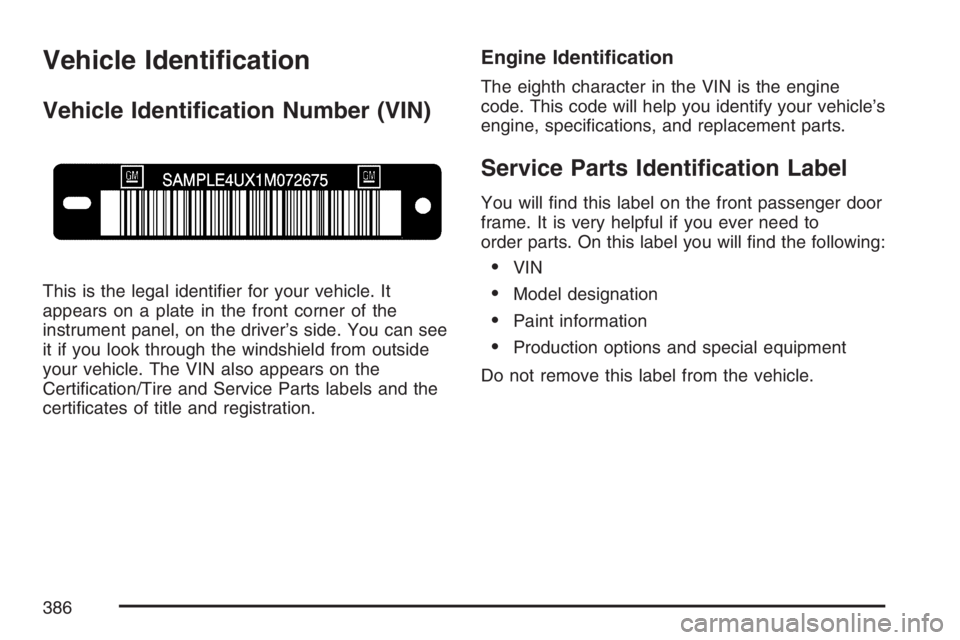
This is the legal identifier for your vehicle. It
appears on a plate in the front corner of the
instrument panel, on the driver’s side. You can see
it if you look through the windshield from outside
your vehicle. The VIN also appears on the
Certification/Tire and Service Parts labels and the
certificates of title and registration.
Engine Identication
The eighth character in the VIN is the engine
code. This code will help you identify your vehicle’s
engine, specifications, and replacement parts.
Service Parts Identication Label
You will find this label on the front passenger door
frame. It is very helpful if you ever need to
order parts. On this label you will find the following:
•VIN
•Model designation
•Paint information
•Production options and special equipment
Do not remove this label from the vehicle.
386
Page 391 of 452
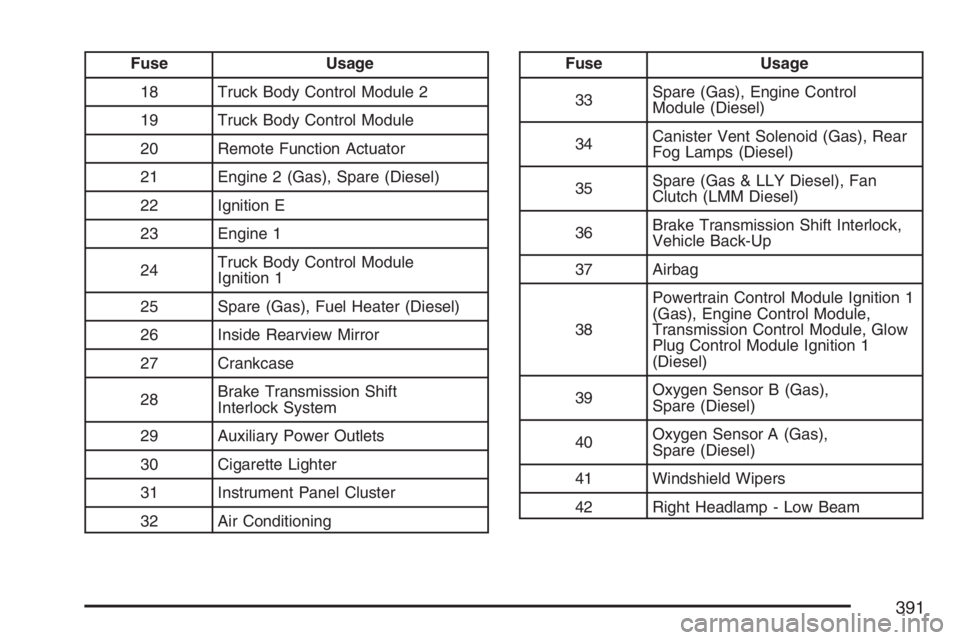
Fuse Usage
18 Truck Body Control Module 2
19 Truck Body Control Module
20 Remote Function Actuator
21 Engine 2 (Gas), Spare (Diesel)
22 Ignition E
23 Engine 1
24Truck Body Control Module
Ignition 1
25 Spare (Gas), Fuel Heater (Diesel)
26 Inside Rearview Mirror
27 Crankcase
28Brake Transmission Shift
Interlock System
29 Auxiliary Power Outlets
30 Cigarette Lighter
31 Instrument Panel Cluster
32 Air ConditioningFuse Usage
33Spare (Gas), Engine Control
Module (Diesel)
34Canister Vent Solenoid (Gas), Rear
Fog Lamps (Diesel)
35Spare (Gas & LLY Diesel), Fan
Clutch (LMM Diesel)
36Brake Transmission Shift Interlock,
Vehicle Back-Up
37 Airbag
38Powertrain Control Module Ignition 1
(Gas), Engine Control Module,
Transmission Control Module, Glow
Plug Control Module Ignition 1
(Diesel)
39Oxygen Sensor B (Gas),
Spare (Diesel)
40Oxygen Sensor A (Gas),
Spare (Diesel)
41 Windshield Wipers
42 Right Headlamp - Low Beam
391
Page 418 of 452
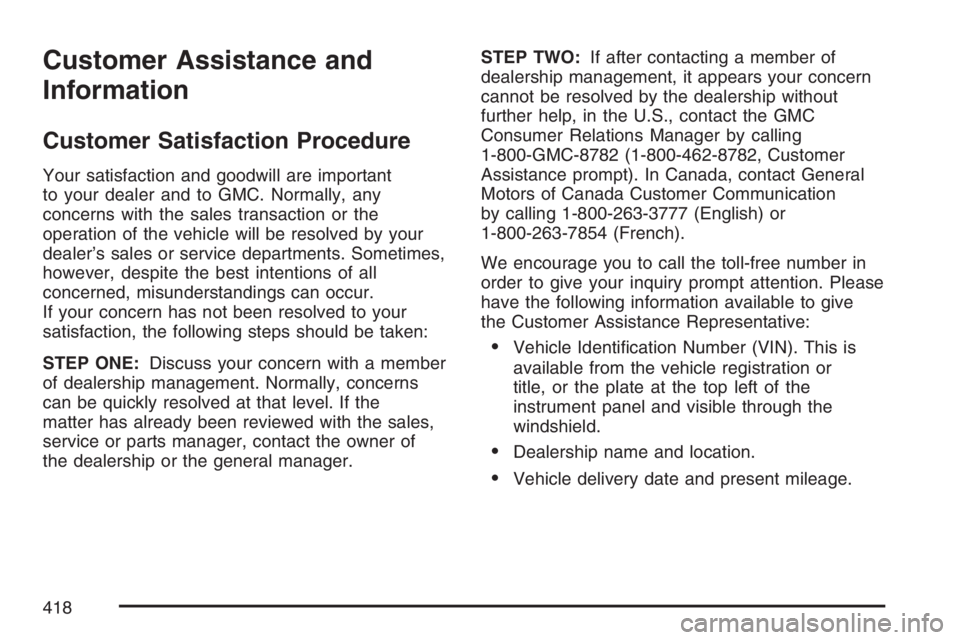
Customer Assistance and
Information
Customer Satisfaction Procedure
Your satisfaction and goodwill are important
to your dealer and to GMC. Normally, any
concerns with the sales transaction or the
operation of the vehicle will be resolved by your
dealer’s sales or service departments. Sometimes,
however, despite the best intentions of all
concerned, misunderstandings can occur.
If your concern has not been resolved to your
satisfaction, the following steps should be taken:
STEP ONE:Discuss your concern with a member
of dealership management. Normally, concerns
can be quickly resolved at that level. If the
matter has already been reviewed with the sales,
service or parts manager, contact the owner of
the dealership or the general manager.STEP TWO:If after contacting a member of
dealership management, it appears your concern
cannot be resolved by the dealership without
further help, in the U.S., contact the GMC
Consumer Relations Manager by calling
1-800-GMC-8782 (1-800-462-8782, Customer
Assistance prompt). In Canada, contact General
Motors of Canada Customer Communication
by calling 1-800-263-3777 (English) or
1-800-263-7854 (French).
We encourage you to call the toll-free number in
order to give your inquiry prompt attention. Please
have the following information available to give
the Customer Assistance Representative:
•Vehicle Identification Number (VIN). This is
available from the vehicle registration or
title, or the plate at the top left of the
instrument panel and visible through the
windshield.
•Dealership name and location.
•Vehicle delivery date and present mileage.
418
Page 439 of 452
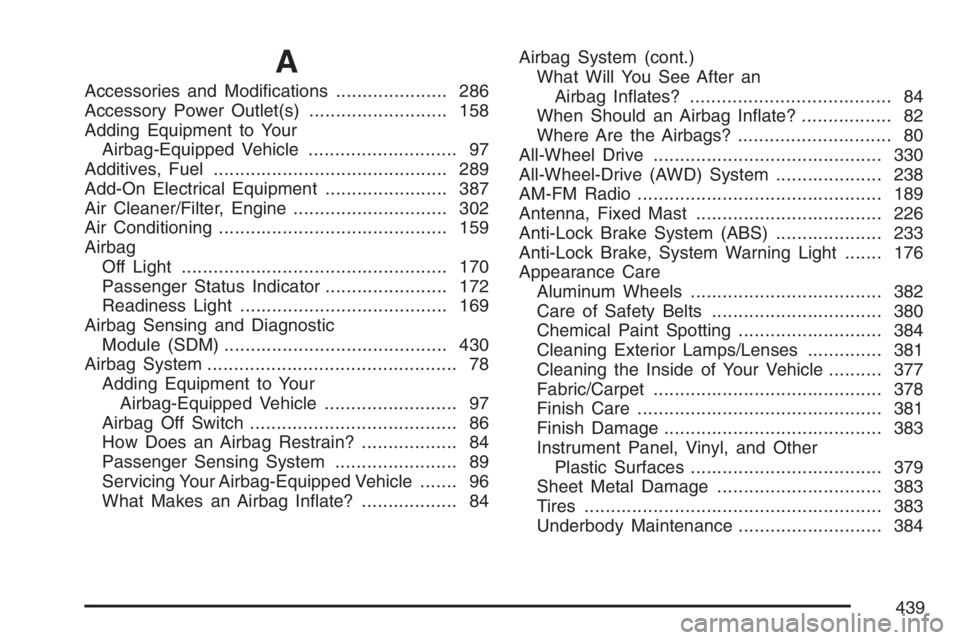
A
Accessories and Modifications..................... 286
Accessory Power Outlet(s).......................... 158
Adding Equipment to Your
Airbag-Equipped Vehicle............................ 97
Additives, Fuel............................................ 289
Add-On Electrical Equipment....................... 387
Air Cleaner/Filter, Engine............................. 302
Air Conditioning........................................... 159
Airbag
Off Light.................................................. 170
Passenger Status Indicator....................... 172
Readiness Light....................................... 169
Airbag Sensing and Diagnostic
Module (SDM).......................................... 430
Airbag System............................................... 78
Adding Equipment to Your
Airbag-Equipped Vehicle......................... 97
Airbag Off Switch....................................... 86
How Does an Airbag Restrain?.................. 84
Passenger Sensing System....................... 89
Servicing Your Airbag-Equipped Vehicle....... 96
What Makes an Airbag Inflate?.................. 84Airbag System (cont.)
What Will You See After an
Airbag Inflates?...................................... 84
When Should an Airbag Inflate?................. 82
Where Are the Airbags?............................. 80
All-Wheel Drive........................................... 330
All-Wheel-Drive (AWD) System.................... 238
AM-FM Radio.............................................. 189
Antenna, Fixed Mast................................... 226
Anti-Lock Brake System (ABS).................... 233
Anti-Lock Brake, System Warning Light....... 176
Appearance Care
Aluminum Wheels.................................... 382
Care of Safety Belts................................ 380
Chemical Paint Spotting........................... 384
Cleaning Exterior Lamps/Lenses.............. 381
Cleaning the Inside of Your Vehicle.......... 377
Fabric/Carpet........................................... 378
Finish Care.............................................. 381
Finish Damage......................................... 383
Instrument Panel, Vinyl, and Other
Plastic Surfaces.................................... 379
Sheet Metal Damage............................... 383
Tires........................................................ 383
Underbody Maintenance........................... 384
439
Page 441 of 452
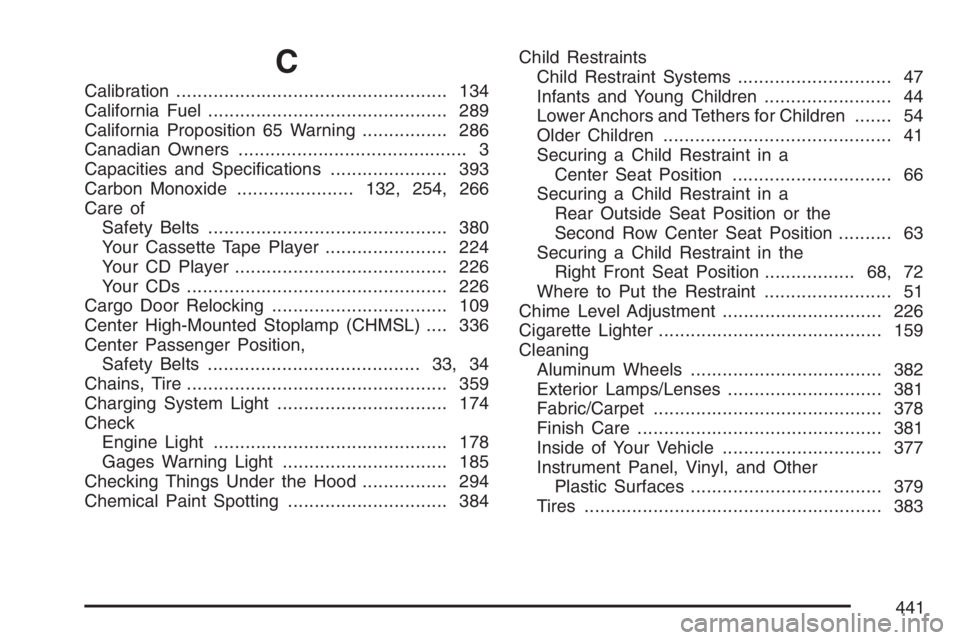
C
Calibration................................................... 134
California Fuel............................................. 289
California Proposition 65 Warning................ 286
Canadian Owners........................................... 3
Capacities and Specifications...................... 393
Carbon Monoxide......................132, 254, 266
Care of
Safety Belts............................................. 380
Your Cassette Tape Player....................... 224
Your CD Player........................................ 226
Your CDs ................................................. 226
Cargo Door Relocking................................. 109
Center High-Mounted Stoplamp (CHMSL).... 336
Center Passenger Position,
Safety Belts........................................ 33, 34
Chains, Tire................................................. 359
Charging System Light................................ 174
Check
Engine Light............................................ 178
Gages Warning Light............................... 185
Checking Things Under the Hood................ 294
Chemical Paint Spotting.............................. 384Child Restraints
Child Restraint Systems............................. 47
Infants and Young Children........................ 44
Lower Anchors and Tethers for Children....... 54
Older Children........................................... 41
Securing a Child Restraint in a
Center Seat Position.............................. 66
Securing a Child Restraint in a
Rear Outside Seat Position or the
Second Row Center Seat Position .......... 63
Securing a Child Restraint in the
Right Front Seat Position................. 68, 72
Where to Put the Restraint........................ 51
Chime Level Adjustment .............................. 226
Cigarette Lighter.......................................... 159
Cleaning
Aluminum Wheels.................................... 382
Exterior Lamps/Lenses............................. 381
Fabric/Carpet........................................... 378
Finish Care.............................................. 381
Inside of Your Vehicle .............................. 377
Instrument Panel, Vinyl, and Other
Plastic Surfaces.................................... 379
Tires........................................................ 383
441
Page 445 of 452

Headlamps.................................................. 334
Bulb Replacement.................................... 334
Daytime Running Lamps.......................... 156
Flash-to-Pass........................................... 149
Front Turn Signal, Sidemarker and
Parking Lamps..................................... 336
Halogen Bulbs......................................... 334
High/Low Beam Changer......................... 149
On Reminder........................................... 155
Heater......................................................... 159
Highbeam On Light..................................... 185
Highway Hypnosis....................................... 251
Hill and Mountain Roads............................. 252
Hood
Checking Things Under............................ 294
Release................................................... 295
Horn............................................................ 146
How to Use This Manual................................ 4
How to Wear Safety Belts Properly............... 22
I
Ignition Positions......................................... 121
Infants and Young Children, Restraints.......... 44
Inflation - Tire Pressure............................... 348Instrument Panel
Overview.................................................. 144
Instrument Panel (I/P)
Brightness................................................ 156
Cluster..................................................... 167
J
Jump Starting.............................................. 324
K
Keyless Entry System................................. 104
Keys........................................................... 102
L
Labeling, Tire Sidewall................................. 341
Lamps
Battery Run-Down Protection................... 158
Dome....................................................... 156
Dome Lamp Override............................... 157
Exterior.................................................... 154
Reading................................................... 157
445