change wheel GMC SAVANA 2010 User Guide
[x] Cancel search | Manufacturer: GMC, Model Year: 2010, Model line: SAVANA, Model: GMC SAVANA 2010Pages: 424, PDF Size: 2.4 MB
Page 341 of 424
If a Tire Goes Flat
It is unusual for a tire to blowout while you are driving,
especially if you maintain your vehicle’s tires properly.
If air goes out of a tire, it is much more likely to leak out
slowly. But if you should ever have a blowout, here
are a few tips about what to expect and what to do:
If a front tire fails, the flat tire creates a drag that pulls
the vehicle toward that side. Take your foot off the
accelerator pedal and grip the steering wheel firmly.
Steer to maintain lane position, and then gently brake to
a stop well out of the traffic lane.
A rear blowout, particularly on a curve, acts much like a
skid and may require the same correction you would
use in a skid. In any rear blowout remove your foot from
the accelerator pedal. Get the vehicle under control
by steering the way you want the vehicle to go. It may
be very bumpy and noisy, but you can still steer. Gently
brake to a stop, well off the road if possible.{WARNING:
Lifting a vehicle and getting under it to do
maintenance or repairs is dangerous without the
appropriate safety equipment and training. If a jack
is provided with the vehicle, it is designed only for
changing a flat tire. If it is used for anything else,
you or others could be badly injured or killed if the
vehicle slips off the jack. If a jack is provided with
the vehicle, only use it for changing a flat tire.
If a tire goes flat, the next part shows how to use the
jacking equipment to change a flat tire safely.
6-79
Page 342 of 424
Changing a Flat Tire
If a tire goes flat, avoid further tire and wheel damage
by driving slowly to a level place. Turn on the hazard
warning flashers. SeeHazard Warning Flashers
on page 4-3.
{WARNING:
Changing a tire can be dangerous. The vehicle
can slip off the jack and roll over or fall on you or
other people. You and they could be badly injured
or even killed. Find a level place to change your
tire. To help prevent the vehicle from moving:
1. Set the parking brake firmly.
2. Put the shift lever in P (Park).
WARNING: (Continued)
WARNING: (Continued)
3. Turn off the engine and do not restart while
the vehicle is raised.
4. Do not allow passengers to remain in the
vehicle.
To be even more certain the vehicle will not move,
you should put blocks at the front and rear of the
tire farthest away from the one being changed.
That would be the tire, on the other side, at the
opposite end of the vehicle.
6-80
Page 343 of 424
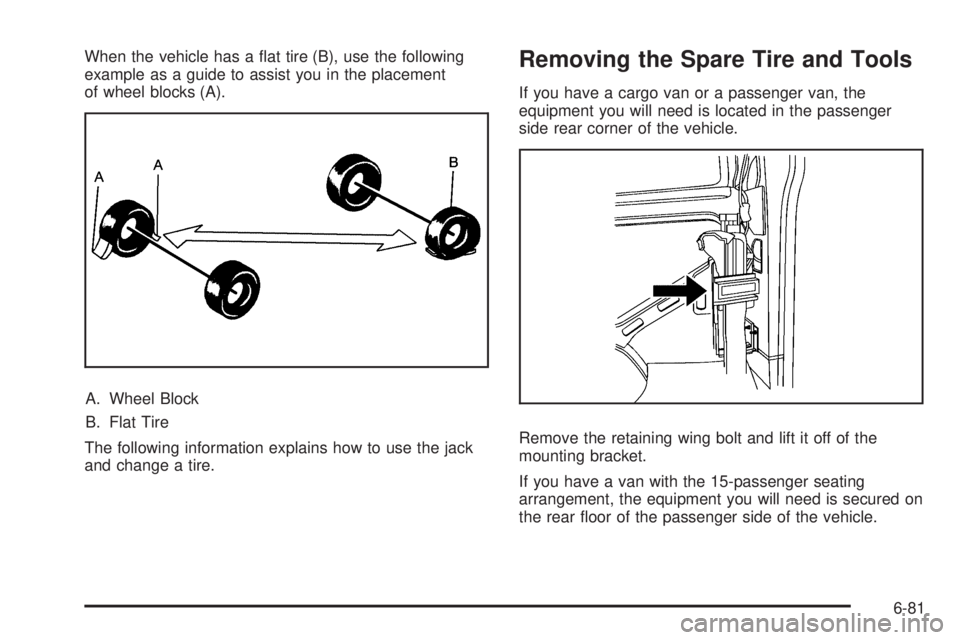
When the vehicle has a flat tire (B), use the following
example as a guide to assist you in the placement
of wheel blocks (A).
A. Wheel Block
B. Flat Tire
The following information explains how to use the jack
and change a tire.Removing the Spare Tire and Tools
If you have a cargo van or a passenger van, the
equipment you will need is located in the passenger
side rear corner of the vehicle.
Remove the retaining wing bolt and lift it off of the
mounting bracket.
If you have a van with the 15-passenger seating
arrangement, the equipment you will need is secured on
the rear floor of the passenger side of the vehicle.
6-81
Page 379 of 424
•Vehicles with diesel engine or GVWR above
4 536 kg (10,000 lbs) only: Shields inspection
for damage or looseness. Adjust or replace as
required. This is a Noise Emission Control Service.
Applicable to vehicles sold in the United States
and recommended for vehicles sold in Canada.
Additional Required Services
At the First 160 km/100 Miles, 1 600 km/
1,000 Miles, and 10 000 km/6,000 Miles
•
For vehicles with dual wheels: Check dual wheel nut
torque. For proper torque, seeCapacities and
Specications on page 6-110.
At Each Fuel Stop
•
Engine oil level check. SeeEngine Oil on
page 6-15.
•Engine coolant level check. SeeEngine Coolant on
page 6-28.
•Windshield washer fluid level check. SeeWindshield
Washer Fluid on page 6-36.
Once a Month
•
Tire inflation check. SeeInation - Tire Pressure on
page 6-63.
•Tire wear inspection. SeeTire Inspection and
Rotation on page 6-69.
Once a Year
•
Starter switch check. SeeOwner Checks and
Services on page 7-9.
•Parking brake and automatic transmission P (Park)
mechanism check. SeeOwner Checks and
Services on page 7-9.
•Automatic transmission shiftlock control system
check. SeeOwner Checks and Services on
page 7-9.
•Ignition transmission lock check. SeeOwner
Checks and Services on page 7-9.
•Engine cooling system and pressure cap pressure
check. Radiator and air conditioning condenser
outside cleaning. SeeCooling System on
page 6-26.
•Exhaust system and nearby heat shields inspection
for loose or damaged components.
•Throttle system inspection for interference, binding
or for damaged or missing parts. Replace parts as
needed. Replace any components that have
high effort or excessive wear. Do not lubricate
accelerator or cruise control cables.
First Engine Oil Change After Every
40 000 km/25,000 Miles
•
Fuel system inspection for damage or leaks.
7-5
Page 380 of 424
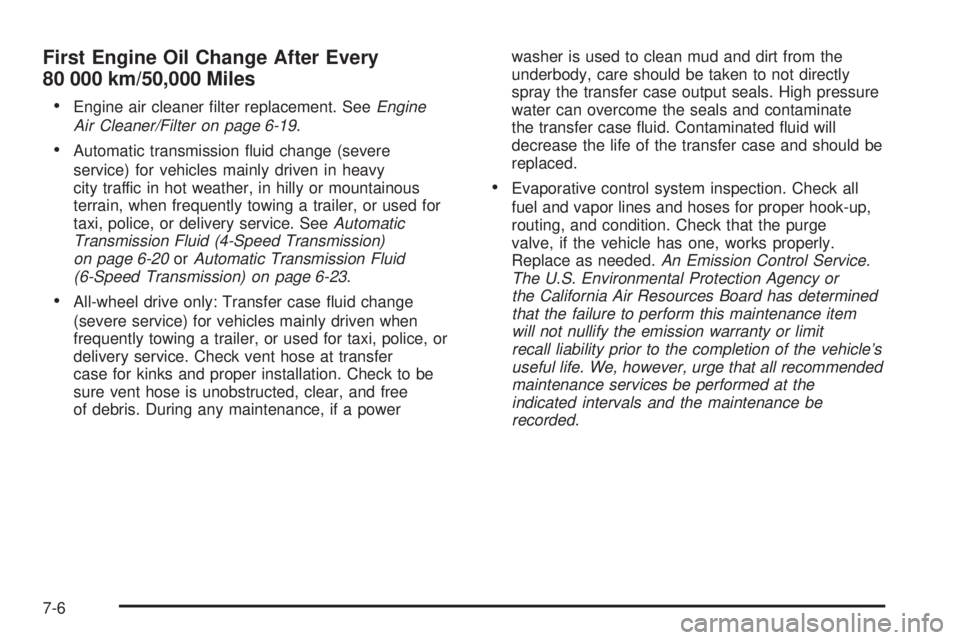
First Engine Oil Change After Every
80 000 km/50,000 Miles
•
Engine air cleaner filter replacement. SeeEngine
Air Cleaner/Filter on page 6-19.
•Automatic transmission fluid change (severe
service) for vehicles mainly driven in heavy
city traffic in hot weather, in hilly or mountainous
terrain, when frequently towing a trailer, or used for
taxi, police, or delivery service. SeeAutomatic
Transmission Fluid (4-Speed Transmission)
on page 6-20orAutomatic Transmission Fluid
(6-Speed Transmission) on page 6-23.
•All-wheel drive only: Transfer case fluid change
(severe service) for vehicles mainly driven when
frequently towing a trailer, or used for taxi, police, or
delivery service. Check vent hose at transfer
case for kinks and proper installation. Check to be
sure vent hose is unobstructed, clear, and free
of debris. During any maintenance, if a powerwasher is used to clean mud and dirt from the
underbody, care should be taken to not directly
spray the transfer case output seals. High pressure
water can overcome the seals and contaminate
the transfer case fluid. Contaminated fluid will
decrease the life of the transfer case and should be
replaced.
•Evaporative control system inspection. Check all
fuel and vapor lines and hoses for proper hook-up,
routing, and condition. Check that the purge
valve, if the vehicle has one, works properly.
Replace as needed.An Emission Control Service.
The U.S. Environmental Protection Agency or
the California Air Resources Board has determined
that the failure to perform this maintenance item
will not nullify the emission warranty or limit
recall liability prior to the completion of the vehicle’s
useful life. We, however, urge that all recommended
maintenance services be performed at the
indicated intervals and the maintenance be
recorded.
7-6
Page 381 of 424
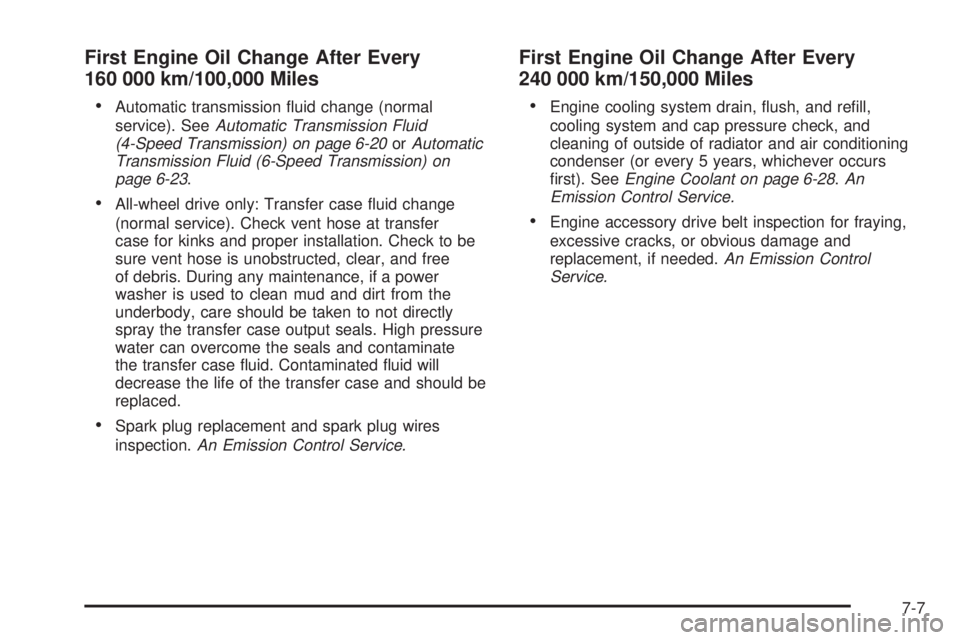
First Engine Oil Change After Every
160 000 km/100,000 Miles
•
Automatic transmission fluid change (normal
service). SeeAutomatic Transmission Fluid
(4-Speed Transmission) on page 6-20orAutomatic
Transmission Fluid (6-Speed Transmission) on
page 6-23.
•All-wheel drive only: Transfer case fluid change
(normal service). Check vent hose at transfer
case for kinks and proper installation. Check to be
sure vent hose is unobstructed, clear, and free
of debris. During any maintenance, if a power
washer is used to clean mud and dirt from the
underbody, care should be taken to not directly
spray the transfer case output seals. High pressure
water can overcome the seals and contaminate
the transfer case fluid. Contaminated fluid will
decrease the life of the transfer case and should be
replaced.
•Spark plug replacement and spark plug wires
inspection.An Emission Control Service.
First Engine Oil Change After Every
240 000 km/150,000 Miles
•
Engine cooling system drain, flush, and refill,
cooling system and cap pressure check, and
cleaning of outside of radiator and air conditioning
condenser (or every 5 years, whichever occurs
first). SeeEngine Coolant on page 6-28.An
Emission Control Service.
•Engine accessory drive belt inspection for fraying,
excessive cracks, or obvious damage and
replacement, if needed.An Emission Control
Service.
7-7
Page 382 of 424
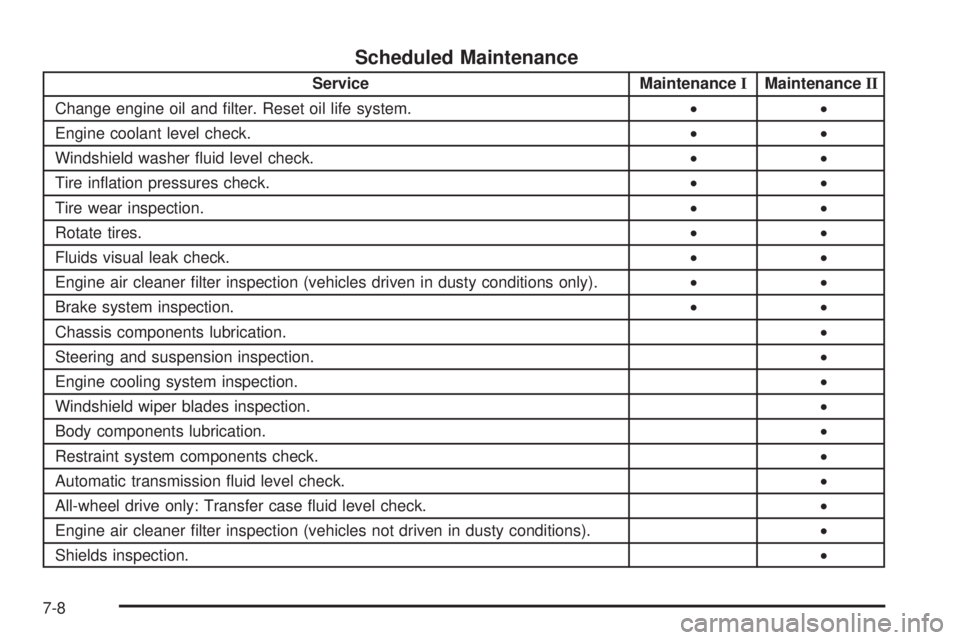
Scheduled Maintenance
Service MaintenanceIMaintenanceII
Change engine oil and filter. Reset oil life system.••
Engine coolant level check.••
Windshield washer fluid level check.••
Tire inflation pressures check.••
Tire wear inspection.••
Rotate tires.••
Fluids visual leak check.••
Engine air cleaner filter inspection (vehicles driven in dusty conditions only).••
Brake system inspection.••
Chassis components lubrication.•
Steering and suspension inspection.•
Engine cooling system inspection.•
Windshield wiper blades inspection.•
Body components lubrication.•
Restraint system components check.•
Automatic transmission fluid level check.•
All-wheel drive only: Transfer case fluid level check.•
Engine air cleaner filter inspection (vehicles not driven in dusty conditions).•
Shields inspection.•
7-8
Page 422 of 424
Securing a Child Restraint
Rear Seat Position......................................2-49
Right Front Seat Position......................2-52, 2-56
Security
Light..........................................................4-35
Service........................................................... 6-3
Accessories and Modifications......................... 6-3
Adding Equipment to the Outside of the
Vehicle..................................................... 6-5
Doing Your Own Work................................... 6-4
Engine Soon Lamp......................................4-31
Parts Identification Label.............................6-103
Publications Ordering Information...................8-15
Scheduling Appointments................................ 8-9
Servicing Your Airbag-Equipped Vehicle..............2-77
Setting the Clock............................................4-60
Sheet Metal Damage.....................................6-102
Shifting
Out of Park................................................3-37
Shifting Into Park............................................3-36
Signals, Turn and Lane-Change.......................... 4-4Sliding Side Door............................................3-12
Spare Tire.....................................................6-96
Installing....................................................6-85
Removing...................................................6-81
Storing.......................................................6-94
Specifications and Capacities..........................6-110
Speedometer..................................................4-22
StabiliTrak
®Indicator Light...............................4-29
StabiliTrak®System.......................................... 5-5
Start Vehicle, Remote....................................... 3-6
Starting the Engine.........................................3-23
Steering.......................................................... 5-7
Steering Wheel Controls, Audio.........................4-77
Steering Wheel, Tilt Wheel................................. 4-3
Storage Areas................................................3-42
Stuck in Sand, Mud, Ice, or Snow.....................5-16
Sun Visors.....................................................3-20
Swing-Out Side Door, 60/40.............................3-13
Swing-Out Windows........................................3-18
12
Page 423 of 424
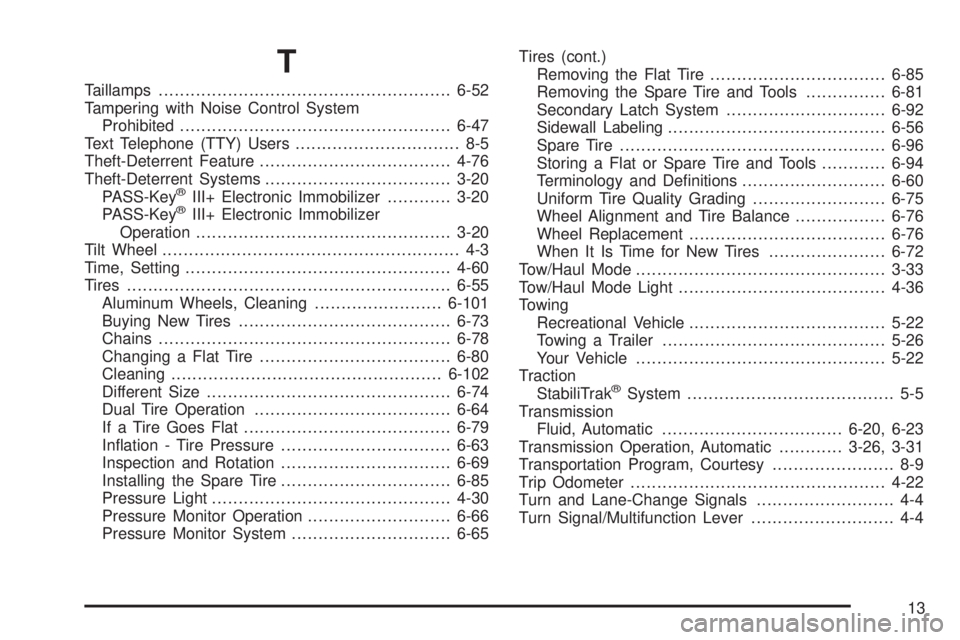
T
Taillamps.......................................................6-52
Tampering with Noise Control System
Prohibited...................................................6-47
Text Telephone (TTY) Users............................... 8-5
Theft-Deterrent Feature....................................4-76
Theft-Deterrent Systems...................................3-20
PASS-Key
®III+ Electronic Immobilizer............3-20
PASS-Key®III+ Electronic Immobilizer
Operation................................................3-20
Tilt Wheel........................................................ 4-3
Time, Setting..................................................4-60
Tires.............................................................6-55
Aluminum Wheels, Cleaning........................6-101
Buying New Tires........................................6-73
Chains.......................................................6-78
Changing a Flat Tire....................................6-80
Cleaning...................................................6-102
Different Size..............................................6-74
Dual Tire Operation.....................................6-64
If a Tire Goes Flat.......................................6-79
Inflation - Tire Pressure................................6-63
Inspection and Rotation................................6-69
Installing the Spare Tire................................6-85
Pressure Light.............................................4-30
Pressure Monitor Operation...........................6-66
Pressure Monitor System..............................6-65Tires (cont.)
Removing the Flat Tire.................................6-85
Removing the Spare Tire and Tools...............6-81
Secondary Latch System..............................6-92
Sidewall Labeling.........................................6-56
Spare Tire..................................................6-96
Storing a Flat or Spare Tire and Tools............6-94
Terminology and Definitions...........................6-60
Uniform Tire Quality Grading.........................6-75
Wheel Alignment and Tire Balance.................6-76
Wheel Replacement.....................................6-76
When It Is Time for New Tires......................6-72
Tow/Haul Mode ...............................................3-33
Tow/Haul Mode Light.......................................4-36
Towing
Recreational Vehicle.....................................5-22
Towing a Trailer..........................................5-26
Your Vehicle
...............................................5-22
Traction
StabiliTrak
®System....................................... 5-5
Transmission
Fluid, Automatic..................................6-20, 6-23
Transmission Operation, Automatic............3-26, 3-31
Transportation Program, Courtesy....................... 8-9
Trip Odometer................................................4-22
Turn and Lane-Change Signals.......................... 4-4
Turn Signal/Multifunction Lever........................... 4-4
13