traction control GMC SAVANA 2010 User Guide
[x] Cancel search | Manufacturer: GMC, Model Year: 2010, Model line: SAVANA, Model: GMC SAVANA 2010Pages: 424, PDF Size: 2.4 MB
Page 235 of 424
Driving in Rain and on Wet Roads
Rain and wet roads can reduce vehicle traction
and affect your ability to stop and accelerate. Always
drive slower in these types of driving conditions
and avoid driving through large puddles and
deep-standing or flowing water.
{WARNING:
Wet brakes can cause crashes. They might not
work as well in a quick stop and could cause
pulling to one side. You could lose control of the
vehicle.
After driving through a large puddle of water or a
car/vehicle wash, lightly apply the brake pedal until
the brakes work normally.
Flowing or rushing water creates strong forces.
Driving through flowing water could cause your
vehicle to be carried away. If this happens, you
and other vehicle occupants could drown. Do not
ignore police warnings and be very cautious about
trying to drive through flowing water.
Hydroplaning
Hydroplaning is dangerous. Water can build up under
your vehicle’s tires so they actually ride on the
water. This can happen if the road is wet enough and
you are going fast enough. When your vehicle is
hydroplaning, it has little or no contact with the road.
There is no hard and fast rule about hydroplaning. The
best advice is to slow down when the road is wet.
Other Rainy Weather Tips
Besides slowing down, other wet weather driving tips
include:
•Allow extra following distance.
•Pass with caution.
•Keep windshield wiping equipment in good shape.
•Keep the windshield washer fluid reservoir filled.
•Have good tires with proper tread depth. SeeTires
on page 6-55.
•Turn off cruise control.
5-11
Page 238 of 424
Winter Driving
Driving on Snow or Ice
Drive carefully when there is snow or ice between the
tires and the road, creating less traction or grip. Wet ice
can occur at about 0°C (32°F) when freezing rain
begins to fall, resulting in even less traction. Avoid
driving on wet ice or in freezing rain until roads can be
treated with salt or sand.
Drive with caution, whatever the condition. Accelerate
gently so traction is not lost. Accelerating too quickly
causes the wheels to spin and makes the surface under
the tires slick, so there is even less traction.
Try not to break the fragile traction. If you accelerate too
fast, the drive wheels will spin and polish the surface
under the tires even more.
TheAntilock Brake System (ABS) on page 5-4improves
vehicle stability during hard stops on a slippery roads,
but apply the brakes sooner than when on dry
pavement.
Allow greater following distance on any slippery road
and watch for slippery spots. Icy patches can occur on
otherwise clear roads in shaded areas. The surface
of a curve or an overpass can remain icy when
the surrounding roads are clear. Avoid sudden steering
maneuvers and braking while on ice.
Turn off cruise control, if equipped, on slippery surfaces.
Blizzard Conditions
Being stuck in snow can be in a serious situation. Stay
with the vehicle unless there is help nearby. If possible,
use theRoadside Assistance Program on page 8-6.To
get help and keep everyone in the vehicle safe:
•Turn on theHazard Warning Flashers on page 4-3.
•Tie a red cloth to an outside mirror.
{WARNING:
Snow can trap engine exhaust under the vehicle.
This may cause exhaust gases to get inside. Engine
exhaust contains carbon monoxide (CO) which
cannot be seen or smelled. It can cause
unconsciousness and even death.
If the vehicle is stuck in the snow:
•Clear away snow from around the base of your
vehicle, especially any that is blocking the
exhaust pipe and/or the fuel operated heater
exhaust system, if equipped. If the vehicle has
a diesel engine and a fuel operated heater, see
“Fuel Operated Heater (FOH)” in the diesel
engine supplement.
WARNING: (Continued)
5-14
Page 265 of 424
Service
For service and parts needs, visit your dealer/retailer.
You will receive genuine GM parts and GM-trained and
supported service people.
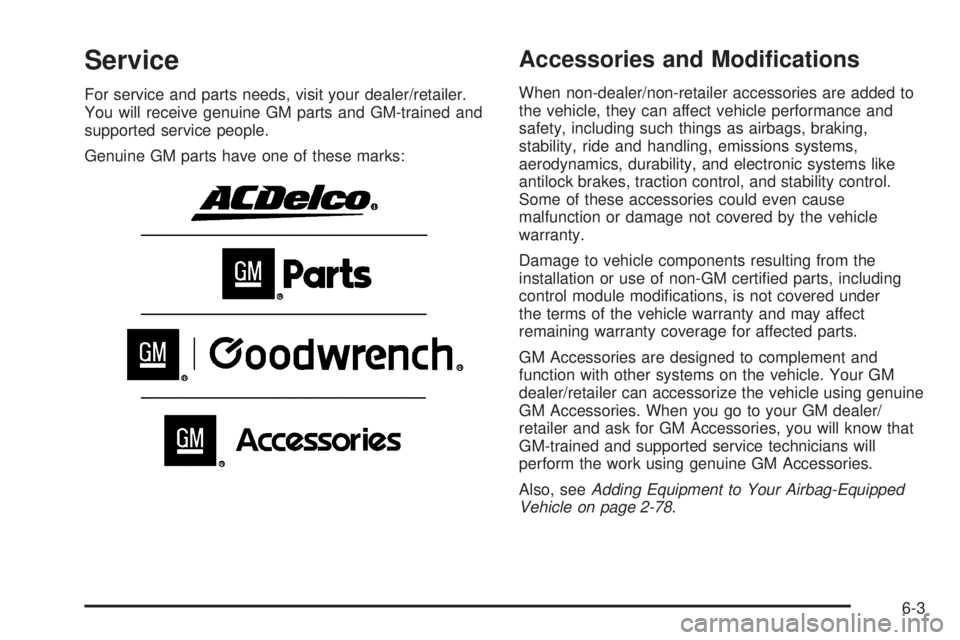
Genuine GM parts have one of these marks:
Accessories and Modications
When non-dealer/non-retailer accessories are added to
the vehicle, they can affect vehicle performance and
safety, including such things as airbags, braking,
stability, ride and handling, emissions systems,
aerodynamics, durability, and electronic systems like
antilock brakes, traction control, and stability control.
Some of these accessories could even cause
malfunction or damage not covered by the vehicle
warranty.
Damage to vehicle components resulting from the
installation or use of non-GM certified parts, including
control module modifications, is not covered under
the terms of the vehicle warranty and may affect
remaining warranty coverage for affected parts.
GM Accessories are designed to complement and
function with other systems on the vehicle. Your GM
dealer/retailer can accessorize the vehicle using genuine
GM Accessories. When you go to your GM dealer/
retailer and ask for GM Accessories, you will know that
GM-trained and supported service technicians will
perform the work using genuine GM Accessories.
Also, seeAdding Equipment to Your Airbag-Equipped
Vehicle on page 2-78.
6-3
Page 335 of 424
Buying New Tires
GM has developed and matched specific tires for your
vehicle. The original equipment tires installed on
your vehicle, when it was new, were designed to meet
General Motors Tire Performance Criteria Specification
(TPC spec) system rating. If you need replacement
tires, GM strongly recommends that you get tires with
the same TPC Spec rating. This way, your vehicle
will continue to have tires that are designed to give the
same performance and vehicle safety, during normal
use, as the original tires.
GM’s exclusive TPC Spec system considers over a
dozen critical specifications that impact the overall
performance of your vehicle, including brake system
performance, ride and handling, traction control, and tire
pressure monitoring performance. GM’s TPC Spec
number is molded onto the tire’s sidewall near the tire
size. If the tires have an all-season tread design,
the TPC spec number will be followed by a MS, for mud
and snow. SeeTire Sidewall Labeling on page 6-56
for additional information.
GM recommends replacing tires in sets of four (or six if
your vehicle has dual rear wheels). This is because
uniform tread depth on all tires will help keep your
vehicle performing most like it did when the tires were
new. Replacing less than a full set of tires can affect the
braking and handling performance of your vehicle.
SeeTire Inspection and Rotation on page 6-69
for information on proper tire rotation.{WARNING:
Mixing tires could cause you to lose control
while driving. If you mix tires of different
sizes, brands, or types (radial and bias-belted
tires) the vehicle may not handle properly,
and you could have a crash. Using tires of
different sizes, brands, or types may also
cause damage to your vehicle. Be sure to
use the correct size, brand, and type of tires
on your vehicle’s wheels.
{WARNING:
If you use bias-ply tires on the vehicle, the
wheel rim flanges could develop cracks after
many miles of driving. A tire and/or wheel
could fail suddenly, causing a crash. Use only
radial-ply tires with the wheels on the vehicle.
If you must replace your vehicle’s tires with those that
do not have a TPC Spec number, make sure they
are the same size, load range, speed rating, and
construction type (radial and bias-belted tires) as your
vehicle’s original tires.
6-73
Page 336 of 424
Vehicles that have a tire pressure monitoring system
could give an inaccurate low-pressure warning if
non-TPC Spec rated tires are installed on your vehicle.
Non-TPC Spec rated tires may give a low-pressure
warning that is higher or lower than the proper warning
level you would get with TPC Spec rated tires. See
Tire Pressure Monitor System on page 6-65.
Your vehicle’s original equipment tires are listed on the
Tire and Loading Information label. SeeLoading the
Vehicle on page 5-17, for more information about
the Tire and Loading Information label and its location
on your vehicle.
Different Size Tires and Wheels
If you add wheels or tires that are a different size than
your original equipment wheels and tires, this could
affect the way your vehicle performs, including its
braking, ride and handling characteristics, stability, and
resistance to rollover. Additionally, if your vehicle
has electronic systems such as anti-lock brakes, rollover
airbags, traction control, and electronic stability control,
the performance of these systems can be affected.
{WARNING:
If you add different sized wheels, your vehicle may
not provide an acceptable level of performance
and safety if tires not recommended for those
wheels are selected. You may increase the
chance that you will crash and suffer serious
injury. Only use GM specific wheel and tire
systems developed for your vehicle, and have
them properly installed by a GM certified
technician.
SeeBuying New Tires on page 6-73andAccessories
and Modications on page 6-3for additional information.
6-74
Page 337 of 424
Uniform Tire Quality Grading
Quality grades can be found where applicable on
the tire sidewall between tread shoulder and
maximum section width. For example:
Treadwear 200 Traction AA
Temperature A
The following information relates to the system
developed by the United States National Highway
Traffic Safety Administration (NHTSA), which
grades tires by treadwear, traction, and
temperature performance. This applies only to
vehicles sold in the United States. The grades are
molded on the sidewalls of most passenger car
tires. The Uniform Tire Quality Grading (UTQG)
system does not apply to deep tread, winter-type
snow tires, space-saver, or temporary use
spare tires, tires with nominal rim diameters of
10 to 12 inches (25 to 30 cm), or to some
limited-production tires.
While the tires available on General Motors
passenger cars and light trucks may vary with
respect to these grades, they must also conform
to federal safety requirements and additional
General Motors Tire Performance Criteria (TPC)
standards.
Treadwear
The treadwear grade is a comparative rating
based on the wear rate of the tire when tested
under controlled conditions on a specified
government test course. For example, a tire
graded 150 would wear one and a half (1.5) times
as well on the government course as a tire
graded 100. The relative performance of tires
depends upon the actual conditions of their use,
however, and may depart significantly from
the norm due to variations in driving habits, service
practices, and differences in road characteristics
and climate.
Traction – AA, A, B, C
The traction grades, from highest to lowest, are
AA, A, B, and C. Those grades represent the tire’s
ability to stop on wet pavement as measured
under controlled conditions on specified
government test surfaces of asphalt and concrete.
A tire marked C may have poor traction
performance.
6-75
Page 340 of 424
Tire Chains
{WARNING:
If your vehicle has dual wheels or P245/70R17 or
LT245/75R16 size tires, do not use tire chains.
They can damage your vehicle because there is not
enough clearance. Tire chains used on a vehicle
without the proper amount of clearance can cause
damage to the brakes, suspension, or other vehicle
parts. The area damaged by the tire chains could
cause you to lose control of your vehicle and you or
others may be injured in a crash.
Use another type of traction device only if its
manufacturer recommends it for use on your
vehicle and tire size combination and road
conditions. Follow that manufacturer’s instructions.
WARNING: (Continued)
WARNING: (Continued)
To help avoid damage to your vehicle, drive
slowly, readjust, or remove the device if it is
contacting your vehicle, and do not spin the
vehicle’s wheels.
If you do find traction devices that will fit, install
them on the rear tires.
Notice:If your vehicle does not have dual wheels
and has a tire size other than P245/70R17 or
LT245/75R16, use tire chains only where legal and
only when you must. Use chains that are the proper
size for your tires. Install them on the tires of the
rear axle. Do not use chains on the tires of the front
axle. Tighten them as tightly as possible with the
ends securely fastened. Drive slowly and follow the
chain manufacturer’s instructions. If you can
hear the chains contacting your vehicle, stop and
retighten them. If the contact continues, slow down
until it stops. Driving too fast or spinning the
wheels with chains on will damage your vehicle.
6-78
Page 423 of 424
T
Taillamps.......................................................6-52
Tampering with Noise Control System
Prohibited...................................................6-47
Text Telephone (TTY) Users............................... 8-5
Theft-Deterrent Feature....................................4-76
Theft-Deterrent Systems...................................3-20
PASS-Key
®III+ Electronic Immobilizer............3-20
PASS-Key®III+ Electronic Immobilizer
Operation................................................3-20
Tilt Wheel........................................................ 4-3
Time, Setting..................................................4-60
Tires.............................................................6-55
Aluminum Wheels, Cleaning........................6-101
Buying New Tires........................................6-73
Chains.......................................................6-78
Changing a Flat Tire....................................6-80
Cleaning...................................................6-102
Different Size..............................................6-74
Dual Tire Operation.....................................6-64
If a Tire Goes Flat.......................................6-79
Inflation - Tire Pressure................................6-63
Inspection and Rotation................................6-69
Installing the Spare Tire................................6-85
Pressure Light.............................................4-30
Pressure Monitor Operation...........................6-66
Pressure Monitor System..............................6-65Tires (cont.)
Removing the Flat Tire.................................6-85
Removing the Spare Tire and Tools...............6-81
Secondary Latch System..............................6-92
Sidewall Labeling.........................................6-56
Spare Tire..................................................6-96
Storing a Flat or Spare Tire and Tools............6-94
Terminology and Definitions...........................6-60
Uniform Tire Quality Grading.........................6-75
Wheel Alignment and Tire Balance.................6-76
Wheel Replacement.....................................6-76
When It Is Time for New Tires......................6-72
Tow/Haul Mode ...............................................3-33
Tow/Haul Mode Light.......................................4-36
Towing
Recreational Vehicle.....................................5-22
Towing a Trailer..........................................5-26
Your Vehicle
...............................................5-22
Traction
StabiliTrak
®System....................................... 5-5
Transmission
Fluid, Automatic..................................6-20, 6-23
Transmission Operation, Automatic............3-26, 3-31
Transportation Program, Courtesy....................... 8-9
Trip Odometer................................................4-22
Turn and Lane-Change Signals.......................... 4-4
Turn Signal/Multifunction Lever........................... 4-4
13