ECU GMC SAVANA 2010 Service Manual
[x] Cancel search | Manufacturer: GMC, Model Year: 2010, Model line: SAVANA, Model: GMC SAVANA 2010Pages: 424, PDF Size: 2.4 MB
Page 253 of 424
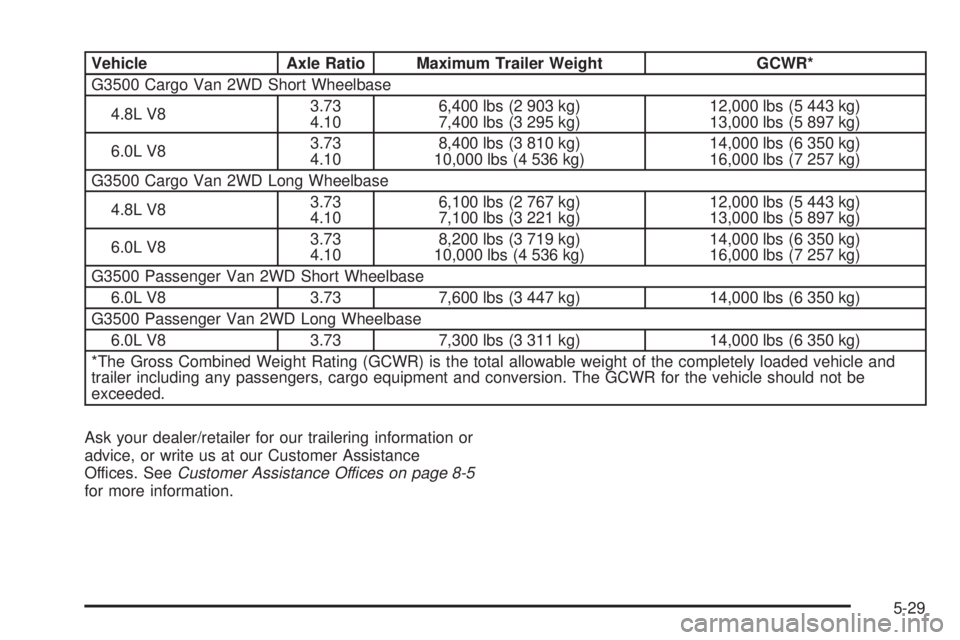
Vehicle Axle Ratio Maximum Trailer Weight GCWR*
G3500 Cargo Van 2WD Short Wheelbase
4.8L V83.73
4.106,400 lbs (2 903 kg)
7,400 lbs (3 295 kg)12,000 lbs (5 443 kg)
13,000 lbs (5 897 kg)
6.0L V83.73
4.108,400 lbs (3 810 kg)
10,000 lbs (4 536 kg)14,000 lbs (6 350 kg)
16,000 lbs (7 257 kg)
G3500 Cargo Van 2WD Long Wheelbase
4.8L V83.73
4.106,100 lbs (2 767 kg)
7,100 lbs (3 221 kg)12,000 lbs (5 443 kg)
13,000 lbs (5 897 kg)
6.0L V83.73
4.108,200 lbs (3 719 kg)
10,000 lbs (4 536 kg)14,000 lbs (6 350 kg)
16,000 lbs (7 257 kg)
G3500 Passenger Van 2WD Short Wheelbase
6.0L V8 3.73 7,600 lbs (3 447 kg) 14,000 lbs (6 350 kg)
G3500 Passenger Van 2WD Long Wheelbase
6.0L V8 3.73 7,300 lbs (3 311 kg) 14,000 lbs (6 350 kg)
*The Gross Combined Weight Rating (GCWR) is the total allowable weight of the completely loaded vehicle and
trailer including any passengers, cargo equipment and conversion. The GCWR for the vehicle should not be
exceeded.
Ask your dealer/retailer for our trailering information or
advice, or write us at our Customer Assistance
Offices. SeeCustomer Assistance Offices on page 8-5
for more information.
5-29
Page 259 of 424
Towing a trailer requires a certain amount of experience.
Get to know the rig before setting out for the open
road. Get acquainted with the feel of handling and
braking with the added weight of the trailer. And always
keep in mind that the vehicle you are driving is now
longer and not as responsive as the vehicle is by itself.
Before starting, check all trailer hitch parts and
attachments, safety chains, electrical connectors, lamps,
tires and mirror adjustments. If the trailer has electric
brakes, start the vehicle and trailer moving and
then apply the trailer brake controller by hand to be sure
the brakes are working. This checks the electrical
connection at the same time.
During the trip, check occasionally to be sure that the
load is secure, and that the lamps and any trailer brakes
are still working.
Following Distance
Stay at least twice as far behind the vehicle ahead as
you would when driving the vehicle without a trailer. This
can help to avoid situations that require heavy braking
and sudden turns.
Passing
More passing distance is needed when towing a trailer.
Because the rig is longer, it is necessary to go much
farther beyond the passed vehicle before returning to
the lane.
Backing Up
Hold the bottom of the steering wheel with one hand.
Then, to move the trailer to the left, move that hand
to the left. To move the trailer to the right, move your
hand to the right. Always back up slowly and, if possible,
have someone guide you.
Making Turns
Notice:Making very sharp turns while trailering
could cause the trailer to come in contact with the
vehicle. The vehicle could be damaged. Avoid
making very sharp turns while trailering.
When turning with a trailer, make wider turns than
normal. Do this so the trailer will not strike soft shoulders,
curbs, road signs, trees or other objects. Avoid jerky or
sudden maneuvers. Signal well in advance.
Turn Signals When Towing a Trailer
The arrows on the instrument panel flash whenever
signaling a turn or lane change. Properly hooked up, the
trailer lamps also flash, telling other drivers the vehicle
is turning, changing lanes or stopping.
When towing a trailer, the arrows on the instrument
panel flash for turns even if the bulbs on the trailer are
burned out. For this reason you may think other
drivers are seeing the signal when they are not. It is
important to check occasionally to be sure the
trailer bulbs are still working.
5-35
Page 294 of 424
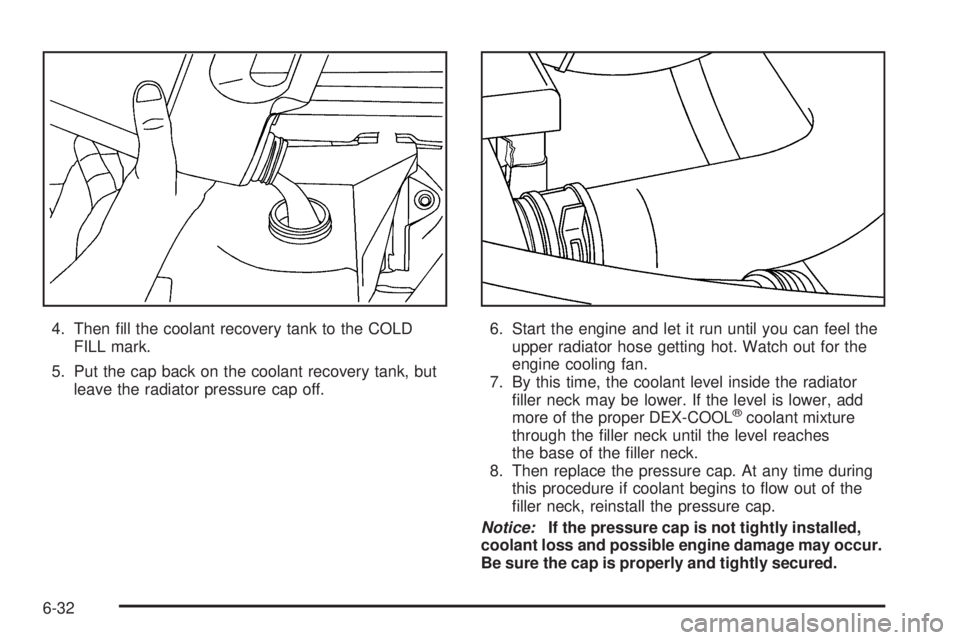
4. Then fill the coolant recovery tank to the COLD
FILL mark.
5. Put the cap back on the coolant recovery tank, but
leave the radiator pressure cap off.6. Start the engine and let it run until you can feel the
upper radiator hose getting hot. Watch out for the
engine cooling fan.
7. By this time, the coolant level inside the radiator
filler neck may be lower. If the level is lower, add
more of the proper DEX-COOL
®coolant mixture
through the filler neck until the level reaches
the base of the filler neck.
8. Then replace the pressure cap. At any time during
this procedure if coolant begins to flow out of the
filler neck, reinstall the pressure cap.
Notice:If the pressure cap is not tightly installed,
coolant loss and possible engine damage may occur.
Be sure the cap is properly and tightly secured.
6-32
Page 315 of 424
11. Slide the taillamp slightly downward to reengage
the lower clip.
12. Push the taillamp straight forward to reengage
the studs.
13. Reinstall the two inboard nuts from the inside of the
taillamp assembly.
License Plate Lamp
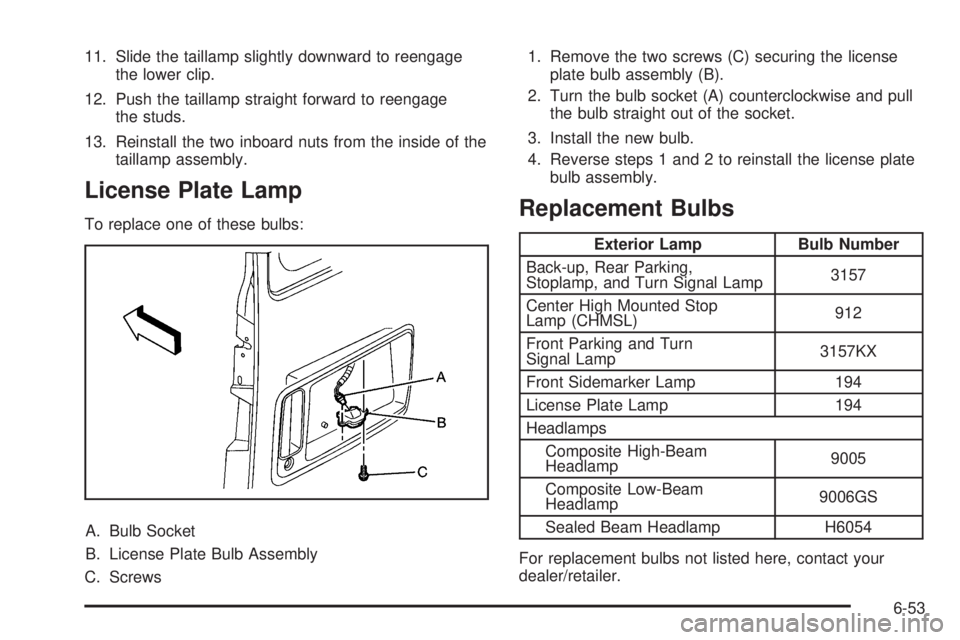
To replace one of these bulbs:
A. Bulb Socket
B. License Plate Bulb Assembly
C. Screws1. Remove the two screws (C) securing the license
plate bulb assembly (B).
2. Turn the bulb socket (A) counterclockwise and pull
the bulb straight out of the socket.
3. Install the new bulb.
4. Reverse steps 1 and 2 to reinstall the license plate
bulb assembly.Replacement Bulbs
Exterior Lamp Bulb Number
Back-up, Rear Parking,
Stoplamp, and Turn Signal Lamp3157
Center High Mounted Stop
Lamp (CHMSL)912
Front Parking and Turn
Signal Lamp3157KX
Front Sidemarker Lamp 194
License Plate Lamp 194
Headlamps
Composite High-Beam
Headlamp9005
Composite Low-Beam
Headlamp9006GS
Sealed Beam Headlamp H6054
For replacement bulbs not listed here, contact your
dealer/retailer.
6-53
Page 333 of 424
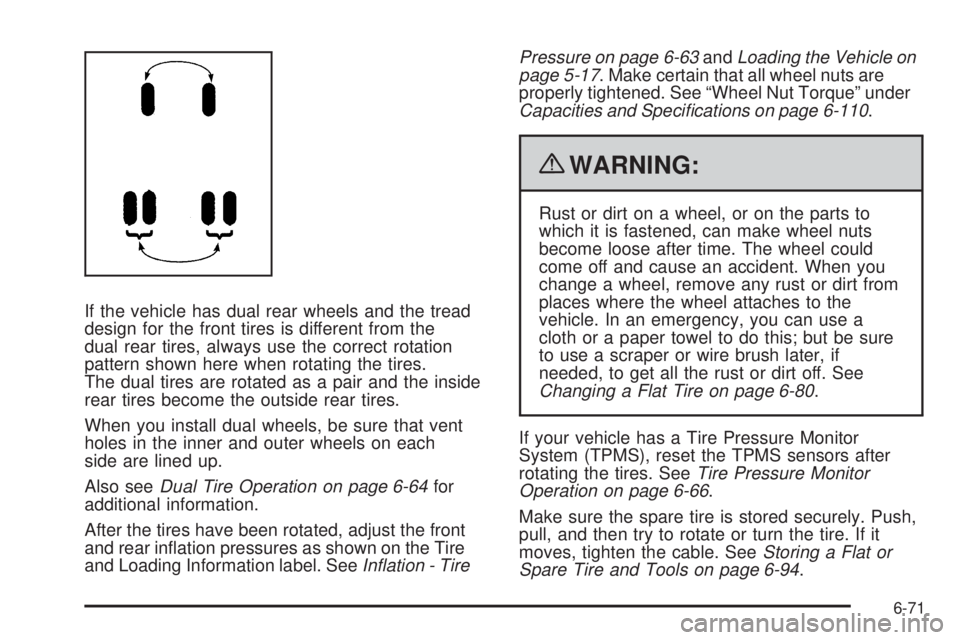
If the vehicle has dual rear wheels and the tread
design for the front tires is different from the
dual rear tires, always use the correct rotation
pattern shown here when rotating the tires.
The dual tires are rotated as a pair and the inside
rear tires become the outside rear tires.
When you install dual wheels, be sure that vent
holes in the inner and outer wheels on each
side are lined up.
Also seeDual Tire Operation on page 6-64for
additional information.
After the tires have been rotated, adjust the front
and rear inflation pressures as shown on the Tire
and Loading Information label. SeeInation - TirePressure on page 6-63andLoading the Vehicle on
page 5-17. Make certain that all wheel nuts are
properly tightened. See “Wheel Nut Torque” under
Capacities and Specications on page 6-110.
{WARNING:
Rust or dirt on a wheel, or on the parts to
which it is fastened, can make wheel nuts
become loose after time. The wheel could
come off and cause an accident. When you
change a wheel, remove any rust or dirt from
places where the wheel attaches to the
vehicle. In an emergency, you can use a
cloth or a paper towel to do this; but be sure
to use a scraper or wire brush later, if
needed, to get all the rust or dirt off. See
Changing a Flat Tire on page 6-80.
If your vehicle has a Tire Pressure Monitor
System (TPMS), reset the TPMS sensors after
rotating the tires. SeeTire Pressure Monitor
Operation on page 6-66.
Make sure the spare tire is stored securely. Push,
pull, and then try to rotate or turn the tire. If it
moves, tighten the cable. SeeStoring a Flat or
Spare Tire and Tools on page 6-94.
6-71
Page 340 of 424
Tire Chains
{WARNING:
If your vehicle has dual wheels or P245/70R17 or
LT245/75R16 size tires, do not use tire chains.
They can damage your vehicle because there is not
enough clearance. Tire chains used on a vehicle
without the proper amount of clearance can cause
damage to the brakes, suspension, or other vehicle
parts. The area damaged by the tire chains could
cause you to lose control of your vehicle and you or
others may be injured in a crash.
Use another type of traction device only if its
manufacturer recommends it for use on your
vehicle and tire size combination and road
conditions. Follow that manufacturer’s instructions.
WARNING: (Continued)
WARNING: (Continued)
To help avoid damage to your vehicle, drive
slowly, readjust, or remove the device if it is
contacting your vehicle, and do not spin the
vehicle’s wheels.
If you do find traction devices that will fit, install
them on the rear tires.
Notice:If your vehicle does not have dual wheels
and has a tire size other than P245/70R17 or
LT245/75R16, use tire chains only where legal and
only when you must. Use chains that are the proper
size for your tires. Install them on the tires of the
rear axle. Do not use chains on the tires of the front
axle. Tighten them as tightly as possible with the
ends securely fastened. Drive slowly and follow the
chain manufacturer’s instructions. If you can
hear the chains contacting your vehicle, stop and
retighten them. If the contact continues, slow down
until it stops. Driving too fast or spinning the
wheels with chains on will damage your vehicle.
6-78
Page 343 of 424
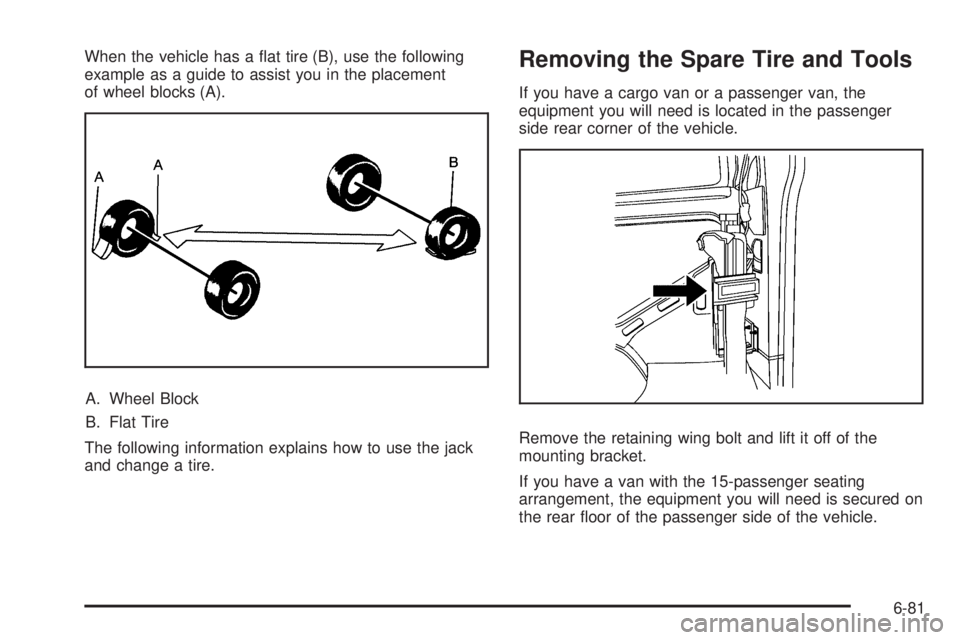
When the vehicle has a flat tire (B), use the following
example as a guide to assist you in the placement
of wheel blocks (A).
A. Wheel Block
B. Flat Tire
The following information explains how to use the jack
and change a tire.Removing the Spare Tire and Tools
If you have a cargo van or a passenger van, the
equipment you will need is located in the passenger
side rear corner of the vehicle.
Remove the retaining wing bolt and lift it off of the
mounting bracket.
If you have a van with the 15-passenger seating
arrangement, the equipment you will need is secured on
the rear floor of the passenger side of the vehicle.
6-81
Page 357 of 424
2. Pull the retaining bar through the center of the
wheel, making sure it is properly attached.
3. Pull the wheel toward the rear of the vehicle,
keeping the cable tight.
4. Put the chisel end of the hoist extension on an
angle through the hole in the rear door frame,
above the bumper.
5. Raise the tire fully against the underside of the
vehicle. Continue turning the wheel wrench until
the tire is secure and the cable is tight. The spare
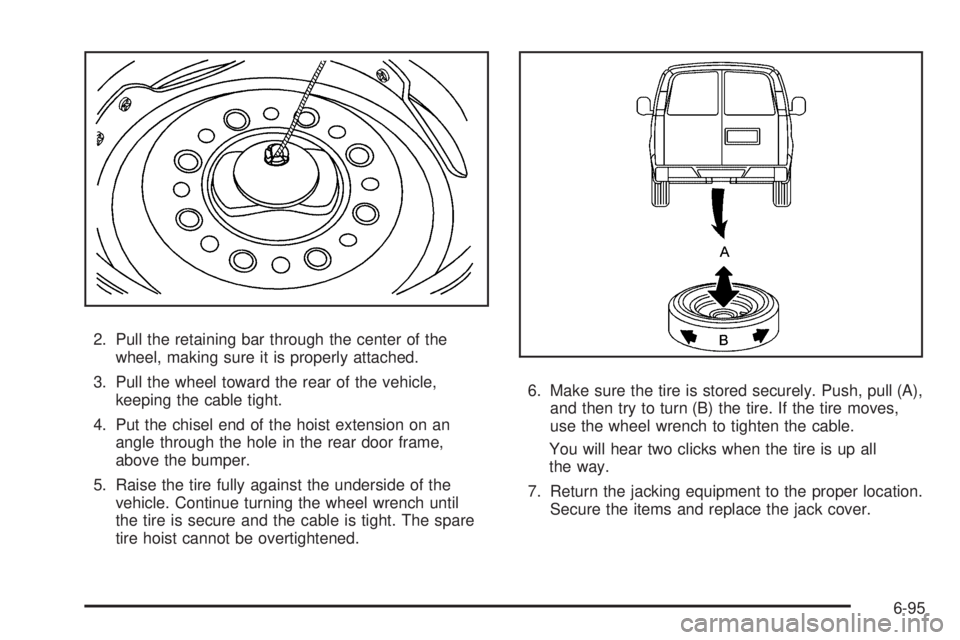
tire hoist cannot be overtightened.6. Make sure the tire is stored securely. Push, pull (A),
and then try to turn (B) the tire. If the tire moves,
use the wheel wrench to tighten the cable.
You will hear two clicks when the tire is up all
the way.
7. Return the jacking equipment to the proper location.
Secure the items and replace the jack cover.
6-95
Page 399 of 424
•Model, year, color, and license plate number of the
vehicle
•Odometer reading, Vehicle Identification
Number (VIN), and delivery date of the vehicle
•Description of the problem
Coverage
Services are provided up to 5 years/100,000 miles
(160 000 km), whichever comes first.
In the U.S., anyone driving the vehicle is covered. In
Canada, a person driving the vehicle without permission
from the owner is not covered.
Roadside Assistance is not a part of the New Vehicle
Limited Warranty. GMC and General Motors of Canada
Limited reserve the right to make any changes or
discontinue the Roadside Assistance program at any
time without notification.
GMC and General Motors of Canada Limited reserve
the right to limit services or payment to an owner
or driver if they decide the claims are made too often, or
the same type of claim is made many times.
Services Provided
•Emergency Fuel Delivery:Delivery of enough fuel
for the vehicle to get to the nearest service station.
•Lock-Out Service:Service is provided to unlock
the vehicle if you are locked out. A remote unlock
may be available if you have OnStar
®. For security
reasons, the driver must present identification before
this service is given.
•Emergency Tow From a Public Road or Highway:
Tow to the nearest GMC dealer for warranty service,
or if the vehicle was in a crash and cannot be driven.
Assistance is also given when the vehicle is stuck in
the sand, mud, or snow.
•Flat Tire Change:Service is provided to change a
flat tire with the spare tire. The spare tire, if equipped,
must be in good condition and properly inflated.
It is the owner’s responsibility for the repair or
replacement of the tire if it is not covered by the
warranty.
•Battery Jump Start:Service is provided to jump
start a dead battery.
8-7
Page 410 of 424
Radio Frequency
Identication (RFID)
RFID technology is used in some vehicles for functions
such as tire pressure monitoring and ignition system
security, as well as in connection with conveniences
such as key fobs for remote door locking/unlocking and
starting, and in-vehicle transmitters for garage door
openers. RFID technology in GM vehicles does not use
or record personal information or link with any other
GM system containing personal information.
Radio Frequency Statement
This vehicle has systems that operate on a radio
frequency that comply with Part 15 of the Federal
Communications Commission (FCC) Rules and with
RSS-210/211 of Industry and Science Canada.
Operation is subject to the following two conditions:
1. The device may not cause interference.
2. The device must accept any interference received,
including interference that may cause undesired
operation of the device.
Changes or modifications to any of these systems by
other than an authorized service facility could void
authorization to use this equipment.
8-18