engine overheat GMC SAVANA 2021 User Guide
[x] Cancel search | Manufacturer: GMC, Model Year: 2021, Model line: SAVANA, Model: GMC SAVANA 2021Pages: 292, PDF Size: 6.38 MB
Page 187 of 292
GMC Savana Owner Manual (GMNA-Localizing-U.S./Canada-14583543) -
2021 - crc - 7/10/20
186 Vehicle Care
trash or pouring it on the ground, into
sewers, or into streams or bodies of water.
Recycle it by taking it to a place that
collects used oil.
Engine Oil Life System
When to Change Engine Oil
This vehicle has a computer system that
indicates when to change the engine oil and
filter. This is based on a combination of
factors which include engine revolutions,
engine temperature, and miles driven. Based
on driving conditions, the mileage at which
an engine oil change is indicated can vary
considerably. For the oil life system to work
properly, the system must be reset every
time the oil is changed.
When the system has calculated that oil life
has been diminished, it indicates that an oil
change is necessary. A CHANGE ENGINE OIL
SOON message comes on. Change the oil as
soon as possible within the next 1 000 km
(600 mi). It is possible that, if driving under
the best conditions, the oil life system
might indicate that an oil change is not
necessary for up to a year. The engine oil
and filter must be changed at least once a
year and, at this time, the system must be
reset. Your dealer has trained service peoplewho will perform this work and reset the
system. It is also important to check the oil
regularly over the course of an oil drain
interval and keep it at the proper level.
If the system is ever reset accidentally, the
oil must be changed at 5 000 km (3,000 mi)
since the last oil change. Remember to reset
the oil life system whenever the oil is
changed.
How to Reset the Engine Oil Life System
Reset the system whenever the engine oil is
changed so that the system can calculate
the next engine oil change.
To reset the Engine Oil Life System on most
models:
1. Display the OIL LIFE REMAINING on the DIC. See Driver Information Center (DIC)
0 81.
2. Press and hold
Von the DIC while the
Oil Life display is active. The oil life will
change to 100%.
The oil life system can also be reset as
follows: 1. Display the OIL LIFE REMAINING on the DIC. See Driver Information Center (DIC)
0 81. 2. Fully press and release the accelerator
pedal three times within five seconds.
If the display shows 100%, the system is
reset.
If the CHANGE ENGINE OIL SOON message
comes back on when the vehicle is started,
the engine oil life system has not reset.
Repeat the procedure.
Automatic Transmission Fluid
(6-Speed Transmission)
When to Check and Change Automatic
Transmission Fluid
It is usually not necessary to check the
transmission fluid level. The only reason for
fluid loss is a transmission leak or
overheated transmission. If a small leak is
suspected, use the following procedures to
check the fluid level. However, if there is a
large leak, it may be necessary to have the
vehicle towed to a dealer and have it
repaired before driving the vehicle further.
Change the fluid and filter at the intervals
listed in Maintenance Schedule 0249, and
be sure to use the transmission fluid listed
in Recommended Fluids and Lubricants
0 255.
Page 188 of 292
GMC Savana Owner Manual (GMNA-Localizing-U.S./Canada-14583543) -
2021 - crc - 7/10/20
Vehicle Care 187
How to Check Automatic Transmission
Fluid
Because this operation can be difficult, it is
recommended to have this check done at
your dealer, which can monitor the
transmission temperature. The transmission
fluid level increases with temperature. To
obtain a highly accurate fluid level check,
the transmission temperature must be
measured.
If it is decided to check the fluid level, be
sure to follow all the instructions here, or a
false reading on the dipstick may occur.
Caution
Too much or too little fluid can damage
the transmission. Too much can mean
that some of the fluid could come out
and fall on hot engine parts or exhaust
system parts, starting a fire. Too little
fluid could cause the transmission to
overheat. Be sure to get an accurate
reading if checking the transmission fluid.
Wait at least 30 minutes with the engine
off, before checking the transmission fluid
level if the vehicle has been driven:
.In hot weather, when outside
temperatures are above 32 °C (90 °F).
.The vehicle is heavily loaded.
.At high speed for quite a while in hot
weather.
.In heavy traffic and hot weather.
.While pulling a trailer.
After driving under these conditions, a hot
check can be performed. The fluid should be
hot, which is 71 °C to 93 °C (160 °F to
200 °F).
A cold fluid level check can be performed
after the vehicle has been sitting for eight
hours or more with the engine off, but this
is used only as a reference. Let the engine
run at idle for five minutes if the outside
temperature is between 15 °C to 32 °C (60 °F
to 90 °F). Should the fluid level be low
during this cold check, the fluid must be
checked warm or hot before adding fluid.
If the outside temperature is colder than 15 °
C (60 °F) or hotter than 32 °C (90 °F), a cold
check cannot be performed.
A warm fluid level check can be performed
by driving the vehicle under lightly loaded
conditions and outside temperatures
between 10 °C to 27 °C (50 °F to 80 °F). The
vehicle should be driven for at least 24 km (15 mi) before performing a warm check.
Checking the fluid warm or hot will give a
more accurate reading of the fluid level than
a cold check.
Because the vehicle is equipped with a
high-efficiency air-to-oil cooler, the
transmission fluid temperature may not
reach the required hot fluid level checking
temperature under normal lightly loaded
driving vehicle conditions.
Checking the Fluid Level
Prepare the vehicle:
1. Park the vehicle on a level place. Keep the engine running.
2. With the parking brake applied, place the shift lever in P (Park).
3. With a foot on the brake pedal, move the shift lever through each gear range,
pausing for about three seconds in each
range. When M is reached, move the
selector from M1 through M3. Then,
position the shift lever in P (Park).
4. Let the engine run at idle for two minutes or more.
Then, without shutting off the engine, use
the steps that follow.
Page 190 of 292
GMC Savana Owner Manual (GMNA-Localizing-U.S./Canada-14583543) -
2021 - crc - 7/10/20
Vehicle Care 189
.After adding fluid, recheck the fluid level
as described under“How to Check
Automatic Transmission Fluid,” earlier in
this section.
.When the correct fluid level is obtained,
push the dipstick back in all the way;
then flip the handle down to lock the
dipstick in place.
Automatic Transmission Fluid
(8-Speed Transmission)
When to Check and Change Automatic
Transmission Fluid
It is usually not necessary to check the
transmission fluid level. The only reason for
fluid loss is a transmission leak or
overheated transmission. This vehicle is not
equipped with a transmission fluid level
dipstick. There is a special procedure for
checking and changing the transmission fluid
in these vehicles. Because this procedure is
difficult, this should be done at the dealer.
Contact the dealer for additional information
or the procedure can be found in the service
manual. See Publication Ordering
Information 0269.
Caution
Use of the incorrect automatic
transmission fluid may damage the
vehicle, and the damage may not be
covered by the vehicle warranty. Always
use the correct automatic transmission
fluid. See Recommended Fluids and
Lubricants 0255.
Change the fluid and filter at the scheduled
maintenance intervals listed in Maintenance
Schedule 0249. Be sure to use the
transmission fluid listed in Recommended
Fluids and Lubricants 0255.
Engine Air Cleaner/Filter
The air cleaner/filter assembly is on the
front of the engine compartment on the
driver side of the vehicle. See Engine
Compartment Overview 0180.
When to Inspect the Engine Air Cleaner/Filter
For intervals on changing and inspecting the
engine air filter, see Maintenance Schedule
0 249. How to Inspect/Replace the Engine Air
Cleaner/Filter
Do not start the engine or have the engine
running with the engine air filter housing
open. Before removing the engine air filter,
make sure that the engine air filter housing
and nearby components are free of dirt and
debris. Do not clean the engine air filter or
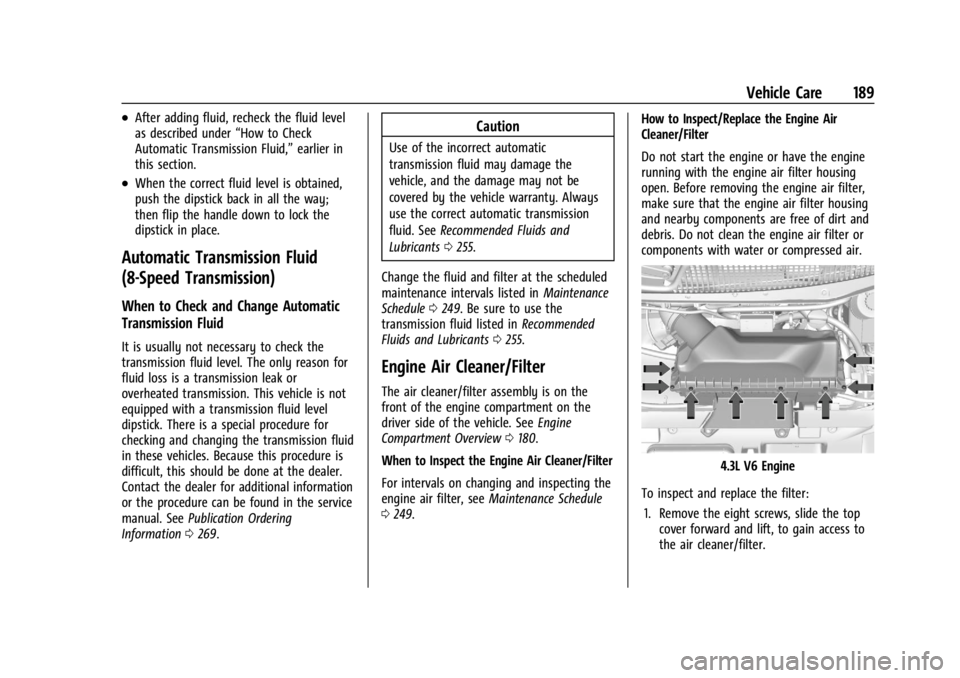
components with water or compressed air.
4.3L V6 Engine
To inspect and replace the filter: 1. Remove the eight screws, slide the top cover forward and lift, to gain access to
the air cleaner/filter.
Page 192 of 292
GMC Savana Owner Manual (GMNA-Localizing-U.S./Canada-14583543) -
2021 - crc - 7/10/20
Vehicle Care 191
Caution
If the air cleaner/filter is off, dirt can
easily get into the engine, which could
damage it. Always have the air cleaner/
filter in place when driving.
Cooling System
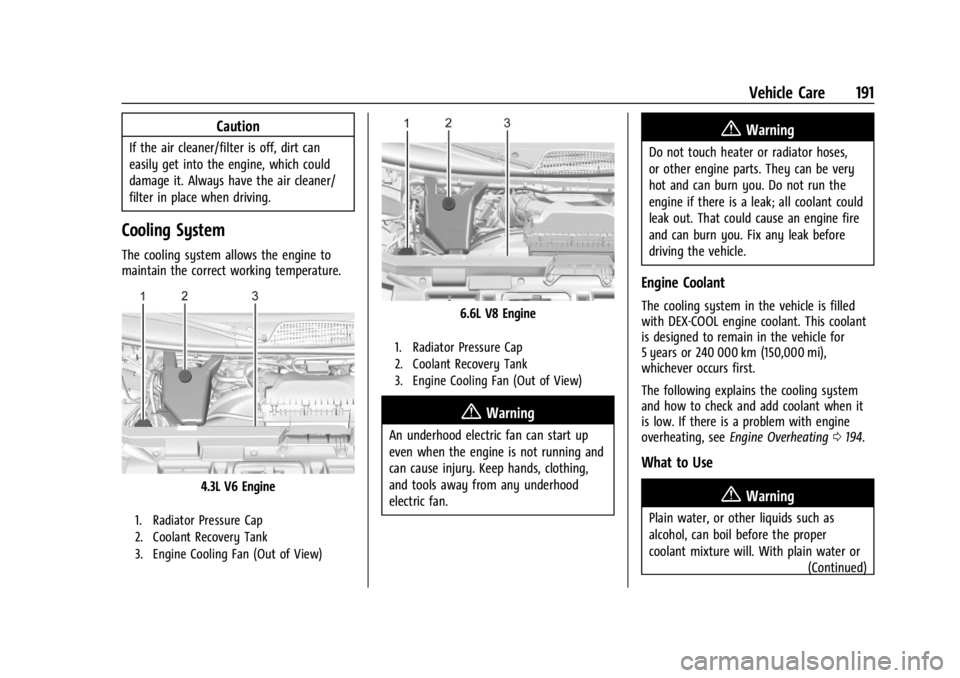
The cooling system allows the engine to
maintain the correct working temperature.
4.3L V6 Engine
1. Radiator Pressure Cap
2. Coolant Recovery Tank
3. Engine Cooling Fan (Out of View)
6.6L V8 Engine
1. Radiator Pressure Cap
2. Coolant Recovery Tank
3. Engine Cooling Fan (Out of View)
{Warning
An underhood electric fan can start up
even when the engine is not running and
can cause injury. Keep hands, clothing,
and tools away from any underhood
electric fan.
{Warning
Do not touch heater or radiator hoses,
or other engine parts. They can be very
hot and can burn you. Do not run the
engine if there is a leak; all coolant could
leak out. That could cause an engine fire
and can burn you. Fix any leak before
driving the vehicle.
Engine Coolant
The cooling system in the vehicle is filled
with DEX-COOL engine coolant. This coolant
is designed to remain in the vehicle for
5 years or 240 000 km (150,000 mi),
whichever occurs first.
The following explains the cooling system
and how to check and add coolant when it
is low. If there is a problem with engine
overheating, seeEngine Overheating 0194.
What to Use
{Warning
Plain water, or other liquids such as
alcohol, can boil before the proper
coolant mixture will. With plain water or
(Continued)
Page 193 of 292
GMC Savana Owner Manual (GMNA-Localizing-U.S./Canada-14583543) -
2021 - crc - 7/10/20
192 Vehicle Care
Warning (Continued)
the wrong mixture, the engine could get
too hot but there would not be an
overheat warning. The engine could catch
fire and you or others could be burned.
Use a 50/50 mixture of clean, drinkable
water and DEX-COOL coolant. If using this
mixture, nothing else needs to be added.
This mixture:
.Gives freezing protection down to −37 °C
(−34 °F), outside temperature.
.Gives boiling protection up to 129 °C
(265 °F), engine temperature.
.Protects against rust and corrosion.
.Will not damage aluminum parts.
.Helps keep the proper engine
temperature.
Caution
Do not use anything other than a mix of
DEX-COOL coolant that meets GM
Standard GMW3420 and clean, drinkable
water. Anything else can cause damage
to the engine cooling system and the
vehicle, which would not be covered by
the vehicle warranty. Never dispose of engine coolant by putting
it in the trash, pouring it on the ground,
or into sewers, streams, or bodies of water.
Have the coolant changed by an authorized
service center, familiar with legal
requirements regarding used coolant
disposal. This will help protect the
environment and your health.
Checking Coolant
The vehicle must be on a level surface when
checking the coolant level.
Check to see if coolant is visible in the
coolant recovery tank. If the coolant inside
the coolant recovery tank is boiling, do not
do anything else until it cools down.
If coolant is visible but the coolant level is
not at or above the indicated mark, add a
50/50 mixture of clean, drinkable water and
DEX-COOL coolant at the coolant recovery
tank, but be sure the cooling system is cool
before this is done.
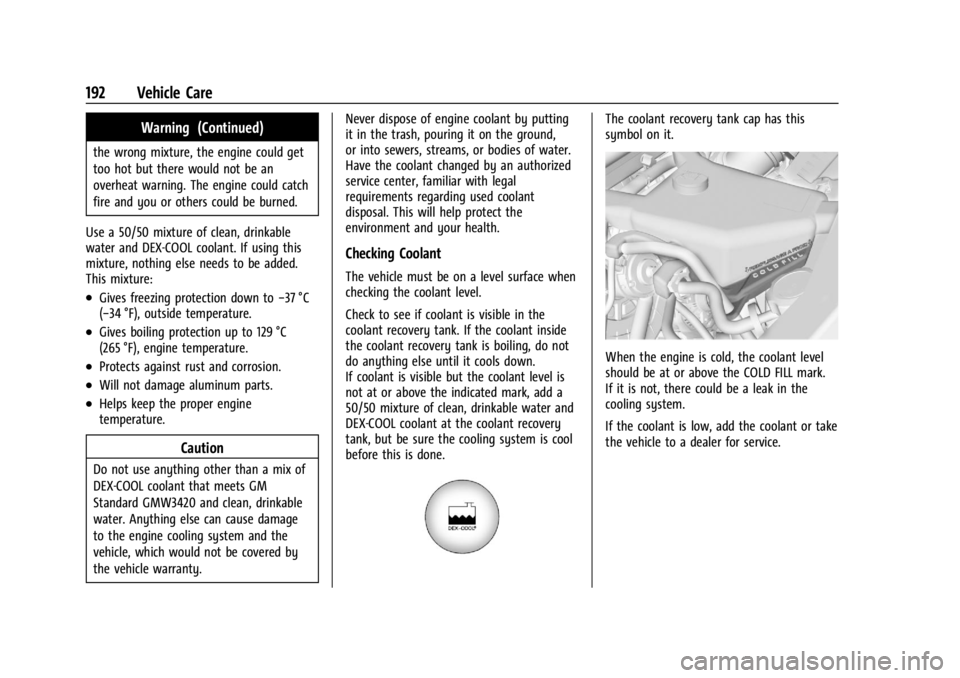
The coolant recovery tank cap has this
symbol on it.
When the engine is cold, the coolant level
should be at or above the COLD FILL mark.
If it is not, there could be a leak in the
cooling system.
If the coolant is low, add the coolant or take
the vehicle to a dealer for service.
Page 194 of 292
GMC Savana Owner Manual (GMNA-Localizing-U.S./Canada-14583543) -
2021 - crc - 7/10/20
Vehicle Care 193
How to Add Coolant to the Recovery
Tank for Gasoline Engines
{Warning
Spilling coolant on hot engine parts can
burn you. Coolant contains ethylene
glycol and it will burn if the engine parts
are hot enough.
{Warning
Plain water, or other liquids such as
alcohol, can boil before the proper
coolant mixture will. With plain water or
the wrong mixture, the engine could get
too hot but there would not be an
overheat warning. The engine could catch
fire and you or others could be burned.
{Warning
Steam and scalding liquids from a hot
cooling system are under pressure.
Turning the pressure cap, even a little,
can cause them to come out at high
speed and you could be burned. Never
turn the cap when the cooling system,(Continued)
Warning (Continued)
including the pressure cap, is hot. Wait
for the cooling system and pressure cap
to cool.
Caution
Failure to follow the specific coolant fill
procedure could cause the engine to
overheat and could cause system
damage. If coolant is not visible in the
surge tank, contact your dealer.
If coolant is needed, add the proper
DEX-COOL coolant mixture at the coolant
recovery tank.
How to Add Coolant to the Radiator
{Warning
Steam and scalding liquids from a hot
cooling system are under pressure.
Turning the pressure cap, even a little,
can cause them to come out at high
speed and you could be burned. Never
turn the cap when the cooling system, (Continued)
Warning (Continued)
including the pressure cap, is hot. Wait
for the cooling system and pressure cap
to cool.
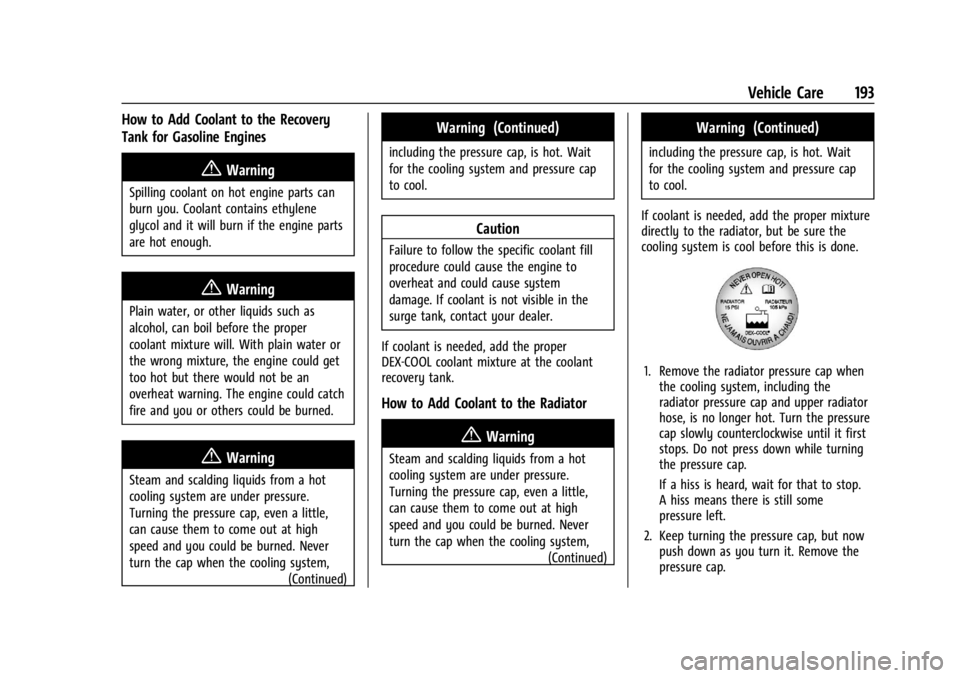
If coolant is needed, add the proper mixture
directly to the radiator, but be sure the
cooling system is cool before this is done.
1. Remove the radiator pressure cap when the cooling system, including the
radiator pressure cap and upper radiator
hose, is no longer hot. Turn the pressure
cap slowly counterclockwise until it first
stops. Do not press down while turning
the pressure cap.
If a hiss is heard, wait for that to stop.
A hiss means there is still some
pressure left.
2. Keep turning the pressure cap, but now push down as you turn it. Remove the
pressure cap.
Page 195 of 292
GMC Savana Owner Manual (GMNA-Localizing-U.S./Canada-14583543) -
2021 - crc - 7/10/20
194 Vehicle Care
3. Fill the radiator with the proper mixture,up to the base of the filler neck. See
Recommended Fluids and Lubricants
0255 for more information about the
proper coolant mixture.
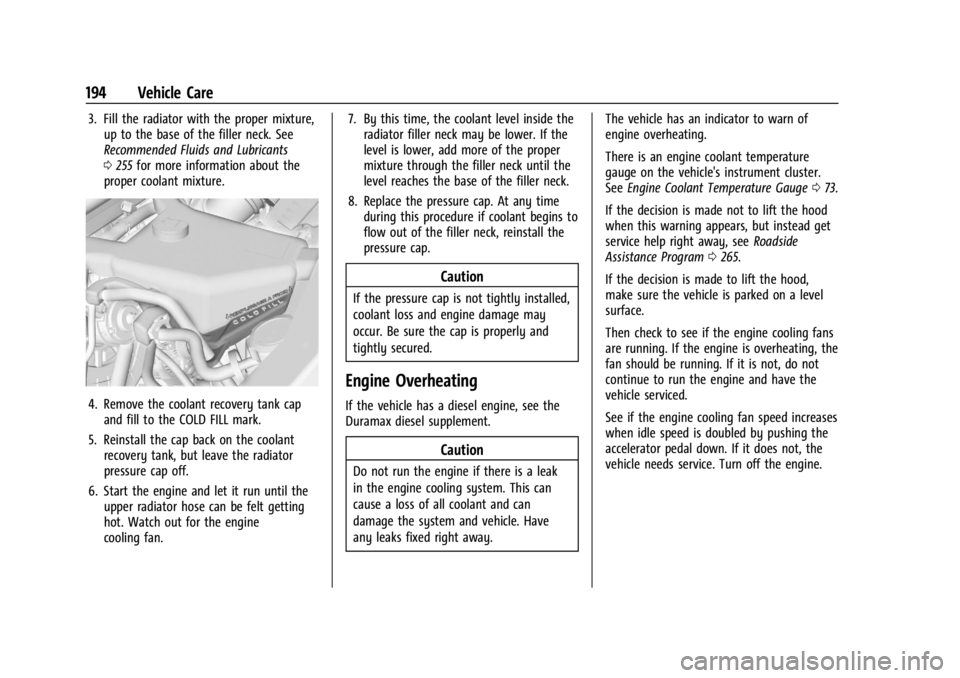
4. Remove the coolant recovery tank cap
and fill to the COLD FILL mark.
5. Reinstall the cap back on the coolant recovery tank, but leave the radiator
pressure cap off.
6. Start the engine and let it run until the upper radiator hose can be felt getting
hot. Watch out for the engine
cooling fan. 7. By this time, the coolant level inside the
radiator filler neck may be lower. If the
level is lower, add more of the proper
mixture through the filler neck until the
level reaches the base of the filler neck.
8. Replace the pressure cap. At any time during this procedure if coolant begins to
flow out of the filler neck, reinstall the
pressure cap.
Caution
If the pressure cap is not tightly installed,
coolant loss and engine damage may
occur. Be sure the cap is properly and
tightly secured.
Engine Overheating
If the vehicle has a diesel engine, see the
Duramax diesel supplement.
Caution
Do not run the engine if there is a leak
in the engine cooling system. This can
cause a loss of all coolant and can
damage the system and vehicle. Have
any leaks fixed right away. The vehicle has an indicator to warn of
engine overheating.
There is an engine coolant temperature
gauge on the vehicle's instrument cluster.
See
Engine Coolant Temperature Gauge 073.
If the decision is made not to lift the hood
when this warning appears, but instead get
service help right away, see Roadside
Assistance Program 0265.
If the decision is made to lift the hood,
make sure the vehicle is parked on a level
surface.
Then check to see if the engine cooling fans
are running. If the engine is overheating, the
fan should be running. If it is not, do not
continue to run the engine and have the
vehicle serviced.
See if the engine cooling fan speed increases
when idle speed is doubled by pushing the
accelerator pedal down. If it does not, the
vehicle needs service. Turn off the engine.
Page 196 of 292
GMC Savana Owner Manual (GMNA-Localizing-U.S./Canada-14583543) -
2021 - crc - 7/10/20
Vehicle Care 195
If Steam is Coming from the Engine
Compartment
{Warning
Steam and scalding liquids from a hot
cooling system are under pressure.
Turning the pressure cap, even a little,
can cause them to come out at high
speed and you could be burned. Never
turn the cap when the cooling system,
including the pressure cap, is hot. Wait
for the cooling system and pressure cap
to cool.
If No Steam is Coming from the Engine
Compartment
If an engine overheat warning is displayed
but no steam can be seen or heard, the
problem may not be too serious. Sometimes
the engine can get a little too hot when the
vehicle:
.Climbs a long hill on a hot day
.Stops after high-speed driving
.Idles for long periods in traffic
.Tows a trailer.
If the overheat warning is displayed with no
sign of steam: 1. Turn the air conditioning off.
2. Turn the heater on to the highest
temperature and to the highest fan
speed. Open the windows as necessary.
3. When it is safe to do so, pull off the road, shift to P (Park) or N (Neutral) and
let the engine idle.
If the engine coolant temperature gauge is
no longer in the overheat zone or an
overheat warning no longer displays, the
vehicle can be driven. Continue to drive the
vehicle slowly for about 10 minutes. Keep a
safe vehicle distance from the vehicle in
front. If the warning does not come back on,
continue to drive normally and have the
cooling system checked for proper fill and
function.
If the warning continues, pull over, stop, and
park the vehicle right away.
If there is still no sign of steam, push down
the accelerator until the engine speed is
about twice as fast as normal idle speed for
at least three minutes while parked. If the
warning is still on, turn off the engine until
it cools down.
If the decision is made not to lift the hood,
get service help right away.
Engine Fan
The vehicle has a clutched engine cooling
fan. When the clutch is engaged, the fan
spins faster to provide more air to cool the
engine. In most everyday driving conditions,
the fan is spinning slower and the clutch is
not fully engaged. This improves fuel
economy and reduces fan noise. Under
heavy vehicle loading, trailer towing, and/or
high outside temperatures, the fan speed
increases as the clutch more fully engages,
so an increase in fan noise may be heard.
This is normal and should not be mistaken
as the transmission slipping or making extra
shifts. It is merely the cooling system
functioning properly. The fan will slow down
when additional cooling is not required and
the clutch partially disengages.
This fan noise may be heard when starting
the engine. It will go away as the fan clutch
partially disengages.
Page 285 of 292

GMC Savana Owner Manual (GMNA-Localizing-U.S./Canada-14583543) -
2021 - crc - 7/10/20
284 Index
Engine (cont'd)Cooling System . . . . . . . . . . . . . . . . . . . . . . . . . 191
Drive Belt Routing . . . . . . . . . . . . . . . . . . . . . 261
Exhaust . . . . . . . . . . . . . . . . . . . . . . . . . . . . . . . . . 141
Fan . . . . . . . . . . . . . . . . . . . . . . . . . . . . . . . . . . . . 195
Oil Life System . . . . . . . . . . . . . . . . . . . . . . . . 186
Oil Pressure Gauge . . . . . . . . . . . . . . . . . . . . . 72
Oil Pressure Light . . . . . . . . . . . . . . . . . . . . . . . 80
Overheating . . . . . . . . . . . . . . . . . . . . . . . . . . . 194
Power Messages . . . . . . . . . . . . . . . . . . . . . . . . 85
Running While Parked . . . . . . . . . . . . . . . . . . 141
Starting . . . . . . . . . . . . . . . . . . . . . . . . . . . . . . . . 136
Enhanced Technology Glass . . . . . . . . . . . . . . . . 21
Entry Lighting . . . . . . . . . . . . . . . . . . . . . . . . . . . . 94
Equipment, Towing . . . . . . . . . . . . . . . . . . . . . . . 172
Event Data Recorders . . . . . . . . . . . . . . . . . . . . 272
Exit Lighting . . . . . . . . . . . . . . . . . . . . . . . . . . . . . . 94
Extender, Seat Belt . . . . . . . . . . . . . . . . . . . . . . . .35
Exterior Lamp Controls . . . . . . . . . . . . . . . . . . . . 90
Exterior Lamps Off Reminder . . . . . . . . . . . . . 90
Exterior Lighting Battery Saver . . . . . . . . . . . 95
F
Fan Engine . . . . . . . . . . . . . . . . . . . . . . . . . . . . . . . . . 195
Fast Idle System . . . . . . . . . . . . . . . . . . . . . . . . . .138 Filter,
Engine Air Cleaner . . . . . . . . . . . . . . . . . . . . . 189
Fixed Mast Antenna . . . . . . . . . . . . . . . . . . . . . 103
Flash-to-Pass . . . . . . . . . . . . . . . . . . . . . . . . . . . . . . .91
Flashers, Hazard Warning . . . . . . . . . . . . . . . . . 92
Flat Tire . . . . . . . . . . . . . . . . . . . . . . . . . . . . . . . . . 226 Changing . . . . . . . . . . . . . . . . . . . . . . . . . . . . . . 228
Floor Mats . . . . . . . . . . . . . . . . . . . . . . . . . . . . . . . 247
Fluid Automatic Transmission . . . . . . . . . . 186, 189
Brakes . . . . . . . . . . . . . . . . . . . . . . . . . . . . . . . . . 197
Power Steering . . . . . . . . . . . . . . . . . . . . . . . . 196
Washer . . . . . . . . . . . . . . . . . . . . . . . . . . . . . . . . 196
Folding Mirrors . . . . . . . . . . . . . . . . . . . . . . . . . . . .18
Forward Collision Alert (FCA) System . . . . .154
Frequency Statement Radio . . . . . . . . . . . . . . . . . . . . . . . . . . . . . . . . . . 270
Front Seats Adjustment . . . . . . . . . . . . . . . . . . . . . . . . . . . . . 22
Front Storage . . . . . . . . . . . . . . . . . . . . . . . . . . . . . 63
Front Turn Signal Bulb Replacement . . . . . . . . . . . . . . . . . . . . . . 202
Fuel Additives . . . . . . . . . . . . . . . . . . . . . . . . . . . . . . 158
Economy, Driving for Better . . . . . . . . . . . 126
Filling a Portable Fuel Container . . . . . . . 160
Filling the Tank . . . . . . . . . . . . . . . . . . . . . . . . 158
Foreign Countries . . . . . . . . . . . . . . . . . . . . . . 158 Fuel (cont'd)
Gauge . . . . . . . . . . . . . . . . . . . . . . . . . . . . . . . . . . . 71
Low Fuel Warning Light . . . . . . . . . . . . . . . . 80
Prohibited Fuels . . . . . . . . . . . . . . . . . . . . . . . 158
Recommended . . . . . . . . . . . . . . . . . . . . . . . . . 158
Top Tier . . . . . . . . . . . . . . . . . . . . . . . . . . . . . . . . 157
Full-Size Spare Tire . . . . . . . . . . . . . . . . . . . . . . . 235
Fuses
Engine Compartment Fuse Block . . . . . . . 206
Floor Console Fuse Block . . . . . . . . . . . . . . . 209
Fuses and Circuit Breakers . . . . . . . . . . . . . 205
G
GaugesEngine Coolant Temperature . . . . . . . . . . . . 73
Engine Oil Pressure . . . . . . . . . . . . . . . . . . . . . 72
Fuel . . . . . . . . . . . . . . . . . . . . . . . . . . . . . . . . . . . . . . 71
Odometer . . . . . . . . . . . . . . . . . . . . . . . . . . . . . . . 71
Speedometer . . . . . . . . . . . . . . . . . . . . . . . . . . . . 71
Trip Odometer . . . . . . . . . . . . . . . . . . . . . . . . . . . 71
Voltmeter . . . . . . . . . . . . . . . . . . . . . . . . . . . . . . . 73
Warning Lights and Indicators . . . . . . . . . . 70
General Information Service and Maintenance . . . . . . . . . . . . . . 248
Towing . . . . . . . . . . . . . . . . . . . . . . . . . . . . . . . . 160
Page 288 of 292

GMC Savana Owner Manual (GMNA-Localizing-U.S./Canada-14583543) -
2021 - crc - 7/10/20
Index 287
OnStar . . . . . . . . . . . . . . . . . . . . . . . . . . . . . . . . . . . 272
OnStar Additional Information . . . . . . . . . . . 274
OnStar Emergency . . . . . . . . . . . . . . . . . . . . . . . 274
OnStar Overview . . . . . . . . . . . . . . . . . . . . . . . . . 273
OnStar Security . . . . . . . . . . . . . . . . . . . . . . . . . . 274
OnStar System . . . . . . . . . . . . . . . . . . . . . . . . . . . 112
OperationInfotainment System . . . . . . . . . . . . . . . . . . 100
Outlets Power . . . . . . . . . . . . . . . . . . . . . . . . . . . . . . . . . . 69
Overheating, Engine . . . . . . . . . . . . . . . . . . . . . 194
Overview . . . . . . . . . . . . . . . . . . . . . . . . . . . . . 97, 99
Instrument Panel . . . . . . . . . . . . . . . . . . . . . . . . 4
P
ParkShifting Into . . . . . . . . . . . . . . . . . . . . . . . . . . . 140
Shifting Out of . . . . . . . . . . . . . . . . . . . . . . . . 140
Park Assist . . . . . . . . . . . . . . . . . . . . . . . . . . . . . . . . 153
Parking Brake . . . . . . . . . . . . . . . . . . . . . . . . . . . . . . . . . . 146
Brake and P (Park) Mechanism
Check . . . . . . . . . . . . . . . . . . . . . . . . . . . . . . . . 201
Over Things That Burn . . . . . . . . . . . . . . . . . . 141
Perchlorate Materials Requirements, California . . . . . . . . . . . . . . . . . . . . . . . . . . . . . . .178
Personalization Vehicle . . . . . . . . . . . . . . . . . . . . . . . . . . . . . . . . . 86 Phone
Bluetooth . . . . . . . . . . . . . . . . . . . . . . . . . . . . . . . 112
Power Door Locks . . . . . . . . . . . . . . . . . . . . . . . . . . . . . . . 11
Mirrors . . . . . . . . . . . . . . . . . . . . . . . . . . . . . . . . . 18
Outlets . . . . . . . . . . . . . . . . . . . . . . . . . . . . . . . . . 69
Protection, Battery . . . . . . . . . . . . . . . . . . . . . . 95
Retained Accessory (RAP) . . . . . . . . . . . . . . 138
Seat Adjustment . . . . . . . . . . . . . . . . . . . . . . . . 23
Steering Fluid . . . . . . . . . . . . . . . . . . . . . . . . . . 196
Windows . . . . . . . . . . . . . . . . . . . . . . . . . . . . . . . 19
Pregnancy, Using Seat Belts . . . . . . . . . . . . . . .35
Privacy Vehicle Data Recording . . . . . . . . . . . . . . . . . 271
Program Courtesy Transportation . . . . . . . . . . . . . . . 267
Prohibited Fuels . . . . . . . . . . . . . . . . . . . . . . . . . .158
Proposition 65 Warning, California . . . . . . . . . . . . . . . . . . . . .178, 198, 236, Back Cover
Publication Ordering Information . . . . . . . . 269
R
Radio Frequency Statement . . . . . . . . . . . . . . 270
Radio Reception . . . . . . . . . . . . . . . . . . . . . . . . . 103
Radios
AM-FM Radio . . . . . . . . . . . . . . . . . . . . . . . . . . 101 Radios (cont'd)
Satellite . . . . . . . . . . . . . . . . . . . . . . . . . . . . . . . . 102
Reading Lamps . . . . . . . . . . . . . . . . . . . . . . . . . . . 94
Rear Axle . . . . . . . . . . . . . . . . . . . . . . . . . . . . . . . . 199 Locking . . . . . . . . . . . . . . . . . . . . . . . . . . . . . . . . 148
Rear Climate Control System . . . . . . . . . . . . . 122
Rear Doors . . . . . . . . . . . . . . . . . . . . . . . . . . . . . . . . . 15
Rear Heating System . . . . . . . . . . . . . . . . . . . . . 121
Rear Seats . . . . . . . . . . . . . . . . . . . . . . . . . . . . . . . . 24
Rear Vision Camera (RVC) . . . . . . . . . . . . . . . . . 152
Rear Windows . . . . . . . . . . . . . . . . . . . . . . . . . . . . . 21
Rearview Mirrors . . . . . . . . . . . . . . . . . . . . . . . . . .19
Reclining Seatbacks . . . . . . . . . . . . . . . . . . . . . . . .23
Recommended Fuel . . . . . . . . . . . . . . . . . . . . . . . . . . . . . . . . . . . . 158
Recommended Fluids and Lubricants . . . . . 255
Records
Maintenance . . . . . . . . . . . . . . . . . . . . . . . . . . . 257
Recreational Vehicle Towing . . . . . . . . . . . . . 239
Reimbursement Program, GM Mobility . . . . . . . . . . . . . . . . . . . . . . . . . . . . . . . 265
Remote Keyless Entry (RKE) System . . . . . . . 8
Remote Vehicle Start . . . . . . . . . . . . . . . . . . . . . 10
Replacement Parts Airbags . . . . . . . . . . . . . . . . . . . . . . . . . . . . . . . . . 45
Maintenance . . . . . . . . . . . . . . . . . . . . . . . . . . . 256
Replacing Airbag System . . . . . . . . . . . . . . . . . . 45