brake fluid GMC SAVANA 2021 Owner's Manual
[x] Cancel search | Manufacturer: GMC, Model Year: 2021, Model line: SAVANA, Model: GMC SAVANA 2021Pages: 292, PDF Size: 6.38 MB
Page 86 of 292
GMC Savana Owner Manual (GMNA-Localizing-U.S./Canada-14583543) -
2021 - crc - 7/10/20
Instruments and Controls 85
the tire positions, seeTire Pressure Monitor
System 0217. See Tire Inspection 0220 and
Tire Rotation 0220.
Change Compass Zone
The vehicle may have this feature. To
change the compass zone through the DIC,
see Compass 067.
Calibrate Compass
The vehicle may have this feature. The
compass can be manually calibrated. To
calibrate the compass through the DIC, see
Compass 067.
Blank Display
This display shows no information.
Vehicle Messages
Messages displayed on the DIC indicate the
status of the vehicle or some action that
may be needed to correct a condition.
Multiple messages may appear one after
another.
The messages that do not require
immediate action can be acknowledged and
cleared by pressing
V. The messages that
require immediate action cannot be cleared
until that action is performed. All messages should be taken seriously;
clearing the message does not correct the
problem.
If a SERVICE message appears, see your
dealer.
Follow the instructions given in the
messages. The system displays messages
regarding the following topics:
.Service Messages
.Fluid Levels
.Vehicle Security
.Brakes
.Steering
.Ride Control Systems
.Driver Assistance Systems
.Cruise Control
.Lighting and Bulb Replacement
.Wiper/Washer Systems
.Doors and Windows
.Seat Belts
.Airbag Systems
.Engine and Transmission
.Tire Pressure
.Battery
Engine Power Messages
ENGINE POWER IS REDUCED
This message displays when the vehicle's
propulsion power is reduced. A reduction in
propulsion power can affect the vehicle's
ability to accelerate. If this message is on,
but there is no observed reduction in
performance, proceed to your destination.
Under certain conditions the performance
may be reduced the next time the vehicle is
driven. The vehicle may be driven while this
message is on, but maximum acceleration
and speed may be reduced. Anytime this
message stays on, or displays repeatedly,
the vehicle should be taken to your dealer
for service as soon as possible.
Under certain operating conditions,
propulsion will be disabled. Try restarting
after the ignition has been off for
30 seconds.
Page 129 of 292
GMC Savana Owner Manual (GMNA-Localizing-U.S./Canada-14583543) -
2021 - crc - 7/10/20
128 Driving and Operating
Hydraulic Power Steering
This vehicle has hydraulic power steering.
It may require maintenance. SeePower
Steering Fluid 0196.
If power steering assist is lost because the
engine stops or because of a system
malfunction, the vehicle can be steered but
may require increased effort. See your
dealer if there is a problem.
Caution
If the steering wheel is turned until it
reaches the end of its travel, and is held
in that position for more than 15 seconds,
damage may occur to the power steering
system and there may be loss of power
steering assist.
Curve Tips
.Take curves at a reasonable speed.
.Reduce speed before entering a curve.
.Maintain a reasonable steady speed
through the curve.
.Wait until the vehicle is out of the curve
before accelerating gently into the
straightaway.
Steering in Emergencies
.There are some situations when steering
around a problem may be more effective
than braking.
.Holding both sides of the steering wheel
allows you to turn 180 degrees without
removing a hand.
.Antilock Brake System (ABS) allows
steering while braking.
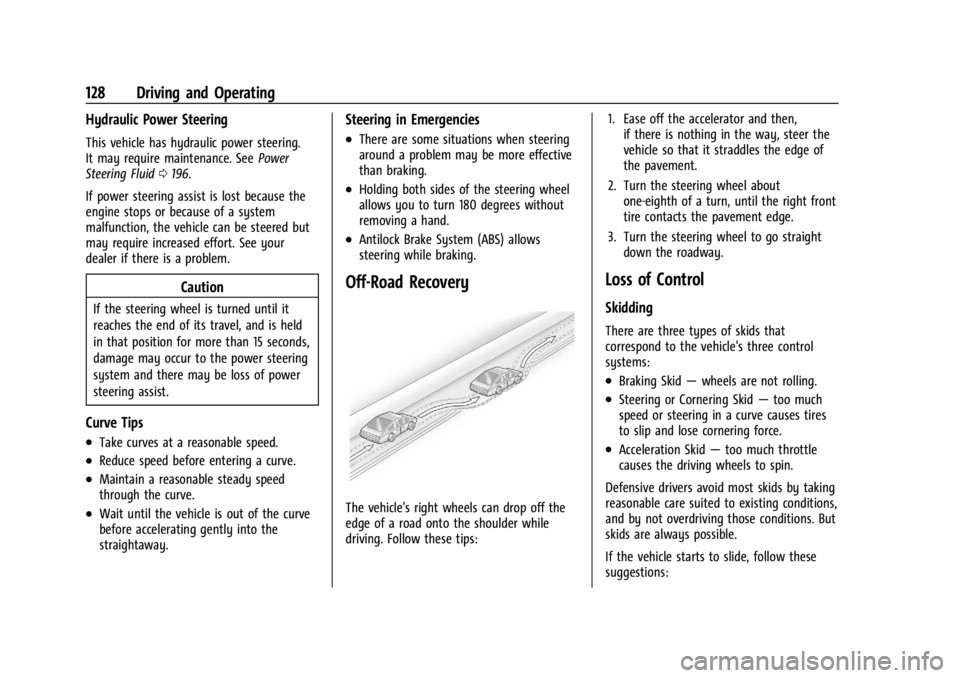
Off-Road Recovery
The vehicle's right wheels can drop off the
edge of a road onto the shoulder while
driving. Follow these tips: 1. Ease off the accelerator and then,
if there is nothing in the way, steer the
vehicle so that it straddles the edge of
the pavement.
2. Turn the steering wheel about one-eighth of a turn, until the right front
tire contacts the pavement edge.
3. Turn the steering wheel to go straight down the roadway.
Loss of Control
Skidding
There are three types of skids that
correspond to the vehicle's three control
systems:
.Braking Skid —wheels are not rolling.
.Steering or Cornering Skid —too much
speed or steering in a curve causes tires
to slip and lose cornering force.
.Acceleration Skid —too much throttle
causes the driving wheels to spin.
Defensive drivers avoid most skids by taking
reasonable care suited to existing conditions,
and by not overdriving those conditions. But
skids are always possible.
If the vehicle starts to slide, follow these
suggestions:
Page 130 of 292
GMC Savana Owner Manual (GMNA-Localizing-U.S./Canada-14583543) -
2021 - crc - 7/10/20
Driving and Operating 129
.Ease your foot off the accelerator pedal
and steer the way you want the vehicle
to go. The vehicle may straighten out. Be
ready for a second skid if it occurs.
.Slow down and adjust your driving
according to weather conditions. Stopping
distance can be longer and vehicle control
can be affected when traction is reduced
by water, snow, ice, gravel, or other
material on the road. Learn to recognize
warning clues—such as enough water,
ice, or packed snow on the road to make
a mirrored surface —and slow down
when you have any doubt.
.Try to avoid sudden steering, acceleration,
or braking, including reducing vehicle
speed by shifting to a lower gear. Any
sudden changes could cause the tires to
slide.
Remember: Antilock brakes help avoid only
the braking skid.
Driving on Wet Roads
Rain and wet roads can reduce vehicle
traction and affect your ability to stop and
accelerate. Always drive slower in these
types of driving conditions and avoid driving
through large puddles and deep-standing or
flowing water.
{Warning
Wet brakes can cause crashes. They
might not work as well in a quick stop
and could cause pulling to one side. You
could lose control of the vehicle.
After driving through a large puddle of
water or a car/vehicle wash, lightly apply
the brake pedal until the brakes work
normally.
Flowing or rushing water creates strong
forces. Driving through flowing water
could cause the vehicle to be carried
away. If this happens, you and other
vehicle occupants could drown. Do not
ignore police warnings and be very
cautious about trying to drive through
flowing water.
Hydroplaning
Hydroplaning is dangerous. Water can build
up under the vehicle's tires so they actually
ride on the water. This can happen if the
road is wet enough and you are going fast
enough. When the vehicle is hydroplaning, it
has little or no contact with the road. There is no hard and fast rule about
hydroplaning. The best advice is to slow
down when the road is wet.
Other Rainy Weather Tips
Besides slowing down, other wet weather
driving tips include:
.Allow extra following distance.
.Pass with caution.
.Keep windshield wiping equipment in
good shape.
.Keep the windshield washer fluid reservoir
filled.
.Have good tires with proper tread depth.
See
Tires 0211.
.Turn off cruise control.
Hill and Mountain Roads
Driving on steep hills or through mountains
is different than driving on flat or rolling
terrain. Tips include:
.Keep the vehicle serviced and in good
shape.
.Check all fluid levels and brakes, tires,
cooling system, and transmission.
.Shift to a lower gear when going down
steep or long hills.
Page 144 of 292
GMC Savana Owner Manual (GMNA-Localizing-U.S./Canada-14583543) -
2021 - crc - 7/10/20
Driving and Operating 143
Caution
Shifting out of P (Park) or N (Neutral) with
the engine running at high speed may
damage the transmission. The repairs
would not be covered by the vehicle
warranty. Be sure the engine is not
running at high speed when shifting the
vehicle.
Caution
A transmission hot message may display
if the automatic transmission fluid is too
hot. Driving under this condition can
damage the vehicle. Stop and idle the
engine to cool the automatic
transmission fluid. This message clears
when the transmission fluid has cooled
sufficiently.
D : This position is for normal driving.
It provides the best fuel economy. If you
need more power for passing, and you are:
.Going less than about 55 km/h (35 mph),
push the accelerator pedal about
halfway down.
.Going about 55 km/h (35 mph) or more,
push the accelerator all the way down. By doing this, the vehicle shifts down to
the next gear and has more power.
D (Drive) can be used when towing a trailer,
carrying a heavy load, or driving on steep
hills. You might want to shift the
transmission to a lower gear selection if the
transmission shifts too often.
Downshifting the transmission in slippery
road conditions could result in skidding. See
“Skidding” underLoss of Control 0128.
The vehicle has a shift stabilization feature
that adjusts the transmission shifting to the
current driving conditions in order to reduce
rapid upshifts and downshifts. This shift
stabilization feature is designed to
determine, before making an upshift, if the
engine is able to maintain vehicle speed by
analyzing things such as vehicle speed,
throttle position, and vehicle load. If the
shift stabilization feature determines that a
current vehicle speed cannot be maintained,
the transmission does not upshift and
instead holds the current gear. In some
cases, this could appear to be a delayed
shift, however the transmission is operating
normally.
The transmission uses adaptive shift
controls. Adaptive shift controls continually
compare key shift parameters to pre-programmed ideal shifts stored in the
transmission’s computer. The transmission
constantly makes adjustments to improve
vehicle performance according to how the
vehicle is being used, such as with a heavy
load or when the temperature changes.
During this adaptive shift control process,
shifting might feel different as the
transmission determines the best settings.
The shift quality of a new vehicle may not
be ideal because the adaptive shift control
process may not have determined the best
settings for a particular shift or condition.
Shift quality will improve with continued
driving.
When temperatures are very cold, the
transmission's gear shifting could be
delayed, providing more stable shifts until
the engine warms up. Shifts could be more
noticeable with a cold transmission. This
difference in shifting is normal.
M :
This position lets drivers select the
range of gears appropriate for current
driving conditions. If the vehicle has this
feature, see “Range Selection Mode” under
Manual Mode 0144.
1 : This position reduces vehicle speed
without using the brakes. You can use it for
major/severe downgrades where the vehicle
Page 165 of 292
GMC Savana Owner Manual (GMNA-Localizing-U.S./Canada-14583543) -
2021 - crc - 7/10/20
164 Driving and Operating
2. Start the engine and shift into a gear.
3. Release the parking brake.
4. Let up on the brake pedal.
5. Drive slowly until the tires are clear ofthe chocks.
6. Stop and have someone pick up and store the chocks.
7. Slowly pull the trailer from the water.
Caution
If the vehicle tires begin to spin and the
vehicle begins to slide toward the water,
remove your foot from the accelerator
pedal and apply the brake pedal. Seek
help to have the vehicle towed up
the ramp.
Maintenance when Trailer Towing
The vehicle needs service more often when
used to tow trailers. See Maintenance
Schedule 0249. It is especially important to
check the automatic transmission fluid,
engine oil, axle lubricant, belts, cooling
system, and brake system before and during
each trip.
Check periodically that all nuts and bolts on
the trailer hitch are tight.
Engine Cooling when Trailer Towing
The cooling system may temporarily
overheat during severe operating conditions.
See Engine Overheating 0194.
Trailer Towing
If equipped with a diesel engine, see the
Duramax diesel supplement.
Caution
Towing a trailer improperly can damage
the vehicle and result in costly repairs
not covered by the vehicle warranty. To
tow a trailer correctly, follow the
directions in this section and see your
dealer for important information about
towing a trailer with the vehicle.
Trailering is different than just driving the
vehicle by itself. Trailering means changes in
handling, acceleration, braking, durability,
and fuel economy. Successful, safe trailering
takes correct equipment, and it has to be
used properly.
The following information has many
time-tested, important trailering tips and
safety rules. Many of these are important
for your safety and that of your passengers.
Read this section carefully before pulling a
trailer.
Page 178 of 292
GMC Savana Owner Manual (GMNA-Localizing-U.S./Canada-14583543) -
2021 - crc - 7/10/20
Vehicle Care 177
Vehicle Care
General Information
General Information . . . . . . . . . . . . . . . . . . . 178
California Proposition 65 Warning . . . . . 178
California Perchlorate MaterialsRequirements . . . . . . . . . . . . . . . . . . . . . . . . 178
Accessories and Modifications . . . . . . . . . 178
Vehicle Checks
Doing Your Own Service Work . . . . . . . . . 179
Hood . . . . . . . . . . . . . . . . . . . . . . . . . . . . . . . . . . 179
Engine Compartment Overview . . . . . . . . 180
Engine Oil . . . . . . . . . . . . . . . . . . . . . . . . . . . . . 184
Engine Oil Life System . . . . . . . . . . . . . . . . 186
Automatic Transmission Fluid (6-Speed Transmission) . . . . . . . . . . . . . . . . . . . . . . . . 186
Automatic Transmission Fluid (8-Speed Transmission) . . . . . . . . . . . . . . . . . . . . . . . . 189
Engine Air Cleaner/Filter . . . . . . . . . . . . . . . 189
Cooling System . . . . . . . . . . . . . . . . . . . . . . . . 191
Engine Overheating . . . . . . . . . . . . . . . . . . . 194
Engine Fan . . . . . . . . . . . . . . . . . . . . . . . . . . . . 195
Power Steering Fluid . . . . . . . . . . . . . . . . . . 196
Washer Fluid . . . . . . . . . . . . . . . . . . . . . . . . . . 196
Brakes . . . . . . . . . . . . . . . . . . . . . . . . . . . . . . . . . 197
Brake Fluid . . . . . . . . . . . . . . . . . . . . . . . . . . . . 197
Battery - North America . . . . . . . . . . . . . . . 198
Rear Axle . . . . . . . . . . . . . . . . . . . . . . . . . . . . . . 199
Noise Control System . . . . . . . . . . . . . . . . . 199 Starter Switch Check . . . . . . . . . . . . . . . . . . 200
Automatic Transmission Shift Lock
Control Function Check . . . . . . . . . . . . . . 201
Ignition Transmission Lock Check . . . . . . 201
Park Brake and P (Park) Mechanism Check . . . . . . . . . . . . . . . . . . . . . . . . . . . . . . . . 201
Wiper Blade Replacement . . . . . . . . . . . . . 201
Windshield Replacement . . . . . . . . . . . . . . 202
Headlamp Aiming
Front Headlamp Aiming . . . . . . . . . . . . . . . 202
Bulb Replacement
Bulb Replacement . . . . . . . . . . . . . . . . . . . . . 202
Halogen Bulbs . . . . . . . . . . . . . . . . . . . . . . . . . 202
Front Turn Signal, Sidemarker, and Parking Lamps . . . . . . . . . . . . . . . . . . . . . . . 202
Taillamps . . . . . . . . . . . . . . . . . . . . . . . . . . . . . . 203
Center High-Mounted Stoplamp (CHMSL) . . . . . . . . . . . . . . . . . . . . . . . . . . . . . 204
License Plate Lamp . . . . . . . . . . . . . . . . . . . . 204
Electrical System
Electrical System Overload . . . . . . . . . . . . 205
Fuses and Circuit Breakers . . . . . . . . . . . . . 205
Engine Compartment Fuse Block . . . . . . 206
Floor Console Fuse Block . . . . . . . . . . . . . . 209
Wheels and Tires
Tires . . . . . . . . . . . . . . . . . . . . . . . . . . . . . . . . . . . 211
All-Season Tires . . . . . . . . . . . . . . . . . . . . . . . . 211
Winter Tires . . . . . . . . . . . . . . . . . . . . . . . . . . . 212 Tire Sidewall Labeling . . . . . . . . . . . . . . . . . . 212
Tire Designations . . . . . . . . . . . . . . . . . . . . . . 213
Tire Terminology and Definitions . . . . . . 214
Tire Pressure . . . . . . . . . . . . . . . . . . . . . . . . . . 216
Tire Pressure Monitor System . . . . . . . . . . 217
Tire Pressure Monitor Operation . . . . . . . 217
Tire Inspection . . . . . . . . . . . . . . . . . . . . . . . . 220
Tire Rotation . . . . . . . . . . . . . . . . . . . . . . . . . . 220
When It Is Time for New Tires . . . . . . . . 222
Buying New Tires . . . . . . . . . . . . . . . . . . . . . . 222
Different Size Tires and Wheels . . . . . . . 224
Uniform Tire Quality Grading . . . . . . . . . 224
Wheel Alignment and Tire Balance . . . . 225
Wheel Replacement . . . . . . . . . . . . . . . . . . . 225
Tire Chains . . . . . . . . . . . . . . . . . . . . . . . . . . . . 226
If a Tire Goes Flat . . . . . . . . . . . . . . . . . . . . . 226
Tire Changing . . . . . . . . . . . . . . . . . . . . . . . . . 228
Full-Size Spare Tire . . . . . . . . . . . . . . . . . . . . 235
Jump Starting
Jump Starting - North America . . . . . . . . 236
Towing the Vehicle
Towing the Vehicle . . . . . . . . . . . . . . . . . . . . 239
Recreational Vehicle Towing . . . . . . . . . . . 239
Appearance Care
Exterior Care . . . . . . . . . . . . . . . . . . . . . . . . . . . 241
Interior Care . . . . . . . . . . . . . . . . . . . . . . . . . . . 245
Floor Mats . . . . . . . . . . . . . . . . . . . . . . . . . . . . 247
Page 179 of 292
GMC Savana Owner Manual (GMNA-Localizing-U.S./Canada-14583543) -
2021 - crc - 7/10/20
178 Vehicle Care
General Information
For service and parts needs, visit your
dealer. You will receive genuine GM parts
and GM-trained and supported service
people.
Genuine GM parts have one of these marks:
California Proposition 65 Warning
{Warning
Most motor vehicles, including this one,
as well as many of its service parts and
fluids, contain and/or emit chemicals
known to the State of California to cause(Continued)
Warning (Continued)
cancer and birth defects or other
reproductive harm. Engine exhaust, many
parts and systems, many fluids, and
some component wear by-products
contain and/or emit these chemicals. For
more information go to
www.P65Warnings.ca.gov/
passenger-vehicle.
See Battery - North America 0198 and
Jump Starting - North America 0236 and
the back cover.
California Perchlorate Materials
Requirements
Certain types of automotive applications,
such as airbag initiators, seat belt
pretensioners, and lithium batteries
contained in electronic keys, may contain
perchlorate materials. Perchlorate Material –
special handling may apply. See
www.dtsc.ca.gov/hazardouswaste/
perchlorate.
Accessories and Modifications
Adding non-dealer accessories or making
modifications to the vehicle can affect
vehicle performance and safety, including
such things as airbags, braking, stability,
ride and handling, emissions systems,
aerodynamics, durability, and electronic
systems like antilock brakes, traction control,
and stability control. These accessories or
modifications could even cause malfunction
or damage not covered by the vehicle
warranty.
Damage to suspension components caused
by modifying vehicle height outside of
factory settings will not be covered by the
vehicle warranty.
Damage to vehicle components resulting
from modifications or the installation or use
of non-GM certified parts, including control
module or software modifications, is not
covered under the terms of the vehicle
warranty and may affect remaining
warranty coverage for affected parts.
GM Accessories are designed to complement
and function with other systems on the
vehicle. See your dealer to accessorize the
vehicle using genuine GM Accessories
installed by a dealer technician.
Page 183 of 292

GMC Savana Owner Manual (GMNA-Localizing-U.S./Canada-14583543) -
2021 - crc - 7/10/20
182 Vehicle Care
1.Battery - North America 0198.
2. Radiator Pressure Cap. See Cooling
System 0191.
3. Coolant Recovery Tank. See Cooling
System 0191.
4. Engine Oil Dipstick. See “Checking Engine
Oil” under Engine Oil 0184. 5. Engine Cooling Fan (Out of View). See
Cooling System 0191.
6. Engine Air Cleaner/Filter 0189.
7. Engine Oil Fill Cap. See “When to Add
Engine Oil” underEngine Oil 0184.
8. Power Steering Fluid Reservoir. See Power Steering Fluid 0196.
9. Engine Compartment Fuse Block 0206. 10. Brake Master Cylinder Reservoir. See
Brake Fluid 0197.
11. Windshield Washer Fluid Reservoir. See “Adding Washer Fluid” underWasher
Fluid 0196.
Page 185 of 292
GMC Savana Owner Manual (GMNA-Localizing-U.S./Canada-14583543) -
2021 - crc - 7/10/20
184 Vehicle Care
10. Brake Master Cylinder Reservoir. SeeBrake Fluid 0197.
11. Windshield Washer Fluid Reservoir. See “Adding Washer Fluid” underWasher
Fluid 0196.
Engine Oil
For diesel engine vehicles, see “Engine Oil”
in the Duramax diesel supplement.
To ensure proper engine performance and
long life, careful attention must be paid to
engine oil. Following these simple, but
important steps will help protect your
investment:
.Use engine oil approved to the proper
specification and of the proper viscosity
grade. See “Selecting the Right Engine
Oil” in this section.
.Check the engine oil level regularly and
maintain the proper oil level. See
“Checking Engine Oil” and“When to Add
Engine Oil” in this section.
.Change the engine oil at the appropriate
time. SeeEngine Oil Life System 0186.
.Always dispose of engine oil properly. See
“What to Do with Used Oil” in this
section.
Checking Engine Oil
Check the engine oil level regularly, every
650 km (400 mi), especially prior to a long
trip. The engine oil dipstick handle is a loop.
See Engine Compartment Overview 0180 for
the location.
{Warning
The engine oil dipstick handle may be
hot; it could burn you. Use a towel or
glove to touch the dipstick handle.
If a low oil Driver Information Center (DIC)
message displays, check the oil level.
Follow these guidelines:
.To get an accurate reading, park the
vehicle on level ground. Check the engine
oil level after the engine has been off for
at least two hours. Checking the engine
oil level on steep grades or too soon after
engine shutoff can result in incorrect
readings. Accuracy improves when
checking a cold engine prior to starting.
Remove the dipstick and check the level.
.If unable to wait two hours, the engine
must be off for at least 15 minutes if the
engine is warm, or at least 30 minutes if
the engine is not warm. Pull out the dipstick, wipe it with a clean paper towel
or cloth, then push it back in all the way.
Remove it again, keeping the tip down,
and check the level.
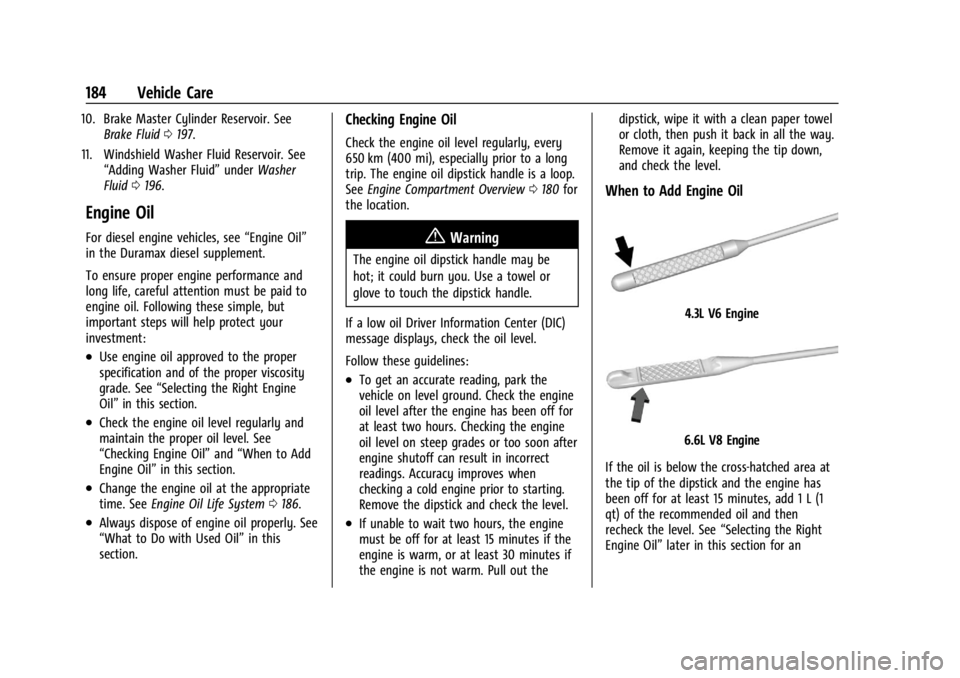
When to Add Engine Oil
4.3L V6 Engine
6.6L V8 Engine
If the oil is below the cross-hatched area at
the tip of the dipstick and the engine has
been off for at least 15 minutes, add 1 L (1
qt) of the recommended oil and then
recheck the level. See “Selecting the Right
Engine Oil” later in this section for an
Page 188 of 292
GMC Savana Owner Manual (GMNA-Localizing-U.S./Canada-14583543) -
2021 - crc - 7/10/20
Vehicle Care 187
How to Check Automatic Transmission
Fluid
Because this operation can be difficult, it is
recommended to have this check done at
your dealer, which can monitor the
transmission temperature. The transmission
fluid level increases with temperature. To
obtain a highly accurate fluid level check,
the transmission temperature must be
measured.
If it is decided to check the fluid level, be
sure to follow all the instructions here, or a
false reading on the dipstick may occur.
Caution
Too much or too little fluid can damage
the transmission. Too much can mean
that some of the fluid could come out
and fall on hot engine parts or exhaust
system parts, starting a fire. Too little
fluid could cause the transmission to
overheat. Be sure to get an accurate
reading if checking the transmission fluid.
Wait at least 30 minutes with the engine
off, before checking the transmission fluid
level if the vehicle has been driven:
.In hot weather, when outside
temperatures are above 32 °C (90 °F).
.The vehicle is heavily loaded.
.At high speed for quite a while in hot
weather.
.In heavy traffic and hot weather.
.While pulling a trailer.
After driving under these conditions, a hot
check can be performed. The fluid should be
hot, which is 71 °C to 93 °C (160 °F to
200 °F).
A cold fluid level check can be performed
after the vehicle has been sitting for eight
hours or more with the engine off, but this
is used only as a reference. Let the engine
run at idle for five minutes if the outside
temperature is between 15 °C to 32 °C (60 °F
to 90 °F). Should the fluid level be low
during this cold check, the fluid must be
checked warm or hot before adding fluid.
If the outside temperature is colder than 15 °
C (60 °F) or hotter than 32 °C (90 °F), a cold
check cannot be performed.
A warm fluid level check can be performed
by driving the vehicle under lightly loaded
conditions and outside temperatures
between 10 °C to 27 °C (50 °F to 80 °F). The
vehicle should be driven for at least 24 km (15 mi) before performing a warm check.
Checking the fluid warm or hot will give a
more accurate reading of the fluid level than
a cold check.
Because the vehicle is equipped with a
high-efficiency air-to-oil cooler, the
transmission fluid temperature may not
reach the required hot fluid level checking
temperature under normal lightly loaded
driving vehicle conditions.
Checking the Fluid Level
Prepare the vehicle:
1. Park the vehicle on a level place. Keep the engine running.
2. With the parking brake applied, place the shift lever in P (Park).
3. With a foot on the brake pedal, move the shift lever through each gear range,
pausing for about three seconds in each
range. When M is reached, move the
selector from M1 through M3. Then,
position the shift lever in P (Park).
4. Let the engine run at idle for two minutes or more.
Then, without shutting off the engine, use
the steps that follow.