lock GMC SAVANA PASSENGER 2008 User Guide
[x] Cancel search | Manufacturer: GMC, Model Year: 2008, Model line: SAVANA PASSENGER, Model: GMC SAVANA PASSENGER 2008Pages: 402, PDF Size: 2.34 MB
Page 48 of 402
{CAUTION:
Children can be seriously injured or strangled
if a shoulder belt is wrapped around their
neck and the safety belt continues to tighten.
Secure any unused safety belts behind the
child restraint so children cannot reach them.
Pull the shoulder belt all the way out of the
retractor to set the lock, if your vehicle has
one, after the child restraint has been installed.
Be sure to follow the instructions of the
child restraint manufacturer.
Notice:Contact between the child restraint LATCH
attachment parts and the vehicle’s safety belt
assembly may cause damage to these parts. Make
sure when securing unused safety belts behind
the child restraint that there is no contact between
the child restraint LATCH attachment parts and
the vehicle’s safety belt assembly.Folding an empty rear seat with the safety belts
secured may cause damage to the safety belt or
the seat. When removing the child restraint,
always remember to return the safety belts to
their normal, stowed position before folding
the rear seat.
1. Attach and tighten the lower attachments to the
lower anchors. If the child restraint does not have
lower attachments or the desired seating position
does not have lower anchors, secure the child
restraint with the top tether and the safety belts.
Refer to your child restraint manufacturer
instructions and the instructions in this manual.
1.1. Find the lower anchors for the desired
seating position.
1.2. Put the child restraint on the seat.
1.3. Attach and tighten the lower attachments
on the child restraint to the lower anchors.
1-44
Page 51 of 402
If you need to install more than one child restraint in the
rear seat, be sure to readWhere to Put the Restraint
on page 1-38.
1. Put the child restraint on the seat.
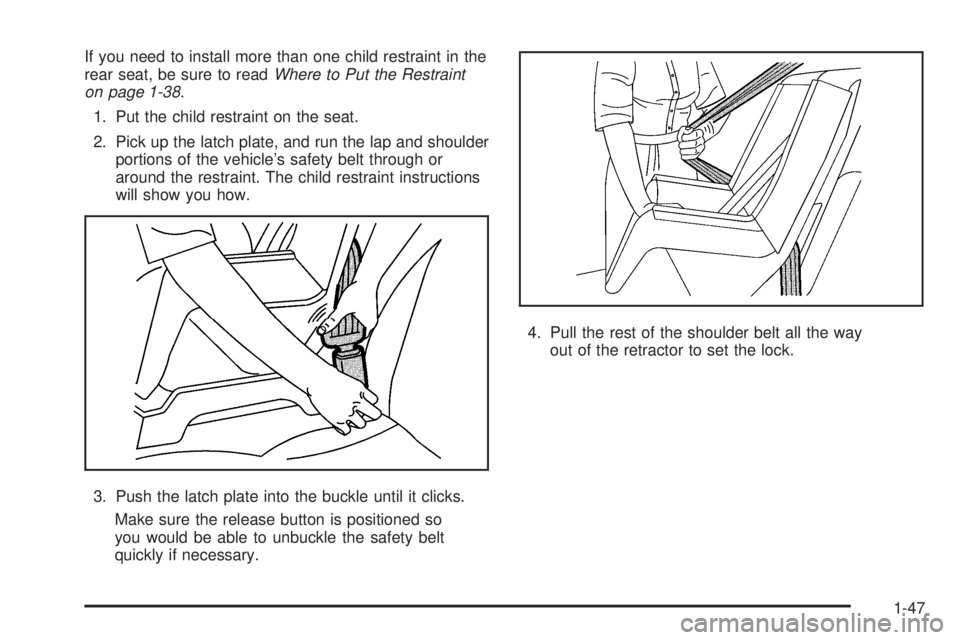
2. Pick up the latch plate, and run the lap and shoulder
portions of the vehicle’s safety belt through or
around the restraint. The child restraint instructions
will show you how.
3. Push the latch plate into the buckle until it clicks.
Make sure the release button is positioned so
you would be able to unbuckle the safety belt
quickly if necessary.4. Pull the rest of the shoulder belt all the way
out of the retractor to set the lock.
1-47
Page 55 of 402
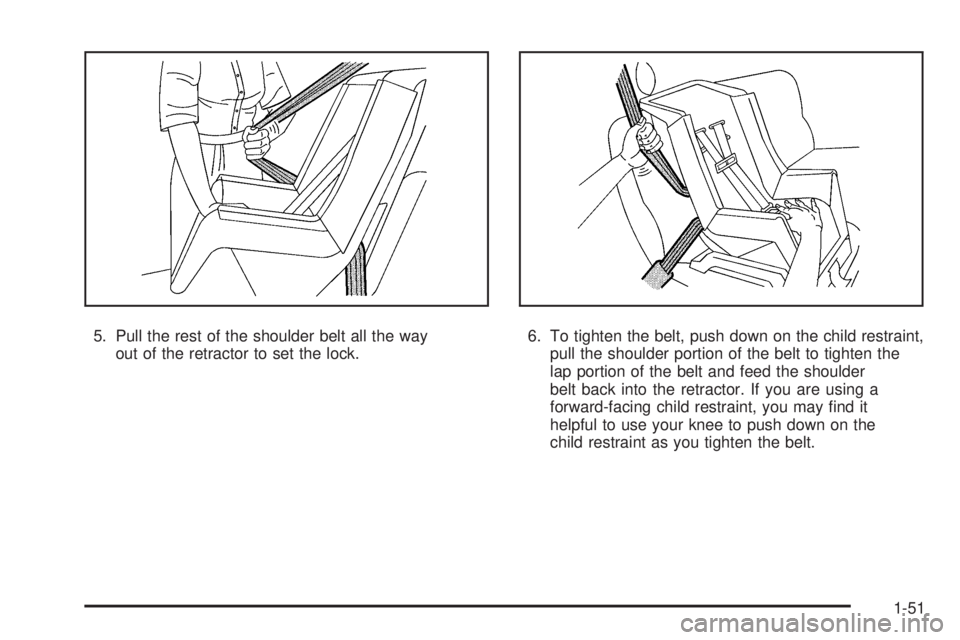
5. Pull the rest of the shoulder belt all the way
out of the retractor to set the lock.6. To tighten the belt, push down on the child restraint,
pull the shoulder portion of the belt to tighten the
lap portion of the belt and feed the shoulder
belt back into the retractor. If you are using a
forward-facing child restraint, you may find it
helpful to use your knee to push down on the
child restraint as you tighten the belt.
1-51
Page 59 of 402
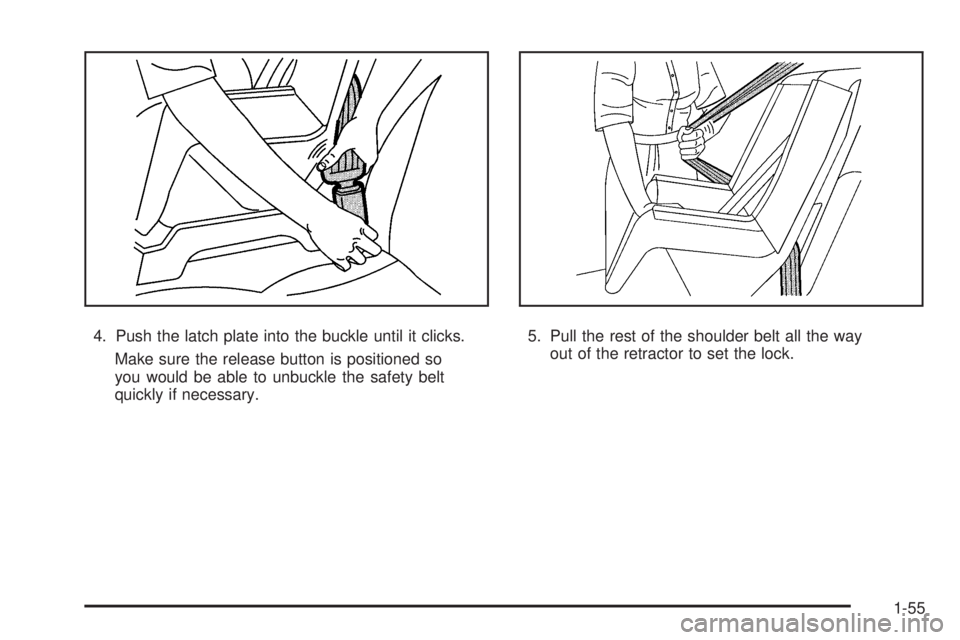
4. Push the latch plate into the buckle until it clicks.
Make sure the release button is positioned so
you would be able to unbuckle the safety belt
quickly if necessary.5. Pull the rest of the shoulder belt all the way
out of the retractor to set the lock.
1-55
Page 66 of 402
For passenger vans with a sliding door, on the
passenger’s side of the vehicle, you will have a separate
roof-rail airbag for the passenger seated directly behind
the right front passenger and the third row outboard
passenger position.
{CAUTION:
If something is between an occupant and an
airbag, the airbag might not inate properly
or it might force the object into that person
causing severe injury or even death. The path
of an inating airbag must be kept clear.
Do not put anything between an occupant
and an airbag, and do not attach or put
anything on the steering wheel hub or on
or near any other airbag covering.
If your vehicle has roof-rail airbags, never
secure anything to the roof of your vehicle
by routing the rope or tie down through any
door or window opening. If you do, the path
of an inating roof-rail airbag will be blocked.
When Should an Airbag Inate?
Frontal airbags are designed to inflate in moderate to
severe frontal or near-frontal crashes to help reduce
the potential for severe injuries mainly to the driver’s
or right front passenger’s head and chest. However,
they are only designed to inflate if the impact exceeds
a predetermined deployment threshold. Deployment
thresholds are used to predict how severe a crash
is likely to be in time for the airbags to inflate and
help restrain the occupants.
Whether your frontal airbags will or should deploy is not
based on how fast your vehicle is traveling. It depends
largely on what you hit, the direction of the impact,
and how quickly your vehicle slows down.
Frontal airbags may inflate at different crash speeds.
For example:
•If the vehicle hits a stationary object, the airbags
could inflate at a different crash speed than if the
vehicle hits a moving object.
•If the vehicle hits an object that deforms, the
airbags could inflate at a different crash speed than
if the vehicle hits an object that does not deform.
1-62
Page 69 of 402
The parts of the airbag that come into contact with
you may be warm, but not too hot to touch. There may
be some smoke and dust coming from the vents in
the deflated airbags. Airbag inflation does not prevent
the driver from seeing out of the windshield or being
able to steer the vehicle, nor does it prevent people
from leaving the vehicle.
{CAUTION:
When an airbag inates, there may be dust
in the air. This dust could cause breathing
problems for people with a history of asthma
or other breathing trouble. To avoid this,
everyone in the vehicle should get out as
soon as it is safe to do so. If you have
breathing problems but cannot get out of
the vehicle after an airbag inates, then get
fresh air by opening a window or a door.
If you experience breathing problems
following an airbag deployment, you should
seek medical attention.Your vehicle has a feature that may automatically
unlock the doors, turn the interior lamps on, and turn
the hazard warning flashers on when the airbags inflate.
You can lock the doors, turn the interior lamps off,
and turn the hazard warning flashers off by using the
controls for those features.
In many crashes severe enough to inflate the airbag,
windshields are broken by vehicle deformation.
Additional windshield breakage may also occur from
the right front passenger airbag.•Airbags are designed to inflate only once. After
an airbag inflates, you will need some new parts
for the airbag system. If you do not get them,
the airbag system will not be there to help protect
you in another crash. A new system will include
airbag modules and possibly other parts. The
service manual for your vehicle covers the need
to replace other parts.
•Your vehicle has a crash sensing and diagnostic
module which records information after a crash.
SeeVehicle Data Recording and Privacy on
page 7-16andEvent Data Recorders on page 7-17.
•Let only qualified technicians work on the airbag
systems. Improper service can mean that an
airbag system will not work properly. See your
dealer/retailer for service.
1-65
Page 81 of 402

Keys...............................................................2-2
Remote Keyless Entry (RKE) System................2-3
Remote Keyless Entry (RKE) System
Operation...................................................2-4
Doors and Locks.............................................2-6
Door Locks....................................................2-6
Power Door Locks..........................................2-6
Cargo Door Relocking.....................................2-7
Delayed Locking.............................................2-7
Programmable Automatic Door Locks................2-7
Automatic Door Lock.......................................2-8
Automatic Door Unlock....................................2-8
Rear Door Security Locks................................2-8
Lockout Protection..........................................2-9
Sliding Side Door...........................................2-9
60/40 Swing-Out Side Door............................2-10
Rear Doors..................................................2-12
Windows........................................................2-13
Manual Windows..........................................2-13
Power Windows............................................2-14
Swing-Out Windows......................................2-15
Enhanced Technology Glass..........................2-16
Sun Visors...................................................2-16
Theft-Deterrent Systems..................................2-16
PASS-Key
®III+............................................2-16
PASS-Key®III+ Operation..............................2-17Starting and Operating Your Vehicle................2-18
New Vehicle Break-In....................................2-18
Ignition Positions..........................................2-19
Retained Accessory Power (RAP)...................2-20
Starting the Engine.......................................2-20
Fuel Regulator.............................................2-21
Engine Coolant Heater..................................2-21
Automatic Transmission Operation...................2-22
Tow/Haul Mode............................................2-25
Parking Brake..............................................2-26
Shifting Into PARK (P)...................................2-27
Shifting Out of PARK (P)...............................2-29
Parking Over Things That Burn.......................2-29
Engine Exhaust............................................2-30
Running the Engine While Parked...................2-31
Mirrors...........................................................2-32
Manual Rearview Mirror.................................2-32
Outside Manual Mirror...................................2-32
Outside Camper-Type Mirrors.........................2-32
Outside Power Mirrors...................................2-33
Outside Convex Mirror...................................2-33
Outside Heated Mirrors..................................2-34
Storage Areas................................................2-34
Section 2 Features and Controls
2-1
Page 82 of 402
Keys
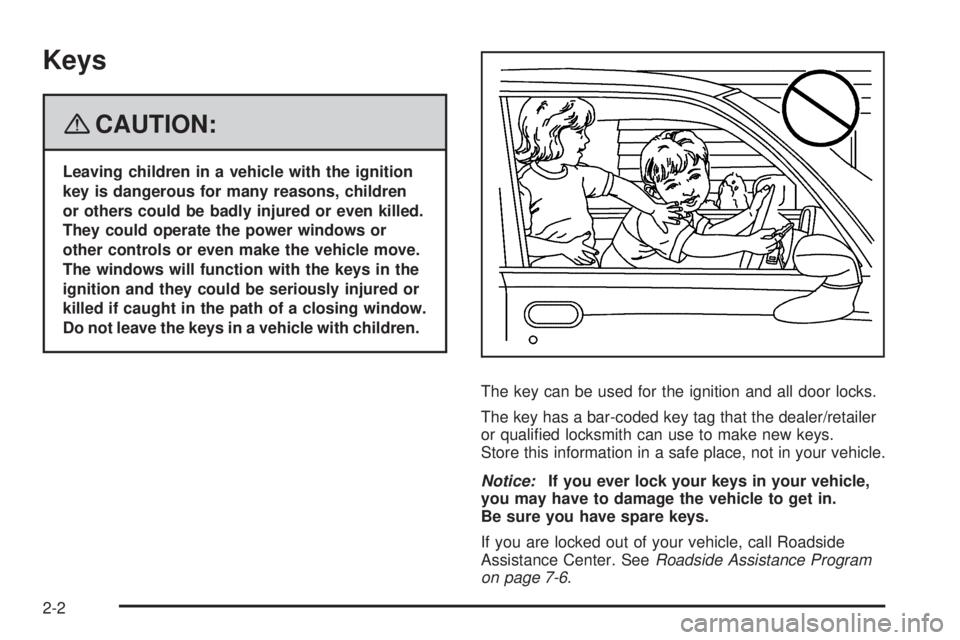
{CAUTION:
Leaving children in a vehicle with the ignition
key is dangerous for many reasons, children
or others could be badly injured or even killed.
They could operate the power windows or
other controls or even make the vehicle move.
The windows will function with the keys in the
ignition and they could be seriously injured or
killed if caught in the path of a closing window.
Do not leave the keys in a vehicle with children.
The key can be used for the ignition and all door locks.
The key has a bar-coded key tag that the dealer/retailer
or qualified locksmith can use to make new keys.
Store this information in a safe place, not in your vehicle.
Notice:If you ever lock your keys in your vehicle,
you may have to damage the vehicle to get in.
Be sure you have spare keys.
If you are locked out of your vehicle, call Roadside
Assistance Center. SeeRoadside Assistance Program
on page 7-6.
2-2
Page 83 of 402
Remote Keyless Entry (RKE)
System
If the vehicle has the Remote Keyless Entry (RKE)
system, it operates on a radio frequency subject to
Federal Communications Commission (FCC) Rules and
with Industry Canada.
This device complies with Part 15 of the FCC Rules.
Operation is subject to the following two conditions:
1. This device may not cause interference.
2. This device must accept any interference received,
including interference that may cause undesired
operation of the device.
This device complies with RSS-210 of Industry Canada.
Operation is subject to the following two conditions:
1. This device may not cause interference.
2. This device must accept any interference received,
including interference that may cause undesired
operation of the device.Changes or modifications to this system by other than
an authorized service facility could void authorization to
use this equipment.
At times you may notice a decrease in range. This is
normal for any RKE system. If the transmitter does not
work or if you have to stand closer to your vehicle
for the transmitter to work, try this:
•Check the distance. You may be too far from your
vehicle. You may need to stand closer during
rainy or snowy weather.
•Check the location. Other vehicles or objects may
be blocking the signal. Take a few steps to the left
or right, hold the transmitter higher, and try again.
•Check to determine if battery replacement is
necessary. See “Battery Replacement” later in this
section.
•If you are still having trouble, see your dealer/retailer
or a qualified technician for service.
2-3
Page 84 of 402
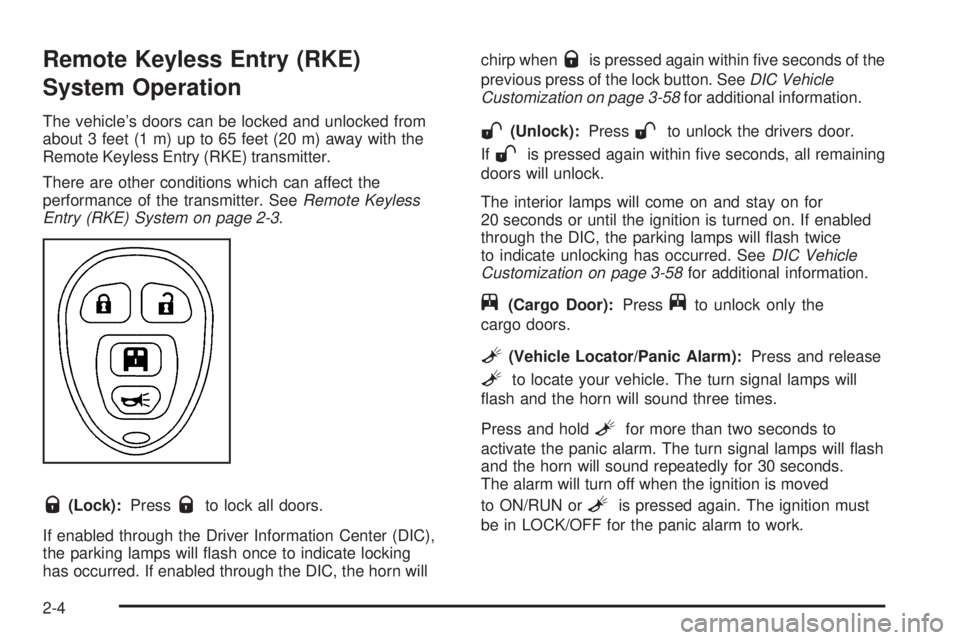
Remote Keyless Entry (RKE)
System Operation
The vehicle’s doors can be locked and unlocked from
about 3 feet (1 m) up to 65 feet (20 m) away with the
Remote Keyless Entry (RKE) transmitter.
There are other conditions which can affect the
performance of the transmitter. SeeRemote Keyless
Entry (RKE) System on page 2-3.
Q(Lock):PressQto lock all doors.
If enabled through the Driver Information Center (DIC),
the parking lamps will flash once to indicate locking
has occurred. If enabled through the DIC, the horn willchirp when
Qis pressed again within five seconds of the
previous press of the lock button. SeeDIC Vehicle
Customization on page 3-58for additional information.
W(Unlock):PressWto unlock the drivers door.
If
Wis pressed again within five seconds, all remaining
doors will unlock.
The interior lamps will come on and stay on for
20 seconds or until the ignition is turned on. If enabled
through the DIC, the parking lamps will flash twice
to indicate unlocking has occurred. SeeDIC Vehicle
Customization on page 3-58for additional information.
j(Cargo Door):Pressjto unlock only the
cargo doors.
L(Vehicle Locator/Panic Alarm):Press and release
Lto locate your vehicle. The turn signal lamps will
flash and the horn will sound three times.
Press and hold
Lfor more than two seconds to
activate the panic alarm. The turn signal lamps will flash
and the horn will sound repeatedly for 30 seconds.
The alarm will turn off when the ignition is moved
to ON/RUN or
Lis pressed again. The ignition must
be in LOCK/OFF for the panic alarm to work.
2-4