change time GMC SAVANA PASSENGER 2008 Owner's Manual
[x] Cancel search | Manufacturer: GMC, Model Year: 2008, Model line: SAVANA PASSENGER, Model: GMC SAVANA PASSENGER 2008Pages: 402, PDF Size: 2.34 MB
Page 261 of 402
When to Check and Change Automatic
Transmission Fluid
A good time to check your automatic transmission fluid
level is when the engine oil is changed.
Change the fluid and filter at the intervals listed in
Additional Required Services (Gasoline Engine) on
page 6-6, and be sure to use the transmission fluid listed
inRecommended Fluids and Lubricants on page 6-14.
How to Check Automatic Transmission
Fluid
Because this operation can be a little difficult, you may
choose to have this done at the dealer/retailer service
department.
If you do it yourself, be sure to follow all the instructions
here, or you could get a false reading on the dipstick.
Notice:Too much or too little uid can damage
your transmission. Too much can mean that some
of the uid could come out and fall on hot engine
parts or exhaust system parts, starting a re.
Too little uid could cause the transmission to
overheat. Be sure to get an accurate reading if you
check your transmission uid.Wait at least 30 minutes before checking the
transmission fluid level if you have been driving:
•When outside temperatures are above 90°F (32°C).
•At high speed for quite a while.
•In heavy traffic — especially in hot weather.
•While pulling a trailer.
To get the right reading, the fluid should be at normal
operating temperature, which is 180°F to 200°F
(82°C to 93°C).
Get the vehicle warmed up by driving about 15 miles
(24 km) when outside temperatures are above 50°F
(10°C). If it is colder than 50°F (10°C), drive the vehicle
in DRIVE (D) until the engine temperature gage
moves and then remains steady for 10 minutes.
A cold fluid check can be made after the vehicle has
been sitting for eight hours or more with the engine off,
but this is used only as a reference. Let the engine run
at idle for five minutes if outside temperatures are
50°F (10°C) or more. If it is colder than 50°F (10°C), you
may have to idle the engine longer. Should the fluid level
be low during this cold check, you must check the fluid
hot before adding fluid. Checking the fluid hot will give
you a more accurate reading of the fluid level.
5-21
Page 279 of 402
Replacing Brake System Parts
The braking system on a vehicle is complex. Its many
parts have to be of top quality and work well together if
the vehicle is to have really good braking. Your vehicle
was designed and tested with top-quality brake parts.
When you replace parts of the braking system — for
example, when the brake linings wear down and you
need new ones put in — be sure you get new approved
replacement parts. If you do not, the brakes might not
work properly. For example, if someone puts in brake
linings that are wrong for your vehicle, the balance
between the front and rear brakes can change — for the
worse. The braking performance you have come to
expect can change in many other ways if someone puts
in the wrong replacement brake parts.
Battery
Your vehicle has a maintenance free battery. When it is
time for a new battery, see your dealer/retailer for one
that has the replacement number shown on the original
battery’s label. SeeEngine Compartment Overview on
page 5-14for battery location.
Warning:Battery posts, terminals, and related
accessories contain lead and lead compounds,
chemicals known to the State of California to cause
cancer and reproductive harm. Wash hands after
handling.
Vehicle Storage
{CAUTION:
Batteries have acid that can burn you and gas
that can explode. You can be badly hurt if you
are not careful. SeeJump Starting on page 5-40
for tips on working around a battery without
getting hurt.
Infrequent Usage: If you drive your vehicle infrequently,
remove the black, negative (−) cable from the battery.
This will help keep the battery from running down.
Extended Storage: For extended storage of your vehicle,
remove the black, negative (−) cable from the battery or
use a battery trickle charger. This will help maintain the
charge of the battery over an extended period of time.
5-39
Page 309 of 402
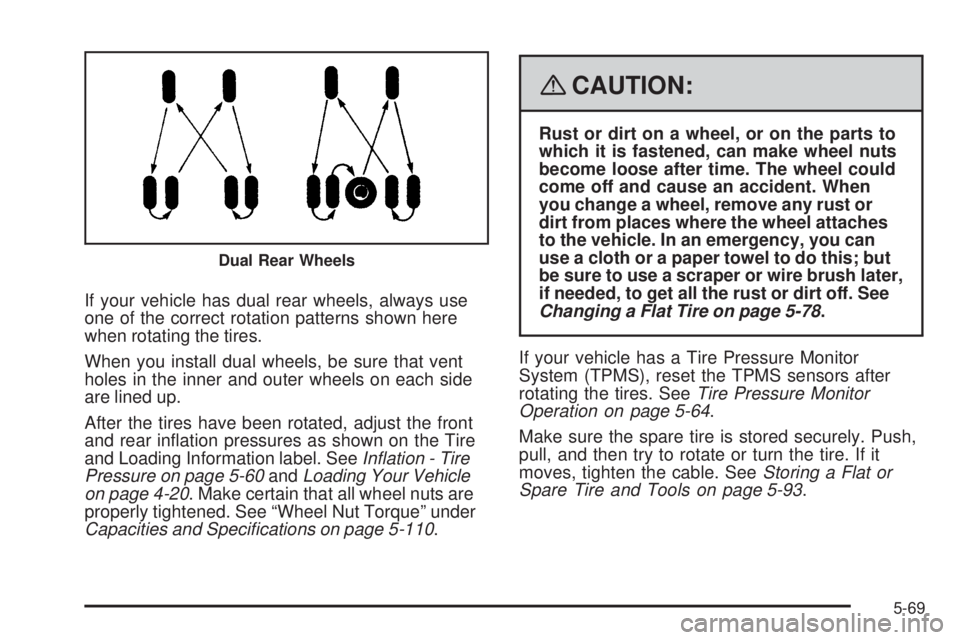
If your vehicle has dual rear wheels, always use
one of the correct rotation patterns shown here
when rotating the tires.
When you install dual wheels, be sure that vent
holes in the inner and outer wheels on each side
are lined up.
After the tires have been rotated, adjust the front
and rear inflation pressures as shown on the Tire
and Loading Information label. SeeInflation - Tire
Pressure on page 5-60andLoading Your Vehicle
on page 4-20. Make certain that all wheel nuts are
properly tightened. See “Wheel Nut Torque” under
Capacities and Specifications on page 5-110.
{CAUTION:
Rust or dirt on a wheel, or on the parts to
which it is fastened, can make wheel nuts
become loose after time. The wheel could
come off and cause an accident. When
you change a wheel, remove any rust or
dirt from places where the wheel attaches
to the vehicle. In an emergency, you can
use a cloth or a paper towel to do this; but
be sure to use a scraper or wire brush later,
if needed, to get all the rust or dirt off. See
Changing a Flat Tire on page 5-78.
If your vehicle has a Tire Pressure Monitor
System (TPMS), reset the TPMS sensors after
rotating the tires. SeeTire Pressure Monitor
Operation on page 5-64.
Make sure the spare tire is stored securely. Push,
pull, and then try to rotate or turn the tire. If it
moves, tighten the cable. SeeStoring a Flat or
Spare Tire and Tools on page 5-93.
Dual Rear Wheels
5-69
Page 326 of 402
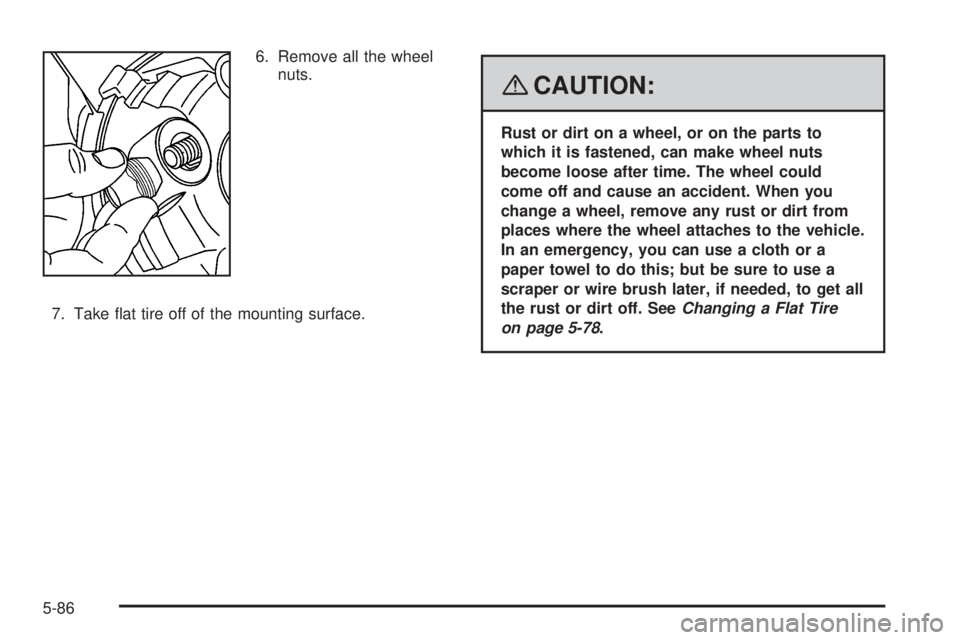
6. Remove all the wheel
nuts.
7. Take flat tire off of the mounting surface.
{CAUTION:
Rust or dirt on a wheel, or on the parts to
which it is fastened, can make wheel nuts
become loose after time. The wheel could
come off and cause an accident. When you
change a wheel, remove any rust or dirt from
places where the wheel attaches to the vehicle.
In an emergency, you can use a cloth or a
paper towel to do this; but be sure to use a
scraper or wire brush later, if needed, to get all
the rust or dirt off. SeeChanging a Flat Tire
on page 5-78.
5-86
Page 356 of 402
If you want to purchase service information, seeService
Publications Ordering Information on page 7-15.
Owner Checks and Services on page 6-10tells you
what should be checked, when to check it, and what
you can easily do to help keep your vehicle in good
condition.
The proper replacement parts, fluids, and lubricants to
use are listed inRecommended Fluids and Lubricants
on page 6-14andMaintenance Replacement Parts
on page 6-16. When your vehicle is serviced, make sure
these are used. All parts should be replaced and all
necessary repairs done before you or anyone else
drives the vehicle. We recommend the use of genuine
parts from your dealer/retailer.
Scheduled Maintenance
This maintenance section applies to vehicles with a
gasoline engine. If your vehicle has a diesel engine, see
the maintenance schedule section in the DURAMAX
®
Diesel manual.
When the CHANGE ENGINE OIL SOON message
comes on, it means that service is required for your
vehicle. Have your vehicle serviced as soon as possible
within the next 600 miles (1 000 km). It is possible that, if
you are driving under the best conditions, the engine oil
life system may not indicate that vehicle service is
necessary for over a year. However, your engine oil andfilter must be changed at least once a year and at this
time the system must be reset. Your dealer/retailer has
trained service technicians who will perform this work
using genuine parts and reset the system.
If the engine oil life system is ever reset accidentally,
you must service your vehicle within 3,000 miles
(5 000 km) since your last service. Remember to reset
the oil life system whenever the oil is changed. See
Engine Oil Life System on page 5-18for information on
the Engine Oil Life System and resetting the system.
When the CHANGE ENGINE OIL SOON message
appears, certain services, checks, and inspections are
required. Required services are described in the
following for “MaintenanceI” and “MaintenanceII.”
Generally, it is recommended that your first service be
MaintenanceI, your second service be MaintenanceII,
and that you alternate MaintenanceIand MaintenanceII
thereafter. However, in some cases, MaintenanceII
may be required more often.
MaintenanceI— Use MaintenanceIif the CHANGE
ENGINE OIL SOON message comes on within
10 months since the vehicle was purchased or
MaintenanceIIwas performed.
MaintenanceII— Use MaintenanceIIif the previous
service performed was MaintenanceI. Always use
MaintenanceIIwhenever the message comes on
10 months or more since the last service or if the
message has not come on at all for one year.
6-4
Page 375 of 402
Although you may be required to resort to this informal
dispute resolution program prior to filling out a court
action, use of the program is free of charge and your case
will generally be heard within 40 days. If you do not agree
with the decision given in your case, you may reject it and
proceed with any other venue for relief available to you.
You may contact the BBB Auto Line Program using the
toll-free telephone number or write them at the following
address:
BBB Auto Line Program
Council of Better Business Bureaus, Inc.
4200 Wilson Boulevard
Suite 800
Arlington, VA 22203-1838
Telephone: 1-800-955-5100
This program is available in all 50 states and the
District of Columbia. Eligibility is limited by vehicle age,
mileage, and other factors. General Motors reserves
the right to change eligibility limitations and/or
discontinue its participation in this program.
STEP THREE — Canadian Owners:In the event that
you do not feel your concerns have been addressed
after following the procedure outlined in Steps 1 and 2,
General Motors of Canada Limited wants you to be
aware of its participation in a no-charge
Mediation/Arbitration Program.General Motors of Canada Limited has committed
to binding arbitration of owner disputes involving
factory-related vehicle service claims. The program
provides for the review of the facts involved by an
impartial third party arbiter, and may include an informal
hearing before the arbiter. The program is designed
so that the entire dispute settlement process, from
the time you file your complaint to the final decision,
should be completed in approximately 70 days.
We believe our impartial program offers advantages
over courts in most jurisdictions because it is informal,
quick, and free of charge.
For further information concerning eligibility in the
Canadian Motor Vehicle Arbitration Plan (CAMVAP),
call toll-free 1-800-207-0685. Alternatively, you can call
the General Motors Customer Communication Centre,
1-800-263-3777 (English), 1-800-263-7854 (French),
or write to:
Mediation/Arbitration Program
c/o Customer Communication Centre
General Motors of Canada Limited
Mail Code: CA1-163-005
1908 Colonel Sam Drive
Oshawa, Ontario L1H 8P7
Telephone: 1-800-955-5100
Your inquiry should be accompanied by your Vehicle
Identification Number (VIN).
7-3
Page 381 of 402
Towing and Road Service Exclusions
Specifically excluded from Roadside Assistance
coverage are towing or services for vehicles operated
on a non-public roadway or highway, fines, impound
towing caused by a violation of local, Municipal, State,
Provincial, or Federal law, and mounting, dismounting or
changing of snow tires, chains, or other traction devices.
Roadside Assistance is not part of or included in the
coverage provided by the New Vehicle Limited Warranty.
GMC and General Motors of Canada Limited reserve
the right to make any changes or discontinue the
Roadside Assistance program at any time without
notification.
Scheduling Service Appointments
When your vehicle requires warranty service, contact
your dealer/retailer and request an appointment.
By scheduling a service appointment and advising your
service consultant of your transportation needs, your
dealer/retailer can help minimize your inconvenience.
If your vehicle cannot be scheduled into the service
department immediately, keep driving it until it can be
scheduled for service, unless, of course, the problem is
safety-related. If it is, please call your dealership/retailer,
let them know this, and ask for instructions.If the dealer/retailer requests that you simply drop the
vehicle off for service, you are urged to do so as early in
the work day as possible to allow for the same day repair.
Courtesy Transportation
To enhance your ownership experience, we and
our participating dealers are proud to offer Courtesy
Transportation, a customer support program for vehicles
with the Bumper to Bumper (Base Warranty Coverage
period in Canada) and extended powertrain warranty
in both the U.S. and Canada.
Several courtesy transportation options are available to
assist in reducing your inconvenience when warranty
repairs are required.
Courtesy Transportation is not a part of the New Vehicle
Limited Warranty. A separate booklet entitled “Warranty
and Owner Assistance Information” furnished with
each new vehicle provides detailed warranty coverage
information.
7-9
Page 383 of 402
Additional Program Information
All program options, such as shuttle service, may not be
available at every dealer. Please contact your dealer
for specific information about availability. All Courtesy
Transportation arrangements will be administered
by appropriate dealer personnel.
General Motors reserves the right to unilaterally modify,
change or discontinue Courtesy Transportation at
any time and to resolve all questions of claim eligibility
pursuant to the terms and conditions described
herein at its sole discretion.
Collision Damage Repair
If your vehicle is involved in a collision and it is
damaged, have the damage repaired by a qualified
technician using the proper equipment and quality
replacement parts. Poorly performed collision repairs
diminish your vehicle’s resale value, and safety
performance can be compromised in subsequent
collisions.
Collision Parts
Genuine GM Collision parts are new parts made with the
same materials and construction methods as the parts
with which your vehicle was originally built. Genuine GM
Collision parts are your best choice to ensure that your
vehicle’s designed appearance, durability, and safety are
preserved. The use of Genuine GM parts can help
maintain your GM New Vehicle Warranty.
Recycled original equipment parts may also be used for
repair. These parts are typically removed from vehicles
that were total losses in prior crashes. In most cases, the
parts being recycled are from undamaged sections of the
vehicle. A recycled original equipment GM part, may be
an acceptable choice to maintain your vehicle’s originally
designed appearance and safety performance, however,
the history of these parts is not known. Such parts are not
covered by your GM New Vehicle Limited Warranty, and
any related failures are not covered by that warranty.
Aftermarket collision parts are also available. These are
made by companies other than GM and may not have
been tested for your vehicle. As a result, these parts may
fit poorly, exhibit premature durability/corrosion problems,
and may not perform properly in subsequent collisions.
Aftermarket parts are not covered by your GM New
Vehicle Limited Warranty, and any vehicle failure related
to such parts are not covered by that warranty.
7-11
Page 388 of 402
Current and Past Model Order Forms
Technical Service Bulletins and Manuals are available
for current and past model GM vehicles. To request
an order form, specify year and model name of
the vehicle.
ORDER TOLL FREE: 1-800-551-4123
Monday-Friday 8:00 AM - 6:00 PM
Eastern Time
For Credit Card Orders Only
(VISA-MasterCard-Discover), visit Helm, Inc. on the
World Wide Web at: www.helminc.com
Or you can write to:
Helm, Incorporated
P.O. Box 07130
Detroit, MI 48207
Prices are subject to change without notice and without
incurring obligation. Allow ample time for delivery.
Note to Canadian Customers: All listed prices are
quoted in U.S. funds. Canadian residents are to make
checks payable in U.S. funds.
Vehicle Data Recording and
Privacy
Your GM vehicle has a number of sophisticated
computers that record information about the vehicle’s
performance and how it is driven. For example,
your vehicle uses computer modules to monitor and
control engine and transmission performance, to monitor
the conditions for airbag deployment and deploy
airbags in a crash and, if so equipped, to provide
antilock braking to help the driver control the vehicle.
These modules may store data to help your
dealer/retailer technician service your vehicle. Some
modules may also store data about how you operate the
vehicle, such as rate of fuel consumption or average
speed. These modules may also retain the owner’s
personal preferences, such as radio pre-sets, seat
positions, and temperature settings.
7-16
Page 395 of 402
F
Filter
Engine Air Cleaner......................................5-19
Finish Damage.............................................5-101
Fixed Mast Antenna........................................3-83
Flashers, Hazard Warning.................................. 3-6
Flash-to-Pass................................................... 3-9
Flat Tire........................................................5-77
Flat Tire, Changing.........................................5-78
Flat Tire, Storing.............................................5-93
Fluid.............................................................5-20
Power Steering...........................................5-34
Windshield Washer......................................5-35
Front Axle......................................................5-45
Fuel............................................................... 5-5
Additives...................................................... 5-7
California Fuel.............................................. 5-6
E85 (85% Ethanol)........................................ 5-8
Filling a Portable Fuel Container....................5-12
Filling the Tank...........................................5-10
Fuels in Foreign Countries.............................. 5-9
Gage.........................................................3-41
Gasoline Octane........................................... 5-6
Gasoline Specifications.................................. 5-6
Regulator...................................................2-21
Fuses
Engine Compartment Fuse Block.................5-106
Floor Console Fuse Block...........................5-104
Fuses and Circuit Breakers.........................5-104
Windshield Wiper.......................................5-104
G
Gage
Engine Coolant Temperature.........................3-35
Fuel..........................................................3-41
Oil Pressure...............................................3-38
Speedometer..............................................3-26
Voltmeter Gage...........................................3-32
Gasoline
Octane........................................................ 5-6
Specifications............................................... 5-6
Glass, Enhanced Technology............................2-16
GM Mobility Reimbursement Program.................. 7-6
H
Hazard Warning Flashers................................... 3-6
Headlamp Wiring...........................................5-104
Headlamps....................................................5-48
Bulb Replacement.......................................5-48
Daytime Running Lamps...............................3-15
Exterior Lamps............................................3-13
Flash-to-Pass............................................... 3-9
Front Turn Signal, Sidemarker and
Parking Lamps.........................................5-50
Halogen Bulbs............................................5-48
High/Low Beam Changer................................ 3-9
On Reminder..............................................3-14
Heater...........................................................3-19
5