parking brake GMC SAVANA PASSENGER 2010 Owner's Manual
[x] Cancel search | Manufacturer: GMC, Model Year: 2010, Model line: SAVANA PASSENGER, Model: GMC SAVANA PASSENGER 2010Pages: 424, PDF Size: 2.38 MB
Page 330 of 424
TPMS Sensor Matching Process
Each TPMS sensor has a unique identification code.
Any time you rotate your vehicle’s tires or replace one or
more of the TPMS sensors, the identification codes
will need to be matched to the new tire/wheel position.
The sensors are matched to the tire/wheel positions
in the following order: driver side front tire, passenger
side front tire, passenger side rear tire, and driver
side rear tire using a TPMS diagnostic tool. See your
dealer/retailer for service.
The TPMS sensors can also be matched to each
tire/wheel position by increasing or decreasing the tire’s
air pressure. If increasing the tire’s air pressure, do
not exceed the maximum inflation pressure indicated on
the tire’s sidewall.
To decrease air-pressure out of a tire you can use the
pointed end of the valve cap, a pencil-style air pressure
gage, or a key.
You have two minutes to match the first tire/wheel
position, and five minutes overall to match all four tire/
wheel positions. If it takes longer than two minutes,
to match the first tire and wheel, or more than
five minutes to match all four tire and wheel positions
the matching process stops and you need to start over.The TPMS sensor matching process is outlined below:
1. Set the parking brake.
2. Turn the ignition switch to ON/RUN with the
engine off.
3. Press the Remote Keyless Entry (RKE) transmitter’s
LOCK and UNLOCK buttons at the same time for
approximately five seconds. The horn sounds twice
to signal the receiver is in relearn mode and
TIRE LEARNING ACTIVE message displays on the
DIC screen.
If your vehicle does not have RKE, press the Driver
Information Center (DIC) vehicle information
button until the PRESS
VTO RELEARN TIRE
POSITIONS message displays. The horn sounds
twice to signal the receiver is in relearn mode
and TIRE LEARNING ACTIVE message displays on
the DIC screen.
If your vehicle does not have RKE or DIC buttons,
press the trip odometer reset stem located on
the instrument panel cluster until the PRESS
VTO
RELEARN TIRE POSITIONS message displays.
The horn sounds twice to signal the receiver
is in relearn mode and TIRE LEARNING ACTIVE
message displays on the DIC screen.
4. Start with the driver side front tire.
6-68
Page 342 of 424
Changing a Flat Tire
If a tire goes flat, avoid further tire and wheel damage
by driving slowly to a level place. Turn on the hazard
warning flashers. SeeHazard Warning Flashers
on page 4-3.
{WARNING:
Changing a tire can be dangerous. The vehicle
can slip off the jack and roll over or fall on you or
other people. You and they could be badly injured
or even killed. Find a level place to change your
tire. To help prevent the vehicle from moving:
1. Set the parking brake firmly.
2. Put the shift lever in P (Park).
WARNING: (Continued)
WARNING: (Continued)
3. Turn off the engine and do not restart while
the vehicle is raised.
4. Do not allow passengers to remain in the
vehicle.
To be even more certain the vehicle will not move,
you should put blocks at the front and rear of the
tire farthest away from the one being changed.
That would be the tire, on the other side, at the
opposite end of the vehicle.
6-80
Page 379 of 424
•Vehicles with diesel engine or GVWR above
4 536 kg (10,000 lbs) only: Shields inspection
for damage or looseness. Adjust or replace as
required. This is a Noise Emission Control Service.
Applicable to vehicles sold in the United States
and recommended for vehicles sold in Canada.
Additional Required Services
At the First 160 km/100 Miles, 1 600 km/
1,000 Miles, and 10 000 km/6,000 Miles
•
For vehicles with dual wheels: Check dual wheel nut
torque. For proper torque, seeCapacities and
Specications on page 6-110.
At Each Fuel Stop
•
Engine oil level check. SeeEngine Oil on
page 6-15.
•Engine coolant level check. SeeEngine Coolant on
page 6-28.
•Windshield washer fluid level check. SeeWindshield
Washer Fluid on page 6-36.
Once a Month
•
Tire inflation check. SeeInation - Tire Pressure on
page 6-63.
•Tire wear inspection. SeeTire Inspection and
Rotation on page 6-69.
Once a Year
•
Starter switch check. SeeOwner Checks and
Services on page 7-9.
•Parking brake and automatic transmission P (Park)
mechanism check. SeeOwner Checks and
Services on page 7-9.
•Automatic transmission shiftlock control system
check. SeeOwner Checks and Services on
page 7-9.
•Ignition transmission lock check. SeeOwner
Checks and Services on page 7-9.
•Engine cooling system and pressure cap pressure
check. Radiator and air conditioning condenser
outside cleaning. SeeCooling System on
page 6-26.
•Exhaust system and nearby heat shields inspection
for loose or damaged components.
•Throttle system inspection for interference, binding
or for damaged or missing parts. Replace parts as
needed. Replace any components that have
high effort or excessive wear. Do not lubricate
accelerator or cruise control cables.
First Engine Oil Change After Every
40 000 km/25,000 Miles
•
Fuel system inspection for damage or leaks.
7-5
Page 383 of 424
Owner Checks and Services
Starter Switch Check
{WARNING:
When you are doing this inspection, the vehicle
could move suddenly. If the vehicle moves, you or
others could be injured.
1. Before starting this check, be sure there is enough
room around the vehicle.
2. Firmly apply both the parking brake and the regular
brake. SeeParking Brake on page 3-35.
Do not use the accelerator pedal, and be ready to
turn off the engine immediately if it starts.
3. Try to start the engine in each gear. The vehicle
should start only in P (Park) or N (Neutral). If the
vehicle starts in any other position, contact
your dealer/retailer for service.
Automatic Transmission Shift Lock
Control System Check
{WARNING:
When you are doing this inspection, the vehicle
could move suddenly. If the vehicle moves, you or
others could be injured.
1. Before starting this check, be sure there is enough
room around the vehicle. It should be parked on a
level surface.
2. Firmly apply the parking brake. SeeParking Brake
on page 3-35.
Be ready to apply the regular brake immediately if
the vehicle begins to move.
3. With the engine off, turn the ignition to ON/RUN,
but do not start the engine. Without applying the
regular brake, try to move the shift lever out
of P (Park) with normal effort. If the shift lever
moves out of P (Park), contact your dealer/retailer
for service.
7-9
Page 384 of 424
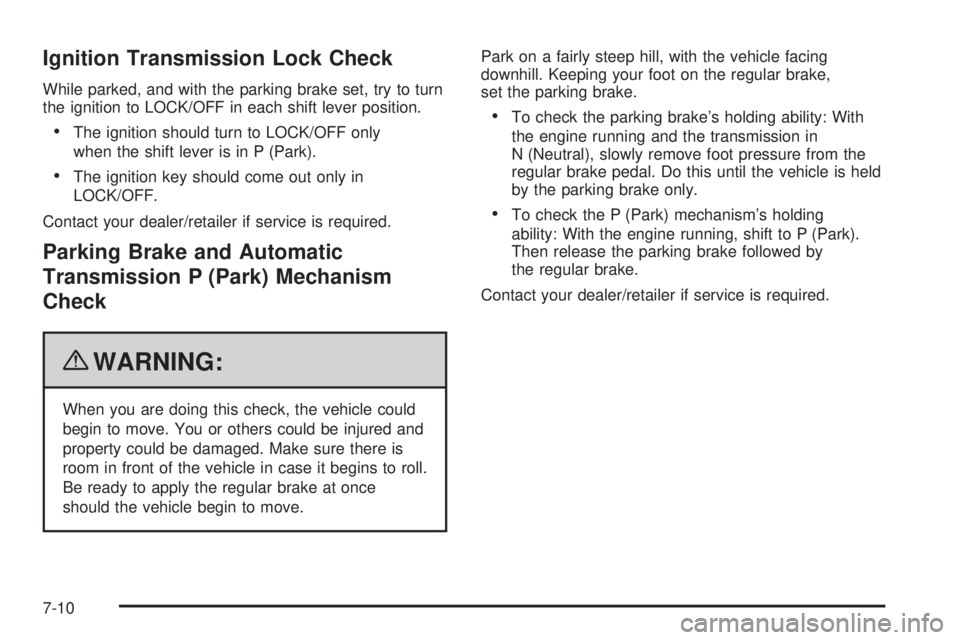
Ignition Transmission Lock Check
While parked, and with the parking brake set, try to turn
the ignition to LOCK/OFF in each shift lever position.
•The ignition should turn to LOCK/OFF only
when the shift lever is in P (Park).
•The ignition key should come out only in
LOCK/OFF.
Contact your dealer/retailer if service is required.
Parking Brake and Automatic
Transmission P (Park) Mechanism
Check
{WARNING:
When you are doing this check, the vehicle could
begin to move. You or others could be injured and
property could be damaged. Make sure there is
room in front of the vehicle in case it begins to roll.
Be ready to apply the regular brake at once
should the vehicle begin to move.Park on a fairly steep hill, with the vehicle facing
downhill. Keeping your foot on the regular brake,
set the parking brake.
•To check the parking brake’s holding ability: With
the engine running and the transmission in
N (Neutral), slowly remove foot pressure from the
regular brake pedal. Do this until the vehicle is held
by the parking brake only.
•To check the P (Park) mechanism’s holding
ability: With the engine running, shift to P (Park).
Then release the parking brake followed by
the regular brake.
Contact your dealer/retailer if service is required.
7-10
Page 385 of 424
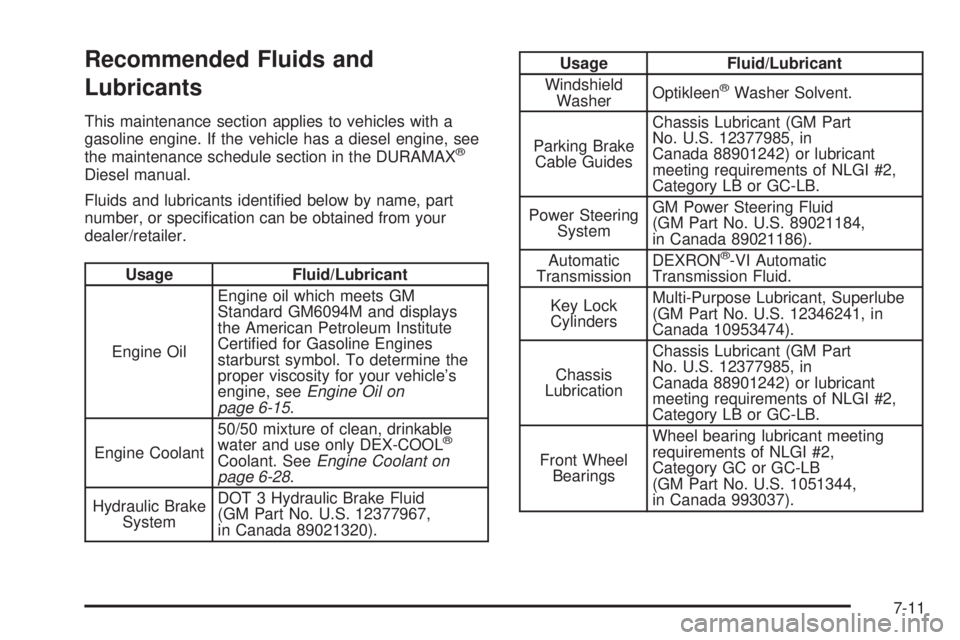
Recommended Fluids and
Lubricants
This maintenance section applies to vehicles with a
gasoline engine. If the vehicle has a diesel engine, see
the maintenance schedule section in the DURAMAX
®
Diesel manual.
Fluids and lubricants identified below by name, part
number, or specification can be obtained from your
dealer/retailer.
Usage Fluid/Lubricant
Engine OilEngine oil which meets GM
Standard GM6094M and displays
the American Petroleum Institute
Certified for Gasoline Engines
starburst symbol. To determine the
proper viscosity for your vehicle’s
engine, seeEngine Oil on
page 6-15.
Engine Coolant50/50 mixture of clean, drinkable
water and use only DEX-COOL
®
Coolant. SeeEngine Coolant on
page 6-28.
Hydraulic Brake
SystemDOT 3 Hydraulic Brake Fluid
(GM Part No. U.S. 12377967,
in Canada 89021320).
Usage Fluid/Lubricant
Windshield
WasherOptikleen
®Washer Solvent.
Parking Brake
Cable GuidesChassis Lubricant (GM Part
No. U.S. 12377985, in
Canada 88901242) or lubricant
meeting requirements of NLGI #2,
Category LB or GC-LB.
Power Steering
SystemGM Power Steering Fluid
(GM Part No. U.S. 89021184,
in Canada 89021186).
Automatic
TransmissionDEXRON
®-VI Automatic
Transmission Fluid.
Key Lock
CylindersMulti-Purpose Lubricant, Superlube
(GM Part No. U.S. 12346241, in
Canada 10953474).
Chassis
LubricationChassis Lubricant (GM Part
No. U.S. 12377985, in
Canada 88901242) or lubricant
meeting requirements of NLGI #2,
Category LB or GC-LB.
Front Wheel
BearingsWheel bearing lubricant meeting
requirements of NLGI #2,
Category GC or GC-LB
(GM Part No. U.S. 1051344,
in Canada 993037).
7-11
Page 412 of 424
Audio System(s).............................................4-62
Automatic Door Lock.......................................3-10
Automatic Door Unlock....................................3-10
Automatic Headlamp System............................4-11
Automatic Transmission
Fluid..................................................6-20, 6-23
Operation...........................................3-26, 3-31
Axle, Rear.....................................................6-46
B
Battery..........................................................6-40
Electric Power Management..........................4-13
Run-Down Protection...................................4-14
Belt Routing, Engine.......................................7-14
Brake
Emergencies................................................ 5-5
Brakes..........................................................6-37
Antilock....................................................... 5-4
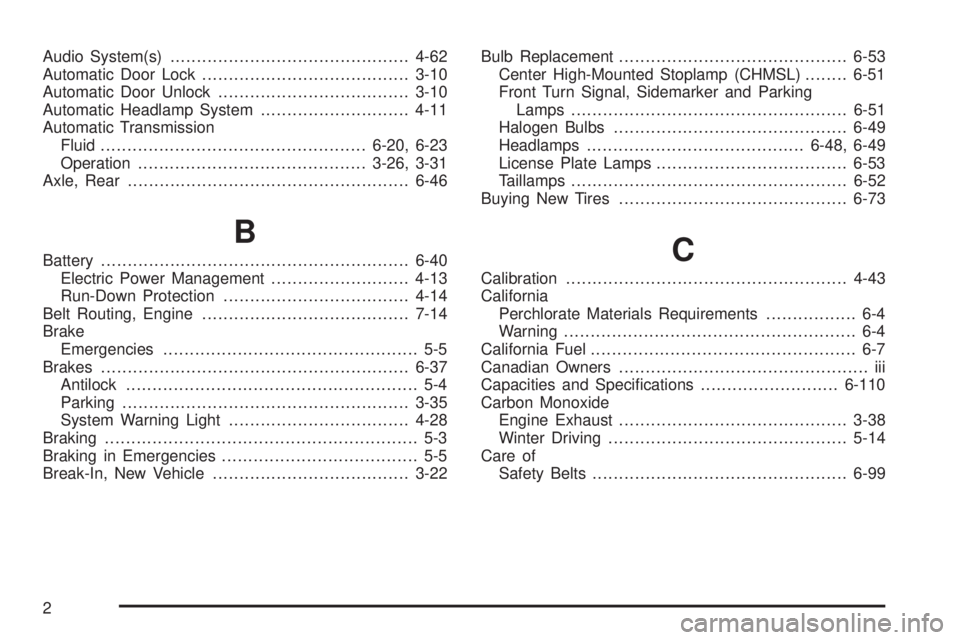
Parking......................................................3-35
System Warning Light..................................4-28
Braking........................................................... 5-3
Braking in Emergencies..................................... 5-5
Break-In, New Vehicle.....................................3-22Bulb Replacement...........................................6-53
Center High-Mounted Stoplamp (CHMSL)........6-51
Front Turn Signal, Sidemarker and Parking
Lamps ....................................................6-51
Halogen Bulbs............................................6-49
Headlamps.........................................6-48, 6-49
License Plate Lamps....................................6-53
Taillamps....................................................6-52
Buying New Tires...........................................6-73C
Calibration.....................................................4-43
California
Perchlorate Materials Requirements................. 6-4
Warning....................................................... 6-4
California Fuel.................................................. 6-7
Canadian Owners............................................... iii
Capacities and Specifications..........................6-110
Carbon Monoxide
Engine Exhaust...........................................3-38
Winter Driving.............................................5-14
Care of
Safety Belts................................................6-99
2
Page 419 of 424
N
Navigation System, Privacy..............................8-17
New Vehicle Break-In......................................3-22
Noise Control System, Tampering......................6-47
O
Odometer......................................................4-22
Trip ...........................................................4-22
Off-Road
Recovery..................................................... 5-8
Oil
Engine.......................................................6-15
Engine Oil Life System.................................6-18
Pressure Gage............................................4-34
Pressure Light.............................................4-35
Older Children, Restraints................................2-30
Online Owner Center........................................ 8-4
OnStar, Privacy..............................................8-17
Outlet Adjustment............................................4-17Outlets
Accessory Power.........................................4-14
Outside
Convex Mirror.............................................3-41
Heated Mirrors............................................3-42
Manual Mirrors............................................3-40
Power Mirrors.............................................3-41
Towing Mirrors............................................3-40
Owner Checks and Services.............................. 7-9
Owners, Canadian.............................................. iii
P
Paint, Damage..............................................6-102
Park
Shifting Into................................................3-36
Shifting Out of............................................3-37
Parking
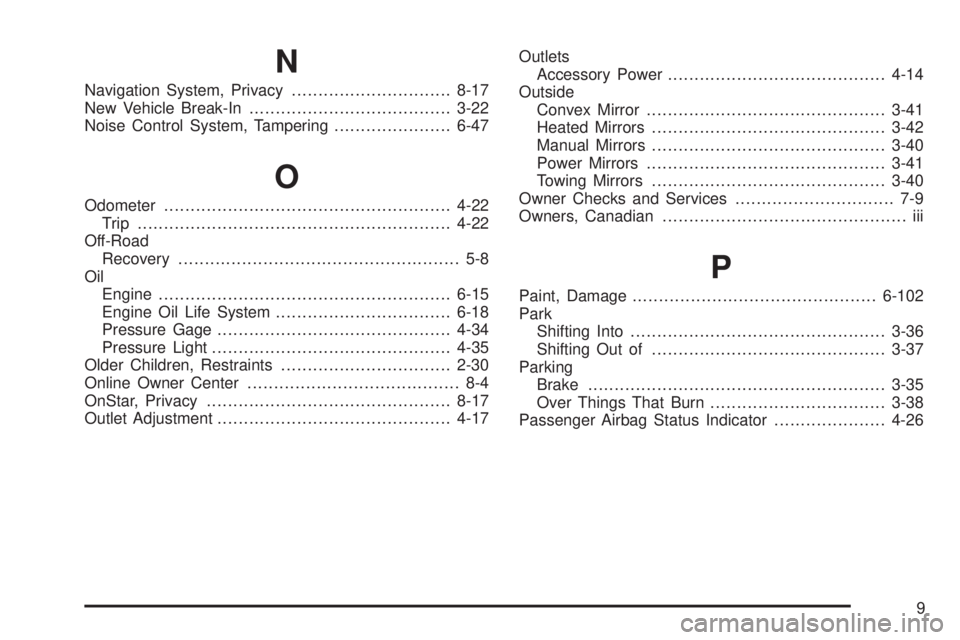
Brake........................................................3-35
Over Things That Burn.................................3-38
Passenger Airbag Status Indicator.....................4-26
9