transmission GMC SIERRA 1500 2011 Workshop Manual
[x] Cancel search | Manufacturer: GMC, Model Year: 2011, Model line: SIERRA 1500, Model: GMC SIERRA 1500 2011Pages: 594, PDF Size: 7.88 MB
Page 391 of 594
Black plate (97,1)GMC Sierra Owner Manual - 2011
Driving and Operating 9-97
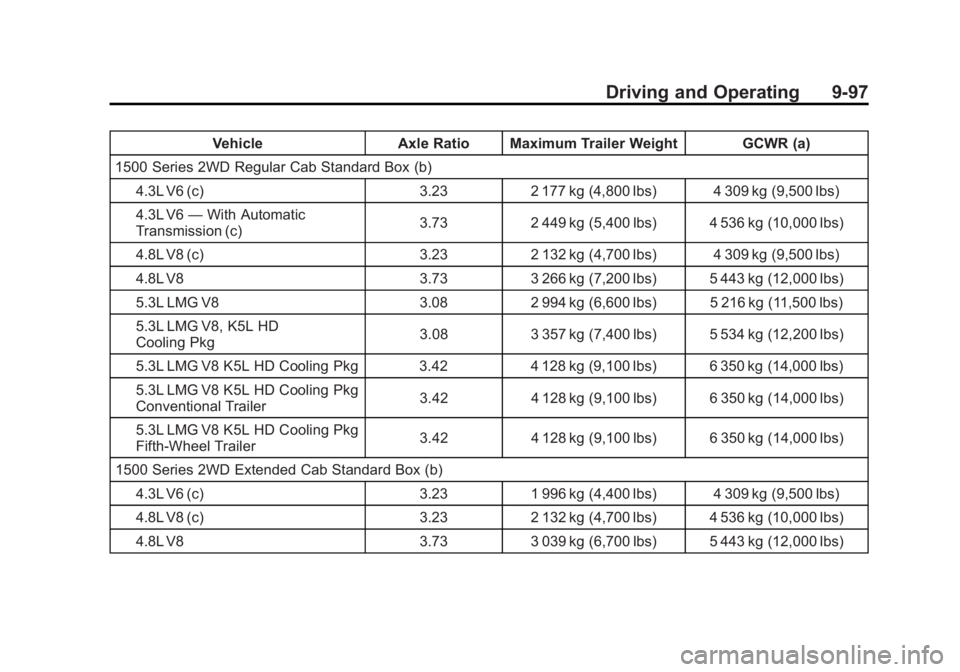
VehicleAxle Ratio Maximum Trailer Weight GCWR (a)
1500 Series 2WD Regular Cab Standard Box (b) 4.3L V6 (c) 3.232 177 kg (4,800 lbs) 4 309 kg (9,500 lbs)
4.3L V6 —With Automatic
Transmission (c) 3.73
2 449 kg (5,400 lbs) 4 536 kg (10,000 lbs)
4.8L V8 (c) 3.232 132 kg (4,700 lbs) 4 309 kg (9,500 lbs)
4.8L V8 3.733 266 kg (7,200 lbs) 5 443 kg (12,000 lbs)
5.3L LMG V8 3.082 994 kg (6,600 lbs) 5 216 kg (11,500 lbs)
5.3L LMG V8, K5L HD
Cooling Pkg 3.08
3 357 kg (7,400 lbs) 5 534 kg (12,200 lbs)
5.3L LMG V8 K5L HD Cooling Pkg 3.42 4 128 kg (9,100 lbs) 6 350 kg (14,000 lbs)
5.3L LMG V8 K5L HD Cooling Pkg
Conventional Trailer 3.42
4 128 kg (9,100 lbs) 6 350 kg (14,000 lbs)
5.3L LMG V8 K5L HD Cooling Pkg
Fifth-Wheel Trailer 3.42
4 128 kg (9,100 lbs) 6 350 kg (14,000 lbs)
1500 Series 2WD Extended Cab Standard Box (b) 4.3L V6 (c) 3.231 996 kg (4,400 lbs) 4 309 kg (9,500 lbs)
4.8L V8 (c) 3.232 132 kg (4,700 lbs) 4 536 kg (10,000 lbs)
4.8L V8 3.733 039 kg (6,700 lbs) 5 443 kg (12,000 lbs)
Page 411 of 594
Black plate (117,1)GMC Sierra Owner Manual - 2011
Driving and Operating 9-117
If the vehicle is equipped with an
Integrated Trailer Brake Control
(ITBC) System, the blunt cuts
exist, but are not connected further
in the harness. If an aftermarket
trailer brake controller is installed,
the ITBC must be disconnected.
Do not power both ITBC and
aftermarket controllers to control
the trailer brakes at the same time.
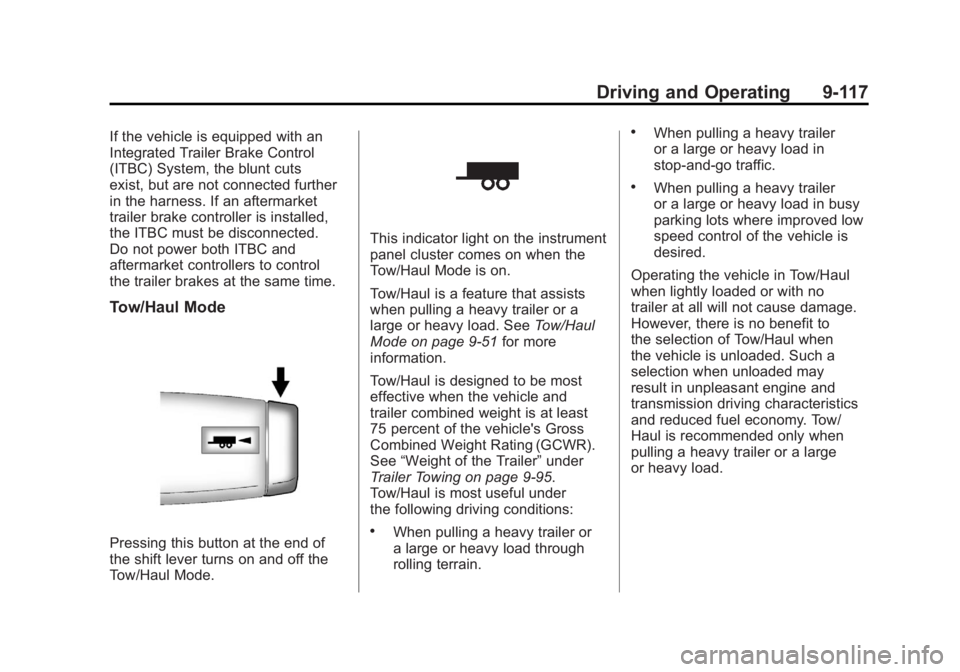
Tow/Haul Mode
Pressing this button at the end of
the shift lever turns on and off the
Tow/Haul Mode.
This indicator light on the instrument
panel cluster comes on when the
Tow/Haul Mode is on.
Tow/Haul is a feature that assists
when pulling a heavy trailer or a
large or heavy load. SeeTow/Haul
Mode on page 9‑51 for more
information.
Tow/Haul is designed to be most
effective when the vehicle and
trailer combined weight is at least
75 percent of the vehicle's Gross
Combined Weight Rating (GCWR).
See “Weight of the Trailer” under
Trailer Towing on page 9‑95.
Tow/Haul is most useful under
the following driving conditions:
.When pulling a heavy trailer or
a large or heavy load through
rolling terrain.
.When pulling a heavy trailer
or a large or heavy load in
stop-and-go traffic.
.When pulling a heavy trailer
or a large or heavy load in busy
parking lots where improved low
speed control of the vehicle is
desired.
Operating the vehicle in Tow/Haul
when lightly loaded or with no
trailer at all will not cause damage.
However, there is no benefit to
the selection of Tow/Haul when
the vehicle is unloaded. Such a
selection when unloaded may
result in unpleasant engine and
transmission driving characteristics
and reduced fuel economy. Tow/
Haul is recommended only when
pulling a heavy trailer or a large
or heavy load.
Page 425 of 594
Black plate (1,1)GMC Sierra Owner Manual - 2011
Vehicle Care 10-1
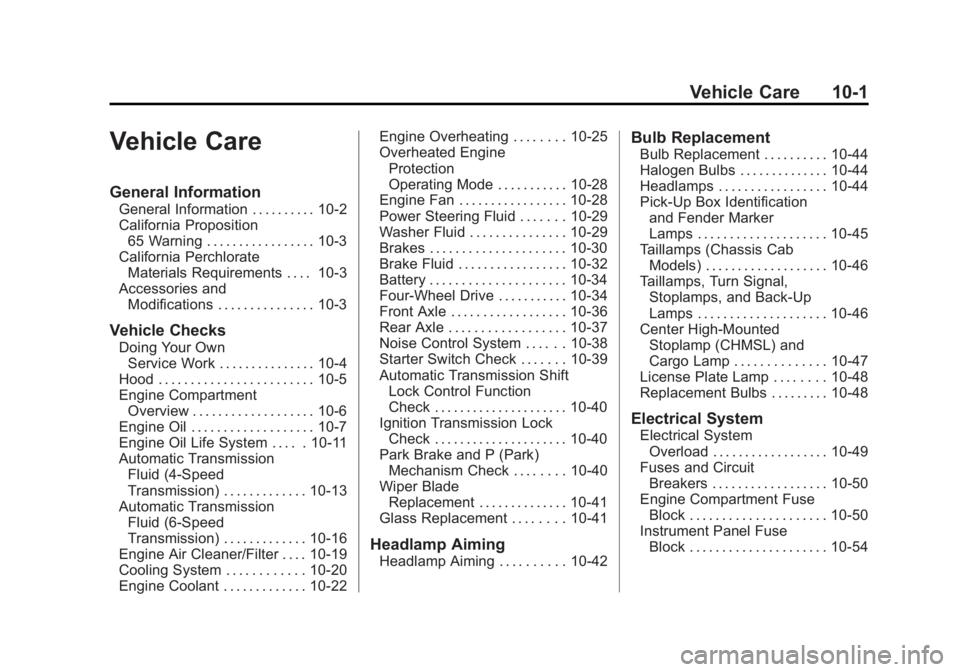
Vehicle Care
General Information
General Information . . . . . . . . . . 10-2
California Proposition65 Warning . . . . . . . . . . . . . . . . . 10-3
California Perchlorate Materials Requirements . . . . 10-3
Accessories and Modifications . . . . . . . . . . . . . . . 10-3
Vehicle Checks
Doing Your OwnService Work . . . . . . . . . . . . . . . 10-4
Hood . . . . . . . . . . . . . . . . . . . . . . . . 10-5
Engine Compartment Overview . . . . . . . . . . . . . . . . . . . 10-6
Engine Oil . . . . . . . . . . . . . . . . . . . 10-7
Engine Oil Life System . . . . . 10-11
Automatic Transmission Fluid (4-Speed
Transmission) . . . . . . . . . . . . . 10-13
Automatic Transmission Fluid (6-Speed
Transmission) . . . . . . . . . . . . . 10-16
Engine Air Cleaner/Filter . . . . 10-19
Cooling System . . . . . . . . . . . . 10-20
Engine Coolant . . . . . . . . . . . . . 10-22 Engine Overheating . . . . . . . . 10-25
Overheated Engine
Protection
Operating Mode . . . . . . . . . . . 10-28
Engine Fan . . . . . . . . . . . . . . . . . 10-28
Power Steering Fluid . . . . . . . 10-29
Washer Fluid . . . . . . . . . . . . . . . 10-29
Brakes . . . . . . . . . . . . . . . . . . . . . 10-30
Brake Fluid . . . . . . . . . . . . . . . . . 10-32
Battery . . . . . . . . . . . . . . . . . . . . . 10-34
Four-Wheel Drive . . . . . . . . . . . 10-34
Front Axle . . . . . . . . . . . . . . . . . . 10-36
Rear Axle . . . . . . . . . . . . . . . . . . 10-37
Noise Control System . . . . . . 10-38
Starter Switch Check . . . . . . . 10-39
Automatic Transmission Shift
Lock Control Function
Check . . . . . . . . . . . . . . . . . . . . . 10-40
Ignition Transmission Lock Check . . . . . . . . . . . . . . . . . . . . . 10-40
Park Brake and P (Park) Mechanism Check . . . . . . . . 10-40
Wiper Blade Replacement . . . . . . . . . . . . . . 10-41
Glass Replacement . . . . . . . . 10-41
Headlamp Aiming
Headlamp Aiming . . . . . . . . . . 10-42
Bulb Replacement
Bulb Replacement . . . . . . . . . . 10-44
Halogen Bulbs . . . . . . . . . . . . . . 10-44
Headlamps . . . . . . . . . . . . . . . . . 10-44
Pick-Up Box Identification and Fender Marker
Lamps . . . . . . . . . . . . . . . . . . . . 10-45
Taillamps (Chassis Cab Models) . . . . . . . . . . . . . . . . . . . 10-46
Taillamps, Turn Signal, Stoplamps, and Back-Up
Lamps . . . . . . . . . . . . . . . . . . . . 10-46
Center High-Mounted Stoplamp (CHMSL) and
Cargo Lamp . . . . . . . . . . . . . . 10-47
License Plate Lamp . . . . . . . . 10-48
Replacement Bulbs . . . . . . . . . 10-48
Electrical System
Electrical System Overload . . . . . . . . . . . . . . . . . . 10-49
Fuses and Circuit Breakers . . . . . . . . . . . . . . . . . . 10-50
Engine Compartment Fuse Block . . . . . . . . . . . . . . . . . . . . . 10-50
Instrument Panel Fuse Block . . . . . . . . . . . . . . . . . . . . . 10-54
Page 431 of 594
Black plate (7,1)GMC Sierra Owner Manual - 2011
Vehicle Care 10-7
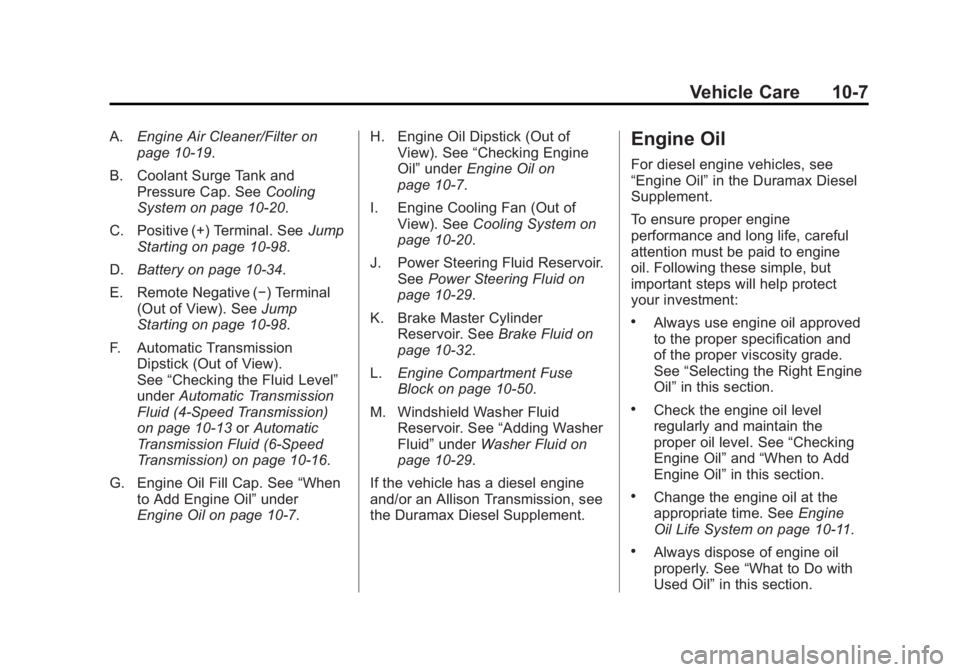
A.Engine Air Cleaner/Filter on
page 10‑19.
B. Coolant Surge Tank and Pressure Cap. See Cooling
System on page 10‑20.
C. Positive (+) Terminal. See Jump
Starting on page 10‑98.
D. Battery on page 10‑34.
E. Remote Negative (−) Terminal (Out of View). See Jump
Starting on page 10‑98.
F. Automatic Transmission Dipstick (Out of View).
See “Checking the Fluid Level”
under Automatic Transmission
Fluid (4-Speed Transmission)
on page 10‑13 orAutomatic
Transmission Fluid (6-Speed
Transmission) on page 10‑16.
G. Engine Oil Fill Cap. See “When
to Add Engine Oil” under
Engine Oil on page 10‑7. H. Engine Oil Dipstick (Out of
View). See “Checking Engine
Oil” under Engine Oil on
page 10‑7.
I. Engine Cooling Fan (Out of View). See Cooling System on
page 10‑20.
J. Power Steering Fluid Reservoir. See Power Steering Fluid on
page 10‑29.
K. Brake Master Cylinder Reservoir. See Brake Fluid on
page 10‑32.
L. Engine Compartment Fuse
Block on page 10‑50.
M. Windshield Washer Fluid Reservoir. See “Adding Washer
Fluid” under Washer Fluid on
page 10‑29.
If the vehicle has a diesel engine
and/or an Allison Transmission, see
the Duramax Diesel Supplement.Engine Oil
For diesel engine vehicles, see
“Engine Oil” in the Duramax Diesel
Supplement.
To ensure proper engine
performance and long life, careful
attention must be paid to engine
oil. Following these simple, but
important steps will help protect
your investment:
.Always use engine oil approved
to the proper specification and
of the proper viscosity grade.
See “Selecting the Right Engine
Oil” in this section.
.Check the engine oil level
regularly and maintain the
proper oil level. See “Checking
Engine Oil” and“When to Add
Engine Oil” in this section.
.Change the engine oil at the
appropriate time. See Engine
Oil Life System on page 10‑11.
.Always dispose of engine oil
properly. See “What to Do with
Used Oil” in this section.
Page 437 of 594
Black plate (13,1)GMC Sierra Owner Manual - 2011
Vehicle Care 10-13
Automatic
Transmission Fluid
(4-Speed Transmission)
When to Check and Change
Automatic Transmission Fluid
A good time to check the automatic
transmission fluid level is when the
engine oil is changed.
Change the fluid and filter at
the intervals listed inScheduled
Maintenance on page 11‑2 and be
sure to use the transmission fluid
listed in Recommended Fluids and
Lubricants on page 11‑8.
How to Check Automatic
Transmission Fluid
Because this operation can be a
little difficult, it may be best to have
this done at the dealer service
department.
If not taken to the dealer, be sure to
follow all the instructions here or a
false reading on the dipstick could
result.
Notice: Too much or too
little fluid can damage the
transmission. Too much can
mean that some of the fluid could
come out and fall on hot engine
parts or exhaust system parts,
starting a fire. Too little fluid
could cause the transmission
to overheat. Be sure to get an
accurate reading if checking
the transmission fluid. Wait at least 30 minutes before
checking the transmission fluid
level if you have been driving:.When outside temperatures are
above 32°C (90°F).
.At high speed for quite a while.
.In heavy traffic
—especially in
hot weather.
.While pulling a trailer.
To get the right reading, the fluid
should be at normal operating
temperature, which is 82°C to 93°C
(180°F to 200°F).
Get the vehicle warmed up by
driving about 24 km (15 miles) when
outside temperatures are above
10°C (50°F). If it is colder than 10°C
(50°F), drive the vehicle in 3 (Third)
until the engine temperature gauge
moves and then remains steady for
10 minutes.
Page 438 of 594
Black plate (14,1)GMC Sierra Owner Manual - 2011
10-14 Vehicle Care
A cold fluid check can be made
after the vehicle has been sitting
for eight hours or more with the
engine off, but this is used only
as a reference. Let the engine
run at idle for five minutes if outside
temperatures are 10°C (50°F)
or more. If it is colder than 10°C
(50°F), the engine may have to idle
longer. Should the fluid level be low
during this cold check, the fluid must
be checked when hot before adding
fluid. Checking the fluid hot will give
you a more accurate reading of the
fluid level.Checking the Fluid Level
Prepare the vehicle as follows:
1. Park the vehicle on a level
place. Keep the engine running.
2. With the parking brake applied, place the shift lever in P (Park).
3. With your foot on the brake pedal, move the shift lever
through each gear range,
pausing for about three seconds
in each range. Then, position
the shift lever in P (Park).
4. Let the engine run at idle for three minutes or more. Then, without shutting off the
engine, follow these steps:
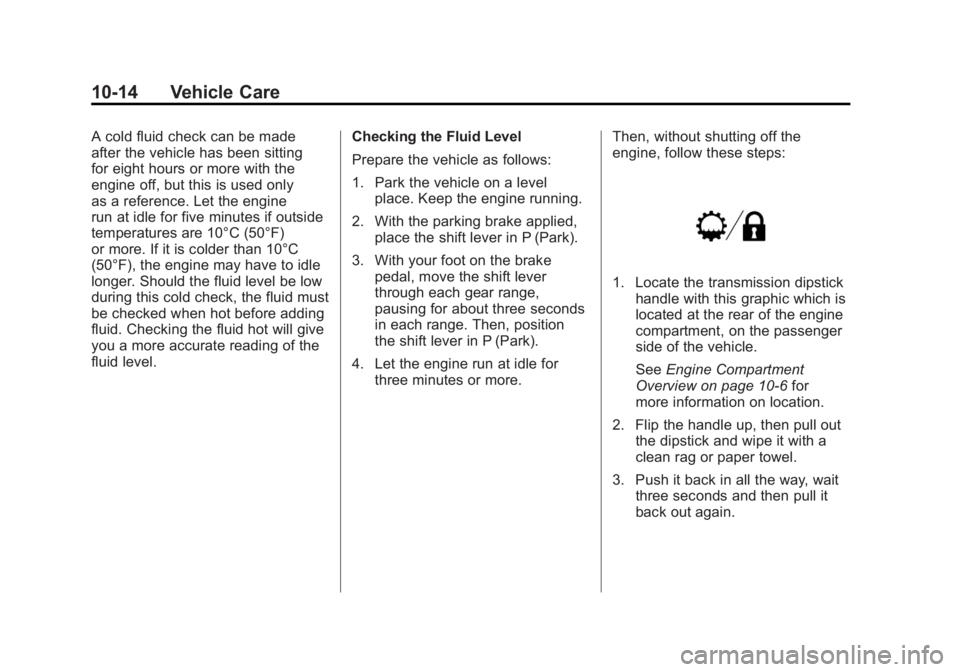
1. Locate the transmission dipstick
handle with this graphic which is
located at the rear of the engine
compartment, on the passenger
side of the vehicle.
See Engine Compartment
Overview on page 10‑6 for
more information on location.
2. Flip the handle up, then pull out the dipstick and wipe it with a
clean rag or paper towel.
3. Push it back in all the way, wait three seconds and then pull it
back out again.
Page 439 of 594
Black plate (15,1)GMC Sierra Owner Manual - 2011
Vehicle Care 10-15
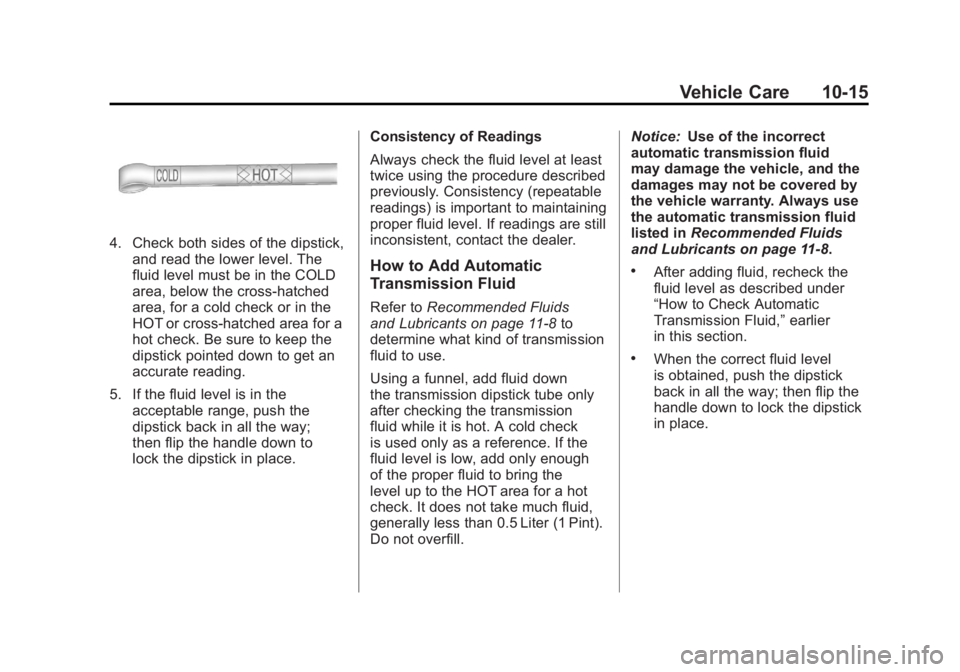
4. Check both sides of the dipstick,and read the lower level. The
fluid level must be in the COLD
area, below the cross-hatched
area, for a cold check or in the
HOT or cross-hatched area for a
hot check. Be sure to keep the
dipstick pointed down to get an
accurate reading.
5. If the fluid level is in the acceptable range, push the
dipstick back in all the way;
then flip the handle down to
lock the dipstick in place. Consistency of Readings
Always check the fluid level at least
twice using the procedure described
previously. Consistency (repeatable
readings) is important to maintaining
proper fluid level. If readings are still
inconsistent, contact the dealer.
How to Add Automatic
Transmission Fluid
Refer to
Recommended Fluids
and Lubricants on page 11‑8 to
determine what kind of transmission
fluid to use.
Using a funnel, add fluid down
the transmission dipstick tube only
after checking the transmission
fluid while it is hot. A cold check
is used only as a reference. If the
fluid level is low, add only enough
of the proper fluid to bring the
level up to the HOT area for a hot
check. It does not take much fluid,
generally less than 0.5 Liter (1 Pint).
Do not overfill. Notice:
Use of the incorrect
automatic transmission fluid
may damage the vehicle, and the
damages may not be covered by
the vehicle warranty. Always use
the automatic transmission fluid
listed in Recommended Fluids
and Lubricants on page 11‑8.
.After adding fluid, recheck the
fluid level as described under
“How to Check Automatic
Transmission Fluid,” earlier
in this section.
.When the correct fluid level
is obtained, push the dipstick
back in all the way; then flip the
handle down to lock the dipstick
in place.
Page 440 of 594
Black plate (16,1)GMC Sierra Owner Manual - 2011
10-16 Vehicle Care
Automatic
Transmission Fluid
(6-Speed Transmission)
When to Check and Change
Automatic Transmission Fluid
It is usually not necessary to
check the transmission fluid level.
The only reason for fluid loss is a
transmission leak or overheated
transmission. If a small leak is
suspected, then use the following
checking procedures to check the
fluid level. However, if there is a
large leak, then it may be necessary
to have the vehicle towed to a
dealer service department and have
it repaired before driving the vehicle
further.Notice:
Use of the incorrect
automatic transmission fluid
may damage the vehicle, and the
damages may not be covered by
the vehicle warranty. Always use
the automatic transmission fluid
listed in Recommended Fluids
and Lubricants on page 11‑8.
Change the fluid and filter
at the scheduled maintenance
intervals listed in Scheduled
Maintenance on page 11‑2.
Be sure to use the transmission
fluid listed in Recommended Fluids
and Lubricants on page 11‑8.
How to Check Automatic
Transmission Fluid
Notice: Too much or too
little fluid can damage the
transmission. Too much can
mean that some of the fluid could
come out and fall on hot engine
parts or exhaust system parts,
starting a fire. Too little fluid
could cause the transmission
to overheat. Be sure to get an
accurate reading if checking
the transmission fluid.
Before checking the fluid level,
prepare the vehicle as follows:
1. Start the engine and park the vehicle on a level surface.
Keep the engine running.
2. Apply the parking brake and place the shift lever in P (Park).
Page 441 of 594
Black plate (17,1)GMC Sierra Owner Manual - 2011
Vehicle Care 10-17
3. With your foot on the brakepedal, move the shift lever
through each gear range,
pausing for about three seconds
in each range. Then, move the
shift lever back to P (Park).
4. Allow the engine to idle (500 –800 rpm) for at least
1 minute. Slowly release the
brake pedal.
5. Keep the engine running and press the Trip/Fuel button or
trip odometer reset stem until
TRANS TEMP (Transmission
Temperature) displays on the
Driver Information Center (DIC).
6. Using the TRANS TEMP reading, determine and
perform the appropriate check
procedure. If the TRANS TEMP
reading is not within the required
temperature ranges, allow the
vehicle to cool, or operate the
vehicle until the appropriate
transmission fluid temperature
is reached. Cold Check Procedure
Use this procedure only as a
reference to determine if the
transmission has enough fluid
to be operated safely until a hot
check procedure can be made.
The hot check procedure is the
most accurate method to check the
fluid level. Perform the hot check
procedure at the first opportunity.
Use this cold check procedure
to check fluid level when the
transmission temperature is
between 27°C and 32°C
(80°F and 90°F).
1. Locate the transmission
dipstick at the rear of the engine
compartment, on the passenger
side of the vehicle.
See Engine Compartment
Overview on page 10‑6 for
more information.
2. Flip the handle up, then pull out the dipstick and wipe it with a
clean rag or paper towel.
3. Install the dipstick by pushing it back in all the way; wait
three seconds, and then pull
it back out again.
4. Check both sides of the dipstick and read the lower level. Repeat
the check procedure to verify the
reading.
Page 442 of 594
Black plate (18,1)GMC Sierra Owner Manual - 2011
10-18 Vehicle Care
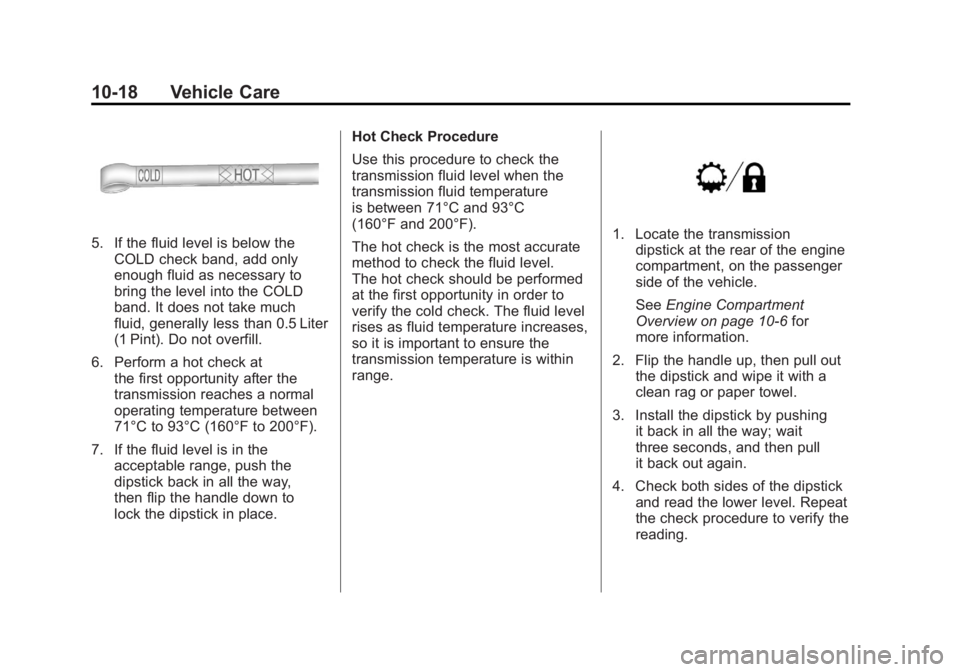
5. If the fluid level is below theCOLD check band, add only
enough fluid as necessary to
bring the level into the COLD
band. It does not take much
fluid, generally less than 0.5 Liter
(1 Pint). Do not overfill.
6. Perform a hot check at the first opportunity after the
transmission reaches a normal
operating temperature between
71°C to 93°C (160°F to 200°F).
7. If the fluid level is in the acceptable range, push the
dipstick back in all the way,
then flip the handle down to
lock the dipstick in place. Hot Check Procedure
Use this procedure to check the
transmission fluid level when the
transmission fluid temperature
is between 71°C and 93°C
(160°F and 200°F).
The hot check is the most accurate
method to check the fluid level.
The hot check should be performed
at the first opportunity in order to
verify the cold check. The fluid level
rises as fluid temperature increases,
so it is important to ensure the
transmission temperature is within
range.1. Locate the transmission
dipstick at the rear of the engine
compartment, on the passenger
side of the vehicle.
See Engine Compartment
Overview on page 10‑6 for
more information.
2. Flip the handle up, then pull out the dipstick and wipe it with a
clean rag or paper towel.
3. Install the dipstick by pushing it back in all the way; wait
three seconds, and then pull
it back out again.
4. Check both sides of the dipstick and read the lower level. Repeat
the check procedure to verify the
reading.