automatic transmission fluid GMC SIERRA 1500 2017 Owners Manual
[x] Cancel search | Manufacturer: GMC, Model Year: 2017, Model line: SIERRA 1500, Model: GMC SIERRA 1500 2017Pages: 494, PDF Size: 7.66 MB
Page 145 of 494
GMC Sierra/Sierra Denali Owner Manual (GMNA-Localizing-U.S./Canada/
Mexico-9955992) - 2017 - crc - 5/3/16
144 Instruments and Controls
Trailer Brake :On vehicles with the
Integrated Trailer Brake Control
(ITBC) system, the trailer brake
display appears in the DIC.
TRAILER GAIN shows the trailer
gain setting. This setting can be
adjusted from 0.0 to 10.0 with either
a trailer connected or disconnected.
OUTPUT shows the power output to
the trailer any time a trailer with
electric brakes is connected. Output
is displayed as a bar graph. Dashes
may appear in the OUTPUT display.
Speed Signs : Shows sign
information, which comes from a
roadway database in the onboard
navigation.
Following Distance : Used to
select the alert timing for the
Forward Collision Alert (FCA). See
Forward Collision Alert (FCA)
System 0293.
Blank Page : Shows no
information. Transmission Fluid Temperature
Gauge :
Shows the temperature of
the automatic transmission fluid in
either degrees Celsius (°C) or
degrees Fahrenheit (°F).
Off Road : Displays vehicle pitch
and roll information, road wheel
angle, and four-wheel drive (4WD)
status.Vehicle Messages
Messages displayed on the DIC
indicate the status of the vehicle or
some action may be needed to
correct a condition. Multiple
messages may appear one after
another.
The messages that do not require
immediate action can be
acknowledged and cleared by
pressing
V.
The messages that require
immediate action cannot be cleared
until that action is performed.
All messages should be taken
seriously and clearing the message
does not correct the problem.
The following are the possible
messages and some information
about them.
If the vehicle has a diesel engine,
see the Duramax diesel
supplement.
Page 308 of 494
GMC Sierra/Sierra Denali Owner Manual (GMNA-Localizing-U.S./Canada/
Mexico-9955992) - 2017 - crc - 5/3/16
Driving and Operating 307
If parking the rig on a hill:1. Press the brake pedal, but do not shift into P (Park) yet. Turn
the wheels into the curb if
facing downhill or into traffic if
facing uphill.
2. Have someone place chocks under the trailer wheels.
3. When the wheel chocks are in place, release the regular
brakes until the chocks absorb
the load.
4. Reapply the brake pedal. Then apply the parking brake and
shift into P (Park).
5. Release the brake pedal.
Leaving After Parking on a Hill
1. Apply and hold the brake pedal.
2. Start the engine.
3. Shift into a gear.
4. Release the parking brake.
5. Let up on the brake pedal.
6. Drive slowly until the trailer is clear of the chocks. 7. Stop and have someone pick
up and store the chocks.
Maintenance when Trailer
Towing
The vehicle needs service more
often when pulling a trailer. See
Maintenance Schedule 0438.
Things that are especially important
in trailer operation are automatic
transmission fluid, engine oil, axle
lubricant, belts, cooling system, and
brake system. It is a good idea to
inspect these before and during
the trip.
Check periodically to see that all
hitch nuts and bolts are tight.
Trailer Towing
If the vehicle has a diesel engine,
see the Duramax diesel
supplement.
If the vehicle is bi-fuel, see the
bi-fuel supplement.
Do not tow a trailer during break-in.
See New Vehicle Break-In 0258.
{Warning
The driver can lose control when
pulling a trailer if the correct
equipment is not used or the
vehicle is not driven properly. For
example, if the trailer is too heavy
or the trailer brakes are
inadequate for the load, the
vehicle may not stop as expected.
The driver and passengers could
be seriously injured. The vehicle
may also be damaged; the
resulting repairs would not be
covered by the vehicle warranty.
Pull a trailer only if all the steps in
this section have been followed.
Ask your dealer for advice and
information about towing a trailer
with the vehicle.
Caution
Pulling a trailer improperly can
damage the vehicle and result in
costly repairs not covered by the
(Continued)
Page 340 of 494
GMC Sierra/Sierra Denali Owner Manual (GMNA-Localizing-U.S./Canada/
Mexico-9955992) - 2017 - crc - 5/3/16
Vehicle Care 339
Vehicle Care
General Information
General Information . . . . . . . . . . 340
California Proposition65 Warning . . . . . . . . . . . . . . . . . 340
California Perchlorate Materials Requirements . . . . . 341
Accessories and Modifications . . . . . . . . . . . . . . . . 341
Vehicle Checks
Doing Your OwnService Work . . . . . . . . . . . . . . . 342
Hood . . . . . . . . . . . . . . . . . . . . . . . . . 342
Engine Compartment Overview . . . . . . . . . . . . . . . . . . . . 343
Engine Oil . . . . . . . . . . . . . . . . . . . . 348
Engine Oil Life System . . . . . . . 351
Automatic Transmission Fluid (6 Speed Transmission) . . . . . 352
Automatic Transmission Fluid (8 Speed Transmission) . . . . . 354
Engine Air Cleaner/Filter . . . . . . 355
Cooling System . . . . . . . . . . . . . . 356
Engine Coolant . . . . . . . . . . . . . . . 357
Engine Overheating . . . . . . . . . . 360
Overheated Engine Protection Operating Mode . . . . . . . . . . . . . 362
Engine Fan . . . . . . . . . . . . . . . . . . . 362 Power Steering Fluid (1500
Series) . . . . . . . . . . . . . . . . . . . . . . 363
Power Steering Fluid (2500/ 3500 Series) . . . . . . . . . . . . . . . . 363
Washer Fluid . . . . . . . . . . . . . . . . . 363
Brakes . . . . . . . . . . . . . . . . . . . . . . . 364
Brake Fluid . . . . . . . . . . . . . . . . . . . 365
Battery - North America . . . . . . 366
Four-Wheel Drive . . . . . . . . . . . . . 367
Front Axle . . . . . . . . . . . . . . . . . . . . 368
Rear Axle . . . . . . . . . . . . . . . . . . . . 368
Noise Control System . . . . . . . . 370
Starter Switch Check . . . . . . . . . 371
Automatic Transmission Shift
Lock Control Function
Check . . . . . . . . . . . . . . . . . . . . . . . 371
Ignition Transmission Lock Check . . . . . . . . . . . . . . . . . . . . . . . 371
Park Brake and P (Park) Mechanism Check . . . . . . . . . . 371
Wiper Blade Replacement . . . . 372
Glass Replacement . . . . . . . . . . 372
Headlamp Aiming
Headlamp Aiming . . . . . . . . . . . . 373
Bulb Replacement
Bulb Replacement . . . . . . . . . . . . 373
Halogen Bulbs . . . . . . . . . . . . . . . . 373
High Intensity Discharge (HID) Lighting . . . . . . . . . . . . . . . . . . . . . 373 LED Lighting . . . . . . . . . . . . . . . . . 373
Taillamps, Turn Signal,
Stoplamps, and Back-Up
Lamps . . . . . . . . . . . . . . . . . . . . . . 374
Center High-Mounted
Stoplamp (CHMSL) and
Cargo Lamp . . . . . . . . . . . . . . . . . 375
Replacement Bulbs . . . . . . . . . . . 375
Electrical System
High Voltage Devices and Wiring . . . . . . . . . . . . . . . . . . . . . . . 376
Electrical System Overload . . . 376
Fuses . . . . . . . . . . . . . . . . . . . . . . . . 376
Engine Compartment Fuse Block . . . . . . . . . . . . . . . . . . . . . . . . 376
Instrument Panel Fuse Block
(Right) . . . . . . . . . . . . . . . . . . . . . . 379
Instrument Panel Fuse Block (Left) . . . . . . . . . . . . . . . . . 381
Wheels and Tires
Tires . . . . . . . . . . . . . . . . . . . . . . . . . . 383
All-Season Tires . . . . . . . . . . . . . . 384
Winter Tires . . . . . . . . . . . . . . . . . . 384
Low-Profile Tires . . . . . . . . . . . . . 385
All-Terrain Tires . . . . . . . . . . . . . . . 385
Tire Sidewall Labeling . . . . . . . . 385
Tire Designations . . . . . . . . . . . . . 388
Tire Terminology andDefinitions . . . . . . . . . . . . . . . . . . 389
Page 345 of 494

GMC Sierra/Sierra Denali Owner Manual (GMNA-Localizing-U.S./Canada/
Mexico-9955992) - 2017 - crc - 5/3/16
344 Vehicle Care
1. Positive (+) Terminal. SeeJump Starting - North
America 0418.
2. Battery - North America 0366.
3. Coolant Surge Tank and Pressure Cap. See Cooling
System 0356.
4. Engine Air Cleaner/Filter 0355.
5. Automatic Transmission Dipstick (If Equipped). See
“How to Check Automatic
Transmission Fluid” under
Automatic Transmission Fluid
(6 Speed Transmission) 0352
or Automatic Transmission
Fluid (8 Speed
Transmission) 0354.
6. Remote Negative (–) Location. See Jump Starting - North
America 0418.
7. Engine Cooling Fans (Out of View). See Cooling
System 0356.
8. Engine Oil Fill Cap. See “When
to Add Engine Oil” under
Engine Oil 0348. 9. Engine Oil Dipstick. See
“Checking Engine Oil” under
Engine Oil 0348.
10. Brake Fluid Reservoir. See Brake Fluid 0365.
11. Windshield Washer Fluid Reservoir. See “Adding Washer
Fluid” under Washer
Fluid 0363.
12. Engine Compartment Fuse
Block 0376.
Page 347 of 494

GMC Sierra/Sierra Denali Owner Manual (GMNA-Localizing-U.S./Canada/
Mexico-9955992) - 2017 - crc - 5/3/16
346 Vehicle Care
1. Positive (+) Terminal. SeeJump Starting - North
America 0418.
2. Battery - North America 0366.
3. Coolant Surge Tank and Pressure Cap. See Cooling
System 0356.
4. Engine Air Cleaner/Filter 0355.
5. Automatic Transmission Dipstick (If Equipped). See
“How to Check Automatic
Transmission Fluid” under
Automatic Transmission Fluid
(6 Speed Transmission) 0352
or Automatic Transmission
Fluid (8 Speed
Transmission) 0354.
6. Remote Negative (–) Location (Out of View). See Jump
Starting - North America 0418.
7. Engine Cooling Fans (Out of View). See Cooling
System 0356.
8. Engine Oil Fill Cap. See “When
to Add Engine Oil” under
Engine Oil 0348. 9. Engine Oil Dipstick. See
“Checking Engine Oil” under
Engine Oil 0348.
10. Windshield Washer Fluid Reservoir. See “Adding Washer
Fluid” under Washer
Fluid 0363.
11. Brake Fluid Reservoir. See Brake Fluid 0365.
12. Engine Compartment Fuse
Block 0376.
Page 349 of 494
GMC Sierra/Sierra Denali Owner Manual (GMNA-Localizing-U.S./Canada/
Mexico-9955992) - 2017 - crc - 5/3/16
348 Vehicle Care
1. Positive (+) Terminal. SeeJump Starting - North
America 0418.
2. Battery - North America 0366.
3. Coolant Surge Tank and Pressure Cap. See Cooling
System 0356.
4. Engine Air Cleaner/Filter 0355.
5. Automatic Transmission Dipstick (If Equipped). See
“How to Check Automatic
Transmission Fluid” under
Automatic Transmission Fluid
(6 Speed Transmission) 0352
or Automatic Transmission
Fluid (8 Speed
Transmission) 0354.
6. Engine Oil Dipstick. See “Checking Engine Oil” under
Engine Oil 0348.
7. Engine Oil Fill Cap. See “When
to Add Engine Oil” under
Engine Oil 0348.
8. Engine Cooling Fan (Out of View). See Cooling
System 0356. 9. Remote Negative (–) Location.
See Jump Starting - North
America 0418.
10. Power Steering Fluid Reservoir. See Power Steering
Fluid (1500 Series) 0363
or Power Steering Fluid (2500/
3500 Series) 0363.
11. Windshield Washer Fluid Reservoir. See “Adding Washer
Fluid” under Washer
Fluid 0363.
12. Brake Fluid Reservoir. See Brake Fluid 0365.
13. Auxiliary Battery (If Equipped). SeeBattery - North
America 0366.
14. Engine Compartment Fuse
Block 0376.
If the vehicle has a diesel engine
and/or an Allison Transmission, see
the Duramax diesel supplement.
For an eAssist vehicle, see the
Silverado/Sierra supplement.Engine Oil
For diesel engine vehicles, see
“Engine Oil” in the Duramax diesel
supplement.
To ensure proper engine
performance and long life, careful
attention must be paid to engine oil.
Following these simple, but
important steps will help protect
your investment:
. Use engine oil approved to the
proper specification and of the
proper viscosity grade. See
“Selecting the Right Engine Oil”
in this section.
. Check the engine oil level
regularly and maintain the
proper oil level. See “Checking
Engine Oil” and“When to Add
Engine Oil” in this section.
. Change the engine oil at the
appropriate time. See Engine Oil
Life System 0351.
. Always dispose of engine oil
properly. See “What to Do with
Used Oil” in this section.
Page 353 of 494
GMC Sierra/Sierra Denali Owner Manual (GMNA-Localizing-U.S./Canada/
Mexico-9955992) - 2017 - crc - 5/3/16
352 Vehicle Care
If the vehicle has a CHANGE
ENGINE OIL SOON message and it
comes back on when the vehicle is
started and/or the OIL LIFE
REMAINING is near 0%, the engine
oil life system has not been reset.
Repeat the procedure.
Automatic Transmission
Fluid (6 Speed
Transmission)
When to Check and Change
Automatic Transmission Fluid
It is usually not necessary to check
the transmission fluid level. The only
reason for fluid loss is a
transmission leak or overheated
transmission. If a small leak is
suspected, then use the following
checking procedures to check the
fluid level. However, if there is a
large leak, then it may be necessary
to have the vehicle towed to a
dealer service department and have
it repaired before driving the vehicle
further.
Caution
Use of the incorrect automatic
transmission fluid may damage
the vehicle, and the damage may
not be covered by the vehicle
warranty. Always use the
automatic transmission fluid listed
inRecommended Fluids and
Lubricants 0447.
Change the fluid and filter at the
scheduled maintenance intervals
listed in Maintenance Schedule
0 438. Be sure to use the
transmission fluid listed in
Recommended Fluids and
Lubricants 0447.
How to Check Automatic
Transmission Fluid
Caution
Too much or too little fluid can
damage the transmission. Too
much can mean that some of the (Continued)
Caution (Continued)
fluid could come out and fall on
hot engine parts or exhaust
system parts, starting a fire. Too
little fluid could cause the
transmission to overheat. Be sure
to get an accurate reading if
checking the transmission fluid.
Before checking the fluid level,
prepare the vehicle: 1. Start the engine and park the vehicle on a level surface.
Keep the engine running.
2. Apply the parking brake and place the shift lever in P (Park).
3. With your foot on the brake pedal, move the shift lever
through each gear range,
pausing for about
three seconds in each range.
Then, move the shift lever back
to P (Park).
Page 355 of 494
GMC Sierra/Sierra Denali Owner Manual (GMNA-Localizing-U.S./Canada/
Mexico-9955992) - 2017 - crc - 5/3/16
354 Vehicle Care
Hot Check Procedure
Use this procedure to check the
transmission fluid level when the
transmission fluid temperature is
between 71 °C and 93 °C (160 °F
and 200 °F).
The hot check is the most accurate
method to check the fluid level. The
hot check should be performed at
the first opportunity in order to verify
the cold check. The fluid level rises
as fluid temperature increases, so it
is important to ensure the
transmission temperature is within
range.
1. Locate the transmissiondipstick at the rear of the
engine compartment, on the
passenger side of the vehicle.
See Engine Compartment
Overview 0343. 2. Flip the handle up, then pull out
the dipstick and wipe it with a
clean rag or paper towel.
3. Install the dipstick by pushing it back in all the way; wait
three seconds, and then pull it
back out again.
4. Check both sides of the dipstick and read the lower
level. Repeat the check
procedure to verify the reading.
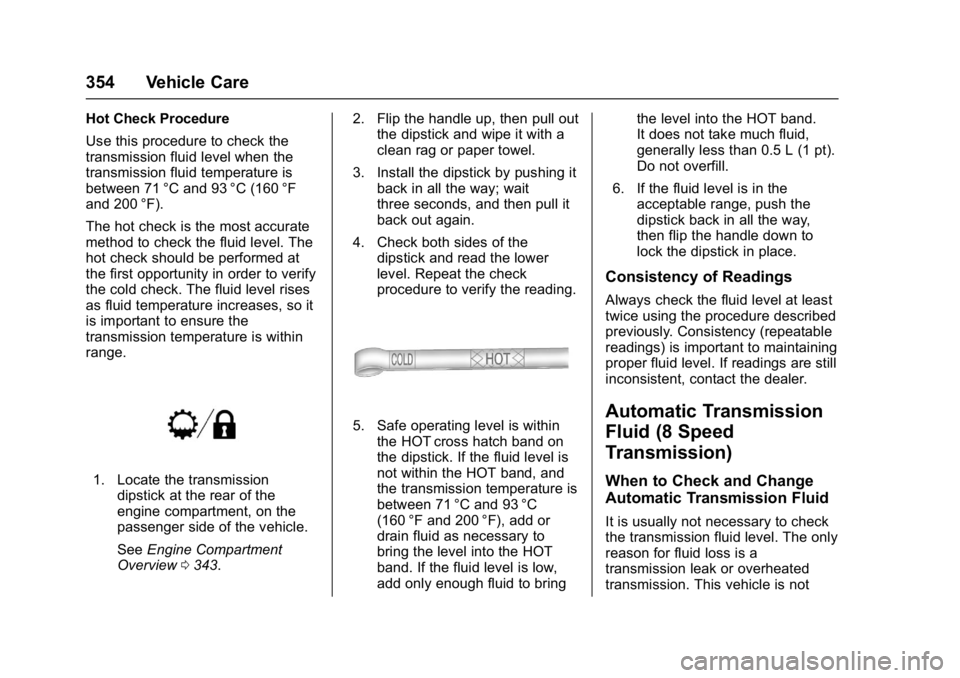
5. Safe operating level is within
the HOT cross hatch band on
the dipstick. If the fluid level is
not within the HOT band, and
the transmission temperature is
between 71 °C and 93 °C
(160 °F and 200 °F), add or
drain fluid as necessary to
bring the level into the HOT
band. If the fluid level is low,
add only enough fluid to bring the level into the HOT band.
It does not take much fluid,
generally less than 0.5 L (1 pt).
Do not overfill.
6. If the fluid level is in the acceptable range, push the
dipstick back in all the way,
then flip the handle down to
lock the dipstick in place.
Consistency of Readings
Always check the fluid level at least
twice using the procedure described
previously. Consistency (repeatable
readings) is important to maintaining
proper fluid level. If readings are still
inconsistent, contact the dealer.
Automatic Transmission
Fluid (8 Speed
Transmission)
When to Check and Change
Automatic Transmission Fluid
It is usually not necessary to check
the transmission fluid level. The only
reason for fluid loss is a
transmission leak or overheated
transmission. This vehicle is not
Page 356 of 494
GMC Sierra/Sierra Denali Owner Manual (GMNA-Localizing-U.S./Canada/
Mexico-9955992) - 2017 - crc - 5/3/16
Vehicle Care 355
equipped with a transmission fluid
level dipstick. There is a special
procedure for checking and
changing the transmission fluid in
these vehicles. Because this
procedure is difficult, this should be
done at the dealer. Contact the
dealer for additional information or
the procedure can be found in the
service manual. SeeService
Publications Ordering
Information 0466.
Caution
Use of the incorrect automatic
transmission fluid may damage
the vehicle, and the damage may
not be covered by the vehicle
warranty. Always use the
automatic transmission fluid listed
in Recommended Fluids and
Lubricants 0447.
Change the fluid and filter at the
scheduled maintenance intervals
listed in Maintenance Schedule
0 438. Be sure to use the transmission fluid listed in
Recommended Fluids and
Lubricants
0447.
Engine Air Cleaner/Filter
If the vehicle has a diesel engine,
see “8-Cylinder Pickup Models”
under “Engine Air Cleaner/Filter” in
the Duramax diesel supplement for
the correct inspection and
replacement procedures.
The engine air cleaner/filter is on
the passenger side of the engine
compartment. See Engine
Compartment Overview 0343.
When to Inspect the Engine Air
Cleaner/Filter
For intervals on changing and
inspecting the engine air filter, see
Maintenance Schedule 0438.
How to Inspect the Engine Air
Cleaner/Filter
Do not start the engine or have the
engine running with the engine air
cleaner/filter housing open. Before
removing the engine air cleaner/
filter, make sure that the engine air cleaner/filter housing and nearby
components are free of dirt and
debris. Remove the engine air
cleaner/filter. Lightly tap and shake
the engine air cleaner/filter (away
from the vehicle), to release loose
dust and dirt. Inspect the engine air
cleaner/filter for damage, and
replace if damaged. Do not clean
the engine air cleaner/filter or
components with water or
compressed air.
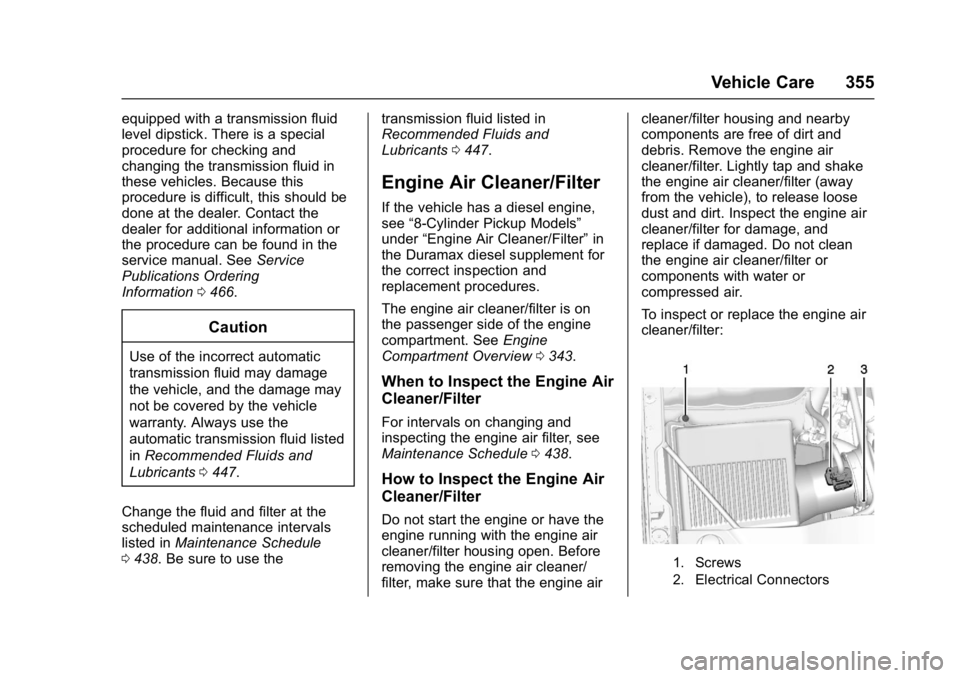
To inspect or replace the engine air
cleaner/filter:
1. Screws
2. Electrical Connectors
Page 444 of 494
GMC Sierra/Sierra Denali Owner Manual (GMNA-Localizing-U.S./Canada/
Mexico-9955992) - 2017 - crc - 5/3/16
Service and Maintenance 443
Maintenance Schedule
Additional Required
Services - Severe12 000 km/7,500 mi
24 000 km/15,000 mi
36 000 km/22,500 mi
48 000 km/30,000 mi
60 000 km/37,500 mi
72 000 km/45,000 mi
84 000 km/52,500 mi
96 000 km/60,000 mi
108 000 km/67,500 mi
120 000 km/75,000 mi
132 000 km/82,500 mi
144 000 km/90,000 mi
156 000 km/97,500 mi
168 000 km/105,000 mi 180 000 km/112,500 mi
192 000 km/120,000 mi
204 000 km/127,500 mi
216 000 km/135,000 mi
228 000 km/142,500 mi
240 000 km/150,000 mi
Rotate tires and perform Required Services.
Check engine oil level and oil life percentage.
Change engine oil and filter, if needed.@ @ @ @ @ @ @ @ @ @ @ @ @ @ @ @ @ @ @ @
Replace passenger compartment air filter. (1)@ @@@@@
Inspect evaporative control system. (2)@ @@
Replace engine air cleaner filter. (3)@@@
Replace spark plugs. Inspect spark plug wires.@
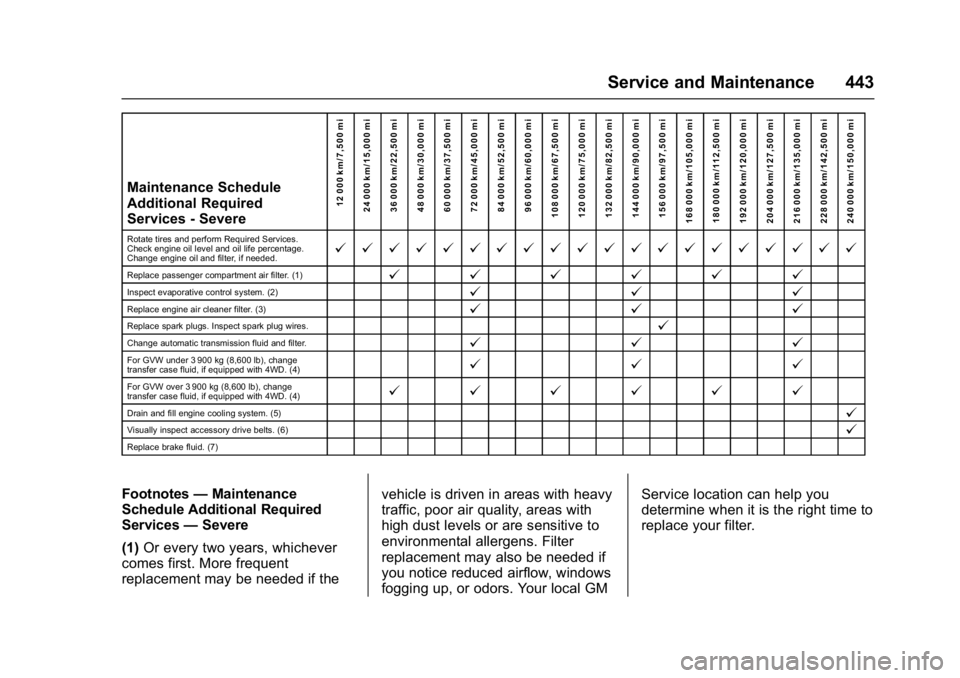
Change automatic transmission fluid and filter.@@@
For GVW under 3 900 kg (8,600 lb), change
transfer case fluid, if equipped with 4WD. (4)@@@
For GVW over 3 900 kg (8,600 lb), change
transfer case fluid, if equipped with 4WD. (4)@@@@@@
Drain and fill engine cooling system. (5)@
Visually inspect accessory drive belts. (6)@
Replace brake fluid. (7)
Footnotes—Maintenance
Schedule Additional Required
Services —Severe
(1) Or every two years, whichever
comes first. More frequent
replacement may be needed if the vehicle is driven in areas with heavy
traffic, poor air quality, areas with
high dust levels or are sensitive to
environmental allergens. Filter
replacement may also be needed if
you notice reduced airflow, windows
fogging up, or odors. Your local GMService location can help you
determine when it is the right time to
replace your filter.