air condition GMC SIERRA 1993 User Guide
[x] Cancel search | Manufacturer: GMC, Model Year: 1993, Model line: SIERRA, Model: GMC SIERRA 1993Pages: 436, PDF Size: 23.88 MB
Page 252 of 436

Problems on the Road
If your engine catches fire because you keep driving with no cool\
ant, your
vehicle can be bac"lI damaged.
T- ! costly rep; 1 would not be Iverec
by your warranty.
If No Steam Is Coming From Your Engine:
If you get the overheat warning but see or hear no steam, th\
e problem may
not be too serious. Sometimes the engine can get a little too\
hot when you:
Climb a long hill on a hot day.
Stop after high speed driving.
Idle for long periods in traffic.
Tow a trailer.
If you get the overheat warning with no sign of steam, try t\
his for a minute
or
so:
1. If you have an air conditioner, turn it off.
2. Turn on your heater to full hot at the highest fan speed and\
open the
3. If you're in a traffic jam, shift to N (Neutral).
window as necessary.
If you no longer have the overheat warning, you can drive. Just
to be safe,
drive slower for about ten minutes.
If the warning doesn't come back on, you
can drive normally.
If the warning continues, pull over, stop, and park your vehic\
le right away.
If there's still no sign of steam, push the accelerator until the engine speed is
about twice
as fast as normal idle speed. Bring the engine speed back to
normal idle speed after two or three minutes. Now see if the warning stops.
But then,
if you still have the warning, TURN OFF THE ENGINE AND GET
EVERYONE
OUT OF THE VEHICLE until it cools down.
You may decide not to
lift the hood but to get service help right away.
5-1 0
ProCarManuals.com
Page 259 of 436
Engine Fan Noise
This vehicle has a clutched engine cooling fan. When the clutch is engaged,
the fan spins faster to provide more air to
cool the engine. In most every day
driving conditions the clutch is not engaged. This improves fue\
l economy and
reduces fan noise. Under heavy vehicle loading, trailer towing andlor high
outside temperatures, the fan speed increases when the clutch e\
ngages.
So
you may hear an increase in fan noise. This is normal and should not be
mistaken as the transmission slipping or making extra shifts. It is merely the
cooling system functioning properly. The fan will
slow down when additional
cooling is not required and the clutch disengages.
You may also hear this fan noise when you start the engine. It will go away
as the fan clutch disengages.
If a Tire Goes Fiat
It’s unusual for a tire to “blow out” while you’re driving, especially if you
maintain your tires properly. If air goes out of a tire, it’s much more likely to
leak out slowly. But
if you should ever have a “blowout,” here are a few tips
about what to expect and what to do:
If a front tire fails, the flat tire will create a drag that pulls the vehicle toward
that side. Take your foot off the accelerator pedal and grip \
the steering wheel
firmly. Steer to maintain lane position, then gently brake to a stop well out of
the traffic lane.
A rear blowout, particularly on a curve, acts much like a skid and may
require the same correction you’d use in a skid. In any rear blowout, remove
your foot from the accelerator pedal. Get the‘vehicle under control by steering
the way you want the vehicle to go. It may be very bumpy and noisy, but
you can still steer. Gently brake to a stop, well off the road
if possible.
If your tire goes flat, the next part shows how to use your jacking equipment
to change a flat tire safely.
Changing a Flat Tire
If a tire goes flat, avoid further tire and wheel damage by driv\
ing slowly to a
level place. Turn on your hazard warning flashers.
5-1 7
ProCarManuals.com
Page 296 of 436

Service & Appearance Cam
i r:
PO21 7
If your vehicle has air conditioning, the auxiliary fan under the \
hood
can start up and injure you even when the engine is not runn\
ing.
Keep your hands, clothing and tools away from any underhood
electric fan,
if you have one.
Things that burn can get on hot engine parts and start
a fire. These
b include liquids like gasoline or diesel fuel, oil, coolant, bra\
ke fluid,
windshield washer and other fluids, and plastic or rubber. You or
others could be burned. Be careful not
to drop or spill things that will
burn onto a hot engine.
Before closing the hood, be sure all the filler caps are
on properly. Then just
pull the hood down and close it firmly.
6-1 8
ProCarManuals.com
Page 321 of 436
1 CAUTION
4 Adding only plain water to your cooling system can be dangerous.
Plain water, or some other liquid like alcohol, can boil before th(
)per coolant mix will. Your vehicle’s coolant warning system is set
for the proper coolant mix. With plain water or the wrong mix\
, your
engine could get too hot but you wouldn’t get the overheat warning.
Your engine could catch fire and you or others could be burned. Use
a
50/50 mix of clean water and a proper antifreeze.
NOTICE
If you use an improper coolant mix, your engine could overheat an\
d 1:
badly damaged. The repair cost wouldn’t be covered by your warranty. 1
much water in the mix can freeze and xk +?e t line radiator, heater
core and other parts.
Some conditions, such as air trapped in the cooling system, can affect the
coolant level in the radiator. Check the coolant level when the engine is cold
and follow the steps under “Adding Coolant” for the prope\
r way to add
coolant.
If you have the low coolant warning system, refer to the General Motors
Service Manual or see your dealer for the proper coolant
fill procedure. (To
purchase a Service Manual, see “Service Publications’’ in the Index.) Using
the wrong
fill procedure can cause a low coolant warning indication.
If you have to add coolant more than four times a year, have your dealer
check your cooling system.
If you use the proper coolant, you don’t have to add extra inhibitors or
additives which claim to improve
the system. These can be harmful.
-
NOTICE .I
6-43
ProCarManuals.com
Page 330 of 436
Service & Appearance Care
Windshield Wiper Blade Inserts
I -
r
PO232
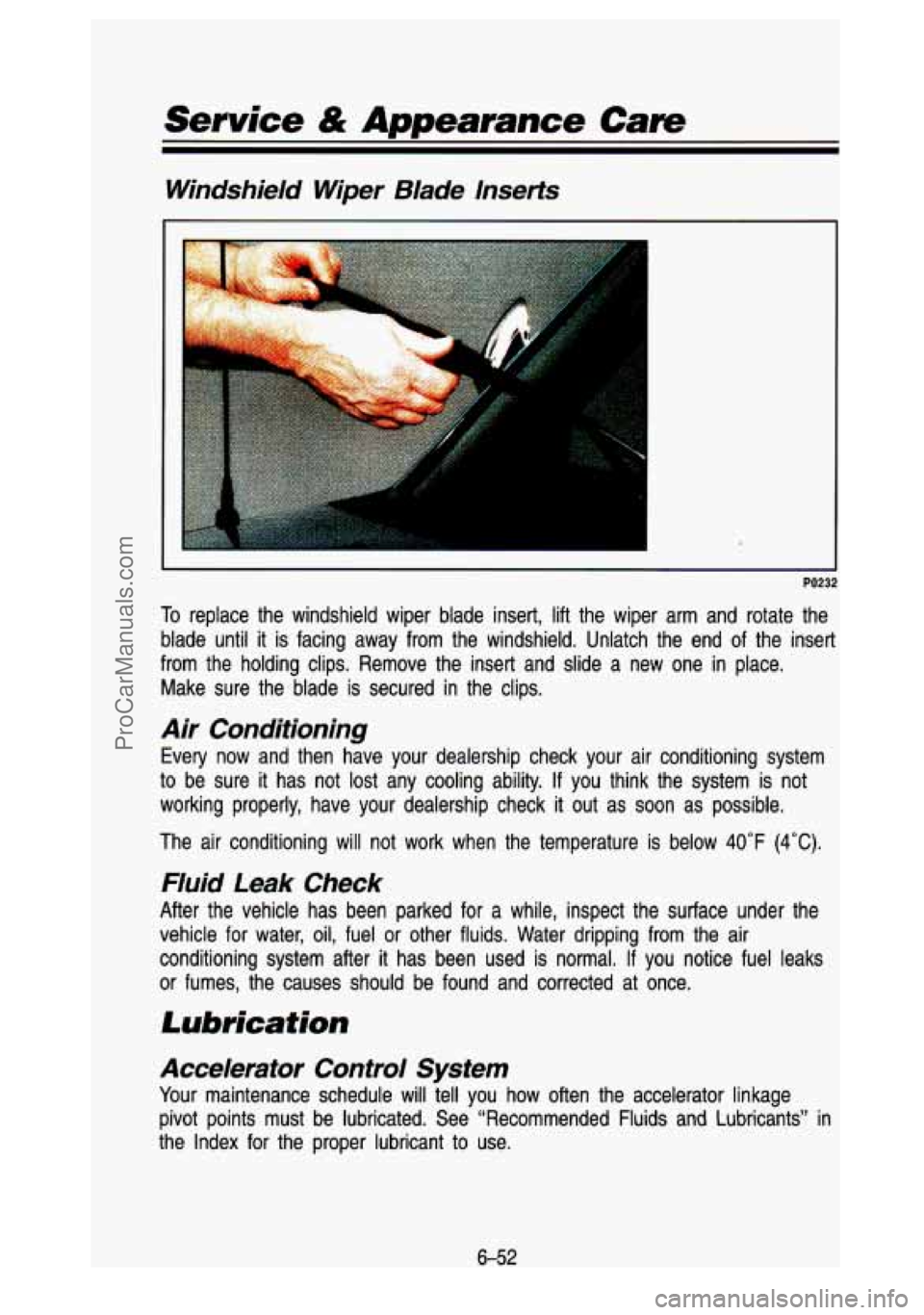
To replace the windshield wiper blade insert, lift the wiper arm and rotate the
blade until it is facing away from the windshield. Unlatch the\
end of the insert
from the holding clips. Remove the insert and slide a new one\
in place.
Make sure the blade is secured in the clips.
Air Conditioning
Every now and then have your dealership check your air conditi\
oning system
to be sure it has not lost any cooling ability.
If you think the system is not
working properly, have your dealership check it out as soon as\
possible.
The air conditioning will not work when the temperature is bel\
ow 40°F
(4°C).
Fluid Leak Check
After the vehicle has been parked for a while, inspect the su\
rface under the
vehicle
for water, oil, fuel or other fluids. Water dripping from the air
conditioning system after it has been used is normal, If you notice fuel leaks
or fumes, the causes should be found and corrected at once.
Lubrication
Accelerator Control System
Your maintenance schedule will tell you how often the accelerator linkage
pivot points must be lubricated. See “Recommended Fluids and \
Lubricants” in
the Index for the proper lubricant to use.
6-52
ProCarManuals.com
Page 359 of 436
r CAUTION I
If you operate your vehicle with a tire that is badly underinflated, the
tire can overheat. An overheated tire can lose air suddenly or catcl.
fire. You or others could be injured. Be sure all tires (including the
spare,
if any) are properly inflated.
Buying New Tires
To find out what kind and size of tires you need, look at the Certificationflire
label. The tires installed on your vehicle when it was new had a Tire
Performance Criteria Specification (TPC Spec) number on each tire’s sidewall.
When you get new tires, get ones with that same TPC Spec num\
ber. That
way, your vehicle will continue to have tires that are designed to give proper
endurance, handling, speed rating, traction, ride and other thin\
gs during
normal service on your vehicle. If your tires have an all-season tread design,
the TPC number will be followed by a
“MS” (for mud and snow).
If you ever replace your tires with those not having a TPC Spec number,
make sure they are the same size, load range, speed rating and construction
type (bias, bias-belted
or radial) as your original tires.
1 CAUTION
* Mixing tires could cause you to lose control while driving. If you mix
vehicle may not handle properly, and you could have a crash. Be
- ) tires of different sizes or types (radial and bias-belted tires), the
I sure to use the same size and type tires on all wheels. I
Uniform Tire Qua/ity Grading
The following information relates to the system developed by the United
States National Highway Traffic Safety Administration which grade\
s tires by
treadwear, traction and temperature performance. (This applies o\
nly to
vehicles sold in the United States.)
Treadwear
The treadwear grade is a comparative rating based on the wear rate of the
tire when tested under controlled conditions on a specified governmen\
t test
course. For example, a tire graded
150 would wear one and a half (1 1/2)
times as well on the government course as a tire graded 100. The relative
performance
of tires depends upon the actual conditions of their use,
however, and may depart significantly from the norm due to var\
iations in
driving habits, service practices and differences in road characteristics and
climate.
6-8 1
ProCarManuals.com
Page 361 of 436

Wheel Replacement
Re'place any' wheel that is bent, cracked or badly rusted. If wheel nuts keep
coming loose, the wheel, wheel bolts, and wheel nuts should be\
replaced.
If
the wheel leaks air out,, replace it (except some aluminum wheels, which can
sometimes be repaired). See your GM dealer
if any of these conditions
exists. Your dealer will know what kind of wheel you need.
Each new wheel should' have the same load carrying capacity, d\
iameter,
width, offset, and be mounted the same way as the one it' replaces.
If you need to replace any of'your wheels, wheel bolts, or wheel nuts,
replace them only with
new GM original equipm-ent parts. This way, you will
be sure to have the right ,wheel, wheel bolts, .and wheel nuts for your vehicle.
1 CAUTION
Using the wrong replacement wheels, wheel bolts or wheel nuts \
on
your vehicle can be dangerous.
It could affect the braking and
handling of your vehicle, make your tires lose air and make you lose
control. You could have an collision in which you or others could be
injured. Always use the correct wheel, wheel bolts, and wheel \
nuts
for redacement.
I
NnTICF
I
Used Replacement Wheels
* Putting a used wheel on your vehicle is dangerous. You can't know
1 how it's been used or how many miles it's been driven. It could fail
suddenly and cause an accident.
If you have to replace a wheel, use
I a new GM original equipment wheel.
6-83
ProCarManuals.com
Page 368 of 436
Service & Appearance Care
Finish Damage
Any stone chips, fractures or deep scratches in the finish should be repaired
right away. Bare metal will corrode quickly and may develop into a major
repair expense.
Minor chips and scratches can be repaired with touch-up materia\
ls available
from your dealer or other service outlets. Larger areas of finish damage can
be corrected
in your dealer’s body and paint shop.
Underbody Maintenance
Chemicals used for ice and snow removal and dust control can \
collect on the
underbody.
If these are not removed, accelerated corrosion (rust) can occur \
on the underbody parts such as fuel lines, frame, floor pan, \
and exhaust
system even though they have corrosion protection.
At least every spring, flush these materials from the underbody wi\
th plain
water. Clean any areas where mud and other debris can collect.\
Dirt packed
in closed areas of the frame should be loosened before being flushed. Your
dealer or an underbody washing system can do this for you.
Chemical Paint Spotting
Some weather and atmospheric conditions can create a chemical fallout.
Airborne pollutants fall upon and attack painted surfaces on yo\
ur vehicle. This
damage
can take two forms: blotchy, ringiet-shaped discolorations, and small\
irregular dark spots etched into the paint surface.
Although no defect in the paint job causes this, General Motors will repair, at
no charge to the owner, the surfaces of new vehicles damaged by this fallout
condition within
12 months or 12,000 miles (20 000 km) of purchase,
whichever comes first. This applies only to materials manufactured and
sold
by General Motors. Bodies, body conversions or equipment not made or sold
by General Motors are not covered.
6-90
ProCarManuals.com
Page 375 of 436
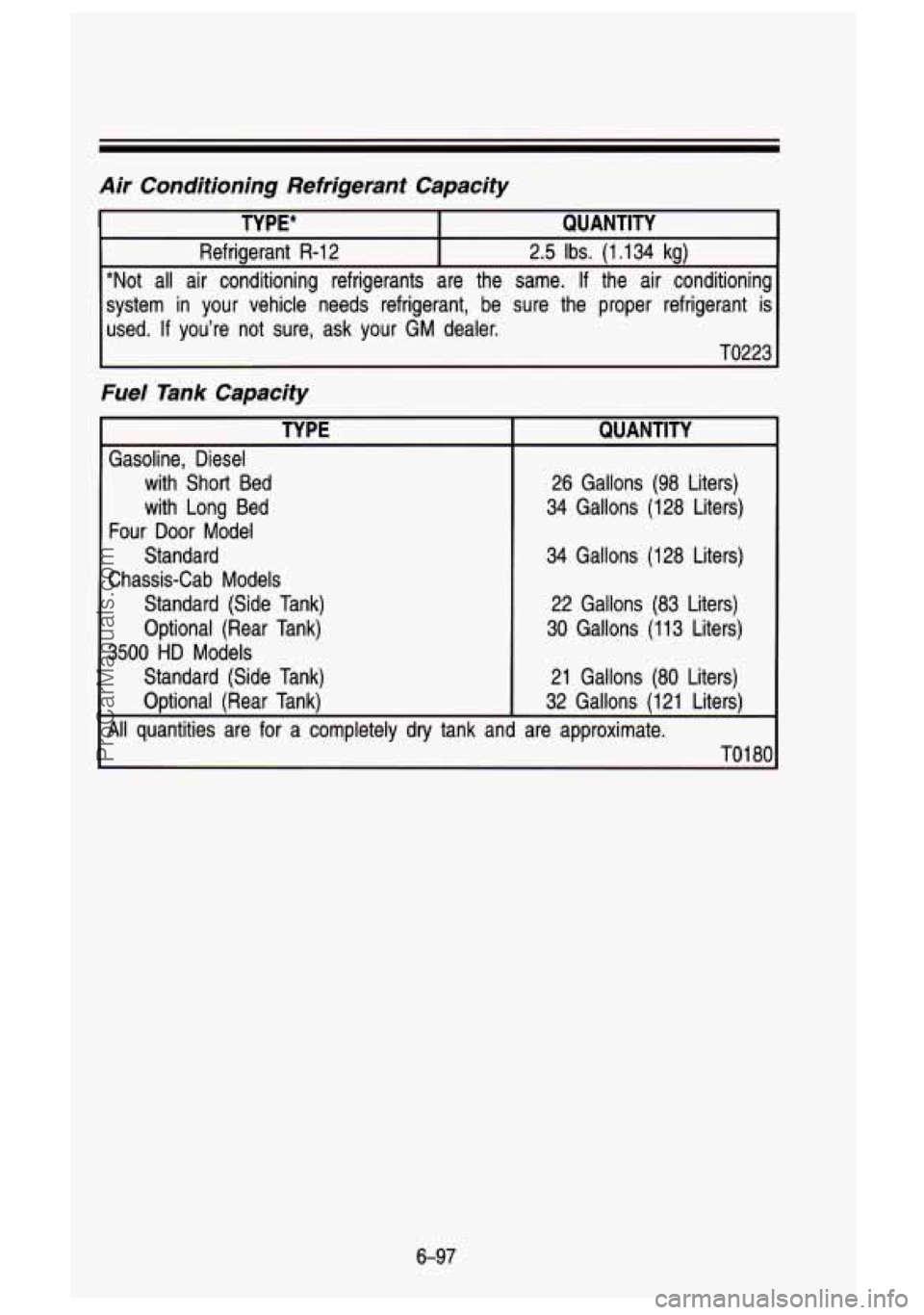
Air Conditioning Refrigerant Capacity
TYPE* QUANTITY
Refrigerant R-12 2.5 Ibs. (1.1 34 kg)
*Not all air conditioning refrigerants are the same. If the air conditioning
system in your vehicle needs refrigerant, be sure the proper r\
efrigerant is
used.
If you’re not sure, ask your GM dealer.
TO223
Fuel Tank Capacity
TYPE
Gasoline, Diesel with Short Bed
with Long Bed
Four Door Model
Standard
Chassis-Cab Models Standard (Side Tank)
Optional (Rear Tank)
Standard (Side Tank)
Optional (Rear Tank)
3500 HD Models
QUANTITY
-
.-
-
All quantities are for a completely dry tank and are approximate.
TO1
8C
26 Gallons (98 Liters)
34 Gallons (128 Liters)
34 Gallons
(1 28 Liters)
22 Gallons (83 Liters)
30 Gallons
(1 13 Liters)
21 Gallons (80 Liters)
32 Gallons (121 Liters)
6-97
ProCarManuals.com
Page 383 of 436
A Word About Maintenance
We at General Motors want to help you keep your vehicle in good working
condition. But we don’t know exactly how you’ll drive it. You may drive very
short distances only a few times a week. Or you may drive long distances all
the time in very hot, dusty weather. You may use your vehicle in making
deliveries. Or you may drive it
to work, to do errands, or in many other ways.
Because of all the different ways people use their GM vehicles, maintenance
needs vary. You may even need more frequent checks and replacements than
you will find in the schedules in this section.
So please read this section and
note how you drive.
If you have any questions on how to keep your vehicle
in good condition, see your GM dealer, the place many GM owners choose
to have their maintenance work done. Your dealer can be relied upon to use
proper parts and practices.
Your Vehicle and the Environment
Proper vehicle maintenance not only helps keep your vehicle in good working
condition, but also helps the environment. All recommended maintenance
procedures are important. Improper vehicle maintenance or the removal of
important components can significantly affect the quality of the air we breathe.
Improper fluid levels or even the wrong tire inflation can inc\
rease the level of
emissions from your vehicle. To help protect our environment, and to help
keep your vehicle in
good condition, please maintain your vehicle properly.
Recording Maintenance Services
The Maintenance Record near the end of this section provides a place for
you
to record the maintenance performed on your vehicle. Whenever any
maintenance is performed, be sure
to write it down in the Maintenance
Record. This will help you determine when your next maintenance should be
done, In addition, it is a good idea to keep your maintenance receipts. They
may be needed to qualify your vehicle for warranty repairs.
CAUTION
+ CAUTION: Performing maintenance work on a vehicle can be
dangerous. In trying
to do some jobs, you can be seriously injured.
Do your own maintenance work only if you have the required
know-how and the proper tools and equipment for the job.
If you
have any doubt. have
a aualified technician do the work.
If you are skilled enough to do some work on your vehicle, you will probably
want to get the service information GM publishes. You will
find a list of
publications and how to get them in the back of Section
8, “Customer
Assistance Information.” See “Service Publications’’ in the Index.
7-3
ProCarManuals.com