air condition GMC SIERRA 1993 Owner's Manual
[x] Cancel search | Manufacturer: GMC, Model Year: 1993, Model line: SIERRA, Model: GMC SIERRA 1993Pages: 436, PDF Size: 23.88 MB
Page 394 of 436
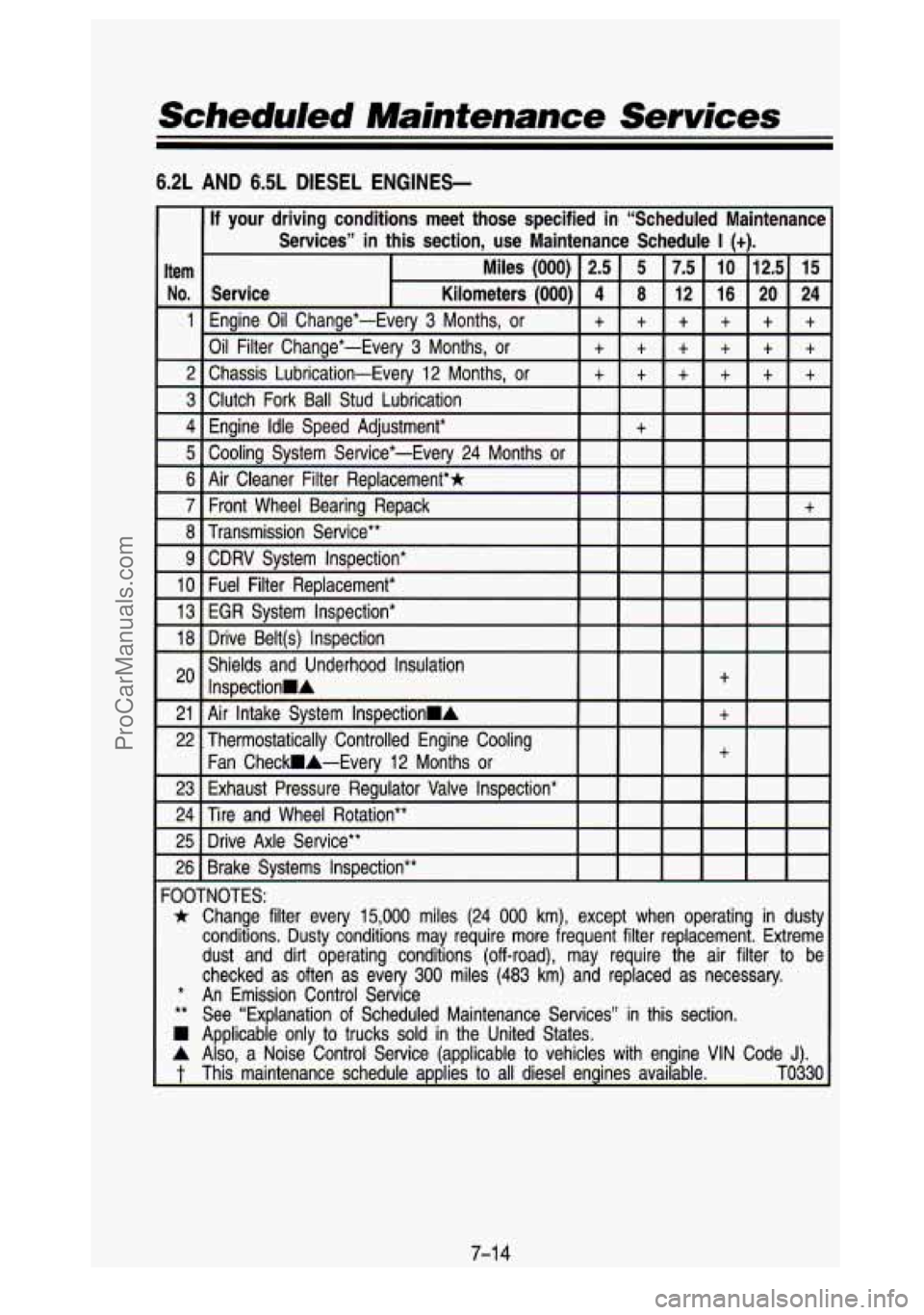
6.2L AND 6.5L DIESEL ENGINES-
-0OTNOTES:
rt Change filter every 15,000 miles (24 000 km), except when operating in dusty
conditions. Dusty conditions may require more frequent filter re\
placement. Extreme
dust and dirt operating conditions (off-road), may require the air filter
to be
checked as often as every 300 miles (483 km) and replaced as necessary.
* An Emission Control Service
** See “Explanation of Scheduled Maintenance Services” in this section.
1 Applicable only to trucks sold in the United States.
A Also, a Noise Control Service (applicable to vehicles with engine VIN Code J).
t This maintenance schedule applies to all diesel engines available. TO330
7-1 4
ProCarManuals.com
Page 398 of 436
Scheduled Maintenance Services
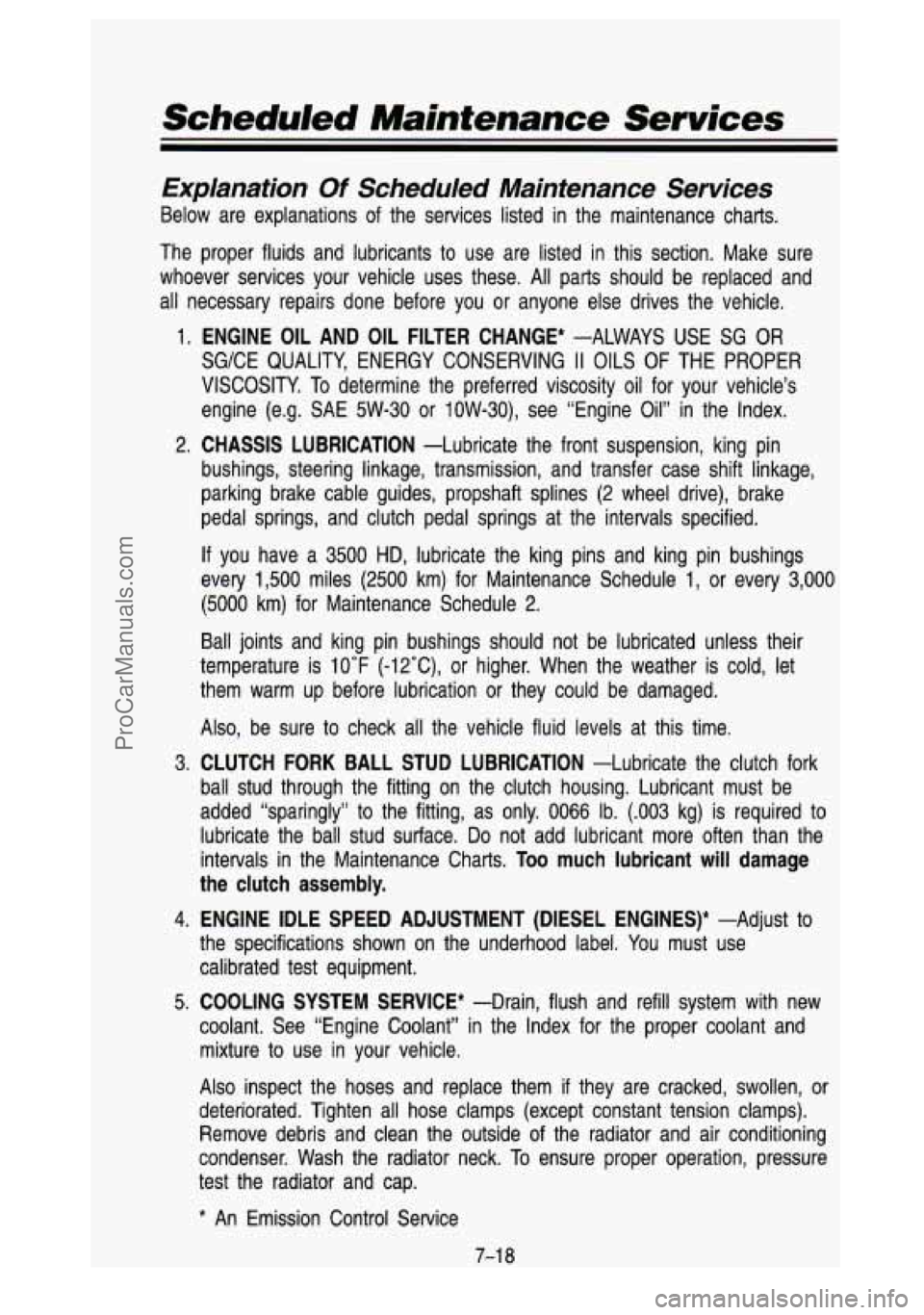
Explanation Of Scheduled Maintenance Services
Below are explanations of the services listed in the maintenance charts.
The proper fluids and lubricants to use are listed in this section. Make sure
whoever services your vehicle uses these. All parts should be \
replaced and
all necessary repairs done before you or anyone else drives the ve\
hicle.
1.
ENGINE OIL AND OIL FILTER CHANGE* -ALWAYS USE SG OR
SGKE QUALITY, ENERGY CONSERVING II OILS OF THE PROPER
VISCOSITY. To determine the preferred viscosity oil for your vehicle’s
engine (e.g. SAE 5W-30 or 10W-30), see “Engine Oil” in the Index.
2. CHASSIS LUBRICATION -Lubricate the front suspension, king pin
bushings, steering linkage, transmission, and transfer case shift\
linkage,
parking brake cable guides, propshaft splines (2 wheel drive), brake
pedal springs, and clutch pedal springs at the intervals specified.
If you have a 3500 HD, lubricate the king pins and king pin bushings
every 1,500 miles
(2500 km) for Maintenance Schedule 1, or every 3,000
(5000 km) for Maintenance Schedule 2.
Ball joints and king pin bushings should not be lubricated unless their
temperature is
10°F (-12”C), or higher. When the weather is cold, let
them warm up before lubrication or they could be damaged.
Also, be sure to check
all the vehicle fluid levels at this time.
3.
CLUTCH FORK BALL STUD LUBRICATION -Lubricate the clutch fork
ball stud through the fitting on the clutch housing. Lubricant must be
added “sparingly” to the fitting, as only.
0066 Ib. (.003 kg) is required to
lubricate the ball stud surface.
Do not add lubricant more often than the
intervals in the Maintenance Charts.
Too much lubricant will damage
the clutch assembly.
4. ENGINE IDLE SPEED ADJUSTMENT (DIESEL ENGINES)* -Adjust to
the specifications shown on the underhood label. You must use
calibrated test equipment.
5. COOLING SYSTEM SERVICE* -Drain, flush and refill system with new
coolant. See “Engine Coolant’’ in the Index for the proper coolant and
mixture to use in your vehicle.
Also inspect the hoses and replace them
if they are cracked, swollen, or
deteriorated. Tighten all hose clamps (except constant tension \
clamps).
Remove debris and clean the outside
of the radiator and air conditioning
condenser. Wash the radiator neck.
To ensure proper operation, pressure
test the radiator and cap.
* An Emission Control Service
7-1
8
ProCarManuals.com
Page 399 of 436
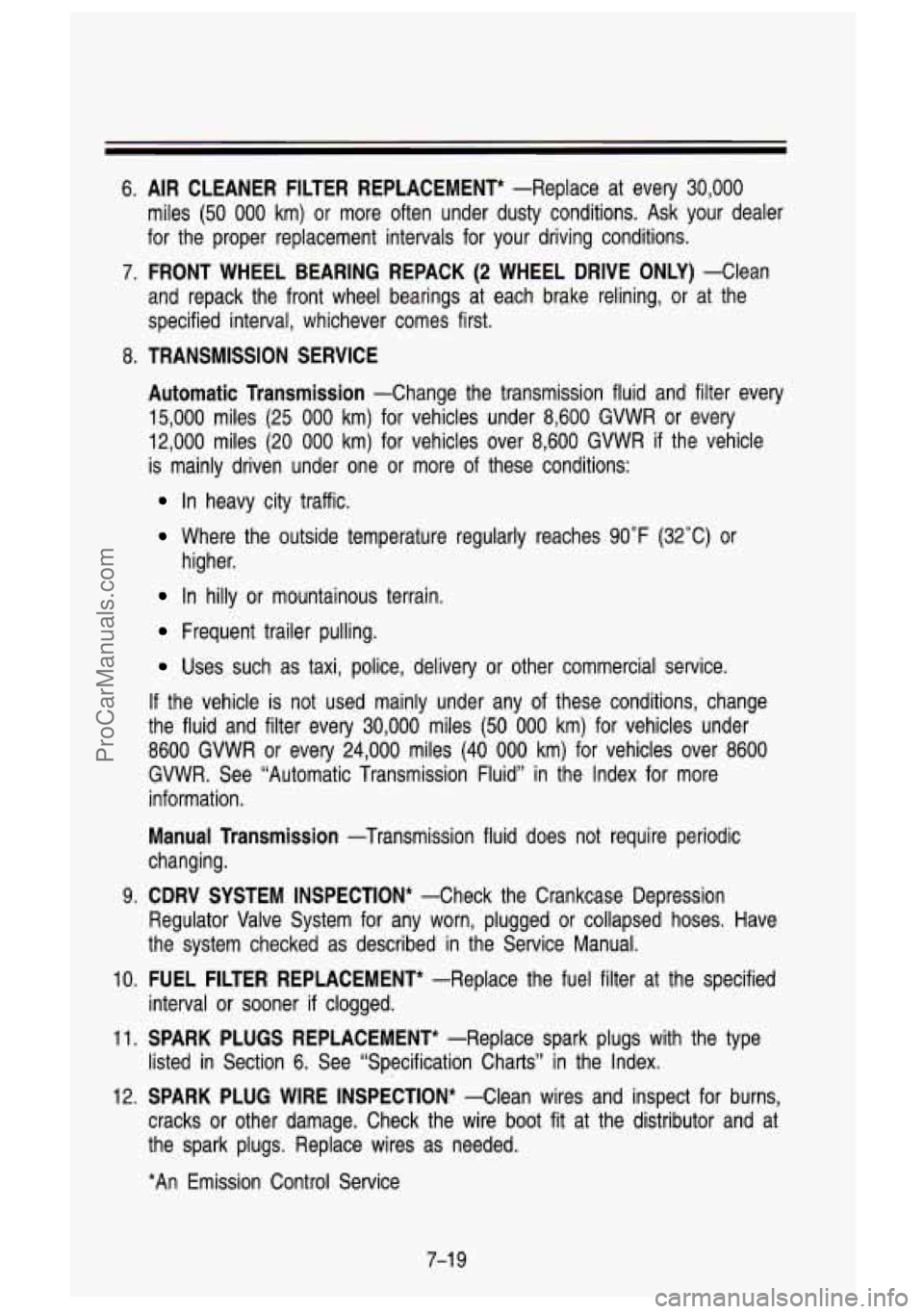
6. AIR CLEANER FILTER REPLACEMENT* -Replace at every 30,000
miles (50 000 km) or more often under dusty conditions. Ask your dealer
for the proper replacement intervals for your driving conditions\
.
7. FRONT WHEEL BEARING REPACK (2 WHEEL DRIVE ONLY) -Clean
and repack the front wheel bearings at each brake relining, or\
at the specified interval, whichever comes first.
8.
TRANSMISSION SERVICE
Automatic Transmission
-Change the transmission fluid and filter every
15,000 miles (25 000 km) for vehicles under 8,600 GVWR or every
12,000 miles (20 000 km) for vehicles over 8,600 GVWR if the vehicle
is mainly driven under one or more of these conditions:
In heavy city traffic.
Where the outside temperature regularly reaches 90°F (32°C\
) or
higher.
In hilly or mountainous terrain.
Frequent trailer pulling.
Uses such as taxi, police, delivery or other commercial service\
.
If the vehicle is not used mainly under any of these conditions, change
the fluid and filter every 30,000 miles
(50 000 km) for vehicles under
8600 GVWR or every
24,000 miles (40 000 km) for vehicles over 8600
GVWR. See “Automatic Transmission Fluid” in the Index for more
information.
Manual Transmission -Transmission fluid does not require periodic
changing.
Regulator Valve System for any worn, plugged or collapsed hoses. Have
the system checked as described in the Service Manual.
9.
CDRV SYSTEM INSPECTION* -Check
the Crankcase Depression
10. FUEL FILTER REPLACEMENT* -Replace the fuel filter at the specified
interval
or sooner if clogged.
11. SPARK PLUGS REPLACEMENT* -Replace spark plugs with the type
listed in Section
6. See “Specification Charts” in the Index.
12.
SPARK PLUG WIRE INSPECTION* -Clean wires and inspect for burns,
cracks or other damage. Check the wire boot fit at the distributor and at
the spark plugs. Replace wires as needed.
*An Emission Control Service
7-1 9
ProCarManuals.com
Page 400 of 436
Scheduled Maintenance Services
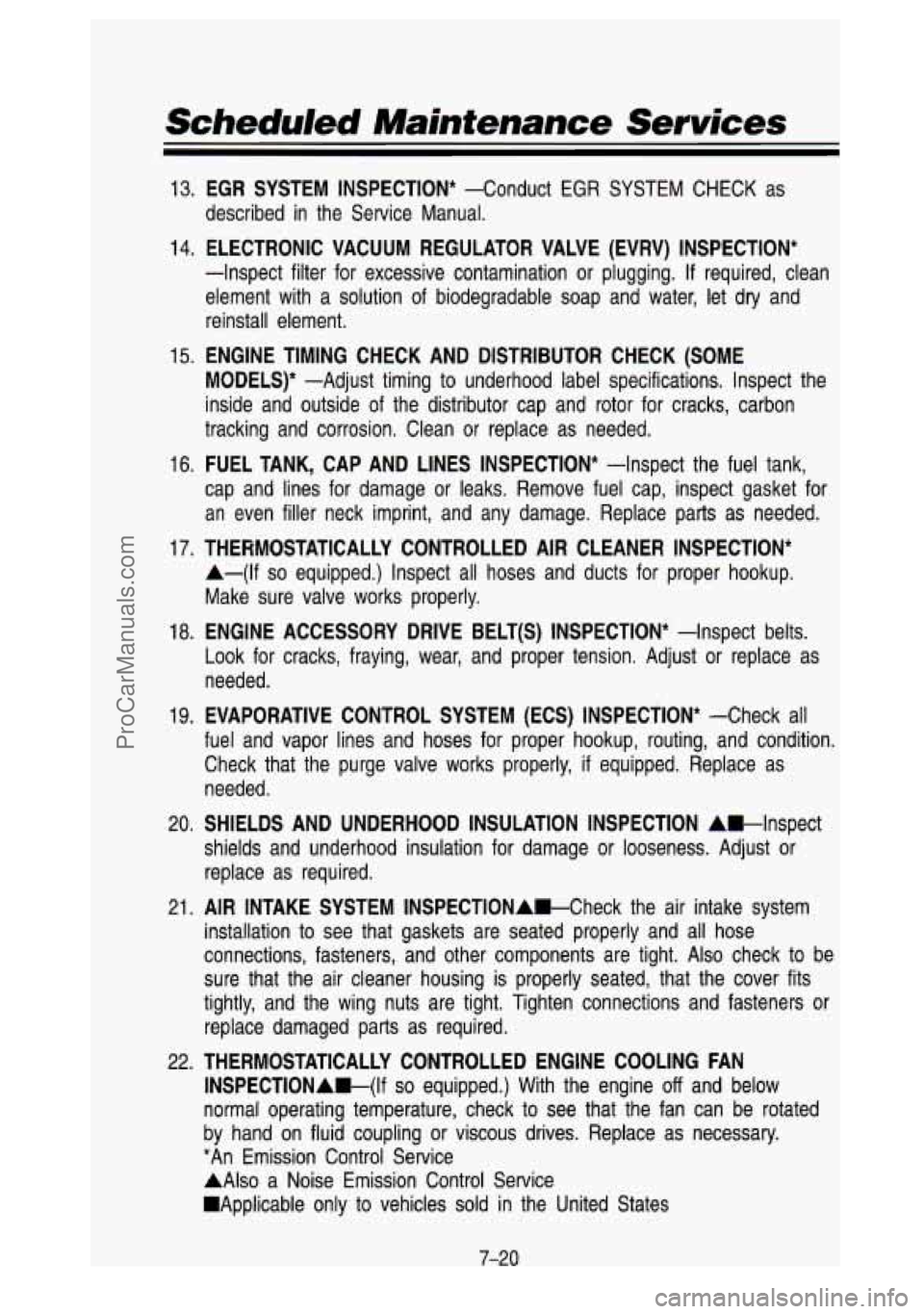
13. EGR SYSTEM INSPECTION* -Conduct EGR SYSTEM CHECK as
described in the Service Manual.
14. ELECTRONIC VACUUM REGULATOR VALVE (EVRV) INSPECTION*
-Inspect filter for excessive contamination or plugging. If required, clean
element with a solution of biodegradable soap and water, let
dry and
reinstall element.
15. ENGINE TIMING CHECK AND DISTRIBUTOR CHECK (SOME
MODELS)”
-Adjust timing to underhood label specifications. Inspect the
inside and outside of the distributor cap and rotor for cracks, carbon
tracking and corrosion. Clean or replace as needed.
cap and lines for damage or leaks. Remove fuel cap, inspect g\
asket for
an even filler neck imprint, and any damage. Replace parts as \
needed.
16. FUEL TANK, CAP AND LINES INSPECTION* -Inspect the fuel tank,
17. THERMOSTATICALLY CONTROLLED AIR CLEANER INSPECTION*
A-(If so equipped.) Inspect all hoses and ducts for proper hookup.
Make sure valve works properly.
Look for cracks, fraying, wear, and proper tension. Adjust or replace as
needed.
19. EVAPORATIVE CONTROL SYSTEM (ECS) INSPECTION* -Check all
fuel and vapor lines and hoses for proper hookup, routing, and\
condition.
Check that the purge valve works properly,
if equipped. Replace as
needed.
18. ENGINE ACCESSORY DRIVE BELT(S) INSPECTION* --Inspect belts.
20. SHIELDS AND UNDERHOOD INSULATION INSPECTION Am-Inspect
shields and underhood insulation for damage or looseness. Adjust\
or
replace as required.
21. AIR INTAKE SYSTEM INSPECTlONAWCheck the air intake system
installation to see that gaskets are seated properly and all hose
connections, fasteners, and other components are tight. Also check to be
sure that the air cleaner housing is properly seated, that the\
cover fits
tightly, and the wing nuts are tight. Tighten connections and \
fasteners or
replace damaged parts as required.
22. THERMOSTATICALLY CONTROLLED ENGINE COOLING FAN INSPECTI0NA.-(If
so equipped.) With the engine off and below
normal operating temperature, check to see that the fan can be rotated
by hand on fluid coupling or viscous drives. Replace as necessary.
*An Emission Control Service
AAlso a Noise Emission Control Service
.Applicable only to vehicles
sold in the United States
7-20
ProCarManuals.com
Page 402 of 436

Scheduled Maintenance Sewices
When the wheels are removed for rotation, inspect disc brake pads f\
or wear
and rotors for surface condition.
Also inspect drum brake linings for wear and
cracks. Inspect other brake parts, including drums, wheel cylind\
ers, parking
brake, etc., at the same time. Remove any rust
or dirt from the wheel and
mounting surfaces before mounting the wheel.
Inspect brakes more often if driving habits or conditions resull In
frequent braking.
Owner Checks and Services
Listed below are owner checks and services which should be mad\
e at the
time period specified
to help ensure proper safety, emission performance, and
dependability of your vehicle.
Be sure any necessary repairs are completed at once. Whenever \
any fluids
or lubricants are added to your vehicle, make sure they are the proper ones,
as shown
in this Section.
At Least Once a Month
Tire inflation pressure check -Check the tires for proper inflation. If they
are low, inflate them
to the level specified on the certification label or on the
tire inflation charts. See “Loading Your Vehicle’’ or “Inflation-Tire Pressure” in
the Index.
At Least Once a Year
Key lock cylinder lubrication -Lubricate key lock cylinders with engine oil.
See the “Recommended Fluid and Lubricants’’ chart in this section.
Transmission neutral or clutch start switch operation
CAUTION
~
1. Before you start, be sure you have enough room around the veh\
icle.
2. Firmly apply both the manual parking brake and the regular brake. See
“Brakes” and “Parking Brake” in the Index.
Do not use the accelerator
pedal.
3. Be ready to turn off the engine immediately if it starts.
4. On automatic transmission vehicles, try to start the engine in each gear.
The starter should work only in
P (Park) or N (Neutral).
7-22
ProCarManuals.com
Page 403 of 436
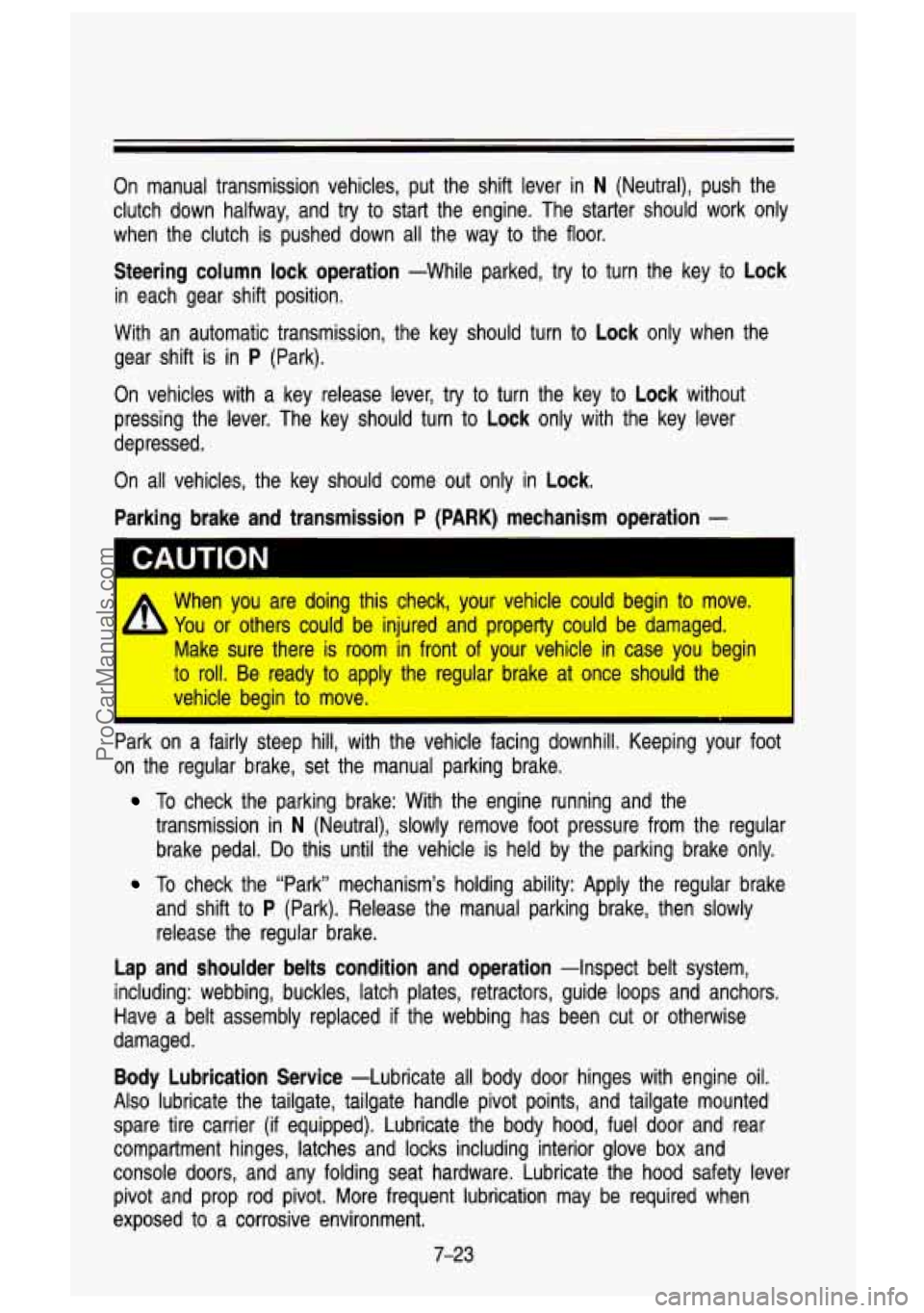
On manual transmission vehicles, put the shift lever in N (Neutral), push the
clutch down halfway, and try to start the engine. The starter should work only
when the clutch is pushed down all the way to the floor.
Steering column lock operation -While parked, try to turn the key to Lock
in each gear shift position.
With an automatic transmission, the key should turn to
Lock only when the
gear shift is in
P (Park).
On vehicles with a key release lever, try to turn the key to
Lock without
pressing the lever. The key should turn to
Lock only with the key lever
depressed.
On all vehicles, the key should come out only in
Lock.
Parking brake and transmission
P (PARK) mechanism operation -
CAUTION I
4 When you are doing this check, your vehicle could begin to move.
You
or others could be injured and property could be damaged.
Make sure there is
room in front of your vehicle in case you begin
to
roll. Be ready to apply the regular brake at once should the
vehicle begin to move.
IW
Park on a fairly steep hill, with the vehicle facing downhill.\
Keeping your foot
on the regular brake, set the manual parking brake.
To check the parking brake: With the engine running and the
transmission in
N (Neutral), slowly remove foot pressure from the regular
brake pedal.
Do this until the vehicle is held by the parking brake only.
To check the “Park” mechanism’s holding ability: Apply the \
regular brake
and shift to
P (Park). Release the manual parking brake, then slowly
release the regular brake.
Lap and shoulder belts condition and operation -Inspect belt system,
including: webbing, buckles, latch plates, retractors, guide loop\
s and anchors.
Have a belt assembly replaced
if the webbing has been cut or otherwise
damaged.
Body
Lubrication Service -Lubricate all body door hinges with engine oil.
Also lubricate the tailgate, tailgate handle pivot points, and tailga\
te mounted
spare tire carrier
(if equipped). Lubricate the body hood, fuel door and rear
compartment hinges, latches and locks including interior glove
box and
console
doors, and any folding seat hardware. Lubricate the hood safety lever
pivot and prop
rod pivot. More frequent lubrication may be required when
exposed to a corrosive environment.
7-23
ProCarManuals.com
Page 404 of 436

Scheduled Maintenance Services
Periodic Maintenance Inspections
Listed below are inspections and services which should be perfo\
rmed at least
twice a year (for instance each spring or fall).
You should let your GM
dealer’s service department or other qualified service center \
do these jobs.
Make sure any necessary repairs are completed at once.
Steering and Suspension lnspectiont -Inspect front and rear suspension
and steering system for damaged, loose or missing parts, signs \
of wear or
lack of lubrication. Inspect power steering lines and hoses for proper \
hook-up,
binding, leaks, cracks, chafing, etc. (On vehicles equipped wit\
h manual
steering gear, check for seal leakage.) Lubricate the steering linkage.
Accelerator Control System -Lubricate all pivot points with engine oil,
except the
TBI throttle shaft. Remove all external deposits from the injector
pump face cam on 6.2L and 6.5L engines.
Do this when the engine is cold
and not running.
Do not oil any accelerator or cruise control cables. Replace
any cables that have high effort or excessive wear.
Exhaust System Inspection -Inspect the complete system including the
three-way catalytic converter. Inspect the body near the exhaust\
system. Look
for broken, damaged, missing or out-of-position parts, as well \
as, open
seams, holes, loose connections or other conditions which could \
cause a heat buildup in the floor pan or could let exhaust fumes seep into the passenger
compartments.
Drive Axle Service -Check readfront axle fluid level and add as needed.
Check constant velocity joints and axle seals for leaking.
Transfer Case (four-wheel drive) lnspectiont -Every 12 months or at oil
change intervals, check front axle and transfer case and add l\
ubricant when necessary. Oil the control lever pivot point and all exposed c\
ontrol linkage.
Check vent hose at transfer case for kinks and proper installa\
tion. More
frequent lubrication may be required on heavy-duty or off-road use.
tA fluid loss in these systems may indicate a problem. Have them inspected
and repaired at once.
7-24
ProCarManuals.com
Page 416 of 436

Customer Assistance Information
Service Publications
Information on how to obtain Product Service Publications, Subsc\
riptions and
Indexes as described below is applicable only in the fifty
US. states (and the
District of Columbia) and only for light trucks with GVWR less than
10,000
pounds (4536 kg).
In Canada, information pertaining to Product Service Bulletins a\
nd Indexes
can be obtained by writing to: General Motors of Canada Limited, Service
Publications Department, 1908 Colonel Sam Dr., Oshawa, Ontario
L1 H 8P7.
GMC Truck regularly sends its dealers useful service bulletins \
about GMC
Truck products. GMC Truck monitors product performance in the f\
ield. We
then prepare bulletins for servicing our products better. Now, \
you can get
these bulletins too.
Bulletins cover various subjects. Some pertain to the proper us\
e and care
of
your vehicle. Some describe costly repairs. Others describe inex\
pensive repairs which,
if done on time with the latest parts, may avoid future costly
repairs. Some bulletins tell a technician how to repair a new \
or unexpected
condition. Others describe a quicker way to
fix your vehicle. They can help a
technician service your vehicle better.
Most bulletins apply
to conditions affecting a small number of trucks. Your
GMC Truck dealer or a qualified technician may have
to determine if a
specific bulletin applies to your vehicle.
You can subscribe to all GMC Truck bulletins. This way you’ll g\
et them as
they come out. You can wait a while and get an index to the bulletins. You
can also get individual bulletins. However, you’ll need the \
index to identify
them.
Subscriptions
You can subscribe to all GMC Truck Product Service Publications (P\
SP’s).
This
will include bulletins for all light trucks (less than 10,000 Ibs. [4536 kg]
GVWR)
sold by GMC Truck and will not be limited to PSP’s applicable to any
particular model. When you buy a subscription, you
will receive the PSP’s in
periodic mailings, shortly after they come out.
A subscription costs US.
$75,00 ($85.00 including a special binder) and it entitles you to all PSP’s
published by GMC Truck during the model year. You can purchase a
subscription by sending a check or money order to GMC Truck Service
Publications, Post Office Box 436006, Pontiac, Michigan 48343 al\
ong with the
order form located at the end of this section. You may get additional
subscription ordering forms by calling the toll-free number show\
n in this
section, or you can find them at participating dealerships.
8-6
ProCarManuals.com
Page 427 of 436
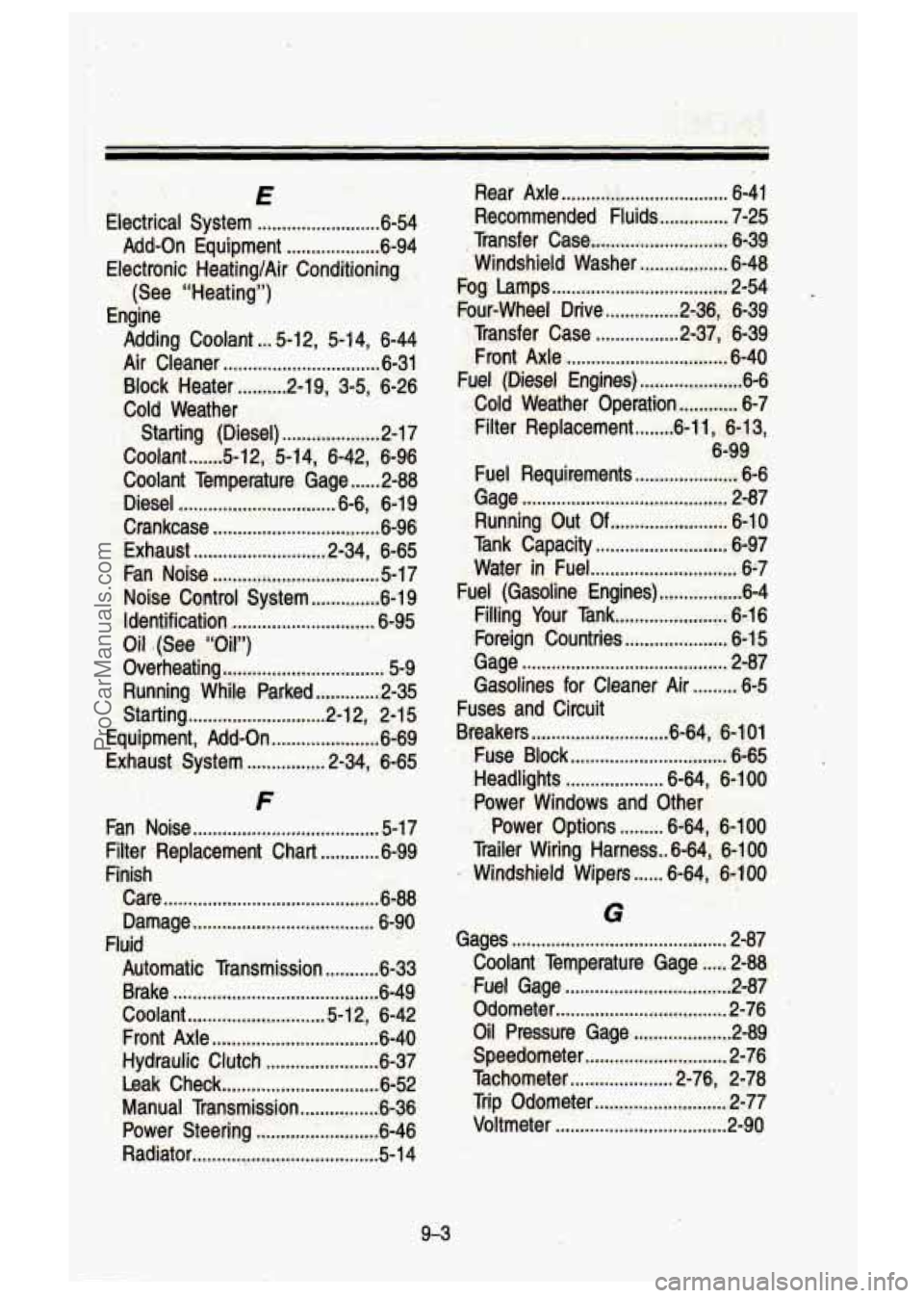
1 Add-on Equipment ................... 6-94
I- Electronic Heatinghir Conditioning
(See "Heating")
Adding Coolant
... 5.12, 5.14. 6-44
... Engine I
Air Cleaner ................................ 6-31
Block Heater
.......... 2.19. 3.5. 6-26
Cold Weather Starting (Diesel)
.................... 2-1 7
Coolant
....... 5.12. 5-1 4. 6.42. 6-96
Coolant Temperature Gage
...... 2-88
Diesel
................................ 6.6. 6-1 9
Crankcase
.................................. 6-96
Fan Noise
.................................. 5-1 7
Noise Control System
.............. 6-1 9
.-Identification,
............................ 6-95
Oil .(See "Oil")
Overheating
................................. 5-9
Running While Parked
............. 2-35
Equipment, Add-on
...................... 6-69
Exhaust System
................ 2.34, 6-65
Exhaust
........................... 2.34,
6-65
Starting
............................ 2.12, 2-1 5
F
Fan Noise ...................................... 5-1 7
Filter
. Replacement Chart ............ 6-99
Finish Care
............................................ 6-88
Damage
..................................... 6-90
Automatic Transmission
........... 6-33
Brake
.......................................... 6-49
Coolant
............................ 5-1 2. 6-42
Front Axle
.................................. 6- 40
Hydraulic Clutch
....................... 6-37
Leak Check
................................ 6-52
Manual Transmission
................ 6-36
Power Steering
............ 1 ............ 6-46
Radiator
....................................... 5-1 4
Fluid
9-3
Rear Axle .................................. 6-41
Recommended Fluids
.............. 7-25
. Transfer Case ............................ 6-39
Windshield Washer.
................. 6-48
Fog Lamps
.................................... 2-54 .
Four-wheel Drive ............... 2.36, 6-39
Transfer Case
................ .2-37, 6-39
Front Axle
................................. 6-40
Fuel (Diesel Engines)
..................... 6.6
Cold Weather Operation
............ 6-7
Filter Replacement
........ 6-1 1, 6.13,
6-99
Fuel Requirements
..................... 6-6
Gage
........................ ; ................. 2-87
Running Out Of
........................ 6-10
Tank Capacity
........................... 6-97
Water in Fuel
.............................. 627
Fuel (Gasoline Engines)
................. 6-4
Filling Your Ta'nk
....................... 6-16
Foreign
. Countries ..................... 6-15
Gage
.......................................... 2-87
Gasolines for Cleaner Air
......... 6-5 A-
Fuses and Circuit
Breakers
............................ 6-64, 6-1 01 * .
Fuse Block ................................ 6-65 . . f
Headlights .................... 6.64, 6-100
Power Windows and Other
Trailer Wiring Harness
.. 6.64, 6-1 00
. Windshield Wipers ...... 6-64, 6-100
G
Gages ............................................ 2.87
Coolant Temperature Gage
..... 2-88
Fuel Gage
.................................. 2-87
Odometer
................................... 2-76
Oil Pressure Gage
..................... 2-89
Speedometer.
............................ 2-76
Tachometer
..................... 2.76, 2-78
Trip Odameter 2-77
Voltmeter
................................... 2-90
-
-.
I
Power Options ......... 6.64, 6-100 :
. ...........................
...
ProCarManuals.com