change wheel GMC SIERRA 1993 User Guide
[x] Cancel search | Manufacturer: GMC, Model Year: 1993, Model line: SIERRA, Model: GMC SIERRA 1993Pages: 436, PDF Size: 23.88 MB
Page 224 of 436
‘
Your Driving and the Road
Weather Forecasts: What’s the weather outlook along your route?
Should -you delay your trip a short time to avoid a major storm system?
Maps: Do you have up-to-date maps? . .. .. . -1 .. On fhe Road
Unless you are the only driver, ‘it is good .to share the driving task’with
others. Limit turns behind the wheel to about
100 miles (160 km) or two
hours at a sitting. Then, either change drivers or stop for s\
ome- refreshment
like coffee, tea or soft drinks and some limbering up. But do\
stop and move
around. Eat lightly along the way. Heavier meals tend
to make some people
sleepy.
.. . .- , - .~
On two-lane highways or undivided multilane highways that do no\
t have
controlled access, you’ll want to watch for some situations \
not usually found
on freeways. Examples are: stop signs and signals, shopping cen\
ters with
direct access to the highway, no passing zones and school zone\
s, vehicles
turning’ left and right
off the road, pedestrians, cyclists, parked vehicles, and
even animals.
Highway Hypnosis
Is there actually such a condition as “highway hypnosis?” Or \
is it just plain ,
falling asleep at the wheel? Call it highway hypnosis, lack of awareness, or
whatever.
’ There is something about an easy stretch of road with the sam\
e scenery,
along with the hum
of the tires on the road, the drone of the engine, and the
, rush of the wind against the vehicle that can make you sleepy\
. Don’t let it ’.
happen to you! If it does, your vehicle can leave the road in less than a
second,
and you could crash and be injured.
What can you do about highway hypnosis? First, be aware that it
can
happen.
Then here are some tips:
Make sure your vehicle is well - ventilated, with a comfortably cool interior.
Keep your eyes moving. Scan the road ahead and to the sides. \
Check
your rearview mirrors frequently and your instruments from time \
to time.
This can help you avoid a fixed stare.
-
,x ! - : ,-.:.&---z-.- ..* .-7
0 d
Wear good sunglasses in bright light. Glare can cause drowsiness. But
don’t wear sunglasses at night. They will drastically reduce \
your overall
-%
vision at the very time you need all the s.eeing power you h\
ave.
If you get sleepy, pull off the road into a rest, service, or parking area
and take a nap, get some exercise, or both. For safety, treat\
drowsiness
on the highway as an emergency.
4-46
ProCarManuals.com
Page 237 of 436
Driving with a Trailer
Towing a trailer requires a certain amount of experience. Before setting out
for the open road, you’ll want to get to know your rig. Acquaint yourself with
the feel of handling and braking with the added weight of the trailer. And
always keep in mind that the vehicle you are driving is now a good deal
longer and not nearly
so responsive as your vehicle is by itself.
Before you start, check the trailer hitch and platform, safety \
chains, electrical
connector, lights, tires and mirror adjustment.
If the trailer has electric brakes,
start your vehicle and trailer moving and then apply the trailer brake controller
by hand to be sure the brakes are working. This lets you check your
electrical connection at the same time.
During your trip, check occasionally to be sure that the load is secure, and
that the lights and any trailer brakes are still working.
Following Distance
Stay at least twice as far behind the vehicle ahead as you w\
ould when
driving your vehicle without a trailer. This can help you avoid situations \
that
require heavy braking and sudden turns.
Passing
You’ll need more passing distance up ahead when you’re towing a trailer.
And, because you’re a good deal longer, you’ll need to g\
o much farther beyond the passed vehicle before you can return to your lane.
Backing Up
Hold the bottom of the steering wheel with one hand. Then, to move the
trailer left, just move your hand to the left.
To move the trailer to the right,
move your hand to the right. Always back up slowly and,
if possible, have
someone guide you.
Making Turns
When you’re turning with a trailer, make wider turns than normal. Do this so
your trailer wheels won’t strike soft shoulders, curbs, road signs\
, trees, or
other objects. Avoid jerky or sudden maneuvers. Signal well in advance.
Turn Signals When Towing a Trailer
When you tow a trailer, your vehicle has to have a different turn signal
flasher and extra wiring. The green arrows on your instrument \
panel will flash
whenever you signal a turn or lane change. Properly hooked up, the trailer
lights will also flash, telling other drivers you’re about t\
o turn, change lanes,
or stop.
When towing a trailer, the green arrows on your instrument pan\
el will flash for
turns even
if the bulbs on the trailer are burned out. Thus, you may think
4-59
ProCarManuals.com
Page 250 of 436
Problenrs on the Road
Towing Your Vehicle
Try to have a GM dealer or a professional towing service tow your vehicle.
They can provide the right equipment and know how to tow it without dam-
age.
If your vehicle has been changed since it was factory-new, by adding things
like fog lamps, aero skirting, or special tires and wheels, th\
ese things could
be damaged during towing.
Before you do anything, turn on the hazard warning flashers.
When you call, tell the towing service:
That your vehicle has rear-wheel drive, or that it has the four-wheel drive
option.
The make, model, and year of your vehicle.
Whether you can move the shift lever for the transmission and \
transfer case,
if you have one.
If there was an accident, what was damaged.
I A To help avoid injury to you or others:
Never let passengers ride in a vehicle that is being towed.
Never tow faster than safe or posted speeds.
Never tow with damaged parts not fully secured.
Never get under your vehicle after it has been lifted by the tow
truck.
Always use separate safety chains on each side when towing a
vehicle.
When your vehicle is being towed, have the ignition key
off. The steering
wheel should be clamped in a straight-ahead position, with a clamping device
designed for towing service.
Do not use the vehicle’s steering column lock for
this. The transmission and transfer case,
if you have one, should be in Neu-
tral and the parking brake released.
If you have a two-wheel drive vehicle, don’t have your vehicle \
towed on the
rear wheels, unless you must. If the vehicle must be towed on\
the rear
wheels, don’t go more than
35 mph (56 km/h) or farther than 50 miles (80
krn) or your transmission will be damaged. If these limits must be exceeded,
then the rear drive wheels have to be supported on a dolly.
5-8
ProCarManuals.com
Page 259 of 436
Engine Fan Noise
This vehicle has a clutched engine cooling fan. When the clutch is engaged,
the fan spins faster to provide more air to
cool the engine. In most every day
driving conditions the clutch is not engaged. This improves fue\
l economy and
reduces fan noise. Under heavy vehicle loading, trailer towing andlor high
outside temperatures, the fan speed increases when the clutch e\
ngages.
So
you may hear an increase in fan noise. This is normal and should not be
mistaken as the transmission slipping or making extra shifts. It is merely the
cooling system functioning properly. The fan will
slow down when additional
cooling is not required and the clutch disengages.
You may also hear this fan noise when you start the engine. It will go away
as the fan clutch disengages.
If a Tire Goes Fiat
It’s unusual for a tire to “blow out” while you’re driving, especially if you
maintain your tires properly. If air goes out of a tire, it’s much more likely to
leak out slowly. But
if you should ever have a “blowout,” here are a few tips
about what to expect and what to do:
If a front tire fails, the flat tire will create a drag that pulls the vehicle toward
that side. Take your foot off the accelerator pedal and grip \
the steering wheel
firmly. Steer to maintain lane position, then gently brake to a stop well out of
the traffic lane.
A rear blowout, particularly on a curve, acts much like a skid and may
require the same correction you’d use in a skid. In any rear blowout, remove
your foot from the accelerator pedal. Get the‘vehicle under control by steering
the way you want the vehicle to go. It may be very bumpy and noisy, but
you can still steer. Gently brake to a stop, well off the road
if possible.
If your tire goes flat, the next part shows how to use your jacking equipment
to change a flat tire safely.
Changing a Flat Tire
If a tire goes flat, avoid further tire and wheel damage by driv\
ing slowly to a
level place. Turn on your hazard warning flashers.
5-1 7
ProCarManuals.com
Page 271 of 436
I CAUTION
Sust or dirt on the wheel, or on the parts to which it is fastened,
could come
off and cause an accident. When you change a wheel,
remove any rust or dirt from the places where the wheel attac\
hes to
the vehicle. In an emergency, you can use a cloth or a paper towel
to
do this; but be sure to use a scraper or wire brush later- if vou
need to, to get all the rust or dirt
off.
A :an make the wheel nuts become loose after a time. The wheel
Remove any rust
or dirt from the wheel bolts, mounting surfaces or spare
wheel. Place the spare on the wheel mounting surface.
1 CAUTION I
Never use oil or grease on studs or nuts. If you do, the nuts migh
come loose. Your wheel could fall
off, causing a serious accident.
K2530
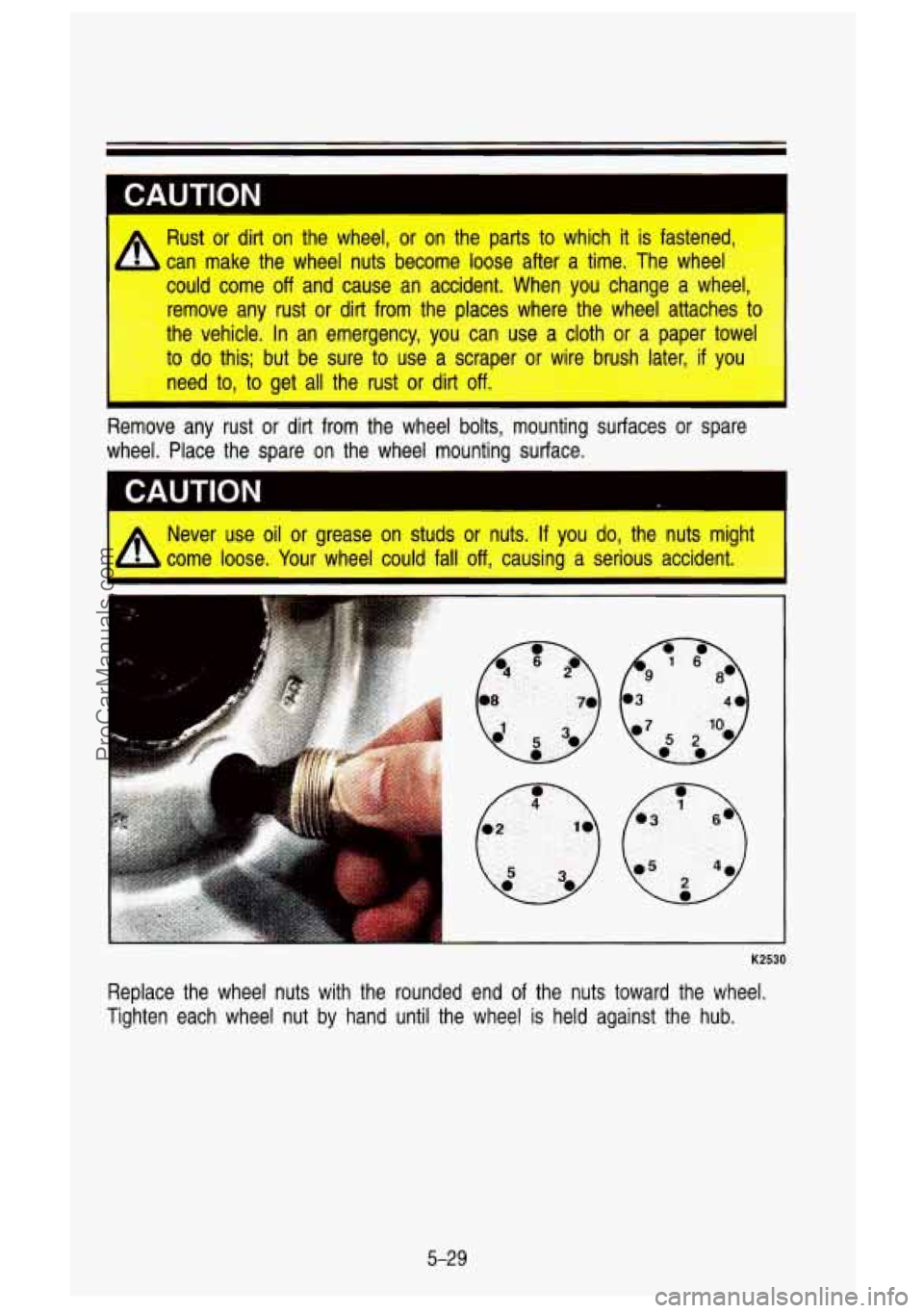
Replace the wheel nuts with the rounded end of the nuts toward the wheel.
Tighten each wheel nut by hand until the wheel is held against the hub.
5-29
ProCarManuals.com
Page 356 of 436
Service & Appearance Cam
Tire lnspecfion and Rotation
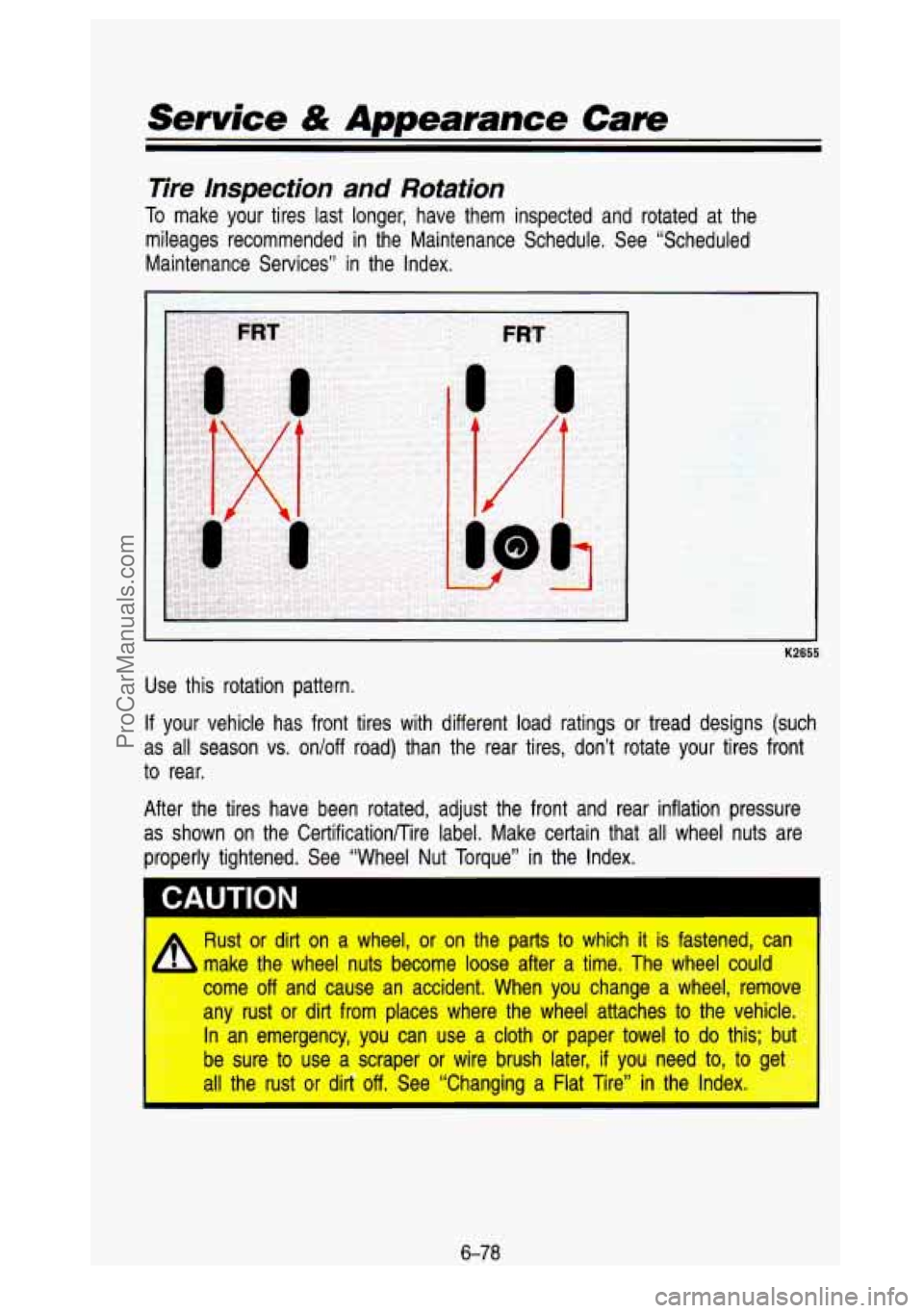
To make your tires last longer, have them inspected and rotated at the
mileages recommended in the Maintenance Schedule. See “Scheduled
Maintenance Services” in the Index.
Q
-
-
K2655
Use this rotation pattern.
If your vehicle has front tires with different load ratings or tread designs (such
as all season
vs. onloff road) than the rear tires, don’t rotate your tires \
front
to rear.
After the tires have been rotated, adjust the front and rear \
inflation pressure
as shown on the CertificationRire label. Make certain that all wheel nuts are
properly tightened. See “Wheel Nut Torque”
in the Index.
A Rust or dirt on a wheel, or on the parts to which -it is fastened, can
make the wheel nuts become loose after a time. The wh.eel could
come
off and cause an accident. When you change- a- :wheel, remove
’ any -rust or dirt from places where the wheel attaches to the vehicle:
,: In an emergency, you can use a cloth or paper towel to do this; but
3 be sure to use a scraper or wire brush later, if you need- to, to get
-T all the rust or dirf off. See “Changing a Flat Tire” in the Index.
6-78
ProCarManuals.com
Page 373 of 436

Specification Charts
Replacement Parts
Replacement part numbers listed in this section are based on the latest
information available at the time of printing, and are subject \
to change. If a
part listed in this manual is not the same as the part used \
in your vehicle
when it was built, or
if you have any questions, please contact your GM truck
dealer.
Engine Identification
Liter Produced Fuel VIN
Displacement Type
U.S. TBI N
V8 7.4 H.D.
us. Diesel F V8 6.5
H.D. U.S. Diesel J V8 6.2
L. D. us. Diesel C V8 6.2
US., Can.
TBI K V8
5.7
L. D. US., Can.
TBI H
V8 5.0
U.S. TBI 2 V6
4.3
Emissions
BY
System
Engine Code
*
*
*
*Light Duty Emissions with 8500 GVWR and below or:
Heavy Duty Emissions with 8501 GVWR and above.
TO035
Wheel Nut Torque
MODEL I DESCRIPTION I TORQUE I
C 1500 5 bolts (14mm) 120 ft. Ibs. (160 Nmm)
K 1500 & C-K 2500 6 bolts f14mm) 120 ft. Ibs. (1 60 N.m)
C-K
2500 (w/C6P) 8 bolts (14mm) 120 ft. Ibs. (160 Nmm)
C-K 3500 Single Rear Wheels 8 bolts (14mm) 120
ft. Ibs.
(1 60 N-m)
C3500 Dual Rear Wheels
8 bolts (14mm) 140 ft. Ibs. (190
N-m)
C3500 HD -Front
5 bolts (5/8 in.) 175 ft. Ibs. (240 Nsm)
TO040
--Rear
10 bolts (5/8 in.)
6-95
ProCarManuals.com
Page 398 of 436
Scheduled Maintenance Services
Explanation Of Scheduled Maintenance Services
Below are explanations of the services listed in the maintenance charts.
The proper fluids and lubricants to use are listed in this section. Make sure
whoever services your vehicle uses these. All parts should be \
replaced and
all necessary repairs done before you or anyone else drives the ve\
hicle.
1.
ENGINE OIL AND OIL FILTER CHANGE* -ALWAYS USE SG OR
SGKE QUALITY, ENERGY CONSERVING II OILS OF THE PROPER
VISCOSITY. To determine the preferred viscosity oil for your vehicle’s
engine (e.g. SAE 5W-30 or 10W-30), see “Engine Oil” in the Index.
2. CHASSIS LUBRICATION -Lubricate the front suspension, king pin
bushings, steering linkage, transmission, and transfer case shift\
linkage,
parking brake cable guides, propshaft splines (2 wheel drive), brake
pedal springs, and clutch pedal springs at the intervals specified.
If you have a 3500 HD, lubricate the king pins and king pin bushings
every 1,500 miles
(2500 km) for Maintenance Schedule 1, or every 3,000
(5000 km) for Maintenance Schedule 2.
Ball joints and king pin bushings should not be lubricated unless their
temperature is
10°F (-12”C), or higher. When the weather is cold, let
them warm up before lubrication or they could be damaged.
Also, be sure to check
all the vehicle fluid levels at this time.
3.
CLUTCH FORK BALL STUD LUBRICATION -Lubricate the clutch fork
ball stud through the fitting on the clutch housing. Lubricant must be
added “sparingly” to the fitting, as only.
0066 Ib. (.003 kg) is required to
lubricate the ball stud surface.
Do not add lubricant more often than the
intervals in the Maintenance Charts.
Too much lubricant will damage
the clutch assembly.
4. ENGINE IDLE SPEED ADJUSTMENT (DIESEL ENGINES)* -Adjust to
the specifications shown on the underhood label. You must use
calibrated test equipment.
5. COOLING SYSTEM SERVICE* -Drain, flush and refill system with new
coolant. See “Engine Coolant’’ in the Index for the proper coolant and
mixture to use in your vehicle.
Also inspect the hoses and replace them
if they are cracked, swollen, or
deteriorated. Tighten all hose clamps (except constant tension \
clamps).
Remove debris and clean the outside
of the radiator and air conditioning
condenser. Wash the radiator neck.
To ensure proper operation, pressure
test the radiator and cap.
* An Emission Control Service
7-1
8
ProCarManuals.com
Page 399 of 436
6. AIR CLEANER FILTER REPLACEMENT* -Replace at every 30,000
miles (50 000 km) or more often under dusty conditions. Ask your dealer
for the proper replacement intervals for your driving conditions\
.
7. FRONT WHEEL BEARING REPACK (2 WHEEL DRIVE ONLY) -Clean
and repack the front wheel bearings at each brake relining, or\
at the specified interval, whichever comes first.
8.
TRANSMISSION SERVICE
Automatic Transmission
-Change the transmission fluid and filter every
15,000 miles (25 000 km) for vehicles under 8,600 GVWR or every
12,000 miles (20 000 km) for vehicles over 8,600 GVWR if the vehicle
is mainly driven under one or more of these conditions:
In heavy city traffic.
Where the outside temperature regularly reaches 90°F (32°C\
) or
higher.
In hilly or mountainous terrain.
Frequent trailer pulling.
Uses such as taxi, police, delivery or other commercial service\
.
If the vehicle is not used mainly under any of these conditions, change
the fluid and filter every 30,000 miles
(50 000 km) for vehicles under
8600 GVWR or every
24,000 miles (40 000 km) for vehicles over 8600
GVWR. See “Automatic Transmission Fluid” in the Index for more
information.
Manual Transmission -Transmission fluid does not require periodic
changing.
Regulator Valve System for any worn, plugged or collapsed hoses. Have
the system checked as described in the Service Manual.
9.
CDRV SYSTEM INSPECTION* -Check
the Crankcase Depression
10. FUEL FILTER REPLACEMENT* -Replace the fuel filter at the specified
interval
or sooner if clogged.
11. SPARK PLUGS REPLACEMENT* -Replace spark plugs with the type
listed in Section
6. See “Specification Charts” in the Index.
12.
SPARK PLUG WIRE INSPECTION* -Clean wires and inspect for burns,
cracks or other damage. Check the wire boot fit at the distributor and at
the spark plugs. Replace wires as needed.
*An Emission Control Service
7-1 9
ProCarManuals.com
Page 401 of 436

23. EXHAUST PRESSURE REGULATOR VALVE INSPECTION* -Check that
the valve works properly. Correct any binding. Inspect hoses fo\
r cracks, chafing or decay. Replace parts as needed.
24.
TIRE AND WHEEL ROTATION AND INSPECTION -For proper wear
and maximum tire life, rotate tires at the first
6,000 miles (1 0 000
kilometers) for Schedule I (t) or 7,500 miles (12 500 kilometers) for
Schedule
II (.) and then every 15,000 miles (25 000 kilometers)
thereafter. Follow the instructions and patterns shown in Section 6.
Check tires for uneven wear or damage.
If irregular or premature wear is
apparent, check wheel alignment. Also, check for damaged wheels.\
See
“Tires” in the Index for more information.
For dual wheels, whenever the vehicle, wheels, or fasteners are new,
have the wheel fastener torque set at the first 100,
1,000 and 6,000
miles (160, 1600 and 10
000 km).
For 3500 H.D. Models, block the tires opposite those being removed to
keep the vehicle from rolling.
25.
DRIVE AXLE SERVICE -Check readfront axle fluid level and add as
needed. Check constant velocity joints and axle seals for leaki\
ng.
Locking differential-Drain fluid at first oil change and refill. Check
fluid level and add as needed at subsequent oil changes.
In dusty
areas, or trailer towing applications drain fluid at every 15,0\
00 miles
(24 135 kilometers) and refill$
every oil change. In dusty areas, or trailer towing applications, drain
fluid every 15,000 miles
(24 135 kilometers) and refi1l.t
More frequent lubrication may be required on heavy-duty or off-road
use.
Standard differential -Check fluid level and add as needed at
26.
BRAKE SYSTEM INSPECTION -When the engine oil is changed,
inspect the lines and hoses for proper hookup, binding, leaks, \
cracks,
chafing, etc. Check the parking brake adjustment, and the fluid level in
the master cylinder.
A low fluid level can indicate worn disc brake pads
which may need to be sewiced.t
*An Emission Control Service
tA fluid
loss in these systems may indicate a problem. Have them
inspected and repaired at once.
7-2
1
ProCarManuals.com