engine coolant GMC SIERRA 1993 User Guide
[x] Cancel search | Manufacturer: GMC, Model Year: 1993, Model line: SIERRA, Model: GMC SIERRA 1993Pages: 436, PDF Size: 23.88 MB
Page 258 of 436
Prob/ems on the Road
t
e;
K2550
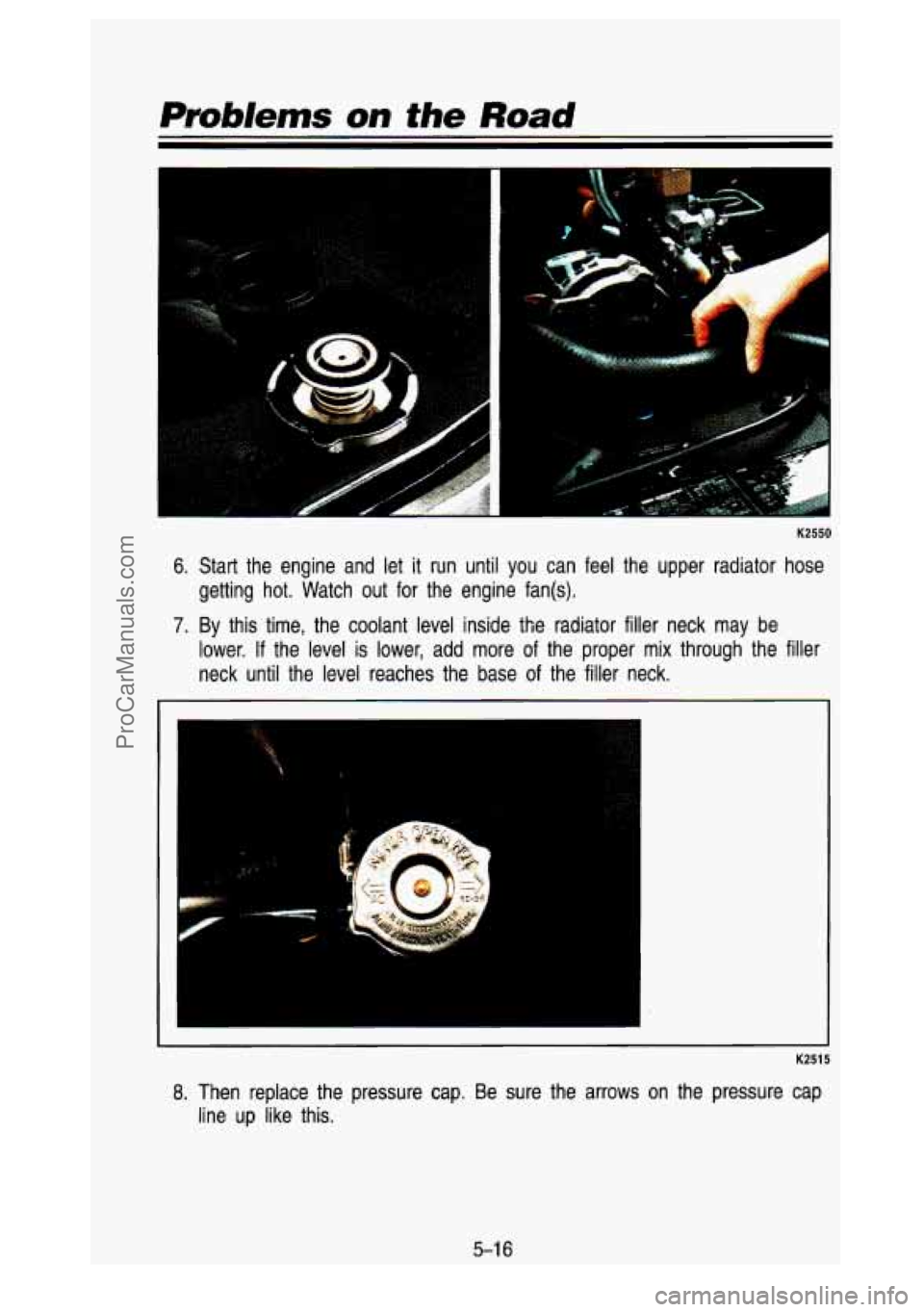
6. Start the engine and let it run until you can feel the upper radiator hose
getting hot. Watch out for the engine fan(s).
7. By this time, the coolant level inside the radiator filler neck m\
ay be
lower.
If the level is lower, add more of the proper mix through the f\
iller
neck until the level reaches the base of the filler neck.
K2515
8. Then replace the pressure cap. Be sure the arrows on the pressure cap
line up like this.
5-1 6
ProCarManuals.com
Page 280 of 436

Service & Appearance Care
Engine Coolant ........................................................................\
........................ 6-42
Power Steering Fluid
........................................................................\
............... 6-46
Windshield Washer Fluid
........................................................................\
......... 6-48
Brake Master Cylinder
........................................................................\
............. 6-49
Replacing Brake System Parts
........................................................................\
.. 6-50
Other Maintenance Items ........................................................................\
........... 6-51
Lubrication
........................................................................\
.................................... 6-52
Electrical System
........................................................................\
......................... 6-54
Battery
........................................................................\
...................................... 6-54
Fuses and Circuit Breakers
........................................................................\
.... 6-64
Bulb Replacement
........................................................................\
.................... 6-54
Exhaust System
........................................................................\
........................... 6-65
Loading Your Vehicle
........................................................................\
.................. 6-67
Tires
........................................................................\
.............................................. 6-72
Inflation-Tire Pressure
........................................................................\
........... 6-73
Tire Inspection and Rotation
........................................................................\
.. 6-78
When It's Time for New Tires
........................................................................\
6-80
Buying New Tires
........................................................................\
.................... 6-81
Wheel Alignment and Tire Balance
............................................................... 6-82
Wheel Replacement
........................................................................\
................. 6-83
Tire Chains
........................................................................\
............................... 6-84
Appearance Care
........................................................................\
........................ 6-84
Cleaning the Inside Of Your Vehicle
............................................................. 6-85
Cleaning the Outside Of Your Vehicle
.......................................................... 6-88
Appearance Care Materials
.r.ikl...rr.r.n.....lr. ........ ... .. 6-91
Vehicle Identification Number
........................................................................\
..... 6-92
Service Parts Identification Label
...................................................................... 6-94
Specification Charts
....++t....,.,.*,..-".,,. .............. , ........... .................... 6-95
Uniform Tire Quality Grading
........................................................................\
.. 6-81
..................................................
6-2
ProCarManuals.com
Page 296 of 436

Service & Appearance Cam
i r:
PO21 7
If your vehicle has air conditioning, the auxiliary fan under the \
hood
can start up and injure you even when the engine is not runn\
ing.
Keep your hands, clothing and tools away from any underhood
electric fan,
if you have one.
Things that burn can get on hot engine parts and start
a fire. These
b include liquids like gasoline or diesel fuel, oil, coolant, bra\
ke fluid,
windshield washer and other fluids, and plastic or rubber. You or
others could be burned. Be careful not
to drop or spill things that will
burn onto a hot engine.
Before closing the hood, be sure all the filler caps are
on properly. Then just
pull the hood down and close it firmly.
6-1 8
ProCarManuals.com
Page 320 of 436

Service & Appearance ,Care
Engine Coolant
r
PO593
The following explains your cooling system and how to add cool\
ant when it is low.
If you have a problem with -engine overheating, see “Engine
Overheating” in the Index.
The proper coolant for your vehicle will:
Give freezing protection down to -34°F (-37°C).
Give boiling protection up to 258°F (125°C).
Protect against rust and corrosion:
Help keep the proper engine temperature.
Let the warning lights and gages work as thiy should.
What to Use:
Use a ,mixture of clean water (preferably distilled), and antifreeze that meets
“GM Specification 6038-M,” which won’t damage aluminum p\
arts.
Also use
GM Engine Coolant Supplement (sealer) with a complete coolant change. If
you use these, you don’t need to add anything else.
,
6-42
ProCarManuals.com
Page 321 of 436
1 CAUTION
4 Adding only plain water to your cooling system can be dangerous.
Plain water, or some other liquid like alcohol, can boil before th(
)per coolant mix will. Your vehicle’s coolant warning system is set
for the proper coolant mix. With plain water or the wrong mix\
, your
engine could get too hot but you wouldn’t get the overheat warning.
Your engine could catch fire and you or others could be burned. Use
a
50/50 mix of clean water and a proper antifreeze.
NOTICE
If you use an improper coolant mix, your engine could overheat an\
d 1:
badly damaged. The repair cost wouldn’t be covered by your warranty. 1
much water in the mix can freeze and xk +?e t line radiator, heater
core and other parts.
Some conditions, such as air trapped in the cooling system, can affect the
coolant level in the radiator. Check the coolant level when the engine is cold
and follow the steps under “Adding Coolant” for the prope\
r way to add
coolant.
If you have the low coolant warning system, refer to the General Motors
Service Manual or see your dealer for the proper coolant
fill procedure. (To
purchase a Service Manual, see “Service Publications’’ in the Index.) Using
the wrong
fill procedure can cause a low coolant warning indication.
If you have to add coolant more than four times a year, have your dealer
check your cooling system.
If you use the proper coolant, you don’t have to add extra inhibitors or
additives which claim to improve
the system. These can be harmful.
-
NOTICE .I
6-43
ProCarManuals.com
Page 322 of 436
Service & Amearance Care
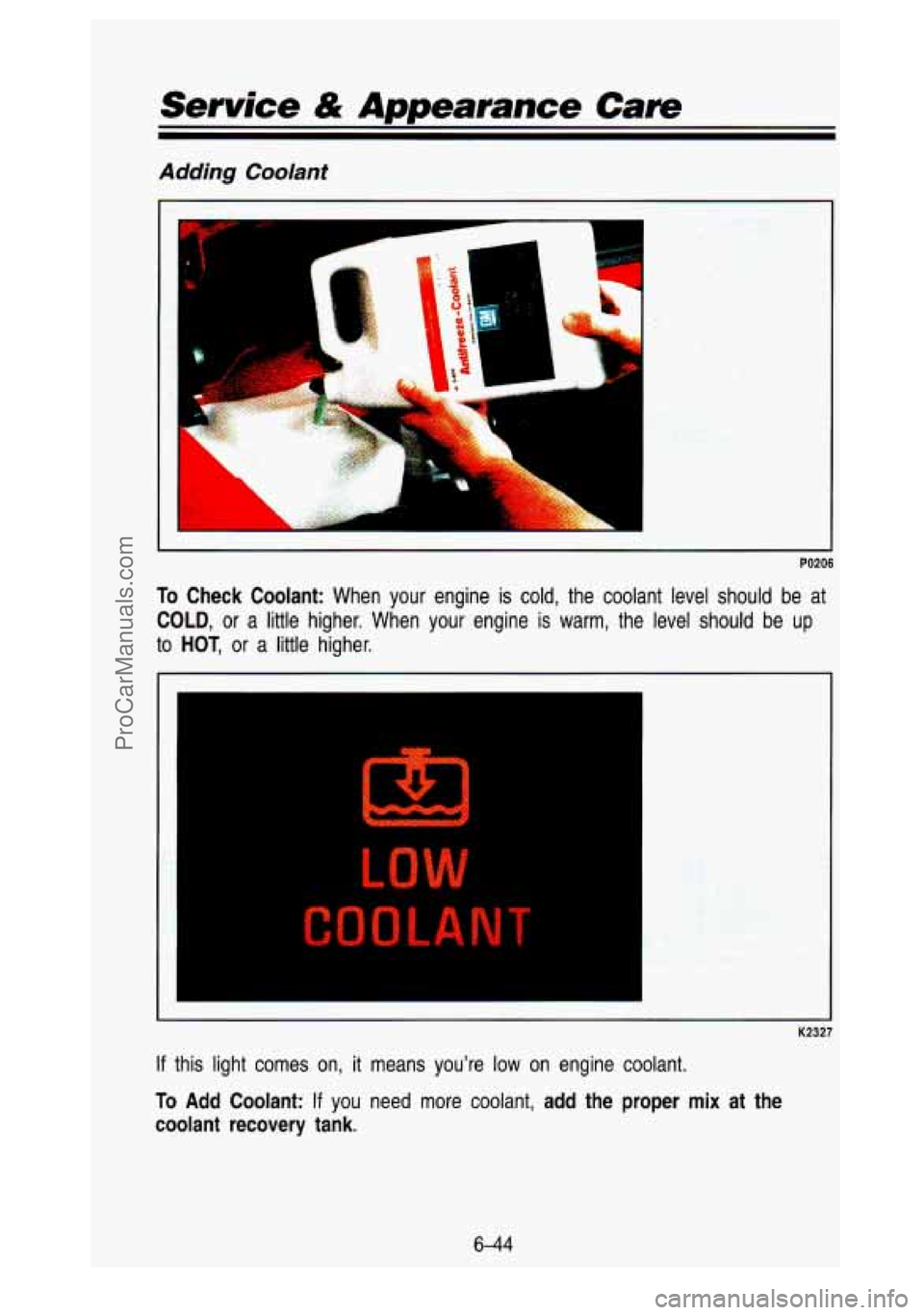
Adding Coolant
r
PO206
To Check Coolant: When your engine is cold, the coolant level should be at
COLD, or a little higher. When your engine is warm, the level should be up
to HOT, or a little higher.
LOW
COOLANT
K2327
If this light comes on, it means you're low on engine coolant.
To Add Coolant: If you need more coolant, add the proper mix at the
coolant recovery tank.
6-44
ProCarManuals.com
Page 323 of 436
CAUTION
Turning the radiator pressure cap when the engine and radiator are
hot can allow steam and scalding liquids to blow out and burn you
badly. With the coolant recovery tank, you will almost never h\
ave to
add coolant at the radiator. Never turn the radiator pressure cap-even a little-when the engine and radiator are hot.
Add coolant mix at the recovery tank, but be careful not to \
spill it.
You can be burned
if you spill coolant on hot engine parts. Coolant
mtains ethylene glycol, and
it will burn if the engine parts are hot
enough. Don’t spill coolant on a hot engine. ’
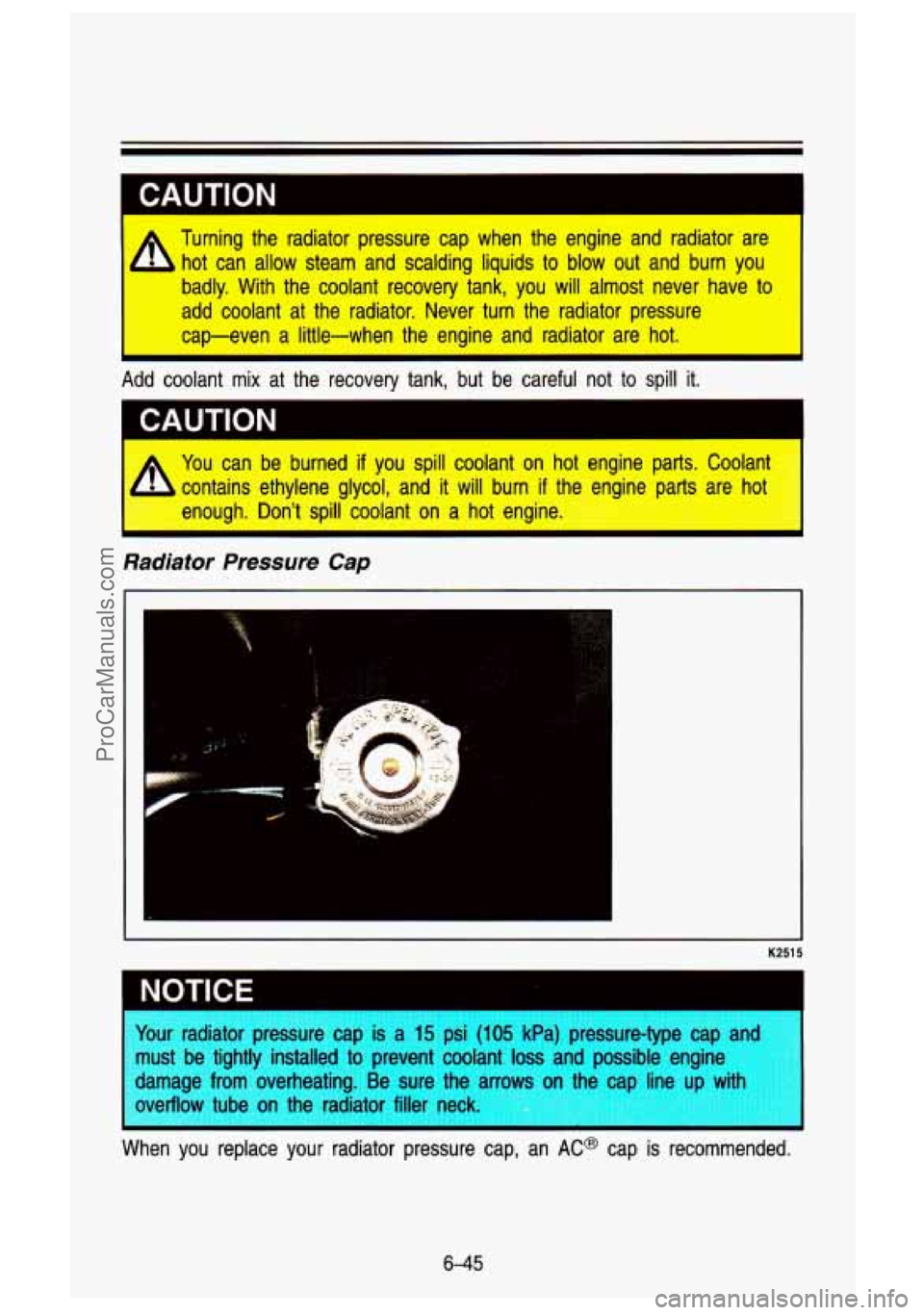
Radiator Pressure Cap
K2515
1
Your radiator pressure cap is a 15 psi (105 kPa) pressure-type cap
must be tightly installed to prevent coolant
loss and possible engine
damage from overheating. Be sure the arrows on the cap line up w
overflow tube on the radiator filler neck.
-
When you replace your radiator pressure cap, an ACa cap is recommended.
-
I
6-45
ProCarManuals.com
Page 324 of 436

Service & Appearance Cam
Thermostat
Engine coolant temperature is controlled by a thermostat in the engine coolant
system. The thermostat stops the flow of coolant through the r\
adiator until the
coolant reaches a preset temperature.
When you replace your thermostat, an
AC@ thermostat is recommended.
Power Steering Fluid
K2630
How To Check Power Steering Fluid:
Unscrew the cap and wipe the dipstick with a clean rag. Replace the cap
and completely tighten it. Then remove the cap again and look at the fluid
level on the dipstick.
K2693
6-46
ProCarManuals.com
Page 377 of 436
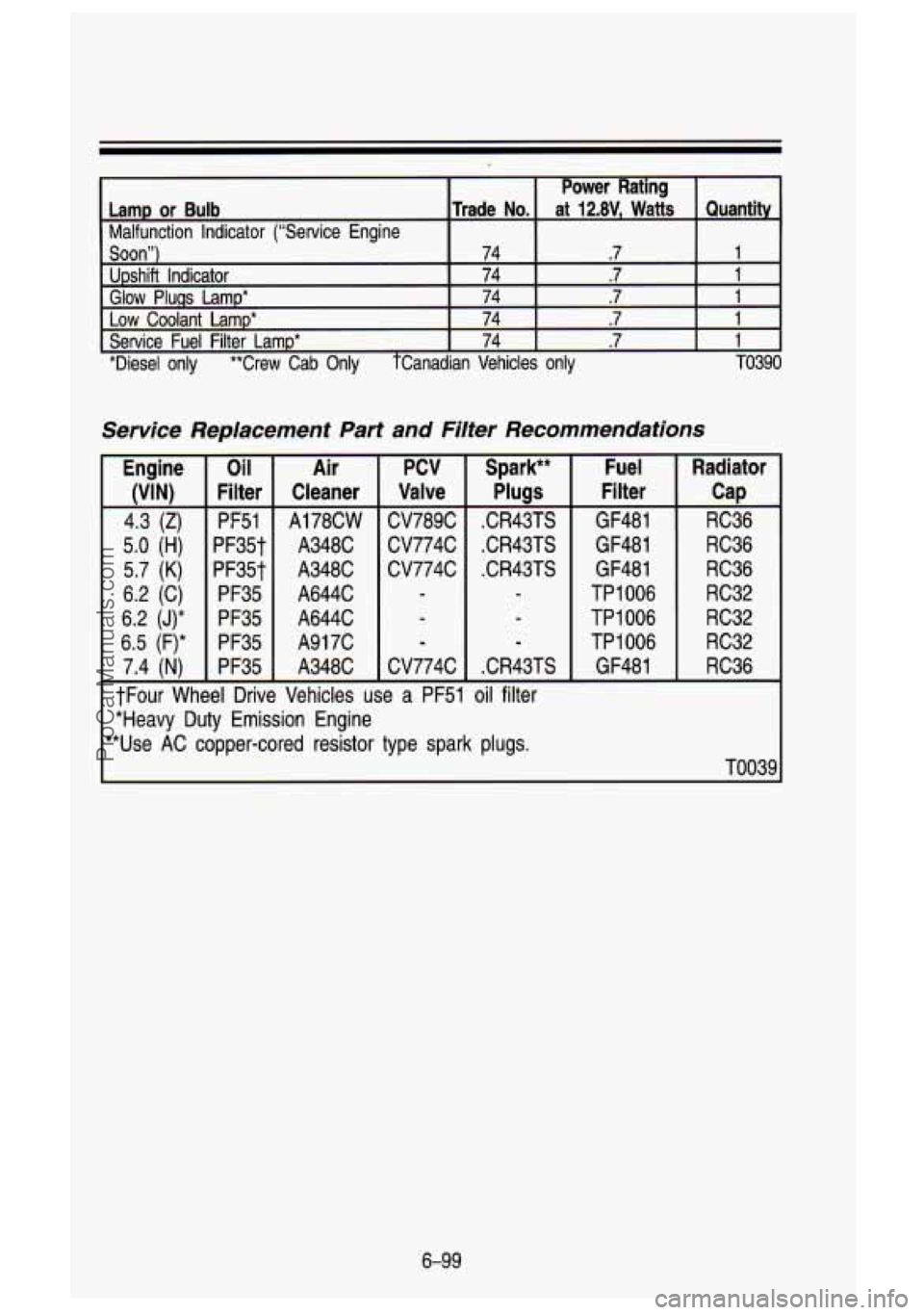
I I Power Rating I 1
Lamp or Bulb
Malfunction Indicator (“Service Engine
Quantity
at 12.8V, Watts Trade No.
Soon”)
“Diesel only
**Crew Cab Only tCanadian Vehicles only t0390
1 .7
74
Service Fuel Filter Lamp*
1 .7
74
Low Coolant Lamp*
1 .7 74 Glow Plugs Lamp*
1 .7
74
Upshift Indicator
1 .7
74
Service Replacement Part and Filter Recommendations
Engine
(VIN)
4.3 (Z)
5.0 (H)
5.7 (K)
6.2 (C)
6.2
(J)*
6.5 (F)*
7.4
(N)
-
Oil
Filter
PF51
PF35t
PF35t
PF35
PF35
PF35
PF35
-
Air
Cleaner
A1 78CW A348C
A348C
A644C A644C
A917C
A348C
PCV
Valve
CV789C
cv774c
cv774c
-
-
-
cv774c I I
tFour Wheel Drive Vehicles use a PF51
*Heavy
Duty Emission Engine
1,
Spark** Plugs
CR43TS
.CR43TS
.CR43TS
-
-
.CR43TS
oil filter
’*Use AC copper-cored resistor type spark plugs.
Fuel
Filter
GF481
GF481
GF481
TP 1
006
TP 1 006
TP1006
GF481
-I
RC36
RC36
RC32
RC32
RC32
RC36
t0039
6-99
ProCarManuals.com
Page 398 of 436
Scheduled Maintenance Services
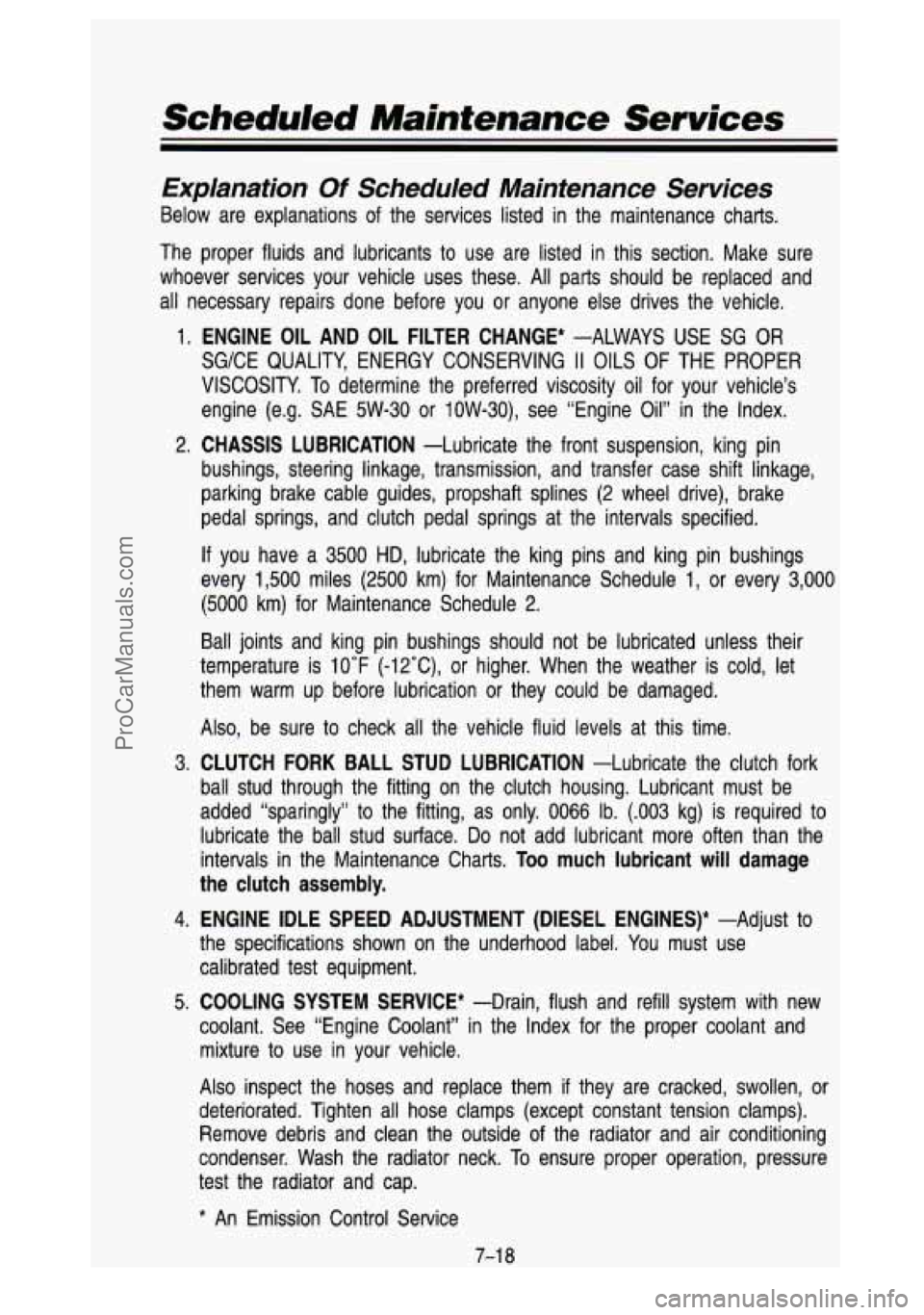
Explanation Of Scheduled Maintenance Services
Below are explanations of the services listed in the maintenance charts.
The proper fluids and lubricants to use are listed in this section. Make sure
whoever services your vehicle uses these. All parts should be \
replaced and
all necessary repairs done before you or anyone else drives the ve\
hicle.
1.
ENGINE OIL AND OIL FILTER CHANGE* -ALWAYS USE SG OR
SGKE QUALITY, ENERGY CONSERVING II OILS OF THE PROPER
VISCOSITY. To determine the preferred viscosity oil for your vehicle’s
engine (e.g. SAE 5W-30 or 10W-30), see “Engine Oil” in the Index.
2. CHASSIS LUBRICATION -Lubricate the front suspension, king pin
bushings, steering linkage, transmission, and transfer case shift\
linkage,
parking brake cable guides, propshaft splines (2 wheel drive), brake
pedal springs, and clutch pedal springs at the intervals specified.
If you have a 3500 HD, lubricate the king pins and king pin bushings
every 1,500 miles
(2500 km) for Maintenance Schedule 1, or every 3,000
(5000 km) for Maintenance Schedule 2.
Ball joints and king pin bushings should not be lubricated unless their
temperature is
10°F (-12”C), or higher. When the weather is cold, let
them warm up before lubrication or they could be damaged.
Also, be sure to check
all the vehicle fluid levels at this time.
3.
CLUTCH FORK BALL STUD LUBRICATION -Lubricate the clutch fork
ball stud through the fitting on the clutch housing. Lubricant must be
added “sparingly” to the fitting, as only.
0066 Ib. (.003 kg) is required to
lubricate the ball stud surface.
Do not add lubricant more often than the
intervals in the Maintenance Charts.
Too much lubricant will damage
the clutch assembly.
4. ENGINE IDLE SPEED ADJUSTMENT (DIESEL ENGINES)* -Adjust to
the specifications shown on the underhood label. You must use
calibrated test equipment.
5. COOLING SYSTEM SERVICE* -Drain, flush and refill system with new
coolant. See “Engine Coolant’’ in the Index for the proper coolant and
mixture to use in your vehicle.
Also inspect the hoses and replace them
if they are cracked, swollen, or
deteriorated. Tighten all hose clamps (except constant tension \
clamps).
Remove debris and clean the outside
of the radiator and air conditioning
condenser. Wash the radiator neck.
To ensure proper operation, pressure
test the radiator and cap.
* An Emission Control Service
7-1
8
ProCarManuals.com