four wheel drive GMC SIERRA 1993 User Guide
[x] Cancel search | Manufacturer: GMC, Model Year: 1993, Model line: SIERRA, Model: GMC SIERRA 1993Pages: 436, PDF Size: 23.88 MB
Page 107 of 436

Whenever you are in four wheel-drive, the rear wheel anti-lock brake system
does not operate. The regular brake system operates normally. W\
hen you shift back into two-wheel drive, the anti-lock brake system will operate.
Windows
To open your manual windows, turn the hand crank on each door to raise or
lower your side door windows.
If you have the optional power windows, the controls are on each
of the side
doors.
The driver's door has a switch for the passenger windows as well. Your
power windows will work when the ignition has been turned to
ACC or Run.
Push the switch with the down pointing arrow to lower the window.
Push the switch with the up pointing arrow to raise the window.
2-39
ProCarManuals.com
Page 179 of 436
Your Driving and the Road
.
Here you’ll find information about driving different kinds of roads and in
varying weather conditions
. We’ve also included many other useful tips on
driving
.
Road Signs ........................................................................\
.................................... 4-3
Defensive Driving ........................................................................\
........................ 4-10
Drunken Driving ........................................................................\
........................... 4-11
Control of a Vehicle ........................................................................\
.................... 4-14
Braking ........................................................................\
...................................... 4-14
Steering ........................................................................\
.................................... 4-19
Steering in Emergencies ........................................................................\
......... 4-21
rassing ........................................................................\
..................................... 4-22
Loss of Control ........................................................................\
........................ 4-24
Off-Road Driving With Your Four-wheel Drive Vehicle
.................................... 4-25
Driving at Night
.............. w..i*&r,+v ........................................................................\
4-36
Driving in the Rain ........................................................................\
...................... 4-30
Driving in Fog, Mist and Haze ........................................................................\
.. 4-41
City Driving ........................................................................\
.................................. 4-42
Freeway Driving ........................................................................\
........................... 4-43
Driving a Long Distance ........................................................................\
............. 4-45
Hill and Mountain Roads ........................................................................\
............ 4-47
4-1
ProCarManuals.com
Page 195 of 436

c
AM41 501 6
As you brake, your computer keeps receiving updates on rear wheel spee\
d
and controls braking pressure accordingly.
CAUTION I
A
Anti-lock doesn’t change the time you need to get your foot up to I
the brake pedal. If you get too close to the vehicle in front of you,
you won’t have time
to apply your brakes if that vehicle suddenly
slows or stops. Always leave enough room up ahead to stop, even
though you have anti-lock brakes.
To Use Anti-Lock:
Use rear wheel anti-lock like regular brakes. You may feel the brakes vibrate,
or you may notice some noise outside your vehicle, but this is normal. Let
anti-lock work for you, but remember: Your front wheels can still stop rolling.
If that happens, release enough pressure on the brakes to get the wheels
rolling again
so that you can steer.
With the four-wheel drive option you won’t have anti-lock braking when you
shift into four-wheel drive. But you will have regular braking. When you shift
back into two-wheel drive, you will have anti-lock again.
4-1 7
ProCarManuals.com
Page 200 of 436
Your Drivm - and the Road.
Off-Road Recovery
You may find. sometime that your right wheels have dropped off the edge of
a road onto the shoulder while you're driving.
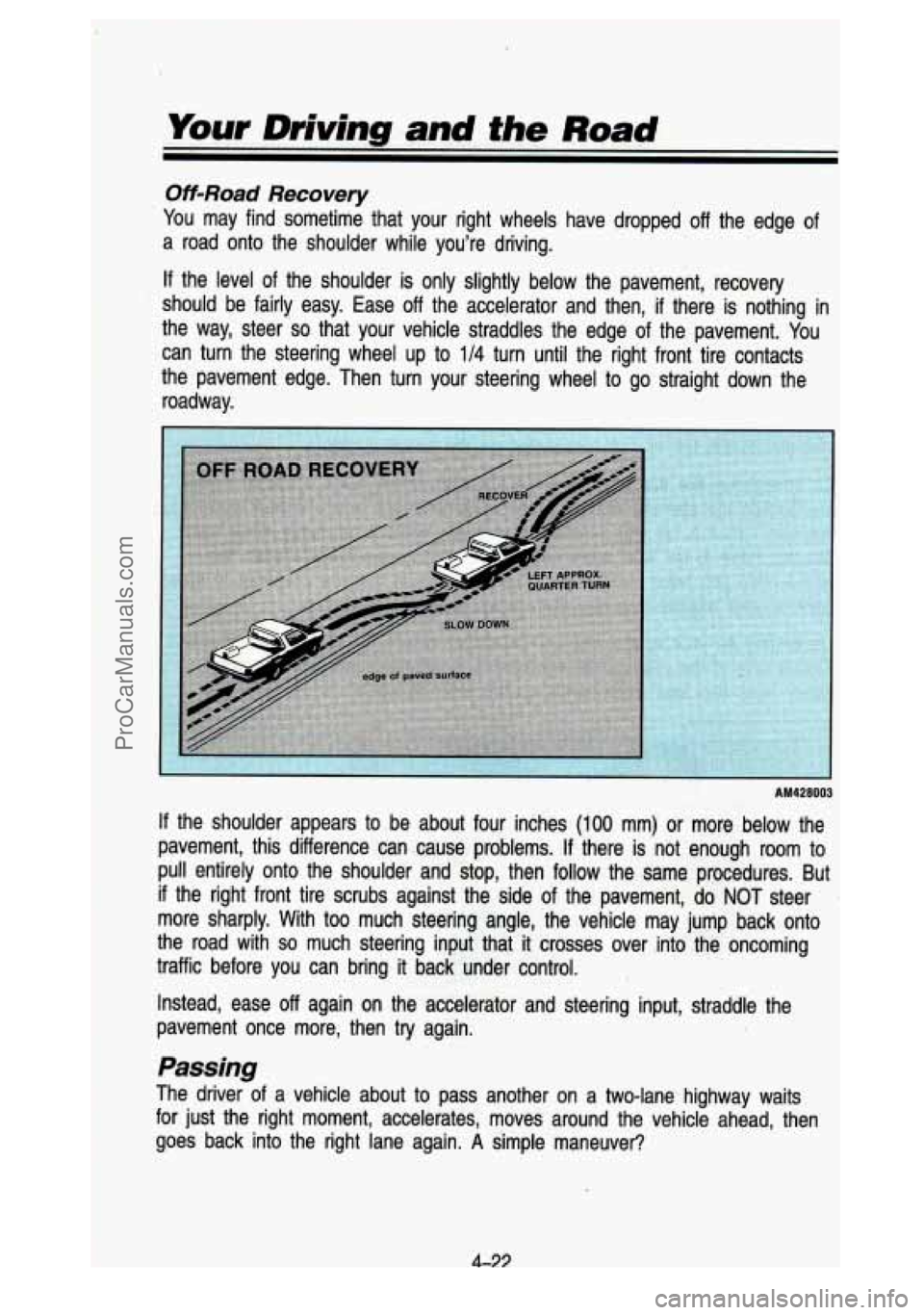
If the level of the shoulder is only slightly below the pavement, recovery
should be fairly easy. Ease
off the accelerator and then, if there is nothing in
the way, steer
'so that your vehicle straddles the edge of the pavement. You
can turn the steering wheel up to
1/4 turn until the right front tire contacts
the pavement edge. Then turn your steering wheel to go straight down the
roadway.
AM428003
If the shoulder appears to be about four inches (100 mm) or more below the
pavement, this difference can .cause problems.
If there is not enough room to
pull entirely onto the shoulder and stop, then follow the same proc\
edures. But
if the right front tire scrubs against the side of the pavement, do NOT steer
more sharply. With
too much steering angle, the vehicle may jump back onto
the road with
so much steering input that it crosses over .into the oncoming
traffic before you can bring
it back under control.
Instead, ease off again on the accelerator and steering input, \
straddle the
pavement once more, then
try again.
Passing
The driver of a vehicle about to pass another on a two-lane highway waits
for just the right moment, accelerates, moves around the vehicl\
e ahead, then
goes back into the right lane again.
A simple maneuver?
4-22
ProCarManuals.com
Page 203 of 436
may not realize the surface is slippery until your vehicle is skidding. Learn to
recognize warning clues-such as enough water, ice
or packed snow on the
road to make a “mirrored surface’’-and slow down when you have \
any
doubt.
Remember: the rear wheel anti-lock braking system (RWAL) helps\
avoid only
a rear braking skid. In a braking skid (where the front wheels are no longer
rolling), release enough pressure on the brakes to get the front wheels rolling
again. This restores steering control. Push the brake pedal dow\
n steadily
when you have to stop suddenly.
As long as the front wheels are rolling, you
will have steering control. Steer the way you want to go.
Off-Road Driving with Your FourcWheel
Drive Vehicle
This off-road guide is for vehicles that have four-wheel drive. Also, see
“Anti-lock Brakes” in the Index.
If your vehicle doesn’t have four-wheel drive,
you shouldn’t drive off-road unless you’re on a level, so\
lid surface.
Off-road driving can be great fun. But it does have some defi\
nite hazards.
The greatest
of these is the terrain itself.
“Off-roading” means you’ve left the great North American\
road system behind.
Traffic lanes aren’t marked. Curves aren’t banked. There a\
re no road signs.
Surfaces can be slippery, rough, uphill
or downhill. In short, you’ve gone right
back
to nature.
Off-road driving involves some new skills. And that’s why it’s very important
that you read this guide. You’ll find many driving tips and suggestions. These
will help make your off-road driving safer and more enjoyable. \
Before You Go Off-Roading
There are some things to do before you go out. For example, be sure to
have all necessary maintenance and service work done. Be sure \
you read all
the information about your four-wheel drive vehicle in this manual.
Is there
enough fuel?
Is the spare tire fully inflated? Are the fluid levels up where
they should be? What are the local laws that apply to off-roa\
ding where you’ll be driving?
If you don’t know, you should check with law enforcement people\
in the area. Will you be on someone’s private land?
If so, be sure to get the
necessary permission.
4-25
ProCarManuals.com
Page 238 of 436
Your Driving and the Road
drivers behind you are seeing your signal when they are not. It’s important to
check occasionally to be sure the trailer bulbs are still working.
Driving on Grades
Reduce speed and shift to a lower gear before you start down long or steep
downgrade.
If you don’t shift down, you might have to use your brakes so
much that they would get hot and no longer work well.
On a long uphill grade, shift down and reduce your speed to
45 mph (70
kmlh) or less to reduce the possibility of engine and transmission overheating.
IT you have an automatic transmission, you should use D (or, as you need to,
a lower gear) when towing a trailer. Operating your vehicle i\
n
D when towing
a trailer will minimize heat buildup and extend the life of your transmission.
Or, if you have a manual transmission with fifth gear and you are towing a
trailer, it’s better not to use fifth gear. Just drive in fourth gear
(or, as you
need to, a lower gear).
Parking on Hills
You really should not park your vehicle, with a trailer attached, \
on a hill. If
something goes wrong, your rig could start to move. People can\
be injured
and both your vehicle and the trailer can be damaged.
But
if you ever have to park your rig on a hill, here’s how to do it:
1. Apply your regular brakes, but don’t shift into P (Park) yet, or into gear
2. Have someone place chocks under the trailer wheels.
for a manual transmission.
3. When the wheel chocks are
in place, release the regular brakes until the
chocks absorb the load.
4. Reapply the regular brakes. Then apply your parking brake, and \
then
5. If you have a four-wheel-drive vehicle, be sure the transfer case is in a
6. Release the regular brakes.
shift
to
P (Park), or R (Reverse) for a manual transmission.
drive gear-not in
N (Neutral).
4-60
ProCarManuals.com
Page 239 of 436
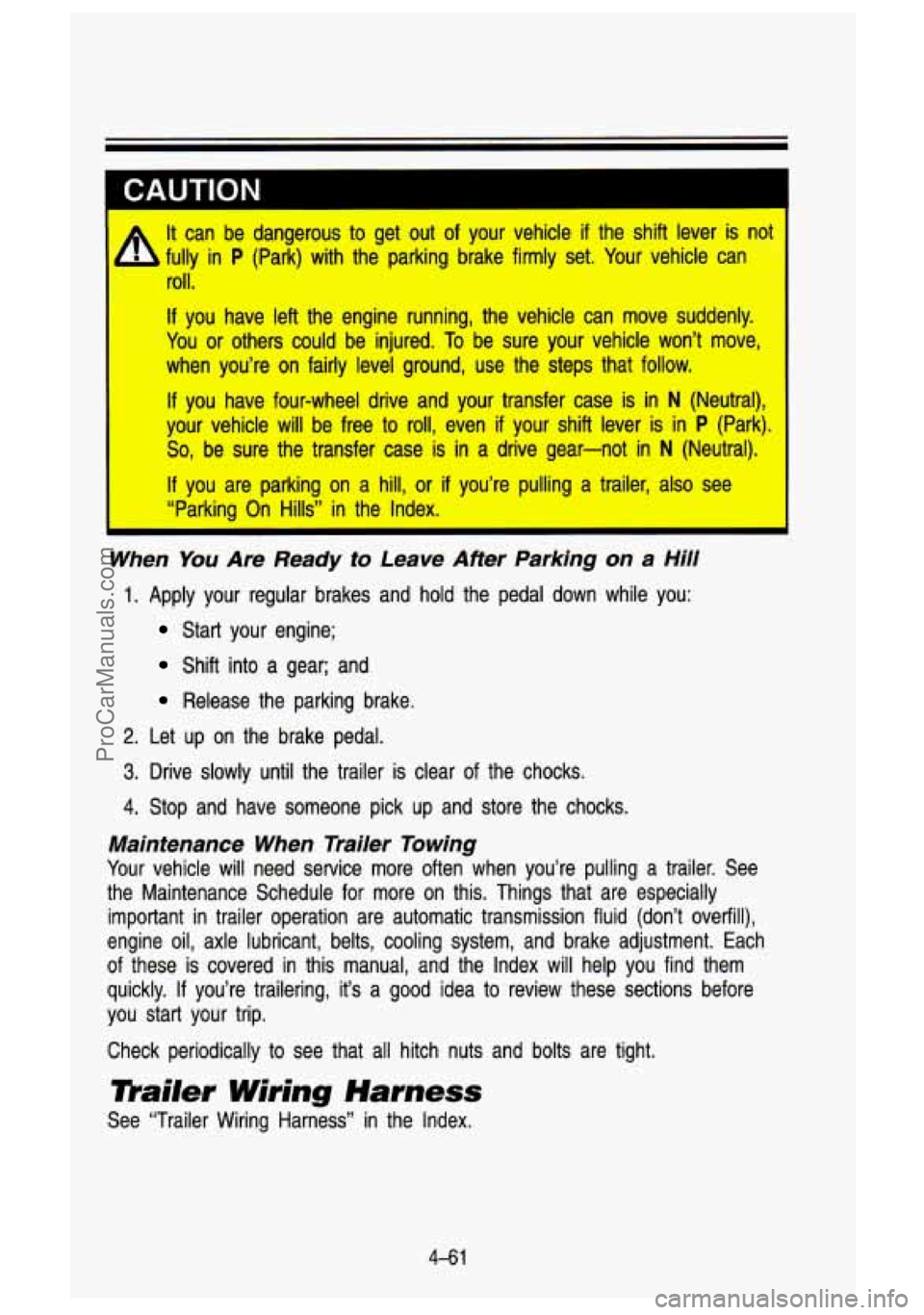
CAUTION
It can be dangerous to get out of your vehicle if the shift lever is not
fully in
P (Park) with the parking brake firmly set. Your vehicle can
roll.
If you have left the engine running, the vehicle can move suddenl\
y.
You
or others could be injured. To be sure your vehicle won’t move,
when you’re on fairly level ground, use the steps that follow.
If you have four-wheel drive and your transfer case is in N (Neutral),
your vehicle will be free to
roll, even if your shift lever is in P (Park).
So, be sure the transfer case is in a drive gear-not in N (Neutral).
If you are parking on a hill, or if you’re pulling a trailer, also see
“Parking On Hills” in the Index.
When You Are Ready to Leave After Parklng on a Hill
1. Apply your regular brakes and hold the pedal down while you:
Start your engine;
Shift into a gear; and
Release the parking brake.
2. Let up on the brake pedal.
3. Drive slowly until the trailer is clear of the chocks.
4. Stop and have someone pick up and store the chocks.
Maintenance When Trailer To wing
Your vehicle will need service more often when you’re pulling a trailer. See
the Maintenance Schedule for more on this. Things that are esp\
ecially
important in trailer operation are automatic transmission fluid (don’t overfill),
engine oil, axle lubricant, belts, cooling system, and brake ad\
justment. Each
of these is covered in this manual, and the Index will help \
you find them
quickly.
If you’re trailering, it’s a good idea to review these sections before
you start your trip.
Check periodically
to see that all hitch nuts and bolts are tight.
mailer Wiring Harness
See “Trailer Wiring Harness’’ in the Index.
4-61
ProCarManuals.com
Page 240 of 436

Your Driving and the Road
Power Winches
i !
If you wish to use a power winch on your vehicle, only use it \
when your
vehicle is stationary or anchored.
i
NOTICE
Use the regular brakes, set the parking brake or block the wh\
eels to keep
your vehicle from rolling.
Power rake-off (PTO)
Before using a power take-off, refer to the manufacturer’s or installer’s
instructions.
To engage a power take-off:
1. Set ths parking brake.
2. Shift the transmission into N (Neutral).
3. Hold the clutch pedal down and engage the power take-off.
*
If you are going to drive the vehicle, shift the transmission int\
o the gear
you want. Then shift the transfer case into the range you wan\
t
(if you
have four-wheel-drive), apply the regular brakes and release th\
e parking
brake.
When you release the clutch, the power take-off will start.
4. Release the clutch (and the regular brakes) as you normally \
would.
4-62
ProCarManuals.com
Page 246 of 436
Pmbkms on the Road
not be able to get enough power from a single battery in another vehicle
to start your diesel engine.
If your vehicle has more than one battery, use the battery that’\
s closest
to the starter-this will reduce electrical resistance.
2. Get the vehicles close enough so the jumper cables can reach, but be
sure the vehicles aren’t touching each other.
If they are, it could cause a
ground connection you don’t want. You wouldn’t be able
to start your
vehicle, and the bad grounding could damage the electrical syst\
ems.
You could be injured
if the vehicles roll. Set the parking brake firmly
manual transmission in
N (Neutral).
If you have a four-wheel-drive vehicle, be sure the transfer c\
ase is
not in
N (Neutral).
1 on each vehicle. Put an automatic transmission in P (Park) or a
3. Turn off the ignition on both vehicles. Turn off all lights that aren’t need-
ed, and radios. This will avoid sparks and help save both bat\
teries. And
it could save your radio!
ou leave your radio on, it could be badly damaged. The repairs
r.,Jldn’t be covered by your warranty. I
4. Open the hoods and locate the batteries.
Find the positive
(t) and negative (-) terminals on each battery.
5-4
ProCarManuals.com
Page 250 of 436
Problenrs on the Road
Towing Your Vehicle
Try to have a GM dealer or a professional towing service tow your vehicle.
They can provide the right equipment and know how to tow it without dam-
age.
If your vehicle has been changed since it was factory-new, by adding things
like fog lamps, aero skirting, or special tires and wheels, th\
ese things could
be damaged during towing.
Before you do anything, turn on the hazard warning flashers.
When you call, tell the towing service:
That your vehicle has rear-wheel drive, or that it has the four-wheel drive
option.
The make, model, and year of your vehicle.
Whether you can move the shift lever for the transmission and \
transfer case,
if you have one.
If there was an accident, what was damaged.
I A To help avoid injury to you or others:
Never let passengers ride in a vehicle that is being towed.
Never tow faster than safe or posted speeds.
Never tow with damaged parts not fully secured.
Never get under your vehicle after it has been lifted by the tow
truck.
Always use separate safety chains on each side when towing a
vehicle.
When your vehicle is being towed, have the ignition key
off. The steering
wheel should be clamped in a straight-ahead position, with a clamping device
designed for towing service.
Do not use the vehicle’s steering column lock for
this. The transmission and transfer case,
if you have one, should be in Neu-
tral and the parking brake released.
If you have a two-wheel drive vehicle, don’t have your vehicle \
towed on the
rear wheels, unless you must. If the vehicle must be towed on\
the rear
wheels, don’t go more than
35 mph (56 km/h) or farther than 50 miles (80
krn) or your transmission will be damaged. If these limits must be exceeded,
then the rear drive wheels have to be supported on a dolly.
5-8
ProCarManuals.com