fuel GMC SIERRA 1993 User Guide
[x] Cancel search | Manufacturer: GMC, Model Year: 1993, Model line: SIERRA, Model: GMC SIERRA 1993Pages: 436, PDF Size: 23.88 MB
Page 148 of 436

Features & Controls
that the pedal is harder to push. Or, the pedal may go closer to the floor.\
It
may take longer to stop. If the light is still on, have the vehicle towed for
service. (See “Towing Your Vehicle” in the Index.)
CAUTION
* Your brake system may not be working properly if the brake warning
light is on. Driving with the brake warning light on can lead\
to an
accident.
If the light is still on after you’ve pulled off the road and
stopped carefully, have
+hq vehicle towed for service.
“WATER IN FUEL” Light
WATER
IN
FUEL I
-l PB010
This light will come on to warn you if there is too much water in the diesel
fuel system. For more information on how this light works, see\
“Diesel Fuel
Requirements and Fuel System” in the Index.
2-80
ProCarManuals.com
Page 151 of 436
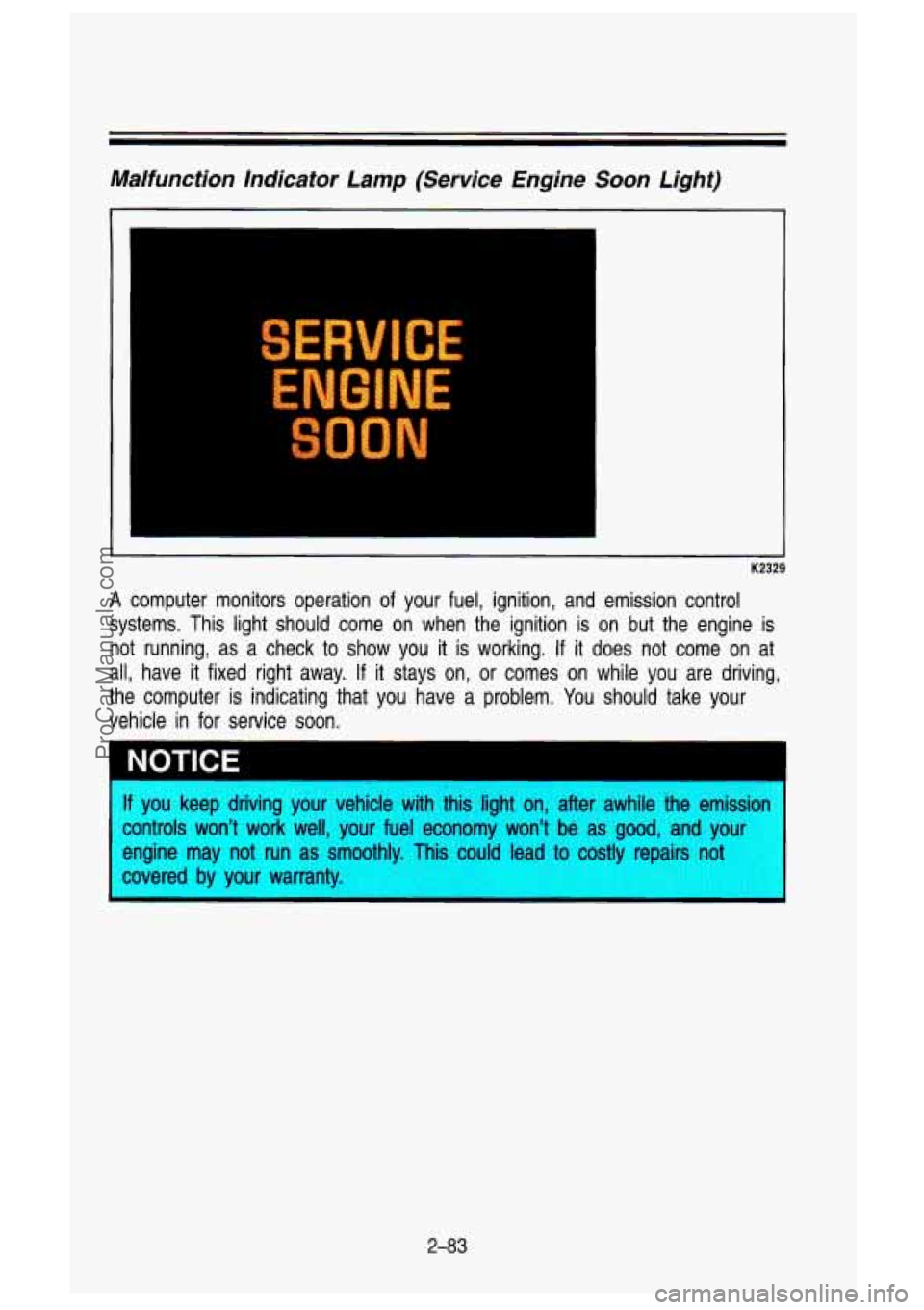
Malfunction Indicator Lamp (Service Engine Soon Light)
I
SERVICE
EF_'31NE
SOON
K2329
A computer monitors operation of your fuel, ignition, and emission control
systems. This light should come on when the ignition is on bu\
t the engine is not running, as a check to show you it is working. If it does not come on at
all, have it fixed right away.
If it stays on, or comes on while you are driving,
the computer is indicating that you have a problem. You should take your
vehicle in for service soon.
NOTICE
E
If you keep driving your vehicle with this light on, after awhile the emission
controls won't work well, your fuel economy won't be as good, and your
engine may not run as smoothly. This could lead
to costly repairs not
covered by your warranty.
2-83
ProCarManuals.com
Page 153 of 436
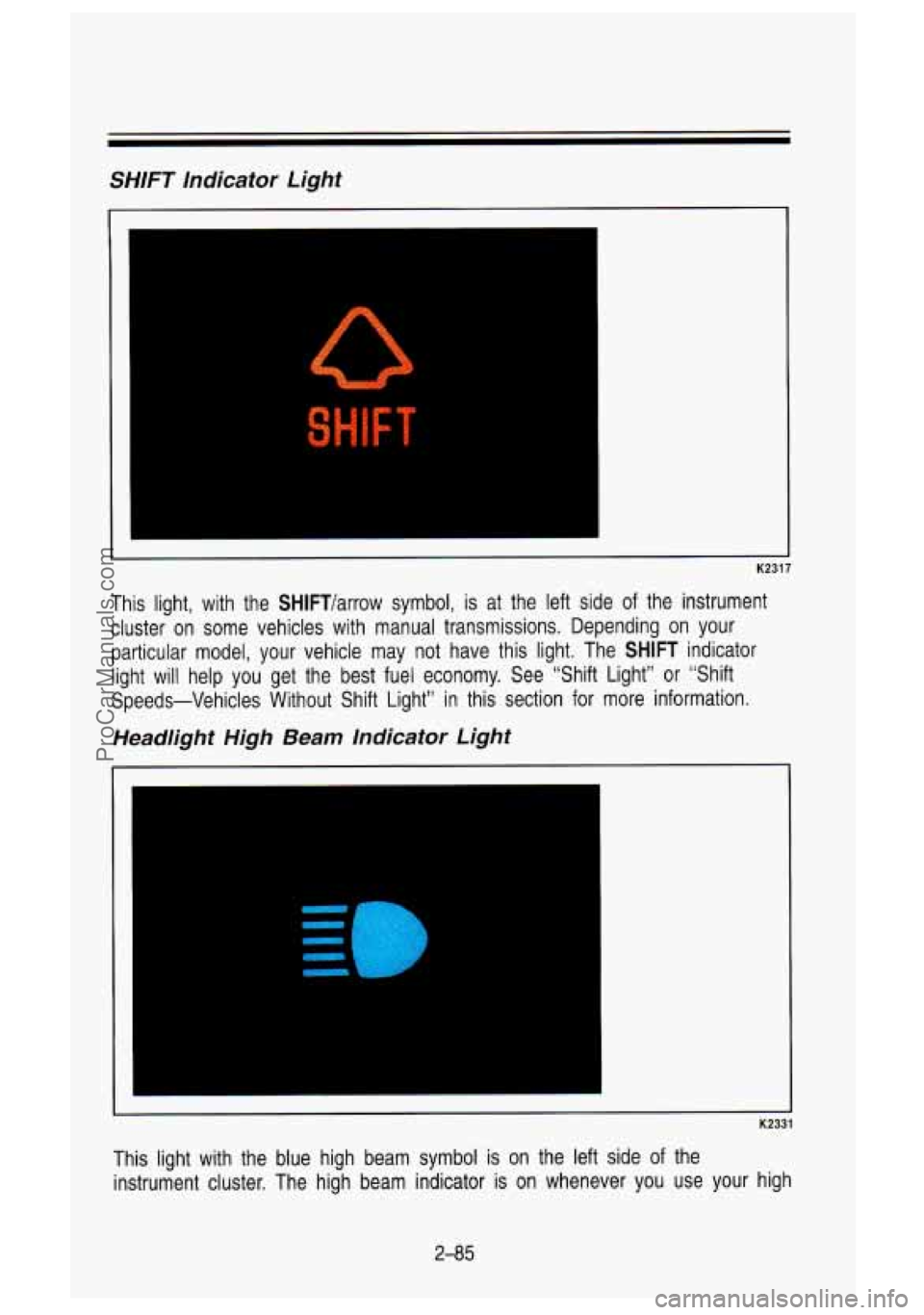
SHlFT Indicator Light
I
K2317
This light, with the SHlFTlarrow symbol, is at the left side of the instrument
cluster on some vehicles with manual transmissions. Depending on your
particular model, your vehicle may not have this light. The SH\
IFT indicator light will help you get the best fuel economy. See “Shift \
Light” or “Shift
Speeds-Vehicles Without Shift Light” in this section for more\
information.
Headlight High Beam Indicator Light
-4
K2331
This light with the blue high beam symbol is on the left sid\
e of the
instrument cluster. The high beam indicator is on whenever you \
use your high
2-85
ProCarManuals.com
Page 155 of 436
Gages
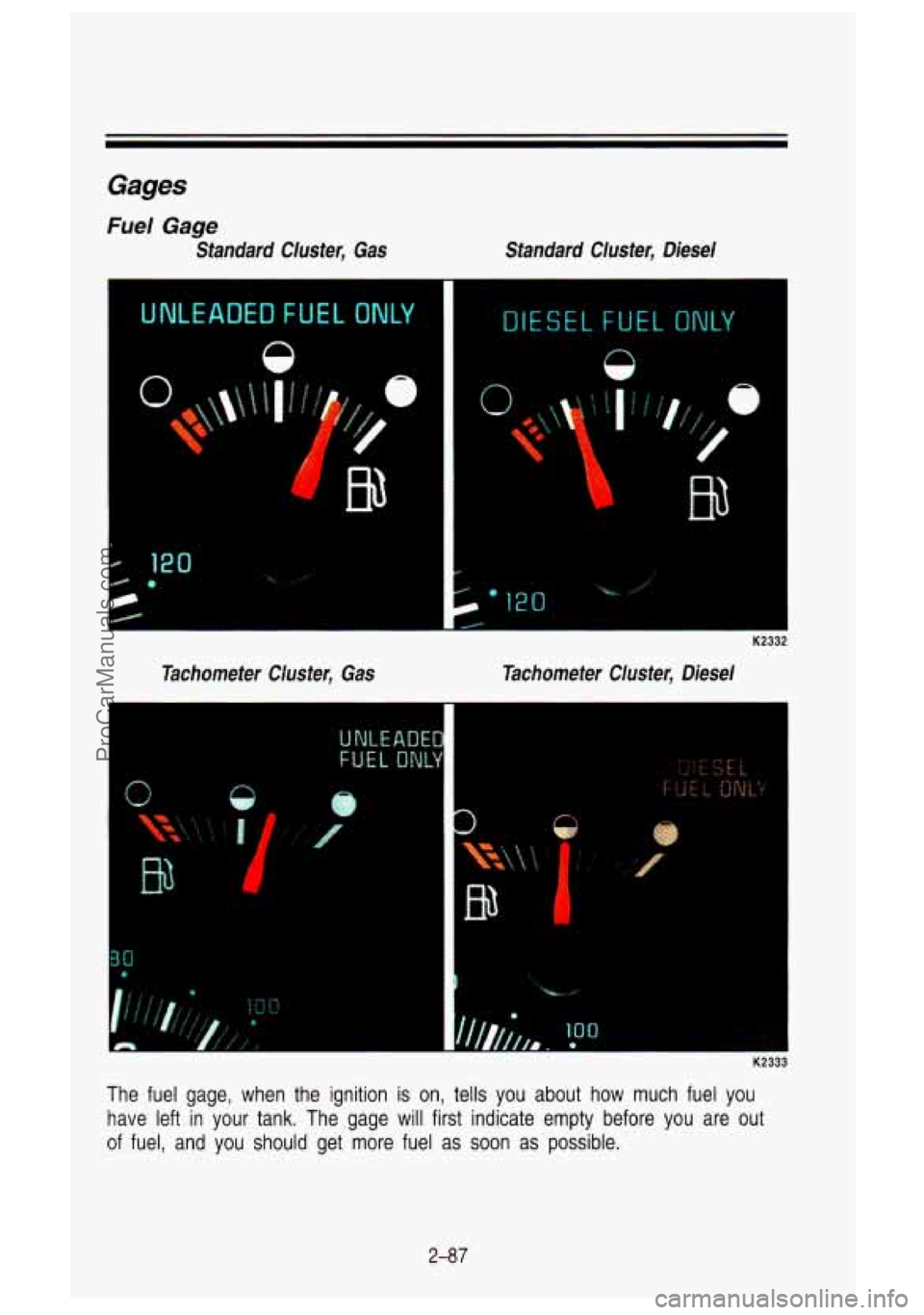
Fuel Gage
Standard Cluster, Gas Standard Clusfer, Diesel
ADED FUEL ONLY DtESEL FUEL ONLY
n
Tachometer Cluster, Gas Tachometer Cluster, Diesel
UNtE
FUEL
a
EL I
K2333
The fuel gage, when the ignition is on, tells you about how much fuel you
have left in your tank. The gage will first indicate empty be\
fore you are out
of fuel, and you should get more fuel
as soon as possible.
2-87
ProCarManuals.com
Page 156 of 436

Features & Controls
Listed are four situations you may experience with your fuel g\
age:
At the gas station, the fuel pump shuts off before the gage reads full.
It takes a little more or less fuel to fill up than the fuel gage indicated.
For example, the gage may have indicated the tank was half fu\
ll, but
it
actually took a little more or less than half the tank's capa\
city to fill the
tank.
The gage moves a little when you turn a corner or speed up. \
The gage doesn't go back to empty when you turn off the ignition.
None of these indicate a problem with the fuel gage.
For information on how to
fill your fuel tank see "Fuel-Filling Your Tank" in
the Index.
For your fuel tank capacity, see "Fuel-Tank Capacity"
in the Index.
Engine Coolant Temperature Gage
760
K2334
This gage shows the engine coolant temperature. If the gage pointer moves
into the red area, about 260°F
(145°C) or more, your engine is too hot! It
means that your engine coolant has overheated.
If you have been operating
your vehicle under normal operating conditions, you should pull \
off the road,
stop your vehicle and turn
off the engine as soon as possible.
Hot Coolant Can Burn You Badly!
In "Problems on the Road", this manual shows what to do. See \
"Engine
Overheating" in the Index.
2-88
ProCarManuals.com
Page 193 of 436

Most drivers treat their brakes with care. Some, however, overw\
ork the
braking system with poor driving habits.
Avoid needless heavy braking. Some people drive in spurts-heavy
acceleration followed by heavy braking-rather than keeping pace with
traffic. This is
a mistake. Your brakes may not have time to cool
between hard stops. Your brakes will wear out much faster
if you do a
lot of heavy braking.
Don’t “ride” the brakes by letting your left foot rest\
lightly on the brake
pedal while driving.
I
I
AM410001
CAUTION I
1 “Riding” your brakes can cause them to overheat to the point that
- they won’t work well. You might not be able to stop your vehicle in
time to avoid an accident. If you “ride” your brakes, they will get
so
hot they will require a lot of pedal force to slow you down. Avoid
“riding” the brakes.
NOTICE
“Riding” the brakes wears them out much faster. You would need costly
brake replacement much sooner than normal. and it also reduces fuel
economv.
4-1 5
ProCarManuals.com
Page 203 of 436
may not realize the surface is slippery until your vehicle is skidding. Learn to
recognize warning clues-such as enough water, ice
or packed snow on the
road to make a “mirrored surface’’-and slow down when you have \
any
doubt.
Remember: the rear wheel anti-lock braking system (RWAL) helps\
avoid only
a rear braking skid. In a braking skid (where the front wheels are no longer
rolling), release enough pressure on the brakes to get the front wheels rolling
again. This restores steering control. Push the brake pedal dow\
n steadily
when you have to stop suddenly.
As long as the front wheels are rolling, you
will have steering control. Steer the way you want to go.
Off-Road Driving with Your FourcWheel
Drive Vehicle
This off-road guide is for vehicles that have four-wheel drive. Also, see
“Anti-lock Brakes” in the Index.
If your vehicle doesn’t have four-wheel drive,
you shouldn’t drive off-road unless you’re on a level, so\
lid surface.
Off-road driving can be great fun. But it does have some defi\
nite hazards.
The greatest
of these is the terrain itself.
“Off-roading” means you’ve left the great North American\
road system behind.
Traffic lanes aren’t marked. Curves aren’t banked. There a\
re no road signs.
Surfaces can be slippery, rough, uphill
or downhill. In short, you’ve gone right
back
to nature.
Off-road driving involves some new skills. And that’s why it’s very important
that you read this guide. You’ll find many driving tips and suggestions. These
will help make your off-road driving safer and more enjoyable. \
Before You Go Off-Roading
There are some things to do before you go out. For example, be sure to
have all necessary maintenance and service work done. Be sure \
you read all
the information about your four-wheel drive vehicle in this manual.
Is there
enough fuel?
Is the spare tire fully inflated? Are the fluid levels up where
they should be? What are the local laws that apply to off-roa\
ding where you’ll be driving?
If you don’t know, you should check with law enforcement people\
in the area. Will you be on someone’s private land?
If so, be sure to get the
necessary permission.
4-25
ProCarManuals.com
Page 214 of 436

Your Driving and the Road
After Off-Road Driving
Remove any brush or debris that has collected on the underbody\
, chassis, or
under the hood. These accumulations can be a fire hazard.
After operation in mud or sand, have the brake linings cleaned\
and checked. These substances can cause glazing and uneven braking. Check th\
e body
structure, steering, suspension, wheels, tires, and exhaust syste\
m for damage.
Also, check the fuel lines and cooling system for any leakage.
Your vehicle will require more frequent service due
to off-road use. Refer to
Section
7 for additional information.
Driving at Night
I
--.
-
- AM450002 I
Night driving is more dangerous than day driving. One reason is that some
drivers are likely
to be impaired-by alcohol or drugs, with night vision
problems, or by fatigue.
Here are some tips on night driving.
Drive defensively. Remember, this is the most dangerous time.
Don’t drink and drive (See “Drunken Driving” in the Index for more on
this problem).
Adjust your inside rear view mirror to reduce the glare from headlights
Since you can’t see as well, you may need to slow down and keep
behind
you.
more space between you and other vehicles. It’s hard
to tell how fast
the vehicle ahead is going just
by looking at its taillights.
4-36
ProCarManuals.com
Page 223 of 436
 as extra warning that you are about to slow
down and ex")
close behind you, you can allow a little extra time and flash\
your brake lights (in addition to your turn signal) as extra warning that you are about to slow
down and exit.
The exit ramp can be curvea, somerlmes quite sharply. The exit\
speed is
usually posted. Reduce your speed according to your speedometer,\
not to
your sense of motion. After driving for any distance at higher\
speeds, you
may tend to think you are going slower than you actually are.\
For example,
40 rnph (65 km/h) might seem like only 20 mph (30 km/h). Obviously, this
could lead to serious trouble
on a ramp designed for 20 mph (30 kmlh)!
Driving a Long Distance
Although most long trips today are made on freeways, there are\
still many
made on regular highways.
Long-distance driving on freeways and regular highways is the s\
ame in some
ways. The trip has to be planned and the vehicle prepared, you drive at\
higher-than-city speeds, and there are longer turns behind the \
wheel. You’ll
enjoy your trip more
if you and your vehicle are in good shape. Here are
some tips for a successful long trip.
Before Leaving on a Long Trip
Make sure you’re ready. Try to be well rested. If you must start when you’re
not fresh-such as after a day’s work-don’t plan to make too many miles
that first part of the journey. Wear comfortable clothing and \
shoes you can easily drive in.
Is your vehicle ready for a long trip? If you keep it serviced and maintained,
it’s ready to go.
If it needs service, have it done before starting out. Of
course, you’ll find experienced and able service experts in \
your vehicle’s
dealerships all across North America. They’ll be ready and willing to help \
if
you need it.
Here are some things you can check before a trip:
Windshield Washer Fluid: Is the reservoir full? Are all windows clean
Wiper Blades: Are they in good shape?
Fuel, Engine Oil, Other Fluids: Have you checked all levels?
Lights: Are they all working? Are the lenses clean?
Tires: They are vitally important to a safe, trouble-free trip. Is the tread
good enough for long distance driving? Are the tires all inflated to the
recommended pressure? inside and outside?
445
ProCarManuals.com
Page 233 of 436
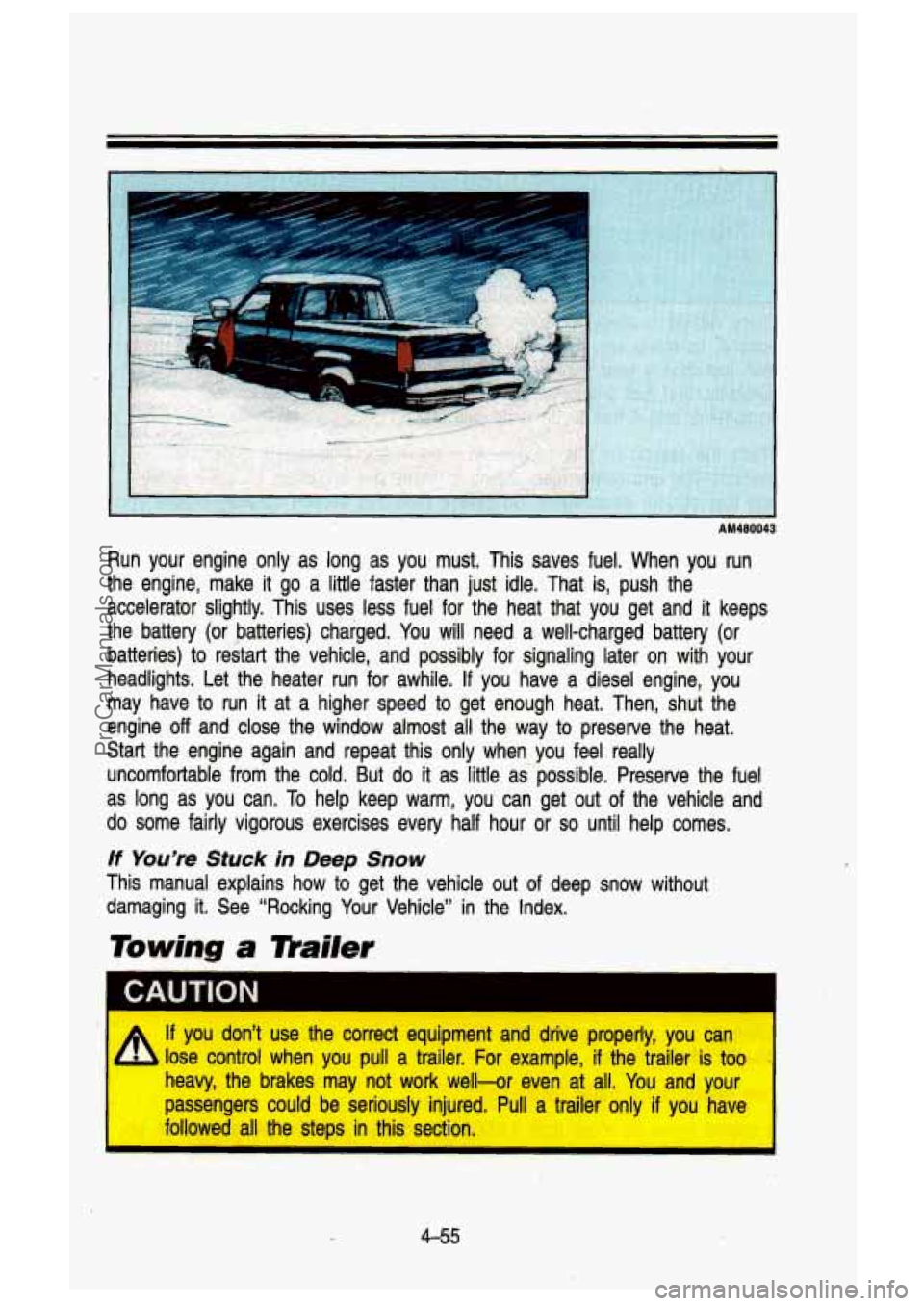
AM480043
Run your engine only as long as you musk. This saves fuel. When you run
the engine, make it go a little faster than just idle. That is, push the
accelerator slightly. This uses less fuel for the heat that yo\
u get and
it keeps
the battery (or batteries) charged. You will need a well-charged battery (or
batteries) to restart the' vehicle, and possibly for signaling later on with your
headlights. Let the heater run for awhile.
If you 'have a diesel engine, you
may have to run it at a higher speed
to lget enough heat. Then, shut the
engine
off and close the window almost all the way to preserve the heat.
Start the engine again and repeat this only when you feel really
uncomfortable from the cold. But
do it as little as'possible. Preserve the fuel
as long as you can.
To help keep warm, you can get out of the vehicle and
do some fairly vigorous exercises every half hour or so until help comes.
If You're Stuck in Deep Snow
This manual explains how to get the vehicle out of deep snow without
damaging it. See "Rocking Your Vehicle" in the Index.
Towing a mailer
CAUTION I
If you don't use the correct equipment and drive properly, you ca\
n
lose control when you pull a trailer. For example, if the trailer is too
heavy, the brakes may not work well-or even at all. You and your
passengers could be seriously injured. Pull a trailer only if \
you have
followed all the steps in this section.
I
i'- ." "
4-55
ProCarManuals.com