fuel GMC SIERRA 1993 Owners Manual
[x] Cancel search | Manufacturer: GMC, Model Year: 1993, Model line: SIERRA, Model: GMC SIERRA 1993Pages: 436, PDF Size: 23.88 MB
Page 14 of 436
How To Use This Manual
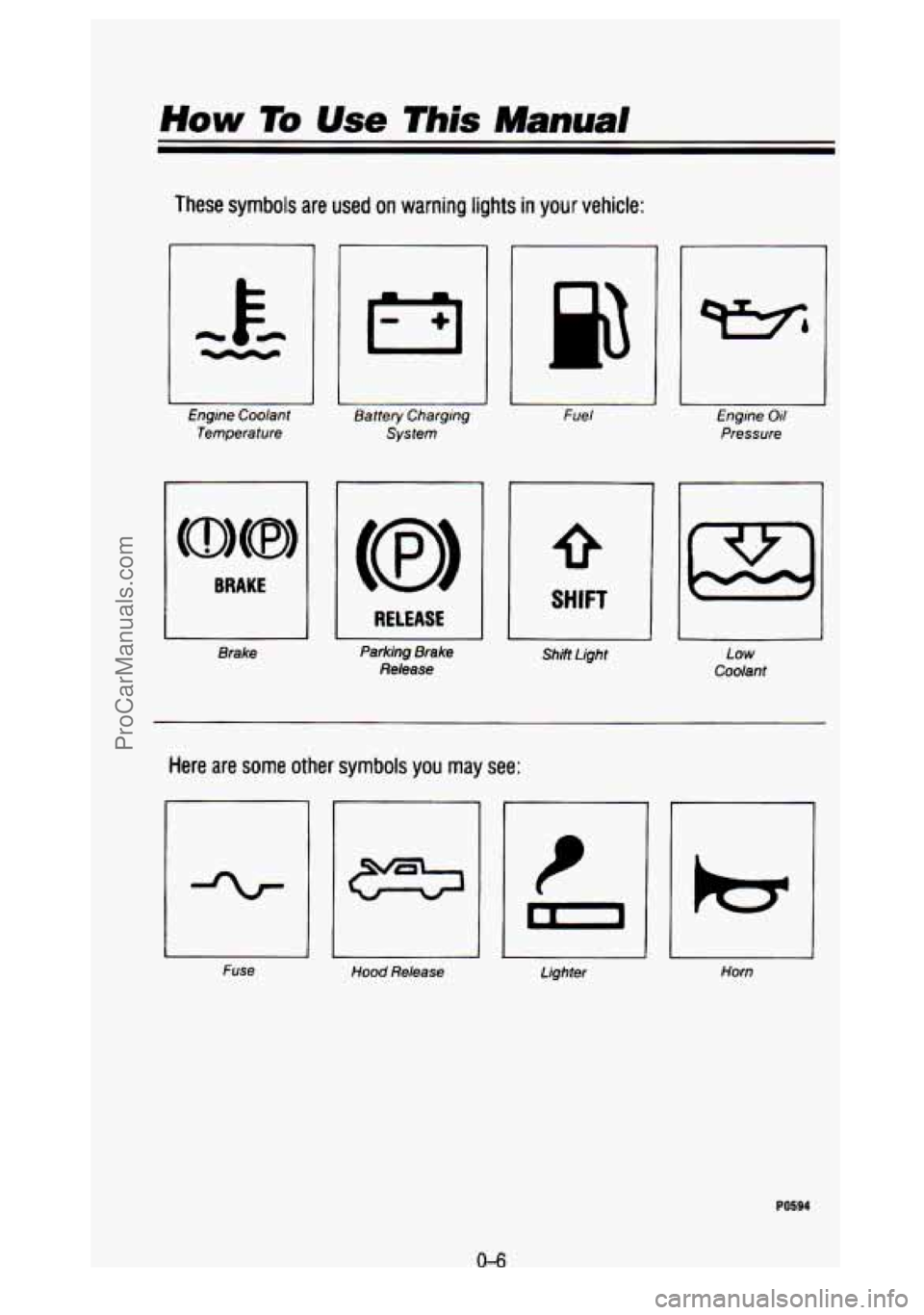
These symbols are used on warning lights in your vehicle:
1-
Engine Coolant Temperature
BRAKE
Brake Battery
Charging
System
I RELEASE
Parking Brake Release
s Fuel
SHIFT
Shift Light
Engine Oil
Pressure
Low
Coolant
Here are some other symbols you may see:
Fuse
I II
Hood Release Lighter Horn
PO594
0-6
ProCarManuals.com
Page 81 of 436

2. Don’t push the accelerator pedal before starting your engine.\
In some
other vehicles you might need to do this, but because of your vehicle’s
computer systems, you don’t.
key. The idle speed will go down as your engine gets warm.
3. Turn your ignition key to Start. When the engine starts, let go of the
Holding your key in
Start for longer than 15 seconds at a time will caus
your battery to be drained much sooner. And the :essive heal
m
damage your starter motor.
4.
5.
If it doesn’t start right away, hold your key in Start. If it doesn’t start in
three seconds, push the accelerator pedal about one-quarter of the way
down for
12 more seconds, or until it starts.
If your engine still won’t start (or starts but then stops), \
it could be
flooded with too much gasoline. Try this:
Wait
15 seconds to let the starter motor cool down. Then push your
accelerator pedal all the way to the floor. Hold it there. Then, hold the
key in
Start for no more than ten seconds. This clears the extra
gasoline from the engine.
If the engine still doesn’t start, wait another 15 seconds and do it all again.
When the engine starts, let go of the key and accelerator ped\
al.
Your engine is designed to work with the electronics in your vehicle.
If you
add electrical parts or accessories, you could change the way \
the fuel
injection system operates. Before adding electrical equipment, ch\
eck with
-w dealer. If you don’t, your engine might not perform properly
If you ever have to have your vehicle towed, see the part of th\
is Manua
that tells how to do
it wit‘--.Jt damaging your ?hide. See “Tc ‘ng Yo
Vehicle’’ in the lnde
To Start Your 5.7 Liter (Code K) engine
or 7.4 Liter (Code N) engine:
1. Automatic Transmission
Move your shift lever to P (Park) or N (Neutral). Your engine won’t start
in any other position-that’s a safety feature.
To restart when you’re
already moving,
use N (Neutral) only.
2-1 3
ProCarManuals.com
Page 83 of 436

When the engine starts, let go of the key and accelerator ped\
al. Your engine is designed to work with the electronics in your vehicle.
If you 1
add electrical parts or accessories, you could change the way the fuel
injection system operates. Before adding electrical equipment, ch\
eck with
your dealer. If you don’t, your engine might not perform properly.
If you ever have to have your vehicle towed, see the part of this Manu; .
that tells how to do it without damaging your vehicle. See “Towing Your
Vehicle” in the Index.
NOTICE I
If you -drive too quickly through deep puddles or standing water, water can
come
in through your engine’s air intake and badly damage your engin\
e. 1%-
you can’t avoid deep puddles or standing water, drive through very slowlv. I
--
Never drive through standing water more than 8 inches deep if yo~
vehicle has a diesel engine.
Also, don’t drive through any standing water
faster than
5 mph (8 kmh). If you do, water can be drawn in through the
air intake, and this can severely damage your engine.
-
Driving In Snow (Diesel Engines)
When driving in a heavy snowstorm or in swirling snow with a diesel engine,
snow can get into the air intake system.
If you keep driving in these
conditions, the air cleaner may get plugged, causing black smok\
e and
loss of
power. In an emergency,
if the air cleaner is plugged with snow, you can
remove the air cleaner. Then, drive to a place
of safety as soon as possible
and put the air cleaner back on.
Starting Your Diesel Engine
Your diesel .engine starts differently than a gasoline engine.
1. Automatic Transmission:
Move your shift lever to P (Park) or N (Neutral). Your engine won’t start
in any other position-that’s a safety feature.
To restart when you’re
already moving, use
N (Neutral) only.
2-1 5
ProCarManuals.com
Page 86 of 436

CAUTION
Plugging the cord into an ungrounded outlet could cause an ele\
ctrical
shock.
Also, the wrong kind of extension cord could overheat and
cause a fire. You could be seriously injured. Plug the cord into a
properly grounded three-prong
11 0-volt outlet. If the cord won’t reach,
use a heavy-duty three-prong extension cord rated for at least \
15
amps.
1 NOTICE
1 After you’ve used the block heater, be sure to store the cord in th~~~~
manner it was, to help keep it away from moving engine parts.\
If YOU
don’t, it could be torn and damaged.
~p@&%?yl~
How long should you keep tne MOCK neater plugged in? The answer depends
on the weather, the kind
of oil ,you have, and some other things. Follow this-
chart.
,.
ENGINE BLOCK HEATER USAGE”
Viscosity . 32’ $0 0°F ’ 0’ to -10°F ‘Belaw -1 0°F
Grade Oil (0” to &I S‘C) ’ ’ (-18’ to. -23°C) (B&w -23°C)
SAE Not Two Eight Hours
I OW-30 Required Hours or Overnight
SAE . Nit ’ . Two Eight Hours
15W-40 f3equired Hours or Overnight
..
* The times listed are minimum. times. It will not harm &her
the block heater
TO1 57
or the vehicle to leave it plugged in longer than the times stated. 3
For best results in cold weather, use Number I-D diesel fuel or a “winterized”
Number
2-D fuel.
If Your Diesel Engine Won’t- Start
If you’ve run out of fuel, look -at “Running Out Of Fuel” (see ‘‘Diesel Fuel
Requirements and Fuel System”
m the Index).
If you’re not out of fuel, and your engine won’t start, do this:
Turn y6ur ignition key
to Run. .Make sure that the GLOW PLUGS light is out.
Then turn
the ignition key to Stkrt while you ‘push the accelerator pedal
down.
2-1 8
ProCarManuals.com
Page 87 of 436
. If the light. doesn’t go off, wait a few seconds, then try staiting your engine
again. And, see your dealer
as soon as you- can for a starting system check.
If the light comes on and then goes out and you know your batte\
ries are
charged, but your engine still won’t start, your vehicle nee\
ds service.
If your batteries don’t have enough .charge to start ,your engine, see “Battery”
in the Index.
Be sure you have the right oil for your engine, and that you’ve changed the
oil
at the proper times. If you use the wrong oil, your engine may be harder
to start.
If the engine starts, runs a short time, then stops, your vehicle needs service.
NOTICE
Don’t use starting “aids” such as ether or gasoline, in the m~v intakc They
could damage your engine.
..- - .- * K2214
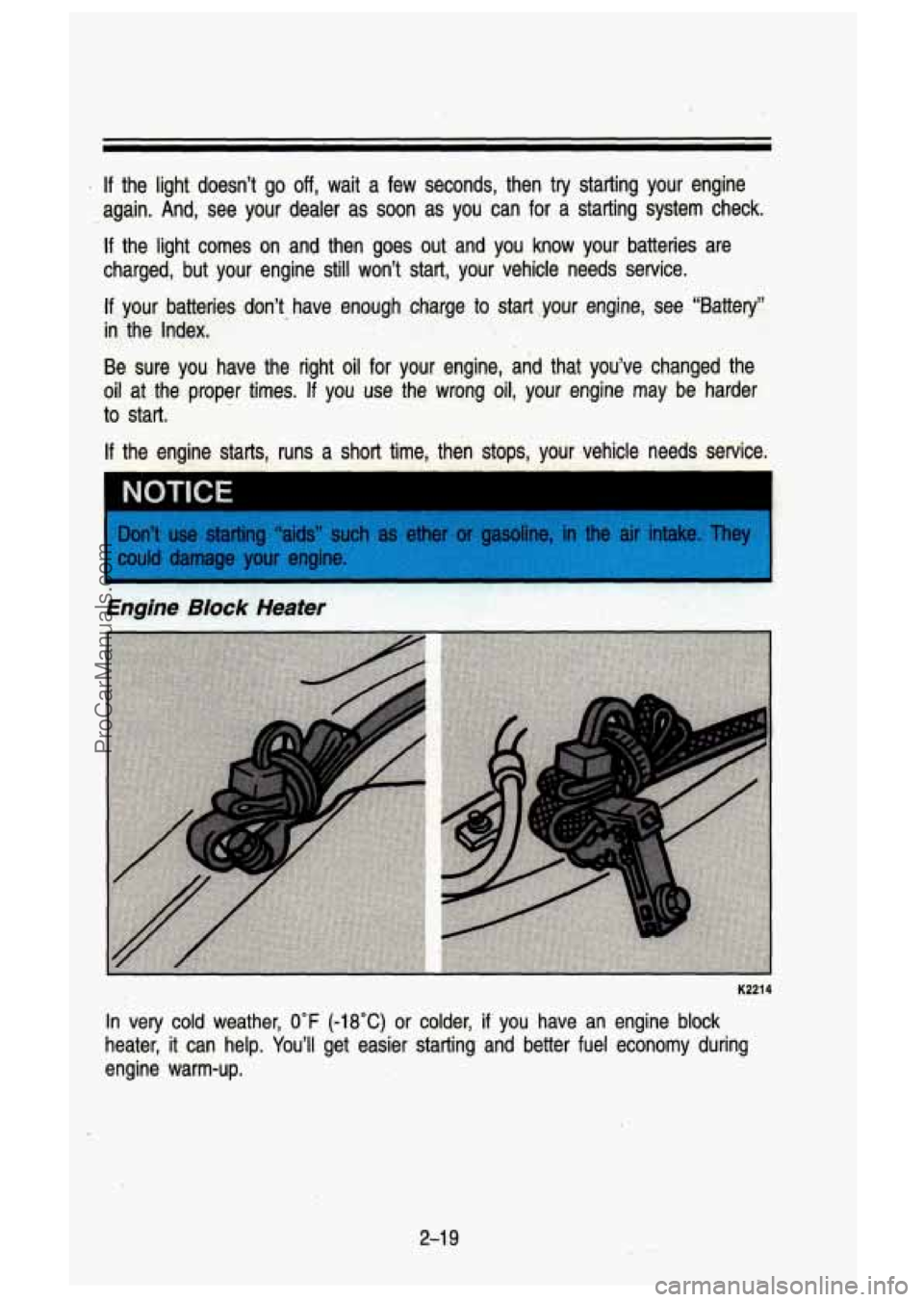
In very cold weather, 0°F (-18°C) or colder, if you have an engine block
heater, it can help. You’ll get easier starting and better fuel economy during
engine warm-up.
2-1 9
ProCarManuals.com
Page 91 of 436
D (Third Gear)
This is like
OD, but you never go into Overdrive. You should use D when
towing a trailer, carrying a heavy load, driving on steep hills, or for off-road
driving.
2 (Second Gear)
This position gives you more power but lower fuel economy. You can use
2
on hills. It can help control your speed as you go down steep mountain
roads, but then you would also want to use your brakes
off and on.
If you manually select 2, the transmission will drive in second gear. You may
use this feature for reducing torque to the rear wheels when you are trying
to
start your vehicle from a stop on slippery road surfaces.
1 (First Gear)
This position gives you even more power (but lower fuel econo\
my) than
2.
You can use it on very steep hills, or in deep snow or mud. If the selector
lever
is put in 1, the transmission won’t shift into first gear until the vehic\
le is
going slowly enough.
NWTIGE
If your rear wheels can’t rotate, don’t try to drive. This might happen if
you were stuck in very deep sand or mud or were up against a. solid
object. You could damage your transmission.
AWZ , <,*,~l,<.,. ...
Also, if you stop when going uphill, don’t hold your vehic there with only the
accelerator pedal.
This could overheat and damage ,the transmission. Use your
brakes or shii into P (Park) to hdd your vehicle in position on a hill.
.,$*’,,&:&> ._,, , . ~ ~ ,>&:a
2-23
ProCarManuals.com
Page 95 of 436
.
N (")
To Stop-Let up on the accelerator pedal and press the brake pedal\
. Just
before the vehicle stops, press the clutch pedal and the brake pedal, and
shift to
N (Neutral).
N (Neutral)-Use this position when you start or idle your engine.
R (Reverse)-To back up, press the clutch pedal and shift into R. Let up on
the clutch pedal slowly while pressing the accelerator pedal. If you shift from
OD into R, the shift lever must first be placed in the N (Neutral) position
centered between
2 and 3 prior to shifting into R.
NOTICE I
Shift to R (Reverse) only after your vehicle is stopped. Shifting to R
(Reverse) while vour vehicle is movina could damaae vour transmission.
- -
Also, use Reverse, along with the parking brake, for parking your ve\
hicle.
Shift Light
I K2317
If you have a manual transmission, you may have a SHIFT light. This light
will show you when to shift to the next higher gear for best fuel economy.
When this light comes on, you can shift to the next higher gear
if weather,
road and traffic conditions let you. For the best fuel economy, accelerate
slowly and shift when the light comes on.
While you accelerate, it is normal for the light to go on and
off if you quickly
change the position
of the accelerator. Ignore the SHIFT light when you
downshift.
2-27
ProCarManuals.com
Page 96 of 436

Features & Controls
Four-Wheel-Drive Vehicles Only: If your vehicle has four-wheel drive and is
equipped with a manual transmission, disregard the shift light \
when the
transfer case is in
4 LOW.
Shift Speeds-Manual Transmission
This chart shows when to shift to the next higher gear for best fuel economy.
MANUAL TRANSMISSION RECOMMENDED SHIFT SPEED
IN MPH (KMIH)
Engine
and
VIN
45-50 25-40 50 40 15
4,3L
V6
3 to 4 2 to 3 1 to 2 3 to 4 2 to 3 1 to 2 Code
Trans. Cruise Shift Speed
Acceleration Shift Speed
(4
- (64) (40) (24) (K)
(72-80)
(40-64) - (80) (64)
(24)
5-Speed*
40 25 15 5.7L V8
- -
* Transmission with L (low) gear only. L (low) is intended for heavy loads and
is not recommended for normal driving.
I TO1 61 I
If your speed drops below 20 mph (32 km/h), or if the engine is not running
smoothly, you should downshift to the next lower gear. You may have to
downshift two or more gears
to keep the engine running smoothly or for good
performance.
I A If you skip more than one gear when you downshift, you could lose
I & control of your vehicle: And you could injure yourself or others. I
I Ju skip more than one gear when you downshift, or if you race the
;,,,ine when you downshift, you can damage the clutch or transmission. \
I
Locking Rear Axle
If you have this feature, your rear axle can give you additional \
traction on
snow, mud, ice, sand or gravel.
It works like a standard axle most of the
time,
but when one of the rear wheels has no traction and the other does,
the locking feature
will allow the wheel with traction to move the vehicle.
2-28
ProCarManuals.com
Page 106 of 436
Featwes & Contmk
The front axle portion of the indicator diagram will light up when you shift into
four-wheel drive.
A slight delay between shifting and the indicator’s lighting is
normal.
If the indicator does not light up, or if the front axle light does not go
out after you shift out of four-wheel drive, have your dealer check your
system.
When your headlights or parking lights are on, rotate the dial\
to the right of
your headlight switch up
to brighten, or down to dim, your transfer case
indicator light.
Transfer Case Shift Positions
2H (High): This setting is for driving in most street and highway situations.
Your front axle is not engaged in two-wheel drive.
4H (High): This setting engages your front axle to help drive your vehicle.
Use
4H when you need extra traction, such as on wet or icy roads, or in
most
off -road situations.
N (Neutral): Shift to this setting only when your vehicle needs to be towed or
when using a power take
off.
4L (Low): This setting also engages your front axle to give you extra traction,
but should be used only for off-road or on extremely slippery surfaces.
You can shift from
2H to 4H or from 4H to 2H while the vehicle is moving.
Your front axle will engage faster
if you take your foot off of the accelerator
for a few seconds after you shift. In extremely cold weather it may be
necessary to stop or slow the vehicle to shift out of
2H.
To shift into or out of 4L or N (Neutral):
1. Slow the vehicle to a roll, about 3 mph (5 kmlh) and shift your
2. Shift the transfer case shift lever in one continuous motion.
transmission into neutral.
Don’t pause in
N (Neutral) as you shift the transfer case into 4L, or your
aears could clash.
Kernember that driving
in 4H or 4L may reduce fuel economy. Also, driving in
four-wheel drive on dry pavement could cause your tires to wea\
r faster and
make your transfer case harder
to shift.
Front Axle Locking Feature
The front axle locks and unlocks automatically when you shift the transfer
case.
A slight delay for the axle to lock or unlock is normal. If the outside
temperature is very hot, or the vehicle has been used under hard driving
conditions, there may be a slight delay for the axle to unlock.
2-38
ProCarManuals.com
Page 144 of 436

Features & Contmls
Instrument CIuster
Your instrument cluster is designed to let you know at a glance how your
vehicle is running. You’ll know how fast you’re going, ab\
out how much fuel
you have and many other things you’ll need to know to driv\
e safely and economically.
Tachometer Cluster
If you have the tachometer cluster, it looks different but will t\
ell you
everything the standard cluster does, with the addition
of displaying your
engines revolutions per minute (rpm).
Speedometer and Odometer
K2322
Your speedometer lets you see your speed in both miles per hour (\
mph) and
kilometers per hour (kmlh). Your odometer shows how far your vehicle has
been driven, in either miles (used in the U.S.) or kilometers (used in
Canada).
If you have the Sport Performance Model (RPO B4U), your speedome\
ter
reading will
go to 110 mph (1 80 km/h).
Tamper-Resistant Odometer
Your odometer is tamper-resistant. The odometer will show silver line\
s
between the numbers
if someone tries to turn it back.
You may wonder what happens
if your vehicle needs a new odometer
installed.
If the new one can be set to the mileage total of the old odometer,
then it must be. But
if it can’t, then it’s set at zero, and a label must be p\
ut
2-76
ProCarManuals.com