parking brake GMC SIERRA 1993 User Guide
[x] Cancel search | Manufacturer: GMC, Model Year: 1993, Model line: SIERRA, Model: GMC SIERRA 1993Pages: 436, PDF Size: 23.88 MB
Page 103 of 436
Running Your Engine While You%
Parked [Automatic mansmission)
It’s better not to park with the engine running. But if you ever have to, here
are some things
to know.
1 CAUTION I
* Idling the engine with the air system control off could allow
‘ jangerous exhaust into your vehicle. (See the earlier Caution under
**A :E ..:i *; !.< .. 5;:. ::.; ,$+ : ‘Engine Exhaust”.) ~~-?~c-~~~~~=~~:-
Also, Idling in a closed-in place can let deadly oxide (CO)
nto your vehicle, even if the fan switch is at the highest setting. One
place this can happen
is a garage. Exhaust-with co--( -% -c ?& 2asily. NEVER park in a garage with the engine runni
?-! 4nother ,I: -‘i closed-in place can be a blizzard. (See “Blizzard“ in th
Index.)
CAUTION
It can be dangerous to get out of your vehicle if the shift lever is not
L fully in P (Park) with the parking brake firmly set. Your vehicle can
roll. Don’t leave your vehicle when the engine is running unless
you
have to. If you’ve left the engine running, the vehicle can move
suddenly. You
or others could be injured. To be sure your vehicle
won’t move, even when you’re on fairly level ground,, alw\
ays
set your
parking brake and move the shift lever to
P (Park).
I
If you have four-wheel drive and your transfer case is in N (Neutral},
your vehicle
will be free to roll, even if your shift lever is in P (Park),
So, be sure the transfer case is in a drive gear-not in N (Neutral).
Foliow the proper -steps to be sure your vehicle won’t move. -See
“Shifting Into P (Park)” in the Index.
If you are parking on a hill, or if you’re pulling- -a- trailer, also see
“Parking on Hilis”-.or “Towing -a Trailer”‘ in the Index.
235
ProCarManuals.com
Page 104 of 436
Features & Contmls
Four- Wheel Drive
CAUTION I
It can be dangerous to get out of your vehicle if the shift lever -is not
fully in
P (Park) with the parking brake firmly set. Your vehicle can
roll. Don’t leave your vehicle when the engine is running unless you
have
to. If you’ve left the engine running, the vehicle can ‘move
suddenly. You or -others could be injured.
To be sure your vehicle
won’t move, even when you’re on fairly level ground, always
set your
parking brake and move the shift lever
to P (Park).
If you have four-wheel drive and your transfer case is in N (Neutral),
your vehicle
will be free to roll, even if your shift lever is in P’(Park).
So, be sure the transfer case is in a drive gear-not in N (Neutral).
Follow the proper steps
to be suce your vehicle won’t move. See
“Shifting Into
P (Park)” in the Index.
If you are parking on a hill, or if you’re pulling a trailer, also see
“Parking ‘on Hills’’ or “Towing a Trailer” in this section.
I
If your vehicle has four-wheel drive, you can send your engine’\
s driving power
to all four wheels for extra traction. To get the most satisfaction out of
four-wheel drive, you must be familiar with it’s operation. \
Read the part that
follows before using four-wheel drive. You should use
2H for most normal
driving conditions.
Rear-wheel antilock brakes
do not work when you shift into four-wheel drive.
Your regular brakes will still work. When you shift back into two-w\
heel drive,
your rear-wheel antilock brakes will take over again.
I NOTICE
Driving in the 4H or 4L positions for a long time on dry or wet pavement
could shorten the life
of your vehicle’s drivetrain.
2-36
ProCarManuals.com
Page 123 of 436
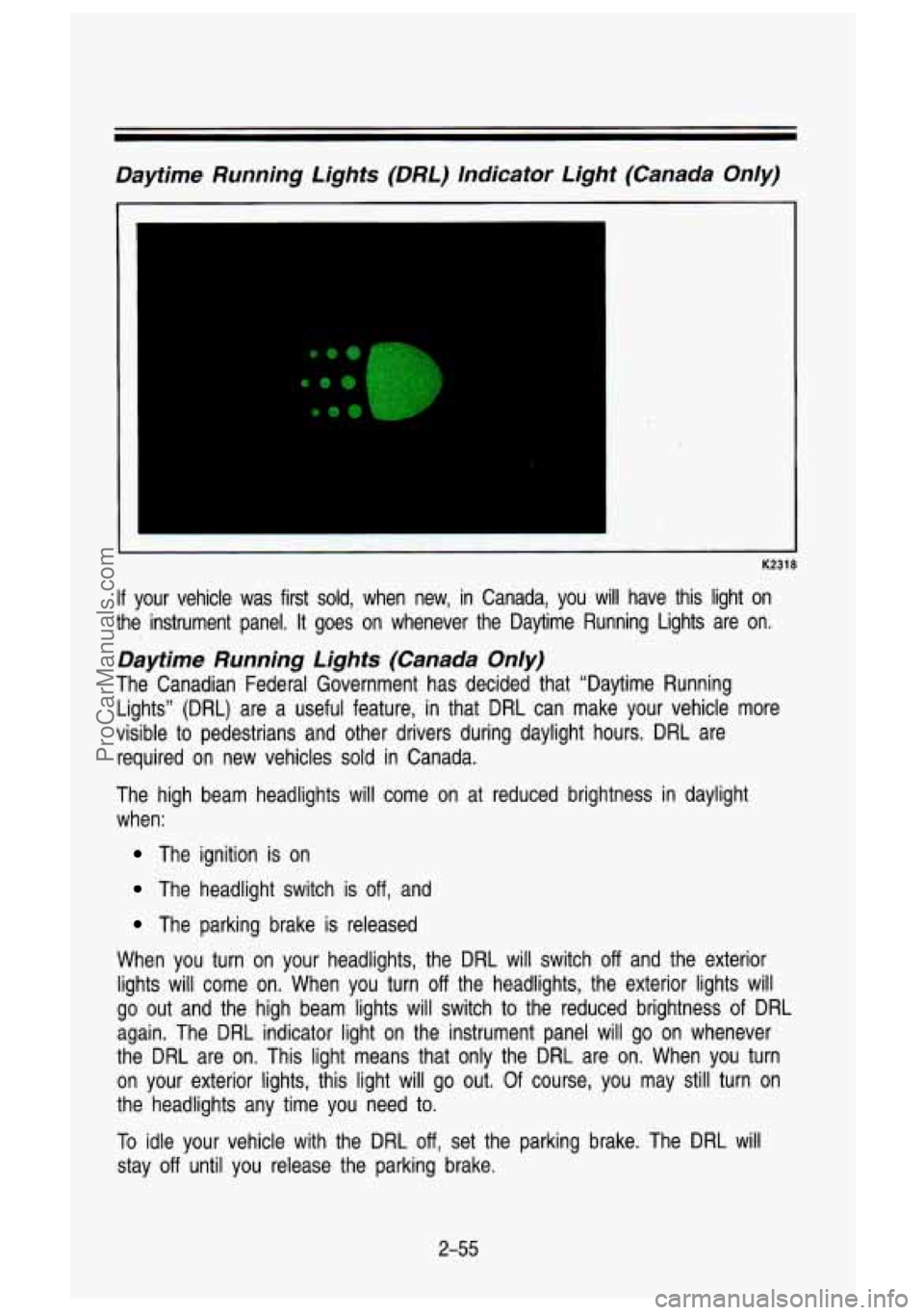
Daytime Running Lights (DRL) Indicator Light (Canada Only)
K2318
If your vehicle was first sold, when new, in Canada, you will have this light on
the instrument panel. It goes on whenever the Daytime Running \
Lights are on.
Daytime Running Lights (Canada Only)
The Canadian Federal Government has decided that “Daytime Run\
ning
Lights” (DRL) are a useful feature, in that
DRL can make your vehicle more
visible to pedestrians and other drivers during daylight hours. DRL are
required on new vehicles sold in Canada.
The high beam headlights will come on at reduced brightness in daylight
when:
The ignition is on
The headlight switch is off, and
The parking brake is released
When you turn on your headlights, the DRL
will switch off and the exterior
lights will come on. When you turn
off the headlights, the exterior lights will
go out and the high beam lights will switch to the reduced brightness
of DRL
again. The DRL indicator light on the instrument panel will go\
on whenever
the DRL are on. This light means that only the DRL are on. When you turn
on your exterior lights, this light will go out.
Of course, you may still turn on
the headlights any time you need to.
To idle your vehicle with the DRL off, set the parking brake. The DRL will
stay
off until you release the parking brake.
2-55
ProCarManuals.com
Page 147 of 436
you know they’re working. If you are familiar. with this section, you should not
be alarmed when this happens.
Gages can indicate when there may be or is _a problem with one of your
vehicle’s functions. Often gages and warning lights work together
to let you
know when there’s a problem with your vehicle.
When one of the warning lights comes on and stays on when yo\
u are driving, or when one of the gages shows there may be a probl\
em, check the
section that tells you what to do about it. Please follow the\
manual’s advice.
Waiting to do repairs can be costly-and even dangerous.
So please get to
know your warning lights and gages. They’re a big help.
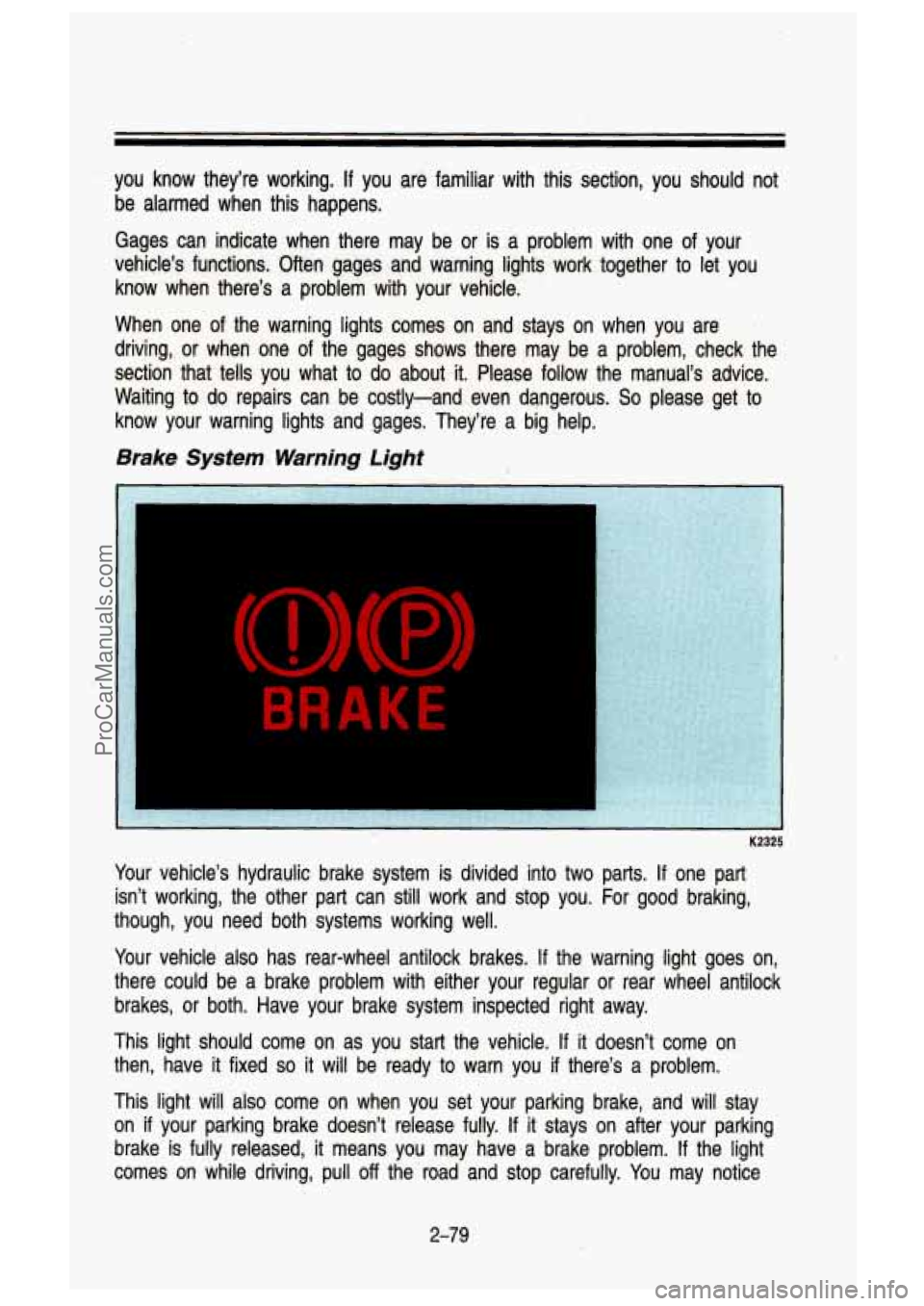
Brake System. Warning Light
BRAKE
. , K2325
Your vehicle’s hydraulic brake system is divided into two parts. If ,one‘ part
isn’t working, the other part can still work and stop you. \
For good braking,
though, you need both- systems working well.
Your vehicle also has rear-wheel antilock brakes.
If the warning light goes on,
there could be a brake problem with either your regular or rear wheel antilock
brakes, or both. Have your brake system inspected right away.
This light should come on as you start the vehicle.
If it doesn’t come on
then, have
it fixed so it will be ready to warn you if there’s a problem.
This light
will also come on when you set your parking brake, and will stay
on
if your parking brake doesn’t release fully. If it stays on after your parking
brake is fully released,
it means you may ‘have a brake problem. If the light
comes on while driving, pull
off the road and stop carefully. You may notice
2-79
ProCarManuals.com
Page 188 of 436

Your Driving and the Road
Defensive Driving
The best advice anyone can give about driving is: Drive defens\
ively. Please start with a very important safety device in your vehicle: Buckle up,
(See “Safety Belts” in the Index.)
Defensive driving really means “be ready for anything.” On\
city streets, rural
roads, or freeways, it means “always expect the unexpected.’’
Assume that pedestrians or other drivers are going to be carel\
ess and make mistakes. Anticipate what they might
do. Be ready for their mistakes.
Expect children to dash out from behind parked cars, often fol\
lowed by other
children. Expect occupants in parked cars to open doors into traffic. Watch for
movement
in parked cars-someone may be about to open a door,
Expect other drivers to run stop signs when you are on a through street, Be
ready to brake
if necessary as you go through intersections. You may not
have to use the brake, but
if you do, you will be ready,
If you’re driving through a shopping center parking lot where there are
well-marked lanes, directional arrows, and designated parking are\
as, expect
some drivers to ignore all these markings and dash straight to\
ward one part
of the lot.
Pedestrians can be careless. Watch for them. In general, you must give way
to pedestrians even
if you know you have the right of way.
Rear-end collisions are about the most preventable of accidents. Yet they are
common. Allow enough following distance.
It’s the best defensive driving
maneuver, in both city and rural driving. You never know when the vehicle in
front of you is going to brake or turn suddenly.
Here’s a final bit of information about defensive driving. The most dangerous
time for driving in the
US. is very early on Sunday morning. In fact, GM
Research studies show that the most and the least dangerous times for
driving, every week, fall on the same day. That day is Sunday. The most
dangerous time is Sunday
3 a.m. to 4 a.m. The safest time is Sunday from
10 a.m. to 11 a.m. Driving the same distance on a Sunday at 3 a.m. isn’t
just a little more dangerous than it
is at 10 a.m. It’s about 134 times more
dangerous.
That leads to the next part.
4-1 0
ProCarManuals.com
Page 208 of 436
Your Driving and the Road
A Turning or driving across steep hills can be dangerous. You could
lose traction, slide sideways, and possibly roll over. You could be
seriously injured or
I 'I' ?d. When driving up hills, always try to go
I straight up.
Ease up on your speed as you approach the top of the hill.
Attach a flag to the vehicle to make you more visible to approaching
traffic on trails or hills.
Sound the horn as you approach the top of hill to let opposing traffic
know you're there.
Use your headlights even during the day. They make you more visible to
oncoming traffic.
I A Driving to the top (crest) of a hill at full speed can muse an
accident.
There could be a drop-off, embankment, cliff, or even
another vehicle. You buld be seriously injured or killed. .As you near
the
top of a hill, slow down and stay alert. I
Q: What should I do if my vehicle stalls, or is about to stall, and I can't
make it
up the hill?
A: If this happens, there are some things you should do, and there are some
things
you must not do. First, here's what you should do:
0
0
0
0
Push the brake pedal to stop the vehicle and keep it from rolling
backwards.
Also, apply the parking brake.
If your engine is still running, shift the transmission into reverse, release
the parking brake, and slowly back down the hill in reverse.
If your engine has stopped running, you'll need to restart it. With the
brake pedal depressed and the parking brake still applied, shift the
transmission to
P (Park) (or, shift to N (Neutral) if your vehicle has a
manual transmission) and restart the engine. Then, shift to Reverse,
release the parking brake, and slowly back down the hill in reverse.
As you are backing down the hill, put your left hand on the ste\
ering
wheel at the
12 o'clock position. This way, you'll be able to tell if your
wheels are straight or turned to the left or right as you back down.
4-30
ProCarManuals.com
Page 209 of 436
Here are some things you must not do if you stall, or are about to stall,
when going up a hill.
Never attempt to prevent a stall by shifting into N (Neutral) (or
depressing the clutch,
if you have a manual transmission) to “rev-up” the
engine and regain forward momentum. This won’t work. Your vehicle will
roll backwards very quickly and you could go out of control.
Instead, apply the regular brake to stop the vehicle. Then apply the parking
brake. Shift into reverse, release the parking brake, and slowl\
y back down.
Never attempt to turn around if you are about to stall when going up a
hill. If the hill is steep enough to stall your vehicle, it’s steep enough to
cause you. to roll over
if you turn around. If you can’t make it up the
hill, you must back down the hill.
Q: Suppose, after stalling, I try to back down the hill and decide I just
can’t
do it. What should I do?
A: Set the parking brake, put your transmission in P (Park) (or the manual
transmission in first gear), and turn off the engine. Leave the vehicle and \
go
get some help. Exit on the uphill side and stay clear of the\
path the vehicle
would take
if it rolled downhill. Do not shift the transfer case to N (Neutral)
when you leave the vehicle. Leave it in some gear.
Shifting the transfer case to
N (Neutral) can cause your vehicle to
roll even
if the transmission is in P (Park) (or, if you have the
manual transmission, even
if you’re in gear). This is because the N
(Neutral) position on the transfer case overrides the transmis\
sion. If
you are going to leave your vehicle, set the parking brake and shi”
the transmission to
P (Park) (or, put your manual transmission in f
gear). But do not shift the transfer case to the N (Neutral) positior
Leave the transfer case in the
2 Wheel, 4 High or 4 Low position.
1
Lriving Downhill
When off-roading takes you downhill, you’ll want to consider a number of
things:
How steep is the downhill? Will
I be able to maintain vehicle control?
What’s the surface like? Smooth? Rough? Slippery? Hard-packed \
dirt? Grave
I?
Are there hidden surface obstacles? Ruts? Logs? Boulders?
What’s at the bottom
of the hill? Is there a hidden creek bank or even a
river bottom with large rocks?
4-31
ProCarManuals.com
Page 210 of 436

Your Driving and the Road
If you decide you can go down a hill safely, then try to keep your vehicle
headed straight down, and use a low gear. This way, engine dr\
ag can help
your brakes and they won’t have to do
all the work. Descend slowly, keeping
your vehicle under control at all times.
CAUTION
A Heavy braking when going down a hill can cause your brakes to
overheat and fade. This could cause
loss of control and a serious ‘
accident. Apply the brakes lightly when descending a hill and use a
low gear to keep vehicle speed under
control.
Q: Are there some things I should not do when driving down a hili?
A: Yes! These are important because if you ignore them you could lose
control and have a serious accident.
When driving downhill, avoid turns that take you across the in\
cline of the
hill.
A hill that’s not too steep to drive down may be too steep to drive
across. You could
roll over if you don’t drive straight down.
Never go downhill with the transmission in N (Neutral), or with the clutch
pedal depressed in a manual shift. This is called “free-whee\
ling,” Your
brakes will have
to do all the work and could overheat and fade.
Avoid braking so hard that you lock the wheels when going downhill. If
your front wheels are locked, you can’t steer your vehicle. \
If your wheels
lock up during downhill braking, you may feel the vehicle star\
ting to slide
sideways.
To regain your direction, just ease off the brakes and steer to
keep the front of the vehicle pointing straight downhill.
Q: Am I likely to stall when going downhill?
A: It’s much more likely to happen going uphill. But if it happens going
downhill, here’s what to do.
Stop your vehicle by applying the regular brakes. Apply the pa\
rking
brake.
Shift to P (Park) (or to Neutral with the manual transmission) and, while
still braking, restart the engine.
Shift back to a low gear, release the parking brake, and drive straight
down.
If the engine won’t start, get out and get help.
4-32
ProCarManuals.com
Page 227 of 436

Parking on Hills
AM470025
Hills and mountains mean spectacular scenery. But please be car\
eful where
you stop
if you decide to look at the view or take pictures. Look for pull-offs
or parking areas provided for scenic viewing.
Another part
of this manual tells how to use your parking brake (see “Parking
Brake” in the Index). But on a mountain or steep hill, you can
do one more
thing. You can turn your front wheels to keep your vehicle from rolling
downhill or out into traffic.
Here’s how:
Downhill Parking
-_ .
AM470031
Turn your wheels to the right.
4-49
ProCarManuals.com
Page 229 of 436
AM470053
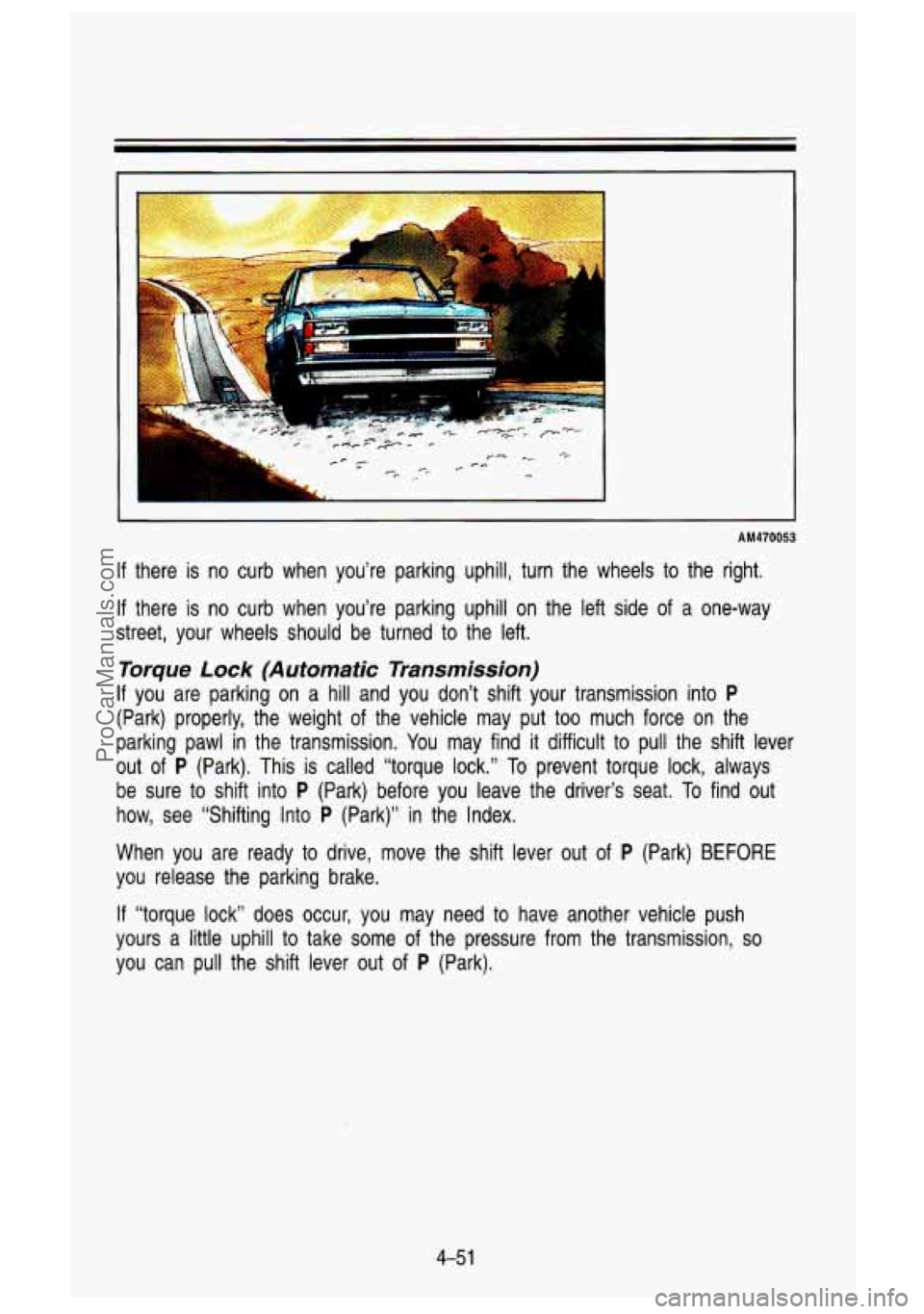
If there is no curb when you’re parking uphill, turn the wheels to the right.
If there is no curb when you’re parking uphill on the left side of a one-way
street, your wheels should be turned to the left.
Torque Lock (Automatic Transmission)
If you are parking on a hill and you don’t shift your tra\
nsmission into P
(Park) properly, the weight of the vehicle may put too much force on the
parking pawl in the transmission. You may find it difficult to pull the shift lever
out of
P (Park). This is called “torque lock.” To prevent torque lock, always
be sure to shift into
P (Park) before you leave the driver’s seat. To find out
how, see “Shifting Into
P (Park)” in the Index.
When you are ready to drive, move the shift lever out
of P (Park) BEFORE
you release the parking brake.
If “torque lock” does occur, you may need to have another vehicle push
yours a little uphill to take some of the pressure from the transmission,
so
you can pull the shift lever out of P (Park).
4-5 1
ProCarManuals.com