tire pressure GMC SIERRA 1993 User Guide
[x] Cancel search | Manufacturer: GMC, Model Year: 1993, Model line: SIERRA, Model: GMC SIERRA 1993Pages: 436, PDF Size: 23.88 MB
Page 353 of 436
- Inflation pressures should never exceed 10 psi (70 kPa) above the
inflation specified for the maximum load of the tire.
If you have 19.5 inch radial tires on your vehicle, and:
- You’ll be driving for very long at speeds of 66 mph (105 km/h) to 70
mph (110 km/h) where legal, inflate tires- to 5 psi (35 kPa) more than
the recommended cold inflation pressures and reduce axle load
capacity by 4%.
- You’ll be driving for very long at speeds of 71 mph (1 15 km/h) to 75
mph (120 kmlh) where legal, cold inflation pressures should be
increased by
5 psi (35 kPa) and you must also reduce axle load
capacity by
12% Do not drive over 75 mph (120 kmh) even if it’s
legal.
inflation specified for the maximum load of the tire.
- Inflation pressures should never exceed 20 psi (140 kPa) above the
For special operating conditions, such as carrying a slide-in c\
amper,
increase recommended cold tire pressures
by 10 psi (70 kPa).
6-75
ProCarManuals.com
Page 356 of 436
Service & Appearance Cam
Tire lnspecfion and Rotation
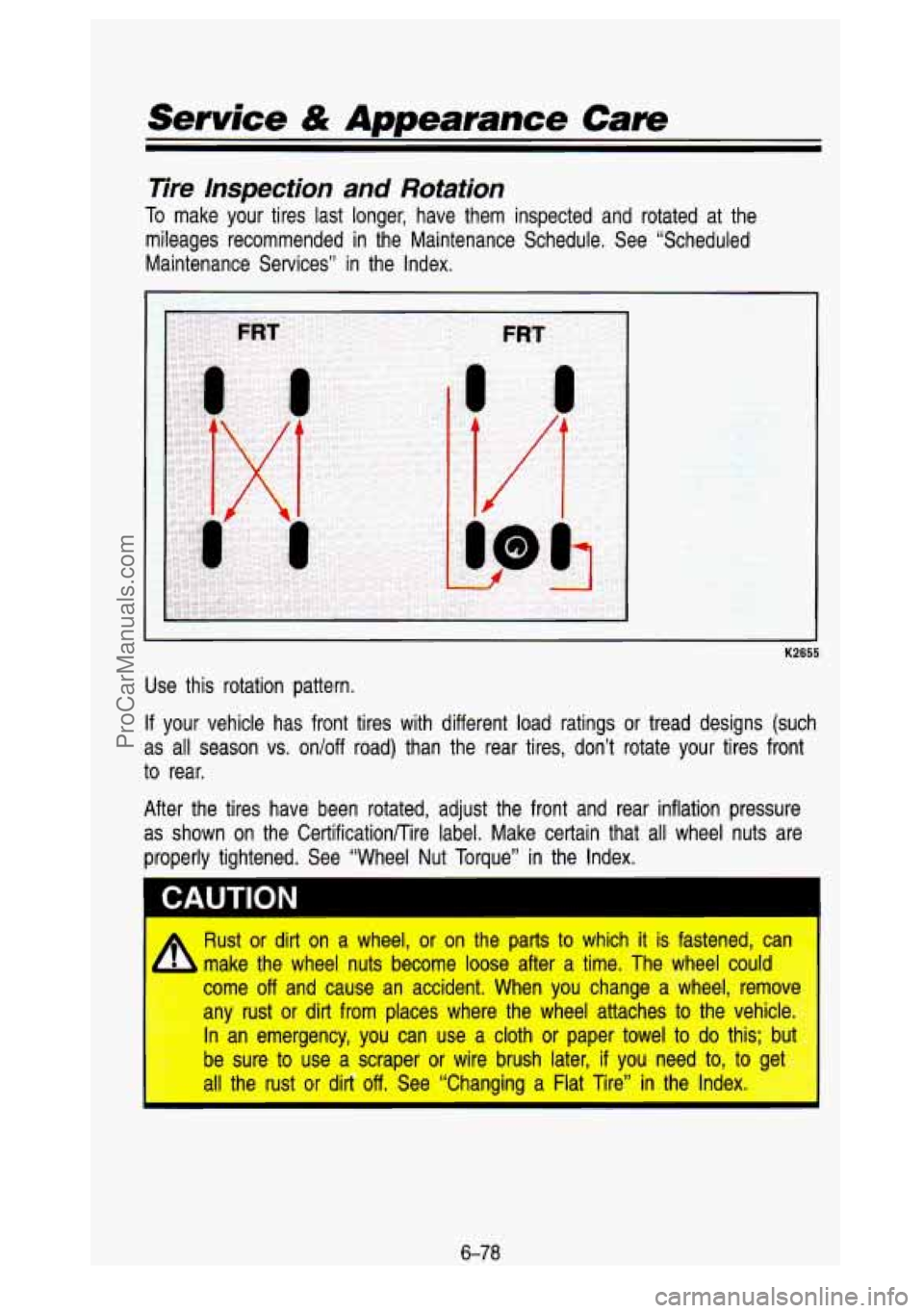
To make your tires last longer, have them inspected and rotated at the
mileages recommended in the Maintenance Schedule. See “Scheduled
Maintenance Services” in the Index.
Q
-
-
K2655
Use this rotation pattern.
If your vehicle has front tires with different load ratings or tread designs (such
as all season
vs. onloff road) than the rear tires, don’t rotate your tires \
front
to rear.
After the tires have been rotated, adjust the front and rear \
inflation pressure
as shown on the CertificationRire label. Make certain that all wheel nuts are
properly tightened. See “Wheel Nut Torque”
in the Index.
A Rust or dirt on a wheel, or on the parts to which -it is fastened, can
make the wheel nuts become loose after a time. The wh.eel could
come
off and cause an accident. When you change- a- :wheel, remove
’ any -rust or dirt from places where the wheel attaches to the vehicle:
,: In an emergency, you can use a cloth or paper towel to do this; but
3 be sure to use a scraper or wire brush later, if you need- to, to get
-T all the rust or dirf off. See “Changing a Flat Tire” in the Index.
6-78
ProCarManuals.com
Page 358 of 436
Service & Appearance Cam
When It’s Time for New Tires
K1656
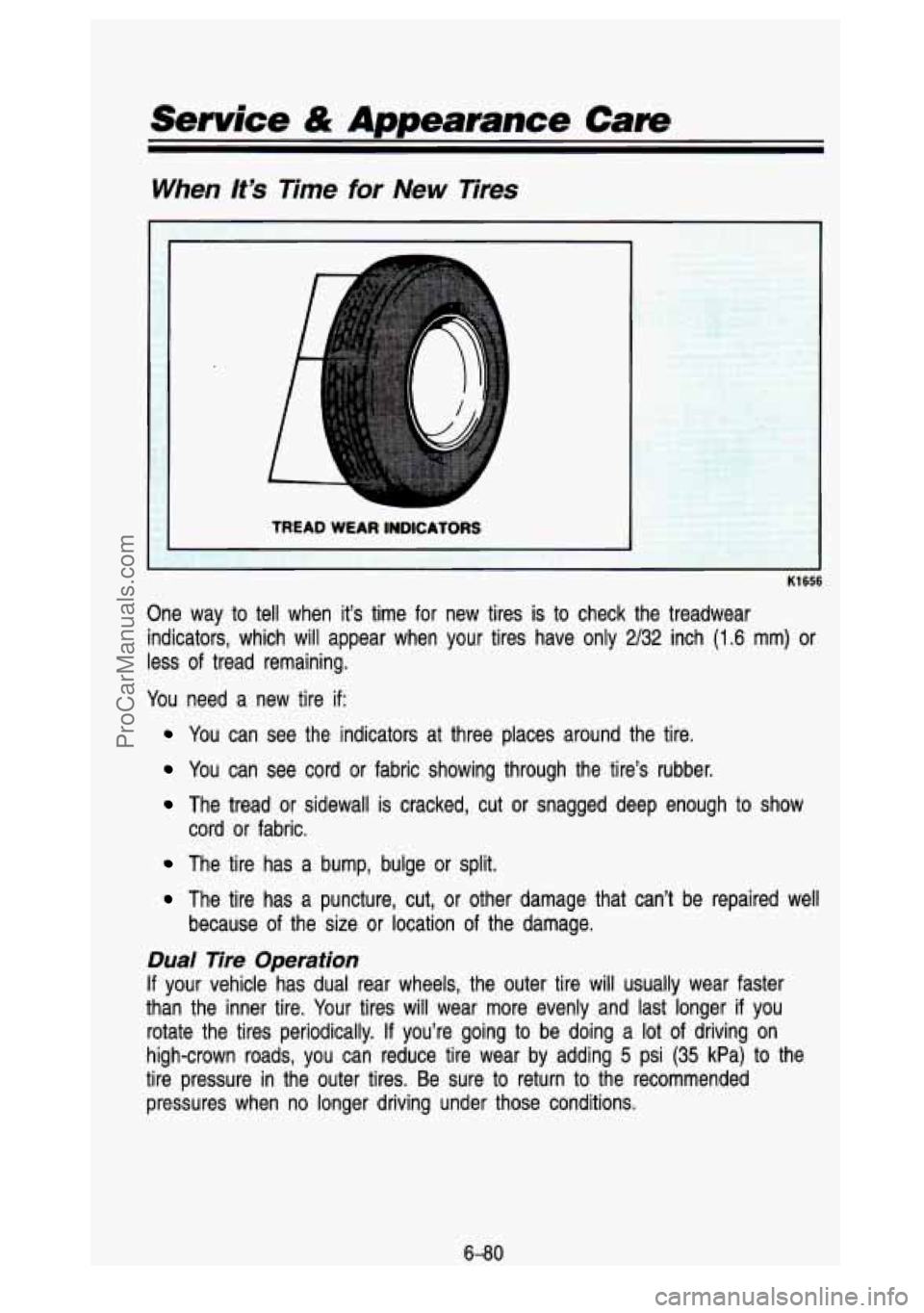
One way to tell when it’s time for new tires is to check the treadwear
indicators, which will appear when your tires have only
2/32 inch (1.6 mm) or
less of tread remaining.
You need a new tire
if:
You can see the indicators at three places around the tire.
You can see cord or fabric showing through the tire’s rubber.
The tread or sidewall is cracked, cut or snagged deep enough to show
cord
or fabric.
The tire has a bump, bulge or split.
The tire has a puncture, cut, or other damage that can’t be repalred well
because of the size or location of the damage.
Dual Tire Operation
If your vehicle has dual rear wheels, the outer tire will usually\
wear faster
than the inner tire. Your tires will wear more evenly and last longer
if you
rotate the tires periodically.
If you’re going to be doing a lot of driving on
high-crown roads, you can reduce tire wear by adding
5 psi (35 kPa) to the
tire pressure in the outer tires. Be sure to return
to the recommended
pressures when no longer driving under those conditions.
6-80
ProCarManuals.com
Page 401 of 436

23. EXHAUST PRESSURE REGULATOR VALVE INSPECTION* -Check that
the valve works properly. Correct any binding. Inspect hoses fo\
r cracks, chafing or decay. Replace parts as needed.
24.
TIRE AND WHEEL ROTATION AND INSPECTION -For proper wear
and maximum tire life, rotate tires at the first
6,000 miles (1 0 000
kilometers) for Schedule I (t) or 7,500 miles (12 500 kilometers) for
Schedule
II (.) and then every 15,000 miles (25 000 kilometers)
thereafter. Follow the instructions and patterns shown in Section 6.
Check tires for uneven wear or damage.
If irregular or premature wear is
apparent, check wheel alignment. Also, check for damaged wheels.\
See
“Tires” in the Index for more information.
For dual wheels, whenever the vehicle, wheels, or fasteners are new,
have the wheel fastener torque set at the first 100,
1,000 and 6,000
miles (160, 1600 and 10
000 km).
For 3500 H.D. Models, block the tires opposite those being removed to
keep the vehicle from rolling.
25.
DRIVE AXLE SERVICE -Check readfront axle fluid level and add as
needed. Check constant velocity joints and axle seals for leaki\
ng.
Locking differential-Drain fluid at first oil change and refill. Check
fluid level and add as needed at subsequent oil changes.
In dusty
areas, or trailer towing applications drain fluid at every 15,0\
00 miles
(24 135 kilometers) and refill$
every oil change. In dusty areas, or trailer towing applications, drain
fluid every 15,000 miles
(24 135 kilometers) and refi1l.t
More frequent lubrication may be required on heavy-duty or off-road
use.
Standard differential -Check fluid level and add as needed at
26.
BRAKE SYSTEM INSPECTION -When the engine oil is changed,
inspect the lines and hoses for proper hookup, binding, leaks, \
cracks,
chafing, etc. Check the parking brake adjustment, and the fluid level in
the master cylinder.
A low fluid level can indicate worn disc brake pads
which may need to be sewiced.t
*An Emission Control Service
tA fluid
loss in these systems may indicate a problem. Have them
inspected and repaired at once.
7-2
1
ProCarManuals.com
Page 402 of 436

Scheduled Maintenance Sewices
When the wheels are removed for rotation, inspect disc brake pads f\
or wear
and rotors for surface condition.
Also inspect drum brake linings for wear and
cracks. Inspect other brake parts, including drums, wheel cylind\
ers, parking
brake, etc., at the same time. Remove any rust
or dirt from the wheel and
mounting surfaces before mounting the wheel.
Inspect brakes more often if driving habits or conditions resull In
frequent braking.
Owner Checks and Services
Listed below are owner checks and services which should be mad\
e at the
time period specified
to help ensure proper safety, emission performance, and
dependability of your vehicle.
Be sure any necessary repairs are completed at once. Whenever \
any fluids
or lubricants are added to your vehicle, make sure they are the proper ones,
as shown
in this Section.
At Least Once a Month
Tire inflation pressure check -Check the tires for proper inflation. If they
are low, inflate them
to the level specified on the certification label or on the
tire inflation charts. See “Loading Your Vehicle’’ or “Inflation-Tire Pressure” in
the Index.
At Least Once a Year
Key lock cylinder lubrication -Lubricate key lock cylinders with engine oil.
See the “Recommended Fluid and Lubricants’’ chart in this section.
Transmission neutral or clutch start switch operation
CAUTION
~
1. Before you start, be sure you have enough room around the veh\
icle.
2. Firmly apply both the manual parking brake and the regular brake. See
“Brakes” and “Parking Brake” in the Index.
Do not use the accelerator
pedal.
3. Be ready to turn off the engine immediately if it starts.
4. On automatic transmission vehicles, try to start the engine in each gear.
The starter should work only in
P (Park) or N (Neutral).
7-22
ProCarManuals.com
Page 403 of 436
On manual transmission vehicles, put the shift lever in N (Neutral), push the
clutch down halfway, and try to start the engine. The starter should work only
when the clutch is pushed down all the way to the floor.
Steering column lock operation -While parked, try to turn the key to Lock
in each gear shift position.
With an automatic transmission, the key should turn to
Lock only when the
gear shift is in
P (Park).
On vehicles with a key release lever, try to turn the key to
Lock without
pressing the lever. The key should turn to
Lock only with the key lever
depressed.
On all vehicles, the key should come out only in
Lock.
Parking brake and transmission
P (PARK) mechanism operation -
CAUTION I
4 When you are doing this check, your vehicle could begin to move.
You
or others could be injured and property could be damaged.
Make sure there is
room in front of your vehicle in case you begin
to
roll. Be ready to apply the regular brake at once should the
vehicle begin to move.
IW
Park on a fairly steep hill, with the vehicle facing downhill.\
Keeping your foot
on the regular brake, set the manual parking brake.
To check the parking brake: With the engine running and the
transmission in
N (Neutral), slowly remove foot pressure from the regular
brake pedal.
Do this until the vehicle is held by the parking brake only.
To check the “Park” mechanism’s holding ability: Apply the \
regular brake
and shift to
P (Park). Release the manual parking brake, then slowly
release the regular brake.
Lap and shoulder belts condition and operation -Inspect belt system,
including: webbing, buckles, latch plates, retractors, guide loop\
s and anchors.
Have a belt assembly replaced
if the webbing has been cut or otherwise
damaged.
Body
Lubrication Service -Lubricate all body door hinges with engine oil.
Also lubricate the tailgate, tailgate handle pivot points, and tailga\
te mounted
spare tire carrier
(if equipped). Lubricate the body hood, fuel door and rear
compartment hinges, latches and locks including interior glove
box and
console
doors, and any folding seat hardware. Lubricate the hood safety lever
pivot and prop
rod pivot. More frequent lubrication may be required when
exposed to a corrosive environment.
7-23
ProCarManuals.com
Page 428 of 436
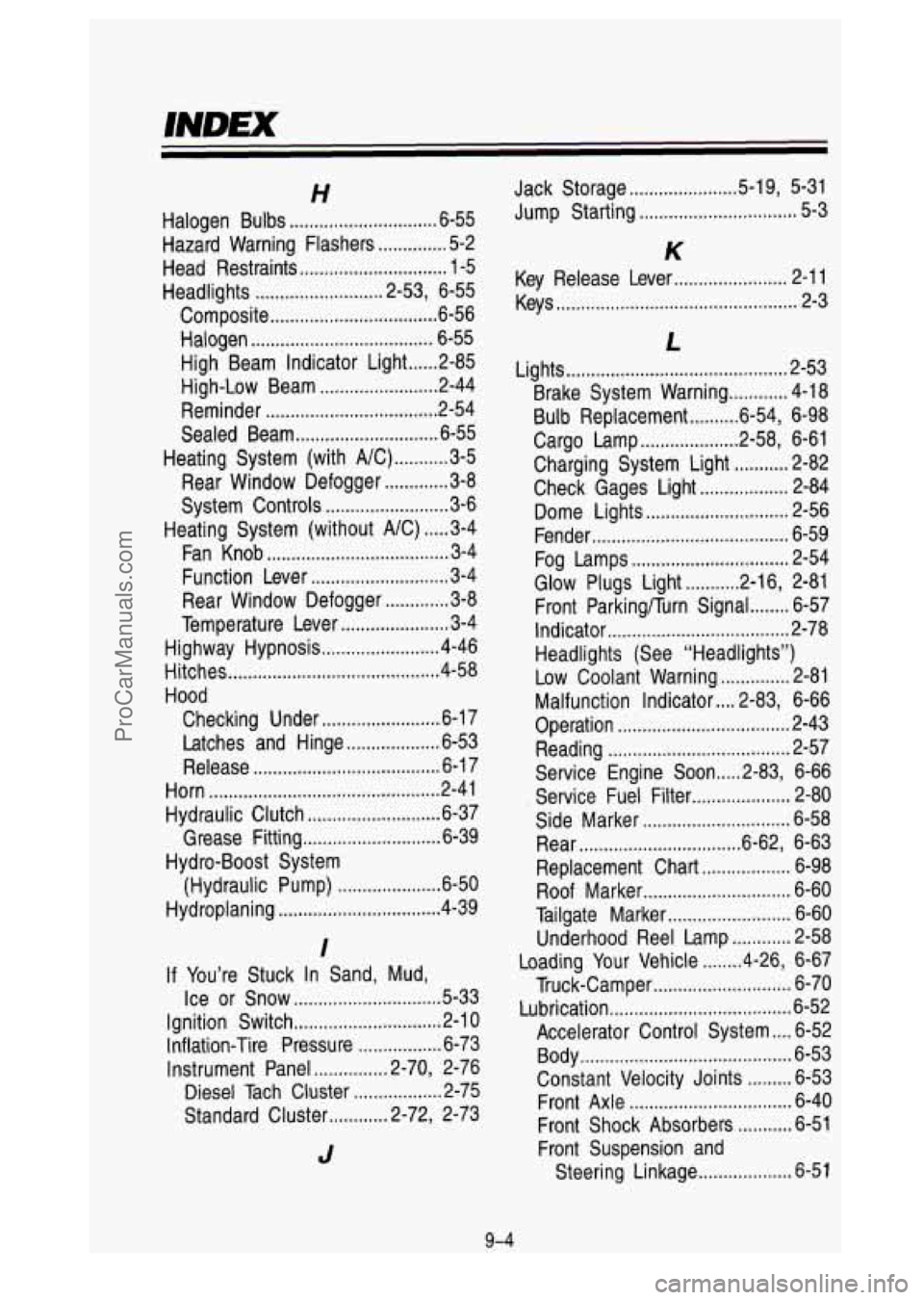
INDEX
H
Halogen Bulbs .............................. 6-55
Hazard Warning Flashers
.............. 5-2
Head Restraints
.............................. 1-5
Headlights .......................... 2.53. 6-55
Composite
.................................. 6-56
Halogen
..................................... 6-55
High-Low Beam
........................ 2-44
Reminder
................................... 2-54
Sealed Beam
............................. 6-55
Heating System (with NC)
........... 3-5
Rear Window Defogger
............. 3-8
System Controls
......................... 3-6
Fan Knob
..................................... 3-4
Function Lever
............................ 3-4
Temperature Lever
...................... 3-4
Hitches
........................................... 4-58
Hood Checking Under
........................ 6-17
Latches and Hinge
................... 6-53
Release
...................................... 6-1 7
Horn
............................................... 2-41
Hydraulic Clutch
........................... 6-37
Grease Fitting
............................ 6-39
Hydro-Boost System (Hydraulic Pump)
..................... 6-50
Hydroplaning
................................. 4-39
I
If You’re Stuck In Sand. Mud.
Ice or Snow
.............................. 5-33
Ignition Switch
.............................. 2-1 0
Inflation-Tire Pressure ................. 6-73
Instrument Panel
............... 2-70. 2-76
Diesel Tach Cluster .................. 2-75
Standard Cluster
............ 2-72, 2-73
J
High Beam Indicator Light ...... 2-85
Heating System (without AIC)
..... 3-4
Rear Window Defogger
............. 3-8
Highway Hypnosis
........................ 4-46 Jack Storage
...................... 5.19.
5-31
Jump Starting
................................ 5-3
K
Key Release Lever ....................... 2-11
Keys
................................................. 2-3
L
Lights ............................................. 2-53
Brake System Warning
............ 4-18
Bulb Replacement
......... .6-54, 6-98
Cargo Lamp
.................... 2-58, 6-61
Charging System Light
........... 2-82
Check Gages Light
.................. 2-84
Dome Lights
............................. 2-56
Fender
........................................ 6-59
Fog Lamps
................................ 2-54
Glow Plugs Light
........... 2-16, 2-81
Front ParkinglTurn Signal
........ 6-57
Indicator
..................................... 2-78
Headlights (See “Headlights”-)
Low Coolant Warning
.............. 2-81
Malfunction Indicator
.... 2-83, 6-66
Operation
................................... 2-43
Reading
..................................... 2-57
Service Fuel Filter
.................... 2-80
Side Marker
.............................. 6-58
Rear
................................. 6-62, 6-63
Replacement Chart
.................. 6-98
Roof Marker
.............................. 6-60
Tailgate Marker
......................... 6-60
Underhood Reel Lamp
............ 2-58
Loading Your Vehicle
........ 4-26, 6-67
Truck-Camper
............................ 6-70
Lubrication
..................................... 6-52
Accelerator Control System
.... 6-52
Body ........................................... 6-53
Constant Velocity Joints
......... 6-53
Front Axle
................................. 6-40
Front Shock Absorbers
........... 6-51
Front Suspension and Steering Linkage
................... 6-51
Service Engine Soon
..... 2-83, 6-66
9-4
ProCarManuals.com
Page 430 of 436
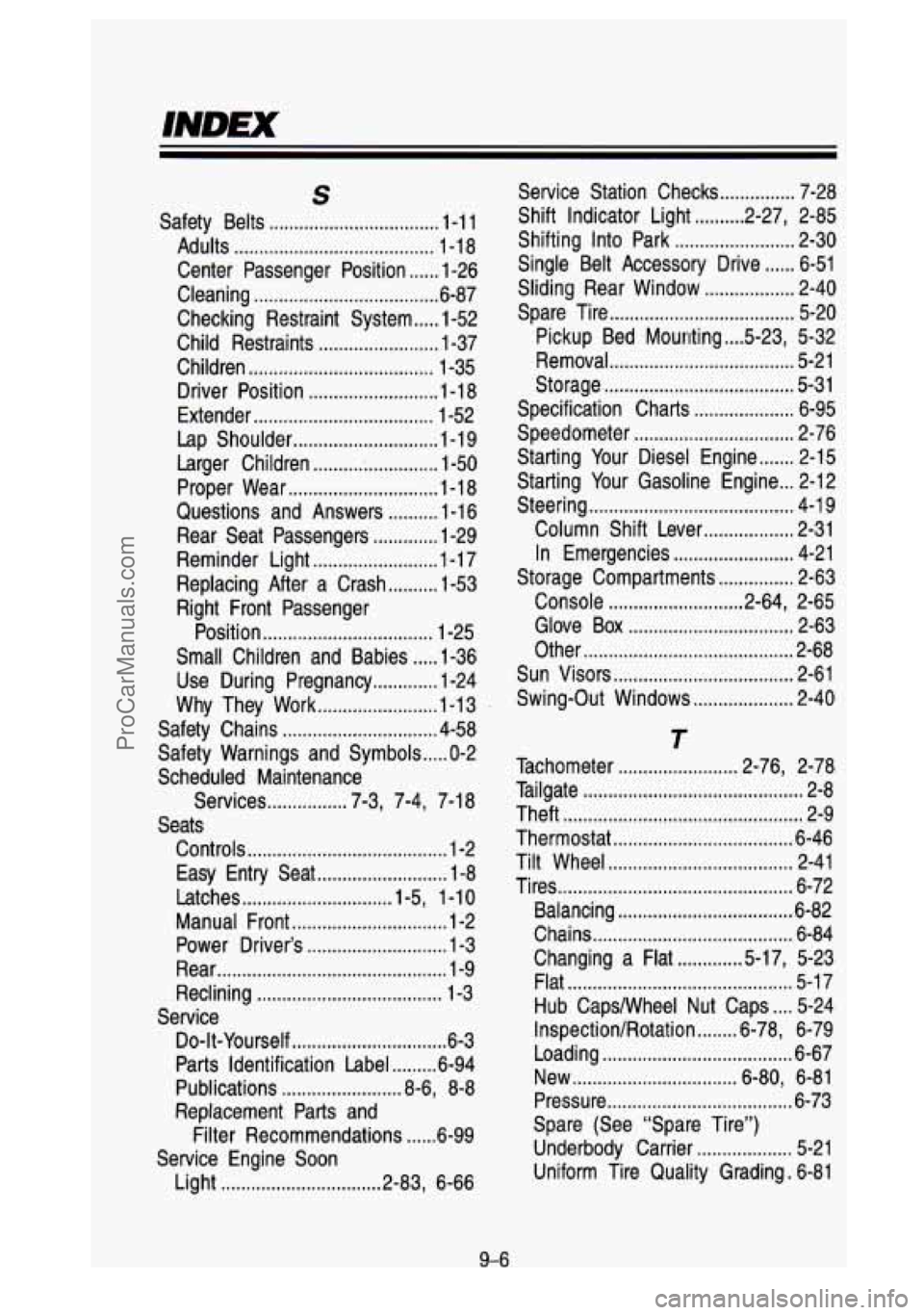
S
Safety Belts .................................. 1-1 1
Center Passenger Position
...... 1-26
Cleaning
..................................... 6-87
Checking Restraint System
..... 1-52
Child Restraints
........................ 1-37
Children
..................................... 1-35
Driver Position
.......................... 1-1 8
Extender
.................................... 1-52
Lap Shoulder
............................. 1-19
Larger Children
.......... : .............. 1-50
Proper Wear
.............................. 1-1 8
Questions and Answers
.......... 1-1 6
Rear Seat Passengers
............. 1-29
Reminder Light
......................... 1-1 7
Replacing After a Crash
.......... 1-53
Right Front Passenger Position
.................................. 1-25
Small Children and Babies
..... 1-36
Use During Pregnancy
............. 1-24
Why They Work
........................ 1-13
Safety Chains
............................... 4-58
Safety Warnings and Symbols
..... 0-2
Scheduled Maintenance Services
................ 7-3, 7-4, 7-18
Seats
Controls
........................................ 1-2
Easy Entry Seat
.......................... 1-8
Latches
.............................. 1-5, 1-10
Manual Front
............................... 1-2
Power Driver’s
............................ 1-3
Rear
.............................................. 1-9
Reclining
..................................... 1-3
Do-It-Yourself
............................... 6-3
Parts Identification Label
......... 6-94
Publications
........................ 8-6, 8-8
Replacement
. Parts and
Filter Recommendations
...... 6-99
Light
................................ 2-83, 6-66
Adults
........................................ 1-1
8
Service
Service Engine Soon Service Station Checks
............... 7-28
Shift Indicator Light
.......... 2.27. 2-85
Shifting Into Park
........................ 2-30
Single Belt Accessory Drive
...... 6-51
Sliding Rear Window
.................. 2-40
Spare Tire
..................................... 5-20
Pickup Bed Mourrting
.... 5.23. 5-32
Removal
..................................... 5-21
Storage
...................................... 5-31
Specification Charts
.................... 6-95
Speedometer
................................ 2-76
Starting Your Diesel Engine
....... 2-15
Starting Your Gasoline Engine
... 2-12
Steering
......................................... 4-19
Column Shift Lever
.................. 2-31
In Emergencies
........................ 4-21
Storage Compartments
............... 2-63
Console
........................... 2.64. 2-65
Glove Box
................................. 2-63
Other
.......................................... 2-68
Sun Visors
.................................... 2-61
Swing-Out Windows
.................... 2-40
T
Tachometer ........................ 2-76, 2-78
Tailgate
............................................ 2-8
Theft
................................................ 2-9
Thermostat
.................................... 6-46
Tilt Wheel
..................................... 2-41
Tires
............................................... 6-72
Balancing
................................... 6-82
Chains
........................................ 6-84
Changing a Flat
............. 5-17, 5-23
Flat
............................................. 5-17
Hub CapsNVheel Nut Caps
.... 5-24
Inspection/Rotation
........ 6-78. 6-79
Loading
...................................... 6-67
New
................................. 6-80. 6-81
Pressure
..................................... 6-73
Spare (See “Spare Tire”) Underbody Carrier
................... 5-21
Uniform Tire Quality Grading
. 6-81
9-6
ProCarManuals.com