trailer GMC SIERRA 1993 Owners Manual
[x] Cancel search | Manufacturer: GMC, Model Year: 1993, Model line: SIERRA, Model: GMC SIERRA 1993Pages: 436, PDF Size: 23.88 MB
Page 70 of 436

Featums & Contmls
Parking Brake ........................................................................\
.............................. 2-29
Parking Over Things That Burn
........................................................................\
. 2-33
Engine Exhaust
........................................................................\
........................... 2-34
Running Your Engine While You’re Parked
...................................................... 2-35
Four-wheel Drive
........................................................................\
........................ 2-36
Transfer Case
........................................................................\
.......................... 2-37
Front Axle Locking Feature
........................................................................\
.... 2-38
Windows
........................................................................\
....................................... 2-39
Horn
........................................................................\
.............................................. 2-41
Tilt Wheel
........................................................................\
..................................... 2-41
Multifunction Lever
........................................................................\
...................... 2-42
Turn Signal and Lane Change Indicator
....................................................... 2-43
Headlight High-Low Beam
........................................................................\
...... 2-44
Windshield Wipers
........................................................................\
................... 2-45
Windshield Washer
........................................................................\
.................. 2-46
Cruise Control
........................................................................\
.......................... 2-47
Headlights and Vehicle Lighting
........................................................................\
. 2-53
Mirrors
........................................................................\
.......................................... 2-59
Sun Visors
........................................................................\
................................... 2-61
Cigarette LighterlAshtrays
........................................................................\
........... 2-62
Storage Compartments
........................................................................\
............... 2-63
Instrument Cluster ........................................................................\
....................... 2-70
Warning and Indicator Lights
........................................................................\
.. 2-78
Gages
........................................................................\
....................................... 2-87
Camper Wiring Harness
........................................................................\
............. 2-91
Trailer Wiring Harness
........................................................................\
................ 2-91
2-2
ProCarManuals.com
Page 89 of 436
Automatic lLansmission
K2362
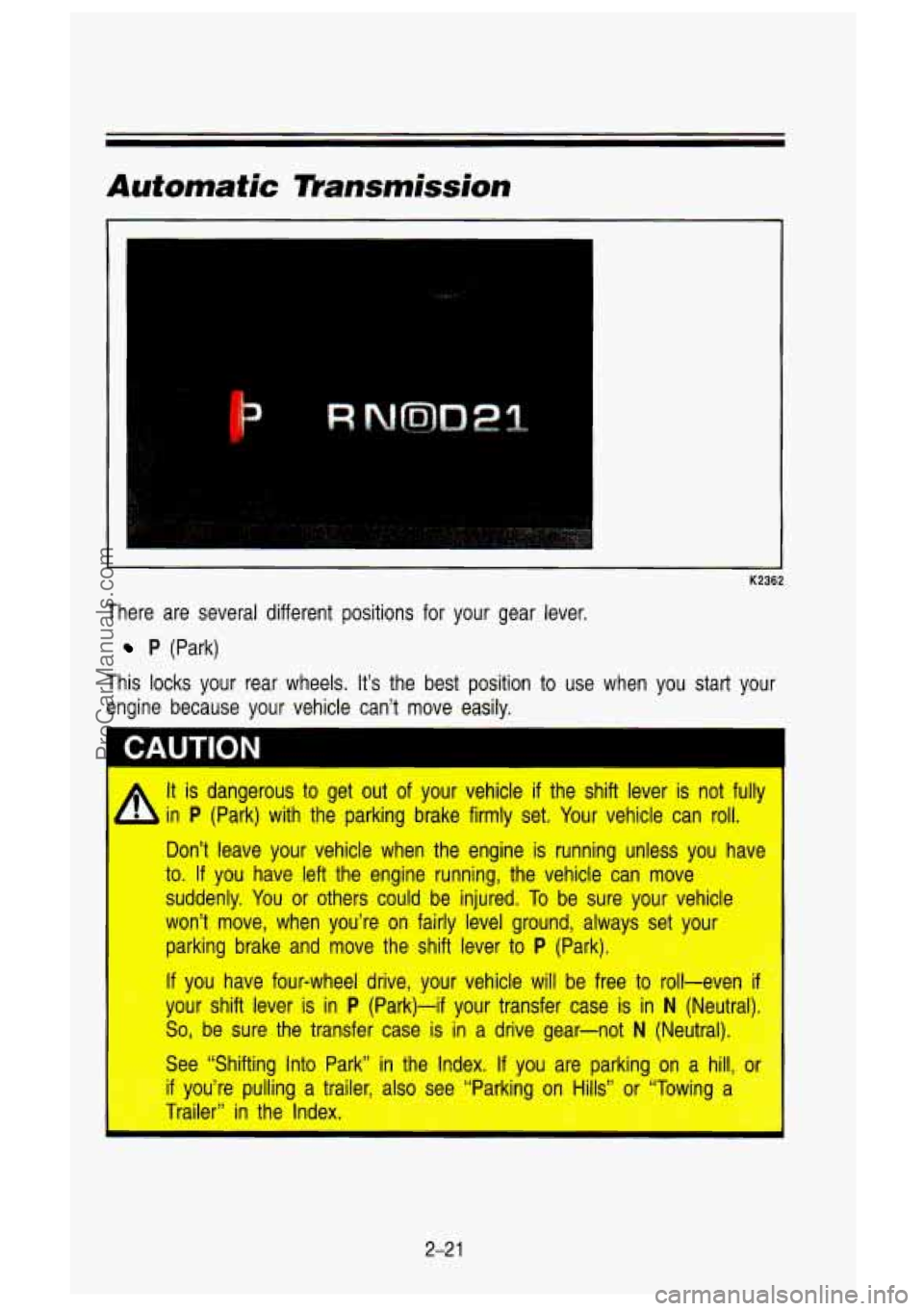
There are several different positions for your gear lever.
P (Park)
This locks your rear wheels. It’s the best position to use when you start your
engine because your vehicle can’t move easily.
* It is dangerous to get out of your vehicle if the shift lever is not fully
in
P (Park) with the parking brake firmly set. Your vehicle can roll.
Don’t leave your vehicle when the engine is running unless \
you have
to. If you have left the engine running, the vehicle can move
suddenly. You or others could be injured.
To be sure your vehicle
won’t move, when you’re on fairly level ground, always se\
t your parking brake and move the shift lever to
P (Park).
If you have four-wheel drive, your vehicle will be free to roll-even
if
your shift lever is in P (ParkLif your transfer case is in N (Neutral).
So, be sure the transfer cas s in a drive gear-not N {“eutral).
See “Shifting Into
P- I;’’ in tne 3ex. If you are parking on a hill, or
if you’re pulling a traller, also see “Parking on Hills” \
or “Towing a
Trailer’’ in the Index.
2-2 1
ProCarManuals.com
Page 90 of 436
Featums & Contmls
R (Reverse)
Use this gear to back up.
Shifting
to R (Reverse) while your vehicle is moving forward could damage
your transmission. Shift
to R (Reverse) only after your vehicle is stopped. I
b
1
damaging your transmission, see “If Yo$re Stuck: In Sand, Mud, Ice or
Snow” in the Index.
N (Neutral)
In this position, your engine doesn’t connect with the wheels.
To restart when
you’re already moving, use
N (Neutral) only. Also, use N (Neutral) when your
vehicle is being towed.
CAUTION I
Shifting out of P (Park) or N (Neutral) while your engine is “racing”
(running at high speed) is dangerous. Unless your foot is fi\
rmly on
the brake pedal, your vehicle could move very rapidly. You cou\
ld lose
control and hit people
or objects. Don’t shift out of P (Park) or N
wI ! your enaine is racing.
I
NOTICE
I
1
Damage to your transmission caused by shifting out of P (Park) or N
(Neutral) with the engine racing isn’t covered by your war\
ranty.
OD (Automatic Overdrive)
This position is
for normal driving. If you need more power for passing, and
you’re:
- Going less than about 35 mph (56 km/h), push your accelerator
- Going about 35 mph (56 kmlh) or more, push the accelerator all the
pedal about halfway down
way down
You’ll shift down
to the next gear and have more power.
OD should not be used when towing a trailer, carrying a heavy load, driving
on steep hills,
or for off-road driving. Select D (third gear) when operating the
vehicle under any of these conditions.
2-22
ProCarManuals.com
Page 91 of 436
D (Third Gear)
This is like
OD, but you never go into Overdrive. You should use D when
towing a trailer, carrying a heavy load, driving on steep hills, or for off-road
driving.
2 (Second Gear)
This position gives you more power but lower fuel economy. You can use
2
on hills. It can help control your speed as you go down steep mountain
roads, but then you would also want to use your brakes
off and on.
If you manually select 2, the transmission will drive in second gear. You may
use this feature for reducing torque to the rear wheels when you are trying
to
start your vehicle from a stop on slippery road surfaces.
1 (First Gear)
This position gives you even more power (but lower fuel econo\
my) than
2.
You can use it on very steep hills, or in deep snow or mud. If the selector
lever
is put in 1, the transmission won’t shift into first gear until the vehic\
le is
going slowly enough.
NWTIGE
If your rear wheels can’t rotate, don’t try to drive. This might happen if
you were stuck in very deep sand or mud or were up against a. solid
object. You could damage your transmission.
AWZ , <,*,~l,<.,. ...
Also, if you stop when going uphill, don’t hold your vehic there with only the
accelerator pedal.
This could overheat and damage ,the transmission. Use your
brakes or shii into P (Park) to hdd your vehicle in position on a hill.
.,$*’,,&:&> ._,, , . ~ ~ ,>&:a
2-23
ProCarManuals.com
Page 97 of 436
Parking Brake
K2221
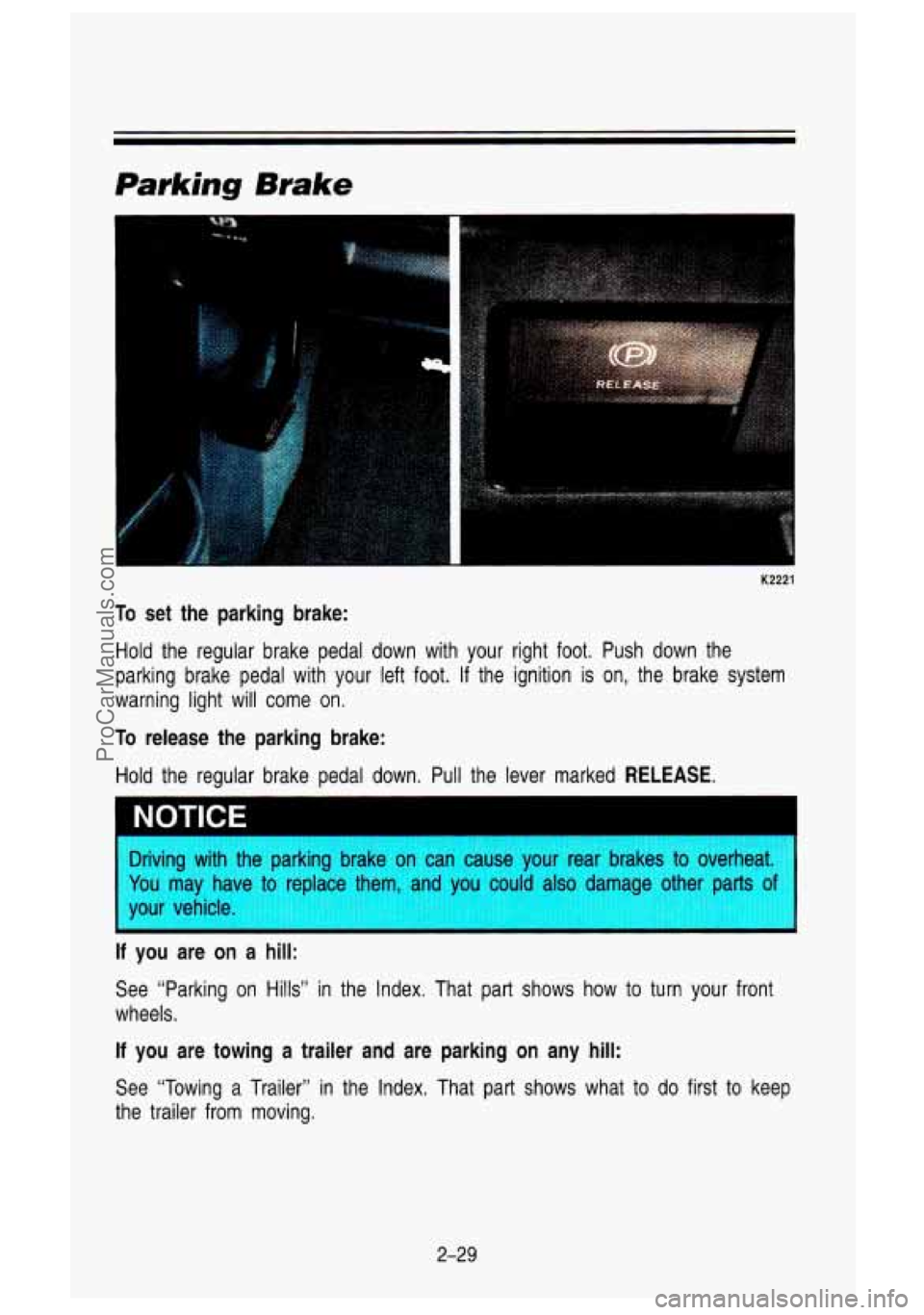
To set the parking brake:
Hold the regular brake pedal down with your right foot. Push down the
parking brake pedal with your left
foot. If the ignition is on, the brake system
warning light will come
on.
To release the parking brake:
Hold the regular brake pedal down. Pull the lever marked RELEASE.
Driving with the parking brake on can cause your rear brakes to overheat.
You may have to replace them, and you also da other p;
of I
your vehicle.
’ ‘
If you are on a hill:
See “Parking on Hills” in the Index. That part shows how to turn your front
wheels.
If you are towing a trailer and are parking on any hill:
See “Towing a Trailer” in the Index. That part shows what to do first to keep
the trailer from moving.
2-29
ProCarManuals.com
Page 98 of 436
Features & Controls
Propshaft Brake Burnish Procedure
If you have a 3500 HD Model, it is recommended that the propshaft mounted
parking brake be burnished as part of the new vehicle break in. The parking
brake
will work best after it has been burnished following these instructions.
Make
10 stops, using the parking brake foot pedal, from 20 mph (32 k\
m/h)
about 2
112 miles (4 km) apart. In between stops, drive the vehicle at 20
mph (32 kmlh).
Torque Lock
The parking brake should be set first whenever leaving the dri\
ver’s seat. If
you are parked on a hill and the transmission is placed in P (Park) before
the parking brake is set, the weight of the vehicle may put too much force
on the parking pawl in the transmission.
It may be difficult to pull the selector
lever out of
P (Park). This is called “torque lock.” To prevent this, the parking
brake should be set
BEFORE moving the selector lever to P (Park).
When preparing
to move the vehicle, the selector lever should be moved out
of
P (Park) BEFORE releasing the parking brake. Set the parking brake first,
then release the transmission from
P (Park), even on level surfaces.
If “torque lock” does occur, you may have to have another vehicle nudge
your vehicle uphill a little
to take some of the pressure off the transmission
while you pull the selector lever out of
P (Park).
Shifting Into P (Park) (Automatic Transmission Models Only)
1 CAUTION
It can be dangerous to get out of your vehicle if the shift lever is not
fully in
P (Park) with the parking brake firmly set. Your vehicle can
roll.
If you have left the engine running, the vehicle can move suddenly.
You
or others could be injured. TO be sure your vehicle won’t move,
when you’re
on fairly level ground, use the steps that follow.
If you have four-wheel drive and your transfer case is in N (Neutral),
your vehicle will be free to roll-even if your shift lever is in P
{Park). So, be sure the transfer case is in a drive gear-not N
(Neutral).
If you are parking on a hill, or if you’re pulling a trailer, also see
“Parking on Hills9’ or “Towing a Trailer” in the Index. I
2-30
ProCarManuals.com
Page 100 of 436
Leaving Your Vehicle With the Engine Running (Automatic
Transmission Models Only)
I CAUTION
A It can be dangerous to leave your vehicle with the engine running. 1
1 Your vehicle could move suddenly if the shift lever is not fully in P
(Park) with the parking brake firmly set.
If you have a four-wheel drive with a manual transfer case sh\
ift lever
and your transfer case
is in N (Neutral), your vehicle will be free to
roll, even
if your shift lever is in P (Park). So be sure the transfer
case is in a drive gear-not in
N (Neutral).
And,
if you leave the vehicle with the engine running, it could
overheat and even catch fire. You or others could be injured. Don’t
leave your vehicle with the engine running unless you have to.\
If you have to leave your vehicle with the engine running, be su\
re your
vehicle
is in P (Park) and your parking brake is firmly set, before you leav\
e
it. If you have a four-wheel drive, be sure that the transfer case i\
s in a drive
gear-not in
N (Neutral).
After you’ve moved the shift lever into the
P (Park) position, hold the regular
brake pedal down. Then, see
if you can move the shift lever away from P
(Park) without first pulling it toward you.
If you can, it means that the shift lever wasn’t fully locked into
P (Park).
Parking Your Vehicle (Manual Transmission Models Only)
Before you get out of your vehicle, put your manual transmission in R
(Reverse) and firmly apply the parking brake.
If you have four-wheel drive, be sure your transfer case is in a\
drive gear.
Your vehicle could roll
if it isn’t.
If you are parking on a hill, or if your vehicle is equipped to tow a trailer,
see “Parking on Hills” or “Towing a Trailer” in the\
Index.
2-32
ProCarManuals.com
Page 103 of 436
Running Your Engine While You%
Parked [Automatic mansmission)
It’s better not to park with the engine running. But if you ever have to, here
are some things
to know.
1 CAUTION I
* Idling the engine with the air system control off could allow
‘ jangerous exhaust into your vehicle. (See the earlier Caution under
**A :E ..:i *; !.< .. 5;:. ::.; ,$+ : ‘Engine Exhaust”.) ~~-?~c-~~~~~=~~:-
Also, Idling in a closed-in place can let deadly oxide (CO)
nto your vehicle, even if the fan switch is at the highest setting. One
place this can happen
is a garage. Exhaust-with co--( -% -c ?& 2asily. NEVER park in a garage with the engine runni
?-! 4nother ,I: -‘i closed-in place can be a blizzard. (See “Blizzard“ in th
Index.)
CAUTION
It can be dangerous to get out of your vehicle if the shift lever is not
L fully in P (Park) with the parking brake firmly set. Your vehicle can
roll. Don’t leave your vehicle when the engine is running unless
you
have to. If you’ve left the engine running, the vehicle can move
suddenly. You
or others could be injured. To be sure your vehicle
won’t move, even when you’re on fairly level ground,, alw\
ays
set your
parking brake and move the shift lever to
P (Park).
I
If you have four-wheel drive and your transfer case is in N (Neutral},
your vehicle
will be free to roll, even if your shift lever is in P (Park),
So, be sure the transfer case is in a drive gear-not in N (Neutral).
Foliow the proper -steps to be sure your vehicle won’t move. -See
“Shifting Into P (Park)” in the Index.
If you are parking on a hill, or if you’re pulling- -a- trailer, also see
“Parking on Hilis”-.or “Towing -a Trailer”‘ in the Index.
235
ProCarManuals.com
Page 104 of 436
Features & Contmls
Four- Wheel Drive
CAUTION I
It can be dangerous to get out of your vehicle if the shift lever -is not
fully in
P (Park) with the parking brake firmly set. Your vehicle can
roll. Don’t leave your vehicle when the engine is running unless you
have
to. If you’ve left the engine running, the vehicle can ‘move
suddenly. You or -others could be injured.
To be sure your vehicle
won’t move, even when you’re on fairly level ground, always
set your
parking brake and move the shift lever
to P (Park).
If you have four-wheel drive and your transfer case is in N (Neutral),
your vehicle
will be free to roll, even if your shift lever is in P’(Park).
So, be sure the transfer case is in a drive gear-not in N (Neutral).
Follow the proper steps
to be suce your vehicle won’t move. See
“Shifting Into
P (Park)” in the Index.
If you are parking on a hill, or if you’re pulling a trailer, also see
“Parking ‘on Hills’’ or “Towing a Trailer” in this section.
I
If your vehicle has four-wheel drive, you can send your engine’\
s driving power
to all four wheels for extra traction. To get the most satisfaction out of
four-wheel drive, you must be familiar with it’s operation. \
Read the part that
follows before using four-wheel drive. You should use
2H for most normal
driving conditions.
Rear-wheel antilock brakes
do not work when you shift into four-wheel drive.
Your regular brakes will still work. When you shift back into two-w\
heel drive,
your rear-wheel antilock brakes will take over again.
I NOTICE
Driving in the 4H or 4L positions for a long time on dry or wet pavement
could shorten the life
of your vehicle’s drivetrain.
2-36
ProCarManuals.com
Page 159 of 436
.
You can only drive for a short time with the reading in either warning zone. If
you must drive, turn
off all unnecessary accessories, and have the vehicle
serviced as soon as possible.
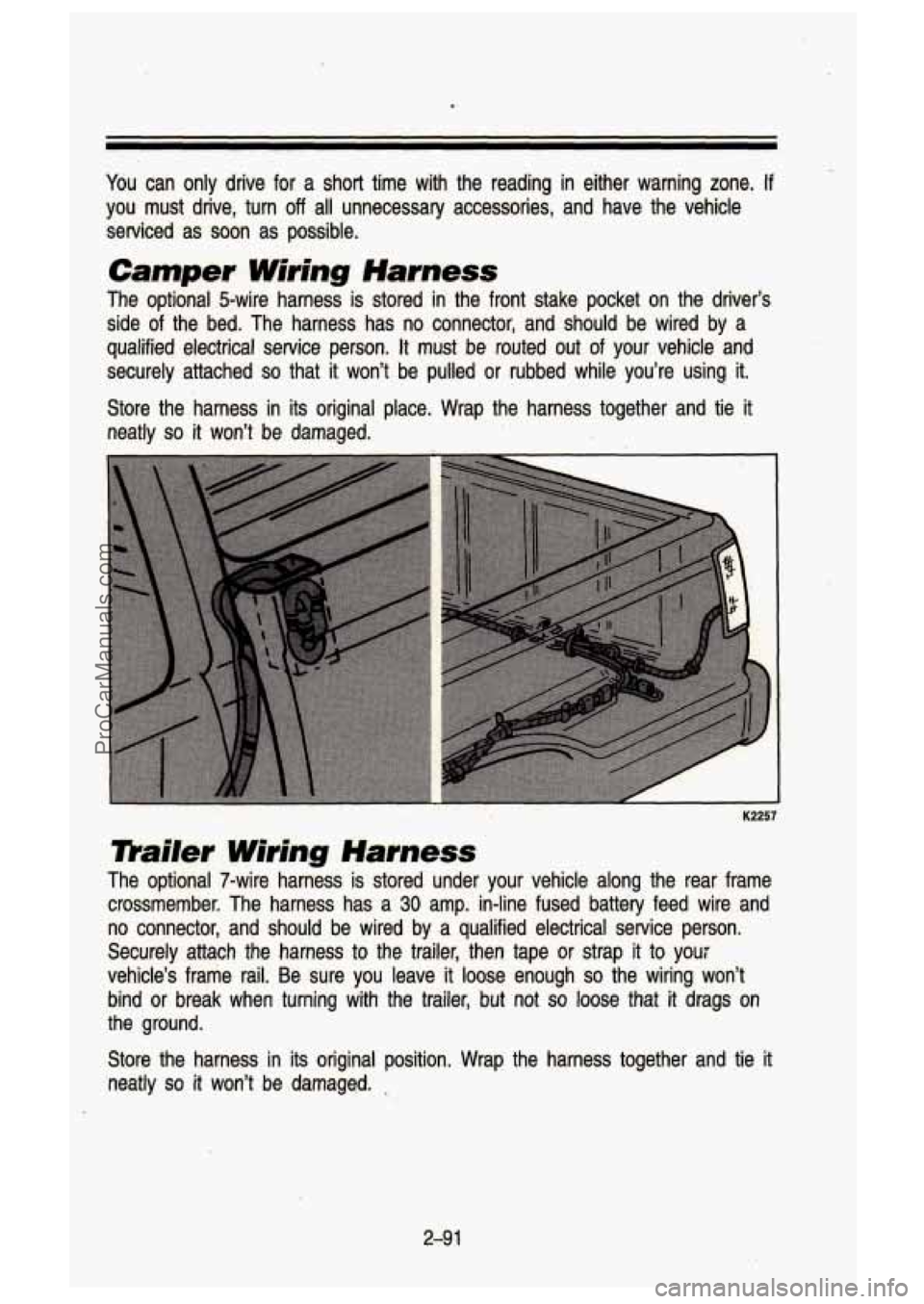
Camper Wiring Harness
The optional 5-wire harness is stored in’ the front stake pocket on the driver’s
side of’ the bed. The harness has no connector, and should be wired by\
a
qualified electrical service person.
It must be routed out of your vehicle and
securely attached
so that it won’t be pulled or rubbed while you’re using it.
Store the -harness in its original place. Wrap the harness together and tie it
neatly
so it won3 be damaged.
The optional 7-wire harness
is stored under your vehicle along the rear frame
crossmember. The harness has a’
30 amp. in-line fused battery feed wire and
no connector, and should be wired by a qualified electrical se\
rvice person.
Securely attach
the harness to the trailer, then tape or strap it to your
vehicle’s frame rail. Be sure you leave it loose enough
so the wiring won’t
bind
or break when turning with the trailer, but not so loose that it drags on
the ground.
Store the harness in its original position. Wrap the harness together and tie it
neatly so it won’t be damaged. ,
2-9 1
ProCarManuals.com