steering wheel GMC SIERRA 1993 Owner's Manual
[x] Cancel search | Manufacturer: GMC, Model Year: 1993, Model line: SIERRA, Model: GMC SIERRA 1993Pages: 436, PDF Size: 23.88 MB
Page 250 of 436
Problenrs on the Road
Towing Your Vehicle
Try to have a GM dealer or a professional towing service tow your vehicle.
They can provide the right equipment and know how to tow it without dam-
age.
If your vehicle has been changed since it was factory-new, by adding things
like fog lamps, aero skirting, or special tires and wheels, th\
ese things could
be damaged during towing.
Before you do anything, turn on the hazard warning flashers.
When you call, tell the towing service:
That your vehicle has rear-wheel drive, or that it has the four-wheel drive
option.
The make, model, and year of your vehicle.
Whether you can move the shift lever for the transmission and \
transfer case,
if you have one.
If there was an accident, what was damaged.
I A To help avoid injury to you or others:
Never let passengers ride in a vehicle that is being towed.
Never tow faster than safe or posted speeds.
Never tow with damaged parts not fully secured.
Never get under your vehicle after it has been lifted by the tow
truck.
Always use separate safety chains on each side when towing a
vehicle.
When your vehicle is being towed, have the ignition key
off. The steering
wheel should be clamped in a straight-ahead position, with a clamping device
designed for towing service.
Do not use the vehicle’s steering column lock for
this. The transmission and transfer case,
if you have one, should be in Neu-
tral and the parking brake released.
If you have a two-wheel drive vehicle, don’t have your vehicle \
towed on the
rear wheels, unless you must. If the vehicle must be towed on\
the rear
wheels, don’t go more than
35 mph (56 km/h) or farther than 50 miles (80
krn) or your transmission will be damaged. If these limits must be exceeded,
then the rear drive wheels have to be supported on a dolly.
5-8
ProCarManuals.com
Page 259 of 436
Engine Fan Noise
This vehicle has a clutched engine cooling fan. When the clutch is engaged,
the fan spins faster to provide more air to
cool the engine. In most every day
driving conditions the clutch is not engaged. This improves fue\
l economy and
reduces fan noise. Under heavy vehicle loading, trailer towing andlor high
outside temperatures, the fan speed increases when the clutch e\
ngages.
So
you may hear an increase in fan noise. This is normal and should not be
mistaken as the transmission slipping or making extra shifts. It is merely the
cooling system functioning properly. The fan will
slow down when additional
cooling is not required and the clutch disengages.
You may also hear this fan noise when you start the engine. It will go away
as the fan clutch disengages.
If a Tire Goes Fiat
It’s unusual for a tire to “blow out” while you’re driving, especially if you
maintain your tires properly. If air goes out of a tire, it’s much more likely to
leak out slowly. But
if you should ever have a “blowout,” here are a few tips
about what to expect and what to do:
If a front tire fails, the flat tire will create a drag that pulls the vehicle toward
that side. Take your foot off the accelerator pedal and grip \
the steering wheel
firmly. Steer to maintain lane position, then gently brake to a stop well out of
the traffic lane.
A rear blowout, particularly on a curve, acts much like a skid and may
require the same correction you’d use in a skid. In any rear blowout, remove
your foot from the accelerator pedal. Get the‘vehicle under control by steering
the way you want the vehicle to go. It may be very bumpy and noisy, but
you can still steer. Gently brake to a stop, well off the road
if possible.
If your tire goes flat, the next part shows how to use your jacking equipment
to change a flat tire safely.
Changing a Flat Tire
If a tire goes flat, avoid further tire and wheel damage by driv\
ing slowly to a
level place. Turn on your hazard warning flashers.
5-1 7
ProCarManuals.com
Page 275 of 436

If You’re Stuck: In Sand,
Mud,
Ice or Snow
What you don’t want to do when your vehicle is stuck is to spin your
wheels. The method known as “rocking” can help you get o\
ut when you’re
stuck, but you must use caution.
CAUTION - --
I * If you let your tires spin at high speed, they can explode and you or
,A others could be injured. And, the transmission or other parts of the
vehicle can overheat. That could cause an engine compartment fire
or other damage. When you’re stuck, spin the wheels as little as
possible. Don’t spin the wheels above
35 mph (55 krnlh) as shown
I on the speedometer.
;pinning your wheels can destroy parts of your vehicle as well as the
res.
If you spin the wheels too fast while shifting your transmission back
.nd forth, you can destroy your transmission.
NOTICE 1
Rocking your vehicle to get it out:
First, turn your steering wheel left and right. That will clear the area around
your front wheels. Then shift back and forth between
R and a forward gear
(or with a manual transmission, between First or Second gear and Reverse),
spinning the wheels as little as possible. Release the accelerator pedal while
you shift, and press lightly on the accelerator pedal when the transmission is
in gear.
If that doesn’t get you out after a few tries, you may need to be
towed out.
Or, you can use your recovery hooks, if your vehicle has them. If
you do need to be towed out, see “Towing Your Vehicle” in the Index.
5-33
ProCarManuals.com
Page 280 of 436

Service & Appearance Care
Engine Coolant ........................................................................\
........................ 6-42
Power Steering Fluid
........................................................................\
............... 6-46
Windshield Washer Fluid
........................................................................\
......... 6-48
Brake Master Cylinder
........................................................................\
............. 6-49
Replacing Brake System Parts
........................................................................\
.. 6-50
Other Maintenance Items ........................................................................\
........... 6-51
Lubrication
........................................................................\
.................................... 6-52
Electrical System
........................................................................\
......................... 6-54
Battery
........................................................................\
...................................... 6-54
Fuses and Circuit Breakers
........................................................................\
.... 6-64
Bulb Replacement
........................................................................\
.................... 6-54
Exhaust System
........................................................................\
........................... 6-65
Loading Your Vehicle
........................................................................\
.................. 6-67
Tires
........................................................................\
.............................................. 6-72
Inflation-Tire Pressure
........................................................................\
........... 6-73
Tire Inspection and Rotation
........................................................................\
.. 6-78
When It's Time for New Tires
........................................................................\
6-80
Buying New Tires
........................................................................\
.................... 6-81
Wheel Alignment and Tire Balance
............................................................... 6-82
Wheel Replacement
........................................................................\
................. 6-83
Tire Chains
........................................................................\
............................... 6-84
Appearance Care
........................................................................\
........................ 6-84
Cleaning the Inside Of Your Vehicle
............................................................. 6-85
Cleaning the Outside Of Your Vehicle
.......................................................... 6-88
Appearance Care Materials
.r.ikl...rr.r.n.....lr. ........ ... .. 6-91
Vehicle Identification Number
........................................................................\
..... 6-92
Service Parts Identification Label
...................................................................... 6-94
Specification Charts
....++t....,.,.*,..-".,,. .............. , ........... .................... 6-95
Uniform Tire Quality Grading
........................................................................\
.. 6-81
..................................................
6-2
ProCarManuals.com
Page 329 of 436
Other Maintenance Items
Front Suspension and Steering Linkage
Your maintenance schedule will tell you how often to lubricate the fittings. See
“Recommended Fluids and Lubricants’’ in the Index for the proper lubricant to
use.
Front Wheel Bearings
Your vehicle has front wheel bearings that must be cleaned and repa\
cked.
Your maintenance schedule will tell you how often this must be done.
Front Shock Absorbers
The front shock absorbers of your vehicle do many things. They help the
vehicle ride smoothly and also control the travel
of the suspension system.
When the shock absorbers are serviced, any replacement shock absorber\
s
must be the same as the original equipment shock absorbers in both
extended length and strength.
1 NOTICE
If you use shock absomers that are nor me same as the original shock
I absorbers, the shock absorbers or suspension system could be da\
maged.
Wheel Nut Torque
For vehicles with dual wheels, when the vehicle, wheel or fast\
eners are new,
have the torque set at the first
100, 1,000 and 6,000 miles (160, 1600 and
9600 km). Use the torque specified in the appropriate Specification \
Chart later
in this section.
Single Belt Accessory Drive
If your new vehicle uses a serpentine belt, it is lighter, and more durable
than systems with several belts.
The belt runs over or around the pulleys
on the engine. A tensioner is used
to keep the belt tight at all times. The tensioner also makes replacing the
belt easier.
If you need to replace the belt, be sure to get the correct
replacement belt. Your dealership
or parts supplier can help you with this.
The Accessory Drive Belt Routing label on your vehicle will sh\
ow you how to
route the belt your vehicle uses.
6-5 1
ProCarManuals.com
Page 398 of 436
Scheduled Maintenance Services
Explanation Of Scheduled Maintenance Services
Below are explanations of the services listed in the maintenance charts.
The proper fluids and lubricants to use are listed in this section. Make sure
whoever services your vehicle uses these. All parts should be \
replaced and
all necessary repairs done before you or anyone else drives the ve\
hicle.
1.
ENGINE OIL AND OIL FILTER CHANGE* -ALWAYS USE SG OR
SGKE QUALITY, ENERGY CONSERVING II OILS OF THE PROPER
VISCOSITY. To determine the preferred viscosity oil for your vehicle’s
engine (e.g. SAE 5W-30 or 10W-30), see “Engine Oil” in the Index.
2. CHASSIS LUBRICATION -Lubricate the front suspension, king pin
bushings, steering linkage, transmission, and transfer case shift\
linkage,
parking brake cable guides, propshaft splines (2 wheel drive), brake
pedal springs, and clutch pedal springs at the intervals specified.
If you have a 3500 HD, lubricate the king pins and king pin bushings
every 1,500 miles
(2500 km) for Maintenance Schedule 1, or every 3,000
(5000 km) for Maintenance Schedule 2.
Ball joints and king pin bushings should not be lubricated unless their
temperature is
10°F (-12”C), or higher. When the weather is cold, let
them warm up before lubrication or they could be damaged.
Also, be sure to check
all the vehicle fluid levels at this time.
3.
CLUTCH FORK BALL STUD LUBRICATION -Lubricate the clutch fork
ball stud through the fitting on the clutch housing. Lubricant must be
added “sparingly” to the fitting, as only.
0066 Ib. (.003 kg) is required to
lubricate the ball stud surface.
Do not add lubricant more often than the
intervals in the Maintenance Charts.
Too much lubricant will damage
the clutch assembly.
4. ENGINE IDLE SPEED ADJUSTMENT (DIESEL ENGINES)* -Adjust to
the specifications shown on the underhood label. You must use
calibrated test equipment.
5. COOLING SYSTEM SERVICE* -Drain, flush and refill system with new
coolant. See “Engine Coolant’’ in the Index for the proper coolant and
mixture to use in your vehicle.
Also inspect the hoses and replace them
if they are cracked, swollen, or
deteriorated. Tighten all hose clamps (except constant tension \
clamps).
Remove debris and clean the outside
of the radiator and air conditioning
condenser. Wash the radiator neck.
To ensure proper operation, pressure
test the radiator and cap.
* An Emission Control Service
7-1
8
ProCarManuals.com
Page 404 of 436

Scheduled Maintenance Services
Periodic Maintenance Inspections
Listed below are inspections and services which should be perfo\
rmed at least
twice a year (for instance each spring or fall).
You should let your GM
dealer’s service department or other qualified service center \
do these jobs.
Make sure any necessary repairs are completed at once.
Steering and Suspension lnspectiont -Inspect front and rear suspension
and steering system for damaged, loose or missing parts, signs \
of wear or
lack of lubrication. Inspect power steering lines and hoses for proper \
hook-up,
binding, leaks, cracks, chafing, etc. (On vehicles equipped wit\
h manual
steering gear, check for seal leakage.) Lubricate the steering linkage.
Accelerator Control System -Lubricate all pivot points with engine oil,
except the
TBI throttle shaft. Remove all external deposits from the injector
pump face cam on 6.2L and 6.5L engines.
Do this when the engine is cold
and not running.
Do not oil any accelerator or cruise control cables. Replace
any cables that have high effort or excessive wear.
Exhaust System Inspection -Inspect the complete system including the
three-way catalytic converter. Inspect the body near the exhaust\
system. Look
for broken, damaged, missing or out-of-position parts, as well \
as, open
seams, holes, loose connections or other conditions which could \
cause a heat buildup in the floor pan or could let exhaust fumes seep into the passenger
compartments.
Drive Axle Service -Check readfront axle fluid level and add as needed.
Check constant velocity joints and axle seals for leaking.
Transfer Case (four-wheel drive) lnspectiont -Every 12 months or at oil
change intervals, check front axle and transfer case and add l\
ubricant when necessary. Oil the control lever pivot point and all exposed c\
ontrol linkage.
Check vent hose at transfer case for kinks and proper installa\
tion. More
frequent lubrication may be required on heavy-duty or off-road use.
tA fluid loss in these systems may indicate a problem. Have them inspected
and repaired at once.
7-24
ProCarManuals.com
Page 427 of 436
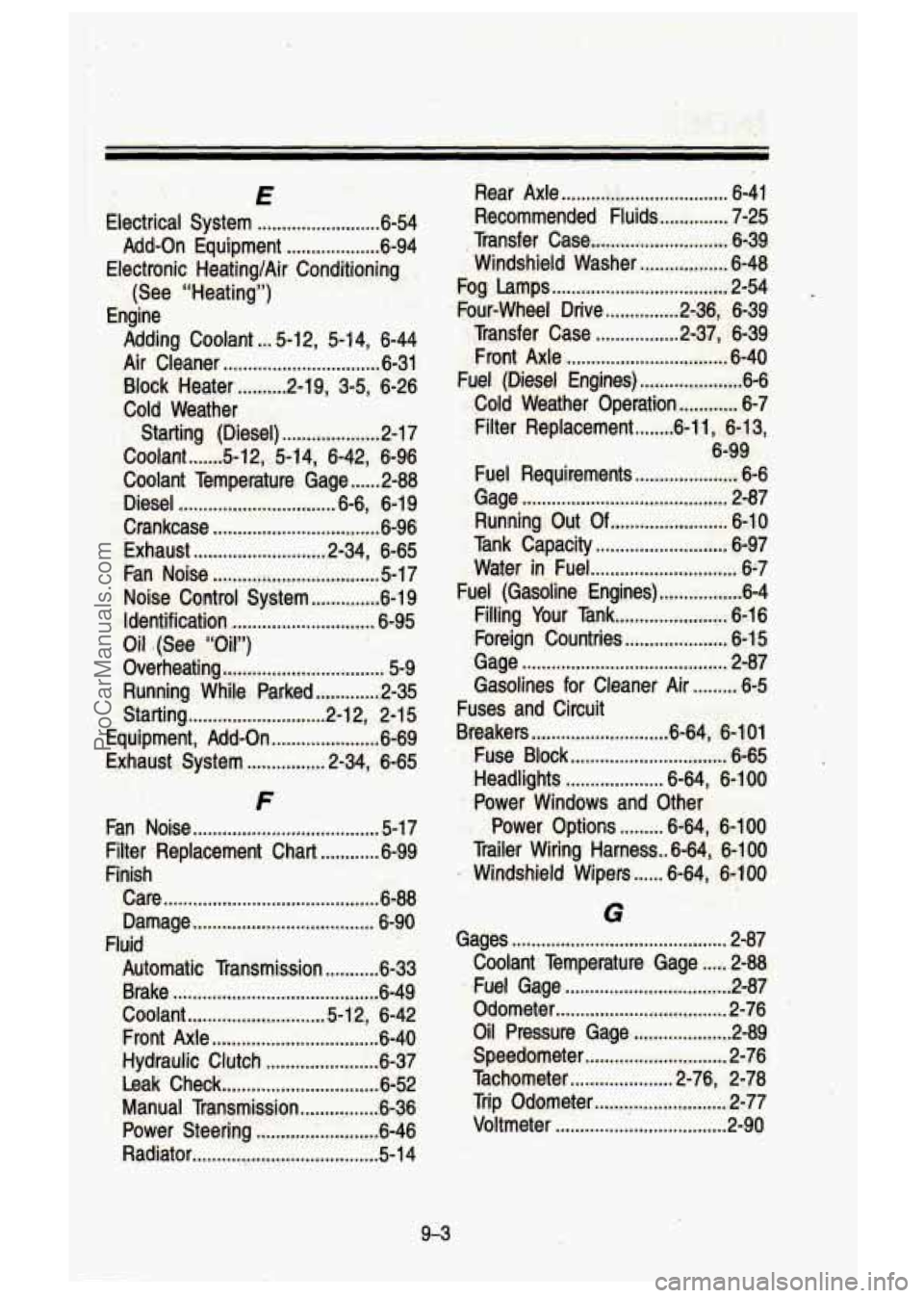
1 Add-on Equipment ................... 6-94
I- Electronic Heatinghir Conditioning
(See "Heating")
Adding Coolant
... 5.12, 5.14. 6-44
... Engine I
Air Cleaner ................................ 6-31
Block Heater
.......... 2.19. 3.5. 6-26
Cold Weather Starting (Diesel)
.................... 2-1 7
Coolant
....... 5.12. 5-1 4. 6.42. 6-96
Coolant Temperature Gage
...... 2-88
Diesel
................................ 6.6. 6-1 9
Crankcase
.................................. 6-96
Fan Noise
.................................. 5-1 7
Noise Control System
.............. 6-1 9
.-Identification,
............................ 6-95
Oil .(See "Oil")
Overheating
................................. 5-9
Running While Parked
............. 2-35
Equipment, Add-on
...................... 6-69
Exhaust System
................ 2.34, 6-65
Exhaust
........................... 2.34,
6-65
Starting
............................ 2.12, 2-1 5
F
Fan Noise ...................................... 5-1 7
Filter
. Replacement Chart ............ 6-99
Finish Care
............................................ 6-88
Damage
..................................... 6-90
Automatic Transmission
........... 6-33
Brake
.......................................... 6-49
Coolant
............................ 5-1 2. 6-42
Front Axle
.................................. 6- 40
Hydraulic Clutch
....................... 6-37
Leak Check
................................ 6-52
Manual Transmission
................ 6-36
Power Steering
............ 1 ............ 6-46
Radiator
....................................... 5-1 4
Fluid
9-3
Rear Axle .................................. 6-41
Recommended Fluids
.............. 7-25
. Transfer Case ............................ 6-39
Windshield Washer.
................. 6-48
Fog Lamps
.................................... 2-54 .
Four-wheel Drive ............... 2.36, 6-39
Transfer Case
................ .2-37, 6-39
Front Axle
................................. 6-40
Fuel (Diesel Engines)
..................... 6.6
Cold Weather Operation
............ 6-7
Filter Replacement
........ 6-1 1, 6.13,
6-99
Fuel Requirements
..................... 6-6
Gage
........................ ; ................. 2-87
Running Out Of
........................ 6-10
Tank Capacity
........................... 6-97
Water in Fuel
.............................. 627
Fuel (Gasoline Engines)
................. 6-4
Filling Your Ta'nk
....................... 6-16
Foreign
. Countries ..................... 6-15
Gage
.......................................... 2-87
Gasolines for Cleaner Air
......... 6-5 A-
Fuses and Circuit
Breakers
............................ 6-64, 6-1 01 * .
Fuse Block ................................ 6-65 . . f
Headlights .................... 6.64, 6-100
Power Windows and Other
Trailer Wiring Harness
.. 6.64, 6-1 00
. Windshield Wipers ...... 6-64, 6-100
G
Gages ............................................ 2.87
Coolant Temperature Gage
..... 2-88
Fuel Gage
.................................. 2-87
Odometer
................................... 2-76
Oil Pressure Gage
..................... 2-89
Speedometer.
............................ 2-76
Tachometer
..................... 2.76, 2-78
Trip Odameter 2-77
Voltmeter
................................... 2-90
-
-.
I
Power Options ......... 6.64, 6-100 :
. ...........................
...
ProCarManuals.com
Page 430 of 436
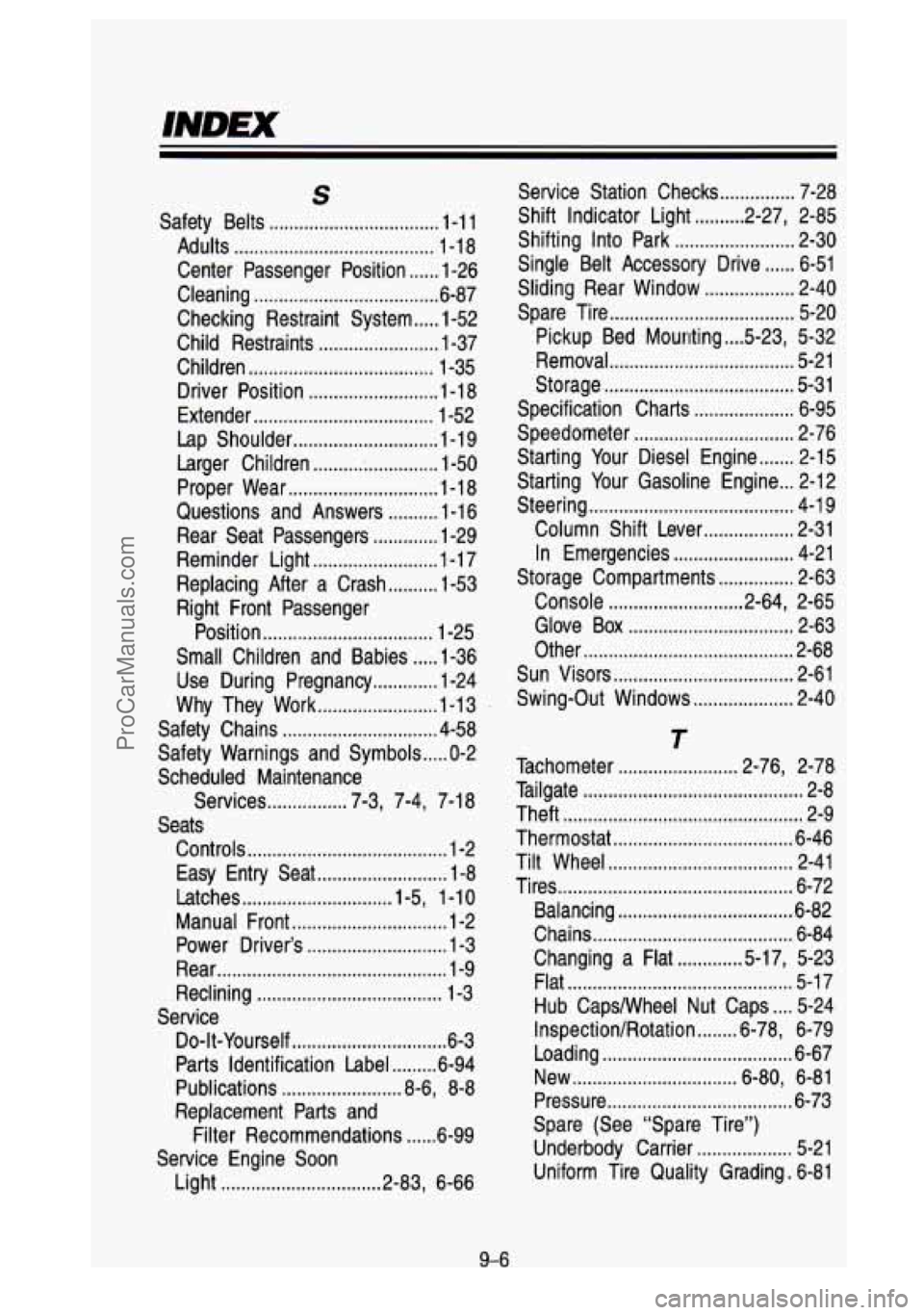
S
Safety Belts .................................. 1-1 1
Center Passenger Position
...... 1-26
Cleaning
..................................... 6-87
Checking Restraint System
..... 1-52
Child Restraints
........................ 1-37
Children
..................................... 1-35
Driver Position
.......................... 1-1 8
Extender
.................................... 1-52
Lap Shoulder
............................. 1-19
Larger Children
.......... : .............. 1-50
Proper Wear
.............................. 1-1 8
Questions and Answers
.......... 1-1 6
Rear Seat Passengers
............. 1-29
Reminder Light
......................... 1-1 7
Replacing After a Crash
.......... 1-53
Right Front Passenger Position
.................................. 1-25
Small Children and Babies
..... 1-36
Use During Pregnancy
............. 1-24
Why They Work
........................ 1-13
Safety Chains
............................... 4-58
Safety Warnings and Symbols
..... 0-2
Scheduled Maintenance Services
................ 7-3, 7-4, 7-18
Seats
Controls
........................................ 1-2
Easy Entry Seat
.......................... 1-8
Latches
.............................. 1-5, 1-10
Manual Front
............................... 1-2
Power Driver’s
............................ 1-3
Rear
.............................................. 1-9
Reclining
..................................... 1-3
Do-It-Yourself
............................... 6-3
Parts Identification Label
......... 6-94
Publications
........................ 8-6, 8-8
Replacement
. Parts and
Filter Recommendations
...... 6-99
Light
................................ 2-83, 6-66
Adults
........................................ 1-1
8
Service
Service Engine Soon Service Station Checks
............... 7-28
Shift Indicator Light
.......... 2.27. 2-85
Shifting Into Park
........................ 2-30
Single Belt Accessory Drive
...... 6-51
Sliding Rear Window
.................. 2-40
Spare Tire
..................................... 5-20
Pickup Bed Mourrting
.... 5.23. 5-32
Removal
..................................... 5-21
Storage
...................................... 5-31
Specification Charts
.................... 6-95
Speedometer
................................ 2-76
Starting Your Diesel Engine
....... 2-15
Starting Your Gasoline Engine
... 2-12
Steering
......................................... 4-19
Column Shift Lever
.................. 2-31
In Emergencies
........................ 4-21
Storage Compartments
............... 2-63
Console
........................... 2.64. 2-65
Glove Box
................................. 2-63
Other
.......................................... 2-68
Sun Visors
.................................... 2-61
Swing-Out Windows
.................... 2-40
T
Tachometer ........................ 2-76, 2-78
Tailgate
............................................ 2-8
Theft
................................................ 2-9
Thermostat
.................................... 6-46
Tilt Wheel
..................................... 2-41
Tires
............................................... 6-72
Balancing
................................... 6-82
Chains
........................................ 6-84
Changing a Flat
............. 5-17, 5-23
Flat
............................................. 5-17
Hub CapsNVheel Nut Caps
.... 5-24
Inspection/Rotation
........ 6-78. 6-79
Loading
...................................... 6-67
New
................................. 6-80. 6-81
Pressure
..................................... 6-73
Spare (See “Spare Tire”) Underbody Carrier
................... 5-21
Uniform Tire Quality Grading
. 6-81
9-6
ProCarManuals.com