tires GMC SIERRA 1993 Owner's Manual
[x] Cancel search | Manufacturer: GMC, Model Year: 1993, Model line: SIERRA, Model: GMC SIERRA 1993Pages: 436, PDF Size: 23.88 MB
Page 237 of 436
Driving with a Trailer
Towing a trailer requires a certain amount of experience. Before setting out
for the open road, you’ll want to get to know your rig. Acquaint yourself with
the feel of handling and braking with the added weight of the trailer. And
always keep in mind that the vehicle you are driving is now a good deal
longer and not nearly
so responsive as your vehicle is by itself.
Before you start, check the trailer hitch and platform, safety \
chains, electrical
connector, lights, tires and mirror adjustment.
If the trailer has electric brakes,
start your vehicle and trailer moving and then apply the trailer brake controller
by hand to be sure the brakes are working. This lets you check your
electrical connection at the same time.
During your trip, check occasionally to be sure that the load is secure, and
that the lights and any trailer brakes are still working.
Following Distance
Stay at least twice as far behind the vehicle ahead as you w\
ould when
driving your vehicle without a trailer. This can help you avoid situations \
that
require heavy braking and sudden turns.
Passing
You’ll need more passing distance up ahead when you’re towing a trailer.
And, because you’re a good deal longer, you’ll need to g\
o much farther beyond the passed vehicle before you can return to your lane.
Backing Up
Hold the bottom of the steering wheel with one hand. Then, to move the
trailer left, just move your hand to the left.
To move the trailer to the right,
move your hand to the right. Always back up slowly and,
if possible, have
someone guide you.
Making Turns
When you’re turning with a trailer, make wider turns than normal. Do this so
your trailer wheels won’t strike soft shoulders, curbs, road signs\
, trees, or
other objects. Avoid jerky or sudden maneuvers. Signal well in advance.
Turn Signals When Towing a Trailer
When you tow a trailer, your vehicle has to have a different turn signal
flasher and extra wiring. The green arrows on your instrument \
panel will flash
whenever you signal a turn or lane change. Properly hooked up, the trailer
lights will also flash, telling other drivers you’re about t\
o turn, change lanes,
or stop.
When towing a trailer, the green arrows on your instrument pan\
el will flash for
turns even
if the bulbs on the trailer are burned out. Thus, you may think
4-59
ProCarManuals.com
Page 250 of 436
Problenrs on the Road
Towing Your Vehicle
Try to have a GM dealer or a professional towing service tow your vehicle.
They can provide the right equipment and know how to tow it without dam-
age.
If your vehicle has been changed since it was factory-new, by adding things
like fog lamps, aero skirting, or special tires and wheels, th\
ese things could
be damaged during towing.
Before you do anything, turn on the hazard warning flashers.
When you call, tell the towing service:
That your vehicle has rear-wheel drive, or that it has the four-wheel drive
option.
The make, model, and year of your vehicle.
Whether you can move the shift lever for the transmission and \
transfer case,
if you have one.
If there was an accident, what was damaged.
I A To help avoid injury to you or others:
Never let passengers ride in a vehicle that is being towed.
Never tow faster than safe or posted speeds.
Never tow with damaged parts not fully secured.
Never get under your vehicle after it has been lifted by the tow
truck.
Always use separate safety chains on each side when towing a
vehicle.
When your vehicle is being towed, have the ignition key
off. The steering
wheel should be clamped in a straight-ahead position, with a clamping device
designed for towing service.
Do not use the vehicle’s steering column lock for
this. The transmission and transfer case,
if you have one, should be in Neu-
tral and the parking brake released.
If you have a two-wheel drive vehicle, don’t have your vehicle \
towed on the
rear wheels, unless you must. If the vehicle must be towed on\
the rear
wheels, don’t go more than
35 mph (56 km/h) or farther than 50 miles (80
krn) or your transmission will be damaged. If these limits must be exceeded,
then the rear drive wheels have to be supported on a dolly.
5-8
ProCarManuals.com
Page 259 of 436
Engine Fan Noise
This vehicle has a clutched engine cooling fan. When the clutch is engaged,
the fan spins faster to provide more air to
cool the engine. In most every day
driving conditions the clutch is not engaged. This improves fue\
l economy and
reduces fan noise. Under heavy vehicle loading, trailer towing andlor high
outside temperatures, the fan speed increases when the clutch e\
ngages.
So
you may hear an increase in fan noise. This is normal and should not be
mistaken as the transmission slipping or making extra shifts. It is merely the
cooling system functioning properly. The fan will
slow down when additional
cooling is not required and the clutch disengages.
You may also hear this fan noise when you start the engine. It will go away
as the fan clutch disengages.
If a Tire Goes Fiat
It’s unusual for a tire to “blow out” while you’re driving, especially if you
maintain your tires properly. If air goes out of a tire, it’s much more likely to
leak out slowly. But
if you should ever have a “blowout,” here are a few tips
about what to expect and what to do:
If a front tire fails, the flat tire will create a drag that pulls the vehicle toward
that side. Take your foot off the accelerator pedal and grip \
the steering wheel
firmly. Steer to maintain lane position, then gently brake to a stop well out of
the traffic lane.
A rear blowout, particularly on a curve, acts much like a skid and may
require the same correction you’d use in a skid. In any rear blowout, remove
your foot from the accelerator pedal. Get the‘vehicle under control by steering
the way you want the vehicle to go. It may be very bumpy and noisy, but
you can still steer. Gently brake to a stop, well off the road
if possible.
If your tire goes flat, the next part shows how to use your jacking equipment
to change a flat tire safely.
Changing a Flat Tire
If a tire goes flat, avoid further tire and wheel damage by driv\
ing slowly to a
level place. Turn on your hazard warning flashers.
5-1 7
ProCarManuals.com
Page 262 of 436

Problenrs on the Road
Jack Storage
Your jack and wheel ratchet are behind the passenger seat. Turn. th\
e wing
nut counterclockwise and remove the cover
if there is one.
Spare Tire
-
i
K2517
Your spare tire is either underneath the rear of the vehicle, or mounted to the
inside of the bed on the driver’s side.
If you have a chassis cab, refer to the
information from the body supplier/installer.
The spare tire
is a full size tire, like the other tires’ on your vehicle.
5-20
ProCarManuals.com
Page 275 of 436

If You’re Stuck: In Sand,
Mud,
Ice or Snow
What you don’t want to do when your vehicle is stuck is to spin your
wheels. The method known as “rocking” can help you get o\
ut when you’re
stuck, but you must use caution.
CAUTION - --
I * If you let your tires spin at high speed, they can explode and you or
,A others could be injured. And, the transmission or other parts of the
vehicle can overheat. That could cause an engine compartment fire
or other damage. When you’re stuck, spin the wheels as little as
possible. Don’t spin the wheels above
35 mph (55 krnlh) as shown
I on the speedometer.
;pinning your wheels can destroy parts of your vehicle as well as the
res.
If you spin the wheels too fast while shifting your transmission back
.nd forth, you can destroy your transmission.
NOTICE 1
Rocking your vehicle to get it out:
First, turn your steering wheel left and right. That will clear the area around
your front wheels. Then shift back and forth between
R and a forward gear
(or with a manual transmission, between First or Second gear and Reverse),
spinning the wheels as little as possible. Release the accelerator pedal while
you shift, and press lightly on the accelerator pedal when the transmission is
in gear.
If that doesn’t get you out after a few tries, you may need to be
towed out.
Or, you can use your recovery hooks, if your vehicle has them. If
you do need to be towed out, see “Towing Your Vehicle” in the Index.
5-33
ProCarManuals.com
Page 280 of 436

Service & Appearance Care
Engine Coolant ........................................................................\
........................ 6-42
Power Steering Fluid
........................................................................\
............... 6-46
Windshield Washer Fluid
........................................................................\
......... 6-48
Brake Master Cylinder
........................................................................\
............. 6-49
Replacing Brake System Parts
........................................................................\
.. 6-50
Other Maintenance Items ........................................................................\
........... 6-51
Lubrication
........................................................................\
.................................... 6-52
Electrical System
........................................................................\
......................... 6-54
Battery
........................................................................\
...................................... 6-54
Fuses and Circuit Breakers
........................................................................\
.... 6-64
Bulb Replacement
........................................................................\
.................... 6-54
Exhaust System
........................................................................\
........................... 6-65
Loading Your Vehicle
........................................................................\
.................. 6-67
Tires
........................................................................\
.............................................. 6-72
Inflation-Tire Pressure
........................................................................\
........... 6-73
Tire Inspection and Rotation
........................................................................\
.. 6-78
When It's Time for New Tires
........................................................................\
6-80
Buying New Tires
........................................................................\
.................... 6-81
Wheel Alignment and Tire Balance
............................................................... 6-82
Wheel Replacement
........................................................................\
................. 6-83
Tire Chains
........................................................................\
............................... 6-84
Appearance Care
........................................................................\
........................ 6-84
Cleaning the Inside Of Your Vehicle
............................................................. 6-85
Cleaning the Outside Of Your Vehicle
.......................................................... 6-88
Appearance Care Materials
.r.ikl...rr.r.n.....lr. ........ ... .. 6-91
Vehicle Identification Number
........................................................................\
..... 6-92
Service Parts Identification Label
...................................................................... 6-94
Specification Charts
....++t....,.,.*,..-".,,. .............. , ........... .................... 6-95
Uniform Tire Quality Grading
........................................................................\
.. 6-81
..................................................
6-2
ProCarManuals.com
Page 345 of 436

Loading Your Vehicle
The CertificationKire label is found on the rear edge of the driver’s door or in
the incomplete vehicle document in the cab. The label shows th\
e size of your
original tires and the inflation pressures needed
to obtain the gross weight
capacity of your vehicle. This is called the GVWR (Gross Vehicle Weight
Rating). The
GWVR includes the weight of the vehicle, all occupants, fuel and
cargo.
The CertificationKire label also tells you the maximum weights for the front
and rear axles, called Gross Axle Weight Rating (GAWR). To find out the
actual loads on .your front and rear axles, you need to go to a weigh station
and weigh your vehicle. Your dealer can help you with this. .Be sure to
spread out your load equally on both sides of the centerline+
.. , - :I. -I lrT1 I I -
Never exceed the GVWR for your vehicle, or the Gross, Axle Weight Rating-
(GAWR) for either the front or rear axle.
And,
if you do have a heavy load, you should spread it out.
. -1 r,
In the case of a sudden stop or collision, things carried in the bed of 7
injuring you and others. If you put things in the bed of your truck,
you should make sure they are properly secured.
r! your truck could shift forward and come into the passenger are\
a,
-
6-67
ProCarManuals.com
Page 350 of 436
Service & Appearance Care
Trailer Recommendations
You must subtract your hitch loads from the CWR for your vehicle. Weigh
your vehicle with your trailer attached,
so that you won’t go over the GVWR
or the GAWR.
You’ll get the best performance
if you spread out the weight of your load the
right way, and
if you choose the correct hitch and trailer brakes.
For more information, see “Trailer Towing” in the Index.
If you want more information on curb weights, cargo weights, cargo wei\
ght
rating and the correct center of gravity zone for your vehicle, your dealer can
help you. Just ask for a copy of “Consumer Information, Truck-Cam\
per
Loading.”
Pickup Conversion lo. Chassis Cab
General Motors is aware that some vehicle owners may consider having the
pickup box removed and a commercial
or recreational body installed. Before
you do
so, first contact the GM Zone Office for your area for information on
such conversions. (See the “Warranty and Owner Assistance”\
booklet for
Zone Office.) Owners should be aware that, as manufactured, th\
ere are
differences between a chassis cab and a pickup with the box r\
emoved which may affect vehicle safety. The components necessary to adapt the pickup to
permit its safe use with a specialized body should be installed by a bod\
y
builder in accordance with the information available from the Z\
one Office.
Tires
We don’t make tires. Your new vehicle comes with high quali\
ty tires made by
a leading tire manufacturer. These tires are warranted by the \
tire
manufacturers and their warranties are delivered with every new \
vehicle.
If
your spare tire is a different brand than your road tires, you will have a tire
warranty folder from each of these manufacturers.
6-72
ProCarManuals.com
Page 351 of 436
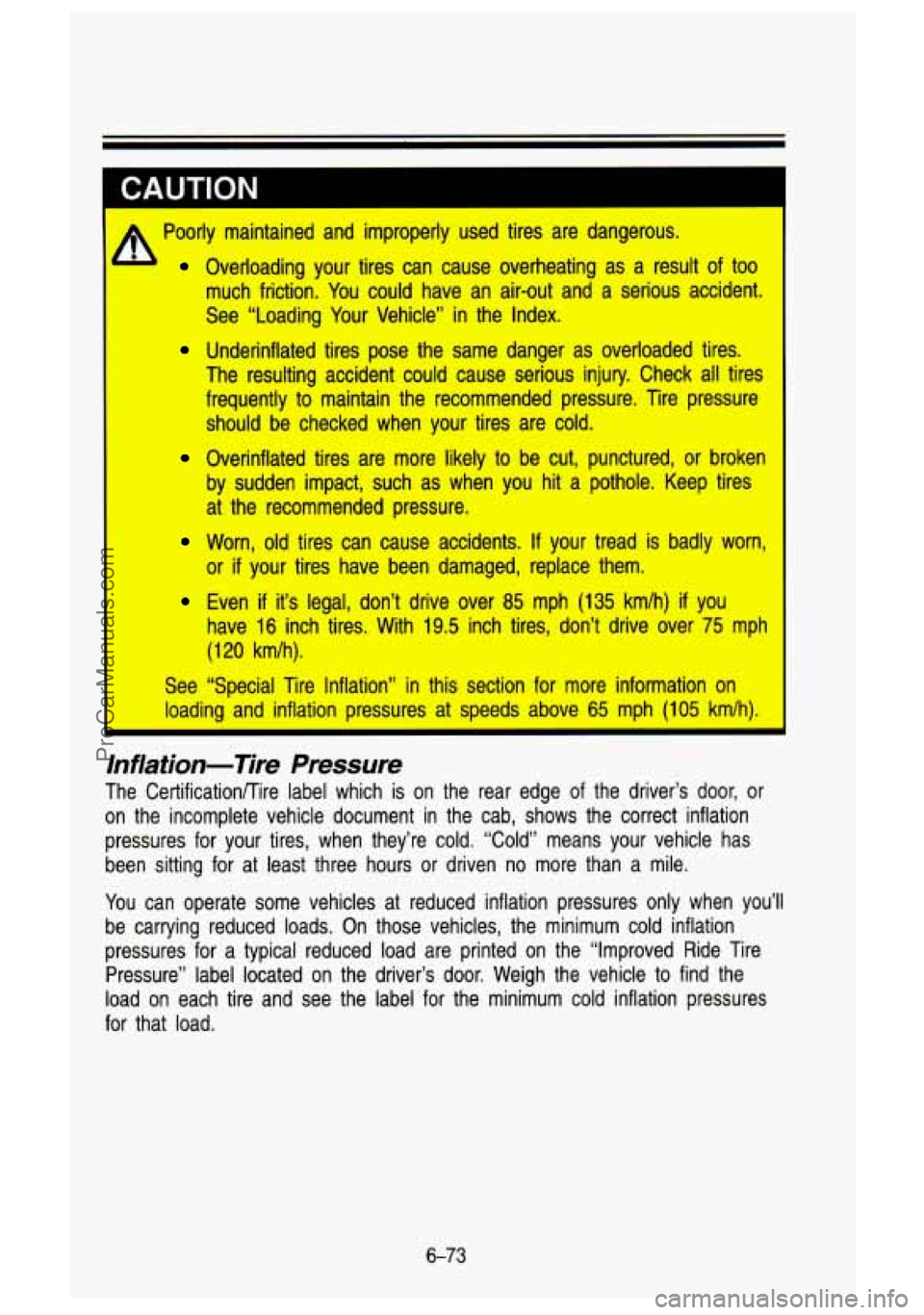
I CAUTION
Poorly maintained and improperly used tires are dangerous.
Overloading your tires can cause overheating as a result of too
much friction. You could have an air-out and a serious accident.
See “Loading Your Vehicle” in the Index:
The resulting accident could cause serious injury. Check all tires
frequently
to maintain the recommended pressure. Tire pressure
should be checked when your tires are cold.
Overinflated tires are more likely to be cut, punctured, or broken
by sudden impact, such as when you hit a pothole. Keep tires
at the recommended pressure.
Worn, old tires can cause accidents; If your tread is badly worn,
or if your tires have been damaged, replace them.
Even if it’s legal, don’t drive over 85 mph (1 35 kmlh) if you
have
16 inch tires. With 19.5 inch tires, don’t drive over 75 mph
(1 20 km/h).
Underinflated tires pose the same danger as overloaded tires.
See “Special Tire Inflation” in this section for more information on
I loading and inflation pressures at speeds above 65 mph (105 kmlh). I
Inflaiion-Tire Pressure
The Certification/Tire label which is on the rear edge of the driver’s door, or
on the incomplete vehicle document in the cab, shows the corre\
ct inflation
pressures for your tires, when they’re cold.
“Cold” means your vehicle has
been sitting for at least three hours or driven no more than
a mile.
You can operate some vehicles at reduced inflation pressures only w\
hen you’ll
be carrying reduced loads. On those vehicles, the minimum cold \
inflation
pressures for a typical reduced load are printed on the “Improved Ride Tire \
Pressure” label located on the driver’s door. Weigh the v\
ehicle
to find the
load on each tire and see the label
for the minimum cold inflation pressures
for that load.
6-73
ProCarManuals.com
Page 352 of 436
Service & Appearance Care
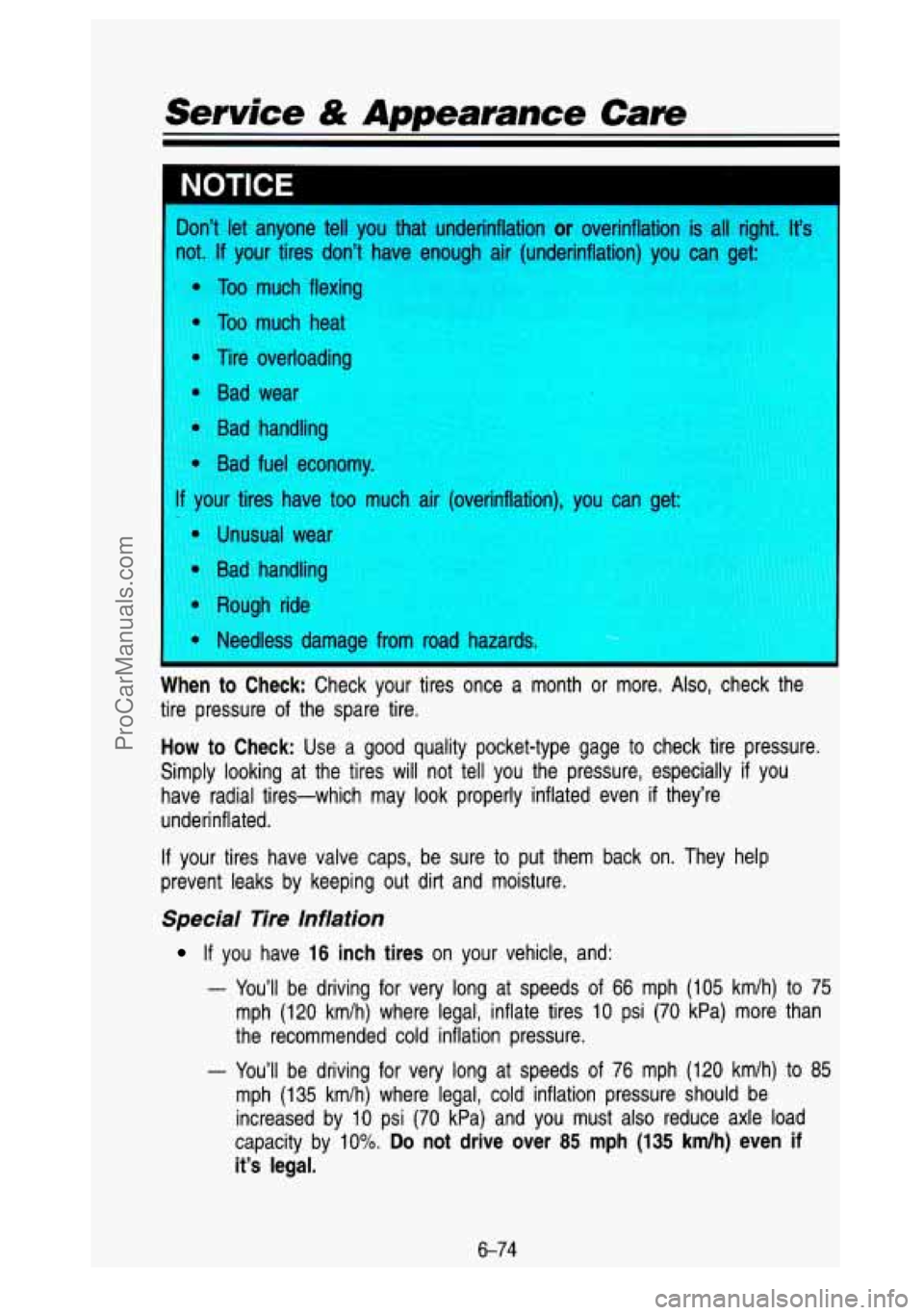
When to Check: Check your tires once a month or more. Also, check the
tire pressure of the spare tire.
How to Check: Use a good quality pocket-type gage to check tire pressure.
Simply looking at the tires will not tell you the pressure, e\
specially
if you
have radial tires-which may look properly inflated even if they\
’re
underinflated.
If your tires have valve caps, be sure to put them back on. They help
prevent leaks by keeping out dirt and moisture.
Special Tire Inflation
If you have 16 inch tires on your vehicle, and:
- You’ll be driving for very long at speeds of 66 mph (1 05 km/h) to 75
mph (120 kmlh) where legal, inflate tires 10 psi (70 kPa) more than
the recommended cold inflation pressure.
- You’ll be driving for very long at speeds of 76 mph (120 kmlh) to 85
mph (1 35 km/h) where legal, cold inflation pressure should be
increased by
10 psi (70 kPa) and you must also reduce axle load
capacity by
10%. Do not drive over 85 mph (135 kdh) even if
it’s legal.
6-74
ProCarManuals.com