Section 7 GMC SIERRA 1993 Owner's Guide
[x] Cancel search | Manufacturer: GMC, Model Year: 1993, Model line: SIERRA, Model: GMC SIERRA 1993Pages: 436, PDF Size: 23.88 MB
Page 284 of 436
Service & Appearance Care
Diesel Fuel Requirements
and Fuel System
Some states and provinces have restrictions on the purchase of diesel fuel
for light-duty vehicles and require you
to buy permits or pay special taxes.
Some of these restrictions apply only
to residents, and others apply to both
residents and visitors. These restrictions can change.
To learn the current
restrictions in any state or province, contact your auto club, \
the police or
other officials.
Fuel Requirements
1 NOTICE
Diesel fuel or fuel additives not recommended in this manual could
damage your fuel system and engine. Your warranty wouldn’t cover thi
damage. And:
Diesel fuel that has been mixed with engine oil could damage your
engine and emission controls.
Always check with your service station
his
diesel fuel, it can be difficult to restart your
engine. “Running Out of Fuel,” later
in this section, tells you how to
get
it started again. To avoid all this, try never to let. your tank get
What Fuel to Use:
You can use either Number I-D or Number 2-D diesel fuel, but you’ll get
better fuel economy using
2-D.
Diesel fuel may foam when you fill your tank. This can cause the automatic
pump nozzle
to shut off, even though your tank isn’t full. If this happens, just
wait for the foaming to stop and then continue to fill your tank.
1 CAUTION
- Heat coming from the engine may cause the fuel to expand and force
the fuel out of your tank. If something ignites the fuel, a \
fire could start
and people could be burned.
To help avoid this, fill your fuel tank only
until the automatic nozzle shuts
off. Don’t try to “top if off .” I
I
6-6
ProCarManuals.com
Page 317 of 436
Hydraulic Clutch Grease Fitting
A grease fitting is on the clutch housing for lubricating the clutch fork ball
stud. See your Maintenance Schedule for when to lubricate the clutch
housing. See “Recommended Fluids and Lubricants” in the Index for the
proper lubricant to use.
Be sure not to over-fill because you could damage your clutch.
Four- Wheel Drive
Most lubricant checks in this section also apply to four-wheel-drive vehicles.
However, they have two additional systems that need lubrication.
Transfer Case
When to Check Lubricant:
Refer to the Maintenance Schedule to determine how often to check the
lubricant. See “Periodic Maintenance Inspections” in the Index.
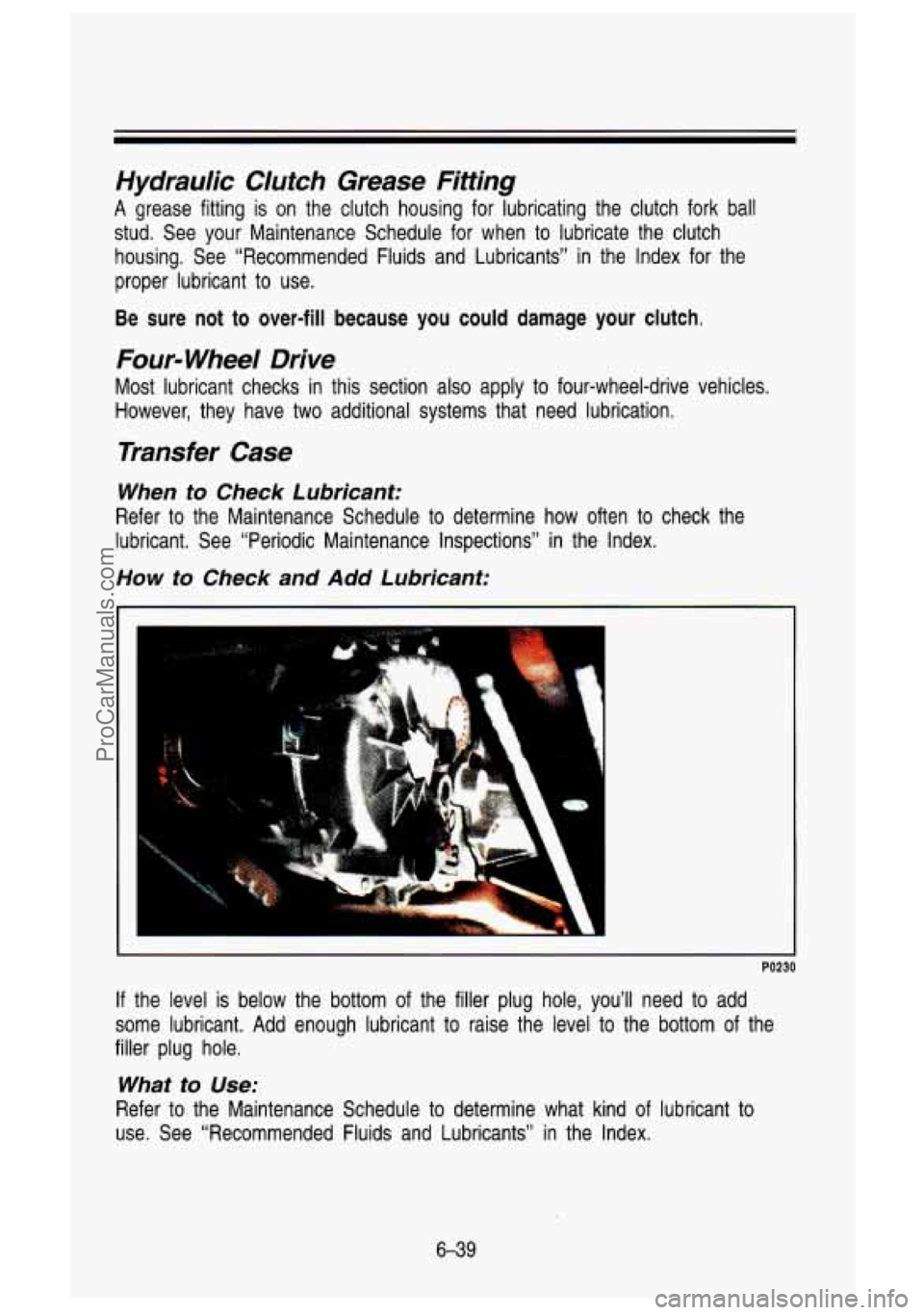
How to Check and Add Lubricant:
I
PO230
If the level is below the bottom of the filler plug hole, you’ll need to add
some lubricant. Add enough lubricant to raise the level to the bottom of the
filler plug hole.
What to Use:
Refer to the Maintenance Schedule to determine what kind of lubricant to
use. See “Recommended Fluids and Lubricants” in the Index.
639
ProCarManuals.com
Page 328 of 436

Service & Appearance Care
MIN mark. If they aren’t, have your brake system checked to see if there is a
leak.
t
After work is done on the brake hydraulic system, make sure t\
he levels are
above
MIN and below the top of each window.
What To Add:
When you do need brake fluid, use only DOT-3 brake fluid-such \
as Delco
Supreme
11 @ (GM Part No. 1052535). Use new brake fluid from a sealed
container only.
Hydro-Boost Brake System (Hydraulic Pump)
The power steering pump is also used as the Hydro-boost pump. Refer to
“Power Steering System” in this section when checking fluid level or adding
fluid.
Replacing Brake System Parts
The braking system on .a modern vehicle is complex. Its many parts have to
be of ‘top quality and work well together
if the vehicle is to have really good
braking. Vehicles we design and test have top-quality
GM brake parts in
them, as your vehicle does when it is new. When you replace parts
of your
braking system-for example, when your brake linings wear down and you
have
to have new ones put in-be sure you get new genuine GM
replacement parts. If you don’t, your brakes may no longer work properly. For
example, if someone puts in brake linings that are wrong for your vehicle, the
balance between your front and rear brakes can change; for the\
worse. The
’ braking performance you’ve come to expect can change in many other ways
if someone puts in the wrong replacement brake parts.
6-50
. . .‘,
ProCarManuals.com
Page 329 of 436
Other Maintenance Items
Front Suspension and Steering Linkage
Your maintenance schedule will tell you how often to lubricate the fittings. See
“Recommended Fluids and Lubricants’’ in the Index for the proper lubricant to
use.
Front Wheel Bearings
Your vehicle has front wheel bearings that must be cleaned and repa\
cked.
Your maintenance schedule will tell you how often this must be done.
Front Shock Absorbers
The front shock absorbers of your vehicle do many things. They help the
vehicle ride smoothly and also control the travel
of the suspension system.
When the shock absorbers are serviced, any replacement shock absorber\
s
must be the same as the original equipment shock absorbers in both
extended length and strength.
1 NOTICE
If you use shock absomers that are nor me same as the original shock
I absorbers, the shock absorbers or suspension system could be da\
maged.
Wheel Nut Torque
For vehicles with dual wheels, when the vehicle, wheel or fast\
eners are new,
have the torque set at the first
100, 1,000 and 6,000 miles (160, 1600 and
9600 km). Use the torque specified in the appropriate Specification \
Chart later
in this section.
Single Belt Accessory Drive
If your new vehicle uses a serpentine belt, it is lighter, and more durable
than systems with several belts.
The belt runs over or around the pulleys
on the engine. A tensioner is used
to keep the belt tight at all times. The tensioner also makes replacing the
belt easier.
If you need to replace the belt, be sure to get the correct
replacement belt. Your dealership
or parts supplier can help you with this.
The Accessory Drive Belt Routing label on your vehicle will sh\
ow you how to
route the belt your vehicle uses.
6-5 1
ProCarManuals.com
Page 351 of 436
I CAUTION
Poorly maintained and improperly used tires are dangerous.
Overloading your tires can cause overheating as a result of too
much friction. You could have an air-out and a serious accident.
See “Loading Your Vehicle” in the Index:
The resulting accident could cause serious injury. Check all tires
frequently
to maintain the recommended pressure. Tire pressure
should be checked when your tires are cold.
Overinflated tires are more likely to be cut, punctured, or broken
by sudden impact, such as when you hit a pothole. Keep tires
at the recommended pressure.
Worn, old tires can cause accidents; If your tread is badly worn,
or if your tires have been damaged, replace them.
Even if it’s legal, don’t drive over 85 mph (1 35 kmlh) if you
have
16 inch tires. With 19.5 inch tires, don’t drive over 75 mph
(1 20 km/h).
Underinflated tires pose the same danger as overloaded tires.
See “Special Tire Inflation” in this section for more information on
I loading and inflation pressures at speeds above 65 mph (105 kmlh). I
Inflaiion-Tire Pressure
The Certification/Tire label which is on the rear edge of the driver’s door, or
on the incomplete vehicle document in the cab, shows the corre\
ct inflation
pressures for your tires, when they’re cold.
“Cold” means your vehicle has
been sitting for at least three hours or driven no more than
a mile.
You can operate some vehicles at reduced inflation pressures only w\
hen you’ll
be carrying reduced loads. On those vehicles, the minimum cold \
inflation
pressures for a typical reduced load are printed on the “Improved Ride Tire \
Pressure” label located on the driver’s door. Weigh the v\
ehicle
to find the
load on each tire and see the label
for the minimum cold inflation pressures
for that load.
6-73
ProCarManuals.com
Page 363 of 436
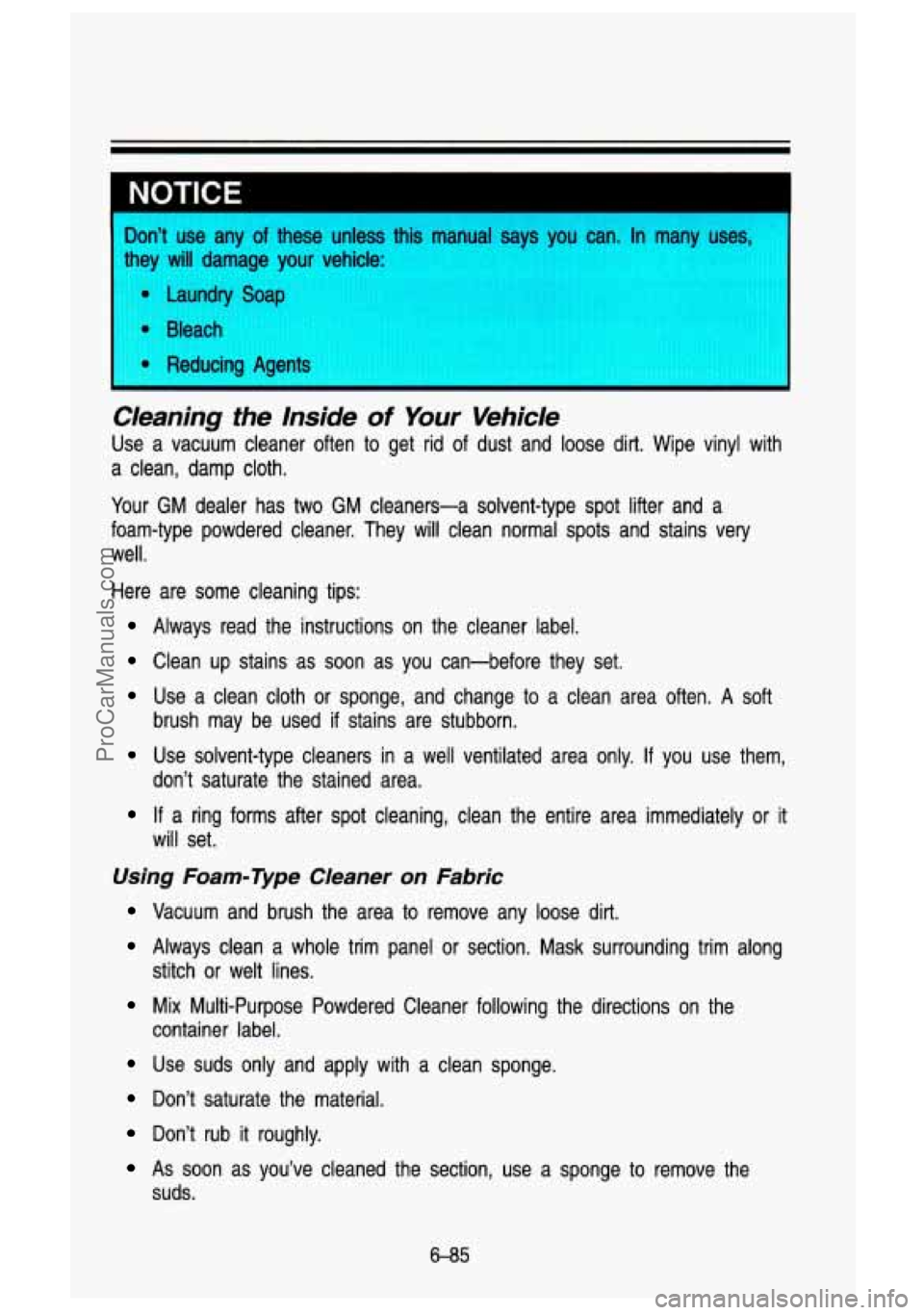
NOTICE I
I Don’t use any of these unless anual says you can. In many uses,
!v will damage your vehicle:
Reducing Agents
Cleaning the Inside of Your Vehicle
Use a vacuum cleaner often to get rid of dust and loose dirt. Wipe vinyl with
a clean, damp cloth.
Your GM dealer has two
GM cleaners-a solvent-type spot lifter and a
foam-type powdered cleaner. They will clean normal spots and st\
ains very
well.
Here are some cleaning tips:
Always read the instructions on the cleaner label.
Clean up stains as soon as you can-before they set.
Use a clean cloth or sponge, and change to a clean area often. A soft
Use solvent-type cleaners in a well ventilated area only. If you use them,
brush
may be used
if stains are stubborn.
don’t saturate the stained area.
If a ring forms after spot cleaning, clean the entire area immedi\
ately or it
will set.
Using Foam-Type Cleaner on Fabric
Vacuum and brush the area to remove any loose dirt.
Always clean a whole trim panel or section. Mask surrounding t\
rim along
stitch or welt lines.
Mix Multi-Purpose Powdered Cleaner following the directions on the
container label.
Use suds only and apply with a clean sponge.
Don’t saturate the material.
Don’t rub it roughly.
As soon as you’ve cleaned the section, use a sponge to remove the
suds.
6-85
ProCarManuals.com
Page 364 of 436
Service & Appearance Care
Rinse the section with a clean, wet sponge.
Wipe off what’s left with a slightly damp paper towel or cloth.
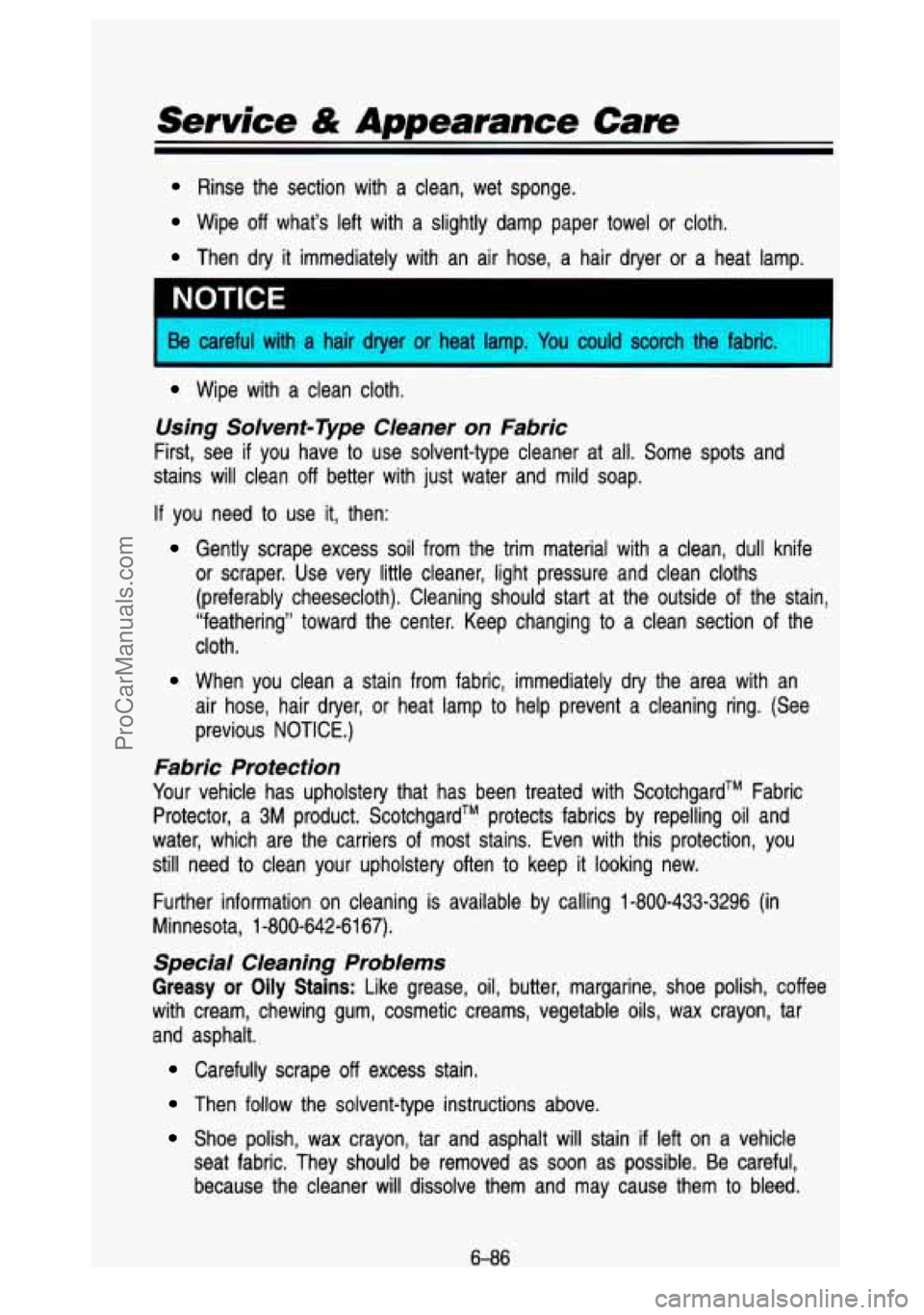
Then dry it immediately with an air hose, a hair dryer or a heat lamp.
I
~~~
careful with a hair dryer or heat lamp. You could scorch me lauric.
Wipe with a clean cloth.
Using Solvent-Type Cleaner on Fabric
First, see if you have to use solvent-type cleaner at all. Some spots and
stains will clean
off better with just water and mild soap.
If you need to use it, then:
Gently scrape excess soil from the trim material with a clean,\
dull knife
or scraper. Use very little cleaner, light pressure and clean cloths
(preferably cheesecloth). Cleaning should start at the outside \
of the stain,
“feathering” toward the center. Keep changing to a clean section of the
cloth.
When you clean a stain from fabric, immediately dry the area with an
air hose, hair dryer,
or heat lamp to help prevent a cleaning ring. (See
previous NOTICE.)
Fabric Protection
Your vehicle has upholstery that has been treated with ScotchgardTM \
Fabric
Protector, a
3M product. ScotchgardTM protects fabrics by repelling oil and
water, which are the carriers of most stains. Even with this protection, you
still need to clean your upholstery often
to keep it looking new.
Further information on cleaning is available by calling 1-800-433-3296
(in
Minnesota, 1-800-642-61 67).
Special Cleaning Problems
Greasy or Oily Stains: Like grease, oil, butter, margarine, shoe polish, coffee
with cream, chewing gum, cosmetic creams, vegetable oils, wax c\
rayon, tar
and asphalt.
Carefully scrape off excess stain.
Then follow the solvent-type instructions above.
Shoe polish, wax crayon, tar and asphalt will stain if left on a vehicle
seat fabric. They should be removed as soon as possible. Be c\
areful,
because the cleaner will dissolve them and may cause them to bleed.
6-86
ProCarManuals.com
Page 370 of 436
Service & Appearance Care
Vehicle identification Number (VIN)
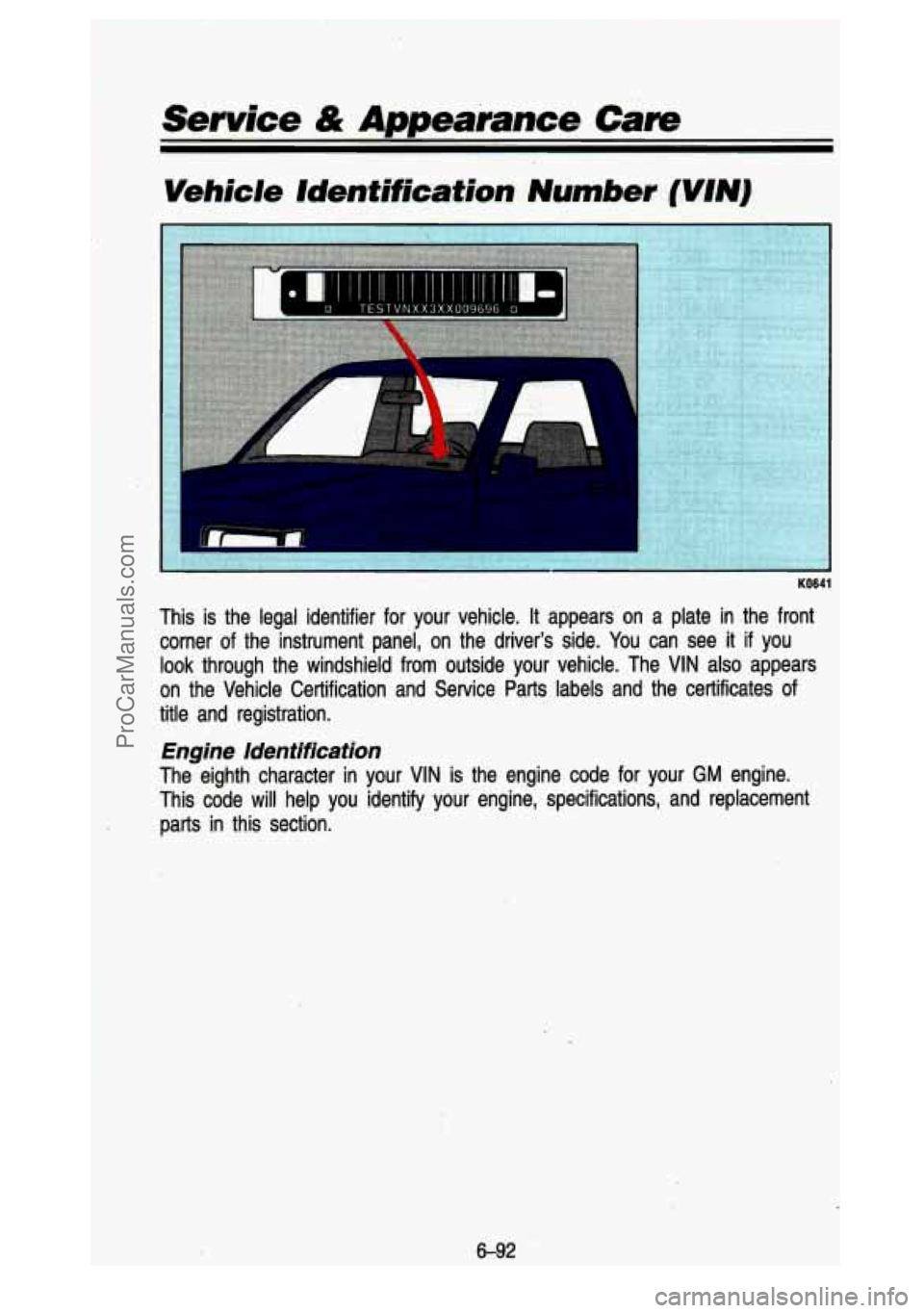
KO641
This is the legal identifier for your vehicle. It appears on a plate in the front
corner of the instrument panel, on the driver’s side. You c\
an see it if you
look through the windshield from outside your vehicle. The VIN also \
appears
on the Vehicle Certification and Service Parts labels and the \
certificates of
title and registration.
Engine Identification
The eighth character in your VIN is the engine code for your \
GM engine.
This code will help you identify your engine, specifications, a\
nd replacement parts in this section.
6-92
ProCarManuals.com
Page 373 of 436

Specification Charts
Replacement Parts
Replacement part numbers listed in this section are based on the latest
information available at the time of printing, and are subject \
to change. If a
part listed in this manual is not the same as the part used \
in your vehicle
when it was built, or
if you have any questions, please contact your GM truck
dealer.
Engine Identification
Liter Produced Fuel VIN
Displacement Type
U.S. TBI N
V8 7.4 H.D.
us. Diesel F V8 6.5
H.D. U.S. Diesel J V8 6.2
L. D. us. Diesel C V8 6.2
US., Can.
TBI K V8
5.7
L. D. US., Can.
TBI H
V8 5.0
U.S. TBI 2 V6
4.3
Emissions
BY
System
Engine Code
*
*
*
*Light Duty Emissions with 8500 GVWR and below or:
Heavy Duty Emissions with 8501 GVWR and above.
TO035
Wheel Nut Torque
MODEL I DESCRIPTION I TORQUE I
C 1500 5 bolts (14mm) 120 ft. Ibs. (160 Nmm)
K 1500 & C-K 2500 6 bolts f14mm) 120 ft. Ibs. (1 60 N.m)
C-K
2500 (w/C6P) 8 bolts (14mm) 120 ft. Ibs. (160 Nmm)
C-K 3500 Single Rear Wheels 8 bolts (14mm) 120
ft. Ibs.
(1 60 N-m)
C3500 Dual Rear Wheels
8 bolts (14mm) 140 ft. Ibs. (190
N-m)
C3500 HD -Front
5 bolts (5/8 in.) 175 ft. Ibs. (240 Nsm)
TO040
--Rear
10 bolts (5/8 in.)
6-95
ProCarManuals.com
Page 374 of 436
Service & Appearance Care
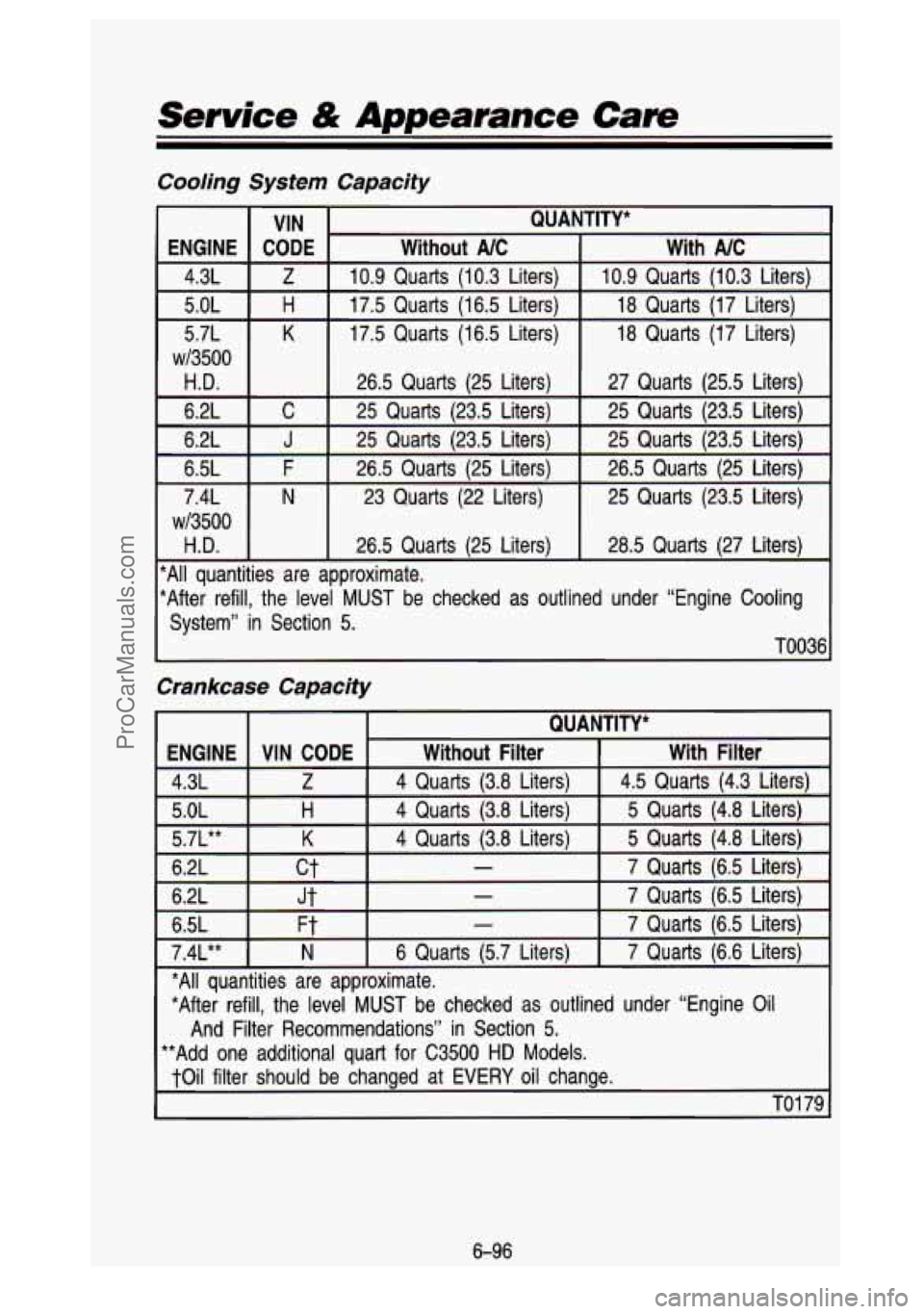
Cooling Systen
VIN
ENGINE
K 5.7L
H 5.0L
Z 4.3L
CODE
~13500
H.D.
6.2L C
6.2L
J
6.5L F
7.4L
N
w/3500
H.D.
Capacity
QUA
Without NC
10.9 Quarts (10.3 Liters)
17.5 Quarts (16.5 Liters)
17.5 Quarts (1 6.5 Liters)
26.5 Quarts (25 Liters)
25 Quarts (23.5 Liters)
25 Quarts (23.5 Liters)
26.5 Quarts (25 Liters) 23 Quarts (22 Liters)
26.5 Quarts (25 Liters)
ITITY*
With NC
10.9 Quarts (10.3 Liters)
18 Quarts (17 Liters)
18 Quarts (17 Liters)
27 Quarts (25.5 Liters)
25 Quarts (23.5 Liters)
25 Quarts 123.5 Liters)
26.5 Quarts (25 Liters)
25 Quarts (23.5 Liters)
28.5 Quarts (27 Liters)
*All quantities are approximate.
*After refill, the level
MUST be checked as outlined under “Engine Cooling
System” in Section
5.
TO036
Crankcase Capacity
ENGINE
5.0L
With Filter
Without Filter VIN CODE
7 Quarts (6.5 Liters) - ct 6.2L
5 Quarts (4.8 Liters) 4 Quarts (3.8 Liters) H
6.2L Jt - 7 Quarts (6.5 Liters)
6.5L
*All quantities are approximate. 7
Quarts (6.5 Liters)
- Ft
*After refill, the level MUST be checked as outlined under “Engine Oil
4.3L
5 Quarts (4.8 Liters)
4 Quarts (3.8 Liters) K 5.7L**
4.5 Quarts (4.3 Liters)
4 Quarts (3.8 Liters) Z
7.4L** 7
Quarts (6.6 Liters)
6 Quarts (5.7 Liters) N
And Filter Recommendations” in Section 5.
**Add one additional quart for C3500 HD Models.
toil filter should be changed at
EVERY oil change.
TO1 79
6-96
ProCarManuals.com