Section 7 GMC SIERRA 1993 Owner's Manual
[x] Cancel search | Manufacturer: GMC, Model Year: 1993, Model line: SIERRA, Model: GMC SIERRA 1993Pages: 436, PDF Size: 23.88 MB
Page 188 of 436

Your Driving and the Road
Defensive Driving
The best advice anyone can give about driving is: Drive defens\
ively. Please start with a very important safety device in your vehicle: Buckle up,
(See “Safety Belts” in the Index.)
Defensive driving really means “be ready for anything.” On\
city streets, rural
roads, or freeways, it means “always expect the unexpected.’’
Assume that pedestrians or other drivers are going to be carel\
ess and make mistakes. Anticipate what they might
do. Be ready for their mistakes.
Expect children to dash out from behind parked cars, often fol\
lowed by other
children. Expect occupants in parked cars to open doors into traffic. Watch for
movement
in parked cars-someone may be about to open a door,
Expect other drivers to run stop signs when you are on a through street, Be
ready to brake
if necessary as you go through intersections. You may not
have to use the brake, but
if you do, you will be ready,
If you’re driving through a shopping center parking lot where there are
well-marked lanes, directional arrows, and designated parking are\
as, expect
some drivers to ignore all these markings and dash straight to\
ward one part
of the lot.
Pedestrians can be careless. Watch for them. In general, you must give way
to pedestrians even
if you know you have the right of way.
Rear-end collisions are about the most preventable of accidents. Yet they are
common. Allow enough following distance.
It’s the best defensive driving
maneuver, in both city and rural driving. You never know when the vehicle in
front of you is going to brake or turn suddenly.
Here’s a final bit of information about defensive driving. The most dangerous
time for driving in the
US. is very early on Sunday morning. In fact, GM
Research studies show that the most and the least dangerous times for
driving, every week, fall on the same day. That day is Sunday. The most
dangerous time is Sunday
3 a.m. to 4 a.m. The safest time is Sunday from
10 a.m. to 11 a.m. Driving the same distance on a Sunday at 3 a.m. isn’t
just a little more dangerous than it
is at 10 a.m. It’s about 134 times more
dangerous.
That leads to the next part.
4-1 0
ProCarManuals.com
Page 201 of 436

Not necessarily! Passing another vehicle on a two-lane highway is a
potentially dangerous move, since the passing vehicle occupies t\
he same lane
as oncoming traffic for several seconds.
A miscalculation, an error in
judgment, or a brief surrender to frustration or anger can suddenly put the
passing driver face to face with the worst of all traffic accidents-the head-on
collision.
So here are some tips for passing:
e
e
e
e
e
“Drive ahead.” Look down the road, to the sides, and to crossroads for
situations that might affect your passing patterns.
If you have any doubt
whatsoever about making a successful pass, wait for a better t\
ime.
Watch for traffic signs, pavement markings, and lines. If you \
can see a
sign up ahead that might indicate a turn or an intersection, delay your
pass.
A broken center line usually indicates it’s all right to pass
(providing the road ahead is clear). Never cross a solid line on your side
of the lane or a double solid line, even
if the road seems empty of
approaching traffic.
If you suspect that the driver of the vehicle you want to pass isn’t aware
of your presence, tap the horn a couple of times before passing.
Do not get too close to the vehicle you want to pass while you’re
awaiting an opportunity. For one thing, following too closely r\
educes your
area of vision, especially
if you’re following a larger vehicle. Also, you
won’t have adequate space
if the vehicle ahead suddenly slows or stops.
Keep back a reasonable distance.
When it looks like a chance to pass is coming up, start
to accelerate
but stay in the right lane and don’t get too close. Time your move
so
you will be increasing speed as the time comes to move into the other
lane.
If the way is clear to pass, you will have a “running start” that
more than makes up for the distance you would lose by droppin\
g back.
And
if something happens to cause you to cancel your pass, you need
only slow down and drop back again and wait for another oppor\
tunity.
If other cars are lined up to pass a slow vehicle, wait your turn. But
take care that someone isn’t trying to pass you as you pull out to pass
the slow vehicle. Remember to glance over your shoulder and check the
blind spot.
Check your mirrors, glance over your shoulder, and start your \
left lane
change signal before moving out of the right lane
to pass. When you
are far enough ahead of the passed vehicle to see its front in your
inside mirror, activate your right lane change signal and move \
back into
4-23
ProCarManuals.com
Page 214 of 436

Your Driving and the Road
After Off-Road Driving
Remove any brush or debris that has collected on the underbody\
, chassis, or
under the hood. These accumulations can be a fire hazard.
After operation in mud or sand, have the brake linings cleaned\
and checked. These substances can cause glazing and uneven braking. Check th\
e body
structure, steering, suspension, wheels, tires, and exhaust syste\
m for damage.
Also, check the fuel lines and cooling system for any leakage.
Your vehicle will require more frequent service due
to off-road use. Refer to
Section
7 for additional information.
Driving at Night
I
--.
-
- AM450002 I
Night driving is more dangerous than day driving. One reason is that some
drivers are likely
to be impaired-by alcohol or drugs, with night vision
problems, or by fatigue.
Here are some tips on night driving.
Drive defensively. Remember, this is the most dangerous time.
Don’t drink and drive (See “Drunken Driving” in the Index for more on
this problem).
Adjust your inside rear view mirror to reduce the glare from headlights
Since you can’t see as well, you may need to slow down and keep
behind
you.
more space between you and other vehicles. It’s hard
to tell how fast
the vehicle ahead is going just
by looking at its taillights.
4-36
ProCarManuals.com
Page 221 of 436
Here are ways to increase your safety in city driving:
e
e
e
e
0
Know the best way to get to where you are going. Try not to drive
around trying to pick out a familiar street or landmark. Get a city map
and plan your trip into an unknown part of the city just as you would for
a cross-country trip.
Try to use the freeways that rim and crisscross most large cities. You’ll
save time and energy. (See the next section, “Freeway Drivi\
ng.”)
Treat a green light as a warning signal.
A traffic light is there because
the corner is busy enough to need it. When a light turns green, and just
before you start to move, check both ways for vehicles that have not
cleared the intersection or may be running the red light.
Obey all posted speed limits. But remember that they are for ideal road,
weather and visibility conditions. You may need to drive below the
posted limit in bad weather or when visibility is especially poor.
Pull to the right (with care) and stop clear of intersections when you see
or hear emergency vehicles.
Freeway Driving
AM461004
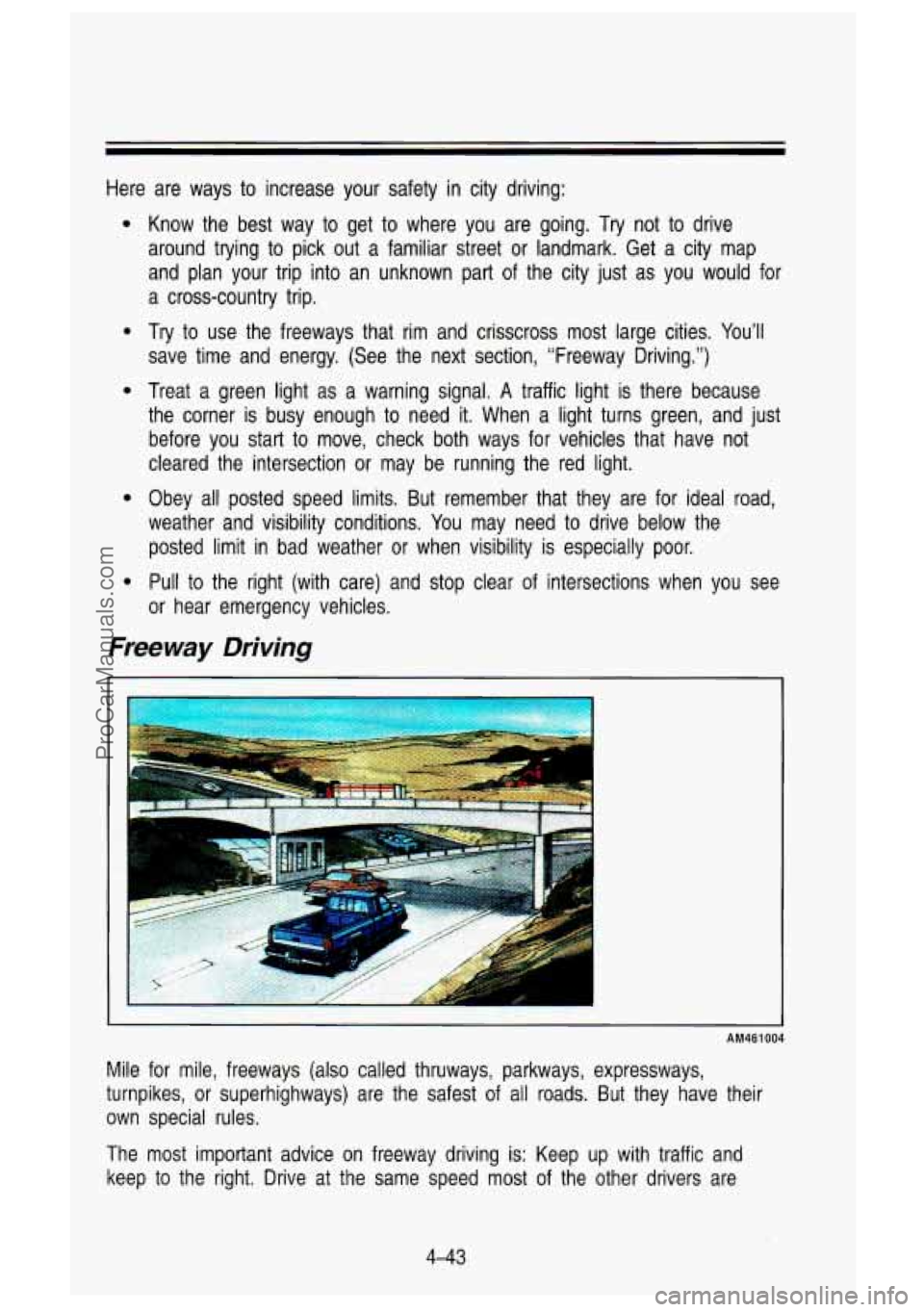
Mile for mile, freeways (also called thruways, parkways, expressways,
turnpikes, or superhighways) are the safest of all roads. But \
they have their
own special rules.
The most important advice on freeway driving is: Keep up with \
traffic and keep to the right. Drive at the same
speed most of the other drivers are
4-43
ProCarManuals.com
Page 233 of 436
AM480043
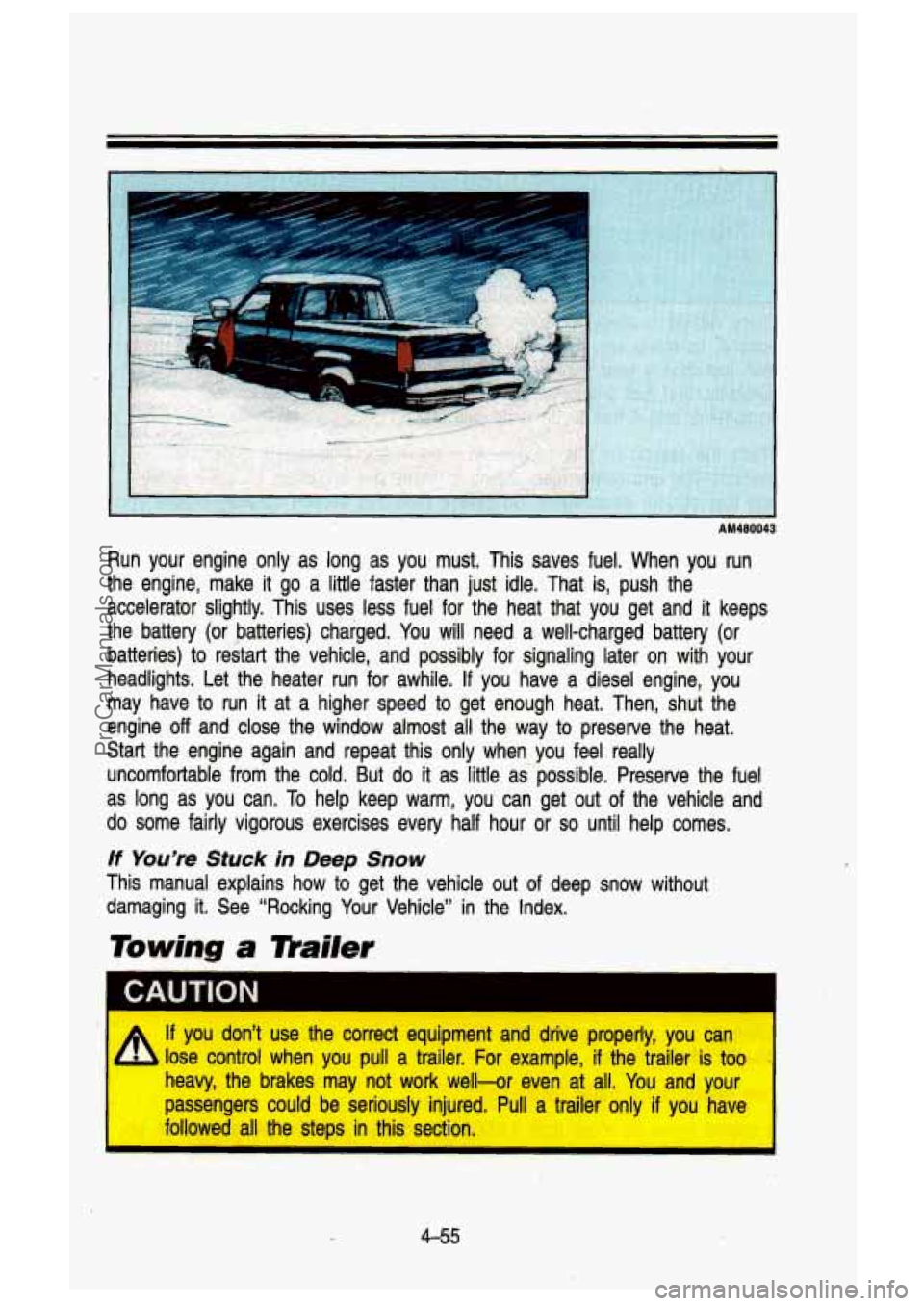
Run your engine only as long as you musk. This saves fuel. When you run
the engine, make it go a little faster than just idle. That is, push the
accelerator slightly. This uses less fuel for the heat that yo\
u get and
it keeps
the battery (or batteries) charged. You will need a well-charged battery (or
batteries) to restart the' vehicle, and possibly for signaling later on with your
headlights. Let the heater run for awhile.
If you 'have a diesel engine, you
may have to run it at a higher speed
to lget enough heat. Then, shut the
engine
off and close the window almost all the way to preserve the heat.
Start the engine again and repeat this only when you feel really
uncomfortable from the cold. But
do it as little as'possible. Preserve the fuel
as long as you can.
To help keep warm, you can get out of the vehicle and
do some fairly vigorous exercises every half hour or so until help comes.
If You're Stuck in Deep Snow
This manual explains how to get the vehicle out of deep snow without
damaging it. See "Rocking Your Vehicle" in the Index.
Towing a mailer
CAUTION I
If you don't use the correct equipment and drive properly, you ca\
n
lose control when you pull a trailer. For example, if the trailer is too
heavy, the brakes may not work well-or even at all. You and your
passengers could be seriously injured. Pull a trailer only if \
you have
followed all the steps in this section.
I
i'- ." "
4-55
ProCarManuals.com
Page 234 of 436
z
Your Driving and the Road
NOTICF
Pulling a trailer improperly can damage your vehicle and result in costly
repairs
not covered by your warranty. To pull a trailer correctly, follow the
advice in this section.
Every vehicle
is ready for some trailer. towing. If it was .built with trailering
options, as many are,
it’s ready for‘heavier trailers. But trailering is different
than just driving your vehicle by itself. Trailering means chan\
ges isn handling,
durability, and fuel .economy. Successful, safe trailering .takes\
correct
equipment, and
it has to be used properly.
That’s the reason for this section. In it are many time-tested, important
trailering tips and safety rules. Many of these are important for your safety
and that of your passengers.
So please read this section carefully before you
pull a trailer.
If You Do Decide To Pull A Trailer
If you do, here are some important .points. .
0 There are many different laws having to do with trailering. Make sure
your rig
will be legal, not only where you live but also where you’ll be\
driving.
A good source for this information can be state or provincial
police.
.Consider using a sway control if your trailer will weigh 4,000 pounds
(1 800 kg) or less. You should always use a sway control if your trailer
will weigh more than 4,000 pounds (1800 kg). You can ask a hitch
dealer about sway controls.
Don’t tow a trailer at all during the first 500 miles (800 km) ‘your new
vehicle is driven. Your engine, axle,
or other parts could be damaged.
Then, during the first 500 miles (800 km) that you tow a trailer, don’t
drive over
50 mph (80 km/ti) and don’t make ,starts at full throttle. T\
hat
will help your engine and other parts of your vehicle wear in at the
heavier load$.
Three important considerations have to do with weight:
Weight
Weight of the Trailer
How heavy can a trailer safely be?
It should never be more than 13,500 Ibs. (6125.6 kg). But even \
that can be
too heavy. It depends on how you plan to use your rig. For example, speed,
altitude, ‘road grades, outside temperature, and how much your vehicle is
4-56
ProCarManuals.com
Page 239 of 436
CAUTION
It can be dangerous to get out of your vehicle if the shift lever is not
fully in
P (Park) with the parking brake firmly set. Your vehicle can
roll.
If you have left the engine running, the vehicle can move suddenl\
y.
You
or others could be injured. To be sure your vehicle won’t move,
when you’re on fairly level ground, use the steps that follow.
If you have four-wheel drive and your transfer case is in N (Neutral),
your vehicle will be free to
roll, even if your shift lever is in P (Park).
So, be sure the transfer case is in a drive gear-not in N (Neutral).
If you are parking on a hill, or if you’re pulling a trailer, also see
“Parking On Hills” in the Index.
When You Are Ready to Leave After Parklng on a Hill
1. Apply your regular brakes and hold the pedal down while you:
Start your engine;
Shift into a gear; and
Release the parking brake.
2. Let up on the brake pedal.
3. Drive slowly until the trailer is clear of the chocks.
4. Stop and have someone pick up and store the chocks.
Maintenance When Trailer To wing
Your vehicle will need service more often when you’re pulling a trailer. See
the Maintenance Schedule for more on this. Things that are esp\
ecially
important in trailer operation are automatic transmission fluid (don’t overfill),
engine oil, axle lubricant, belts, cooling system, and brake ad\
justment. Each
of these is covered in this manual, and the Index will help \
you find them
quickly.
If you’re trailering, it’s a good idea to review these sections before
you start your trip.
Check periodically
to see that all hitch nuts and bolts are tight.
mailer Wiring Harness
See “Trailer Wiring Harness’’ in the Index.
4-61
ProCarManuals.com
Page 243 of 436
Pmb/ems on the Road
1 Section
Here you’ll find what to do about some problems that can occur on the road .
Hazard Warning Flasher ........................................................................\
............... 5-2
Other Warning Devices ........................................................................\
................. 5-3
Jump Starting ........................................................................\
................................ 5-3
Towing Your Vehicle ........................................................................\
...................... 5-8
Engine Overheating ........................................................................\
....................... 5-9
If
If
a Tire Goes Flat ........................................................................\
...................... 5-17
Changing a Flat Tire
........................................................................\
............... 5-17
Jack Storage
........................................................................\
............................ 5-19
Spare Tire
........................................................................\
................................ 5-20
You’re Stuck: In Sand. Mud. Ice or Snow ................................................... 5-33
5-1
ProCarManuals.com
Page 279 of 436
Service & Appearance Care
.....
Here you will find information about the care of your vehicle . This Section
begins with service and fuel information. and then it shows how to check
important fluid and lubricant levels
. There is also technical information about
your vehicle. and a section devoted to its appearance care
.
Service ........................................................................\
........................................... 6-3
Fuel (Gasoline Engines)
........................................................................\
............... 6-4
Diesel Fuel Requirements and Fuel System
...................................................... 6-6
Checking Things Under the Hood
..................................................................... 6-17
Hood Release
........................................................................\
.......................... 6-18
Cleaning Your Diesel Engine
........................................................................\
.. 6-19
Noise Control System
........................................................................\
............. 6-19
Engine Oil (Except Diesel)
........................................................................\
..... 6.20
Engine Oil (Diesel Engines)
........................................................................\
... 6-26
Air Cleaner
........................................................................\
............................... 6-31
Automatic Transmission Fluid
........................................................................\
. 6-33
Manual Transmission Fluid
........................................................................\
..... 6-36
Hydraulic Clutch
........................................................................\
....................... 6-37
Transfer Case
........................................................................\
.......................... 6-39
Front Axle ........................................................................\
................................. 6-40
Rear Axle
........................................................................\
................................. 6-41
6-1
ProCarManuals.com
Page 282 of 436

Service & Appearance Care
1 If you try to do your own service work without knowing enough ab\
out it, I
1 your vehicle could be damaged.
Maintenance Schedule
Section 7 of this manual, “Scheduled Maintenance Services”, explains the \
maintenance your new vehicle needs, and when
it -should be done. It also,
has a form that you can use to record the maintenance work done \
on your
vehicle. Be sure to read this ,information.
-I .. >. ’ , .
Fuel (Gasoline Engines)
If your vehicle has a diesel engine, see “Diesel Fuel Requi\
rements and Fuel
System’’ in this Section: For vehicles with gasoline engines, please read this.
Use regular unleaded gasoline rated at 87 octane or’higher.
It should meet
specifications ASTM D4814 in the
U.S. and CGSB 3.592 in Canada. These
fuels should have the proper additives,
so you should not have to add
anything to the fuel.
In the
U.S. and Canada, it’s easy to be sure you get the right kind of
gasoline (unleaded). You’ll see
UNLEADED right on the pump. And only
unleaded nozzles
will fit into your vehicle’s filler neck.
Be sure the posted octane is at least 87. If the octane
is less than 87, you
may get a heavy knocking noise when you drive.
If it’s bad enough, it can
damage your engine.
6-4
ProCarManuals.com