lights GMC SIERRA 1993 Owner's Guide
[x] Cancel search | Manufacturer: GMC, Model Year: 1993, Model line: SIERRA, Model: GMC SIERRA 1993Pages: 436, PDF Size: 23.88 MB
Page 220 of 436

Your Driving and the Road
Tips on Driving in Fog
If you get caught in fog, turn your headlights on low beam, \
even in daytime.
You’ll see-and be seen-better. Use your fog lights
if your vehicle has them.
Don’t use your high beams. The light will bounce
off the water droplets that
make up fog and reflect back at you.
Use your defogger. In high humidity, even a light buildup of moisture on the
inside of the glass will cut down on your already limited visibility. Ru\
n your
windshield wiper and washer occasionally. Moisture can build up on the
outside glass, and what seems to be
fog may actually be moisture on the
outside of your windshield.
Treat dense fog as an emergency.
Try to find a place to pull off the road. Of
course you want to respect another’s property, but you might need to put
something between you and moving vehicles-space, trees, telephone\
poles,
a private driveway, anything that removes you from other traffic.
If visibility is near zero and you must stop but are unsure whether you are
away from the road, turn your lights on, start your hazard wa\
rning flasher,
and sound your horn at intervals or when you hear approaching \
traffic.
Pass other vehicles in fog only
if you can see far enough ahead to pass
safely. Even then, be prepared to delay your pass
if you suspect the fog is
worse up ahead. If other vehicles try to pass you, make it easy for them.
City Driving
AM460003
One of the biggest problems with city streets is the amount of traffic on them.
You’ll want to watch out for what the other drivers are doing, and keep clos\
e
track
of traffic signals.
4-42
ProCarManuals.com
Page 223 of 436
 as extra warning that you are about to slow
down and ex")
close behind you, you can allow a little extra time and flash\
your brake lights (in addition to your turn signal) as extra warning that you are about to slow
down and exit.
The exit ramp can be curvea, somerlmes quite sharply. The exit\
speed is
usually posted. Reduce your speed according to your speedometer,\
not to
your sense of motion. After driving for any distance at higher\
speeds, you
may tend to think you are going slower than you actually are.\
For example,
40 rnph (65 km/h) might seem like only 20 mph (30 km/h). Obviously, this
could lead to serious trouble
on a ramp designed for 20 mph (30 kmlh)!
Driving a Long Distance
Although most long trips today are made on freeways, there are\
still many
made on regular highways.
Long-distance driving on freeways and regular highways is the s\
ame in some
ways. The trip has to be planned and the vehicle prepared, you drive at\
higher-than-city speeds, and there are longer turns behind the \
wheel. You’ll
enjoy your trip more
if you and your vehicle are in good shape. Here are
some tips for a successful long trip.
Before Leaving on a Long Trip
Make sure you’re ready. Try to be well rested. If you must start when you’re
not fresh-such as after a day’s work-don’t plan to make too many miles
that first part of the journey. Wear comfortable clothing and \
shoes you can easily drive in.
Is your vehicle ready for a long trip? If you keep it serviced and maintained,
it’s ready to go.
If it needs service, have it done before starting out. Of
course, you’ll find experienced and able service experts in \
your vehicle’s
dealerships all across North America. They’ll be ready and willing to help \
if
you need it.
Here are some things you can check before a trip:
Windshield Washer Fluid: Is the reservoir full? Are all windows clean
Wiper Blades: Are they in good shape?
Fuel, Engine Oil, Other Fluids: Have you checked all levels?
Lights: Are they all working? Are the lenses clean?
Tires: They are vitally important to a safe, trouble-free trip. Is the tread
good enough for long distance driving? Are the tires all inflated to the
recommended pressure? inside and outside?
445
ProCarManuals.com
Page 233 of 436
AM480043
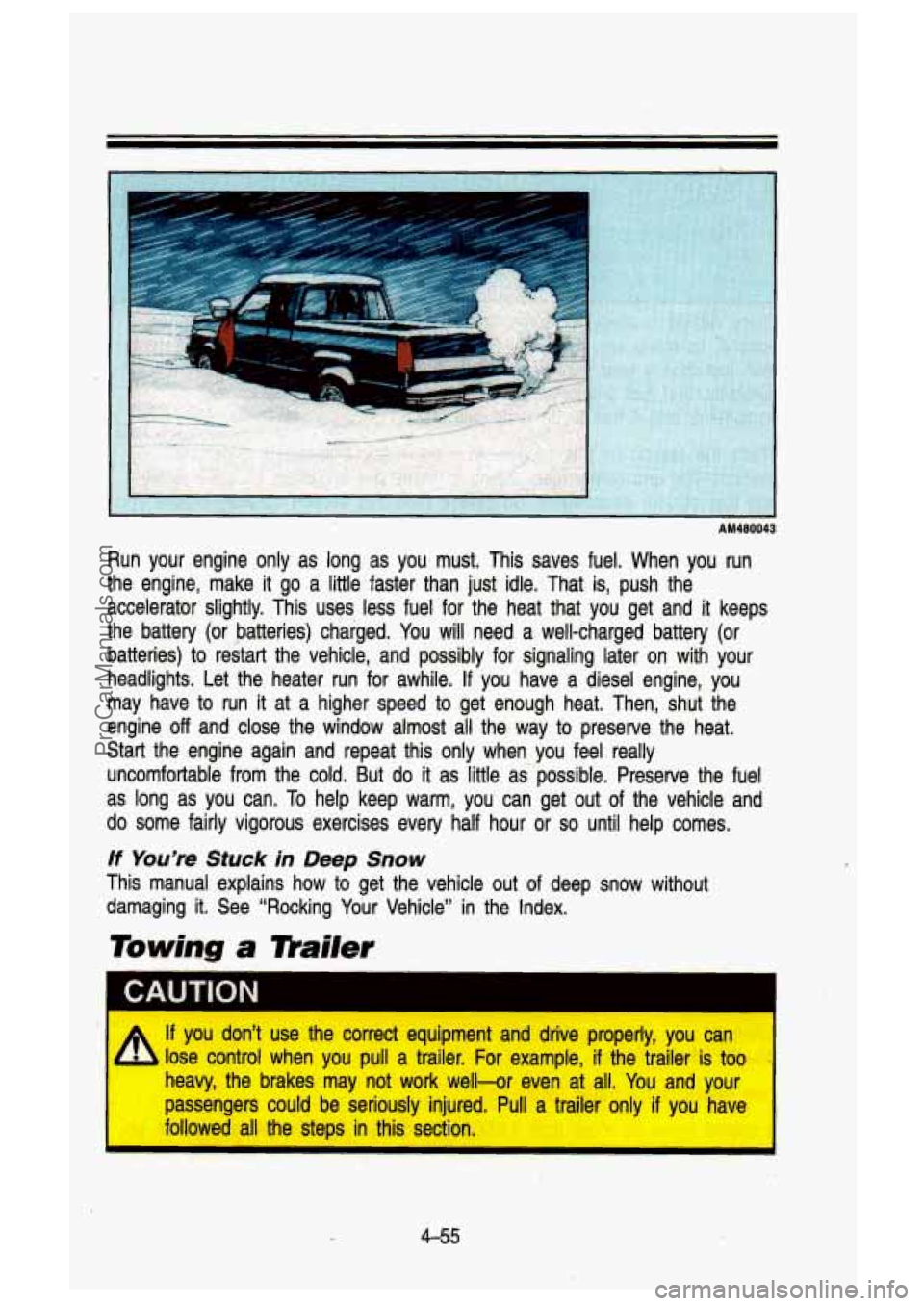
Run your engine only as long as you musk. This saves fuel. When you run
the engine, make it go a little faster than just idle. That is, push the
accelerator slightly. This uses less fuel for the heat that yo\
u get and
it keeps
the battery (or batteries) charged. You will need a well-charged battery (or
batteries) to restart the' vehicle, and possibly for signaling later on with your
headlights. Let the heater run for awhile.
If you 'have a diesel engine, you
may have to run it at a higher speed
to lget enough heat. Then, shut the
engine
off and close the window almost all the way to preserve the heat.
Start the engine again and repeat this only when you feel really
uncomfortable from the cold. But
do it as little as'possible. Preserve the fuel
as long as you can.
To help keep warm, you can get out of the vehicle and
do some fairly vigorous exercises every half hour or so until help comes.
If You're Stuck in Deep Snow
This manual explains how to get the vehicle out of deep snow without
damaging it. See "Rocking Your Vehicle" in the Index.
Towing a mailer
CAUTION I
If you don't use the correct equipment and drive properly, you ca\
n
lose control when you pull a trailer. For example, if the trailer is too
heavy, the brakes may not work well-or even at all. You and your
passengers could be seriously injured. Pull a trailer only if \
you have
followed all the steps in this section.
I
i'- ." "
4-55
ProCarManuals.com
Page 237 of 436
Driving with a Trailer
Towing a trailer requires a certain amount of experience. Before setting out
for the open road, you’ll want to get to know your rig. Acquaint yourself with
the feel of handling and braking with the added weight of the trailer. And
always keep in mind that the vehicle you are driving is now a good deal
longer and not nearly
so responsive as your vehicle is by itself.
Before you start, check the trailer hitch and platform, safety \
chains, electrical
connector, lights, tires and mirror adjustment.
If the trailer has electric brakes,
start your vehicle and trailer moving and then apply the trailer brake controller
by hand to be sure the brakes are working. This lets you check your
electrical connection at the same time.
During your trip, check occasionally to be sure that the load is secure, and
that the lights and any trailer brakes are still working.
Following Distance
Stay at least twice as far behind the vehicle ahead as you w\
ould when
driving your vehicle without a trailer. This can help you avoid situations \
that
require heavy braking and sudden turns.
Passing
You’ll need more passing distance up ahead when you’re towing a trailer.
And, because you’re a good deal longer, you’ll need to g\
o much farther beyond the passed vehicle before you can return to your lane.
Backing Up
Hold the bottom of the steering wheel with one hand. Then, to move the
trailer left, just move your hand to the left.
To move the trailer to the right,
move your hand to the right. Always back up slowly and,
if possible, have
someone guide you.
Making Turns
When you’re turning with a trailer, make wider turns than normal. Do this so
your trailer wheels won’t strike soft shoulders, curbs, road signs\
, trees, or
other objects. Avoid jerky or sudden maneuvers. Signal well in advance.
Turn Signals When Towing a Trailer
When you tow a trailer, your vehicle has to have a different turn signal
flasher and extra wiring. The green arrows on your instrument \
panel will flash
whenever you signal a turn or lane change. Properly hooked up, the trailer
lights will also flash, telling other drivers you’re about t\
o turn, change lanes,
or stop.
When towing a trailer, the green arrows on your instrument pan\
el will flash for
turns even
if the bulbs on the trailer are burned out. Thus, you may think
4-59
ProCarManuals.com
Page 244 of 436

Hazard Warning Flashers U
I
I
. .' ~.
AM505004
Your hazard warning flashers let you warn others. They also let pol\
ice know
you have a problem. Your front and rear turn signal lights will flash
on and
off. But they won't flash if you are braking.
L'
I K2503
I
r 1
Press the button in to make your front and rear turn signal lights flash on
and off.
Your hazard warning flashers work no matter what position your key is in,
and even if the key isn't in.
5-2
ProCarManuals.com
Page 246 of 436
Pmbkms on the Road
not be able to get enough power from a single battery in another vehicle
to start your diesel engine.
If your vehicle has more than one battery, use the battery that’\
s closest
to the starter-this will reduce electrical resistance.
2. Get the vehicles close enough so the jumper cables can reach, but be
sure the vehicles aren’t touching each other.
If they are, it could cause a
ground connection you don’t want. You wouldn’t be able
to start your
vehicle, and the bad grounding could damage the electrical syst\
ems.
You could be injured
if the vehicles roll. Set the parking brake firmly
manual transmission in
N (Neutral).
If you have a four-wheel-drive vehicle, be sure the transfer c\
ase is
not in
N (Neutral).
1 on each vehicle. Put an automatic transmission in P (Park) or a
3. Turn off the ignition on both vehicles. Turn off all lights that aren’t need-
ed, and radios. This will avoid sparks and help save both bat\
teries. And
it could save your radio!
ou leave your radio on, it could be badly damaged. The repairs
r.,Jldn’t be covered by your warranty. I
4. Open the hoods and locate the batteries.
Find the positive
(t) and negative (-) terminals on each battery.
5-4
ProCarManuals.com
Page 320 of 436

Service & Appearance ,Care
Engine Coolant
r
PO593
The following explains your cooling system and how to add cool\
ant when it is low.
If you have a problem with -engine overheating, see “Engine
Overheating” in the Index.
The proper coolant for your vehicle will:
Give freezing protection down to -34°F (-37°C).
Give boiling protection up to 258°F (125°C).
Protect against rust and corrosion:
Help keep the proper engine temperature.
Let the warning lights and gages work as thiy should.
What to Use:
Use a ,mixture of clean water (preferably distilled), and antifreeze that meets
“GM Specification 6038-M,” which won’t damage aluminum p\
arts.
Also use
GM Engine Coolant Supplement (sealer) with a complete coolant change. If
you use these, you don’t need to add anything else.
,
6-42
ProCarManuals.com
Page 332 of 436
Service & Appearance Care
You should not use penetrating oils because they could wash out the factory
installed lubricant and cause the lock to bind. De-icers which contain alcohol
could also wash away the lubricant,
so be sure to lubricate the lock after
using a de-icer of this type.
Tailgate Handle
The tailgate handle pivot points on your vehicle should be lub\
ricated to keep
it working smoothly.
Your maintenance schedule will tell you how often to lubricate the handle.
See “Recommended Fluids and Lubricants” in the Index for the proper
lubricant to use.
Electrical System
Battery
Every new GM vehicle has a Delco Freedom@ battery. You never have to
add water to one of these. When it’s time for a new battery, we recomme\
nd
a Delco Freedom@ battery. Get one that has the catalog number \
shown on
the original battery’s label.
Vehicle Storage
If you’re not going to drive your vehicle for 25 days or more, take off the
black, negative
(-) cable from the battery. This will help keep your battery
from running down.
I - Batteries have acid that can burn you and gas that can explod\
e. You I
1 can be badly hurt if you aren’t careful. See “Jump Starting” in the
Index for tips on working around a battery without getting hur\
t.
Contact your dealer to learn how to prepare your vehicle for longer periods.
Bulb Replacement
Before you replace any bulbs, be sure that all the lights are off and the
engine isn’t running.
6-54
ProCarManuals.com
Page 333 of 436
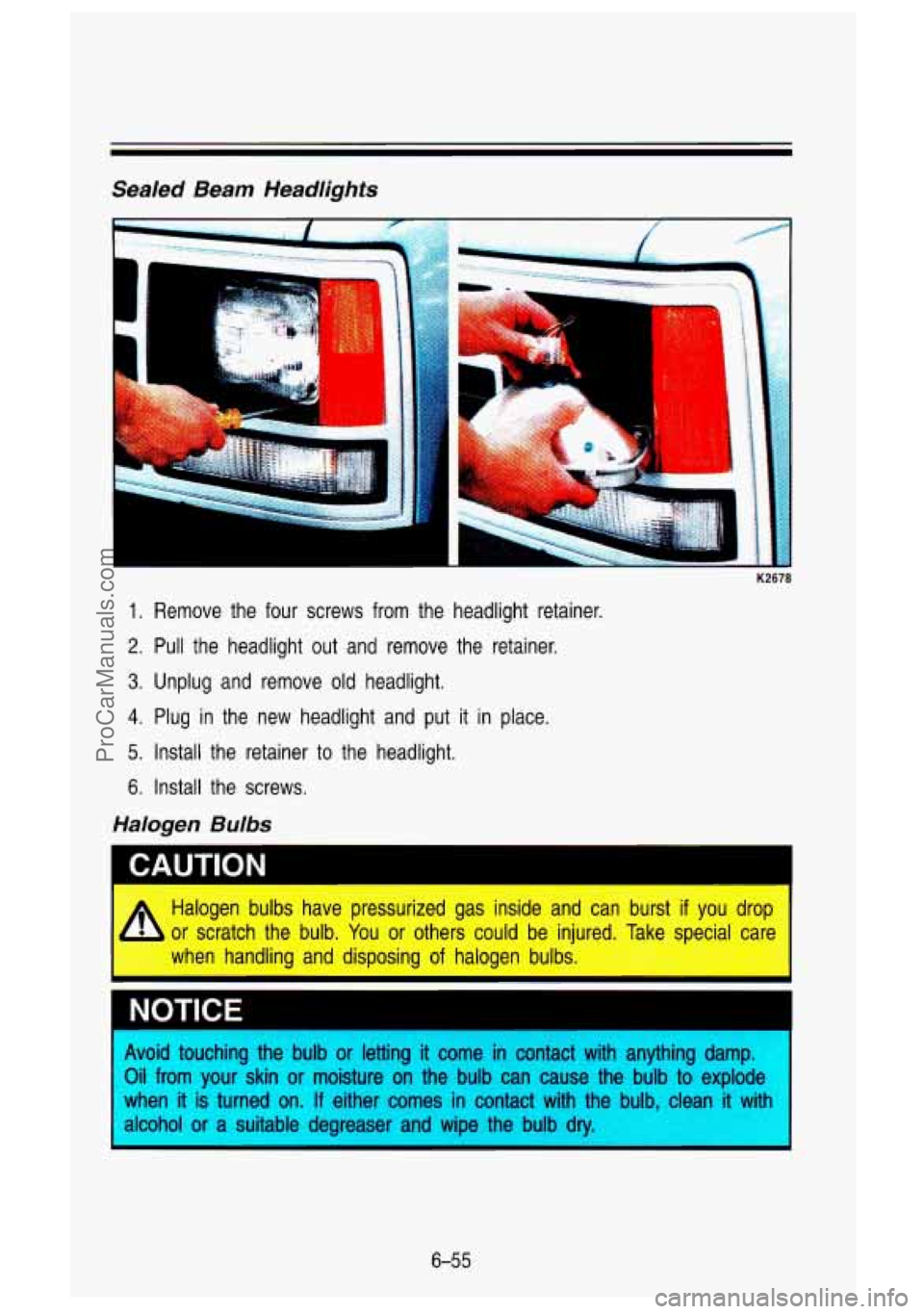
Sealed Beam Headlights
t i
1. Remove the four screws from the headlight retainer.
2. Pull the headlight out and remove the retainer.
3. Unplug and remove old headlight.
4. Plug in the new headlight and put it in place.
5. Install the retainer to the headlight.
6. Install the screws.
Halogen Bulbs
Halogen bulbs have pressurized gas inside and can burst if you drop
or scratch the bulb. You or others could be injured. Take special care
when handling and disposing of halogen bulbs.
& s+?-.- --_ >= - - . * . . . ,x. J - * -
:hi , ._.. i , c: .-?v2 fqk-sq -%. -Lac
Avoid touching the bulb or letting it come in contact with anything damp
Oil from your skin or moisture on the bulb can cause the bulb to explode
when
it is turned on. If either comes in contact with the bulb, clean it with
alcohol or
a suitable degreaser and wipe the bulb dry.
6-55
ProCarManuals.com
Page 334 of 436
Service & Appearance Care
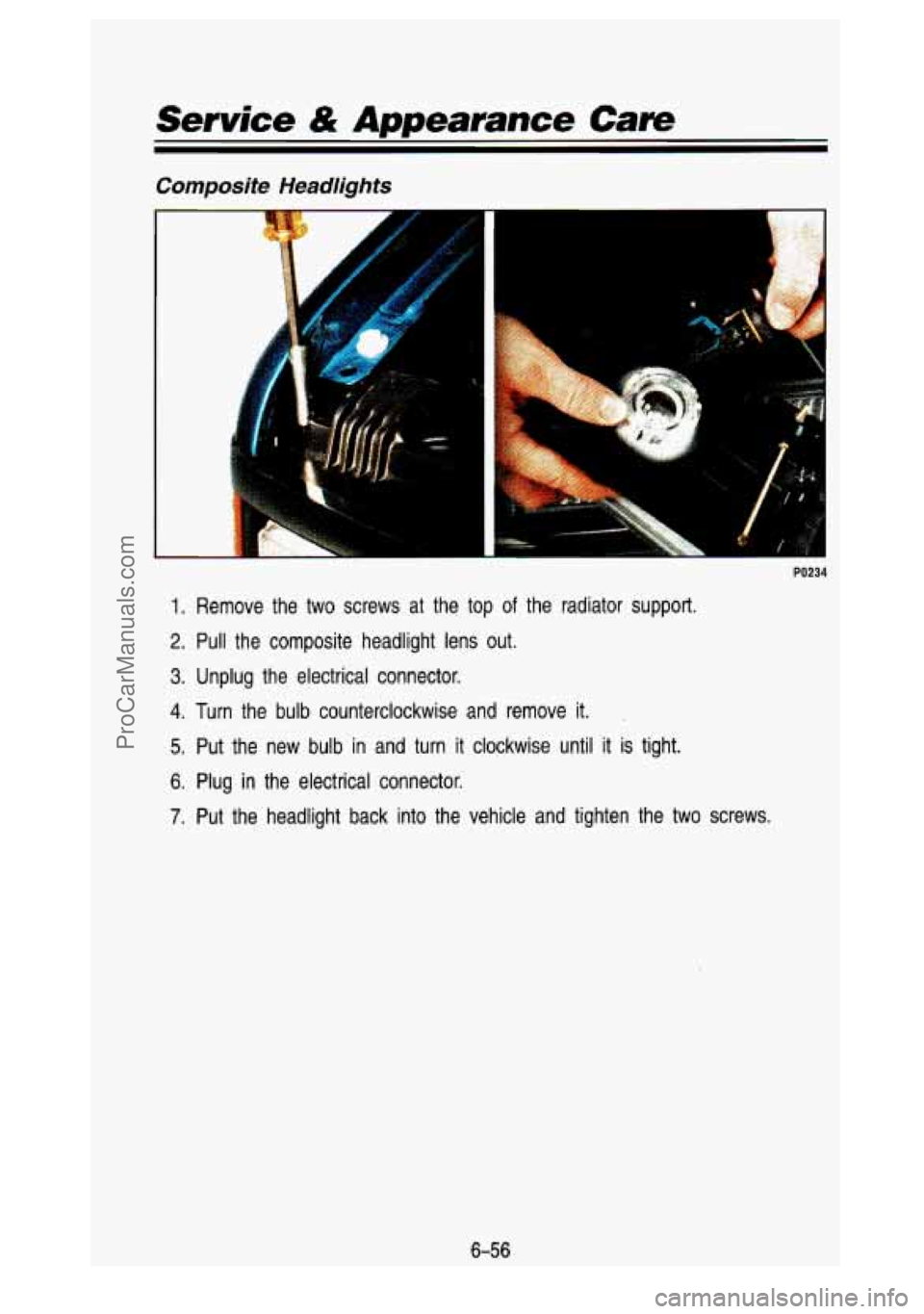
Composite Headlights
A
1
I
PO234
1. Remove the two screws at the top of the radiator support.
2. Pull the composite headlight lens out.
3. Unplug the electrical connector.
4. Turn the bulb counterclockwise and remove it. ,
5. Put the new bulb in and turn it clockwise until it is tight.
6. Plug in the electrical connector.
7. Put the headlight back into the vehicle and tighten the two screws.
6-56
ProCarManuals.com