tow GMC SIERRA 1993 Service Manual
[x] Cancel search | Manufacturer: GMC, Model Year: 1993, Model line: SIERRA, Model: GMC SIERRA 1993Pages: 436, PDF Size: 23.88 MB
Page 271 of 436
I CAUTION
Sust or dirt on the wheel, or on the parts to which it is fastened,
could come
off and cause an accident. When you change a wheel,
remove any rust or dirt from the places where the wheel attac\
hes to
the vehicle. In an emergency, you can use a cloth or a paper towel
to
do this; but be sure to use a scraper or wire brush later- if vou
need to, to get all the rust or dirt
off.
A :an make the wheel nuts become loose after a time. The wheel
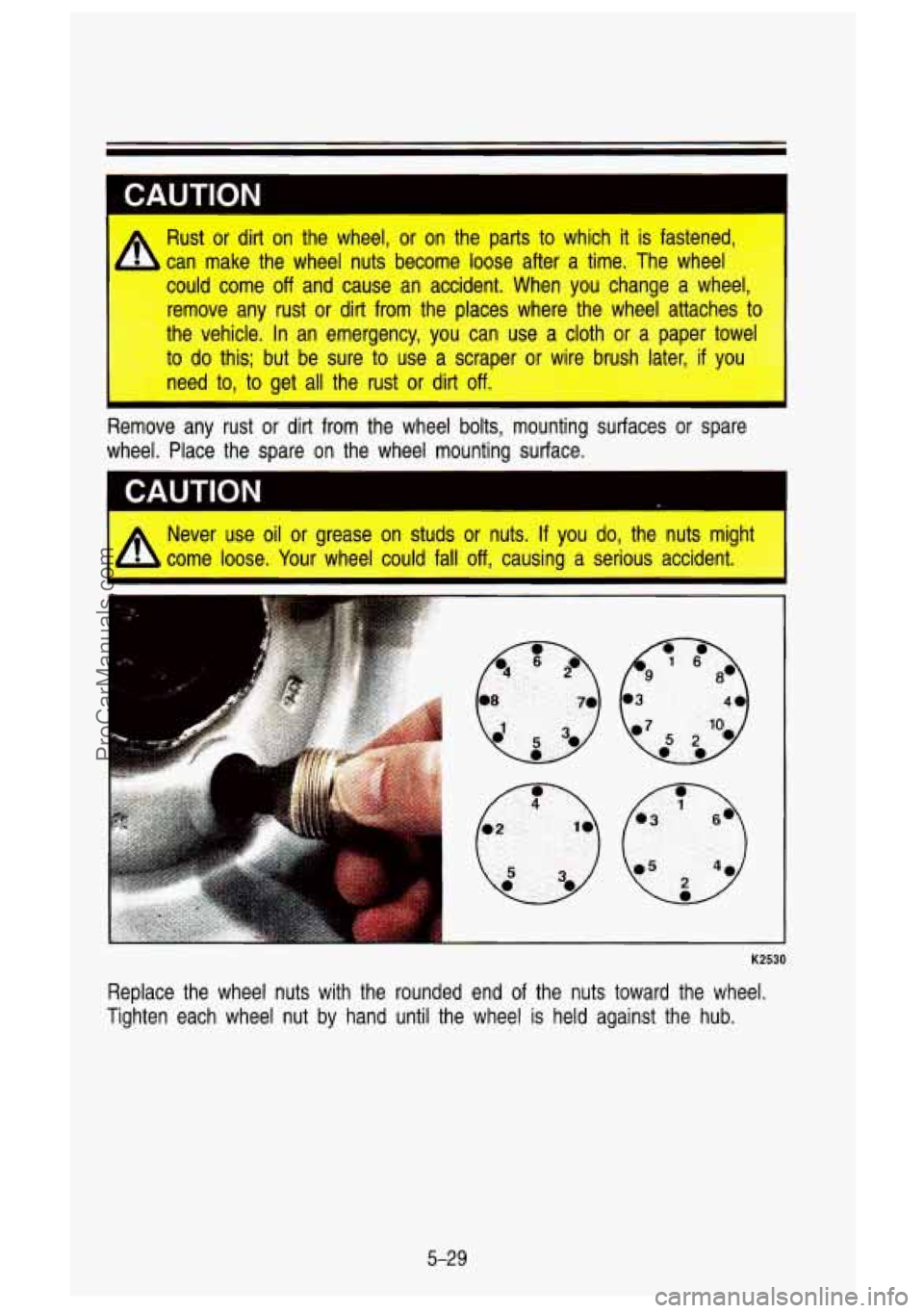
Remove any rust
or dirt from the wheel bolts, mounting surfaces or spare
wheel. Place the spare on the wheel mounting surface.
1 CAUTION I
Never use oil or grease on studs or nuts. If you do, the nuts migh
come loose. Your wheel could fall
off, causing a serious accident.
K2530
Replace the wheel nuts with the rounded end of the nuts toward the wheel.
Tighten each wheel nut by hand until the wheel is held against the hub.
5-29
ProCarManuals.com
Page 275 of 436

If You’re Stuck: In Sand,
Mud,
Ice or Snow
What you don’t want to do when your vehicle is stuck is to spin your
wheels. The method known as “rocking” can help you get o\
ut when you’re
stuck, but you must use caution.
CAUTION - --
I * If you let your tires spin at high speed, they can explode and you or
,A others could be injured. And, the transmission or other parts of the
vehicle can overheat. That could cause an engine compartment fire
or other damage. When you’re stuck, spin the wheels as little as
possible. Don’t spin the wheels above
35 mph (55 krnlh) as shown
I on the speedometer.
;pinning your wheels can destroy parts of your vehicle as well as the
res.
If you spin the wheels too fast while shifting your transmission back
.nd forth, you can destroy your transmission.
NOTICE 1
Rocking your vehicle to get it out:
First, turn your steering wheel left and right. That will clear the area around
your front wheels. Then shift back and forth between
R and a forward gear
(or with a manual transmission, between First or Second gear and Reverse),
spinning the wheels as little as possible. Release the accelerator pedal while
you shift, and press lightly on the accelerator pedal when the transmission is
in gear.
If that doesn’t get you out after a few tries, you may need to be
towed out.
Or, you can use your recovery hooks, if your vehicle has them. If
you do need to be towed out, see “Towing Your Vehicle” in the Index.
5-33
ProCarManuals.com
Page 277 of 436
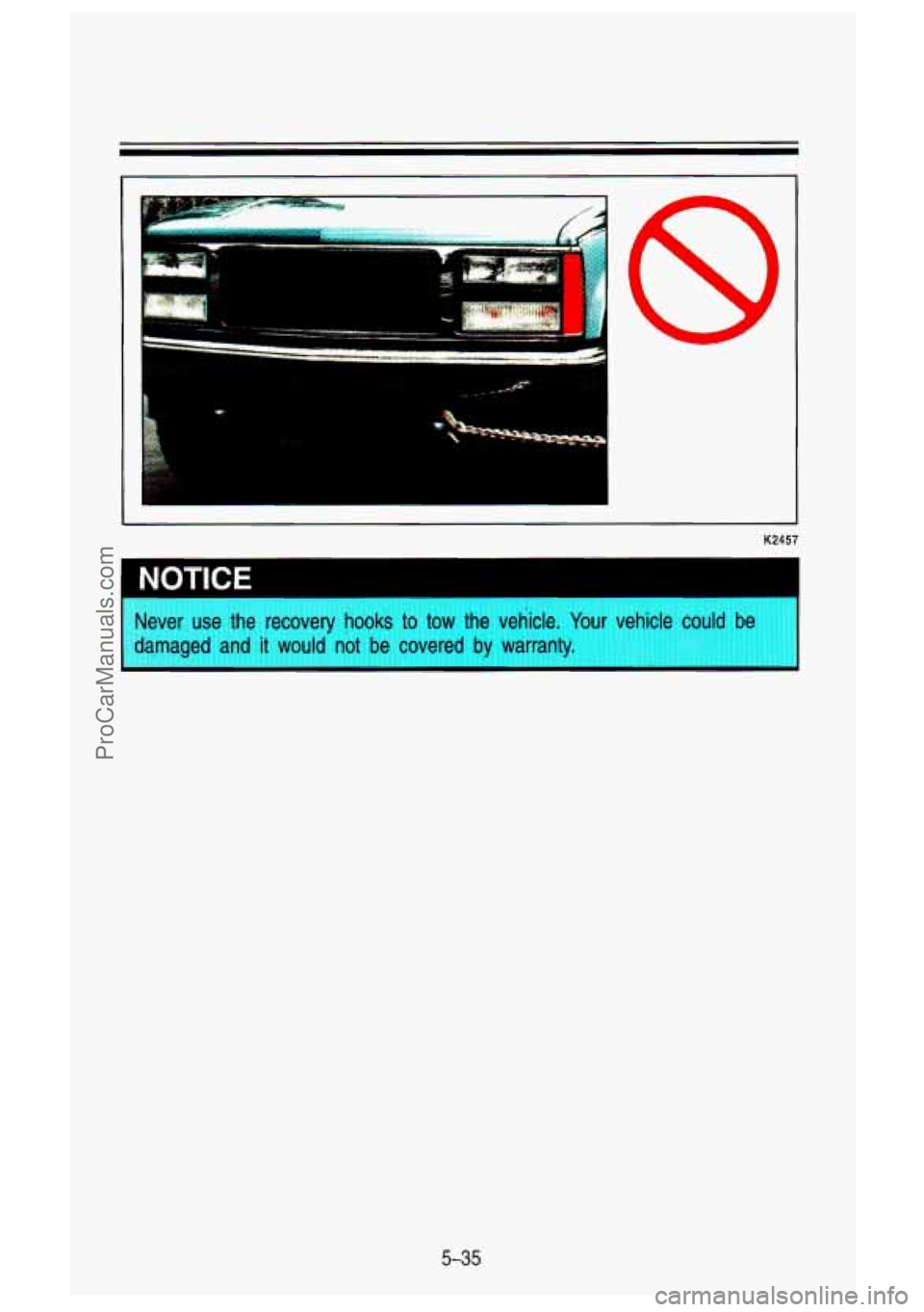
K2457
~ NOTICE
Never use the recovery hooks to tow the vehicle. Your vehicle could be
damaged and it would not be covered
by warranty.
5-35
ProCarManuals.com
Page 298 of 436
Service & Appearance Care
Exhaust:
Removal of muffler andlor resonator.
Removal of exhaust pipes and exhaust pipe clamps.
Engine Oil (Except Diesel)
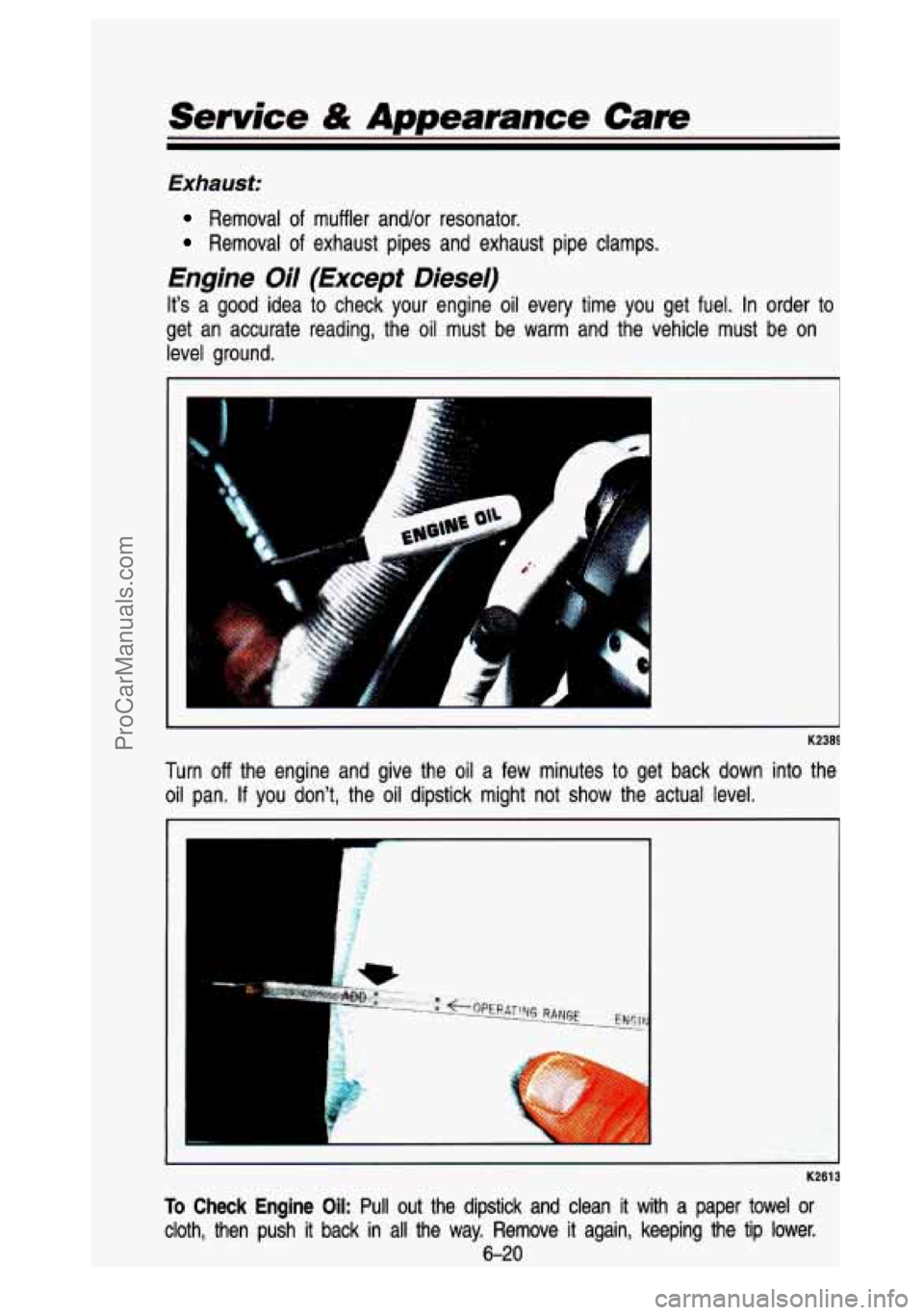
It's a good idea to check your engine oil every time you get fuel. In order to
get an accurate reading, the oil must be warm and the vehicle\
must be on
level ground.
t
L
K2389
Turn off the engine and give the oil a few minutes to get back down into the
oil pan.
If you don't, the oil dipstick might not show the actual level.
I
K2613
To Check Engine Oil: Pull out the dipstick and clean it with a paper towel or
cloth, then push it back in all the way. Remove it again, keeping the tip lower.
6-20
ProCarManuals.com
Page 303 of 436
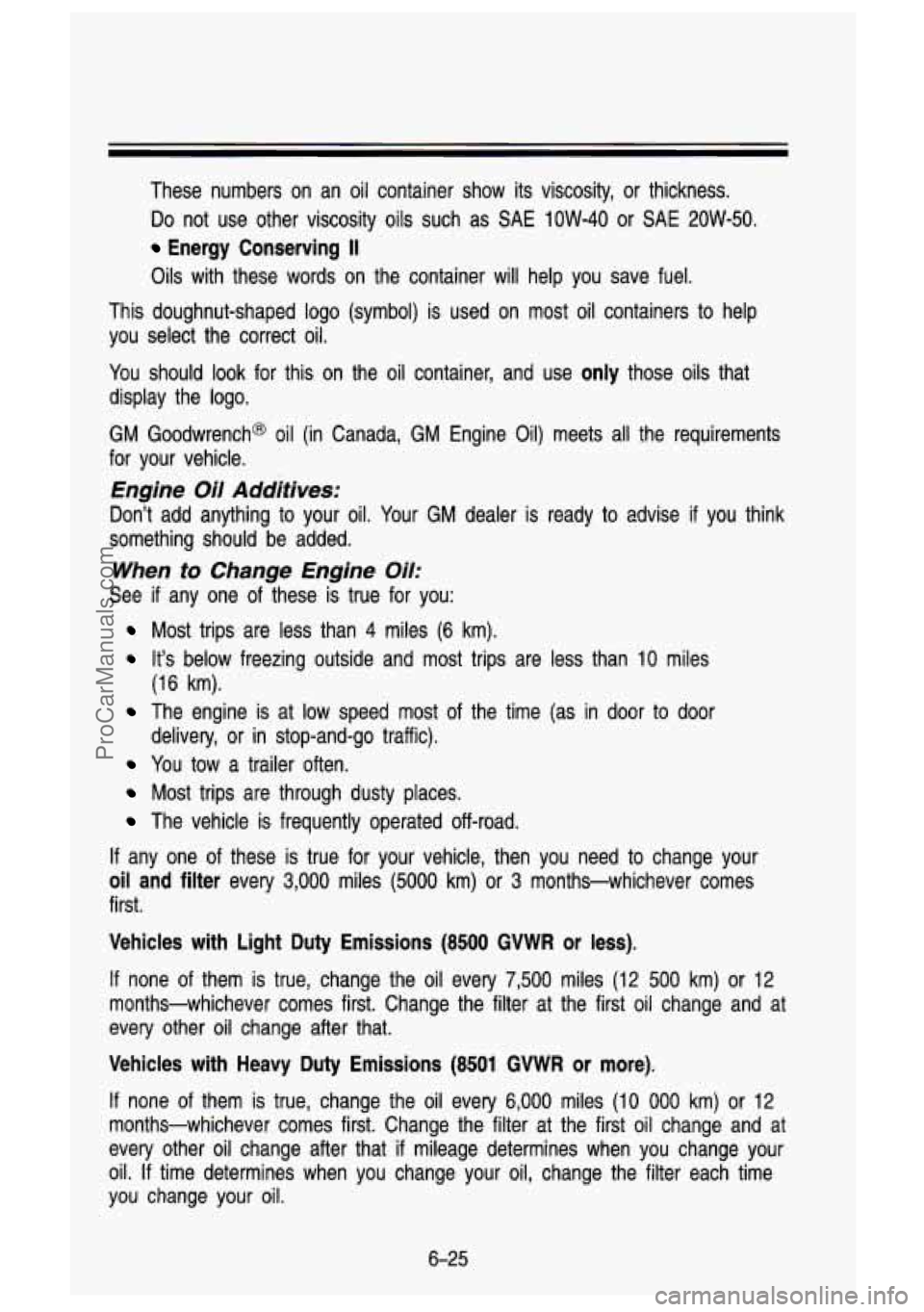
These numbers on an oil container show its viscosity, or thickness.
Do not use other viscosity oils such as
SAE IOW-40 or SAE 2OW-50.
Energy Conserving II
Oils with these words on the container will help you save fuel.
This doughnut-shaped logo (symbol) is used on most oil containers to help
you select the correct oil.
You should look for this on the oil container, and use
only those oils that
display the logo.
GM Goodwrench@ oil (in Canada, GM Engine Oil) meets all the requirements
for your vehicle.
Engine Oil Additives:
Don’t add anything to your oil. Your GM dealer is ready to advise if you think
something should be added.
When to Change Engine Oil:
See if any one of these is true for you:
Most trips are less than 4 miles (6 km).
It’s below freezing outside and most trips are less than 10 miles
(16 km).
The engine is at low speed most of the time (as in door to door
delivery, or in stop-and-go traffic).
You tow a trailer often.
Most trips are through dusty places.
The vehicle is frequently operated off-road.
If any one of these is true for your vehicle, then you need to change your
oil and filter every 3,000 miles (5000 km) or 3 months-whichever comes
first.
Vehicles with Light Duty Emissions (8500 GVWR or less).
If none of them is true, change the oil every 7,500 miles (12 500 km) or 12
months-whichever comes first. Change the filter at the first oil change and at
every other oil change after that.
Vehicles with Heavy Duty Emissions (8501 GVWR or more).
If none of them is true, change the oil every 6,000 miles (10 000 km) or 12
months-whichever comes first. Change the filter at the first oil change and at
every other oil change after that
‘if mileage determines when you change your
oil.
If time determines when you change your oil, change the filter ea\
ch time
you change your oil.
6-25
ProCarManuals.com
Page 305 of 436
T-
K2613
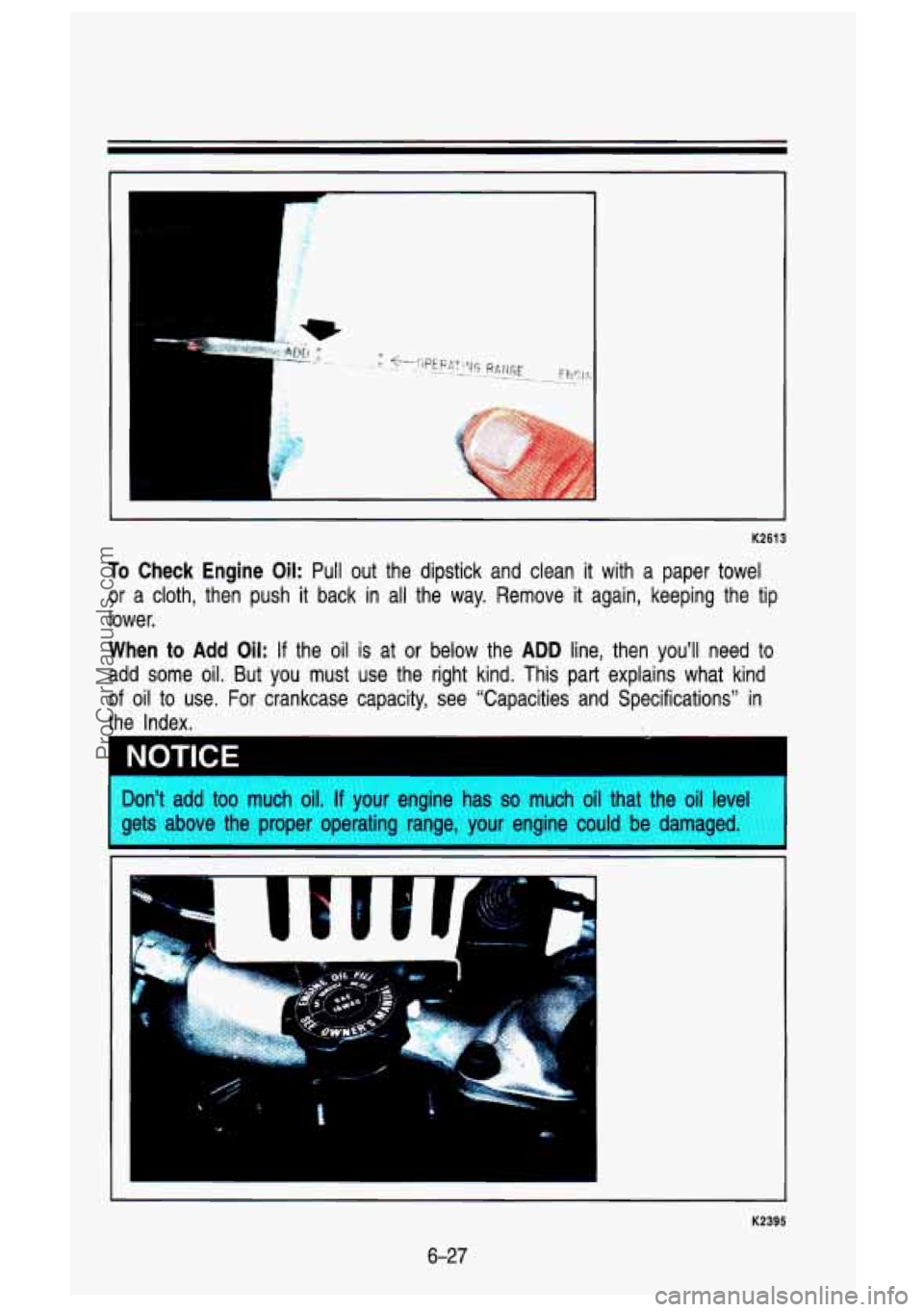
To Check Engine Oil: Pull out the dipstick and clean it with a paper towel
or a cloth, then push it back in all the way. Remove it again, keeping the tip
lower.
When to Add Oil: If the oil is at or below the ADD line, then you’ll need to
add some oil. But you must use the right kind. This part explains what kind\
of oil to use. For crankcase capacity, see “Capacities and Spec\
ifications’’ in
the Index.
Don’t add too much oil. If your engine has so much oil that the oil level
gets above the proper operating range, your engine could
be damaged. I
I
w
ii
I
- “‘I
. ..
Ll
6 -”
i f f i
w
K2395
6-27
ProCarManuals.com
Page 308 of 436
Service & Appearance Cam
heavy-duty applications at temperatures above freezing, 32°F (O’C), SAE
30 grade oil is recommended.
These numbers on an oil container show its viscosity, or thickness.
Do not use other viscosity oils such as
SAE IOW-40 or SAE 2OW-50.
This doughnut-shaped logo (symbol) is used on most oil contai\
ners to help
you select the correct oil.
You should
look for this on the oil container, and use only those oils that
display the logo.
GM Goodwrench@ oil (in Canada, GM Engine Oil) meets all the \
requirements
for your vehicle.
Engine Oil Additives:
Don’t add anything to your oil. Your GM dealer is ready to advise if you think
something should be added.
When to Change Engine Oil:
See if any one of these is true for you:
Most trips are less than 4 miles (6 km).
It’s below freezing outside and most trips are less than 10 miles (16
The engine is at low speed most of the time (as in door to door
You tow a trailer often.
Most trips are through dusty places. km).
delivery, or in stop-and-go traffic).
The vehicle is frequently operated off-road .
If any one of these is true for your vehicle, then you need to change your
oil and filter every 2,500 miles (4000 km) or 3 months-whichever comes
first.
If none of these is true, change the oil and filter every 5,000 miles (8000
km) or 12 months-whichever comes first.
6-30
ProCarManuals.com
Page 312 of 436
Senrr'ce & bmearance Care
To check the fluid hot or cold:
Park your vehicle on a level place.
Place the shift lever in P (Park) with the parking brake applied.
With your foot on the brake pedal, move the shift lever through each
gear range, pausing for about three seconds in each range. Then,
position the shift lever in
P (Park).
Let the engine run at idle for three minutes or more.
Then, without shutting off the engine, follow these steps:
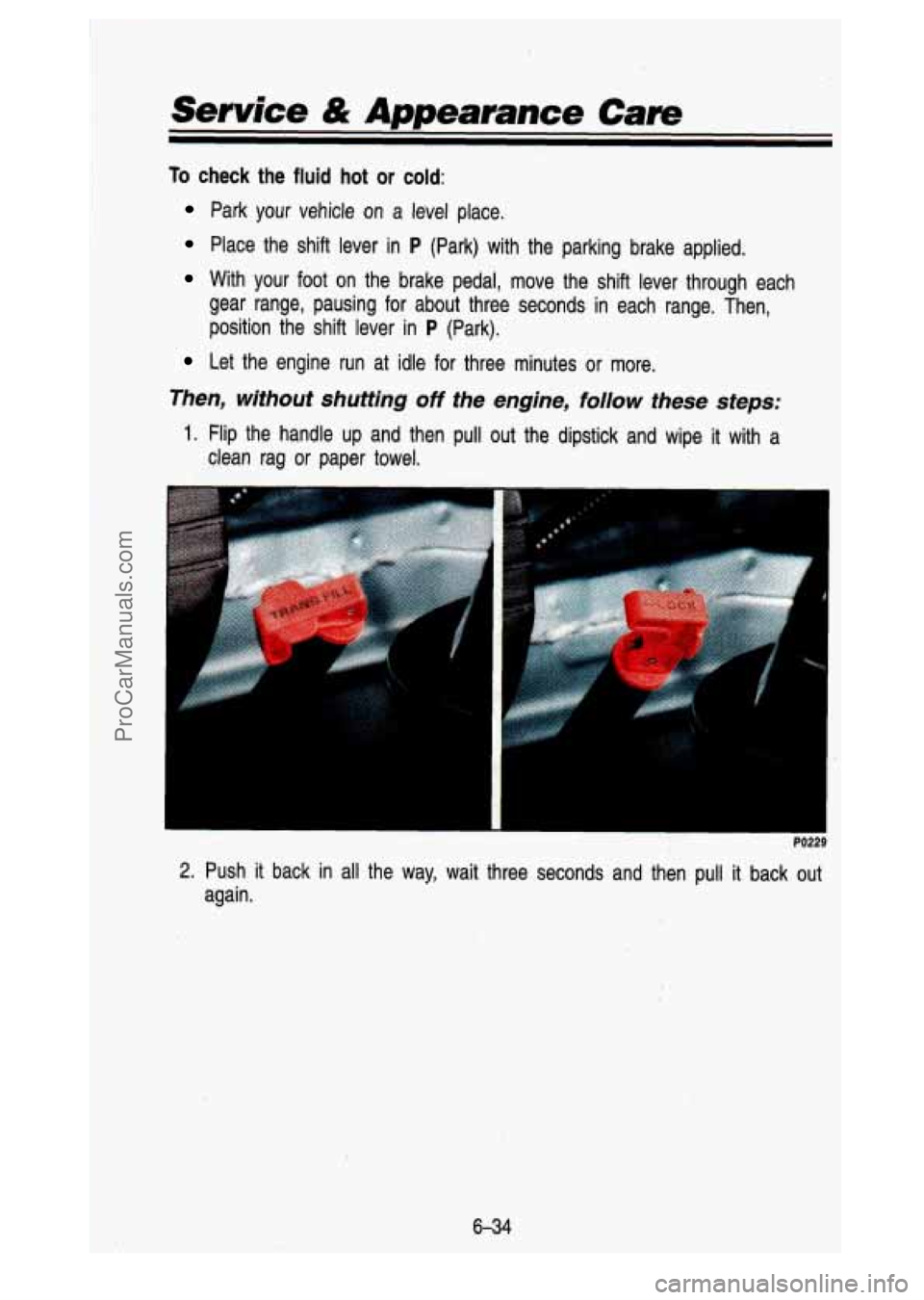
1. Flip the handle up and then pull out the dipstick and wipe it with a
clean rag or paper towel.
PO229
2. Push it back in all the way, wait three seconds and then pull it back out
again.
634
ProCarManuals.com
Page 347 of 436
.;
Trajlering Package
PO339
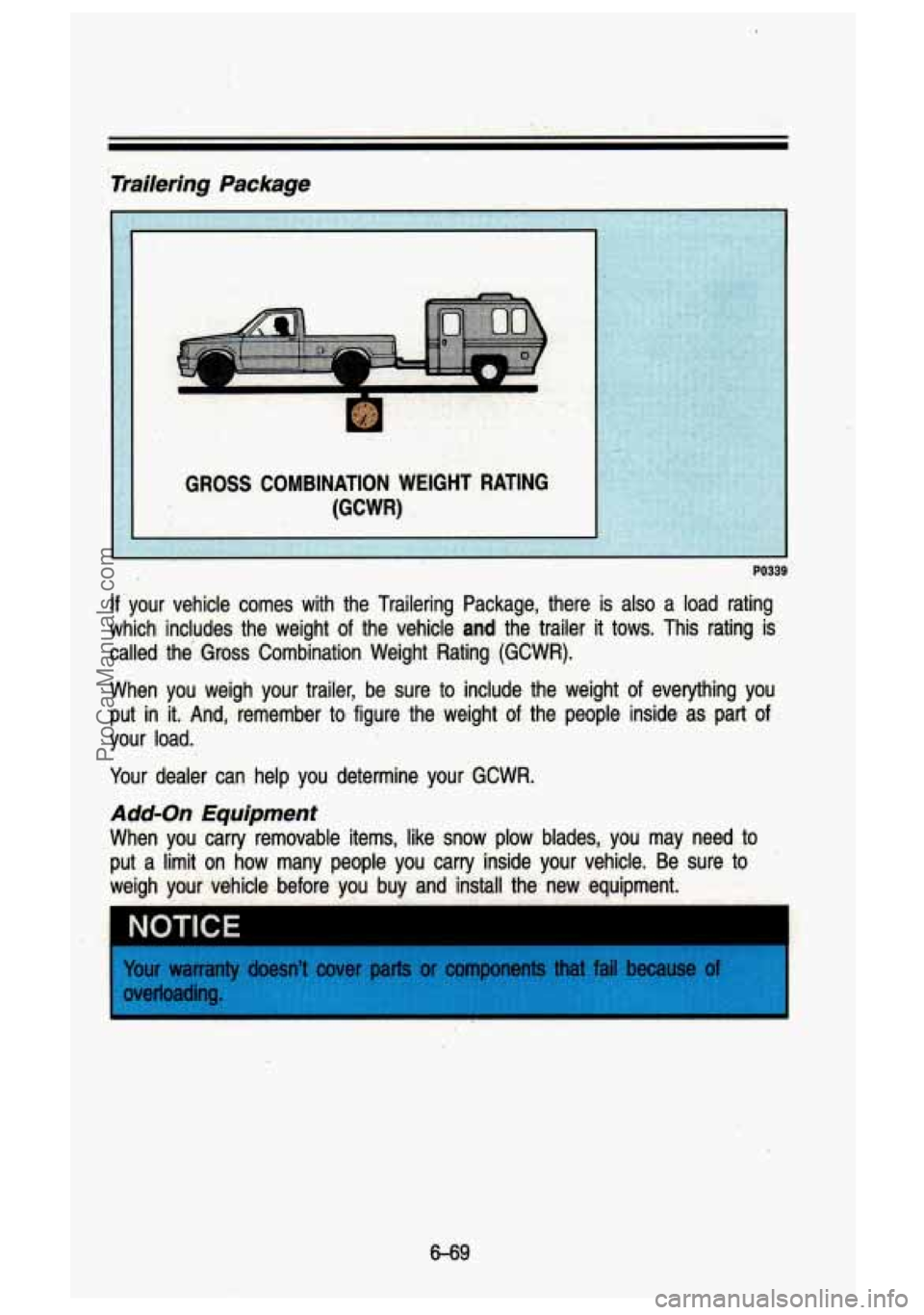
If your vehicle comes with the Trailering Package, there is also 8 load rating
which includes the weight
of the vehicle and the trailer it tows. This rating is
called the Gross Combination Weight Rating (GCWR).
When you weigh your trailer, be sure
to include the weight of everything you
put in it. And, remember to figure the weight
of the people inside as part of
your load.
Your dealer can help you determine your GCWR.
Add-on Equipment
When you carry removable items, like snow plow. blades, you may need to
put a limit on how many people you carry inside your vehicle. Be sure to
weigh your -vehicle -before you buy and install the new equipment.
~____~~.. . __ ~
Your warranty doesn’t cover parts or components that fail because of
~ overloading. I
6-69 ..
ProCarManuals.com
Page 350 of 436
Service & Appearance Care
Trailer Recommendations
You must subtract your hitch loads from the CWR for your vehicle. Weigh
your vehicle with your trailer attached,
so that you won’t go over the GVWR
or the GAWR.
You’ll get the best performance
if you spread out the weight of your load the
right way, and
if you choose the correct hitch and trailer brakes.
For more information, see “Trailer Towing” in the Index.
If you want more information on curb weights, cargo weights, cargo wei\
ght
rating and the correct center of gravity zone for your vehicle, your dealer can
help you. Just ask for a copy of “Consumer Information, Truck-Cam\
per
Loading.”
Pickup Conversion lo. Chassis Cab
General Motors is aware that some vehicle owners may consider having the
pickup box removed and a commercial
or recreational body installed. Before
you do
so, first contact the GM Zone Office for your area for information on
such conversions. (See the “Warranty and Owner Assistance”\
booklet for
Zone Office.) Owners should be aware that, as manufactured, th\
ere are
differences between a chassis cab and a pickup with the box r\
emoved which may affect vehicle safety. The components necessary to adapt the pickup to
permit its safe use with a specialized body should be installed by a bod\
y
builder in accordance with the information available from the Z\
one Office.
Tires
We don’t make tires. Your new vehicle comes with high quali\
ty tires made by
a leading tire manufacturer. These tires are warranted by the \
tire
manufacturers and their warranties are delivered with every new \
vehicle.
If
your spare tire is a different brand than your road tires, you will have a tire
warranty folder from each of these manufacturers.
6-72
ProCarManuals.com