wheel GMC SIERRA 1993 Service Manual
[x] Cancel search | Manufacturer: GMC, Model Year: 1993, Model line: SIERRA, Model: GMC SIERRA 1993Pages: 436, PDF Size: 23.88 MB
Page 214 of 436

Your Driving and the Road
After Off-Road Driving
Remove any brush or debris that has collected on the underbody\
, chassis, or
under the hood. These accumulations can be a fire hazard.
After operation in mud or sand, have the brake linings cleaned\
and checked. These substances can cause glazing and uneven braking. Check th\
e body
structure, steering, suspension, wheels, tires, and exhaust syste\
m for damage.
Also, check the fuel lines and cooling system for any leakage.
Your vehicle will require more frequent service due
to off-road use. Refer to
Section
7 for additional information.
Driving at Night
I
--.
-
- AM450002 I
Night driving is more dangerous than day driving. One reason is that some
drivers are likely
to be impaired-by alcohol or drugs, with night vision
problems, or by fatigue.
Here are some tips on night driving.
Drive defensively. Remember, this is the most dangerous time.
Don’t drink and drive (See “Drunken Driving” in the Index for more on
this problem).
Adjust your inside rear view mirror to reduce the glare from headlights
Since you can’t see as well, you may need to slow down and keep
behind
you.
more space between you and other vehicles. It’s hard
to tell how fast
the vehicle ahead is going just
by looking at its taillights.
4-36
ProCarManuals.com
Page 223 of 436
 as extra warning that you are about to slow
down and ex")
close behind you, you can allow a little extra time and flash\
your brake lights (in addition to your turn signal) as extra warning that you are about to slow
down and exit.
The exit ramp can be curvea, somerlmes quite sharply. The exit\
speed is
usually posted. Reduce your speed according to your speedometer,\
not to
your sense of motion. After driving for any distance at higher\
speeds, you
may tend to think you are going slower than you actually are.\
For example,
40 rnph (65 km/h) might seem like only 20 mph (30 km/h). Obviously, this
could lead to serious trouble
on a ramp designed for 20 mph (30 kmlh)!
Driving a Long Distance
Although most long trips today are made on freeways, there are\
still many
made on regular highways.
Long-distance driving on freeways and regular highways is the s\
ame in some
ways. The trip has to be planned and the vehicle prepared, you drive at\
higher-than-city speeds, and there are longer turns behind the \
wheel. You’ll
enjoy your trip more
if you and your vehicle are in good shape. Here are
some tips for a successful long trip.
Before Leaving on a Long Trip
Make sure you’re ready. Try to be well rested. If you must start when you’re
not fresh-such as after a day’s work-don’t plan to make too many miles
that first part of the journey. Wear comfortable clothing and \
shoes you can easily drive in.
Is your vehicle ready for a long trip? If you keep it serviced and maintained,
it’s ready to go.
If it needs service, have it done before starting out. Of
course, you’ll find experienced and able service experts in \
your vehicle’s
dealerships all across North America. They’ll be ready and willing to help \
if
you need it.
Here are some things you can check before a trip:
Windshield Washer Fluid: Is the reservoir full? Are all windows clean
Wiper Blades: Are they in good shape?
Fuel, Engine Oil, Other Fluids: Have you checked all levels?
Lights: Are they all working? Are the lenses clean?
Tires: They are vitally important to a safe, trouble-free trip. Is the tread
good enough for long distance driving? Are the tires all inflated to the
recommended pressure? inside and outside?
445
ProCarManuals.com
Page 224 of 436
‘
Your Driving and the Road
Weather Forecasts: What’s the weather outlook along your route?
Should -you delay your trip a short time to avoid a major storm system?
Maps: Do you have up-to-date maps? . .. .. . -1 .. On fhe Road
Unless you are the only driver, ‘it is good .to share the driving task’with
others. Limit turns behind the wheel to about
100 miles (160 km) or two
hours at a sitting. Then, either change drivers or stop for s\
ome- refreshment
like coffee, tea or soft drinks and some limbering up. But do\
stop and move
around. Eat lightly along the way. Heavier meals tend
to make some people
sleepy.
.. . .- , - .~
On two-lane highways or undivided multilane highways that do no\
t have
controlled access, you’ll want to watch for some situations \
not usually found
on freeways. Examples are: stop signs and signals, shopping cen\
ters with
direct access to the highway, no passing zones and school zone\
s, vehicles
turning’ left and right
off the road, pedestrians, cyclists, parked vehicles, and
even animals.
Highway Hypnosis
Is there actually such a condition as “highway hypnosis?” Or \
is it just plain ,
falling asleep at the wheel? Call it highway hypnosis, lack of awareness, or
whatever.
’ There is something about an easy stretch of road with the sam\
e scenery,
along with the hum
of the tires on the road, the drone of the engine, and the
, rush of the wind against the vehicle that can make you sleepy\
. Don’t let it ’.
happen to you! If it does, your vehicle can leave the road in less than a
second,
and you could crash and be injured.
What can you do about highway hypnosis? First, be aware that it
can
happen.
Then here are some tips:
Make sure your vehicle is well - ventilated, with a comfortably cool interior.
Keep your eyes moving. Scan the road ahead and to the sides. \
Check
your rearview mirrors frequently and your instruments from time \
to time.
This can help you avoid a fixed stare.
-
,x ! - : ,-.:.&---z-.- ..* .-7
0 d
Wear good sunglasses in bright light. Glare can cause drowsiness. But
don’t wear sunglasses at night. They will drastically reduce \
your overall
-%
vision at the very time you need all the s.eeing power you h\
ave.
If you get sleepy, pull off the road into a rest, service, or parking area
and take a nap, get some exercise, or both. For safety, treat\
drowsiness
on the highway as an emergency.
4-46
ProCarManuals.com
Page 227 of 436

Parking on Hills
AM470025
Hills and mountains mean spectacular scenery. But please be car\
eful where
you stop
if you decide to look at the view or take pictures. Look for pull-offs
or parking areas provided for scenic viewing.
Another part
of this manual tells how to use your parking brake (see “Parking
Brake” in the Index). But on a mountain or steep hill, you can
do one more
thing. You can turn your front wheels to keep your vehicle from rolling
downhill or out into traffic.
Here’s how:
Downhill Parking
-_ .
AM470031
Turn your wheels to the right.
4-49
ProCarManuals.com
Page 228 of 436
Your Driving and the Road
You don't have to jam your tires against the curb, if there is a curb. A gentle
contact is all you need.
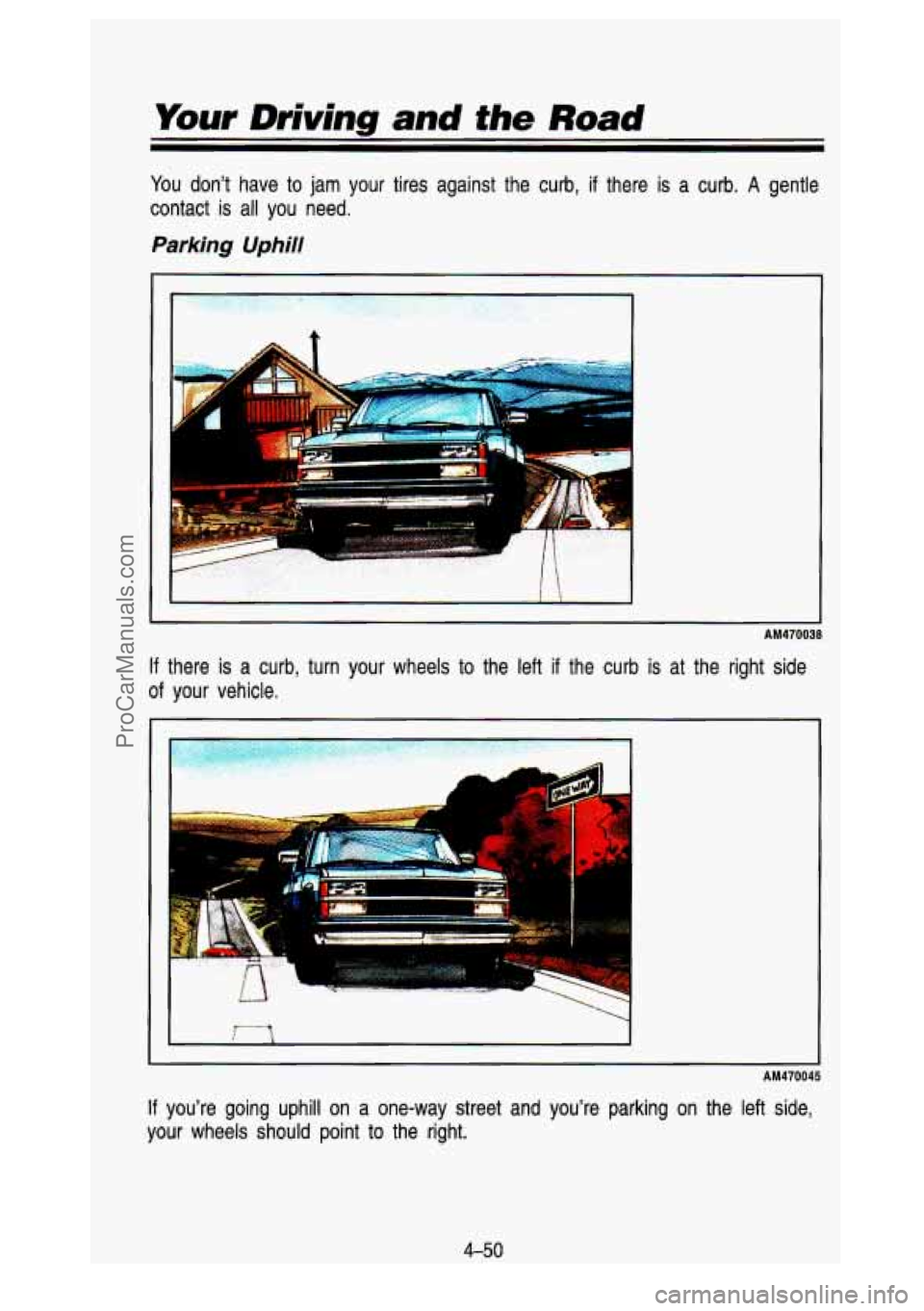
Parking Uphill
I
If there is a curb, turn your wheels to the left if the curb is at the right side
of your vehicle.
1
AM470045
If you're going uphill on a one-way street and you're parking on the left side,
your wheels should point to the right.
4-50
ProCarManuals.com
Page 229 of 436
AM470053
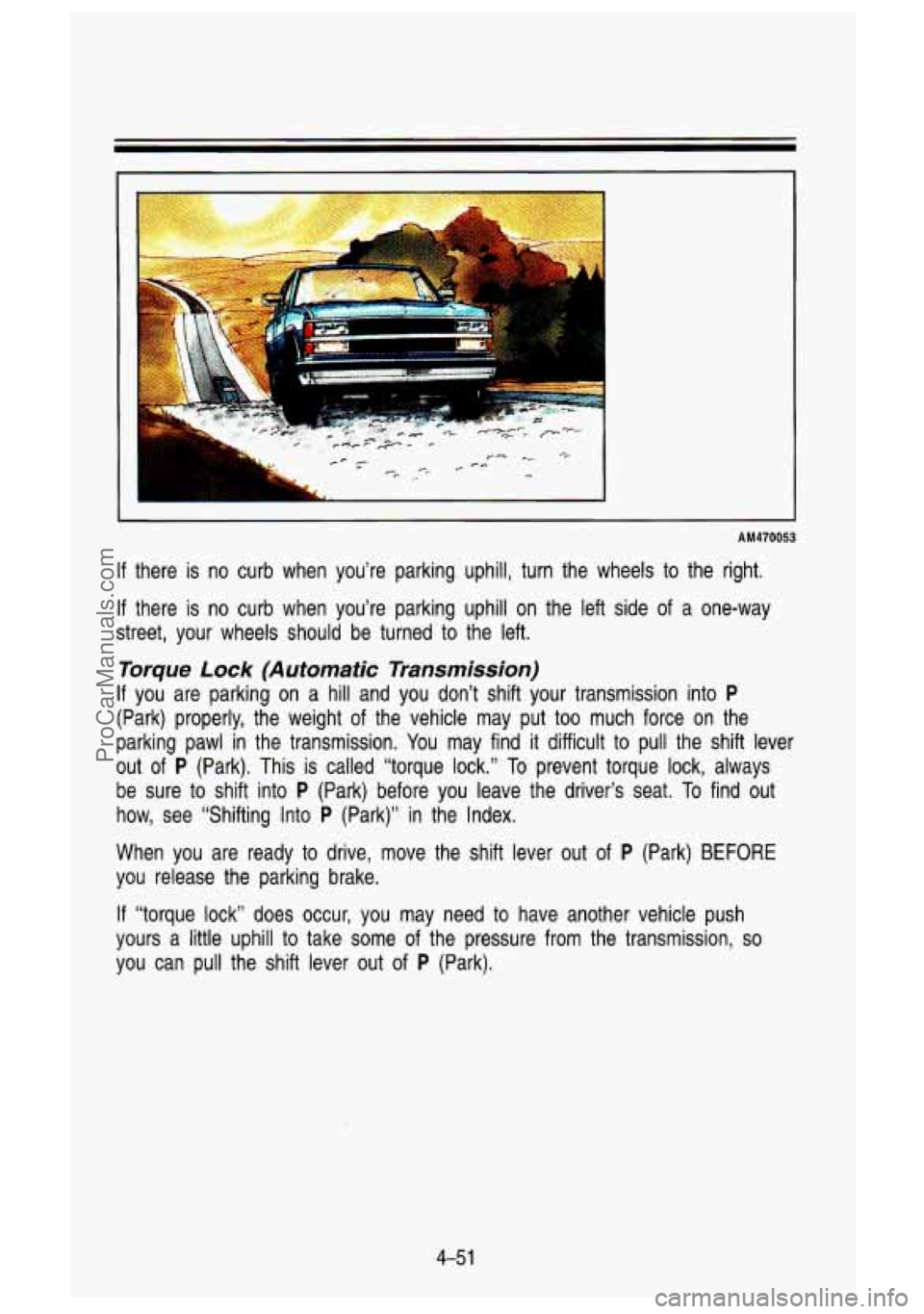
If there is no curb when you’re parking uphill, turn the wheels to the right.
If there is no curb when you’re parking uphill on the left side of a one-way
street, your wheels should be turned to the left.
Torque Lock (Automatic Transmission)
If you are parking on a hill and you don’t shift your tra\
nsmission into P
(Park) properly, the weight of the vehicle may put too much force on the
parking pawl in the transmission. You may find it difficult to pull the shift lever
out of
P (Park). This is called “torque lock.” To prevent torque lock, always
be sure to shift into
P (Park) before you leave the driver’s seat. To find out
how, see “Shifting Into
P (Park)” in the Index.
When you are ready to drive, move the shift lever out
of P (Park) BEFORE
you release the parking brake.
If “torque lock” does occur, you may need to have another vehicle push
yours a little uphill to take some of the pressure from the transmission,
so
you can pull the shift lever out of P (Park).
4-5 1
ProCarManuals.com
Page 231 of 436
AM48001 7
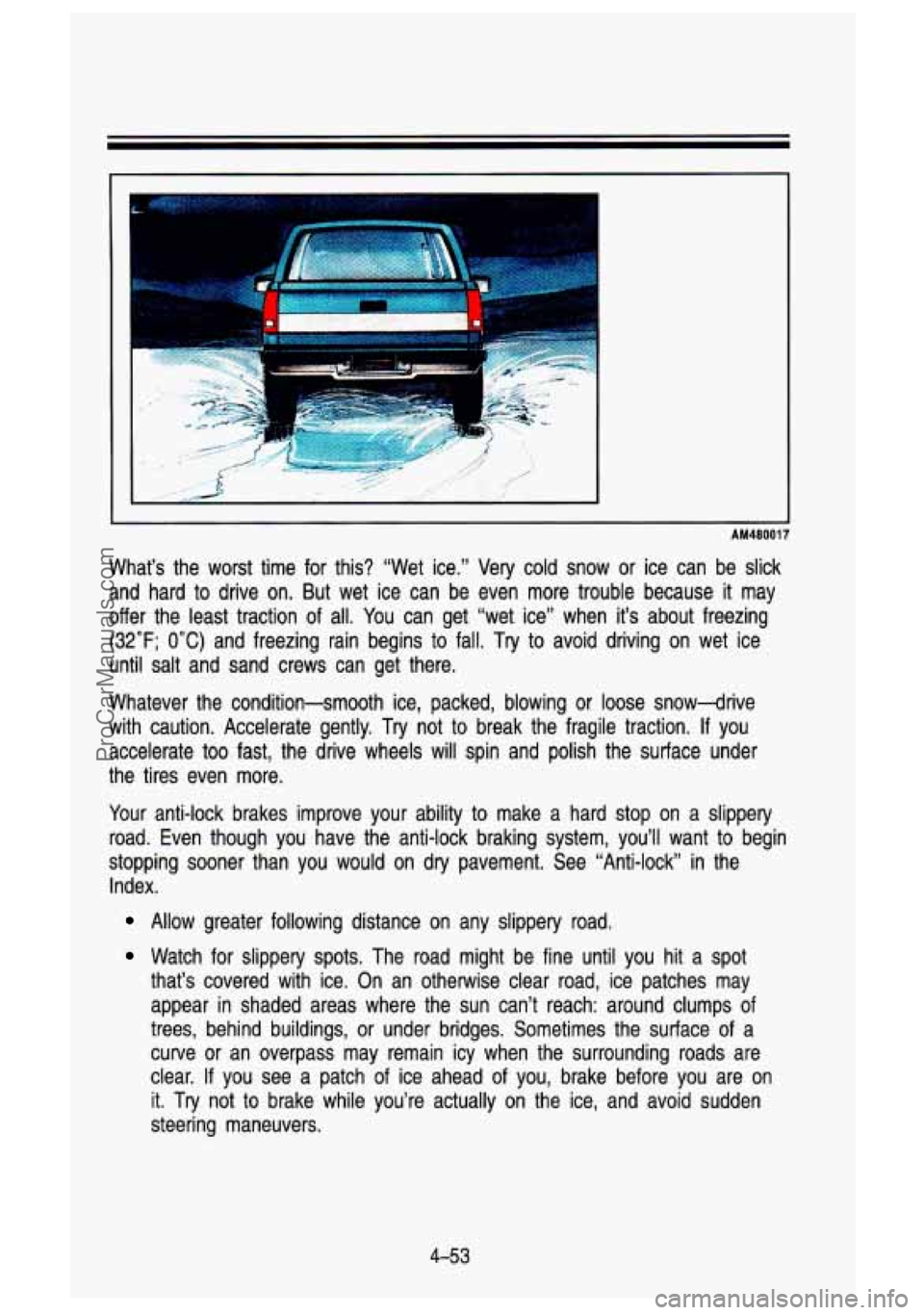
What’s the worst time for this? “Wet ice.’’ Very cold snow or ice can be slick
and hard to drive on. But wet ice can be even more trouble because it may
offer the least traction of all. You can get “wet ice” when it’s about freezing
(32°F; 0°C) and freezing rain begins to fall. Try to avoid driving on wet ice
until salt and sand crews can get there.
Whatever the condition-smooth ice, packed, blowing or loose snow-drive
with caution. Accelerate gently. Try not to break the fragile \
traction.
If you
accelerate
too fast, the drive wheels will spin and polish the surface under \
the tires even more.
Your anti-lock brakes improve your ability
to make a hard stop on a slippery
road. Even though you have the anti-lock braking system, you’\
ll want to begin
stopping sooner than you would on dry pavement. See “Anti-lo\
ck‘’ in the Index.
Allow greater following distance on any slippery road.
Watch for slippery spots. The road might be fine until you hi\
t a spot
that’s covered with ice. On an otherwise clear road, ice patches may
appear in shaded areas where the sun can’t reach: around clumps of
trees, behind buildings,
or under bridges. Sometimes the surface of a
curve
or an overpass may remain icy when the surrounding roads are
clear.
If you see a patch of ice ahead of you, brake before you are on
it. Try not to brake while you’re actually on the ice, and\
avoid sudden
steering maneuvers.
4-53
ProCarManuals.com
Page 237 of 436
Driving with a Trailer
Towing a trailer requires a certain amount of experience. Before setting out
for the open road, you’ll want to get to know your rig. Acquaint yourself with
the feel of handling and braking with the added weight of the trailer. And
always keep in mind that the vehicle you are driving is now a good deal
longer and not nearly
so responsive as your vehicle is by itself.
Before you start, check the trailer hitch and platform, safety \
chains, electrical
connector, lights, tires and mirror adjustment.
If the trailer has electric brakes,
start your vehicle and trailer moving and then apply the trailer brake controller
by hand to be sure the brakes are working. This lets you check your
electrical connection at the same time.
During your trip, check occasionally to be sure that the load is secure, and
that the lights and any trailer brakes are still working.
Following Distance
Stay at least twice as far behind the vehicle ahead as you w\
ould when
driving your vehicle without a trailer. This can help you avoid situations \
that
require heavy braking and sudden turns.
Passing
You’ll need more passing distance up ahead when you’re towing a trailer.
And, because you’re a good deal longer, you’ll need to g\
o much farther beyond the passed vehicle before you can return to your lane.
Backing Up
Hold the bottom of the steering wheel with one hand. Then, to move the
trailer left, just move your hand to the left.
To move the trailer to the right,
move your hand to the right. Always back up slowly and,
if possible, have
someone guide you.
Making Turns
When you’re turning with a trailer, make wider turns than normal. Do this so
your trailer wheels won’t strike soft shoulders, curbs, road signs\
, trees, or
other objects. Avoid jerky or sudden maneuvers. Signal well in advance.
Turn Signals When Towing a Trailer
When you tow a trailer, your vehicle has to have a different turn signal
flasher and extra wiring. The green arrows on your instrument \
panel will flash
whenever you signal a turn or lane change. Properly hooked up, the trailer
lights will also flash, telling other drivers you’re about t\
o turn, change lanes,
or stop.
When towing a trailer, the green arrows on your instrument pan\
el will flash for
turns even
if the bulbs on the trailer are burned out. Thus, you may think
4-59
ProCarManuals.com
Page 238 of 436
Your Driving and the Road
drivers behind you are seeing your signal when they are not. It’s important to
check occasionally to be sure the trailer bulbs are still working.
Driving on Grades
Reduce speed and shift to a lower gear before you start down long or steep
downgrade.
If you don’t shift down, you might have to use your brakes so
much that they would get hot and no longer work well.
On a long uphill grade, shift down and reduce your speed to
45 mph (70
kmlh) or less to reduce the possibility of engine and transmission overheating.
IT you have an automatic transmission, you should use D (or, as you need to,
a lower gear) when towing a trailer. Operating your vehicle i\
n
D when towing
a trailer will minimize heat buildup and extend the life of your transmission.
Or, if you have a manual transmission with fifth gear and you are towing a
trailer, it’s better not to use fifth gear. Just drive in fourth gear
(or, as you
need to, a lower gear).
Parking on Hills
You really should not park your vehicle, with a trailer attached, \
on a hill. If
something goes wrong, your rig could start to move. People can\
be injured
and both your vehicle and the trailer can be damaged.
But
if you ever have to park your rig on a hill, here’s how to do it:
1. Apply your regular brakes, but don’t shift into P (Park) yet, or into gear
2. Have someone place chocks under the trailer wheels.
for a manual transmission.
3. When the wheel chocks are
in place, release the regular brakes until the
chocks absorb the load.
4. Reapply the regular brakes. Then apply your parking brake, and \
then
5. If you have a four-wheel-drive vehicle, be sure the transfer case is in a
6. Release the regular brakes.
shift
to
P (Park), or R (Reverse) for a manual transmission.
drive gear-not in
N (Neutral).
4-60
ProCarManuals.com
Page 239 of 436
CAUTION
It can be dangerous to get out of your vehicle if the shift lever is not
fully in
P (Park) with the parking brake firmly set. Your vehicle can
roll.
If you have left the engine running, the vehicle can move suddenl\
y.
You
or others could be injured. To be sure your vehicle won’t move,
when you’re on fairly level ground, use the steps that follow.
If you have four-wheel drive and your transfer case is in N (Neutral),
your vehicle will be free to
roll, even if your shift lever is in P (Park).
So, be sure the transfer case is in a drive gear-not in N (Neutral).
If you are parking on a hill, or if you’re pulling a trailer, also see
“Parking On Hills” in the Index.
When You Are Ready to Leave After Parklng on a Hill
1. Apply your regular brakes and hold the pedal down while you:
Start your engine;
Shift into a gear; and
Release the parking brake.
2. Let up on the brake pedal.
3. Drive slowly until the trailer is clear of the chocks.
4. Stop and have someone pick up and store the chocks.
Maintenance When Trailer To wing
Your vehicle will need service more often when you’re pulling a trailer. See
the Maintenance Schedule for more on this. Things that are esp\
ecially
important in trailer operation are automatic transmission fluid (don’t overfill),
engine oil, axle lubricant, belts, cooling system, and brake ad\
justment. Each
of these is covered in this manual, and the Index will help \
you find them
quickly.
If you’re trailering, it’s a good idea to review these sections before
you start your trip.
Check periodically
to see that all hitch nuts and bolts are tight.
mailer Wiring Harness
See “Trailer Wiring Harness’’ in the Index.
4-61
ProCarManuals.com