wheel GMC SIERRA 1993 Repair Manual
[x] Cancel search | Manufacturer: GMC, Model Year: 1993, Model line: SIERRA, Model: GMC SIERRA 1993Pages: 436, PDF Size: 23.88 MB
Page 268 of 436
Prablems on the Road
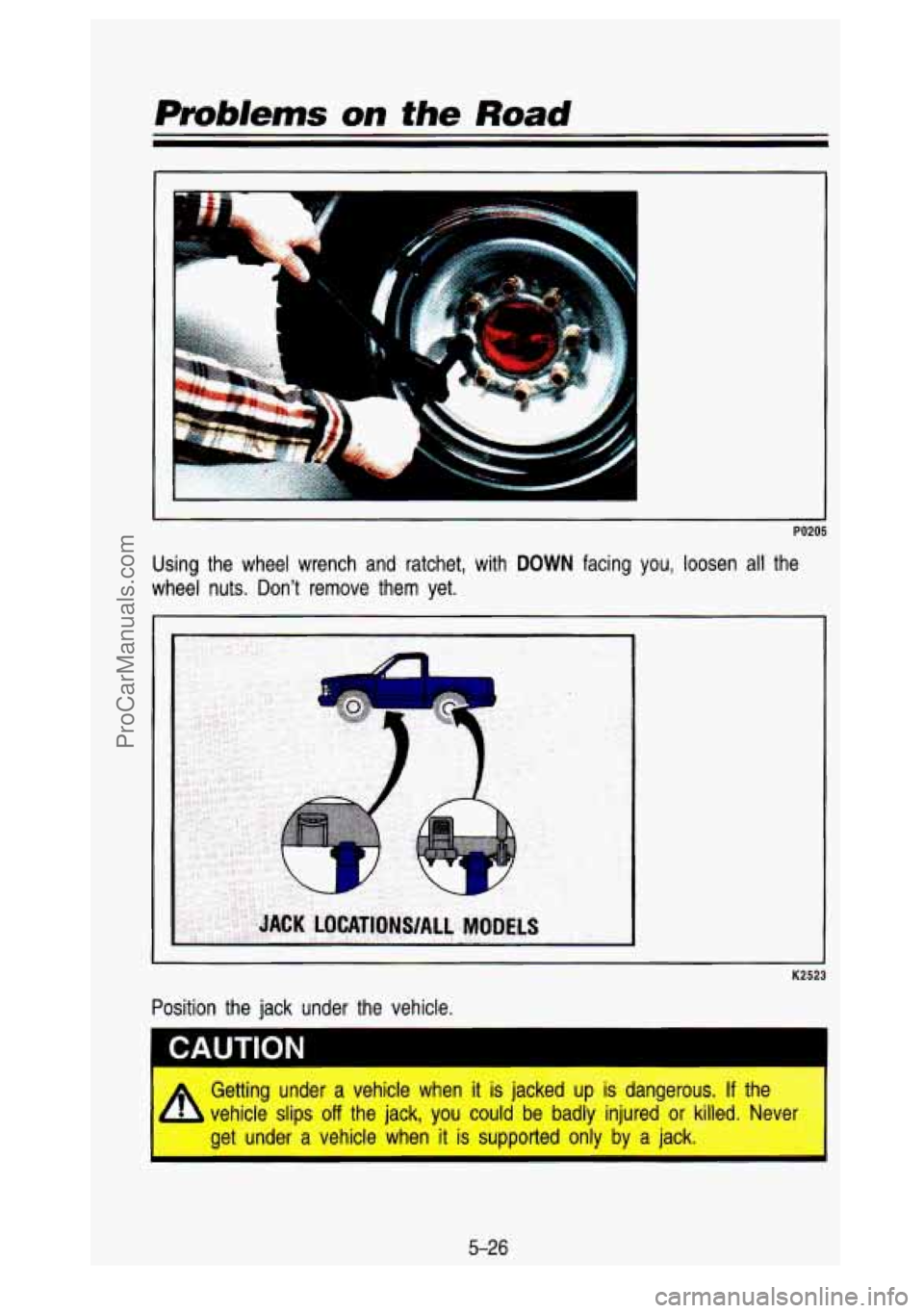
Using the wheel wrench and ratchet, with DOWN facing you, loosen all the
wheel nuts. Don't remove them yet.
Position the jack under the vehicle.
* Getting under a vehicle when it is jacked up is dangerous. If the
A vehicle slips off the jack, you could be badly injured or killed. Never
I
get under a vehicle when it is supported only by a jack. I
5-26
ProCarManuals.com
Page 270 of 436
P!!6/ems on the Road
K2527
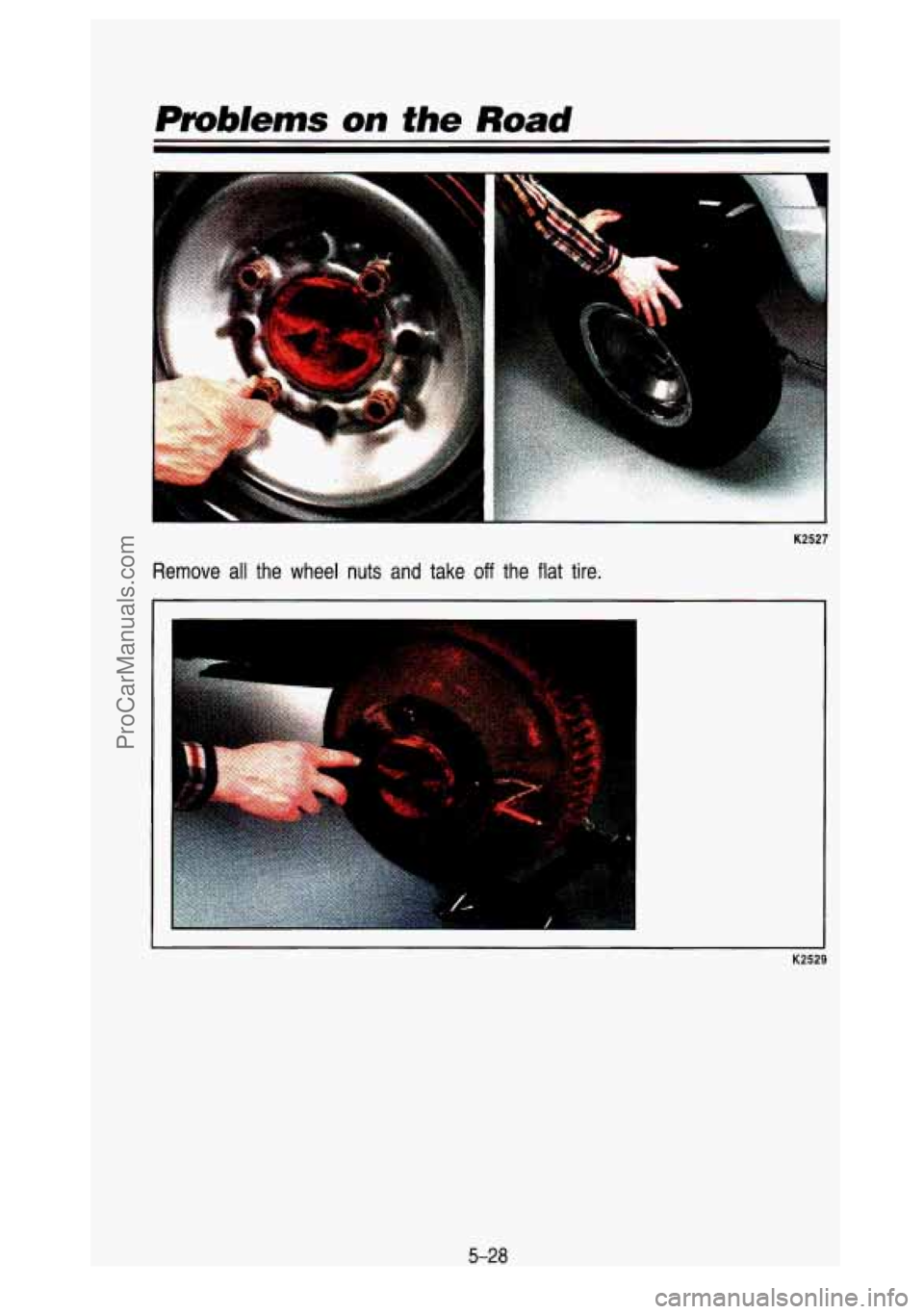
Remove all the wheel nuts and take off the flat tire.
5-28
ProCarManuals.com
Page 271 of 436
I CAUTION
Sust or dirt on the wheel, or on the parts to which it is fastened,
could come
off and cause an accident. When you change a wheel,
remove any rust or dirt from the places where the wheel attac\
hes to
the vehicle. In an emergency, you can use a cloth or a paper towel
to
do this; but be sure to use a scraper or wire brush later- if vou
need to, to get all the rust or dirt
off.
A :an make the wheel nuts become loose after a time. The wheel
Remove any rust
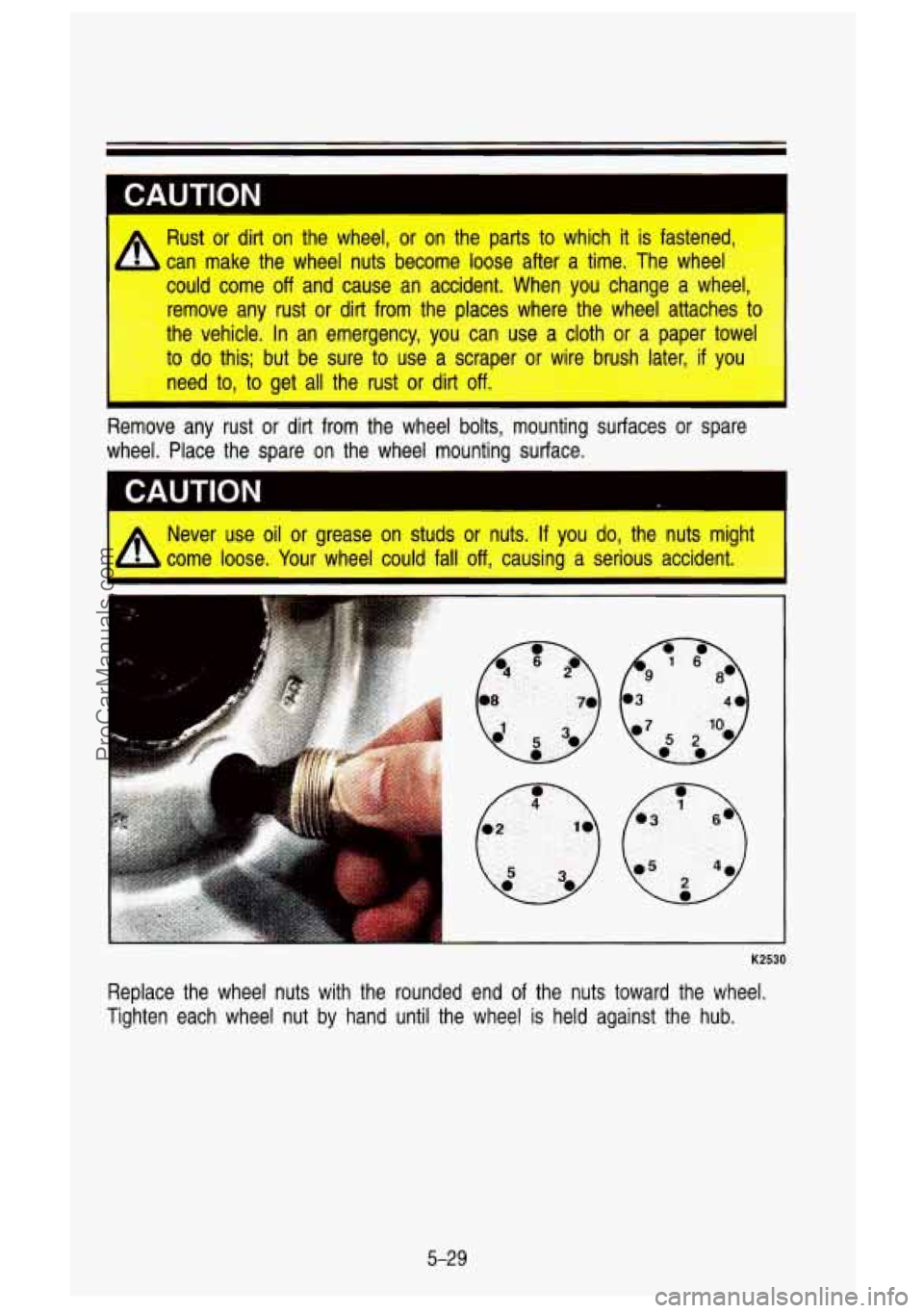
or dirt from the wheel bolts, mounting surfaces or spare
wheel. Place the spare on the wheel mounting surface.
1 CAUTION I
Never use oil or grease on studs or nuts. If you do, the nuts migh
come loose. Your wheel could fall
off, causing a serious accident.
K2530
Replace the wheel nuts with the rounded end of the nuts toward the wheel.
Tighten each wheel nut by hand until the wheel is held against the hub.
5-29
ProCarManuals.com
Page 273 of 436

Incorrect wheel nuts or improperly tightened wheel nuts can cau\
se
the wheel to become loose and even come
off. This could lead to
i accident. Be sure to use the correct wheel nuts. If you have to
Stop somewhere as soon as you can and have tht; wts tightened
vvith a torque wrench to the proper torque.
. lace them, be sure to get the right kind. mGe+ . p+p+<.:,
For proper torque, see “Wheel Nut Torque” in the Index.
Put the wheel trim back on. For vehicles with plastic nut cap\
s, tighten the
caps until they are finger tight, then tighten them an additio\
nal one-half turn
with the ratchet. Remove any wheel
blocks.
ring a jack, a tire or other equipment in the passenger - I.
compartment of the vehicle cnvld cause injuy In a sudden stnn OW 4s
in collision, loose equipment
the proper place.
-
Storing the Jack and Tire
Storing Tire in Underbody Carrier
UNDERBODY SPARE TIRE MOUNTING
HOIST
CABLE
RETAINER
& RATCHET
=r/49q “UP/DOWN” MARKING
WHEEL WRENCH
SHAFT (CHISEL END)
TIRE
a>
SPARE VALVE STEM
(POINTED DOWN)
PB009
Put the tire on the ground at the rear of the vehicle, with the valve stem
pointed down.
5-3 1
ProCarManuals.com
Page 274 of 436

Pzloblenrs on the Road
Pull the retainer through the wheel center. Attach the ratchet,\
with the UP
side facing you, to the wheel wrench. Put the chisel end of the wheel wrench
into the hole in the rear bumper. Turn the ratchet until the tire is raised
against the underside
of the vehicle.
You will hear
two “clicks” when the tire is secure, but pull on the tire to
make sure.
Return the jack, ratchet, wheel wrench and jack extensions to their location
behind the passenger’s seat. Secure the items and replace th\
e jack cover
if
there is one.
Storing Tire ln Pickup Bed
K2534
1. Place the bolt through the bottom wheel nut hole. Be sure the valve
2. Place the nut on the bolt and turn it clockwise until the ti\
re is secure.
faces out.
532
ProCarManuals.com
Page 275 of 436

If You’re Stuck: In Sand,
Mud,
Ice or Snow
What you don’t want to do when your vehicle is stuck is to spin your
wheels. The method known as “rocking” can help you get o\
ut when you’re
stuck, but you must use caution.
CAUTION - --
I * If you let your tires spin at high speed, they can explode and you or
,A others could be injured. And, the transmission or other parts of the
vehicle can overheat. That could cause an engine compartment fire
or other damage. When you’re stuck, spin the wheels as little as
possible. Don’t spin the wheels above
35 mph (55 krnlh) as shown
I on the speedometer.
;pinning your wheels can destroy parts of your vehicle as well as the
res.
If you spin the wheels too fast while shifting your transmission back
.nd forth, you can destroy your transmission.
NOTICE 1
Rocking your vehicle to get it out:
First, turn your steering wheel left and right. That will clear the area around
your front wheels. Then shift back and forth between
R and a forward gear
(or with a manual transmission, between First or Second gear and Reverse),
spinning the wheels as little as possible. Release the accelerator pedal while
you shift, and press lightly on the accelerator pedal when the transmission is
in gear.
If that doesn’t get you out after a few tries, you may need to be
towed out.
Or, you can use your recovery hooks, if your vehicle has them. If
you do need to be towed out, see “Towing Your Vehicle” in the Index.
5-33
ProCarManuals.com
Page 280 of 436

Service & Appearance Care
Engine Coolant ........................................................................\
........................ 6-42
Power Steering Fluid
........................................................................\
............... 6-46
Windshield Washer Fluid
........................................................................\
......... 6-48
Brake Master Cylinder
........................................................................\
............. 6-49
Replacing Brake System Parts
........................................................................\
.. 6-50
Other Maintenance Items ........................................................................\
........... 6-51
Lubrication
........................................................................\
.................................... 6-52
Electrical System
........................................................................\
......................... 6-54
Battery
........................................................................\
...................................... 6-54
Fuses and Circuit Breakers
........................................................................\
.... 6-64
Bulb Replacement
........................................................................\
.................... 6-54
Exhaust System
........................................................................\
........................... 6-65
Loading Your Vehicle
........................................................................\
.................. 6-67
Tires
........................................................................\
.............................................. 6-72
Inflation-Tire Pressure
........................................................................\
........... 6-73
Tire Inspection and Rotation
........................................................................\
.. 6-78
When It's Time for New Tires
........................................................................\
6-80
Buying New Tires
........................................................................\
.................... 6-81
Wheel Alignment and Tire Balance
............................................................... 6-82
Wheel Replacement
........................................................................\
................. 6-83
Tire Chains
........................................................................\
............................... 6-84
Appearance Care
........................................................................\
........................ 6-84
Cleaning the Inside Of Your Vehicle
............................................................. 6-85
Cleaning the Outside Of Your Vehicle
.......................................................... 6-88
Appearance Care Materials
.r.ikl...rr.r.n.....lr. ........ ... .. 6-91
Vehicle Identification Number
........................................................................\
..... 6-92
Service Parts Identification Label
...................................................................... 6-94
Specification Charts
....++t....,.,.*,..-".,,. .............. , ........... .................... 6-95
Uniform Tire Quality Grading
........................................................................\
.. 6-81
..................................................
6-2
ProCarManuals.com
Page 317 of 436
Hydraulic Clutch Grease Fitting
A grease fitting is on the clutch housing for lubricating the clutch fork ball
stud. See your Maintenance Schedule for when to lubricate the clutch
housing. See “Recommended Fluids and Lubricants” in the Index for the
proper lubricant to use.
Be sure not to over-fill because you could damage your clutch.
Four- Wheel Drive
Most lubricant checks in this section also apply to four-wheel-drive vehicles.
However, they have two additional systems that need lubrication.
Transfer Case
When to Check Lubricant:
Refer to the Maintenance Schedule to determine how often to check the
lubricant. See “Periodic Maintenance Inspections” in the Index.
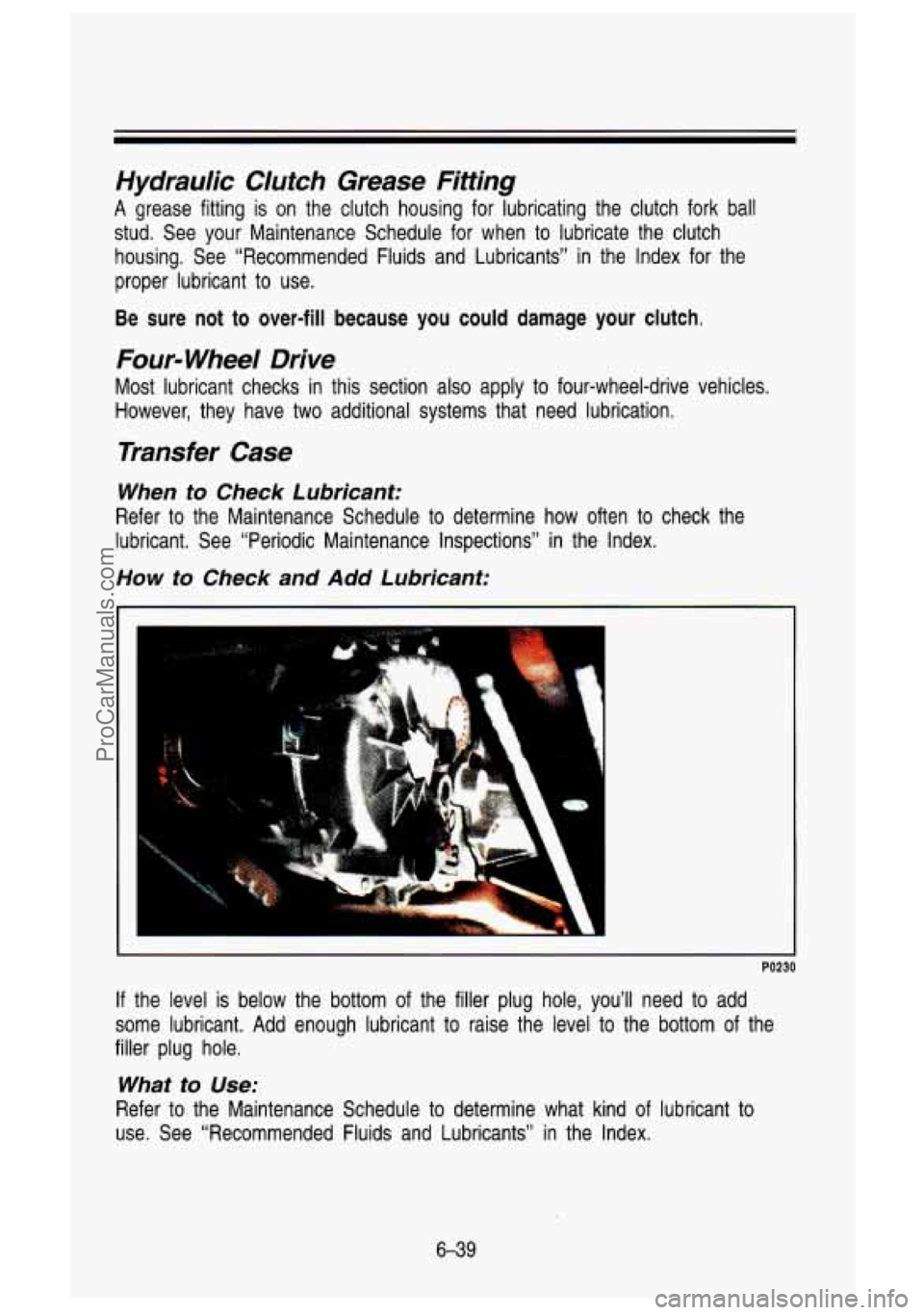
How to Check and Add Lubricant:
I
PO230
If the level is below the bottom of the filler plug hole, you’ll need to add
some lubricant. Add enough lubricant to raise the level to the bottom of the
filler plug hole.
What to Use:
Refer to the Maintenance Schedule to determine what kind of lubricant to
use. See “Recommended Fluids and Lubricants” in the Index.
639
ProCarManuals.com
Page 329 of 436
Other Maintenance Items
Front Suspension and Steering Linkage
Your maintenance schedule will tell you how often to lubricate the fittings. See
“Recommended Fluids and Lubricants’’ in the Index for the proper lubricant to
use.
Front Wheel Bearings
Your vehicle has front wheel bearings that must be cleaned and repa\
cked.
Your maintenance schedule will tell you how often this must be done.
Front Shock Absorbers
The front shock absorbers of your vehicle do many things. They help the
vehicle ride smoothly and also control the travel
of the suspension system.
When the shock absorbers are serviced, any replacement shock absorber\
s
must be the same as the original equipment shock absorbers in both
extended length and strength.
1 NOTICE
If you use shock absomers that are nor me same as the original shock
I absorbers, the shock absorbers or suspension system could be da\
maged.
Wheel Nut Torque
For vehicles with dual wheels, when the vehicle, wheel or fast\
eners are new,
have the torque set at the first
100, 1,000 and 6,000 miles (160, 1600 and
9600 km). Use the torque specified in the appropriate Specification \
Chart later
in this section.
Single Belt Accessory Drive
If your new vehicle uses a serpentine belt, it is lighter, and more durable
than systems with several belts.
The belt runs over or around the pulleys
on the engine. A tensioner is used
to keep the belt tight at all times. The tensioner also makes replacing the
belt easier.
If you need to replace the belt, be sure to get the correct
replacement belt. Your dealership
or parts supplier can help you with this.
The Accessory Drive Belt Routing label on your vehicle will sh\
ow you how to
route the belt your vehicle uses.
6-5 1
ProCarManuals.com
Page 349 of 436
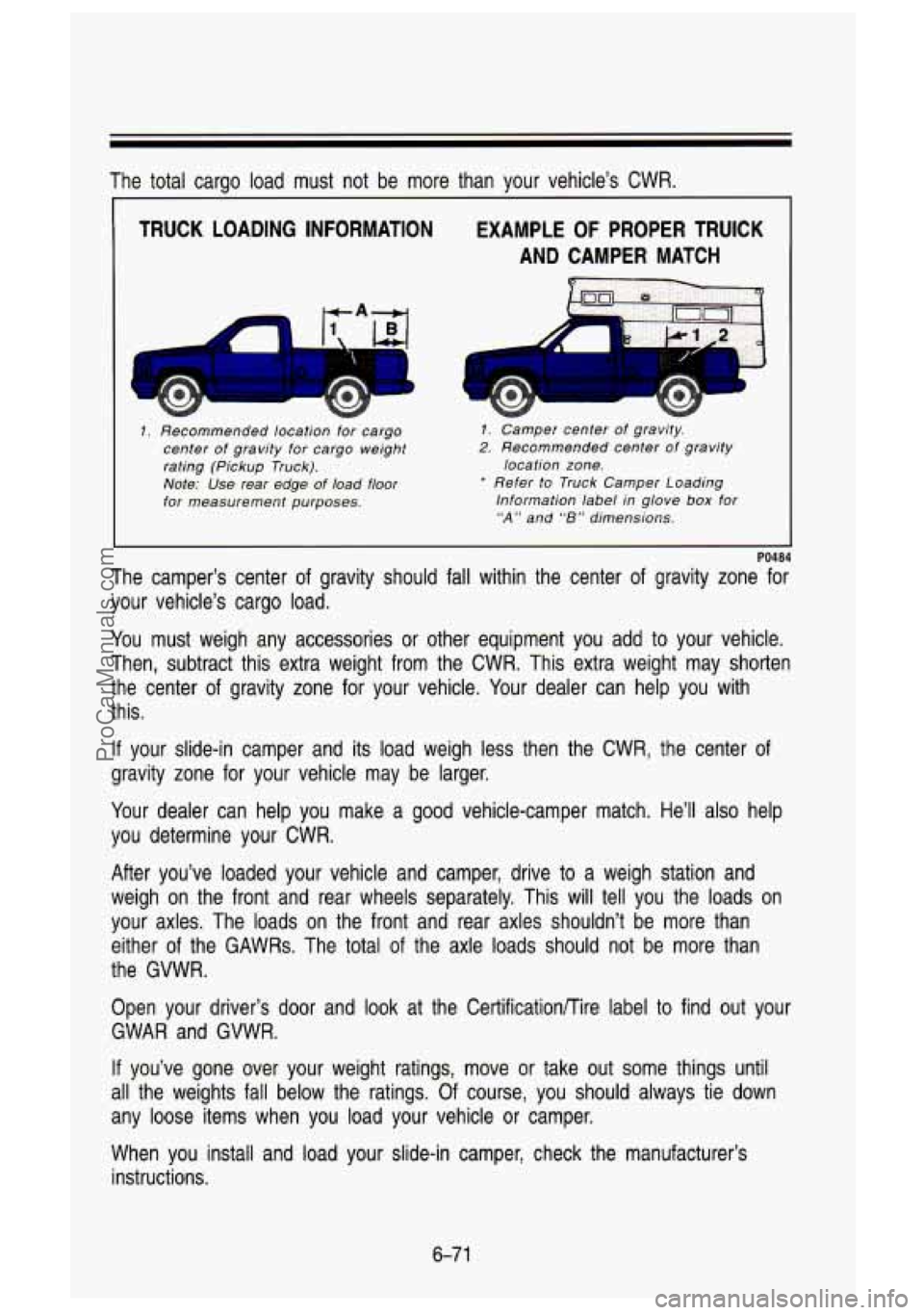
The total carqo load must not be more than your vehicle’s CWR.
TRUCK LOADING INFORMATION
--7 c ‘nl
1. Recommended location for cargo
center of gravity for cargo weight
rating (Pickup Truck).
Note: Use rear edge
of load floor
for measurement purposes.
EXAMPLE OF PROPER TRUCK
AND CAMPER MATCH
I
PO484
The camper’s center of gravity should fall within the center of gravity zone for
your vehicle’s cargo load.
1. Camper center of gravity,
2. Recommended center of gravity
* Refer to Truck Camper Loading
location zone.
Information label in glove
box for
“A” and “8” dimensions.
You must weigh any accessories or other equipment you add to your vehicle.
Then, subtract this extra weight from the CWR. This extra weig\
ht may shorten
the center of gravity zone for your vehicle. Your dealer can help you with
this.
If your slide-in camper and its load weigh less then the CWR, the center of
gravity zone for your vehicle may be larger.
Your dealer can help you make a good vehicle-camper match. He’ll \
also help
you determine your CWR.
After you’ve loaded your vehicle and camper, drive to a weigh station and
weigh on the front and rear wheels separately. This will tell you the loads on
your axles. The loads on the front and rear axles shouldn’t\
be more than
either of the GAWRs. The total of the axle loads should not be more than
the GVWR.
Open your driver’s door and look at the Certificationnire label
to find out your
GWAR and GVWR.
If you’ve gone over your weight ratings, move or take out some\
things until
all the weights fall below the ratings. Of course, you should always tie down
any loose items when you load your vehicle or camper.
When you install and load your slide-in camper, check the manufacturer’s
instructions.
6-7 1
ProCarManuals.com