Index GMC SIERRA 1993 Repair Manual
[x] Cancel search | Manufacturer: GMC, Model Year: 1993, Model line: SIERRA, Model: GMC SIERRA 1993Pages: 436, PDF Size: 23.88 MB
Page 332 of 436
Service & Appearance Care
You should not use penetrating oils because they could wash out the factory
installed lubricant and cause the lock to bind. De-icers which contain alcohol
could also wash away the lubricant,
so be sure to lubricate the lock after
using a de-icer of this type.
Tailgate Handle
The tailgate handle pivot points on your vehicle should be lub\
ricated to keep
it working smoothly.
Your maintenance schedule will tell you how often to lubricate the handle.
See “Recommended Fluids and Lubricants” in the Index for the proper
lubricant to use.
Electrical System
Battery
Every new GM vehicle has a Delco Freedom@ battery. You never have to
add water to one of these. When it’s time for a new battery, we recomme\
nd
a Delco Freedom@ battery. Get one that has the catalog number \
shown on
the original battery’s label.
Vehicle Storage
If you’re not going to drive your vehicle for 25 days or more, take off the
black, negative
(-) cable from the battery. This will help keep your battery
from running down.
I - Batteries have acid that can burn you and gas that can explod\
e. You I
1 can be badly hurt if you aren’t careful. See “Jump Starting” in the
Index for tips on working around a battery without getting hur\
t.
Contact your dealer to learn how to prepare your vehicle for longer periods.
Bulb Replacement
Before you replace any bulbs, be sure that all the lights are off and the
engine isn’t running.
6-54
ProCarManuals.com
Page 342 of 436
Service & Appearance Care
4. Push in gently on the bulb, turn it counterclockwise and remove it from
the socket.
5. Put in a new bulb and, pushing in gently, turn it clockwise until it is
tight.
6. Put the socket back in the light assembly and replace the lens and lens
seal.
Fuses and Circuit Breakers
The wiring circuits in your vehicle are protected from short circuits by a
combination of fuses, circuit breakers, and fusible thermal links in the wiring
itself. This greatly reduces the chance of fires caused by electrical problems.
See “Fuses and Circuit Breakers’’ in the Index for more information.
Headlights
The headlight wiring is protected by a circuit breaker in the light switch. An
electrical overload will cause the lights to go on and
off, or in some cases to
remain
off. If this happens, have your headlight wiring checked right away.
Windshield Wipers
The windshield wiper motor is protected by a circuit breaker a\
nd a fuse. If
the motor overheats due
to heavy snow, etc., the wiper will stop until the
motor cools.
If the overload is caused by some electrical problem and not
snow, etc., be sure to get it fixed.
Power Windows and Other Power Options
Circuit breakers in the fuse panel protect the power windows and other power
accessories. When the current load is too heavy, the circuit breaker opens
and closes, protecting the circuit until the problem is fixed or goes away.
Trailer Wiring Harness
The optional seven-wire trailer wiring harness is protected by an in-line fuse
in the battery feed wire. This fuse is near the junction block. See “Trailer
Wiring Harness” in the Index for more information.
6-64
ProCarManuals.com
Page 343 of 436
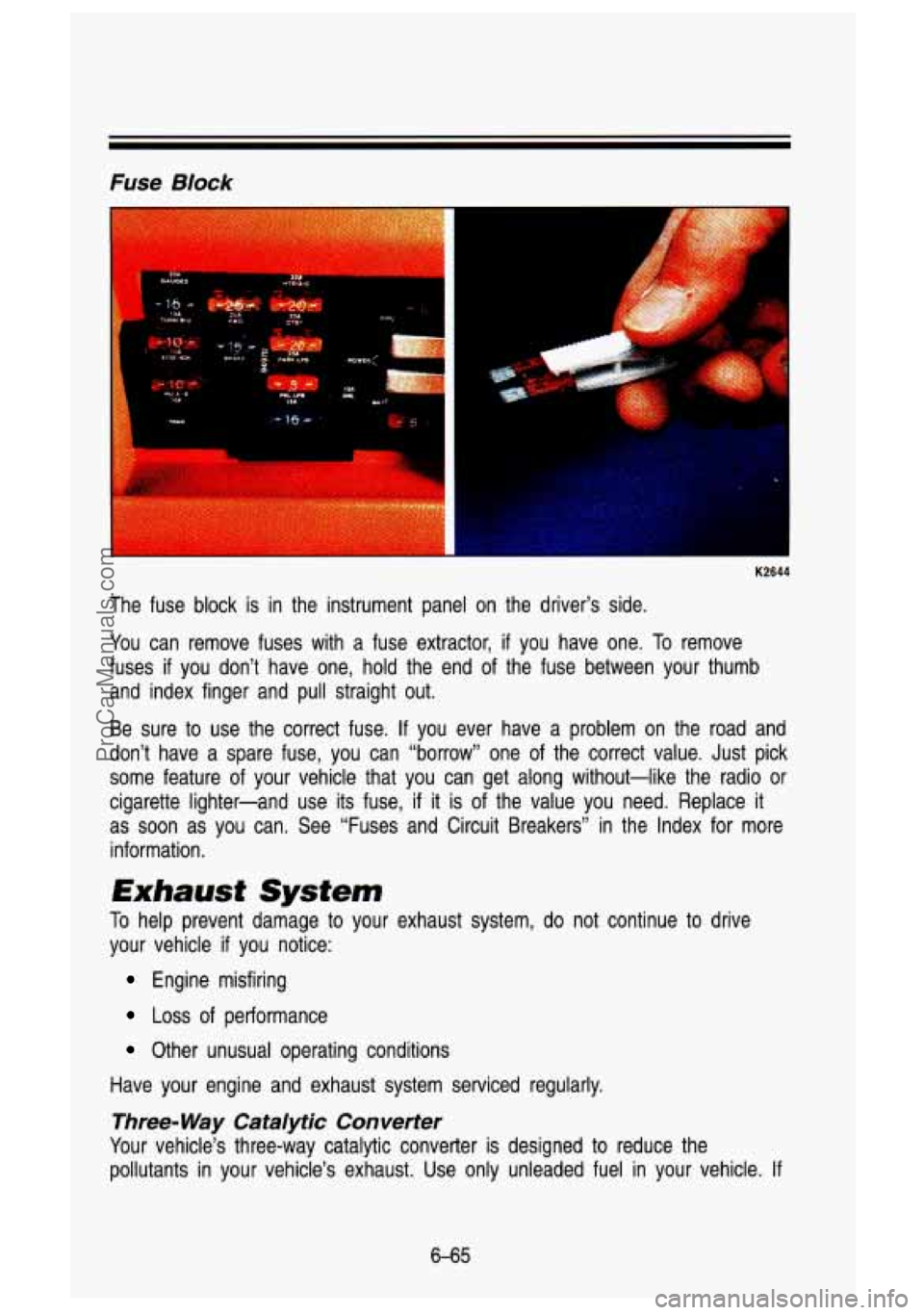
Fuse Block
K2644
The fuse block is in the instrument panel on the driver’s side.
You can remove fuses with a fuse extractor,
if you have one. To remove
fuses
if you don’t have one, hold the end of the fuse between your thumb
and index finger and pull straight out.
Be sure
to use the correct fuse. If you ever have a problem on the road and
don’t have a spare fuse, you can “borrow’’ one of the correct value. Just pick
some feature
of your vehicle that you can get along without-like the radio or
cigarette lighter-and use its fuse,
if it is of the value you need. Replace it
as soon as you can. See “Fuses and Circuit Breakers” in the Index for more
information.
Exhaust System
To help prevent damage to your exhaust system, do not continue to drive
your vehicle
if you notice:
Engine misfiring
Loss of performance
Other unusual operating conditions
Have your engine and exhaust system serviced regularly.
Three- Way Cataiytic Converter
Your vehicle’s three-way catalytic converter is designed to reduce the
pollutants in your vehicle’s exhaust. Use only unleaded fuel in your vehicle.
If
6-65
ProCarManuals.com
Page 350 of 436
Service & Appearance Care
Trailer Recommendations
You must subtract your hitch loads from the CWR for your vehicle. Weigh
your vehicle with your trailer attached,
so that you won’t go over the GVWR
or the GAWR.
You’ll get the best performance
if you spread out the weight of your load the
right way, and
if you choose the correct hitch and trailer brakes.
For more information, see “Trailer Towing” in the Index.
If you want more information on curb weights, cargo weights, cargo wei\
ght
rating and the correct center of gravity zone for your vehicle, your dealer can
help you. Just ask for a copy of “Consumer Information, Truck-Cam\
per
Loading.”
Pickup Conversion lo. Chassis Cab
General Motors is aware that some vehicle owners may consider having the
pickup box removed and a commercial
or recreational body installed. Before
you do
so, first contact the GM Zone Office for your area for information on
such conversions. (See the “Warranty and Owner Assistance”\
booklet for
Zone Office.) Owners should be aware that, as manufactured, th\
ere are
differences between a chassis cab and a pickup with the box r\
emoved which may affect vehicle safety. The components necessary to adapt the pickup to
permit its safe use with a specialized body should be installed by a bod\
y
builder in accordance with the information available from the Z\
one Office.
Tires
We don’t make tires. Your new vehicle comes with high quali\
ty tires made by
a leading tire manufacturer. These tires are warranted by the \
tire
manufacturers and their warranties are delivered with every new \
vehicle.
If
your spare tire is a different brand than your road tires, you will have a tire
warranty folder from each of these manufacturers.
6-72
ProCarManuals.com
Page 351 of 436
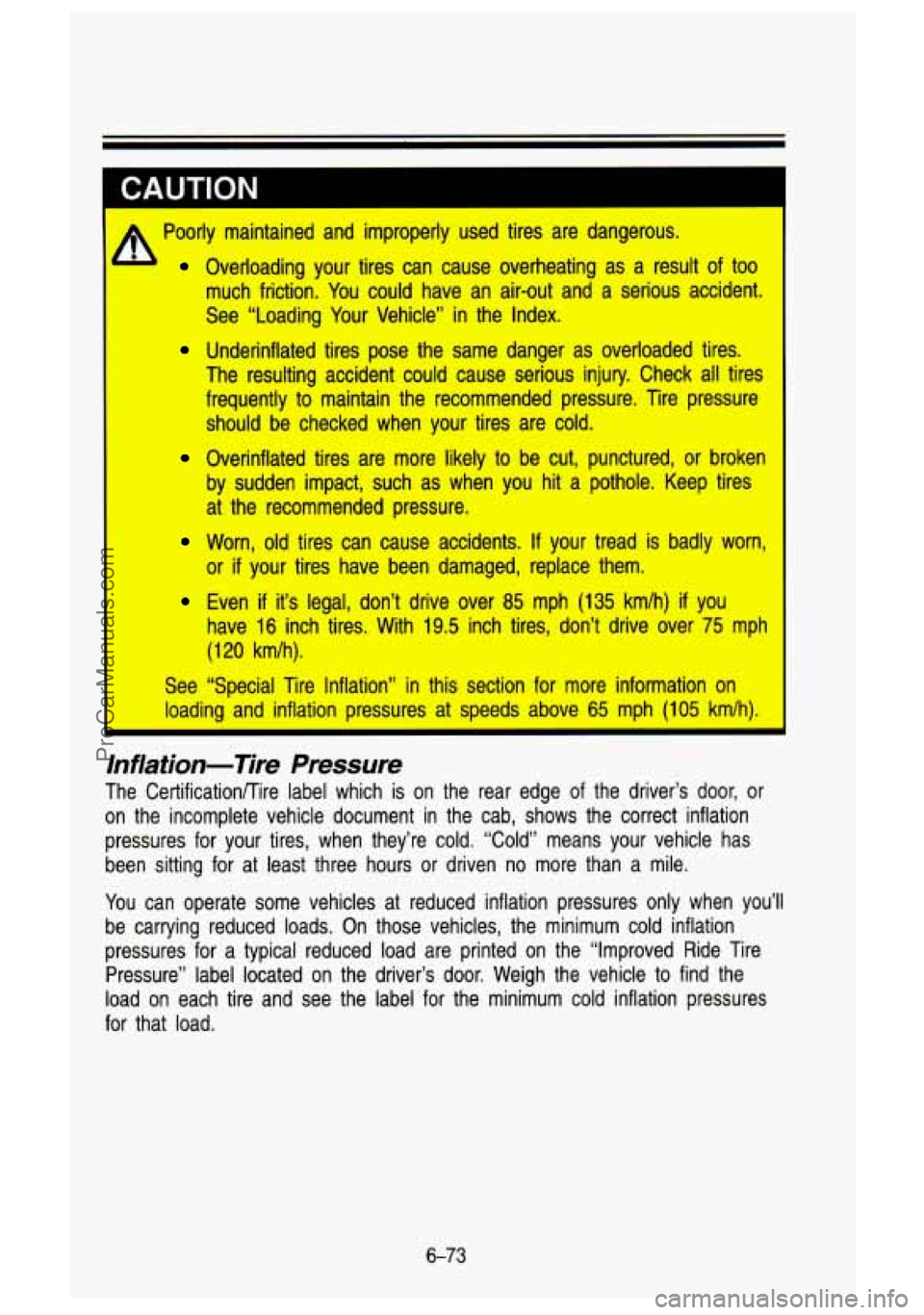
I CAUTION
Poorly maintained and improperly used tires are dangerous.
Overloading your tires can cause overheating as a result of too
much friction. You could have an air-out and a serious accident.
See “Loading Your Vehicle” in the Index:
The resulting accident could cause serious injury. Check all tires
frequently
to maintain the recommended pressure. Tire pressure
should be checked when your tires are cold.
Overinflated tires are more likely to be cut, punctured, or broken
by sudden impact, such as when you hit a pothole. Keep tires
at the recommended pressure.
Worn, old tires can cause accidents; If your tread is badly worn,
or if your tires have been damaged, replace them.
Even if it’s legal, don’t drive over 85 mph (1 35 kmlh) if you
have
16 inch tires. With 19.5 inch tires, don’t drive over 75 mph
(1 20 km/h).
Underinflated tires pose the same danger as overloaded tires.
See “Special Tire Inflation” in this section for more information on
I loading and inflation pressures at speeds above 65 mph (105 kmlh). I
Inflaiion-Tire Pressure
The Certification/Tire label which is on the rear edge of the driver’s door, or
on the incomplete vehicle document in the cab, shows the corre\
ct inflation
pressures for your tires, when they’re cold.
“Cold” means your vehicle has
been sitting for at least three hours or driven no more than
a mile.
You can operate some vehicles at reduced inflation pressures only w\
hen you’ll
be carrying reduced loads. On those vehicles, the minimum cold \
inflation
pressures for a typical reduced load are printed on the “Improved Ride Tire \
Pressure” label located on the driver’s door. Weigh the v\
ehicle
to find the
load on each tire and see the label
for the minimum cold inflation pressures
for that load.
6-73
ProCarManuals.com
Page 356 of 436
Service & Appearance Cam
Tire lnspecfion and Rotation
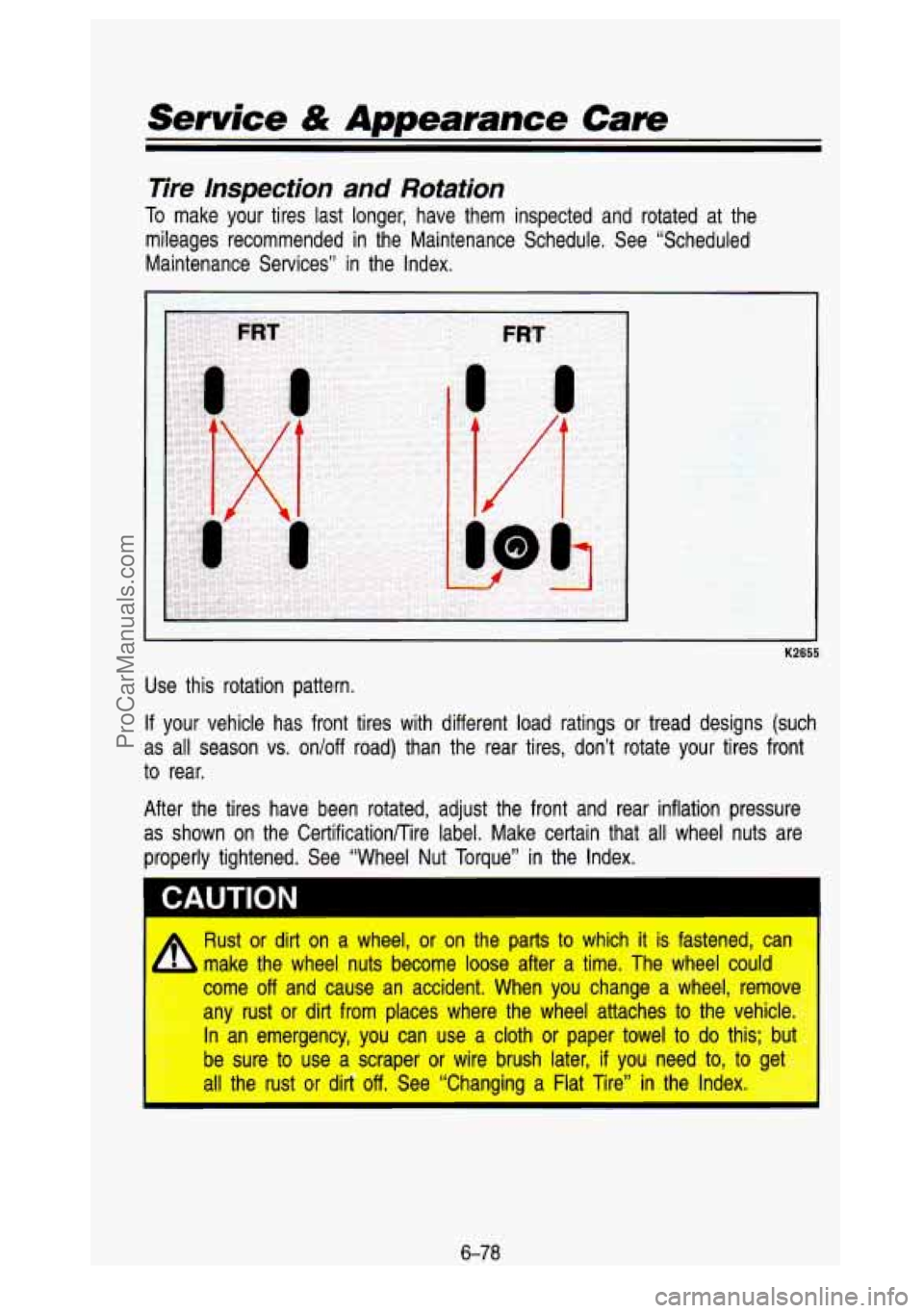
To make your tires last longer, have them inspected and rotated at the
mileages recommended in the Maintenance Schedule. See “Scheduled
Maintenance Services” in the Index.
Q
-
-
K2655
Use this rotation pattern.
If your vehicle has front tires with different load ratings or tread designs (such
as all season
vs. onloff road) than the rear tires, don’t rotate your tires \
front
to rear.
After the tires have been rotated, adjust the front and rear \
inflation pressure
as shown on the CertificationRire label. Make certain that all wheel nuts are
properly tightened. See “Wheel Nut Torque”
in the Index.
A Rust or dirt on a wheel, or on the parts to which -it is fastened, can
make the wheel nuts become loose after a time. The wh.eel could
come
off and cause an accident. When you change- a- :wheel, remove
’ any -rust or dirt from places where the wheel attaches to the vehicle:
,: In an emergency, you can use a cloth or paper towel to do this; but
3 be sure to use a scraper or wire brush later, if you need- to, to get
-T all the rust or dirf off. See “Changing a Flat Tire” in the Index.
6-78
ProCarManuals.com
Page 366 of 436

Service & Appearance Care
Don’t use abrasive cleaners on glass, because they may cause\
scratches.
Avoid placing decals on the inside rear window, since they may\
have to be
scraped
off later. If abrasive cleaners are used on the inside of the rear
window, an electric defogger element may be damaged. Any tempor\
ary
license should not be attached across the defogger grid.
Cleaning the Outside of the Windshield and Wiper Blades
If the windshield is not clear
blade chatters when running,
windshield.
Clean the outside windshield
(GM Part No. 1050011). The
you rinse it with water. after using the windshield washer, or
if the wiper
wax or other material may be on the blade or
with
GM Windshield Cleaner, Bon-Ami Powder@
windshield is clean
if beads do not form when
Clean the blade by wiping vigorously with a cloth soaked
in full strength
washer solvent. Then rinse the blade with water.
Wiper blades should be checked on a regular basis and replaced\
when worn.
Cleaning the Outside of Your Vehicle
The paint finish on your vehicle provides beauty, depth of color, gloss
retention and durability.
Washing Your Vehicle
The best way to preserve your vehicle’s finish is to keep it clean by washing
it often with lukewarm or cold water.
Don’t wash your vehicle in the direct rays of the sun. Don’t use strong soaps
or chemical detergents. Use liquid hand, dish or car washing (\
non-detergent)
soaps. Don’t use cleaning agents that contain acid or abrasi\
ves.
All cleaning
agents should be flushed promptly and not allowed to dry on the surface, or
they could stain.
Dry the finish with a soft, clean chamois or a 100% cotton
towel to avoid surface scratches and water spotting.
High pressure vehicle washes may cause water to enter your veh\
icle.
Finish Care
Occasional waxing or mild polishing of your vehicle may be necessary to
remove residue from the paint finish. You can get
GM approved cleaning
products from your dealer. (See “Appearance Care and Materia\
ls’’ in the Index,)
Your vehicle (except
C 3500 HD) has a “basecoat/clearcoat” paint finish The
clearcoat gives more depth and gloss to the colored basecoat.
ProCarManuals.com
Page 383 of 436
A Word About Maintenance
We at General Motors want to help you keep your vehicle in good working
condition. But we don’t know exactly how you’ll drive it. You may drive very
short distances only a few times a week. Or you may drive long distances all
the time in very hot, dusty weather. You may use your vehicle in making
deliveries. Or you may drive it
to work, to do errands, or in many other ways.
Because of all the different ways people use their GM vehicles, maintenance
needs vary. You may even need more frequent checks and replacements than
you will find in the schedules in this section.
So please read this section and
note how you drive.
If you have any questions on how to keep your vehicle
in good condition, see your GM dealer, the place many GM owners choose
to have their maintenance work done. Your dealer can be relied upon to use
proper parts and practices.
Your Vehicle and the Environment
Proper vehicle maintenance not only helps keep your vehicle in good working
condition, but also helps the environment. All recommended maintenance
procedures are important. Improper vehicle maintenance or the removal of
important components can significantly affect the quality of the air we breathe.
Improper fluid levels or even the wrong tire inflation can inc\
rease the level of
emissions from your vehicle. To help protect our environment, and to help
keep your vehicle in
good condition, please maintain your vehicle properly.
Recording Maintenance Services
The Maintenance Record near the end of this section provides a place for
you
to record the maintenance performed on your vehicle. Whenever any
maintenance is performed, be sure
to write it down in the Maintenance
Record. This will help you determine when your next maintenance should be
done, In addition, it is a good idea to keep your maintenance receipts. They
may be needed to qualify your vehicle for warranty repairs.
CAUTION
+ CAUTION: Performing maintenance work on a vehicle can be
dangerous. In trying
to do some jobs, you can be seriously injured.
Do your own maintenance work only if you have the required
know-how and the proper tools and equipment for the job.
If you
have any doubt. have
a aualified technician do the work.
If you are skilled enough to do some work on your vehicle, you will probably
want to get the service information GM publishes. You will
find a list of
publications and how to get them in the back of Section
8, “Customer
Assistance Information.” See “Service Publications’’ in the Index.
7-3
ProCarManuals.com
Page 384 of 436

Scheduled Maintenance Services
Scheduled Maintenance Services
This part tells you the maintenance services that you should h\
ave done and
the times you should schedule them. Your GM dealer knows your vehicle best
and wants you
to be happy with it. If you go to your dealer for your service
needs, you’ll know that GM-trained and supported service peop\
le will perform
the work using genuine GM parts.
These schedules are for vehicles that:
carry passengers and cargo within the recommended limits. You will find
these limits on your vehicle’s Certification Label. See “L\
oading Your
Vehicle” in the Index.
are driven on regular road surfaces, and within legal driving \
limits.
are driven off-road in the recommended manner. See the Index U\
nder
use the recommended fuel. See “Fuel” in the Index.
“Off Road Driving With Your Four Wheel Drive Vehicle.”
selecting The Proper Maintenance Services
To find the proper maintenance schedule for your vehicle, you must\
know two
things. What engine your vehicle has, and how you use your ve\
hicle. Your
engine type will tell you which chart to use, and your drivin\
g conditions will
tell you which schedule to use. The charts are found later in\
this section.
Selecting the Proper Maintenance Chart
Your engine type (Gasoline or Diesel) and its emissions classificat\
ion (Light
Duty 3r Heavy Duty Emissions) will tell you which maintenance \
chart
to use.
Find your Vehicle Identification Number (VIN), and look at th\
e eighth character
to see what your engine code is. Then use the following Engine E\
missions
Classifications table
to find your emissions classification.
Your VIN is on the plate on the top left corner of your instrument panel,
the Certification Label and on the Service Parts Identification \
Label. See “Vehicle Identification Number” in the Index.
If your engine has more than one emissions classification, look at\
your
Certification Label to see what your Gross Vehicle Weight Ratin\
g
(GVWR)
is. See “Loading Your Vehicle” in the Index.
7-4
ProCarManuals.com
Page 398 of 436
Scheduled Maintenance Services
Explanation Of Scheduled Maintenance Services
Below are explanations of the services listed in the maintenance charts.
The proper fluids and lubricants to use are listed in this section. Make sure
whoever services your vehicle uses these. All parts should be \
replaced and
all necessary repairs done before you or anyone else drives the ve\
hicle.
1.
ENGINE OIL AND OIL FILTER CHANGE* -ALWAYS USE SG OR
SGKE QUALITY, ENERGY CONSERVING II OILS OF THE PROPER
VISCOSITY. To determine the preferred viscosity oil for your vehicle’s
engine (e.g. SAE 5W-30 or 10W-30), see “Engine Oil” in the Index.
2. CHASSIS LUBRICATION -Lubricate the front suspension, king pin
bushings, steering linkage, transmission, and transfer case shift\
linkage,
parking brake cable guides, propshaft splines (2 wheel drive), brake
pedal springs, and clutch pedal springs at the intervals specified.
If you have a 3500 HD, lubricate the king pins and king pin bushings
every 1,500 miles
(2500 km) for Maintenance Schedule 1, or every 3,000
(5000 km) for Maintenance Schedule 2.
Ball joints and king pin bushings should not be lubricated unless their
temperature is
10°F (-12”C), or higher. When the weather is cold, let
them warm up before lubrication or they could be damaged.
Also, be sure to check
all the vehicle fluid levels at this time.
3.
CLUTCH FORK BALL STUD LUBRICATION -Lubricate the clutch fork
ball stud through the fitting on the clutch housing. Lubricant must be
added “sparingly” to the fitting, as only.
0066 Ib. (.003 kg) is required to
lubricate the ball stud surface.
Do not add lubricant more often than the
intervals in the Maintenance Charts.
Too much lubricant will damage
the clutch assembly.
4. ENGINE IDLE SPEED ADJUSTMENT (DIESEL ENGINES)* -Adjust to
the specifications shown on the underhood label. You must use
calibrated test equipment.
5. COOLING SYSTEM SERVICE* -Drain, flush and refill system with new
coolant. See “Engine Coolant’’ in the Index for the proper coolant and
mixture to use in your vehicle.
Also inspect the hoses and replace them
if they are cracked, swollen, or
deteriorated. Tighten all hose clamps (except constant tension \
clamps).
Remove debris and clean the outside
of the radiator and air conditioning
condenser. Wash the radiator neck.
To ensure proper operation, pressure
test the radiator and cap.
* An Emission Control Service
7-1
8
ProCarManuals.com