service GMC SIERRA 1993 Repair Manual
[x] Cancel search | Manufacturer: GMC, Model Year: 1993, Model line: SIERRA, Model: GMC SIERRA 1993Pages: 436, PDF Size: 23.88 MB
Page 340 of 436

Service & Appearance Care
Rear Lights, Pickup Models
I
i
1. Open the tailgate.
2. Remove the two rear light assembly screws near the tailgate la\
tch and
pull out the light assembly.
u PO496
3. Remove the screws from the bulb retainer and take it off the light
4. Pull the old bulb straight out of the socket
assembly.
5. Put
in a new bulb and push it in until it is tight.
6-62
ProCarManuals.com
Page 342 of 436
Service & Appearance Care
4. Push in gently on the bulb, turn it counterclockwise and remove it from
the socket.
5. Put in a new bulb and, pushing in gently, turn it clockwise until it is
tight.
6. Put the socket back in the light assembly and replace the lens and lens
seal.
Fuses and Circuit Breakers
The wiring circuits in your vehicle are protected from short circuits by a
combination of fuses, circuit breakers, and fusible thermal links in the wiring
itself. This greatly reduces the chance of fires caused by electrical problems.
See “Fuses and Circuit Breakers’’ in the Index for more information.
Headlights
The headlight wiring is protected by a circuit breaker in the light switch. An
electrical overload will cause the lights to go on and
off, or in some cases to
remain
off. If this happens, have your headlight wiring checked right away.
Windshield Wipers
The windshield wiper motor is protected by a circuit breaker a\
nd a fuse. If
the motor overheats due
to heavy snow, etc., the wiper will stop until the
motor cools.
If the overload is caused by some electrical problem and not
snow, etc., be sure to get it fixed.
Power Windows and Other Power Options
Circuit breakers in the fuse panel protect the power windows and other power
accessories. When the current load is too heavy, the circuit breaker opens
and closes, protecting the circuit until the problem is fixed or goes away.
Trailer Wiring Harness
The optional seven-wire trailer wiring harness is protected by an in-line fuse
in the battery feed wire. This fuse is near the junction block. See “Trailer
Wiring Harness” in the Index for more information.
6-64
ProCarManuals.com
Page 343 of 436
Fuse Block
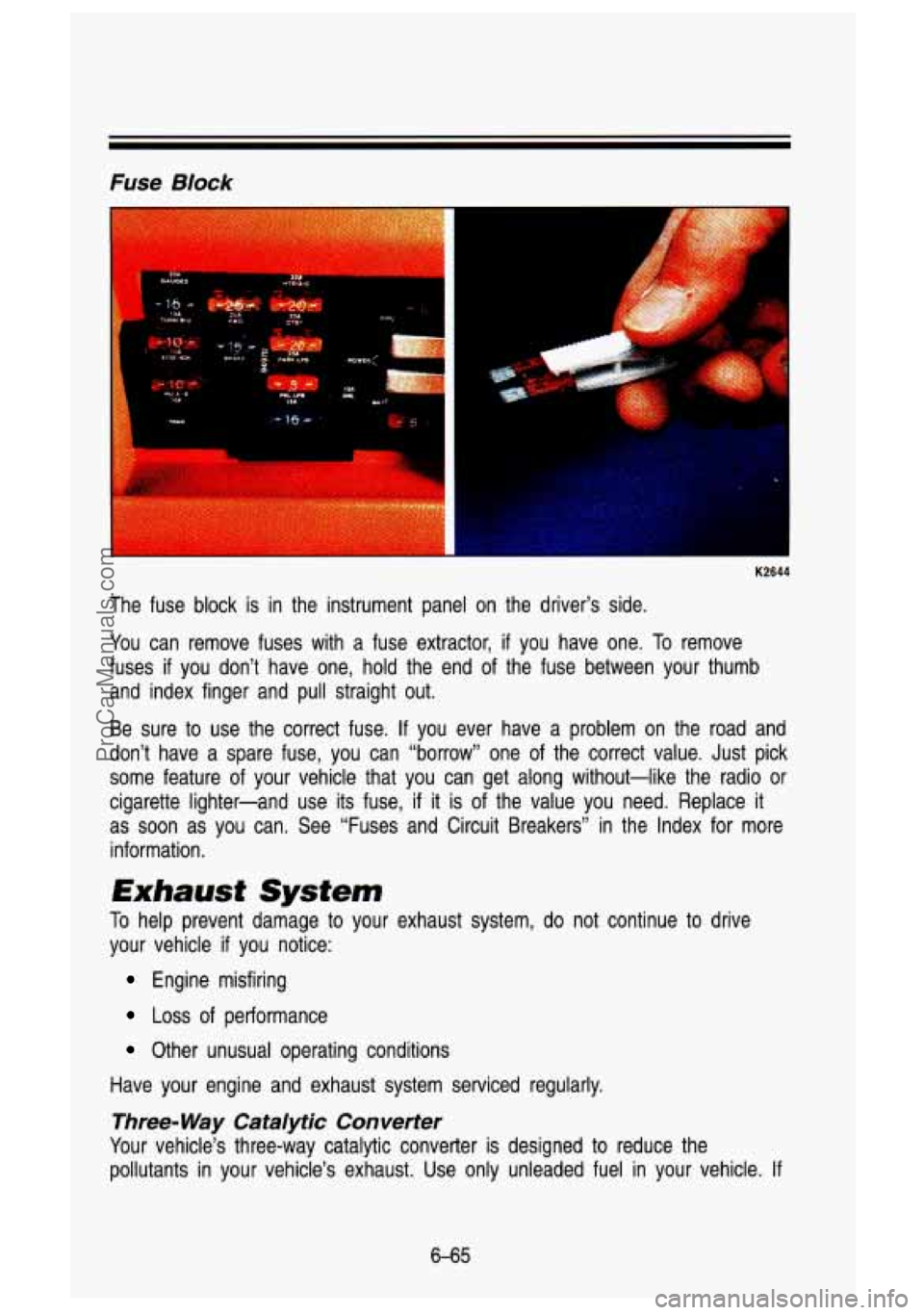
K2644
The fuse block is in the instrument panel on the driver’s side.
You can remove fuses with a fuse extractor,
if you have one. To remove
fuses
if you don’t have one, hold the end of the fuse between your thumb
and index finger and pull straight out.
Be sure
to use the correct fuse. If you ever have a problem on the road and
don’t have a spare fuse, you can “borrow’’ one of the correct value. Just pick
some feature
of your vehicle that you can get along without-like the radio or
cigarette lighter-and use its fuse,
if it is of the value you need. Replace it
as soon as you can. See “Fuses and Circuit Breakers” in the Index for more
information.
Exhaust System
To help prevent damage to your exhaust system, do not continue to drive
your vehicle
if you notice:
Engine misfiring
Loss of performance
Other unusual operating conditions
Have your engine and exhaust system serviced regularly.
Three- Way Cataiytic Converter
Your vehicle’s three-way catalytic converter is designed to reduce the
pollutants in your vehicle’s exhaust. Use only unleaded fuel in your vehicle.
If
6-65
ProCarManuals.com
Page 344 of 436
you use leaded fuel, you could damage your three-way catalytic converter,
and other engine components.
Computer Command Control System (All TBI equipped
vehicles and diesel engine vehicles below
8,500 lbs. GVWR)
Gasoline Engines
This system has an oxygen (OS) sensor that helps keep your engine’s air-fuel
mixture at a proper level. Use only unleaded fuel in your veh\
icle.
If you use
leaded fuel, you could damage your oxygen
(OS) sensor and three-way
catalytic converter.
Diesel Vehicles Below 8,500 LBS. GVWR
This system monitors engine speed and throttle position. It adj\
usts exhaust gas recirculation to limit emissions.
The Malfunction Indicator Lamp
(SERVICE ENGINE SOON) on your
instrument panel lets you know when your emission control syste\
m needs
service. The light will come on briefly when you start your e\
ngine to let you
know that the system is working. If
it does not come on when you start your
engine, or
if it comes on and stays on while you’re driving your system may \
need service. Your vehicle should still be driveable, but you should have your
system serviced right away.
Secondary Air Injection (AIR) System
You may have this system. It lets you know if your engine control module,
wiring harness or solenoid need service.
If the Malfunction Indicator Lamp
(Service Engine Soon) comes on, you need service.
6-66
ProCarManuals.com
Page 346 of 436
Service & Appearance Care
A Do not load your vehicle any heavier than the GWR or the
- b maximum front and rear GAWRs. If you do, parts on your vehicle
can break, or it can change the way your vehicle handles. These
could cause you to lose control.
Also, overloading can shorten the
life
of your vehicle.
Using heavier suspension components to get added durability migh\
t not
change your weight ratings. Ask your dealer to help you load \
your vehicle the right way.
.,ur warranty does
nnt cover par nr componentg that fail becausl
overloading.
If you put things inside your vehicle-like suitcases, tools, packag\
es, or
anything else-they will go as fast as the vehicle goes. If you have to stop
or turn quickly, or if there is a crash, they’ll keep going.
* Things you put inside your vehicle can strike and injure peopl\
e in a
9 Put things in the cargo area of your vehicle. Try to spread the
9 Never stack heavier things, like suitcases, inside the vehicle so
d sudden stop or turn, or in a crash.
weight evenly.
that some
of them are above the tops of the seats.
When you
carry something inside the vehicle, secure it
whenever you can.
Don’t have a seat folded down unless you need to.
6-68
ProCarManuals.com
Page 348 of 436
,. *.
’
Service & Appearance Care
Truck-Camper Loading Information
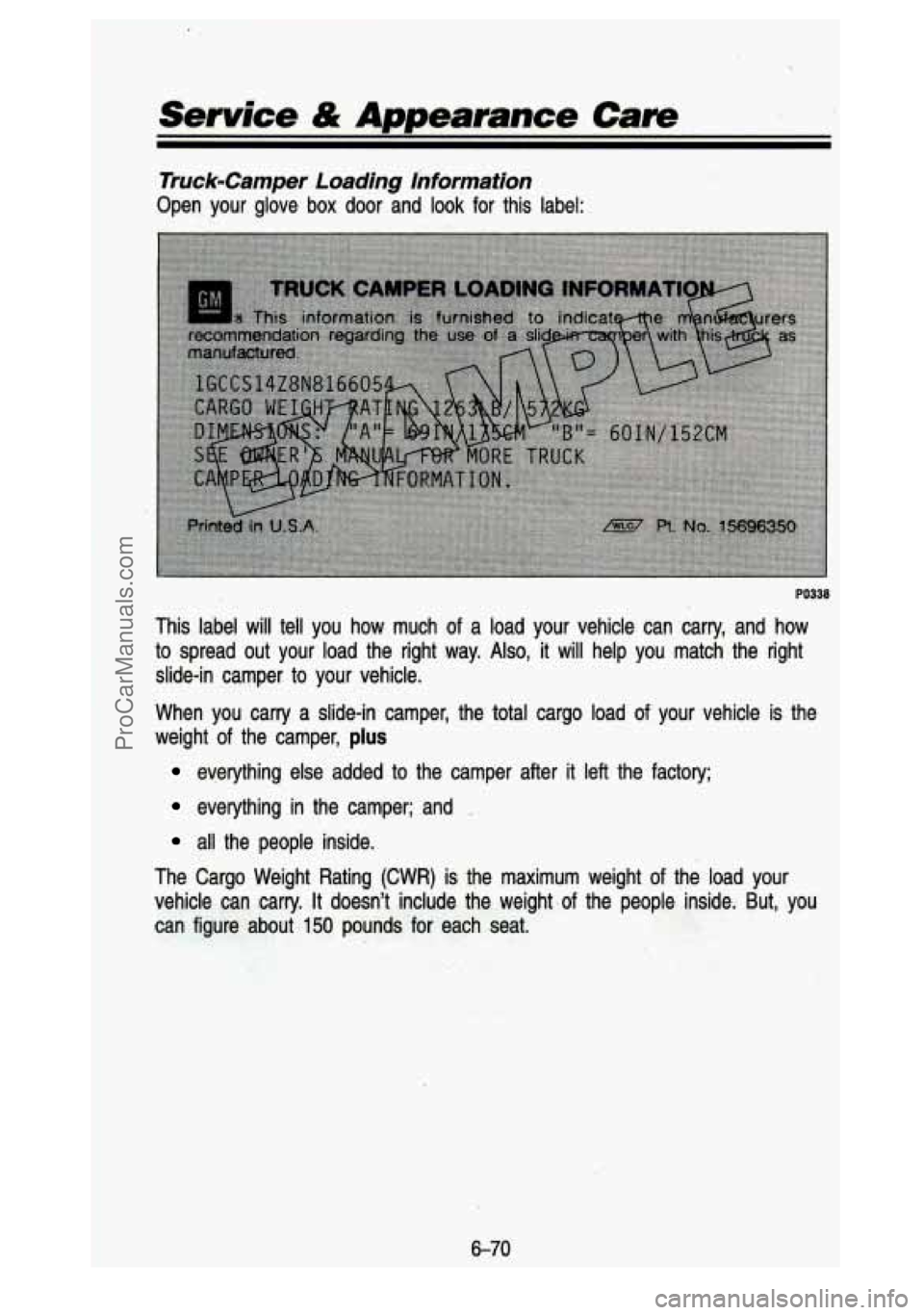
Open your glove box door and look for this label:
PO338
This label will tell you how much of a load your vehicle can carry, and how
to spread out your load the right way.
Also, it will help you match the right
slide-in camper to your vehicle.
When you carry a slide-in camper, the total cargo load
of your vehicle is the
weight of the camper,
plus
everything else added to the camper after it left the factory;
everything in the camper; and
all the people inside.
I ne Cargo Weight Rating (CWR) is the maximum weight of the l\
oad your
vehicle can carry. It doesn’t include the weight of the people inside. But, you
can figure about
150 pounds for each seat.
ProCarManuals.com
Page 350 of 436
Service & Appearance Care
Trailer Recommendations
You must subtract your hitch loads from the CWR for your vehicle. Weigh
your vehicle with your trailer attached,
so that you won’t go over the GVWR
or the GAWR.
You’ll get the best performance
if you spread out the weight of your load the
right way, and
if you choose the correct hitch and trailer brakes.
For more information, see “Trailer Towing” in the Index.
If you want more information on curb weights, cargo weights, cargo wei\
ght
rating and the correct center of gravity zone for your vehicle, your dealer can
help you. Just ask for a copy of “Consumer Information, Truck-Cam\
per
Loading.”
Pickup Conversion lo. Chassis Cab
General Motors is aware that some vehicle owners may consider having the
pickup box removed and a commercial
or recreational body installed. Before
you do
so, first contact the GM Zone Office for your area for information on
such conversions. (See the “Warranty and Owner Assistance”\
booklet for
Zone Office.) Owners should be aware that, as manufactured, th\
ere are
differences between a chassis cab and a pickup with the box r\
emoved which may affect vehicle safety. The components necessary to adapt the pickup to
permit its safe use with a specialized body should be installed by a bod\
y
builder in accordance with the information available from the Z\
one Office.
Tires
We don’t make tires. Your new vehicle comes with high quali\
ty tires made by
a leading tire manufacturer. These tires are warranted by the \
tire
manufacturers and their warranties are delivered with every new \
vehicle.
If
your spare tire is a different brand than your road tires, you will have a tire
warranty folder from each of these manufacturers.
6-72
ProCarManuals.com
Page 352 of 436
Service & Appearance Care
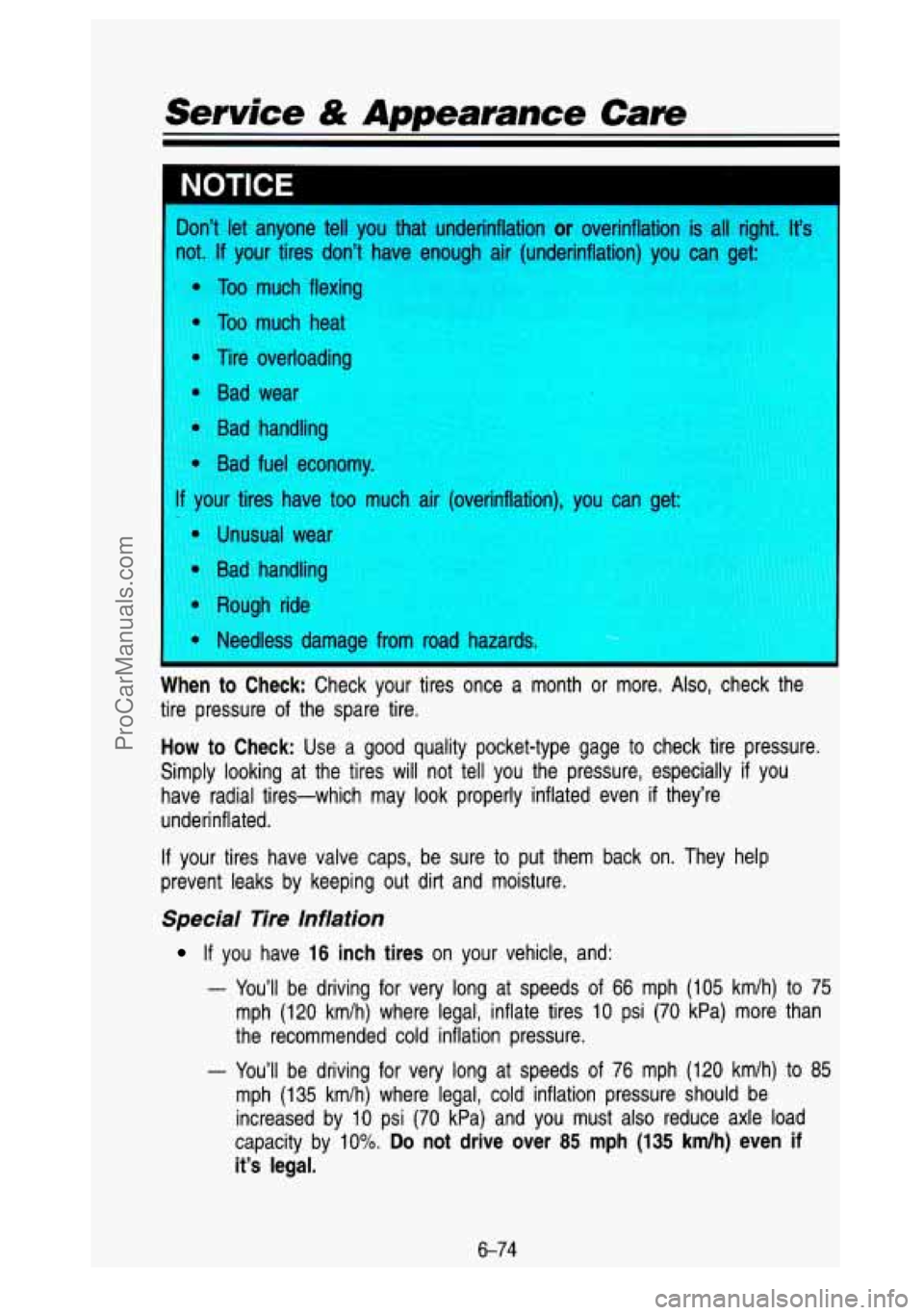
When to Check: Check your tires once a month or more. Also, check the
tire pressure of the spare tire.
How to Check: Use a good quality pocket-type gage to check tire pressure.
Simply looking at the tires will not tell you the pressure, e\
specially
if you
have radial tires-which may look properly inflated even if they\
’re
underinflated.
If your tires have valve caps, be sure to put them back on. They help
prevent leaks by keeping out dirt and moisture.
Special Tire Inflation
If you have 16 inch tires on your vehicle, and:
- You’ll be driving for very long at speeds of 66 mph (1 05 km/h) to 75
mph (120 kmlh) where legal, inflate tires 10 psi (70 kPa) more than
the recommended cold inflation pressure.
- You’ll be driving for very long at speeds of 76 mph (120 kmlh) to 85
mph (1 35 km/h) where legal, cold inflation pressure should be
increased by
10 psi (70 kPa) and you must also reduce axle load
capacity by
10%. Do not drive over 85 mph (135 kdh) even if
it’s legal.
6-74
ProCarManuals.com
Page 356 of 436
Service & Appearance Cam
Tire lnspecfion and Rotation
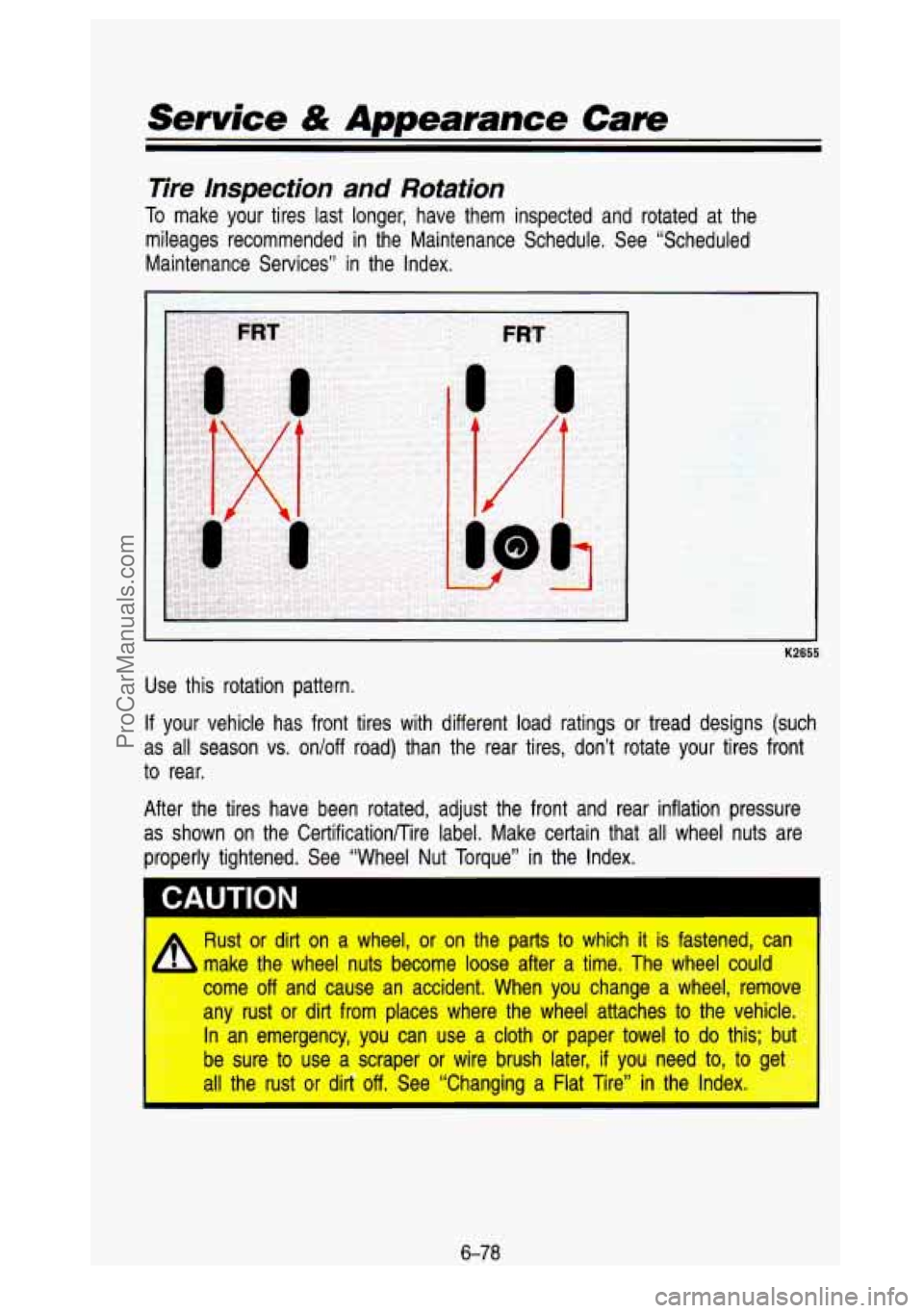
To make your tires last longer, have them inspected and rotated at the
mileages recommended in the Maintenance Schedule. See “Scheduled
Maintenance Services” in the Index.
Q
-
-
K2655
Use this rotation pattern.
If your vehicle has front tires with different load ratings or tread designs (such
as all season
vs. onloff road) than the rear tires, don’t rotate your tires \
front
to rear.
After the tires have been rotated, adjust the front and rear \
inflation pressure
as shown on the CertificationRire label. Make certain that all wheel nuts are
properly tightened. See “Wheel Nut Torque”
in the Index.
A Rust or dirt on a wheel, or on the parts to which -it is fastened, can
make the wheel nuts become loose after a time. The wh.eel could
come
off and cause an accident. When you change- a- :wheel, remove
’ any -rust or dirt from places where the wheel attaches to the vehicle:
,: In an emergency, you can use a cloth or paper towel to do this; but
3 be sure to use a scraper or wire brush later, if you need- to, to get
-T all the rust or dirf off. See “Changing a Flat Tire” in the Index.
6-78
ProCarManuals.com
Page 358 of 436
Service & Appearance Cam
When It’s Time for New Tires
K1656
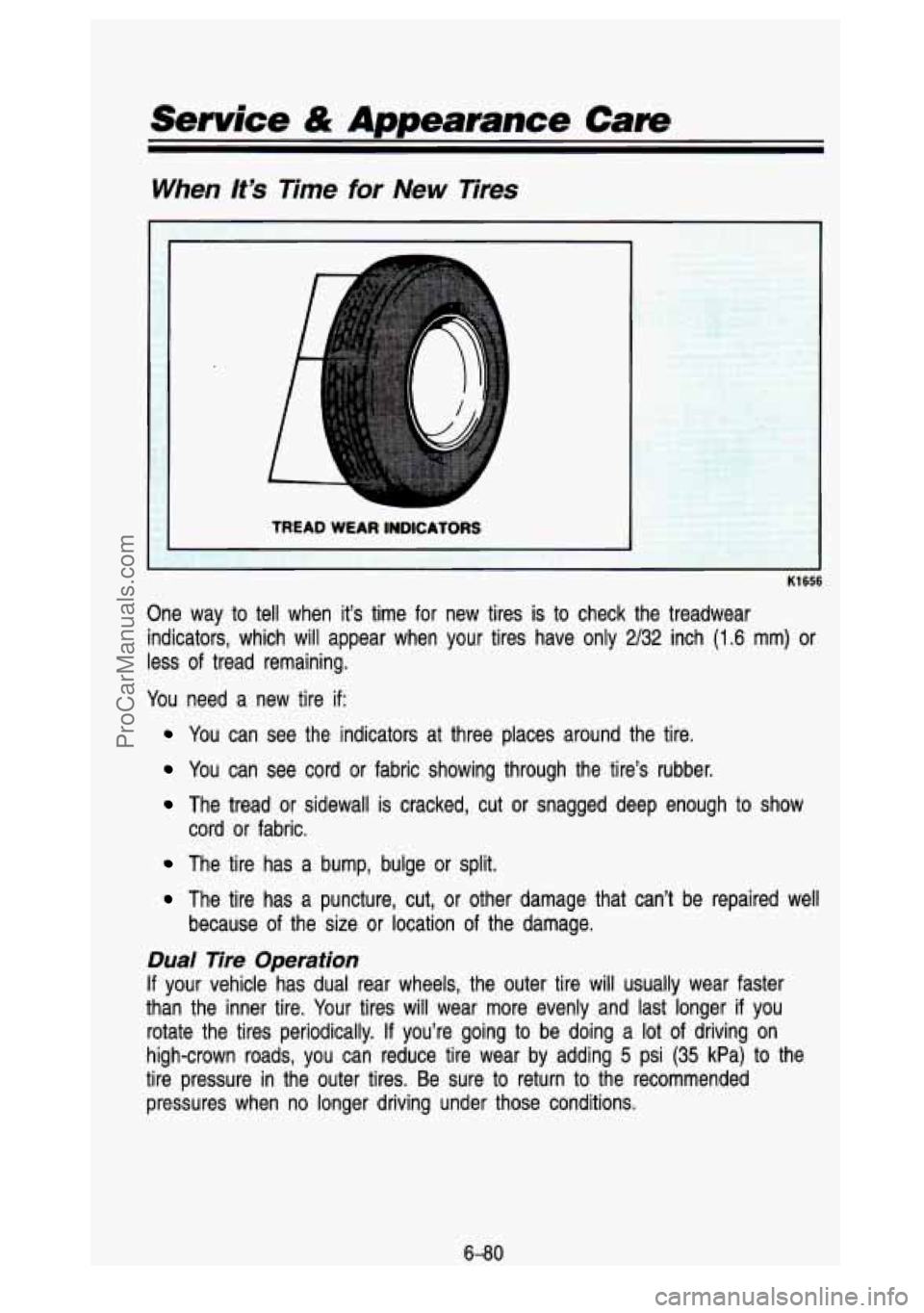
One way to tell when it’s time for new tires is to check the treadwear
indicators, which will appear when your tires have only
2/32 inch (1.6 mm) or
less of tread remaining.
You need a new tire
if:
You can see the indicators at three places around the tire.
You can see cord or fabric showing through the tire’s rubber.
The tread or sidewall is cracked, cut or snagged deep enough to show
cord
or fabric.
The tire has a bump, bulge or split.
The tire has a puncture, cut, or other damage that can’t be repalred well
because of the size or location of the damage.
Dual Tire Operation
If your vehicle has dual rear wheels, the outer tire will usually\
wear faster
than the inner tire. Your tires will wear more evenly and last longer
if you
rotate the tires periodically.
If you’re going to be doing a lot of driving on
high-crown roads, you can reduce tire wear by adding
5 psi (35 kPa) to the
tire pressure in the outer tires. Be sure to return
to the recommended
pressures when no longer driving under those conditions.
6-80
ProCarManuals.com