catalytic converter GMC SIERRA 1993 Owners Manual
[x] Cancel search | Manufacturer: GMC, Model Year: 1993, Model line: SIERRA, Model: GMC SIERRA 1993Pages: 436, PDF Size: 23.88 MB
Page 293 of 436

6. Close the water drain valve and connect a hose going from the air bleed\
valve port
to a fuel-resistant container. The inside diameter of the hose
should be one-eighth of an inch.
for the starter to cool.
Do this until you can see clear fuel coming from
the air bleed valve.
7. Turn your ignition key to Start for 10 to 15 seconds. Wait one minute
8. Close the air bleed valve and replace the fuel tank cap.
9. Start your engine and let it idle for five minutes. Be sure to check your
fuel filter for leaks.
Fuels in Foreign Countries (Gasoline Engines)
If you plan on driving in another country outside the US. or Canada,
unleaded fuel may be hard to find.
Do not use leaded gasoline. If you use
even one tank full, your emission controls won’t work well \
or at all. With
continuous use, spark plugs can get fouled, the exhaust system \
can corrode,
and your engine oil can deteriorate quickly. Your vehicle’s three-way catalytic
converter and oxygen sensor will be damaged.
All of that means costly
repairs that wouldn’t be covered by your warranty.
To check on fuel availability, ask an auto club, or contact a major oil
company that does business in the country where you’ll be driving.
You can also write us at the following address for advice. Just tell us where
you’re going and give your Vehicle Identification Number (VIN).
General Motors of Canada Ltd.
International Export Sales
Post Office Box
828
Oshawa, Ontario L1H 7N1, Canada
6-1 5
ProCarManuals.com
Page 343 of 436
Fuse Block
K2644
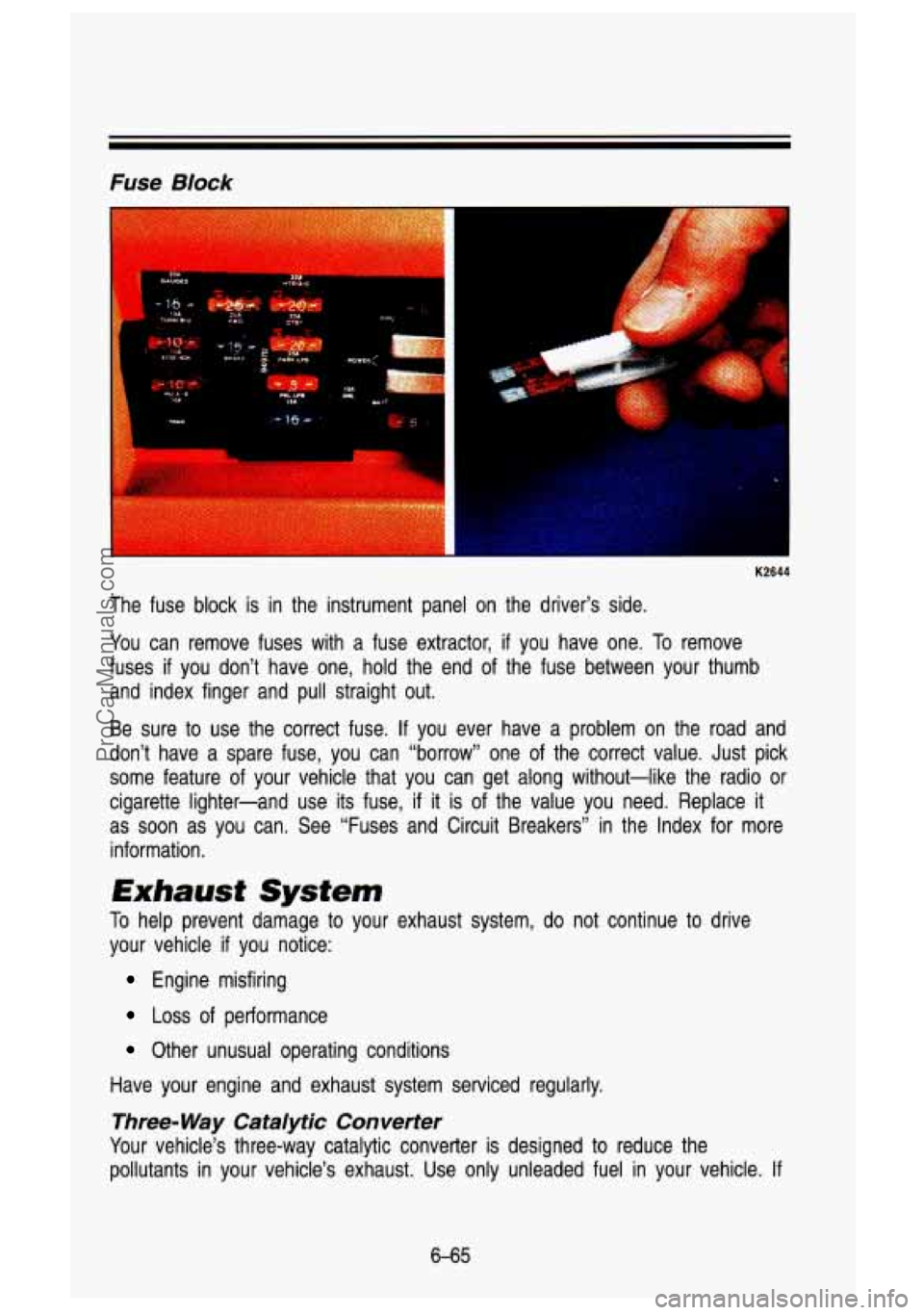
The fuse block is in the instrument panel on the driver’s side.
You can remove fuses with a fuse extractor,
if you have one. To remove
fuses
if you don’t have one, hold the end of the fuse between your thumb
and index finger and pull straight out.
Be sure
to use the correct fuse. If you ever have a problem on the road and
don’t have a spare fuse, you can “borrow’’ one of the correct value. Just pick
some feature
of your vehicle that you can get along without-like the radio or
cigarette lighter-and use its fuse,
if it is of the value you need. Replace it
as soon as you can. See “Fuses and Circuit Breakers” in the Index for more
information.
Exhaust System
To help prevent damage to your exhaust system, do not continue to drive
your vehicle
if you notice:
Engine misfiring
Loss of performance
Other unusual operating conditions
Have your engine and exhaust system serviced regularly.
Three- Way Cataiytic Converter
Your vehicle’s three-way catalytic converter is designed to reduce the
pollutants in your vehicle’s exhaust. Use only unleaded fuel in your vehicle.
If
6-65
ProCarManuals.com
Page 344 of 436
you use leaded fuel, you could damage your three-way catalytic converter,
and other engine components.
Computer Command Control System (All TBI equipped
vehicles and diesel engine vehicles below
8,500 lbs. GVWR)
Gasoline Engines
This system has an oxygen (OS) sensor that helps keep your engine’s air-fuel
mixture at a proper level. Use only unleaded fuel in your veh\
icle.
If you use
leaded fuel, you could damage your oxygen
(OS) sensor and three-way
catalytic converter.
Diesel Vehicles Below 8,500 LBS. GVWR
This system monitors engine speed and throttle position. It adj\
usts exhaust gas recirculation to limit emissions.
The Malfunction Indicator Lamp
(SERVICE ENGINE SOON) on your
instrument panel lets you know when your emission control syste\
m needs
service. The light will come on briefly when you start your e\
ngine to let you
know that the system is working. If
it does not come on when you start your
engine, or
if it comes on and stays on while you’re driving your system may \
need service. Your vehicle should still be driveable, but you should have your
system serviced right away.
Secondary Air Injection (AIR) System
You may have this system. It lets you know if your engine control module,
wiring harness or solenoid need service.
If the Malfunction Indicator Lamp
(Service Engine Soon) comes on, you need service.
6-66
ProCarManuals.com
Page 404 of 436

Scheduled Maintenance Services
Periodic Maintenance Inspections
Listed below are inspections and services which should be perfo\
rmed at least
twice a year (for instance each spring or fall).
You should let your GM
dealer’s service department or other qualified service center \
do these jobs.
Make sure any necessary repairs are completed at once.
Steering and Suspension lnspectiont -Inspect front and rear suspension
and steering system for damaged, loose or missing parts, signs \
of wear or
lack of lubrication. Inspect power steering lines and hoses for proper \
hook-up,
binding, leaks, cracks, chafing, etc. (On vehicles equipped wit\
h manual
steering gear, check for seal leakage.) Lubricate the steering linkage.
Accelerator Control System -Lubricate all pivot points with engine oil,
except the
TBI throttle shaft. Remove all external deposits from the injector
pump face cam on 6.2L and 6.5L engines.
Do this when the engine is cold
and not running.
Do not oil any accelerator or cruise control cables. Replace
any cables that have high effort or excessive wear.
Exhaust System Inspection -Inspect the complete system including the
three-way catalytic converter. Inspect the body near the exhaust\
system. Look
for broken, damaged, missing or out-of-position parts, as well \
as, open
seams, holes, loose connections or other conditions which could \
cause a heat buildup in the floor pan or could let exhaust fumes seep into the passenger
compartments.
Drive Axle Service -Check readfront axle fluid level and add as needed.
Check constant velocity joints and axle seals for leaking.
Transfer Case (four-wheel drive) lnspectiont -Every 12 months or at oil
change intervals, check front axle and transfer case and add l\
ubricant when necessary. Oil the control lever pivot point and all exposed c\
ontrol linkage.
Check vent hose at transfer case for kinks and proper installa\
tion. More
frequent lubrication may be required on heavy-duty or off-road use.
tA fluid loss in these systems may indicate a problem. Have them inspected
and repaired at once.
7-24
ProCarManuals.com
Page 426 of 436
C
Camper Wiring Harness .............. 2-91
Capacities/Specification Charts .. 6-95
Cassette Tape Player
Catalytic Converter
...................... 6-65
Certificationnire Label
................. 6-67
Changing
A Flat Tire ........ 5.17. 5-23
Chemical Paint Spotting
.............. 6-90
Child Restraints
Cigarette Lighter/Ashtrays
........... 2-62
Circuit Breakers (See “Fuses”)
Cleaning (See
“Audio Systems”)
(See “Safety Belts”)
Finish Care
................................ 6-88
Glass
.......................................... 6-87
Inside of Vehicle
....................... 6-85
Instrument Panel. Top
............. 6-87
Outside of Vehicle
.................... 6-88
Special Problems
...................... 6-86
Vinyl
or Leather ........................ 6-87
Wheels and Tires
..................... 6-89
Windshield
................................ 6-88
Clock
................................... 3-1 2. 3-1 5
Computer Command Control
System
..................................... 6-66
Conversion to Chassis Cab
........ 6-72
Coolant (See “Engine”)
Cooling System
............................ 5-1 1
Capacity
.................................... 6-96
Crankcase Capacity
...................... 6-96
Cruise Control
............................... 2-47
Increase Speed
......................... 2.50
On Hills ...................................... 2-51
Passing
...................................... 2-51
Resume
..................................... 2-49
Set
.............................................. 2-48
To Get Out Of
.......................... 2-52
Cup Holder
.................................... 2-65
Customer Assistance for the
Customer Satisfaction Procedure.8-2 Reduce Speed
.......................... 2-51
Hearing
or Speech Impaired .... 8-3
D
Daytime Running Lights
(Canada Only)
.................... 2.55. 2-84
Indicator Light
............... 2.55. 2-84
Diesel Fuel (See “Fuel”)
Dome Lights
................................. 2-56
Doors
............................................... 2-5
Driving Locks
............................................ 2-6
Across an Incline
..................... 4-33
After Off-Road Driving
............ 4-36
At Night
.......................... 4.36. 4-38
Backing Up
............................... 4-59
Defensive
................................... 4-10
Downhill
..................................... 4-31
Freeway
..................................... 4-43
High Beams
.............................. 4-37
Highway Hypnosis
................... 4-46
Hydroplaning
............................. 4-39
In Blizzard
................................. 4-54
In City
....................................... 4-42
In Fog. Mist and Haze
. 4.41 . 4-42
In Rain
............................ 4.38. 4-40
In Sand. Mud. Ice.
Or Snow .................................. 4-34
In Water
.................................... 4-35
Long Distance
.......................... 4-45
Loss of Control
........................ 4-24
Night Vision
.............................. 4-37
Off-Roading
............................... 4-25
On Curves
................................. 4-20
On Grades
................................. 4-60
On Hill and Mountain Roads
. 4-47
On Off-Road Hills
.................... 4-28
On Snow
or Ice .. 2.15. 4.52. 4-55
Passing
............................ 4.22. 4-59
Skidding
..................................... 4-24
Stuck in Deep Snow
..... 4.54. 5-33
Through Water
.............. 2.15. 4-35
Uphill
.......................................... 4-29
Winter
........................................ 4-52
With a Trailer
............................ 4-55
Drunken Driving
........................... 4-11
9-2
ProCarManuals.com