emission GMC SIERRA 1993 Owners Manual
[x] Cancel search | Manufacturer: GMC, Model Year: 1993, Model line: SIERRA, Model: GMC SIERRA 1993Pages: 436, PDF Size: 23.88 MB
Page 151 of 436
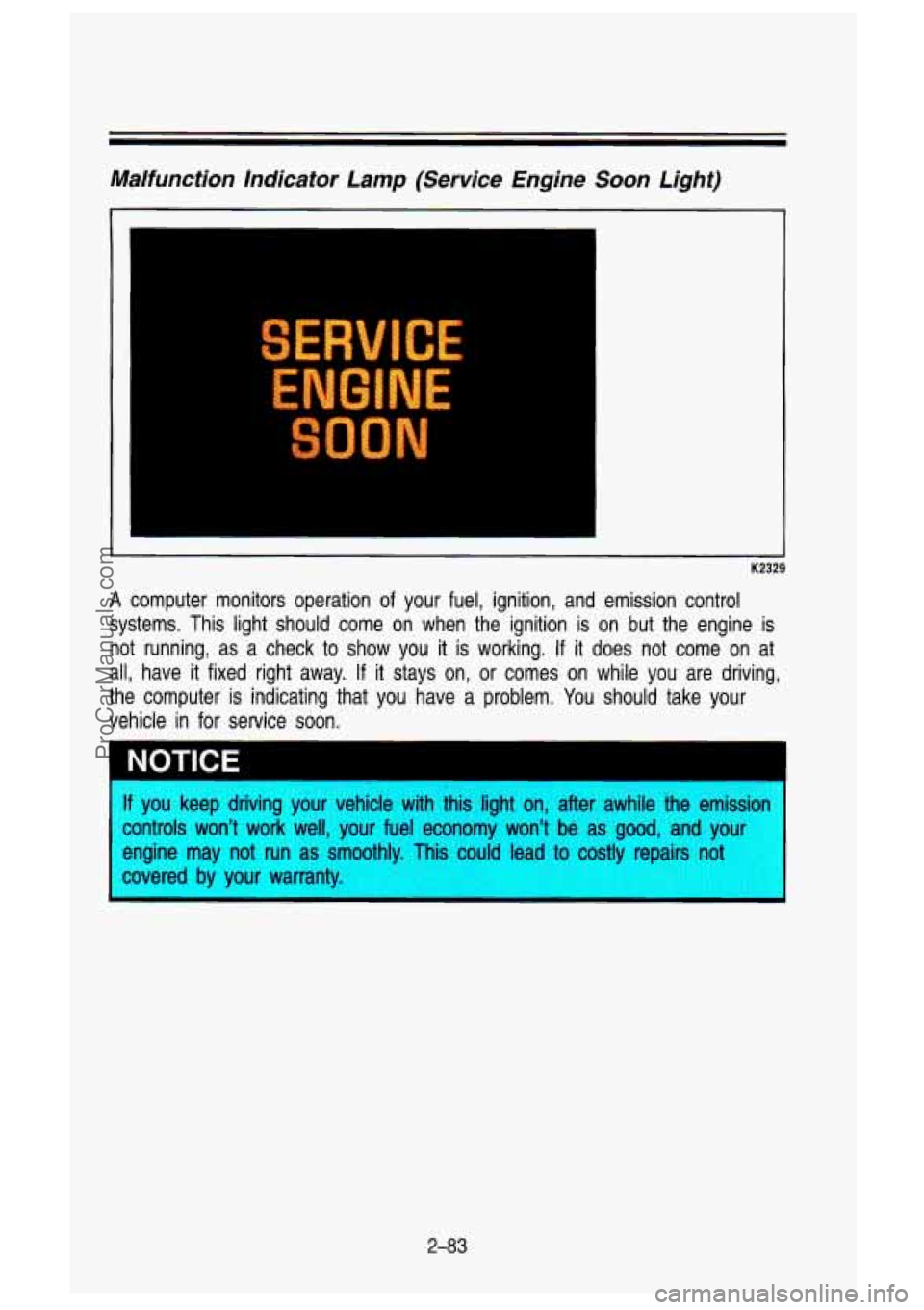
Malfunction Indicator Lamp (Service Engine Soon Light)
I
SERVICE
EF_'31NE
SOON
K2329
A computer monitors operation of your fuel, ignition, and emission control
systems. This light should come on when the ignition is on bu\
t the engine is not running, as a check to show you it is working. If it does not come on at
all, have it fixed right away.
If it stays on, or comes on while you are driving,
the computer is indicating that you have a problem. You should take your
vehicle in for service soon.
NOTICE
E
If you keep driving your vehicle with this light on, after awhile the emission
controls won't work well, your fuel economy won't be as good, and your
engine may not run as smoothly. This could lead
to costly repairs not
covered by your warranty.
2-83
ProCarManuals.com
Page 283 of 436
If you’re using fuel rated at 87 octane or higher and you still hear heavy
knocking, your engine needs service. But don’t worry
if you hear a little
pinging noise when you’re accelerating or driving up a hill. That’s normal and
you don’t have
to buy a higher octane fuel to get rid of pinging. It’s the
heavy, constant knock that means you have a problem.
What about gasoline with blending materials that contain oxygen,\
such as MTBE or alcohol?
MTBE is “methyl tertiary-butyl ether.” Fuel that is no more than 15% MTBE is
fine for your vehicle.
Ethanol is ethyl or grain alcohol. Properly-blended fuel that is no more than
10% ethanol is fine for your vehicle.
Methanol is methyl or wood alcohol.
le1 that is more than
5% methanol is bad for your vehicle. Don’t use it.
can corrode metal parts in your fuel system and also damage plastic
and rubber parts. That damage wouldn’t be covered under your warranty
And even at
5% or less, there must be “cosolvents” and corrosion
- ~wenters in this fuel to help avoid these problems.
Gasolines for CIeaner Air
Your use of gasoline with detergent additives will help prevent depo\
sits from
forming in your engine and fuel system. That helps keep your engine in tune
and your emission control system working properly. It’s good \
for your vehicle,
and you’ll be doing your part for cleaner air.
Many gasolines are now blended with materials that called
oxygenates.General Motors recommends that you use gasolines with \
these
blending materials, such as MTBE and ethanol. By doing
so, you can help
clean the air, especially in those parts
of the country that have higher carbon
monoxide levels.
In addition, some gasoline suppliers are now producing reformulated \
gasolines. These gasolines are specially designed to reduce vehicle
emissions. General Motors recommends that you use reformulated g\
asoline.
By doing
so, you can help clean the air, especially in those parts of the
country that have high ozone levels.
You should ask your service station operators
if their gasolines contain
detergents and oxygenates, and
if they have been reformulated to reduce
vehicle emissions.
6-5
ProCarManuals.com
Page 284 of 436
Service & Appearance Care
Diesel Fuel Requirements
and Fuel System
Some states and provinces have restrictions on the purchase of diesel fuel
for light-duty vehicles and require you
to buy permits or pay special taxes.
Some of these restrictions apply only
to residents, and others apply to both
residents and visitors. These restrictions can change.
To learn the current
restrictions in any state or province, contact your auto club, \
the police or
other officials.
Fuel Requirements
1 NOTICE
Diesel fuel or fuel additives not recommended in this manual could
damage your fuel system and engine. Your warranty wouldn’t cover thi
damage. And:
Diesel fuel that has been mixed with engine oil could damage your
engine and emission controls.
Always check with your service station
his
diesel fuel, it can be difficult to restart your
engine. “Running Out of Fuel,” later
in this section, tells you how to
get
it started again. To avoid all this, try never to let. your tank get
What Fuel to Use:
You can use either Number I-D or Number 2-D diesel fuel, but you’ll get
better fuel economy using
2-D.
Diesel fuel may foam when you fill your tank. This can cause the automatic
pump nozzle
to shut off, even though your tank isn’t full. If this happens, just
wait for the foaming to stop and then continue to fill your tank.
1 CAUTION
- Heat coming from the engine may cause the fuel to expand and force
the fuel out of your tank. If something ignites the fuel, a \
fire could start
and people could be burned.
To help avoid this, fill your fuel tank only
until the automatic nozzle shuts
off. Don’t try to “top if off .” I
I
6-6
ProCarManuals.com
Page 293 of 436

6. Close the water drain valve and connect a hose going from the air bleed\
valve port
to a fuel-resistant container. The inside diameter of the hose
should be one-eighth of an inch.
for the starter to cool.
Do this until you can see clear fuel coming from
the air bleed valve.
7. Turn your ignition key to Start for 10 to 15 seconds. Wait one minute
8. Close the air bleed valve and replace the fuel tank cap.
9. Start your engine and let it idle for five minutes. Be sure to check your
fuel filter for leaks.
Fuels in Foreign Countries (Gasoline Engines)
If you plan on driving in another country outside the US. or Canada,
unleaded fuel may be hard to find.
Do not use leaded gasoline. If you use
even one tank full, your emission controls won’t work well \
or at all. With
continuous use, spark plugs can get fouled, the exhaust system \
can corrode,
and your engine oil can deteriorate quickly. Your vehicle’s three-way catalytic
converter and oxygen sensor will be damaged.
All of that means costly
repairs that wouldn’t be covered by your warranty.
To check on fuel availability, ask an auto club, or contact a major oil
company that does business in the country where you’ll be driving.
You can also write us at the following address for advice. Just tell us where
you’re going and give your Vehicle Identification Number (VIN).
General Motors of Canada Ltd.
International Export Sales
Post Office Box
828
Oshawa, Ontario L1H 7N1, Canada
6-1 5
ProCarManuals.com
Page 295 of 436

I CAUTION
* If you get gasoline on you and then something ignites it, you co\
uld
1 be badly burned. Gasoline can spray out on you if you open the fuel
filler cap too quickly. This spray can happen
if your tank is nearly
full, and is more likely in hot weather. Open the fuel filler\
cap slowly and wait for any "hiss" noise
to stop.
I Then unscrew the cap all the way. I
When you put the cap back on, turn it tc "le :clo-'hise) until you hear
a clicking noise.
I NOTICE
~f you need a new cap, be sure to get the right type. Your dealer can get 1
me for you. If you get the wrong type, it may not fit or -have proper
denting, and your fuel tank and emissions system might be damaged.
Checking Things Under the Hood
U
K2609
Hood Release
To open the hood, first pull the handle inside the vehicle. Then \
go to the
front of the vehicle and pull up on the secondary hood release. Lift t\
he hood.
6-1 7
ProCarManuals.com
Page 297 of 436
Cleaning Your Diesel Engine
you spray or pour water or any other liquid on your engine when it is
arm or hot,
or when it is running, you could cause serious damagl o it.
you ever clean the engine, clean it only when it is cold.
Noise Control System
The following information relates to compliance with Federal noi\
se emission
standards for vehicles with a Gross Vehicle Weight Rating (GVW\
R) of more
than 10,000 pounds
(4 536 kilograms). See your maintenance schedule for
information on maintaining the noise control system to minimize degradation
of
the noise emission control system during the life of your vehicle. The noise
control system warranty is given in your Warranty booklet.
These standards apply only to vehicles sold in the United States.
Tampering With Noise Control System Prohibited
Federal law prohibits the following acts or the causing thereof:
1. The removal or rendering inoperative by any person, other t\
han for purposes of maintenance, repair or replacement, of any device
or
element of design incorporated into any new vehicle for the purpose of
noise control, prior to its sale or delivery to the ultimate purchaser or
while it is in use;
or
2. The use of the vehicle after such device or element of design has been
removed or rendered inoperative by any person.
Among those acts presumed to constitute tampering are the acts listed below.
Insulation:
Removal of noise shields or underhood insulation.
Engine:
Removal or rendering engine speed governor, if so equipped, inoperative
so as to allow engine speed to exceed manufacturer specifications.
Fan and Drive:
Removal of fan clutch, if so equipped, or rendering clutch inoperative.
Removal of fan shroud, if so equipped.
Air Intake:
Removal of air cleaner silencer.
Reversing air cleaner cover.
6-1
9
ProCarManuals.com
Page 301 of 436
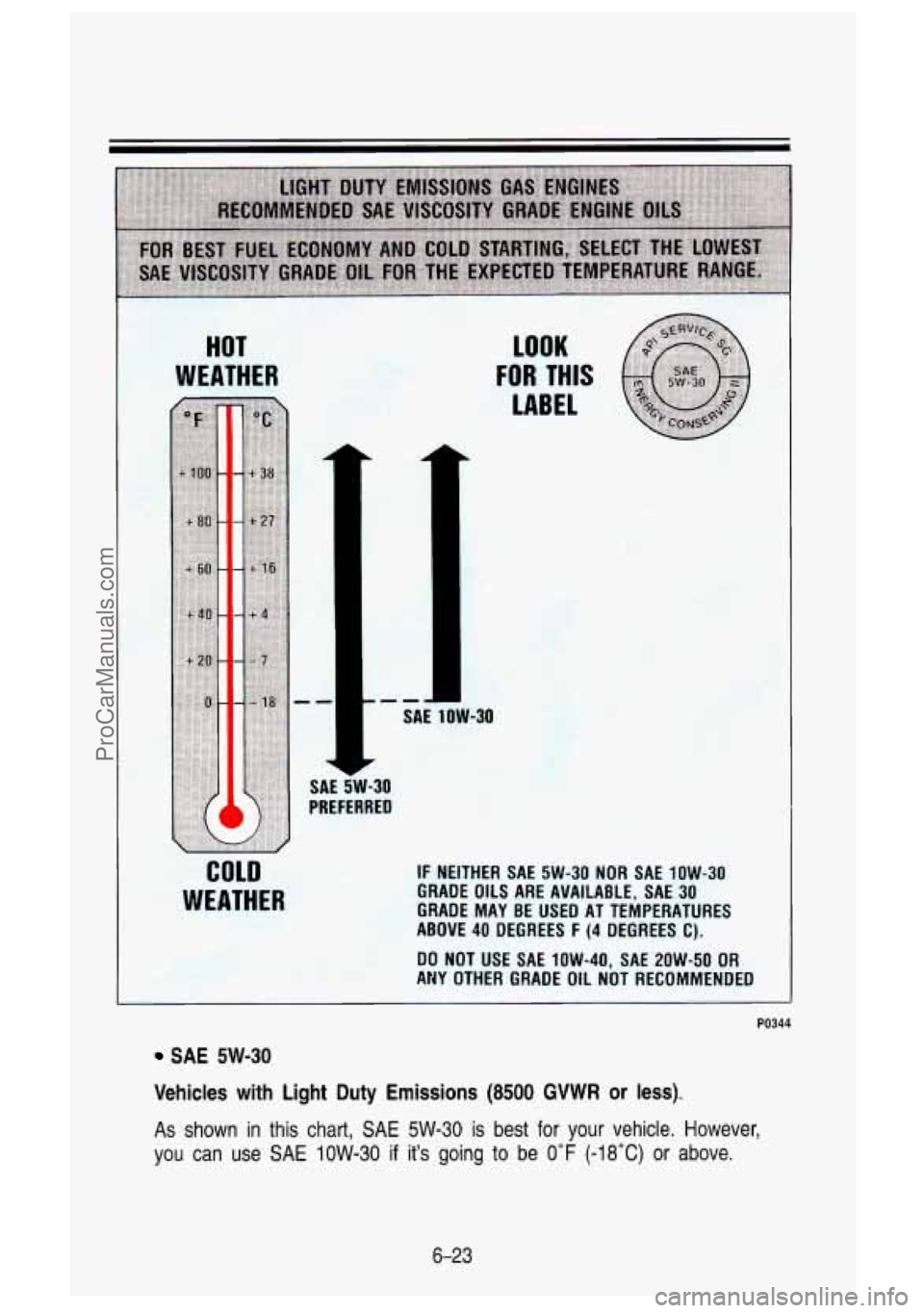
HOT
WEATHER
COLD
WEATHER
LA t
i SAE low-30
SAE SW-30
PREFERRED
IF NEiTHER SAE 5W-30 NOR SAE 1OW-30
GRADE OILS ARE AVAILABLE, SAE 30
GRADE MAY BE USED AT TEMPERATURES
ABOVE
40 DEGREES F (4 DEGREES C).
ANY OTHER GRADE
OIL NOT RECOMMENDED
DO
NOT USE
SAE 1OW-40, SAE 2OW-50 OR
PO344
SAE 5W-30
Vehicles with Light Duty Emissions (8500 GVWR or less).
As
shown in this chart, SAE 5W-30 is best for your vehicle. However,
you can use
SAE IOW-30 if it’s going to be 0°F (-18°C) or above.
6-23
ProCarManuals.com
Page 302 of 436
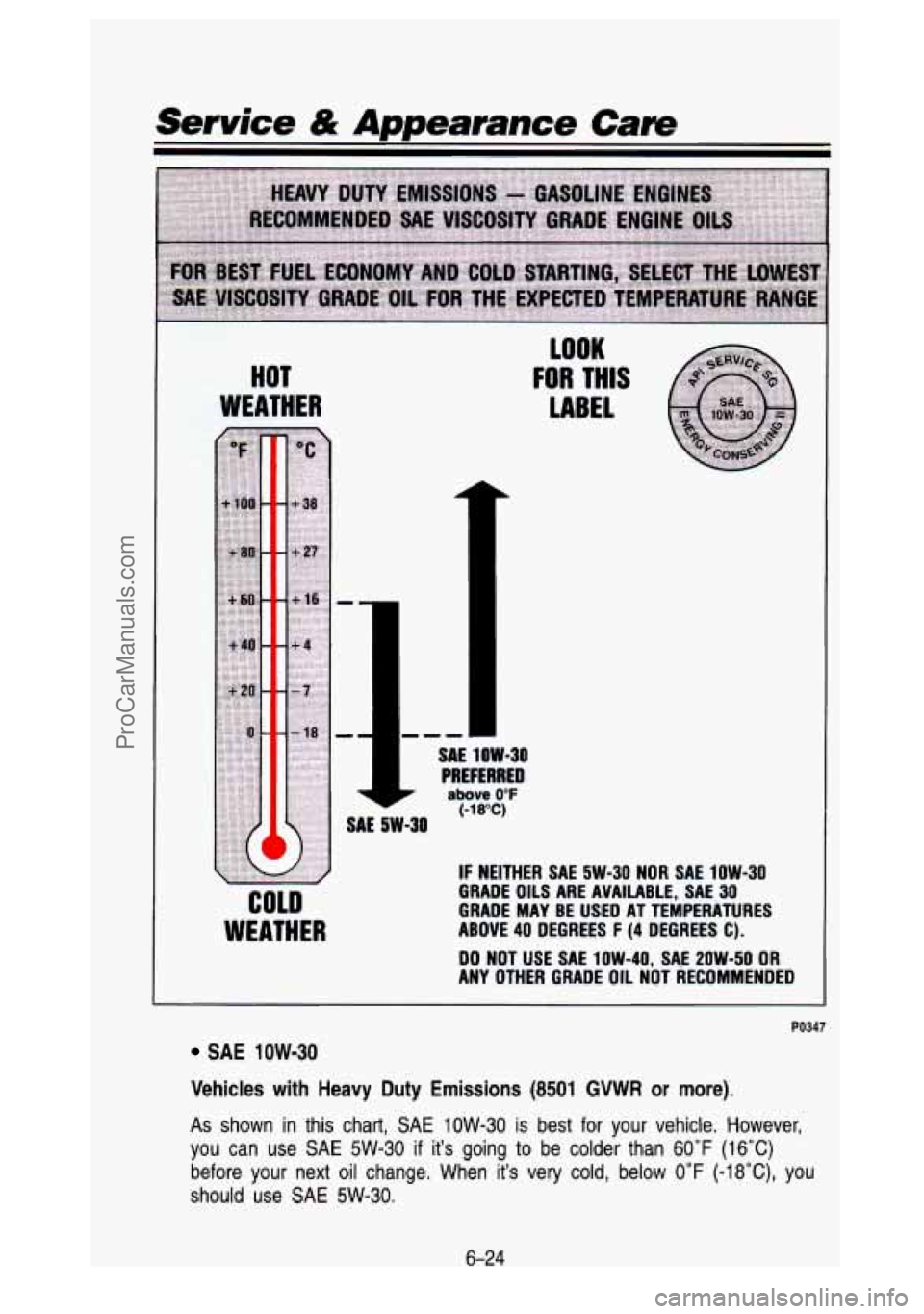
Service & Appearance Care
HOT
WEATHER LOOK FOR THIS
LABEL
SAE 5W-30
SAE 1OW-30
PREFERRED
above 0°F (-18°C)
IF NEITHER
SAE 5W-30 NOR SAE 1OW-30
GRADE
OILS ARE AVAILABLE, SAE 30
GRADE MAY BE USED AT TEMPERATURES
ABOVE
40 DEGREES F (4 DEGREES C).
DO NOT USE SAE 1OW-40, SAE 2OW-50 OR
ANY OTHER GRADE OIL NOT RECOMMENDED
PO347
SAE 1OW-30
Vehicles with Heavy Duty
Emissions (8501 GVWR or more).
As shown in this chart, SAE 1OW-30 is best for your vehicle. However,
you can use
SAE 5W-30 if it's going to be colder than 60°F (16°C)
before your next oil change. When it's very cold, below 0°F (-18"C), you
should use
SAE 5W-30.
6-24
ProCarManuals.com
Page 303 of 436
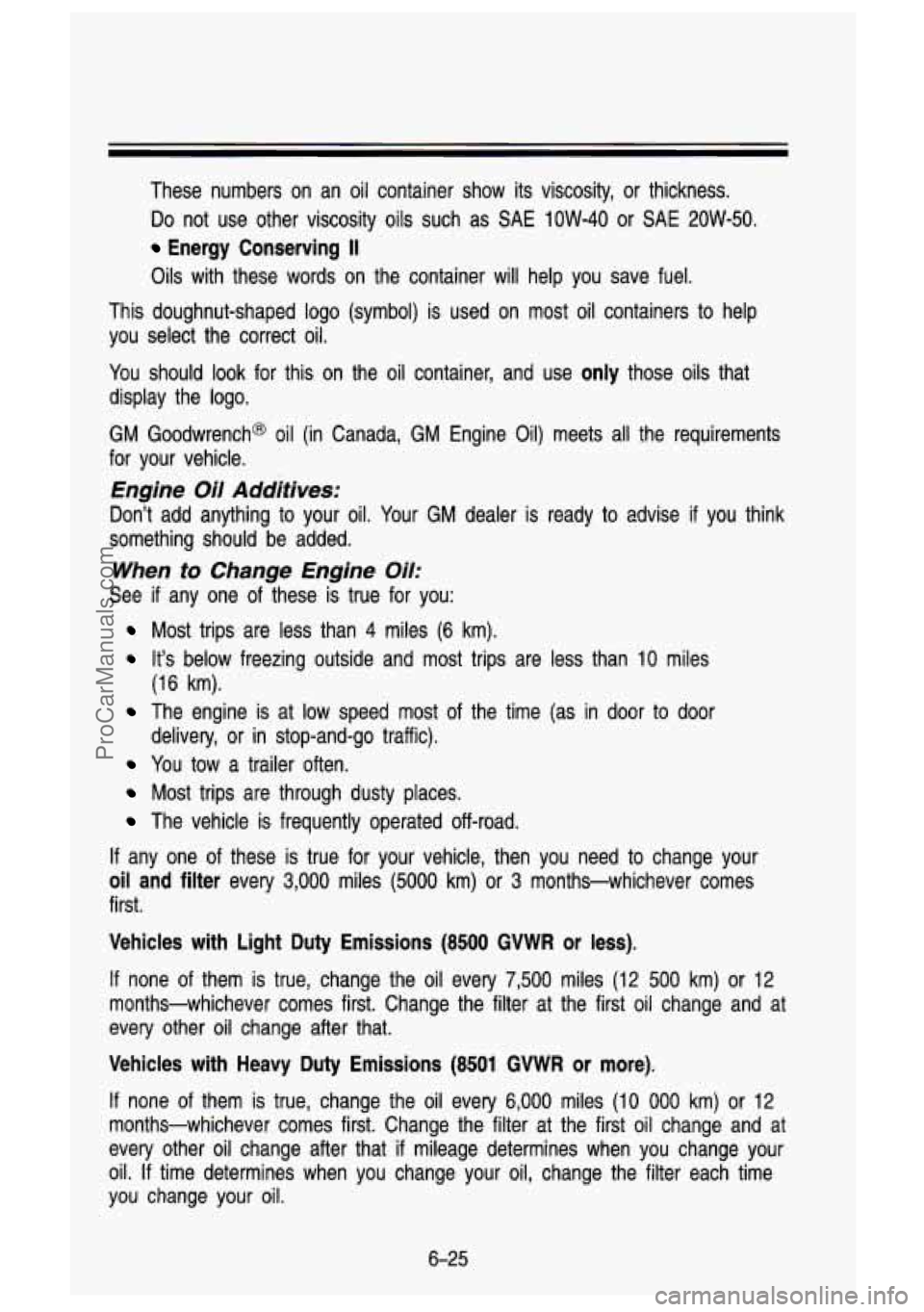
These numbers on an oil container show its viscosity, or thickness.
Do not use other viscosity oils such as
SAE IOW-40 or SAE 2OW-50.
Energy Conserving II
Oils with these words on the container will help you save fuel.
This doughnut-shaped logo (symbol) is used on most oil containers to help
you select the correct oil.
You should look for this on the oil container, and use
only those oils that
display the logo.
GM Goodwrench@ oil (in Canada, GM Engine Oil) meets all the requirements
for your vehicle.
Engine Oil Additives:
Don’t add anything to your oil. Your GM dealer is ready to advise if you think
something should be added.
When to Change Engine Oil:
See if any one of these is true for you:
Most trips are less than 4 miles (6 km).
It’s below freezing outside and most trips are less than 10 miles
(16 km).
The engine is at low speed most of the time (as in door to door
delivery, or in stop-and-go traffic).
You tow a trailer often.
Most trips are through dusty places.
The vehicle is frequently operated off-road.
If any one of these is true for your vehicle, then you need to change your
oil and filter every 3,000 miles (5000 km) or 3 months-whichever comes
first.
Vehicles with Light Duty Emissions (8500 GVWR or less).
If none of them is true, change the oil every 7,500 miles (12 500 km) or 12
months-whichever comes first. Change the filter at the first oil change and at
every other oil change after that.
Vehicles with Heavy Duty Emissions (8501 GVWR or more).
If none of them is true, change the oil every 6,000 miles (10 000 km) or 12
months-whichever comes first. Change the filter at the first oil change and at
every other oil change after that
‘if mileage determines when you change your
oil.
If time determines when you change your oil, change the filter ea\
ch time
you change your oil.
6-25
ProCarManuals.com
Page 344 of 436
you use leaded fuel, you could damage your three-way catalytic converter,
and other engine components.
Computer Command Control System (All TBI equipped
vehicles and diesel engine vehicles below
8,500 lbs. GVWR)
Gasoline Engines
This system has an oxygen (OS) sensor that helps keep your engine’s air-fuel
mixture at a proper level. Use only unleaded fuel in your veh\
icle.
If you use
leaded fuel, you could damage your oxygen
(OS) sensor and three-way
catalytic converter.
Diesel Vehicles Below 8,500 LBS. GVWR
This system monitors engine speed and throttle position. It adj\
usts exhaust gas recirculation to limit emissions.
The Malfunction Indicator Lamp
(SERVICE ENGINE SOON) on your
instrument panel lets you know when your emission control syste\
m needs
service. The light will come on briefly when you start your e\
ngine to let you
know that the system is working. If
it does not come on when you start your
engine, or
if it comes on and stays on while you’re driving your system may \
need service. Your vehicle should still be driveable, but you should have your
system serviced right away.
Secondary Air Injection (AIR) System
You may have this system. It lets you know if your engine control module,
wiring harness or solenoid need service.
If the Malfunction Indicator Lamp
(Service Engine Soon) comes on, you need service.
6-66
ProCarManuals.com